

About this worksheet
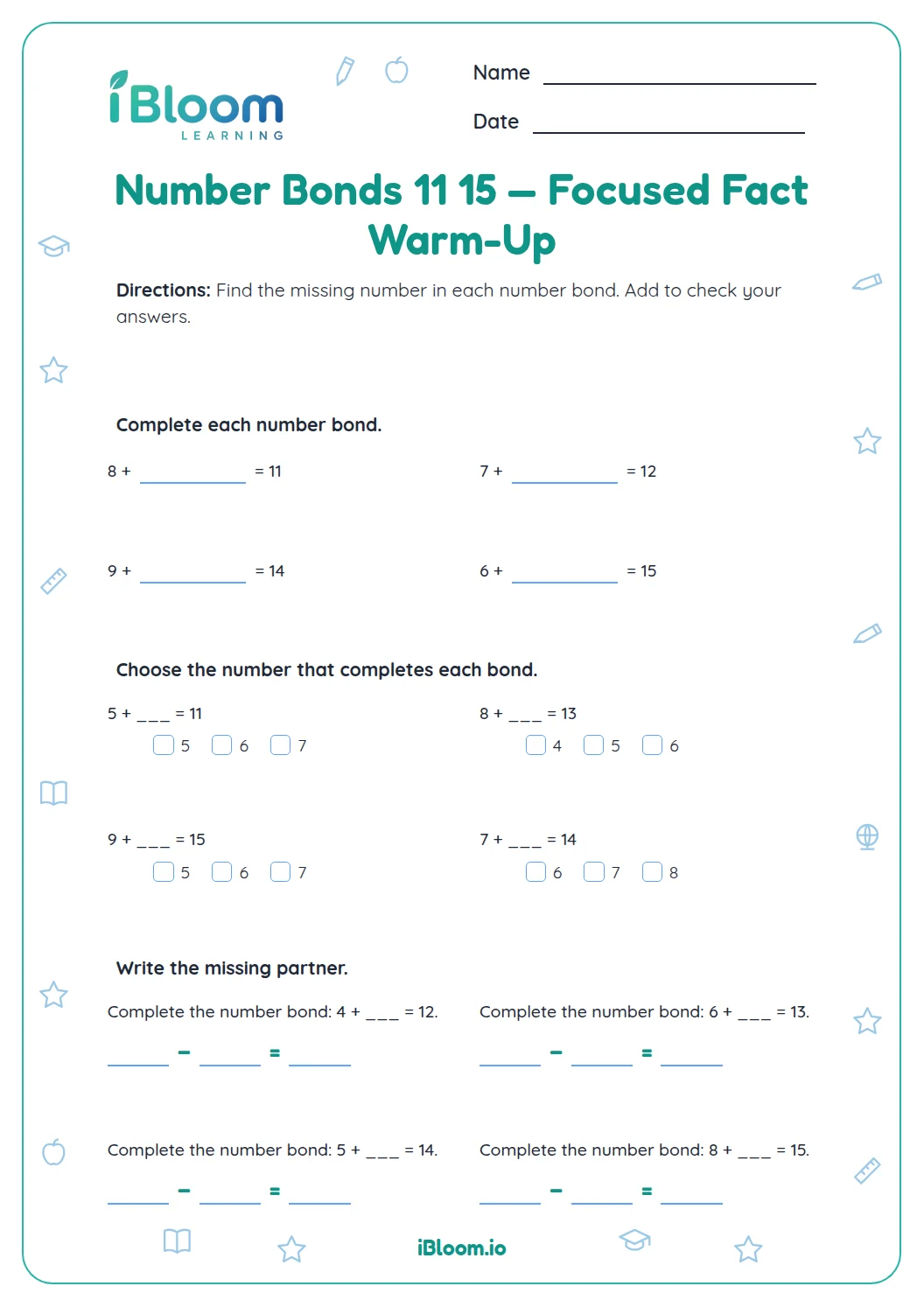
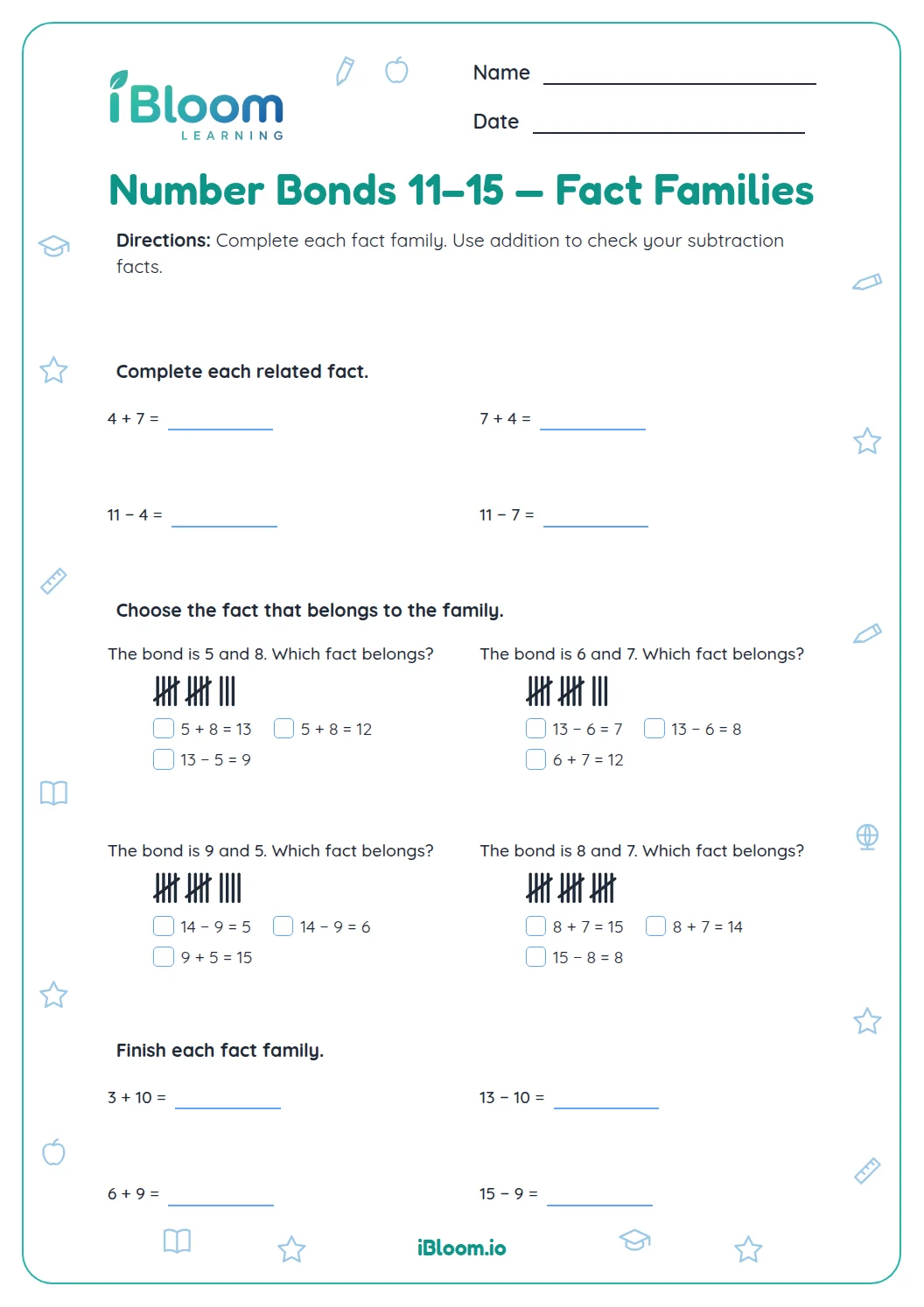
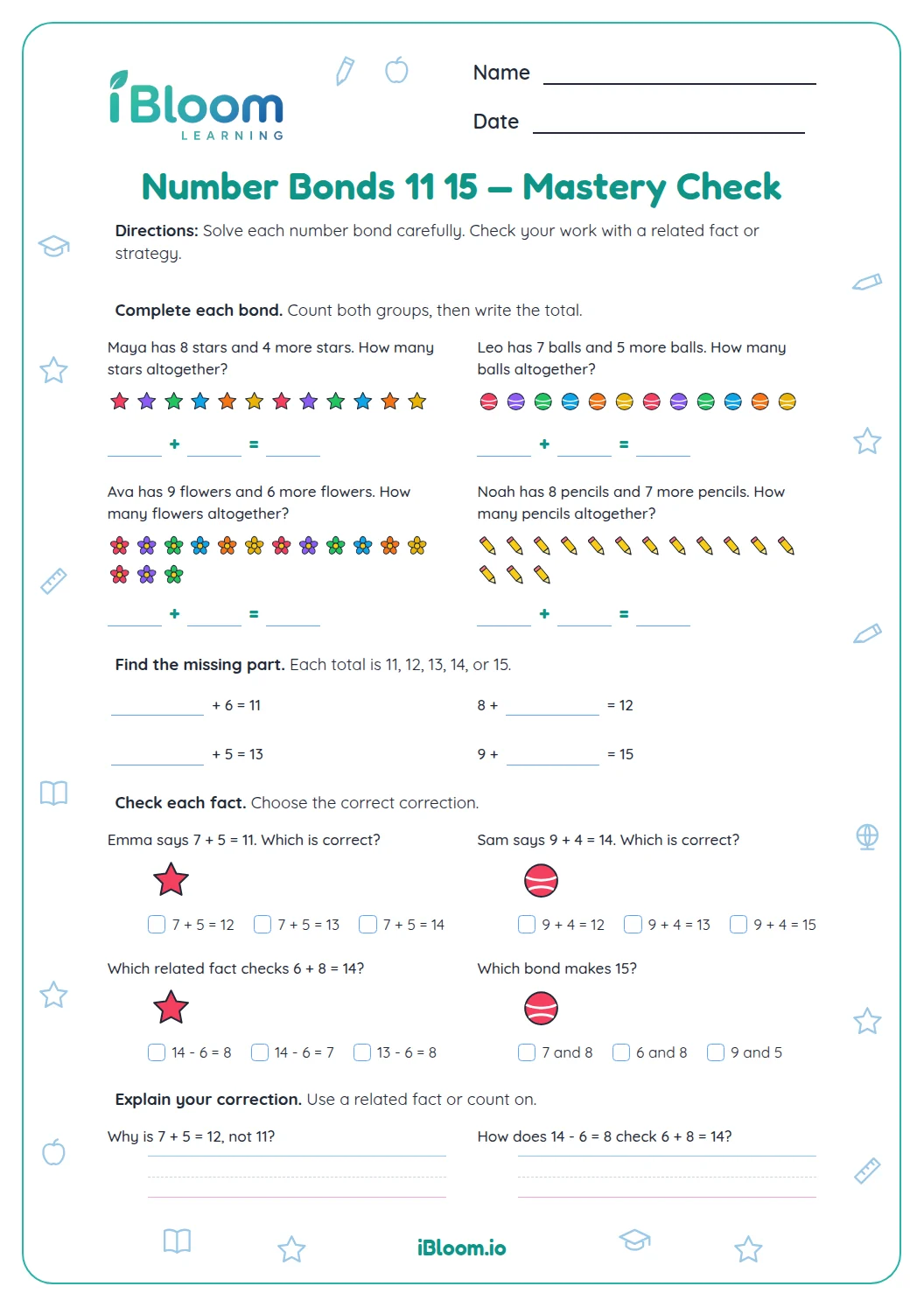
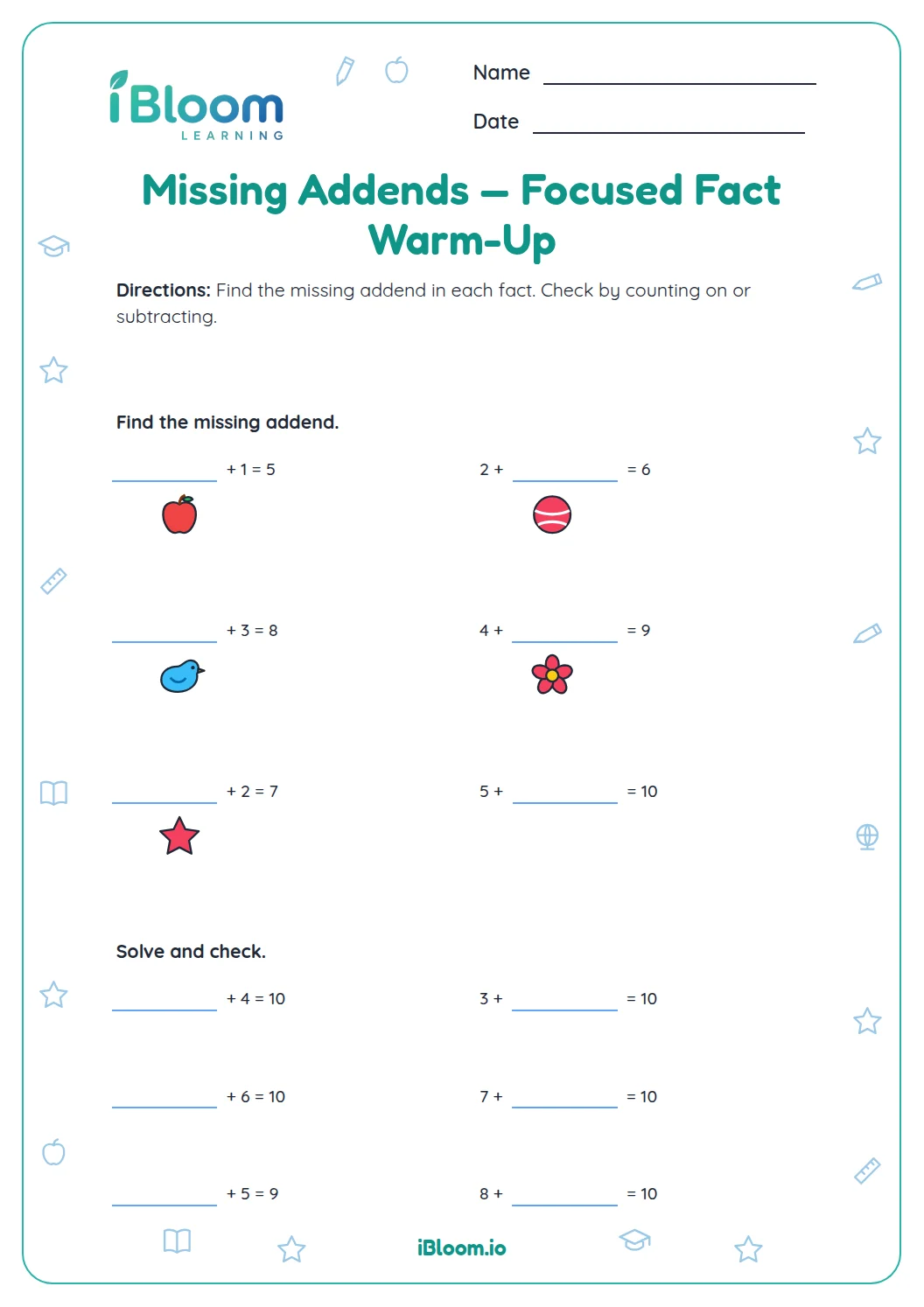
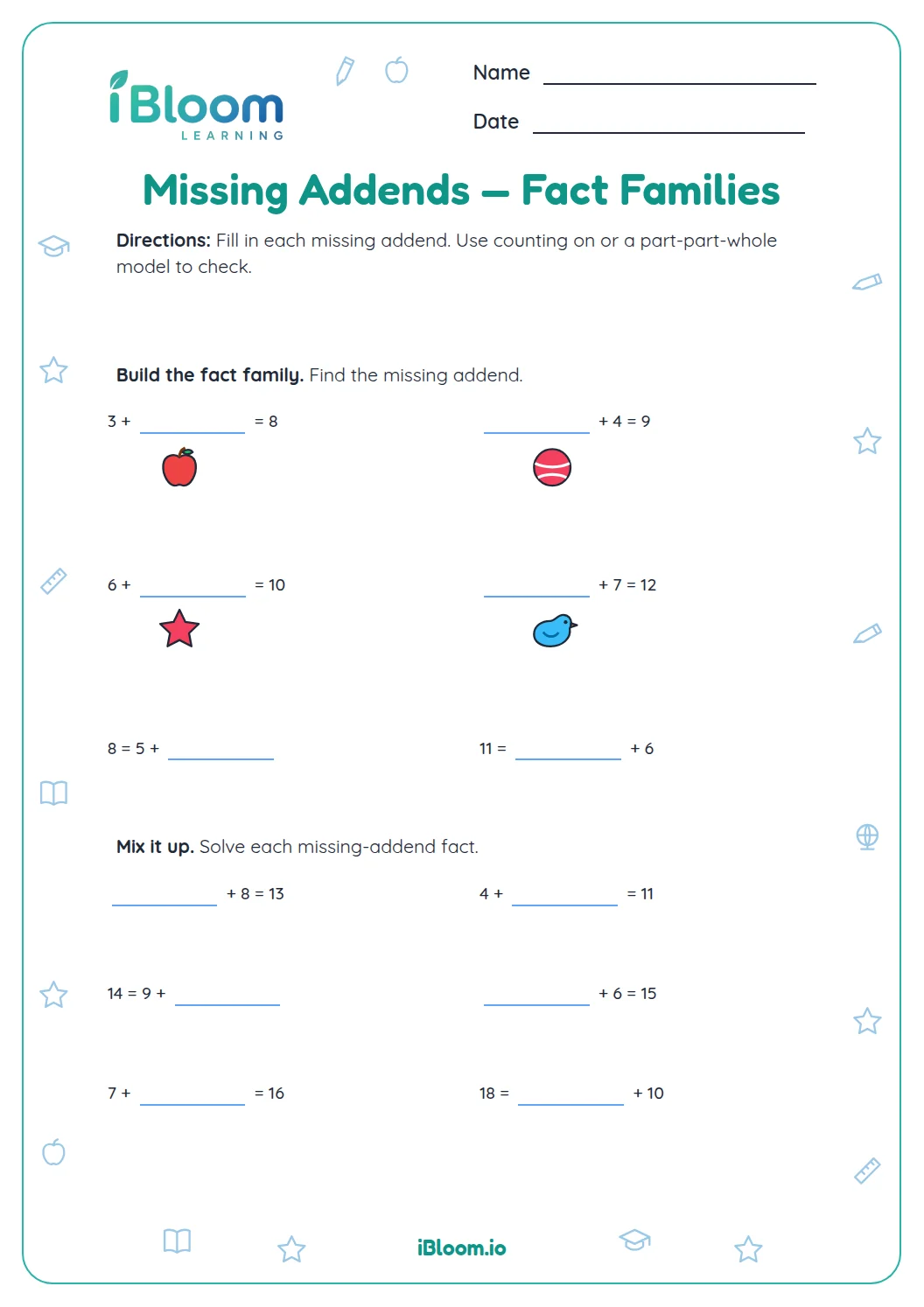
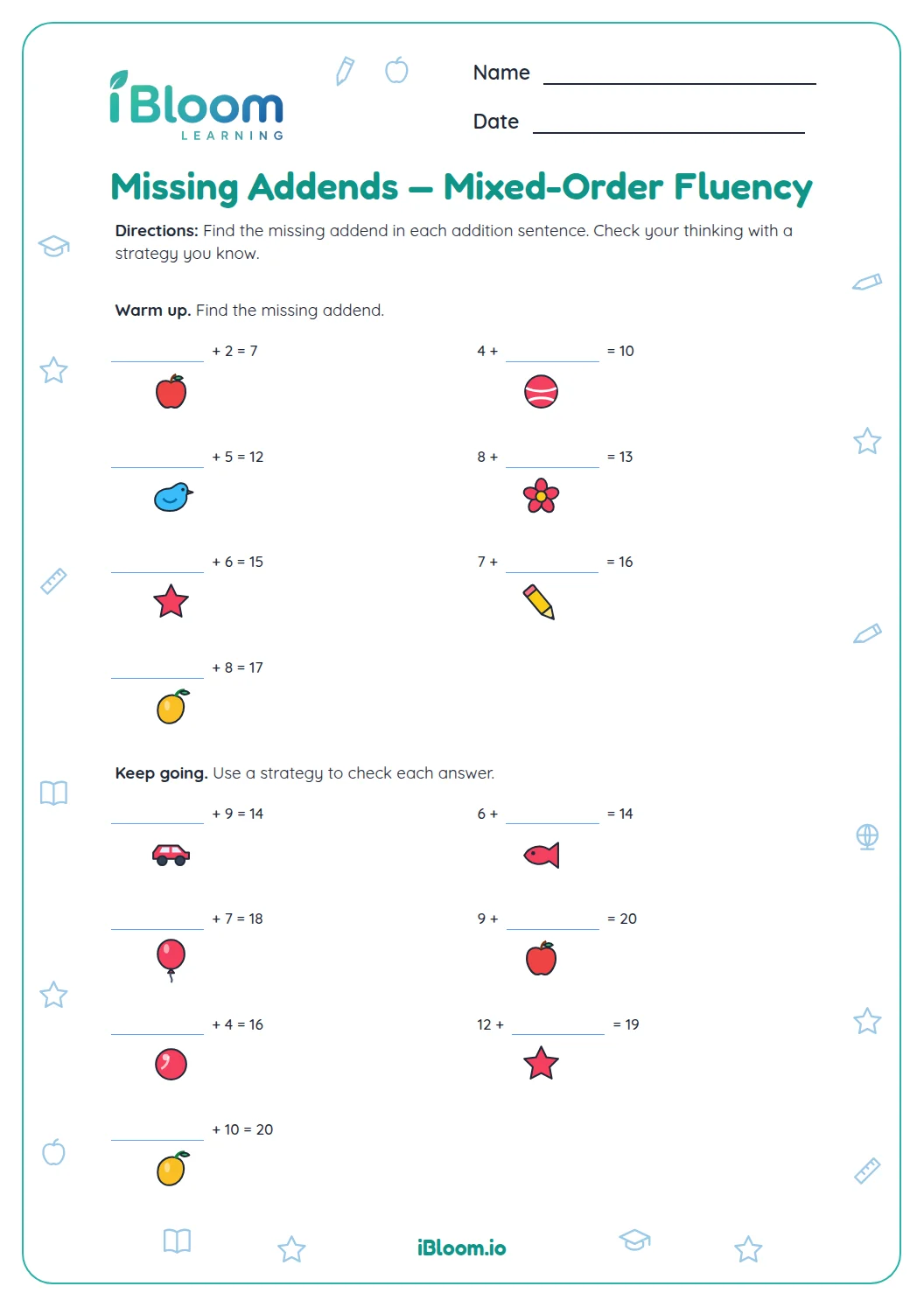
This number-bond worksheet focuses on totals from 11 through 15. Children first complete pictured bonds, then find missing addends, and finish with a short mixed fact round. The sums stay within 20, with an answer key for quick checking. A timer is optional; accuracy and a calm pace come first.
Aligned to 1.OA.C.6
How do number bonds help with addition?
A number bond shows a whole split into two parts. Seeing one part can help a child find the other: if the whole is 12 and one part is 8, the missing part is 4.
This page keeps sums between 11 and 15. The first section uses bond pictures, the next section hides an addend in an equation, and the last section mixes the facts for optional fluency practice.
Keep timed practice low pressure
Children can complete all questions without a timer. If they choose to time the final round, compare their own accuracy and comfort over time rather than racing another student.
How can a missing part be checked?
In question 1, the whole is 11 and one part is 6. The missing part is 5 because 6 + 5 = 11. Adding the two parts checks the bond.
How to use the drill
- 1Work through Part A by naming the whole and the known part.
- 2In Part B, think: “What must I add to reach the total?”
- 3Complete Part C at a steady pace; use a timer only if it feels helpful.
- 4Check each fact with the matching subtraction sentence.
Common addition slips
The mistake
Adding the known part to the whole instead of finding the missing part.
The fix
Subtract the known part from the whole, then check by adding the two parts.
The mistake
Rushing and changing an operation sign or addend.
The fix
Read the whole equation once before solving, even during a timed round.
The mistake
Reading the whole as one of the missing parts.
The fix
Use the whole and known part to find the other part, then add both parts to check.
The mistake
Assuming every sum in the last part is the same.
The fix
Read each new equation and solve its addends before writing the total.
Common Core alignment
The fact practice supports Grade 1 addition fluency.
Add and subtract within 20.
On this sheet: Students solve addition facts with sums from 11 through 15.
Show the official wordingHide the official wording
Add and subtract within 20, demonstrating fluency for addition and subtraction within 10.
What to practice next
Make more practice
Further reading
Questions parents and teachers ask
What is a number bond?
A number bond shows how a whole is made from two parts. If the whole is 13 and one part is 6, the other part must be 7 because 6 + 7 = 13. Children can use the bond picture and addition equation to check that both parts make the stated whole.
Which totals appear on this worksheet?
The practice stays focused on totals from 11 through 15. Children first complete pictured bonds, then find a missing addend, and finally solve mixed addition facts. These totals give practice beyond the easiest facts while keeping every sum within 20.
Is the timed round required?
No. Timing is optional, as the title says. A student can do the full worksheet without a timer. If timing is useful, keep the emphasis on accurate answers and a comfortable pace. Recording a time is only a way to notice personal progress, not to compare children.
How can a student check a missing part?
Add the known part to the answer. The result should equal the whole shown in the bond or equation. For example, if 8 is one part of 14 and the missing part is 6, then 8 + 6 = 14 confirms the bond.
How should a child use the optional timer?
The timer is optional, and the worksheet can be completed without it. If a child chooses to time the final facts, keep the focus on accurate answers and a comfortable pace. The first bond and missing-addend parts are untimed practice, so the student can settle into the facts before deciding whether to record a time.