
About this worksheet
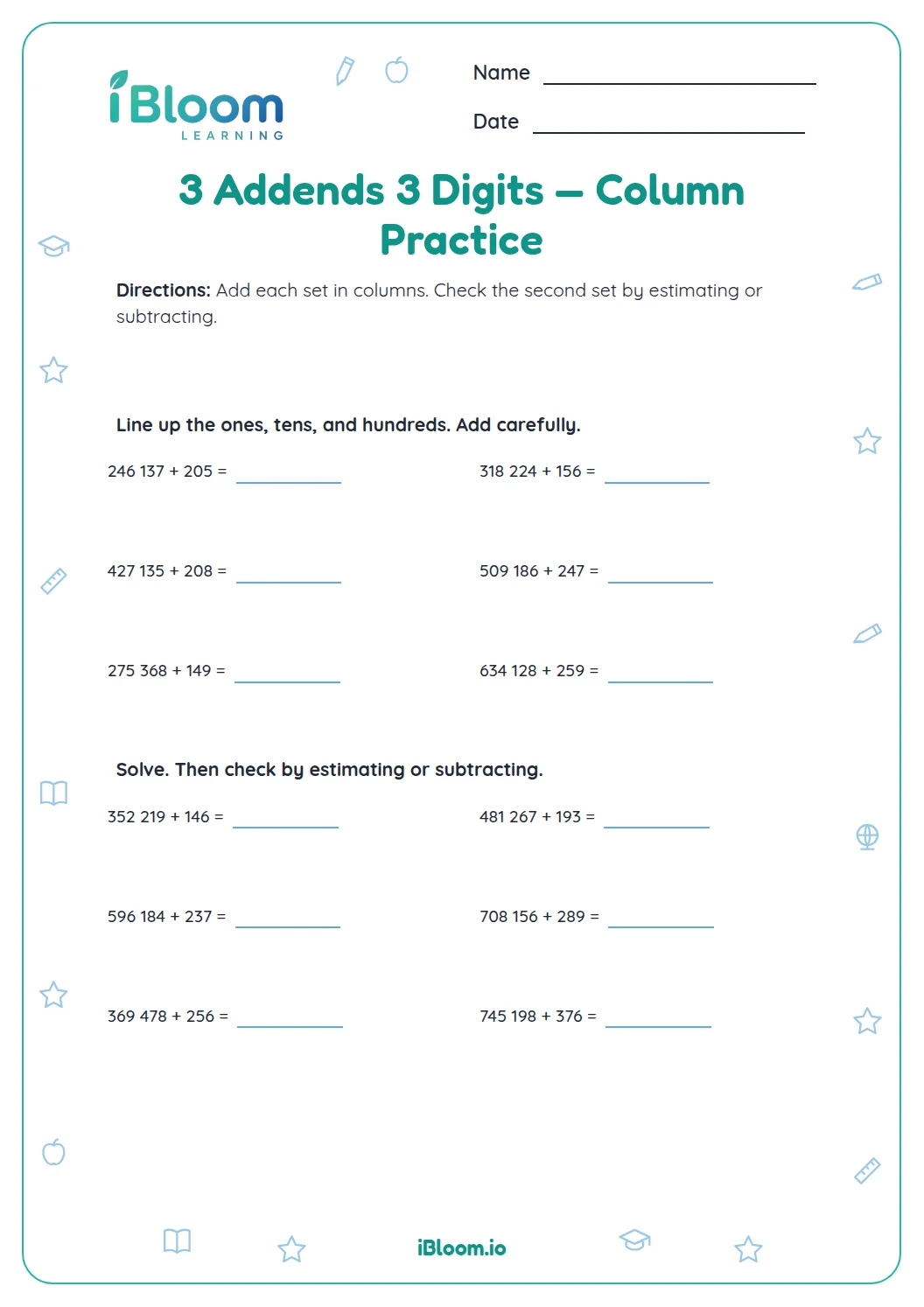
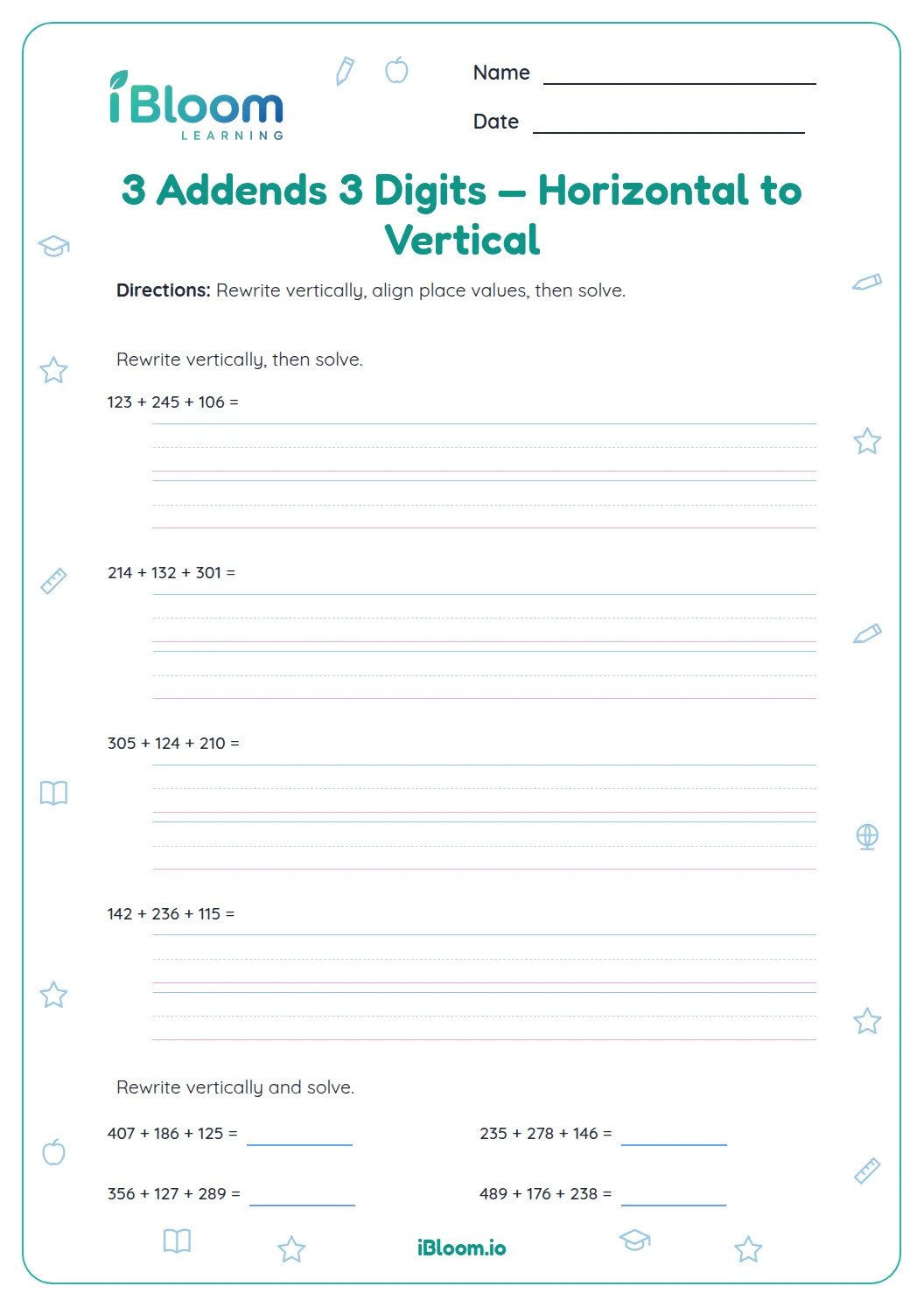
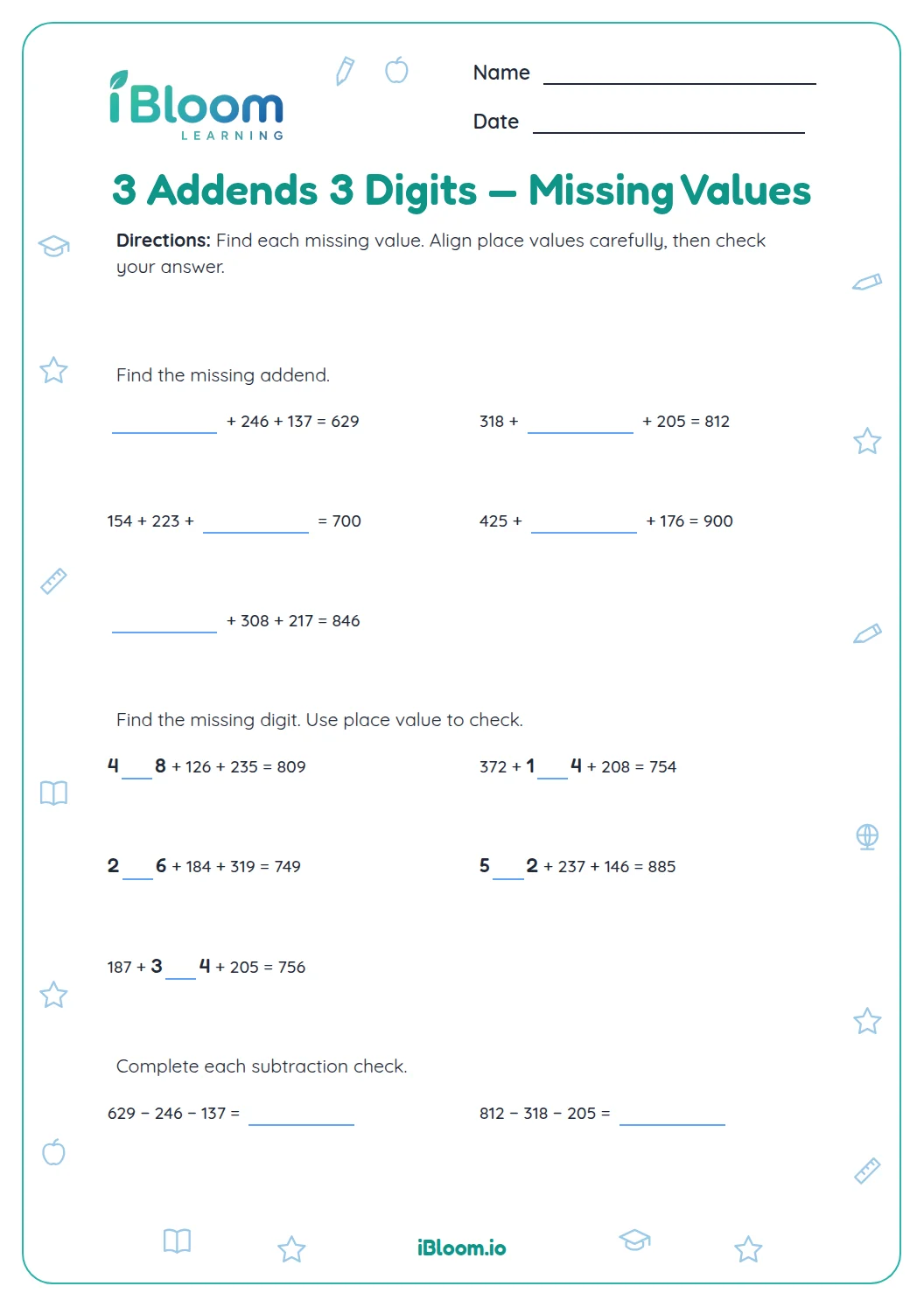
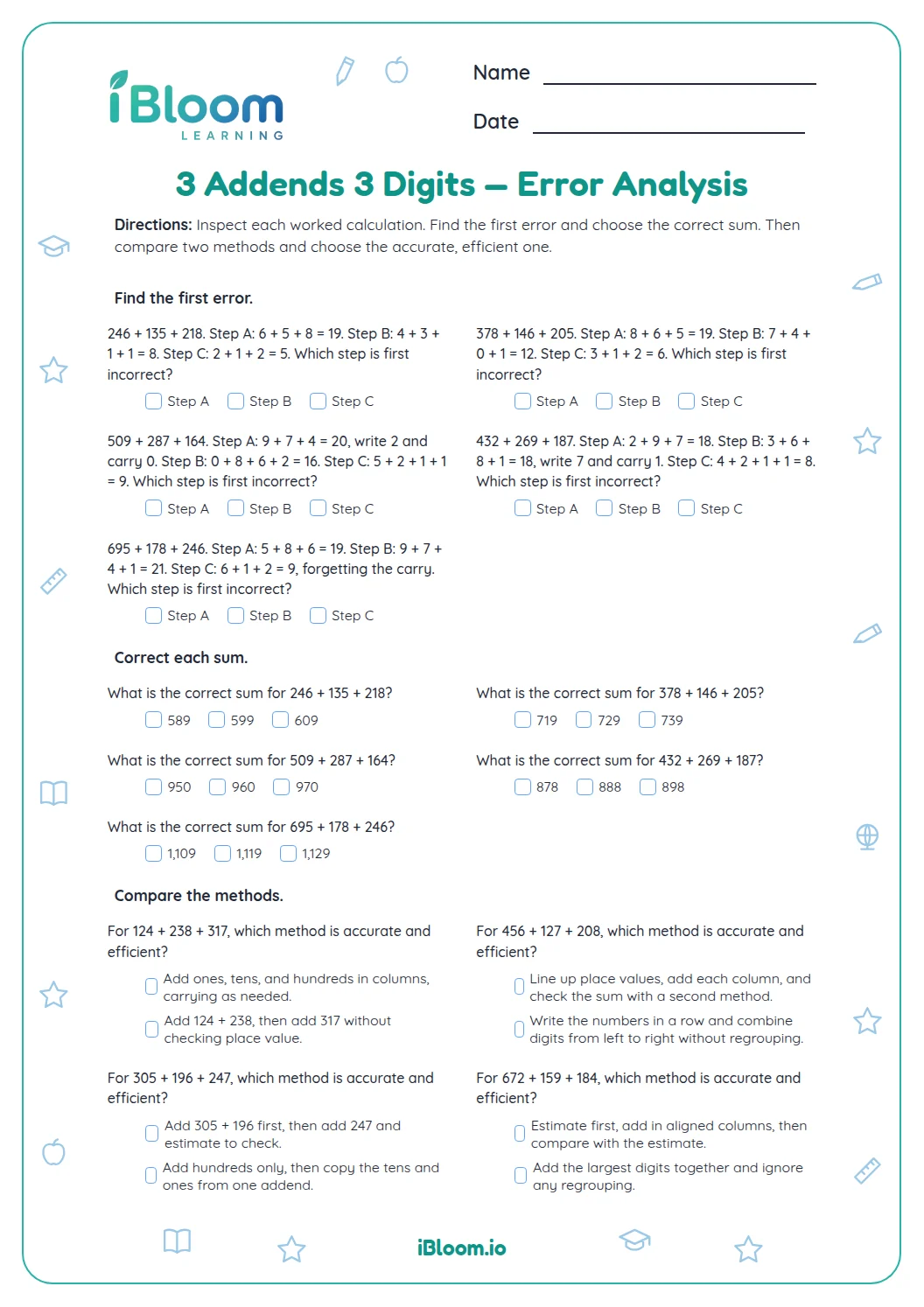
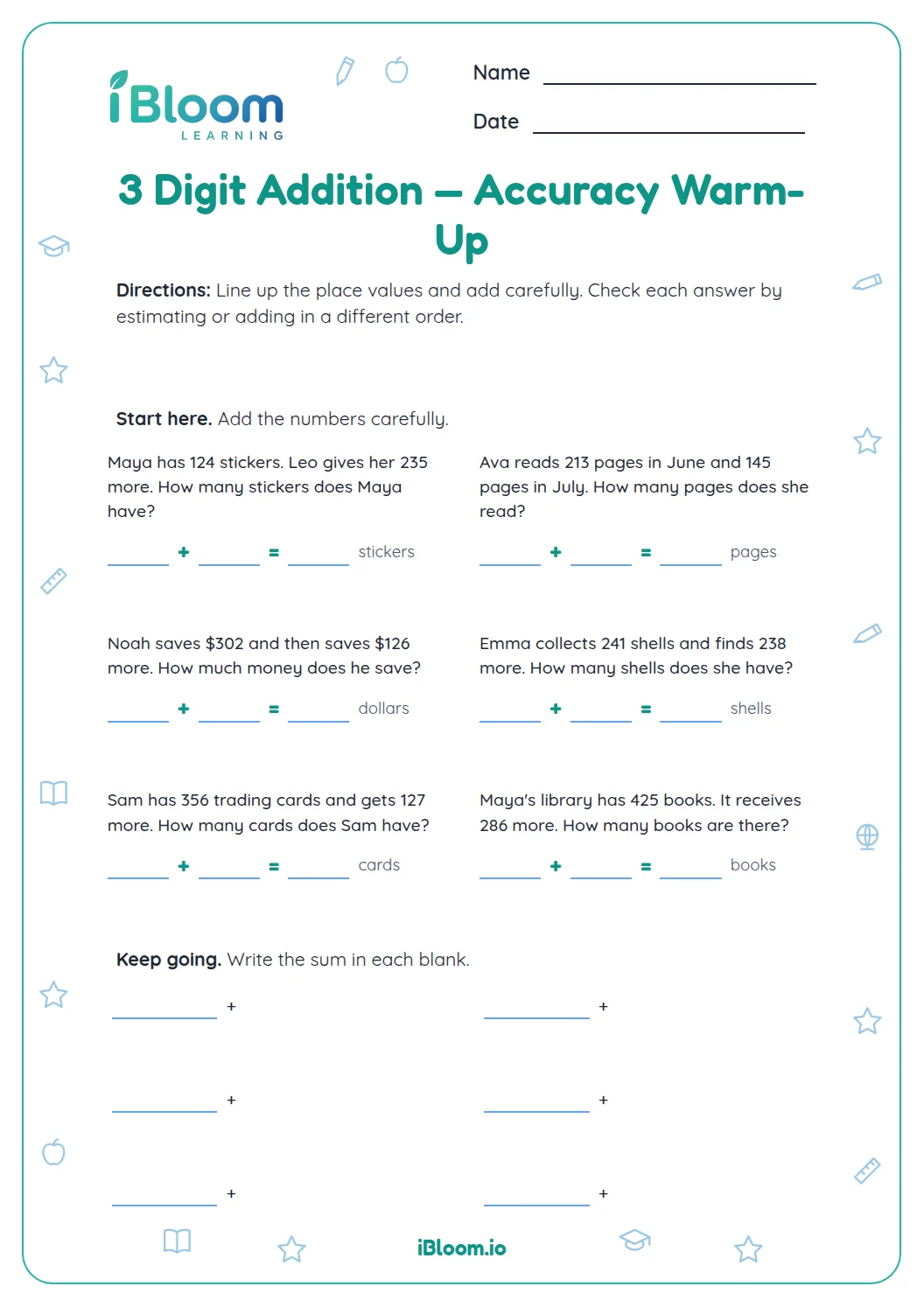
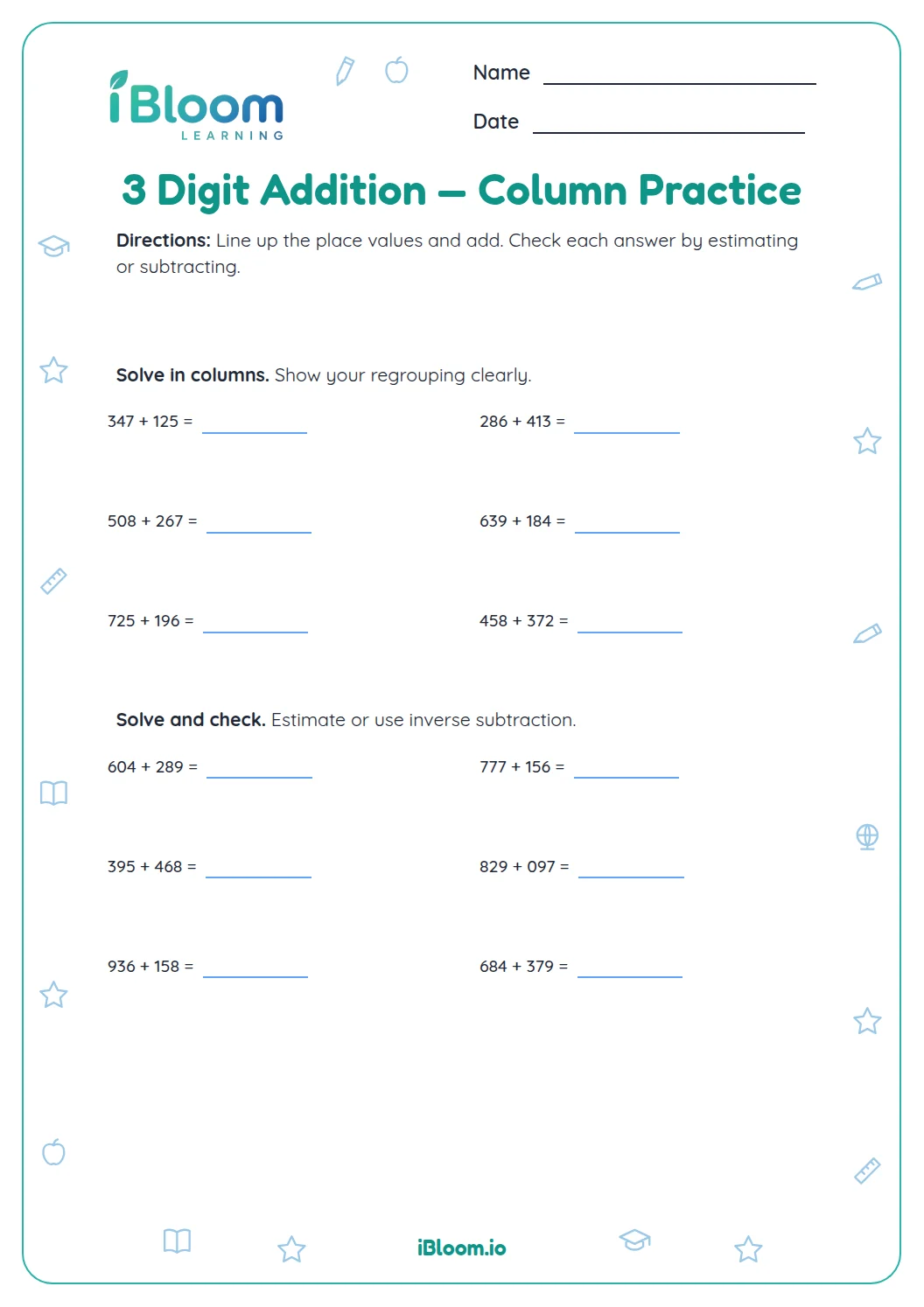
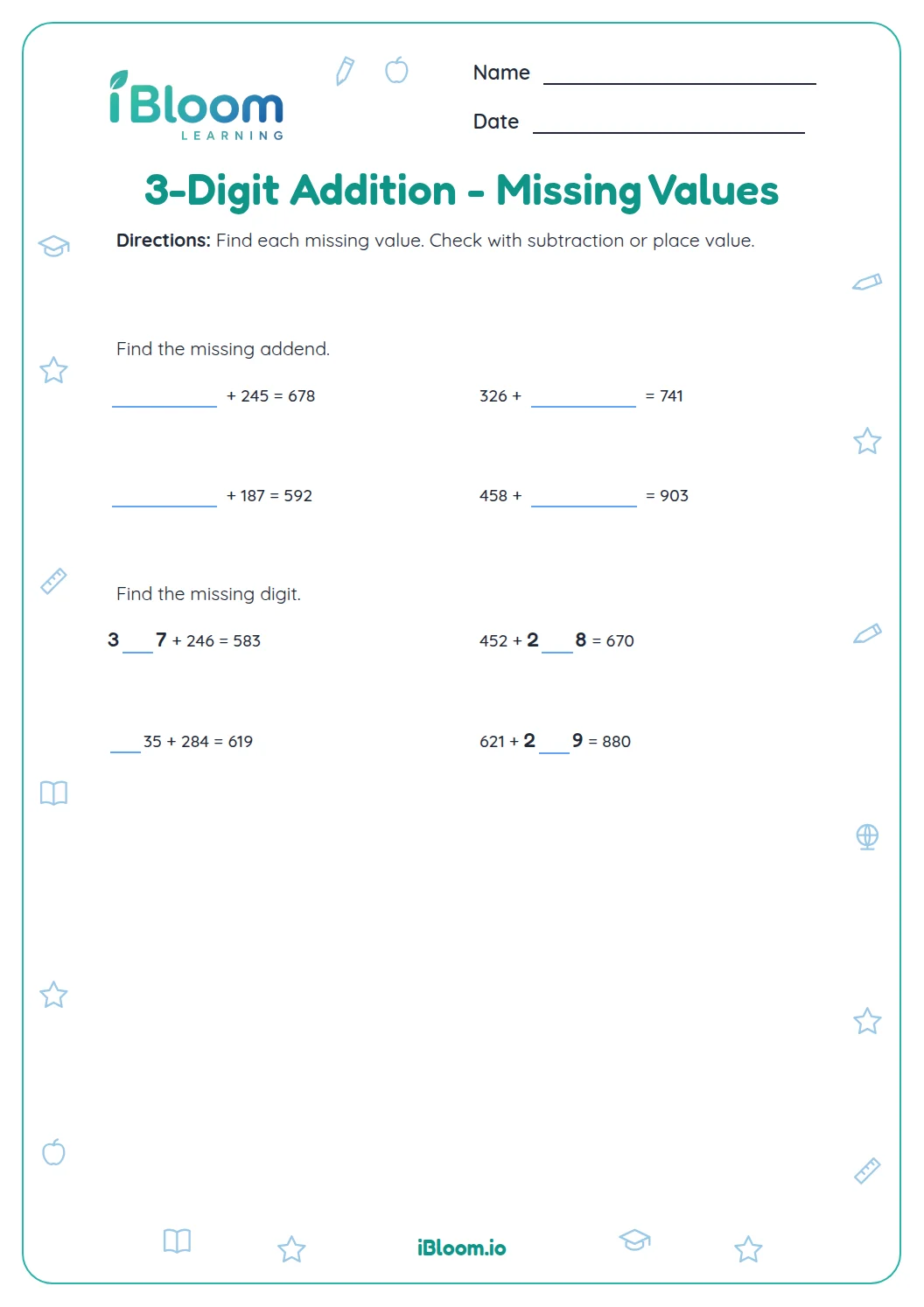
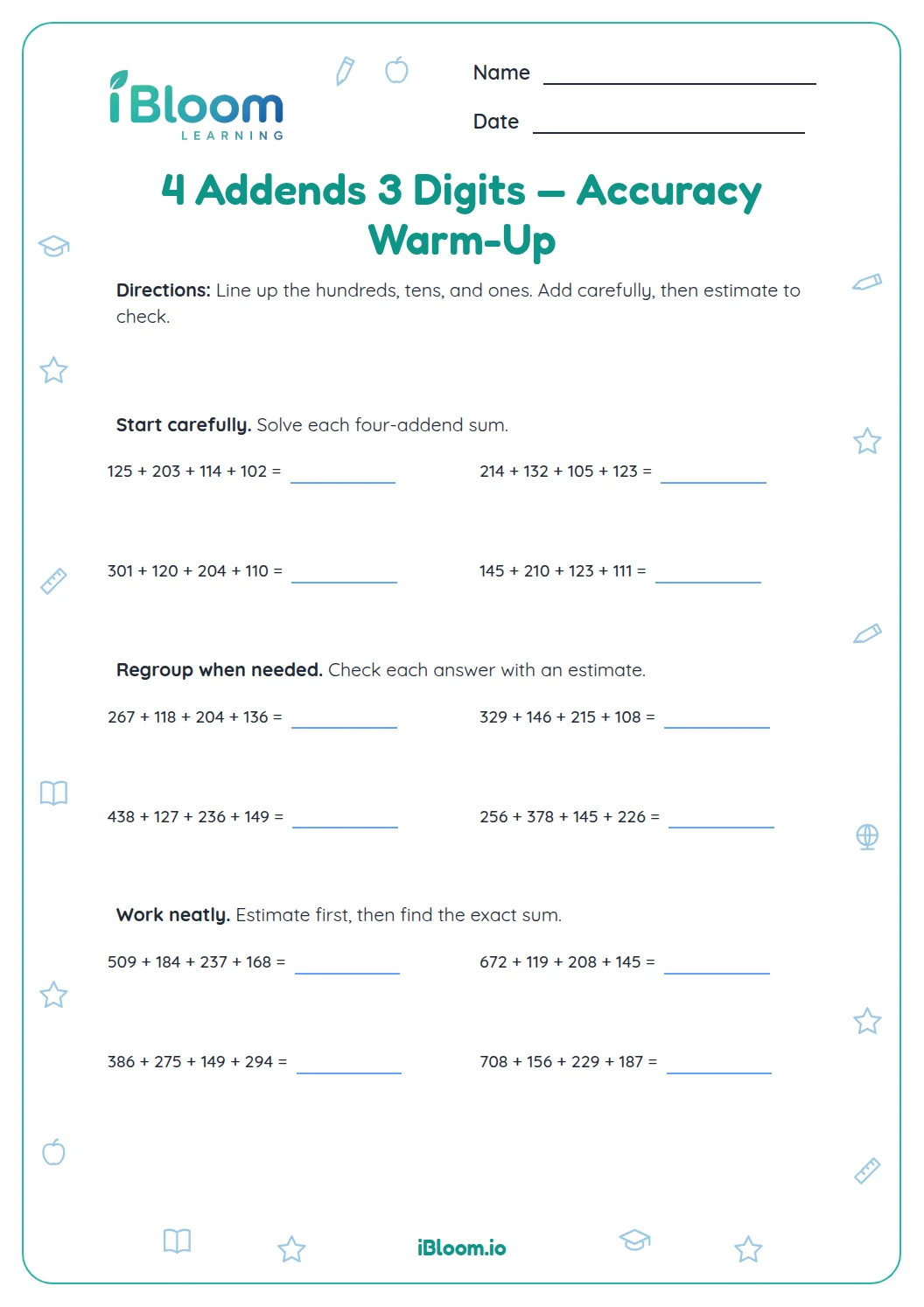
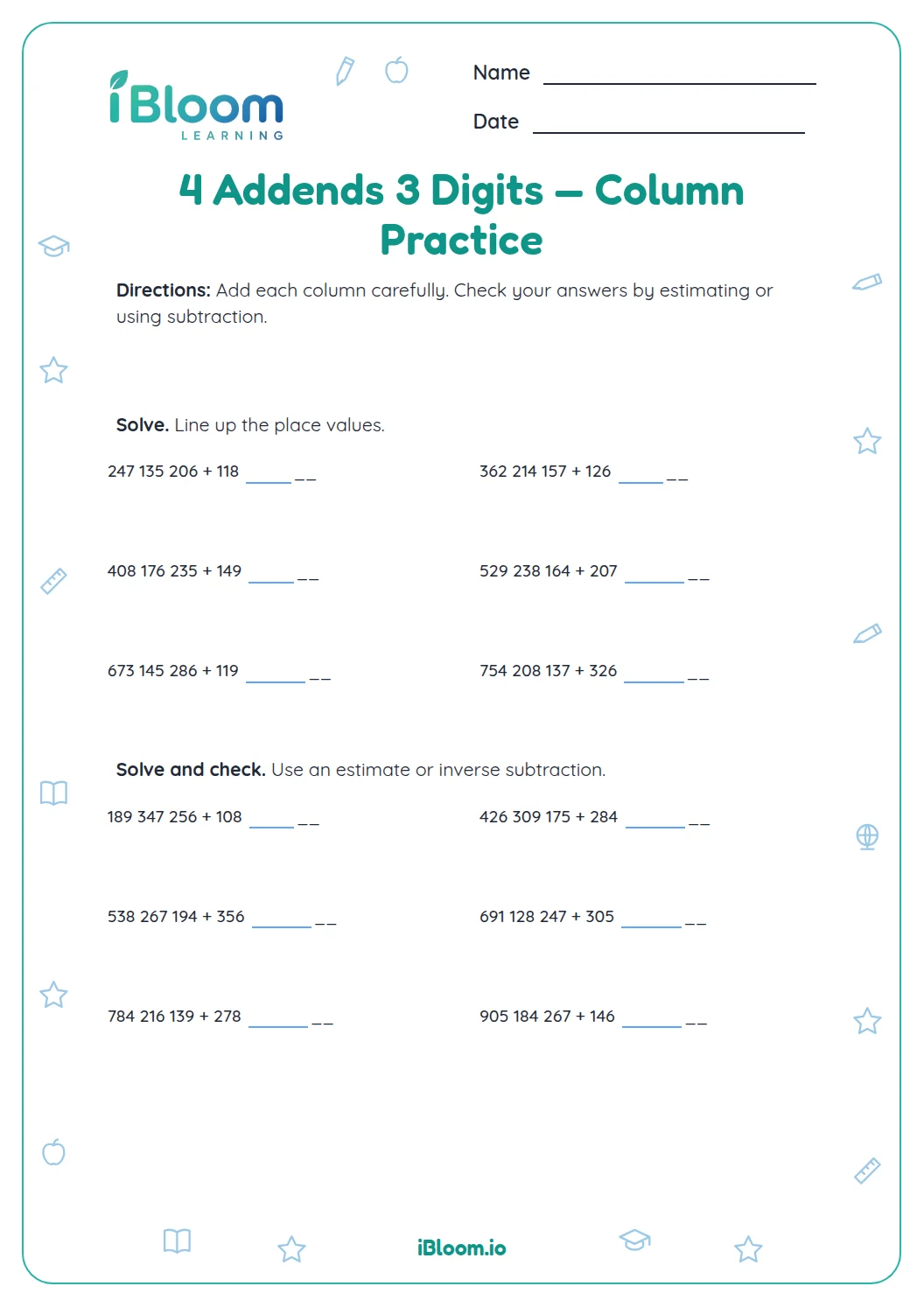
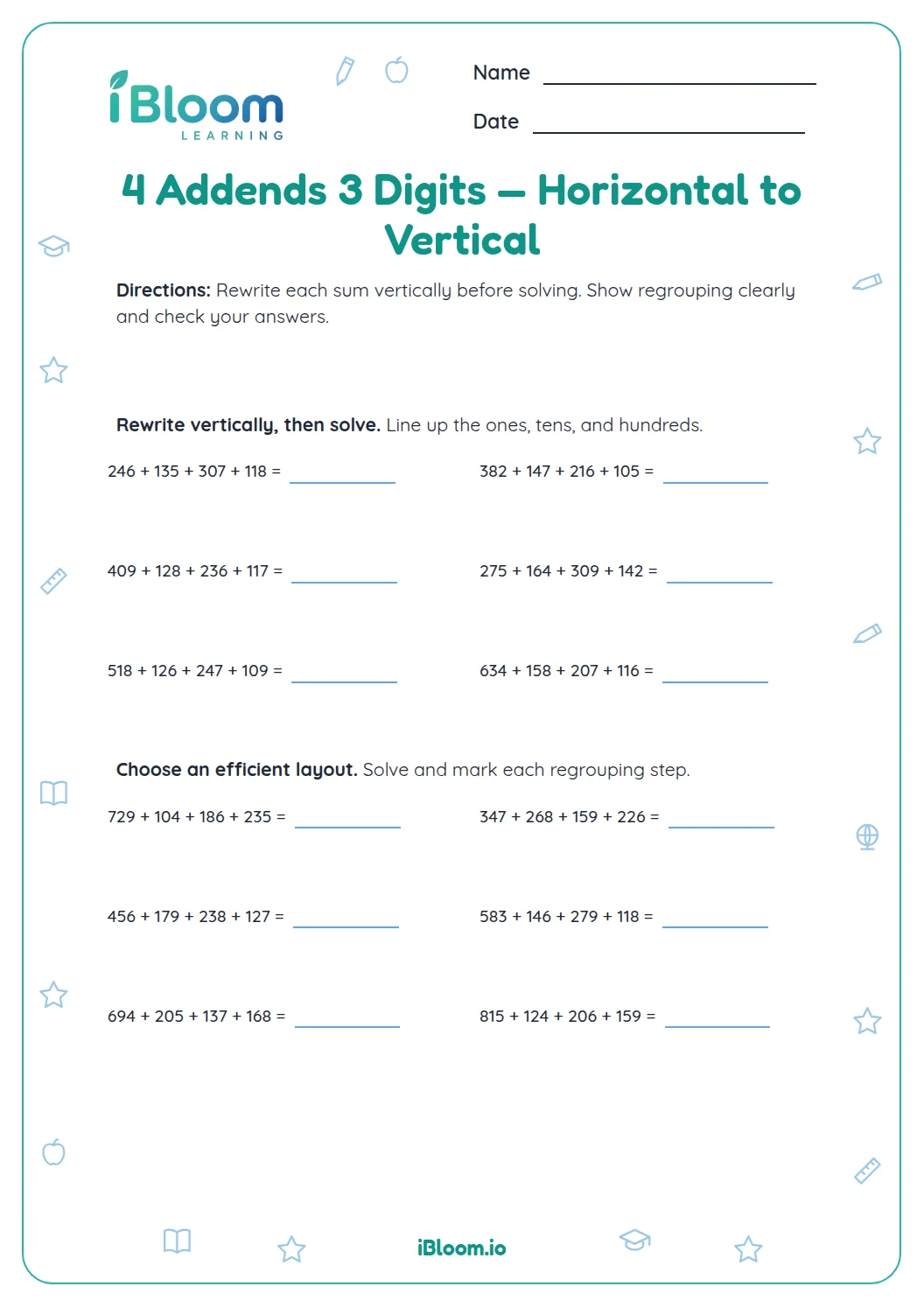
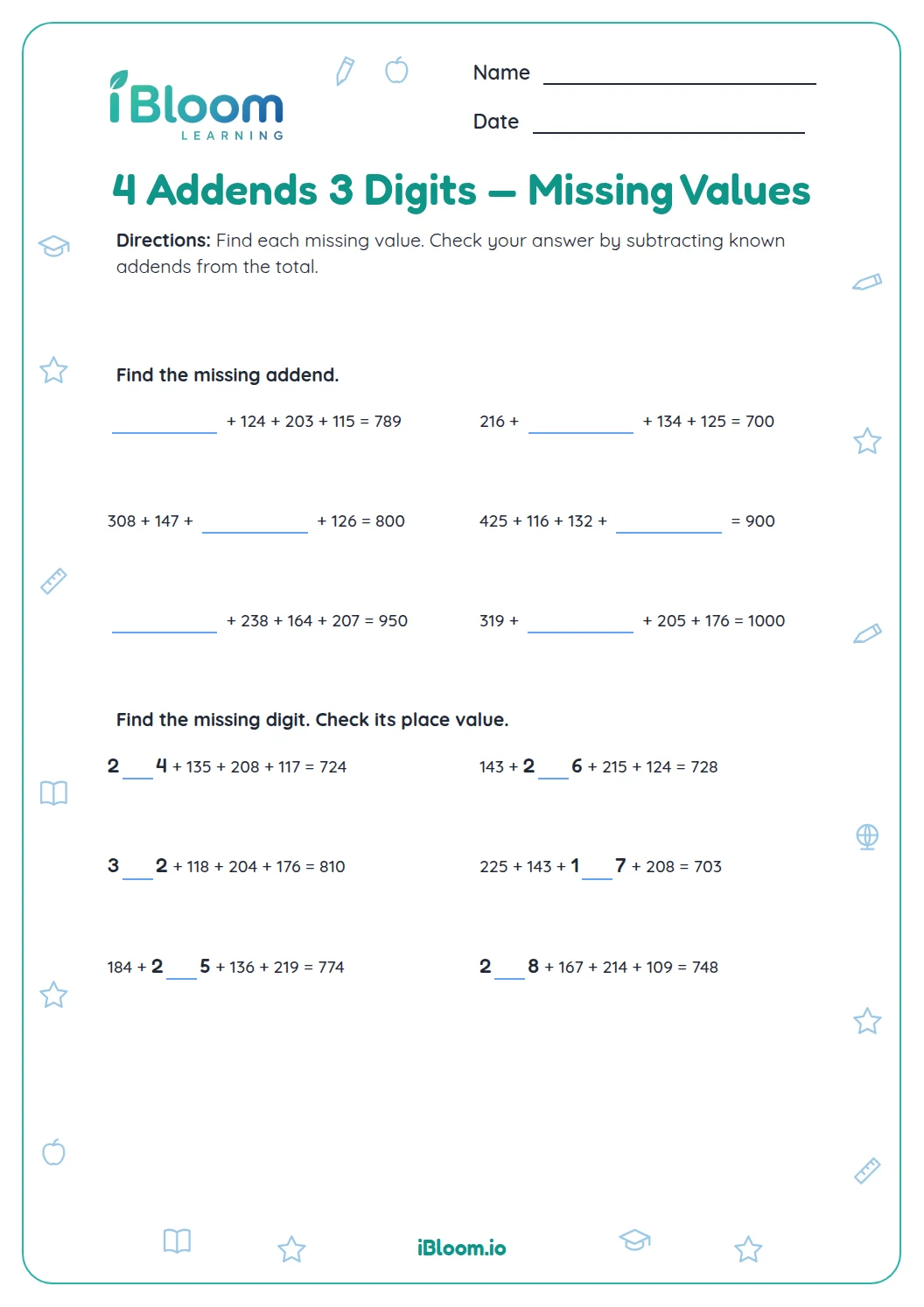
This Grade 3 printable gives 15 questions with three three-digit addends: exact sums, nearest-hundred estimates, and missing addends found by subtraction. Students practice place-value addition and check a total by working backward. The answer key lists exact totals, estimates, and missing values. The practice supports Common Core 3.NBT.A.2.
Aligned to 3.NBT.A.2
How do you add three three-digit numbers?
Keep hundreds under hundreds, tens under tens, and ones under ones. In question 1, 124 + 235 + 316, add the ones (4 + 5 + 6 = 15), regroup 10 ones as 1 ten, then continue by place.
- 1124 + 235 + 316
- 2Ones: 4 + 5 + 6 = 15
- 3Tens: 2 + 3 + 1, plus 1 regrouped ten = 7 tens
- 4Hundreds: 1 + 2 + 3 = 6 hundreds
- 5Total: 675
How can rounding help estimate a total?
Round each addend to the nearest hundred, then add the estimates. In question 6, 482 rounds to 500, 206 to 200, and 193 to 200. The estimated total is 900, which gives a quick way to judge whether an exact answer is reasonable.
- 1482 ≈ 500
- 2206 ≈ 200
- 3193 ≈ 200
- 4500 + 200 + 200 = 900
How can subtraction check a three-addend sum?
Subtract the two known addends from the total to recover the third. Question 11 leaves that addend blank, so the answer is not visible in the equation.
- 1790 − 139 = 651
- 2651 − 267 = 384
- 3The missing addend is 384.
How can you check an exact sum?
Estimate the total first, then add again in a different order or use subtraction after finishing. A total that is far from the estimate may signal a missed regroup or a digit placed in the wrong column.
A steady way to add
- 1Estimate the total by rounding the addends to hundreds.
- 2Solve the exact sums by keeping hundreds, tens, and ones aligned.
- 3Add the ones and record any regrouped ten.
- 4Use the estimate to decide whether the exact total is reasonable.
- 5For an inverse check, subtract two addends from the total.
- 6Compare each result with the answer key.
Common addition slips and quick fixes
The mistake
Leaving a ones total such as 15 in the ones column.
The fix
Write 5 ones and regroup 1 ten into the tens column.
The mistake
Adding only two of the three numbers.
The fix
Point to each addend as it is combined, then estimate whether all three are represented.
The mistake
Putting a regrouped ten in the hundreds column.
The fix
Carry it one place left only, from ones to tens or tens to hundreds.
Common Core alignment
The problems use place-value methods to add within 1,000.
Add three-digit addends using place-value strategies and algorithms.
On this sheet: Add three-digit addends using place-value strategies and algorithms.
Show the official wordingHide the official wording
Fluently add and subtract within 1000 using strategies and algorithms based on place value, properties of operations, and/or the relationship between addition and subtraction.
What to practice next
Make more practice
Further reading
Questions parents and teachers ask
Do all problems have three addends?
Yes. Each of the 15 questions uses three three-digit addends. The first part asks for exact sums, the second rounds each addend to the nearest hundred before estimating, and the last part uses subtraction to recover a missing addend from a stated total.
Are regrouping problems included?
Yes. The exact-sum part includes columns that require regrouping. Learners can add the ones, tens, and hundreds in order and carry a group of ten to the next place. The estimate and inverse-check parts then use different ways to reason about the same addition skill.
How can I help if column addition feels difficult?
Have the learner line up hundreds, tens, and ones, then add one place at a time. In question 1, the ones total is 15, so 10 ones become 1 ten and 5 ones remain. The answer key lists the final sums and can help locate a missed regroup.
What does “mixed mastery” mean on this page?
The worksheet mixes exact addition, estimates from rounding, and inverse checks using subtraction. These tasks ask learners to calculate, judge whether a total is reasonable, and use the relationship between addition and subtraction to find an addend that is not shown.
Is an answer key included?
Yes. The separate key lists answers for all 15 questions. It gives exact sums, estimated totals, and the missing addends in the final part. For the estimate items, check that each addend was rounded individually to the nearest hundred before the rounded values were added.