




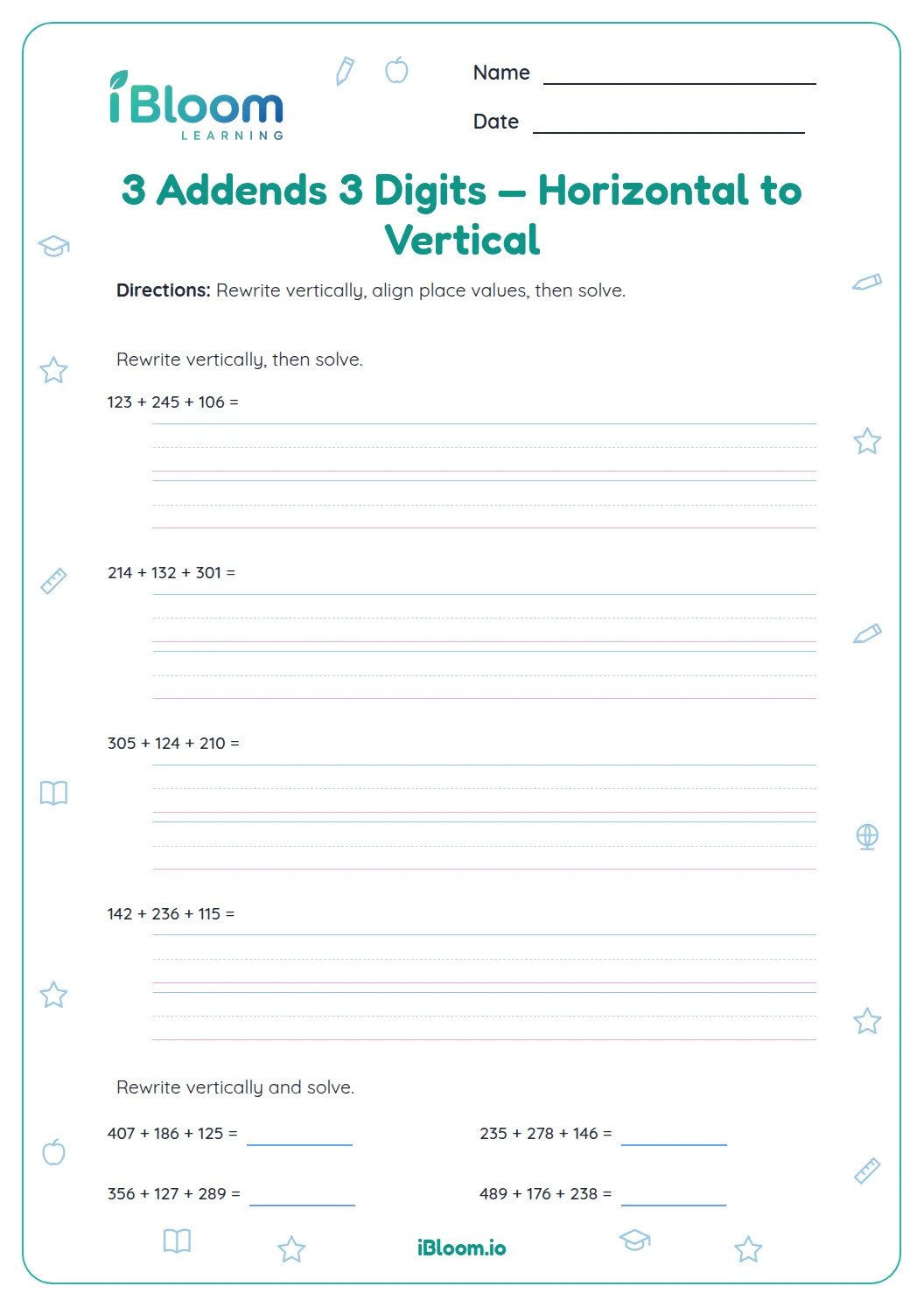
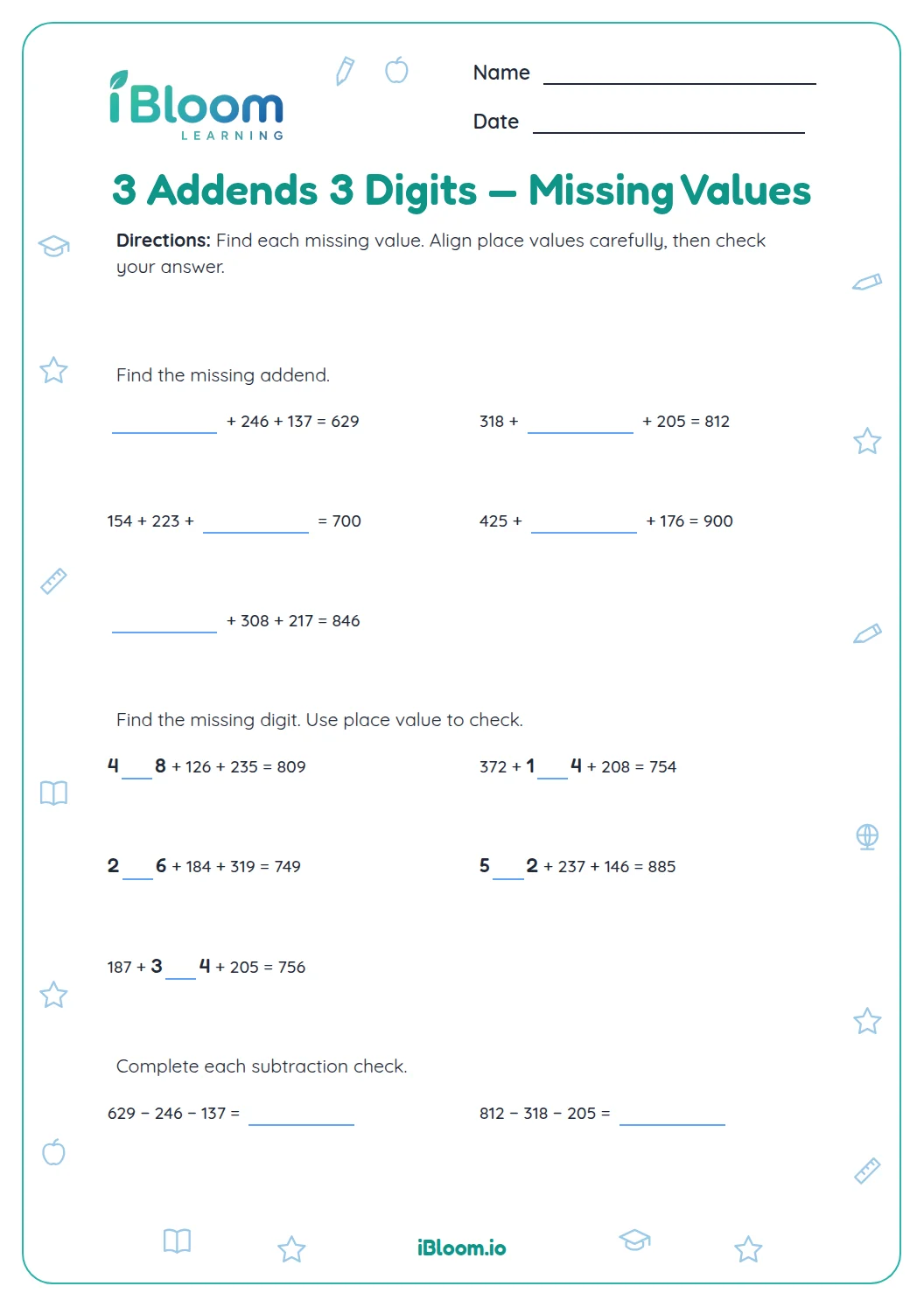
About this worksheet
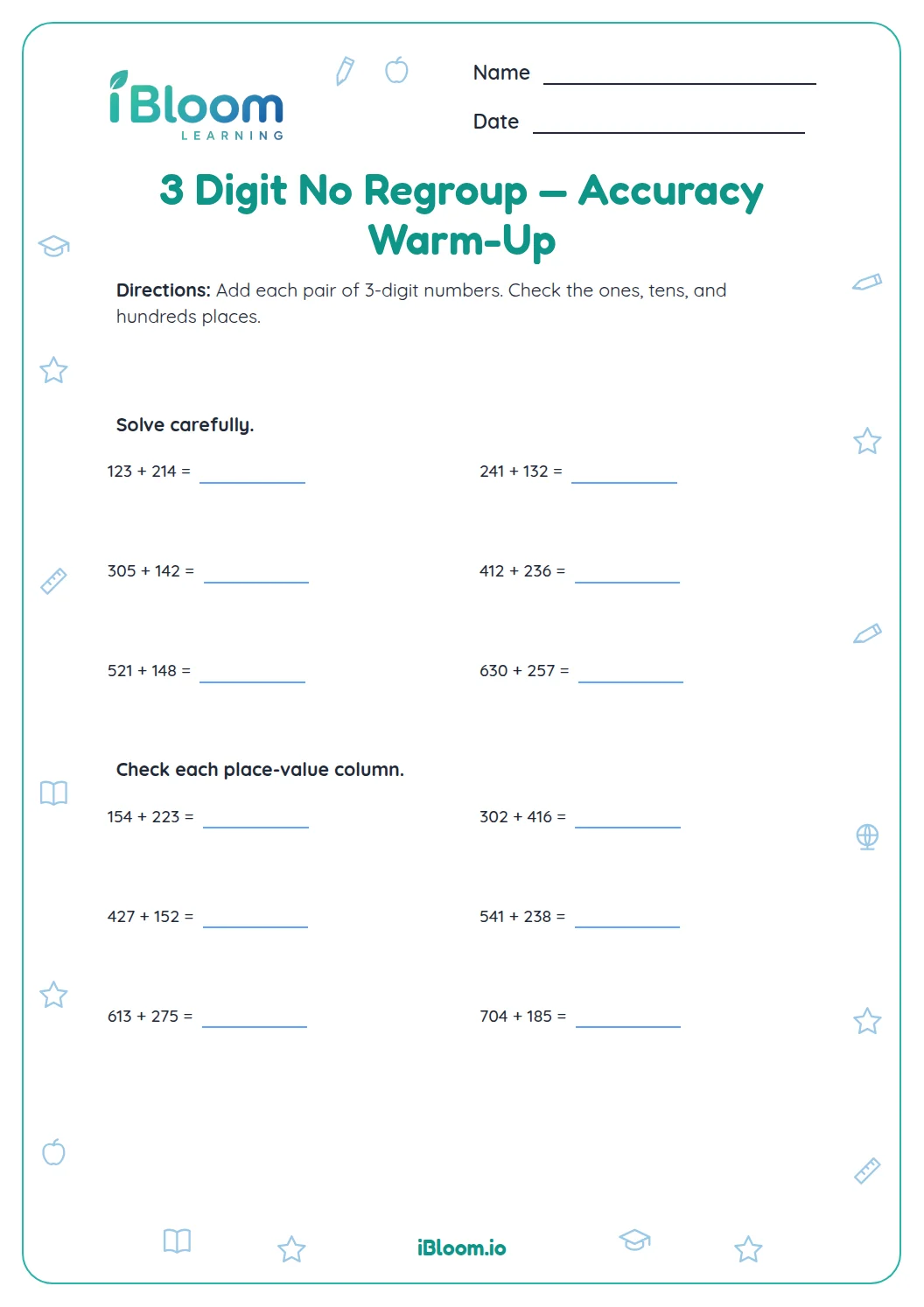
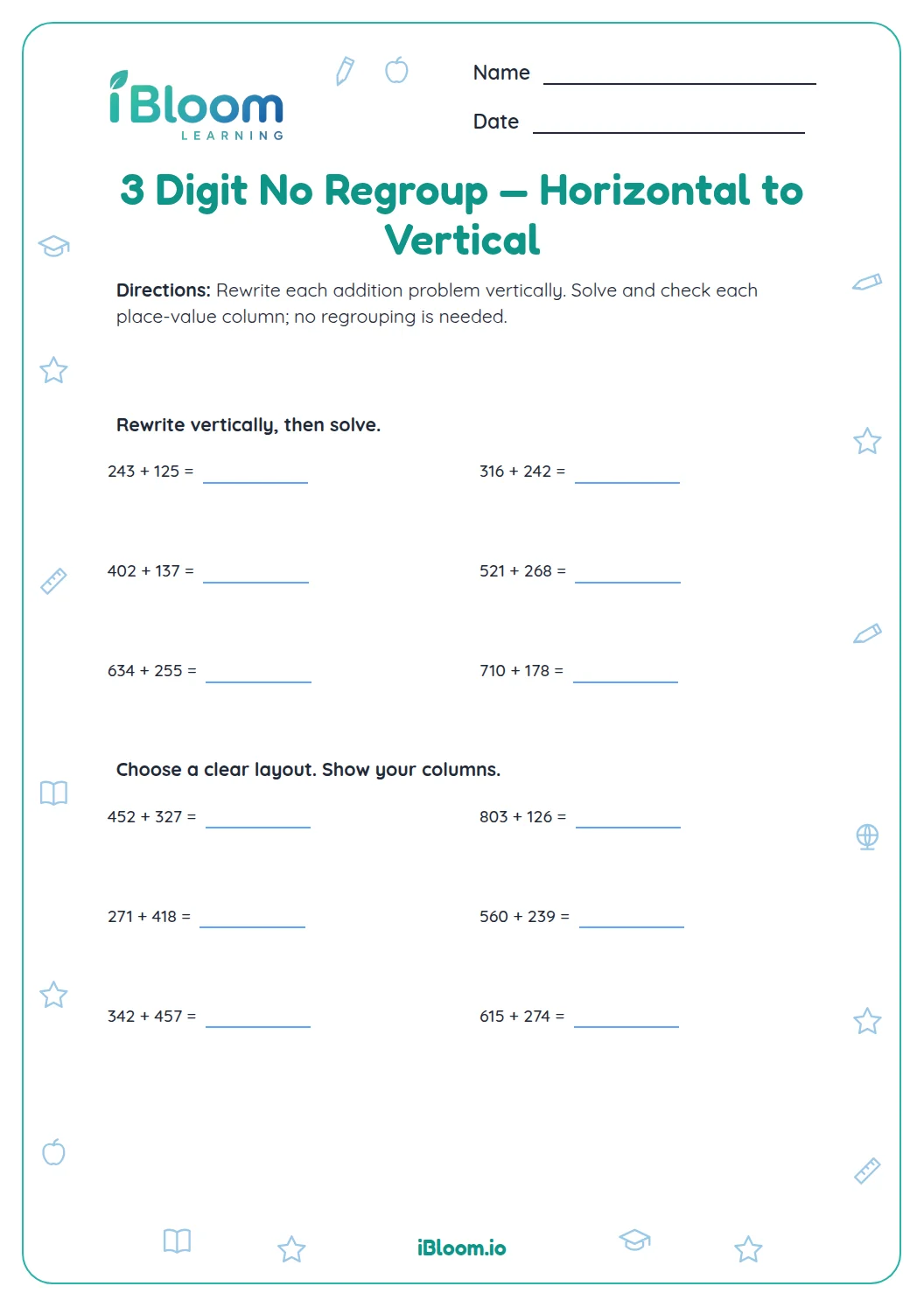
This free printable drill gives students in Grades 3–4 fourteen three-digit additions to rewrite vertically before solving. Part A starts with four sums that keep each column within nine. Part B introduces regrouping in one column, and Part C needs regrouping in both the ones and tens columns. Each question has squared working space for lining up digits. The practice supports Common Core 3.NBT.A.2 through addition within 1,000 using place value. A separate answer key gives every sum; an adult can also check the column setup on the student sheet.
Aligned to 3.NBT.A.2
Why rewrite a sum in columns?
A horizontal sum tells you which numbers to add. A vertical layout makes the place values visible: each digit sits above another digit with the same value. The squares help students keep the ones, tens, and hundreds separate.
For 507 + 182, the zero belongs in the tens column. Keeping that space prevents the 5 hundreds from being added to the 8 tens.
How does regrouping work in question 9?
Ten ones become one ten, and ten tens become one hundred. Write the leftover digit in its own column and move the new unit to the next column to the left.
- 1Ones: 8 + 5 = 13. Write 3 ones and regroup 1 ten.
- 2Tens: 7 + 4 + 1 = 12. Write 2 tens and regroup 1 hundred.
- 3Hundreds: 2 + 1 + 1 = 4.
- 4278 + 145 = 423.
How do the three parts build the skill?
Part A has four additions without regrouping, so students can concentrate on lining up the numbers. Part B has four additions requiring one regroup: one in the ones column and three in the tens column.
Part C has six additions needing two regroups. Ask students to leave the small regrouped digits visible. Those marks help you see whether an incorrect answer came from a fact error or a missed unit.
How to use this worksheet
- 1Read the first horizontal sum and name the hundreds, tens and ones in each addend.
- 2Rewrite both addends on the grid, using one square for each digit.
- 3Add from right to left, marking each regroup above the receiving column.
- 4Finish all three parts and put each sum in its answer box.
- 5Compare the sums with the key, then review any column that produced a different digit.
Mistakes to check
The mistake
Putting the second addend one square too far left.
The fix
Check the rightmost digits first: the ones must line up before adding.
The mistake
Writing 13 under the ones column in 278 + 145.
The fix
Keep 3 in the ones column and record the extra ten above the tens column.
The mistake
Forgetting the regrouped hundred in question 9.
The fix
Include all three hundreds: 2 + 1 + 1 = 4, giving 423.
Common Core alignment
Align hundreds, tens and ones to add two three-digit numbers within 1,000.
On this sheet: Students rewrite horizontal sums in columns and use place value to add, including regrouping.
Show the official wordingHide the official wording
Fluently add and subtract within 1000 using strategies and algorithms based on place value, properties of operations, and/or the relationship between addition and subtraction.
What to practice next
Make more practice
Further reading
Questions parents and teachers ask
Should students rewrite every problem vertically?
Yes, rewriting every sum is the main task of this drill. Even when a child can add 214 + 135 mentally, ask for the column setup on the grid. That lets you check whether the ones, tens, and hundreds are aligned before the harder regrouping problems.
Which questions need regrouping?
Questions 5–8 each need one regroup, and questions 9–14 each need two. The first four sums use no regrouping. In Part B, one sum regroups ones into a ten and three regroup tens into a hundred, so students must check each column separately.
Why is there a zero in 507 + 182?
The zero holds the tens place in 507. When the numbers are written vertically, it sits above the 8 tens in 182. Students add 7 + 2 ones, 0 + 8 tens, and 5 + 1 hundreds to get the sum of 689.
Is this a timed addition drill?
Timing is optional; the worksheet asks for careful rewriting and addition. Allow about fifteen minutes as a starting point, and give extra time for recording regrouped units. Check the written columns as well as the final totals before introducing a personal timing goal.
What does the answer key show?
The separate answer key gives the sum for each of the fourteen problems. Use it to check numerical accuracy, then inspect the student’s working grid for aligned digits and regrouped units. The worked example on this page explains both regroups in 278 + 145.