
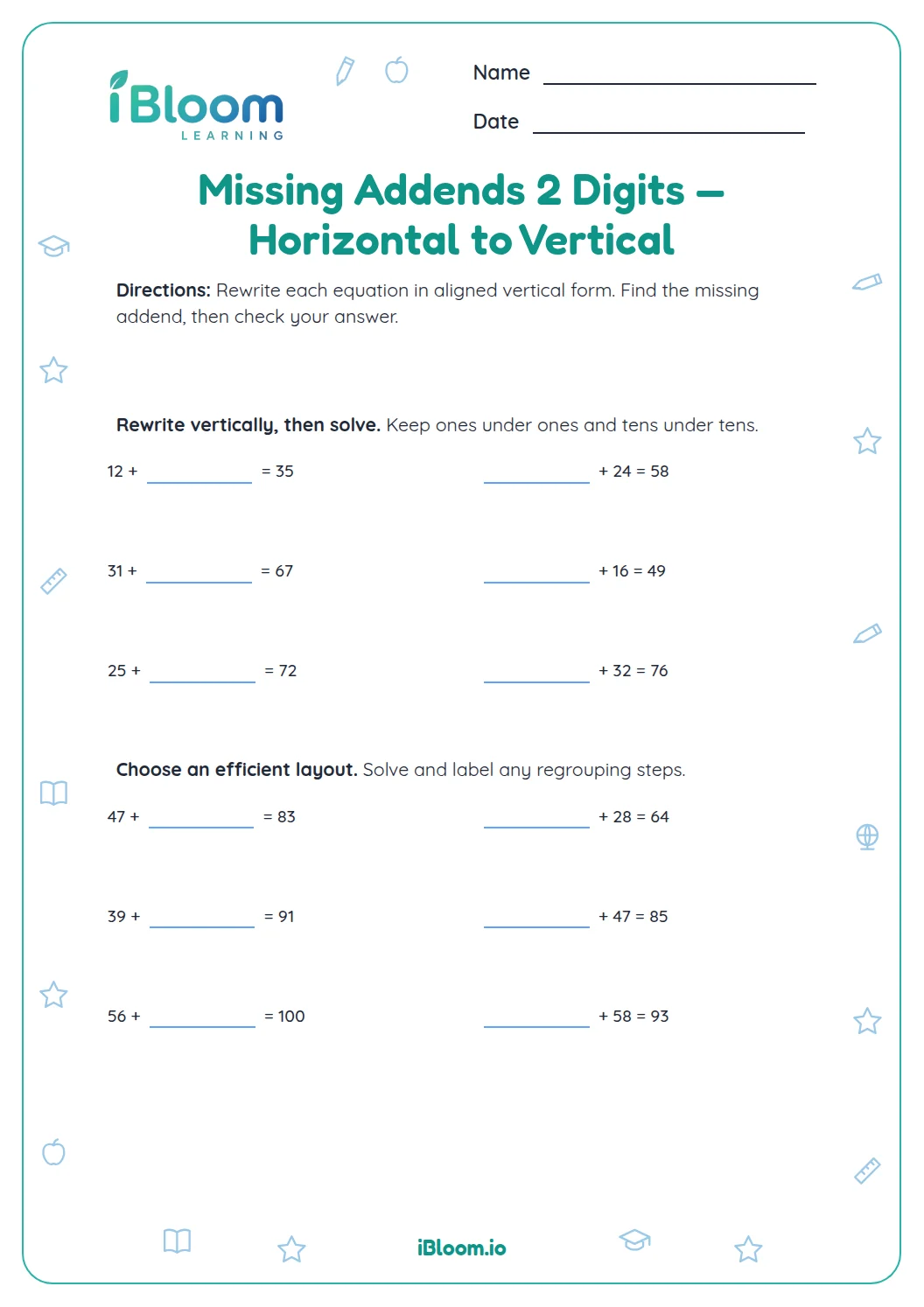
About this worksheet
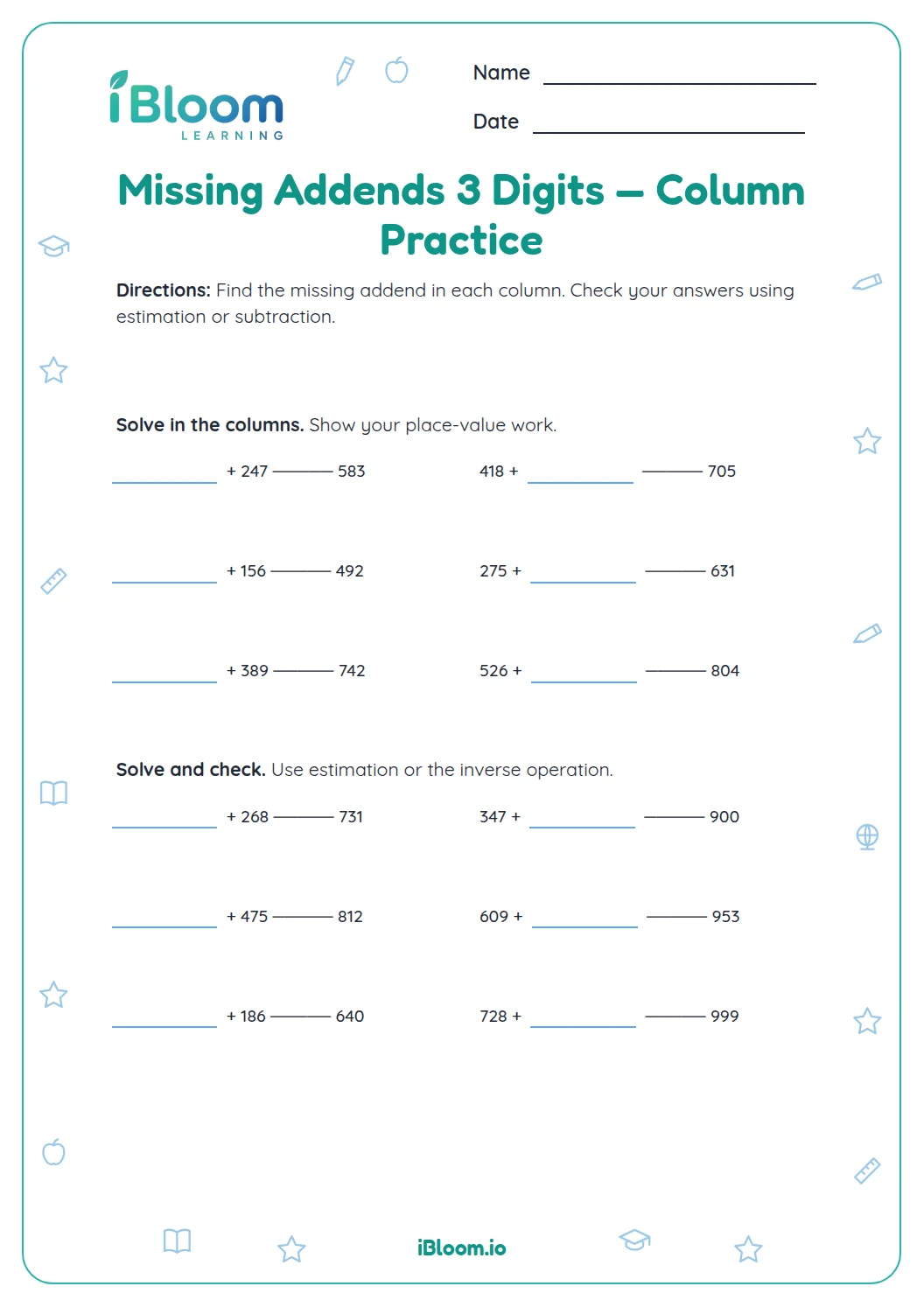
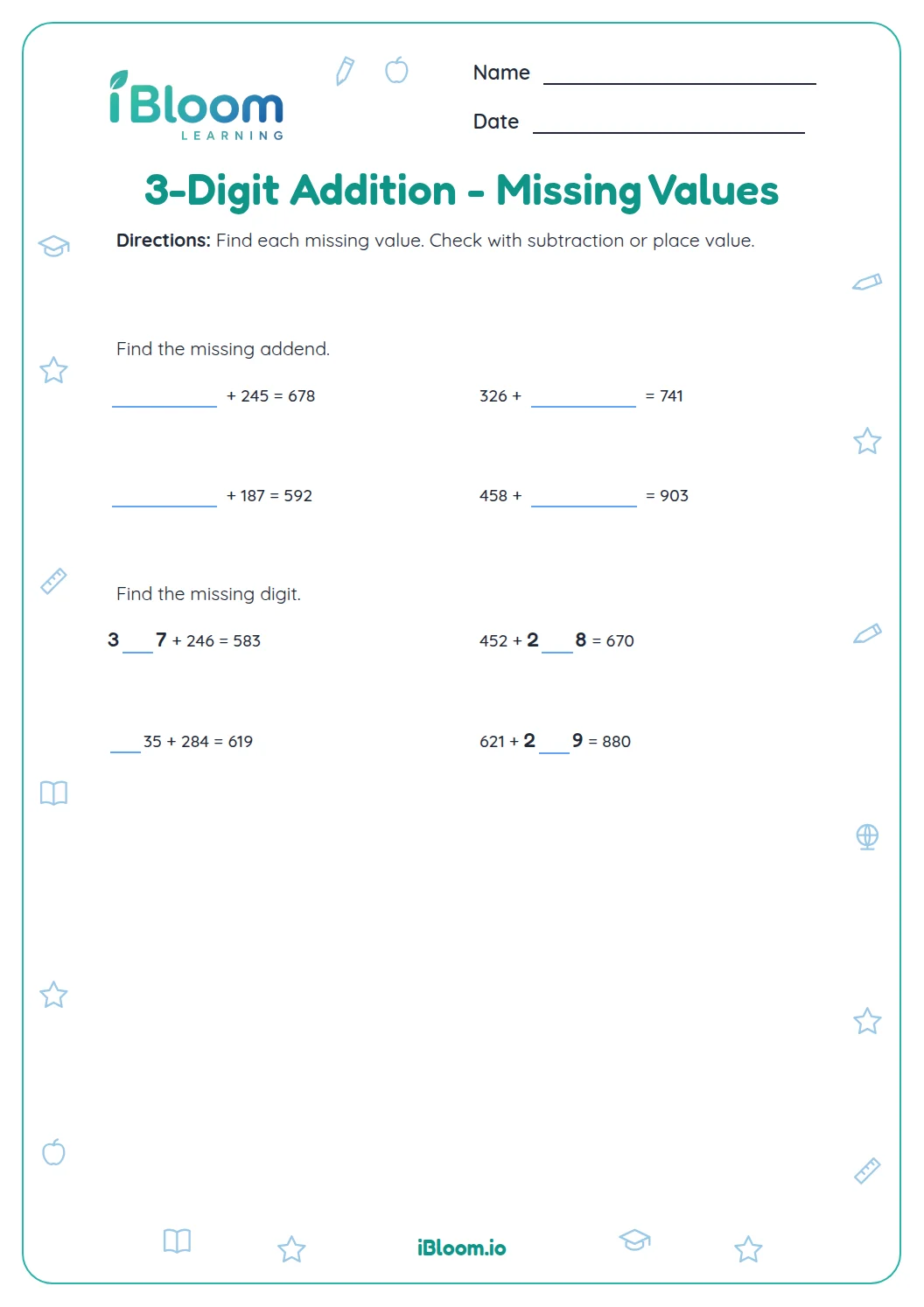
This Grade 3 printable focuses on finding an unknown addend in three-digit addition. Eight horizontal equations lead into eight more equations with room to set up vertical work, so students use the same addition relationship in two layouts. Every sum stays within 1,000. The practice connects to CCSS 3.NBT.A.2, adding and subtracting within 1,000. The answer key is included.
Aligned to 3.NBT.A.2
How do you find an unknown addend?
Use the total and known addend to determine what must be added. Students may subtract the known addend from the total or reason by place value. The first eight questions keep the equation on one line.
- 1236 + ___ = 687
- 2687 − 236 = 451, so the missing addend is 451.
How does column layout help?
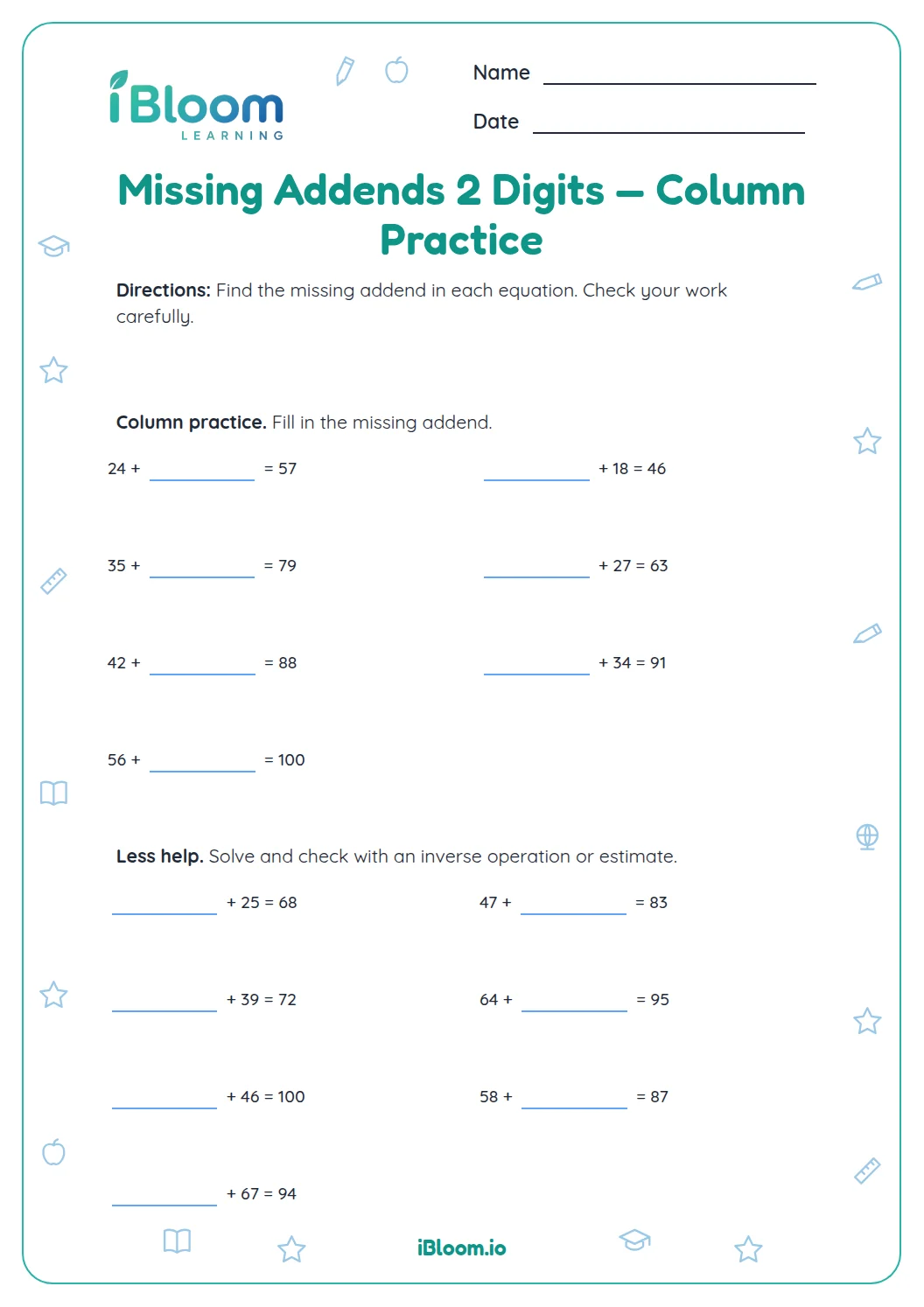
Questions 9–16 place the known addend, blank addend and total in vertical alignment. Students can line up hundreds, tens and ones and regroup where needed.
How can students check each answer?
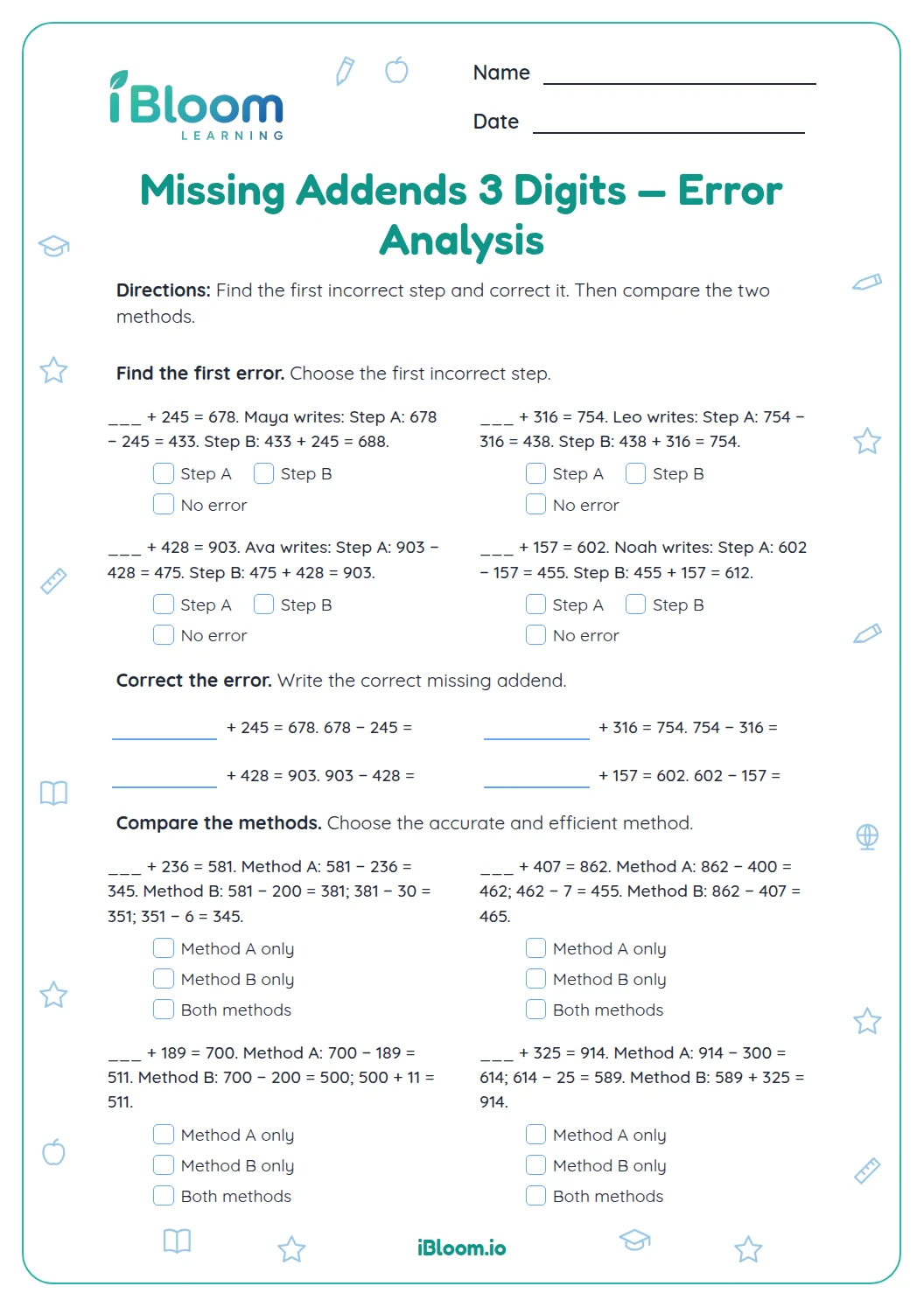
Add the missing number to the known addend. The result should match the total exactly; this inverse check catches many regrouping errors.
How to use this worksheet
- 1Read the part heading and its one-line direction.
- 2Work through the items in order and keep each answer tied to the prompt.
- 3Reread any item where two choices seem possible.
- 4Use the key after completing the page to correct specific answers.
Common slips and helpful fixes
The mistake
Choosing a word by topic alone.
The fix
Read the whole sentence and check how the word is used.
The mistake
Rushing past a key clue.
The fix
Underline or notice the phrase that determines the answer.
The mistake
Copying an answer without checking it.
The fix
Compare each response with the exact question.
Common Core alignment
This worksheet practices the listed Common Core skill through its questions.
Fluently add and subtract within 1,000 using strategies and algorithms based on place value.
On this sheet: Fluently add and subtract within 1,000 using strategies and algorithms based on place value.
Show the official wordingHide the official wording
Fluently add and subtract within 1,000 using strategies and algorithms based on place value, properties of operations, and/or the relationship between addition and subtraction.
What to practice next
Make more practice
Further reading
Questions parents and teachers ask
Why are the later equations vertical?
The later questions give students a clear way to align hundreds, tens and ones. This supports place-value reasoning when regrouping is needed. The mathematical task remains finding the unknown addend, as in the horizontal section. Students may also use place-value jumps, provided the result gives the printed total.
Do the problems require regrouping?
Several totals require regrouping across ones or tens. Students should show the addition in columns when it helps, then verify by checking that the two addends produce the printed total. Writing the subtraction or addition steps makes regrouping easier to inspect afterward.
Can students subtract to find the blank?
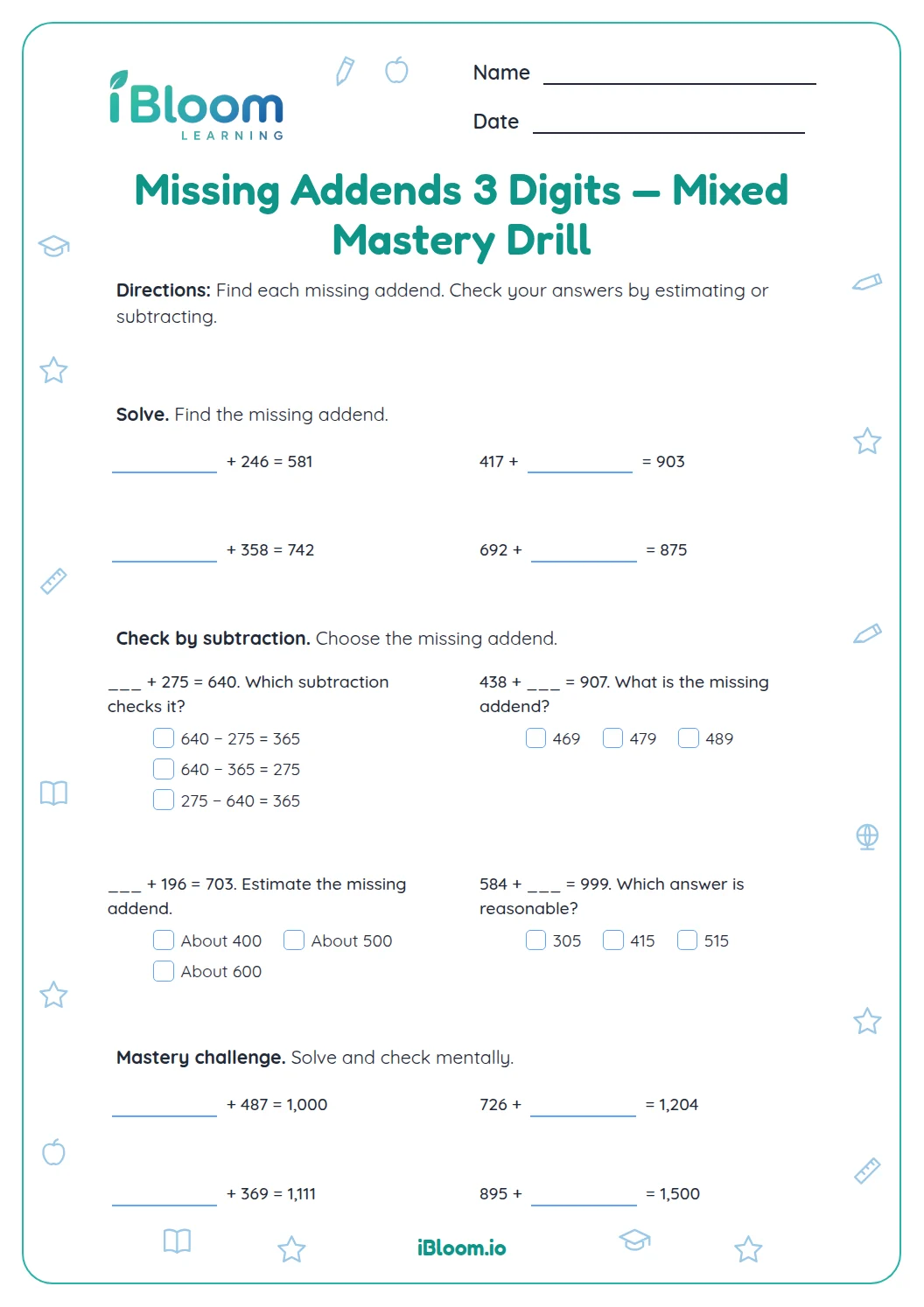
Yes. Addition and subtraction are related, so subtracting the known addend from the total gives the missing addend. For 236 + ___ = 687, compute 687 − 236 to get 451. A quick estimate can show whether a three-digit result is reasonable before checking.
How many questions are on the page?
There are 16 questions: eight horizontal equations and eight vertically arranged equations. The answer key lists each missing addend in question order. The answer key follows the same question order and lists the missing number only. Each equation is checked by adding the two addends together and comparing the sum with the target.
What should students check before moving on?
Check the alignment of the digits, any regrouping marks, and the final sum. A useful final step is to substitute the answer into the original equation and confirm that both sides are equal. Use the second layout to practice aligning digits and showing regrouping marks.