
About this worksheet
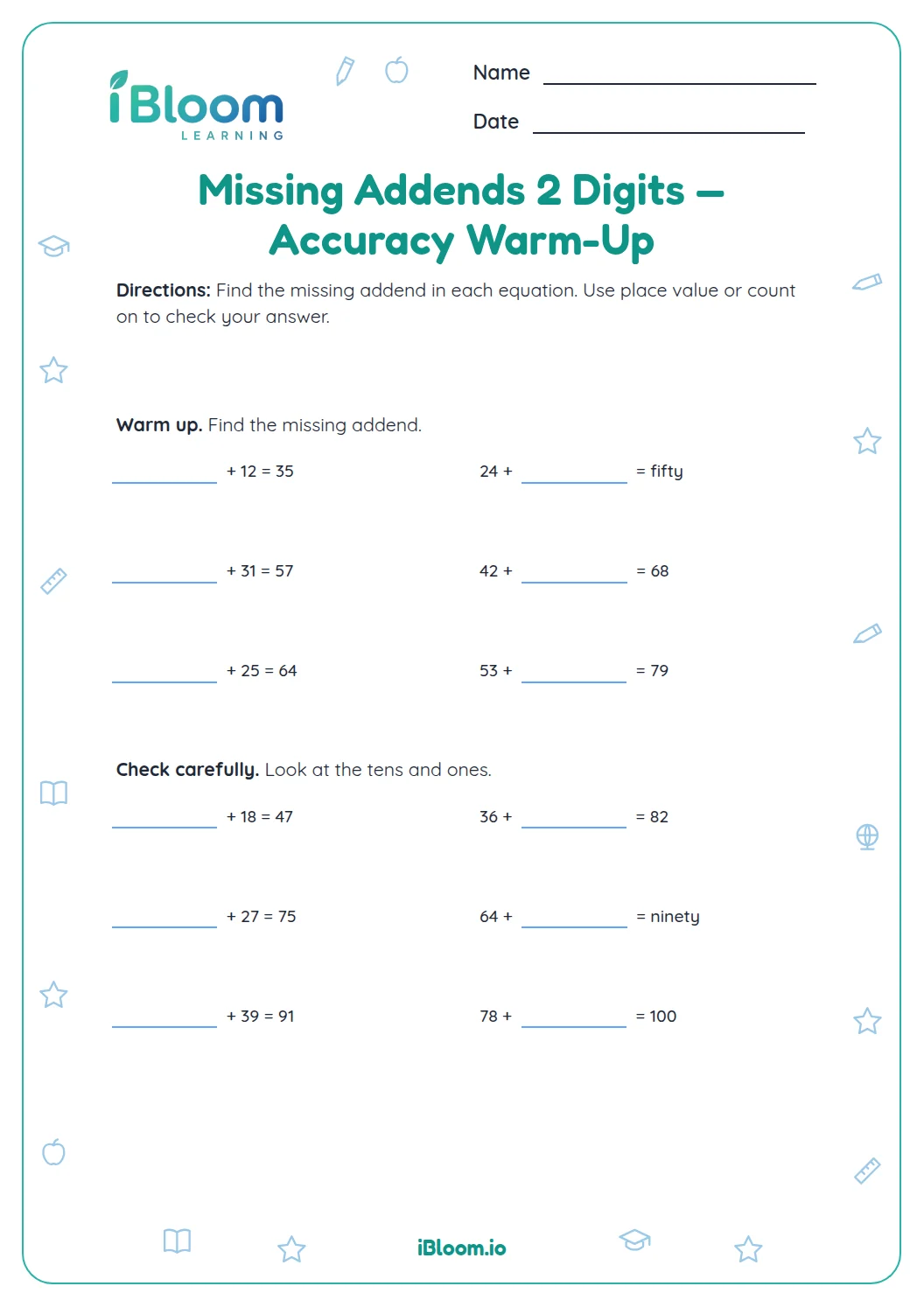
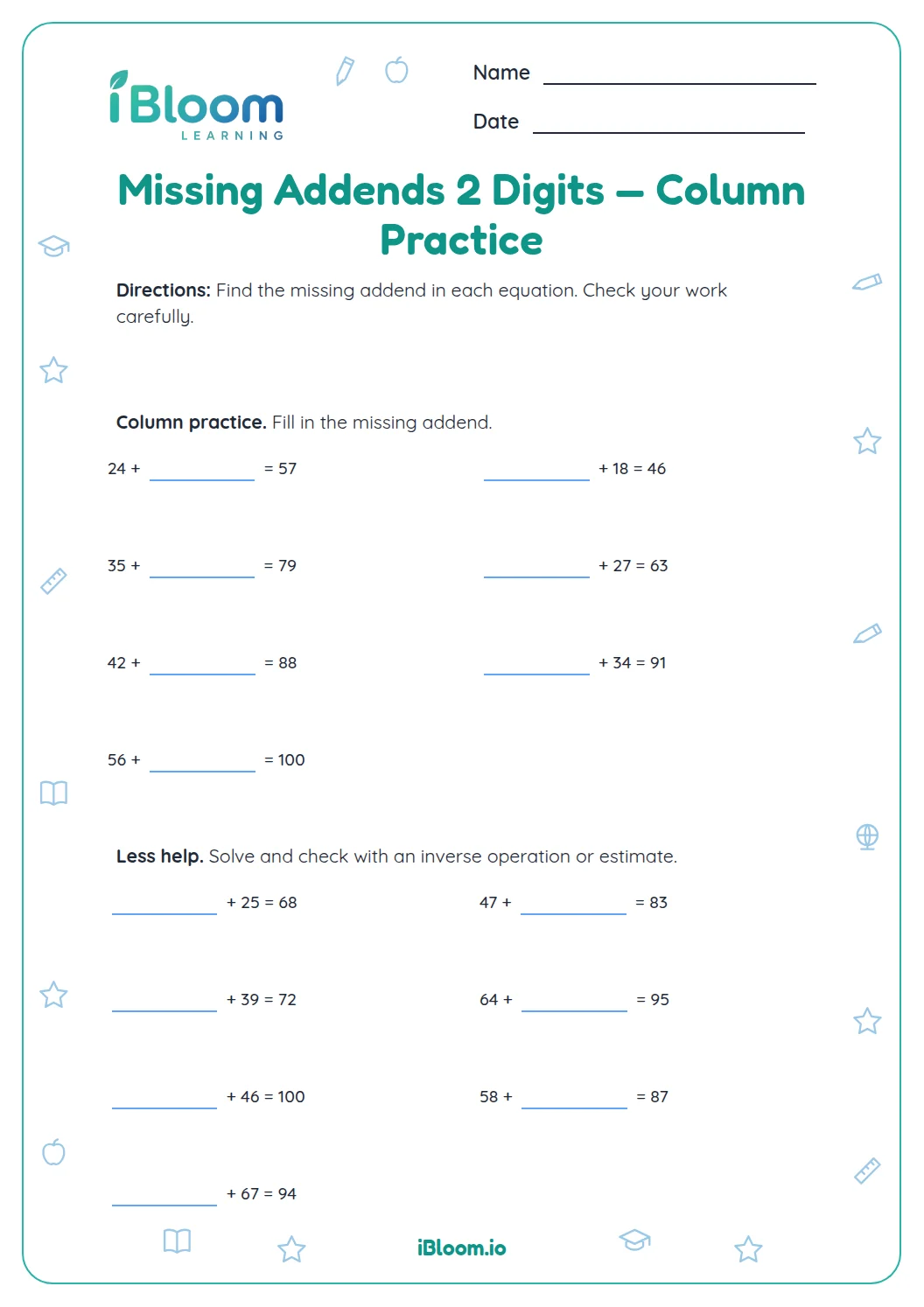
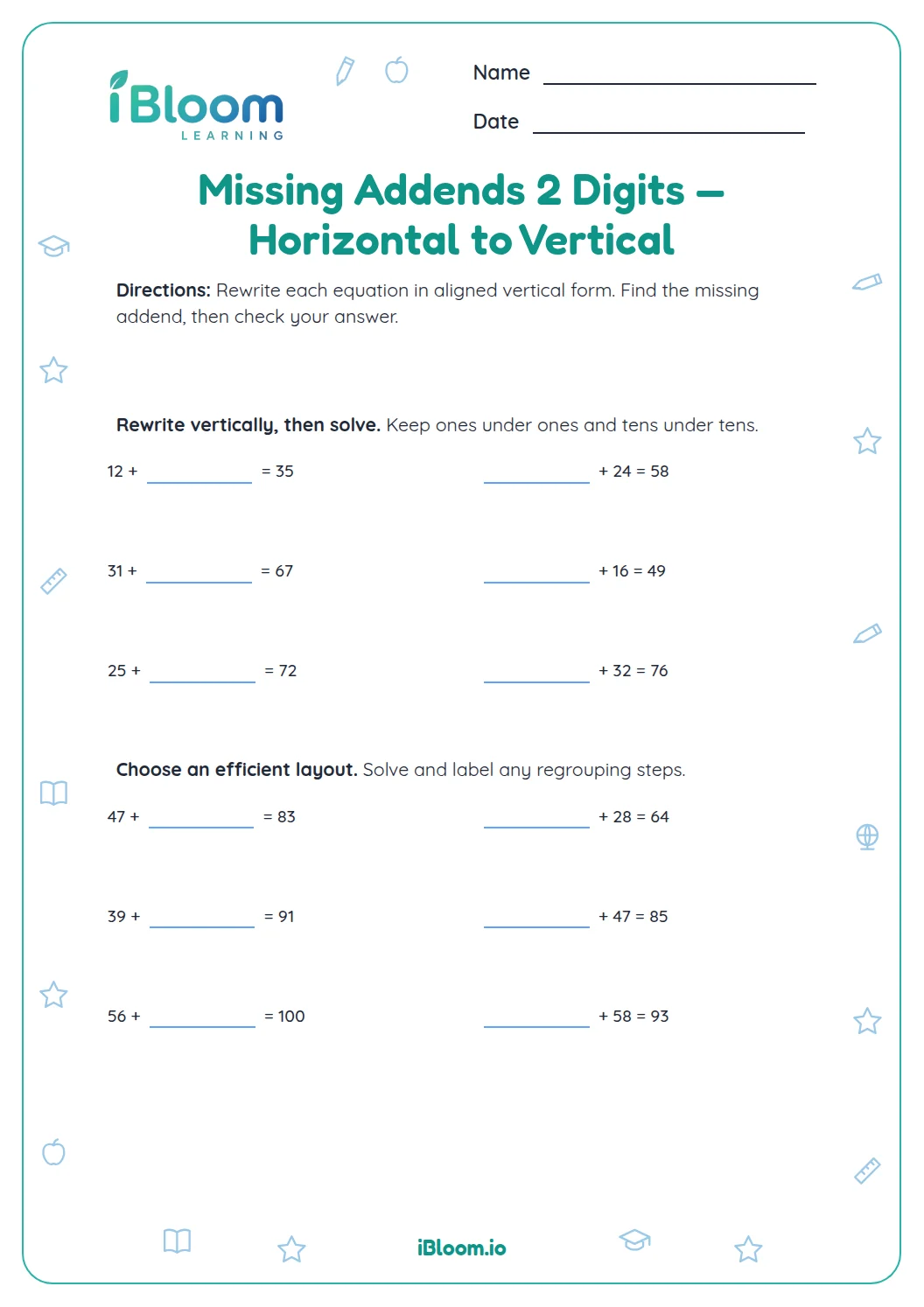
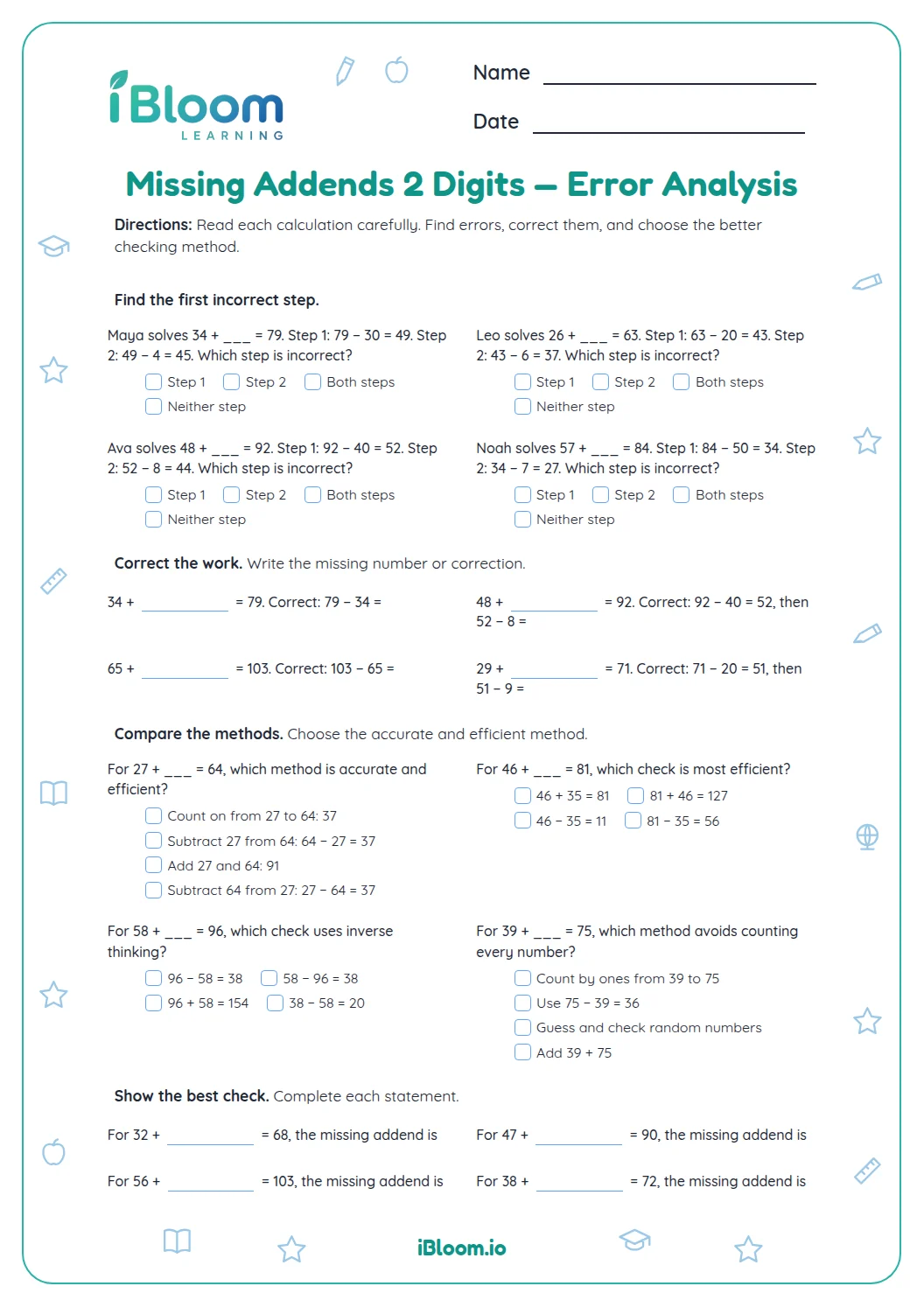
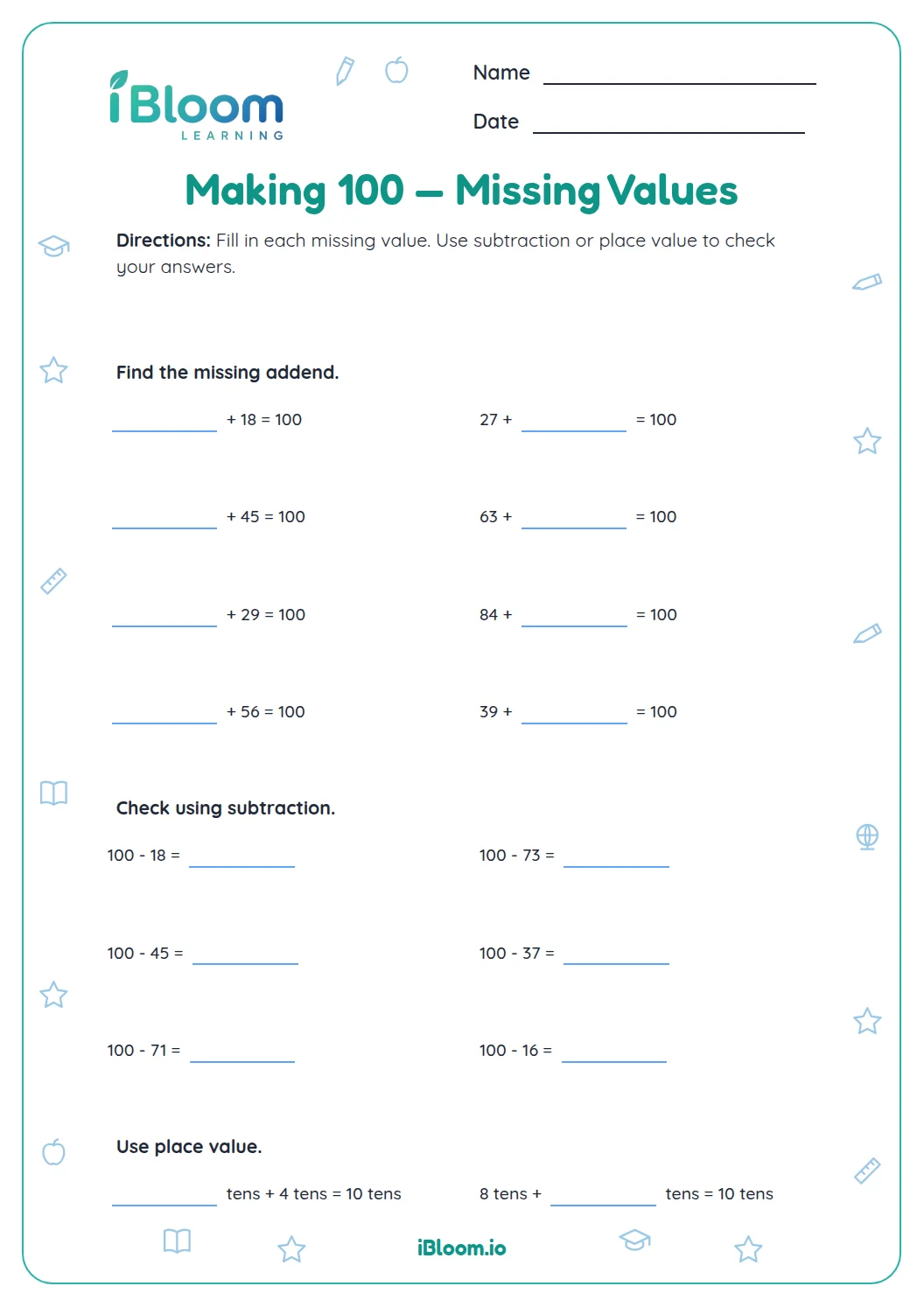
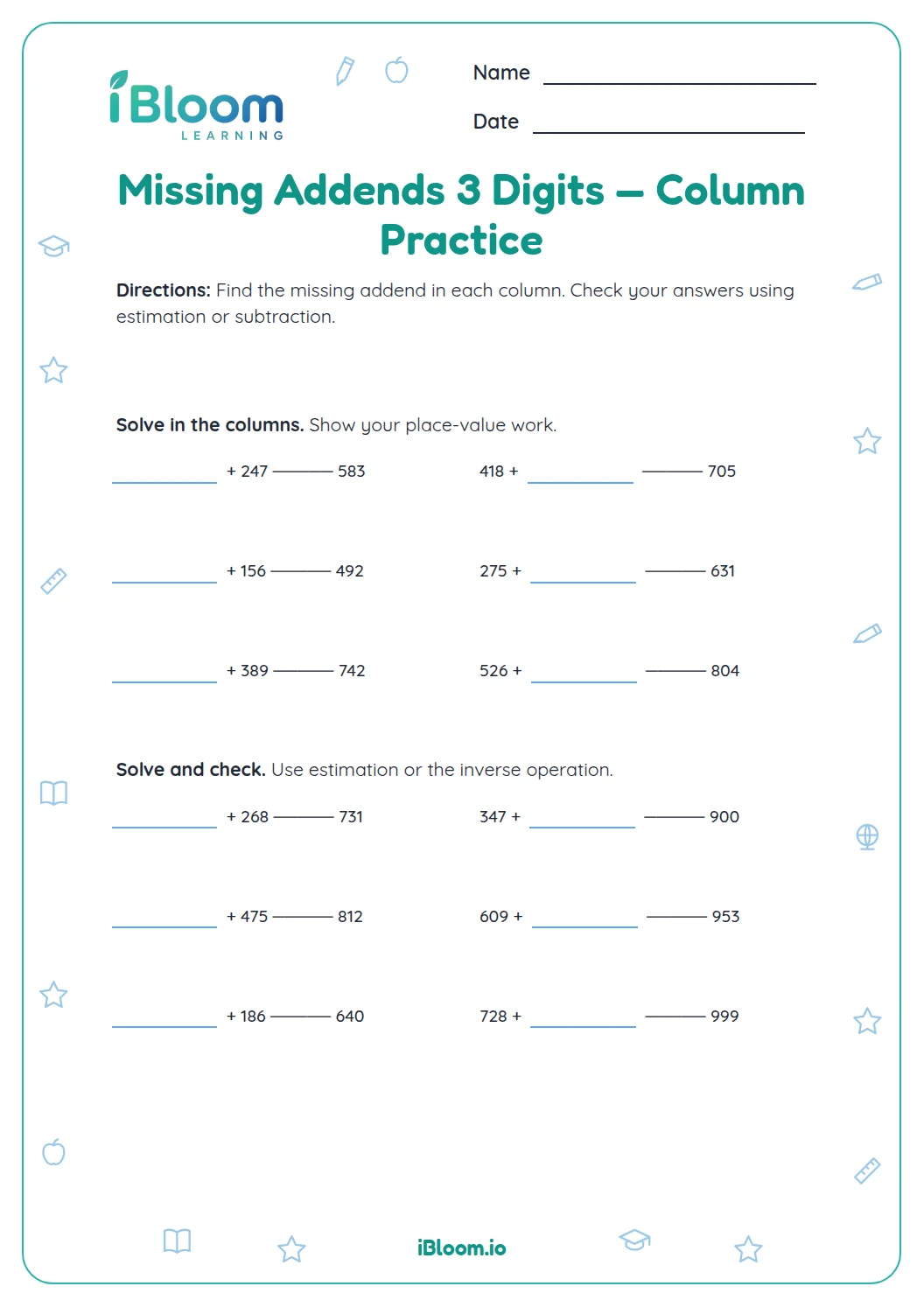
This free printable worksheet gives Grade 2 and Grade 3 learners 16 addition equations with a missing two-digit addend. Part A starts with six equations whose additions need no regrouping. Part B has six that cross a ten. Part C puts the total on the left in four equations, keeping attention on the meaning of the equal sign. Every total is within 100. The practice supports Common Core 2.NBT.B.5 through place value and the relationship between addition and subtraction. A separate answer key shows all 16 missing values.
Aligned to 2.NBT.B.5
Which number is the total?
The total is the value of both addends together. In Parts A and B it appears after the equal sign. In Part C it appears before the equal sign. Its role stays the same, so children should identify the total before deciding what to subtract.
Question 13 reads 63 = 34 + ___. The two addends must make 63, so subtract 34 from 63 to find 29.
How can counting up help when regrouping is needed?
Count from the known addend to a nearby ten, continue by tens, then finish with ones. Add those jumps to find the missing amount. This gives a second route for checking a written subtraction.
- 128 to 30 is 2.
- 230 to 60 is 30.
- 360 to 63 is 3.
- 42 + 30 + 3 = 35.
- 5Check: 28 + 35 = 63.
How do the three parts build the skill?
Part A lets children practice finding the missing part with straightforward tens and ones. Part B requires a change of ten in every addition. Part C combines that arithmetic with equations written total-first.
A useful check is to cover the key and replace each blank with the proposed answer. Read both sides of the equation aloud. They should name the same amount.
How to work through the sheet
- 1Identify the total and the known addend in question 1.
- 2Find the missing part by subtraction or counting up.
- 3Complete Part A and check each answer by addition.
- 4For Part B, write counting-up jumps or regroup carefully in subtraction.
- 5In Part C, name the total before solving; then read the completed equation in both directions.
Mistakes to look for and how to fix them
The mistake
Adding the two visible numbers in 23 + ___ = 37.
The fix
37 is already the total. Find the gap from 23 to 37: 14.
The mistake
Subtracting the smaller digit from the larger digit in each column.
The fix
For 63 − 28, regroup 63 as 5 tens and 13 ones before subtracting.
The mistake
Treating 63 = 34 + ___ as a different operation.
The fix
Read it as “63 is the same as 34 plus something.” The missing part is still 63 − 34.
Common Core alignment
Find missing two-digit addends using subtraction or counting up within 100.
On this sheet: Every equation asks for an unknown addend within 100 and can be checked by addition.
Show the official wordingHide the official wording
Fluently add and subtract within 100 using strategies based on place value, properties of operations, and/or the relationship between addition and subtraction.
What to practice next
Make more practice
Further reading
Questions parents and teachers ask
Are all the missing values two-digit numbers?
Yes, all 16 missing addends have two digits, and every total is within 100. The known addends also have two digits. This keeps the focus on tens and ones while children decide whether to subtract, count up, or use a familiar addition fact to solve.
Does the worksheet include regrouping?
Yes, Parts B and C include additions that cross a ten. For example, question 7 is 28 + ___ = 63, so the missing addend is 35. Children can regroup in subtraction or count up by 2, then 30, then 3 to find that value.
Why is the total on the left in Part C?
The total appears on the left to practice reading the equal sign as “is the same as.” In 63 = 34 + ___, the addends still need to make 63. Children find 29, then check that the right side and left side have equal values.
Should my child use subtraction for every question?
Subtraction is a reliable method, but counting up is also useful. Let your child choose a strategy they can explain. For 28 + ___ = 63, counting through 30 and 60 makes the missing amount visible. Use addition afterward to verify either method’s answer.
How can I use the answer key for corrections?
Use the key after your child has filled the blanks and checked by addition. If an answer differs, ask them to put their number into the equation and calculate both sides. Then revisit the subtraction or counting-up steps to find exactly where the amount changed.