

About this worksheet
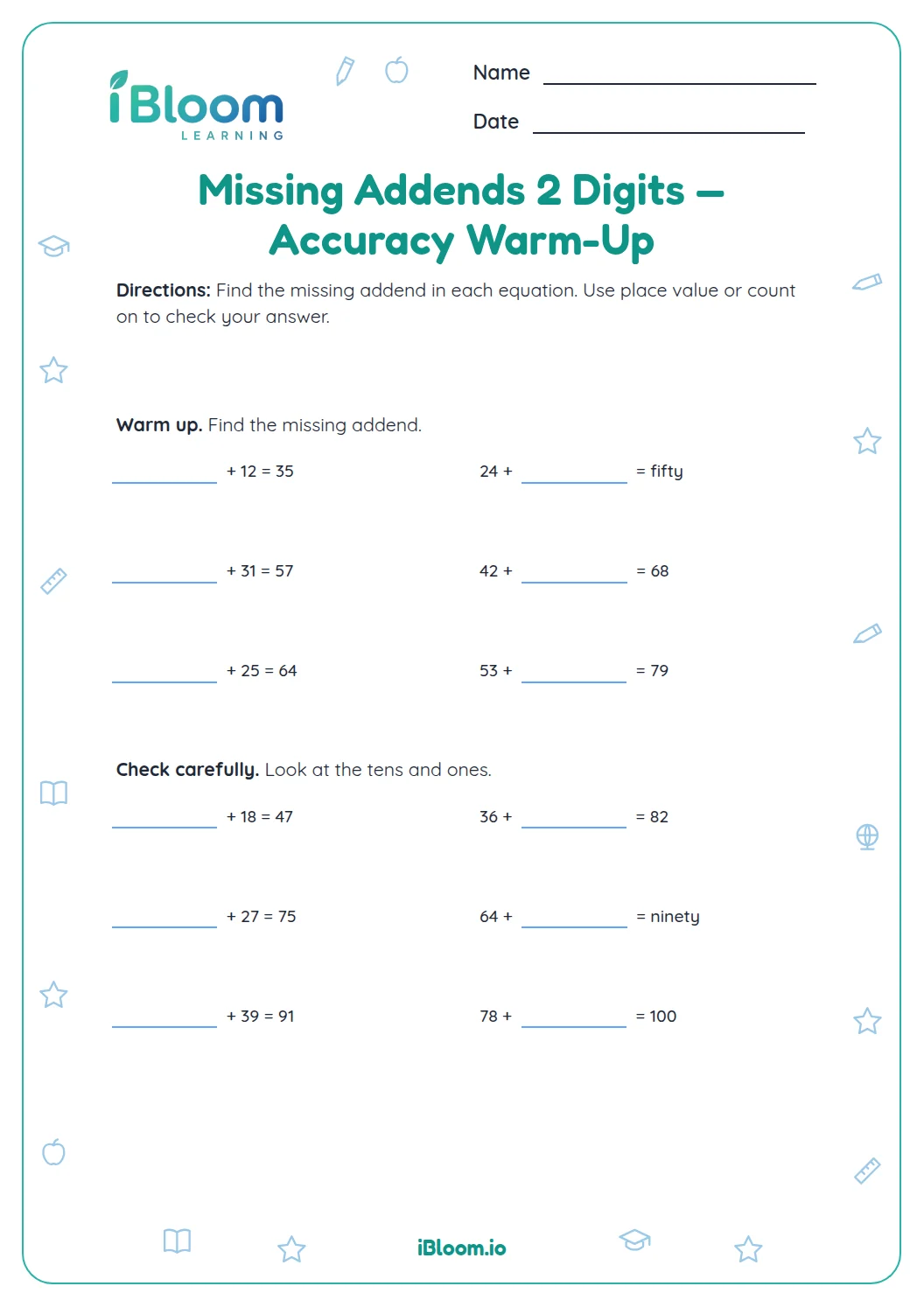
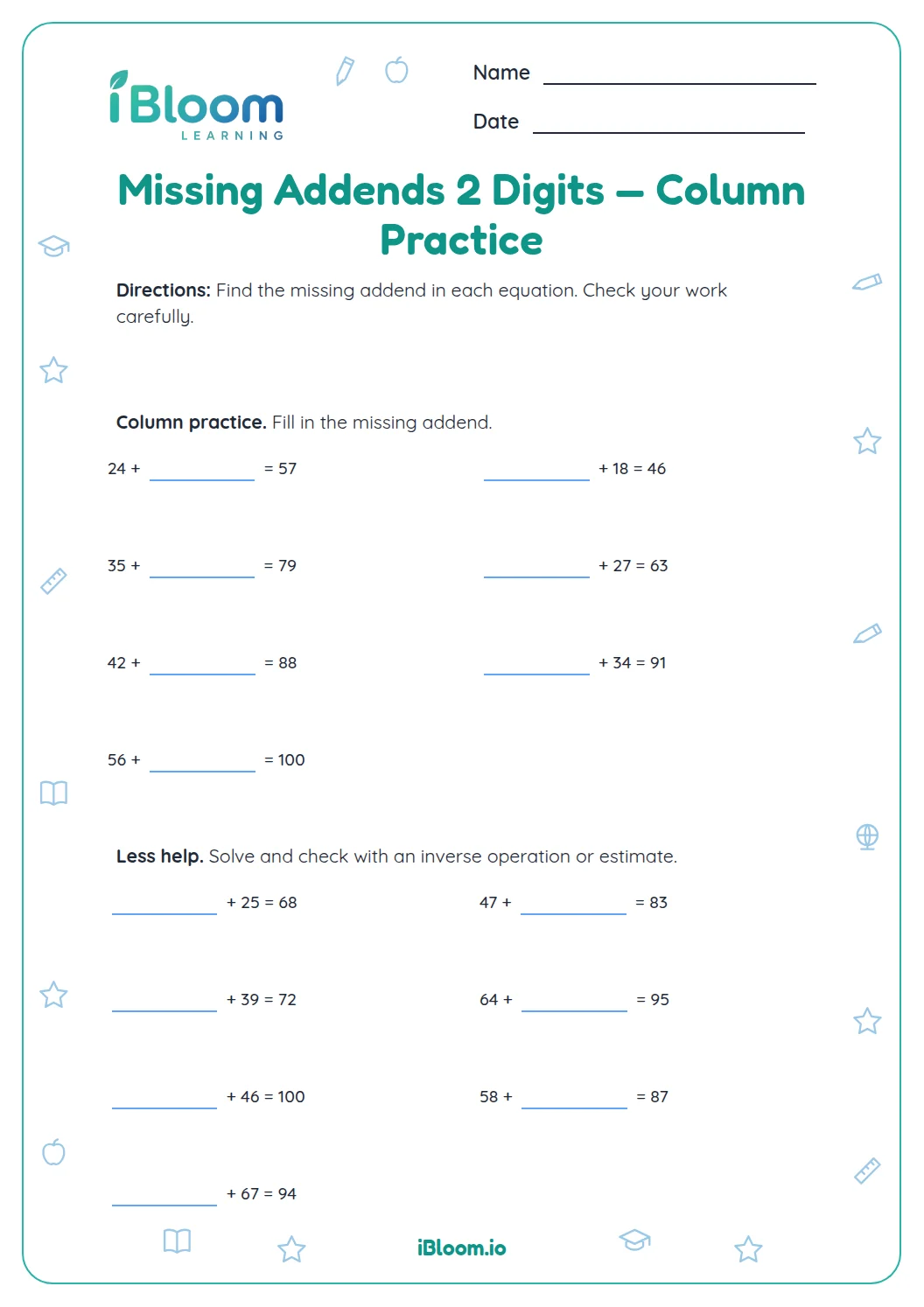
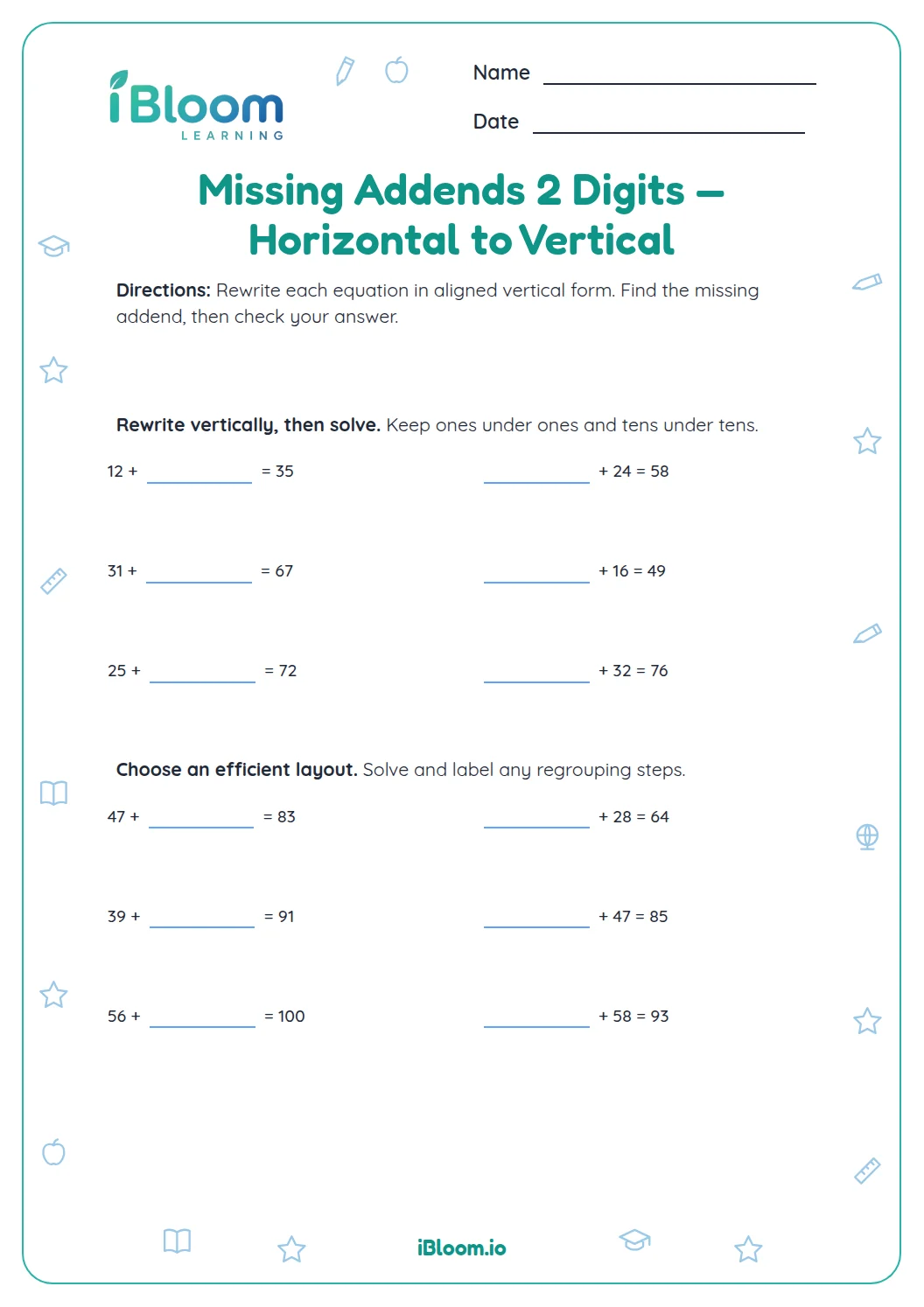
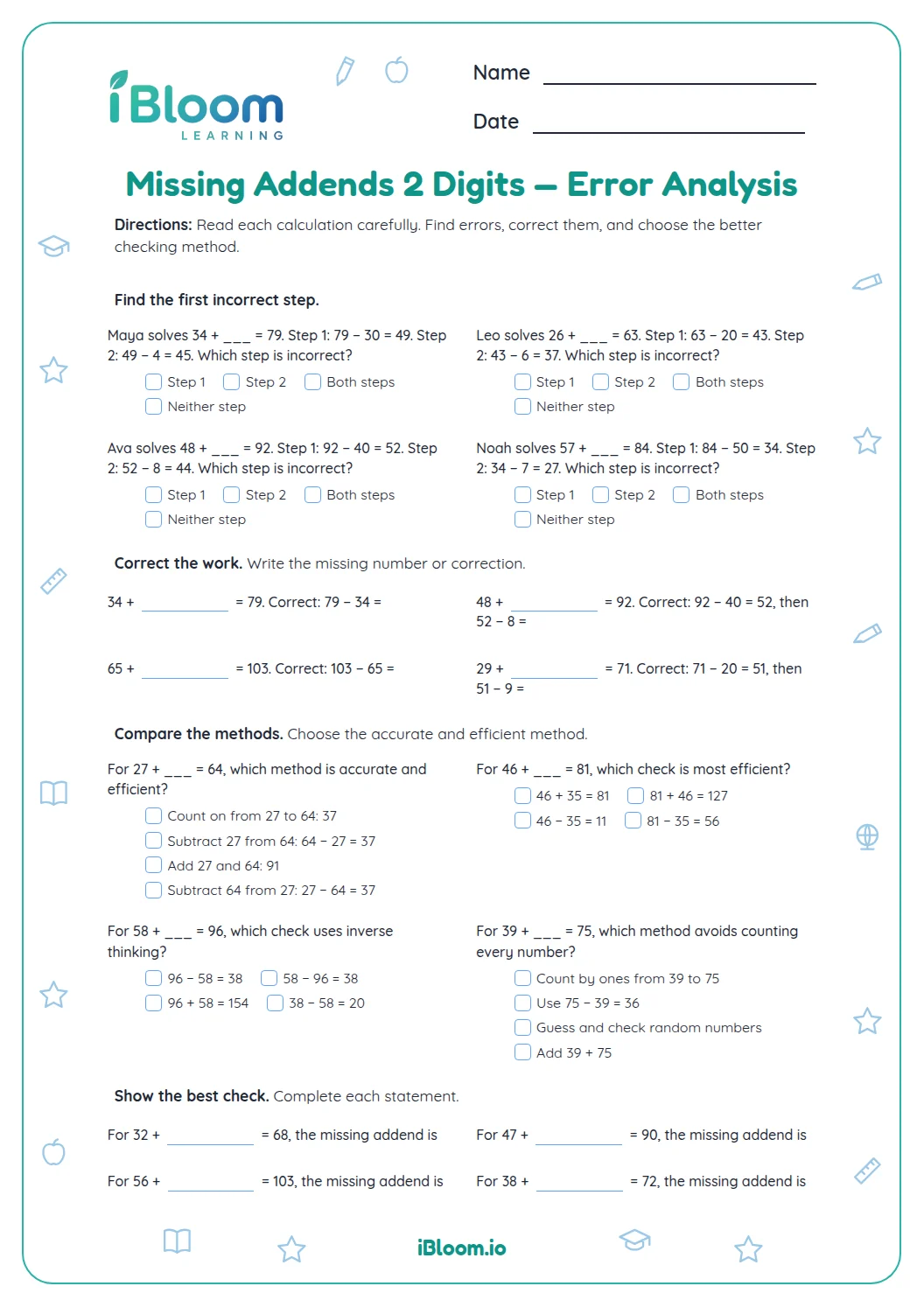
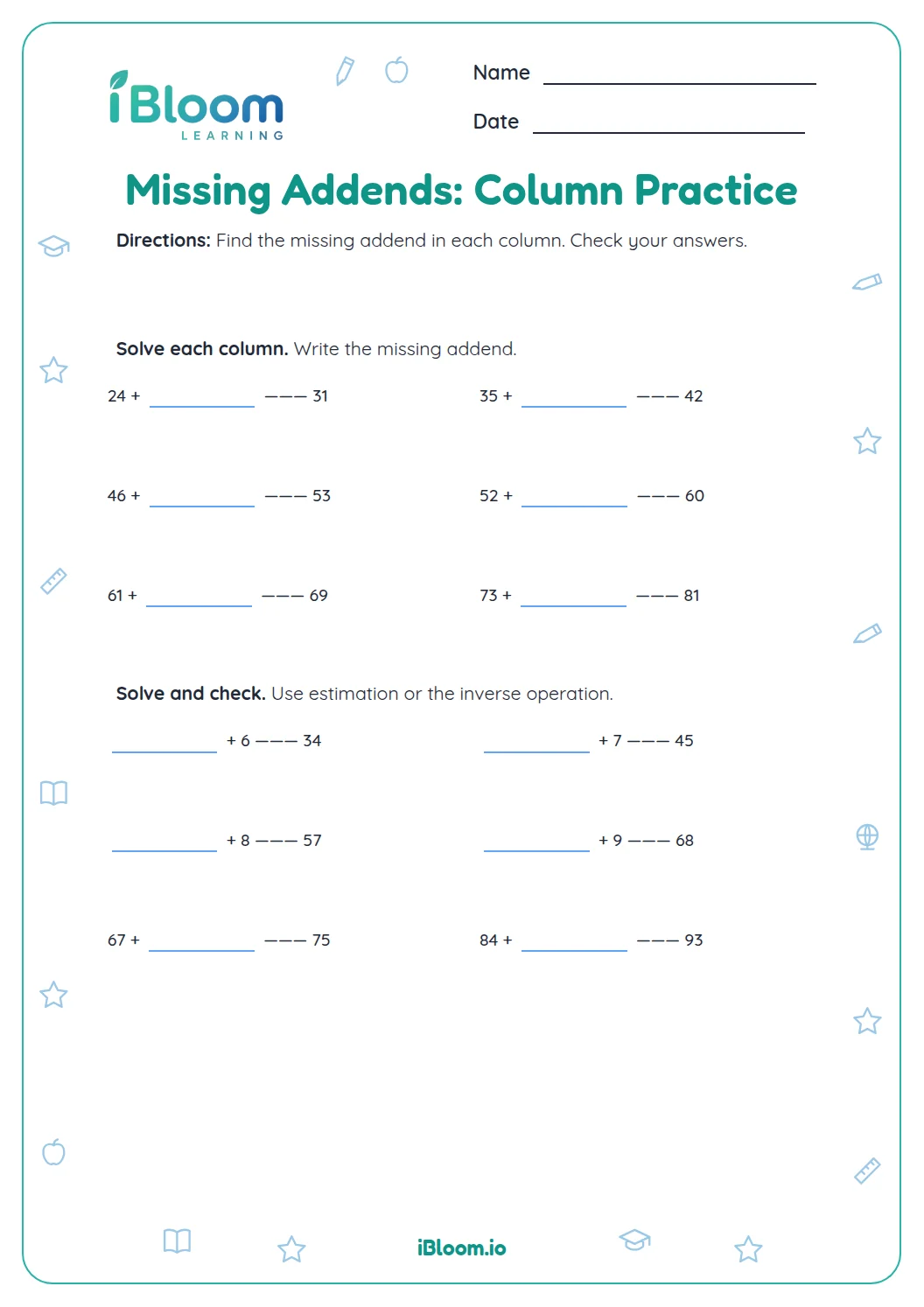
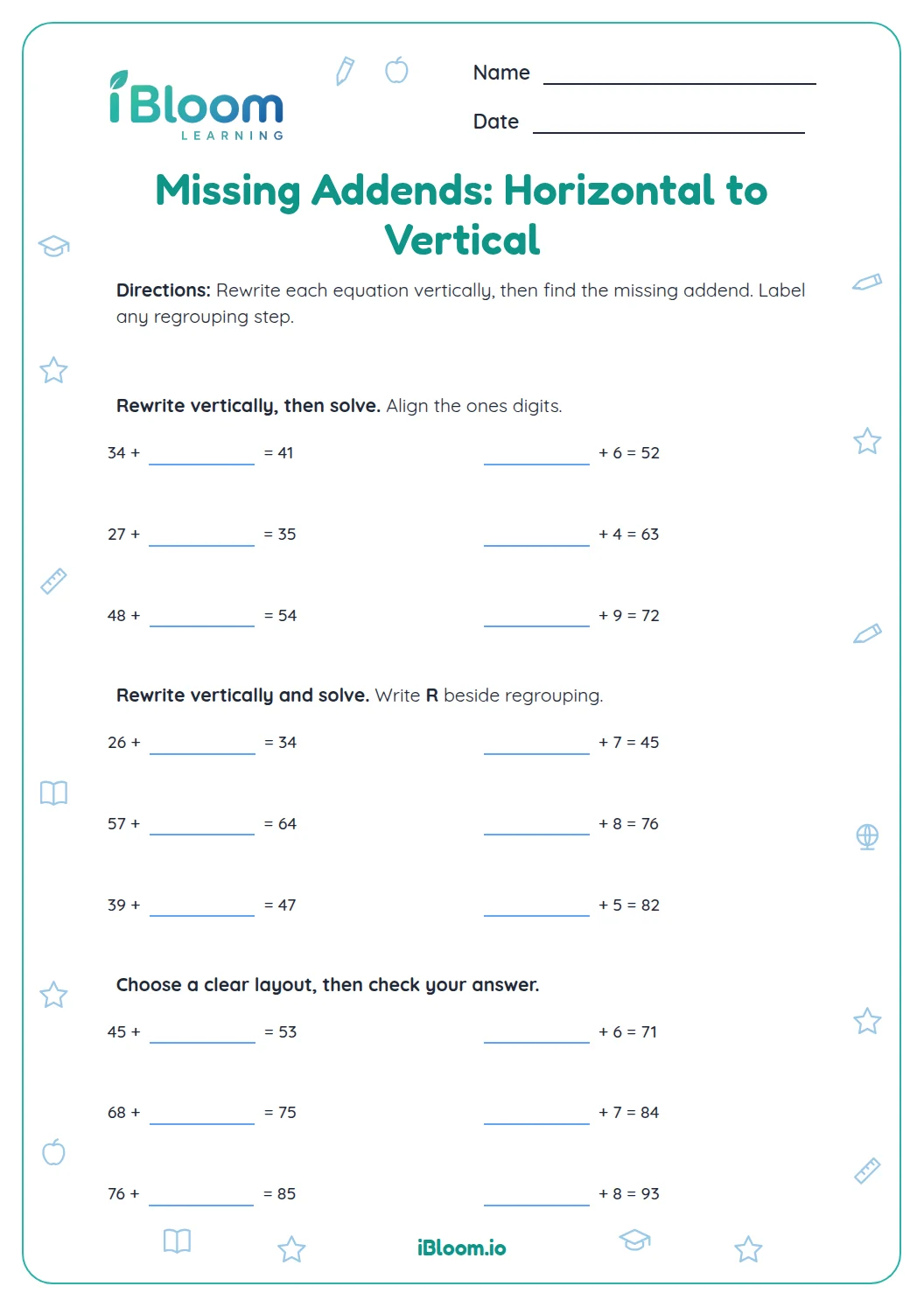
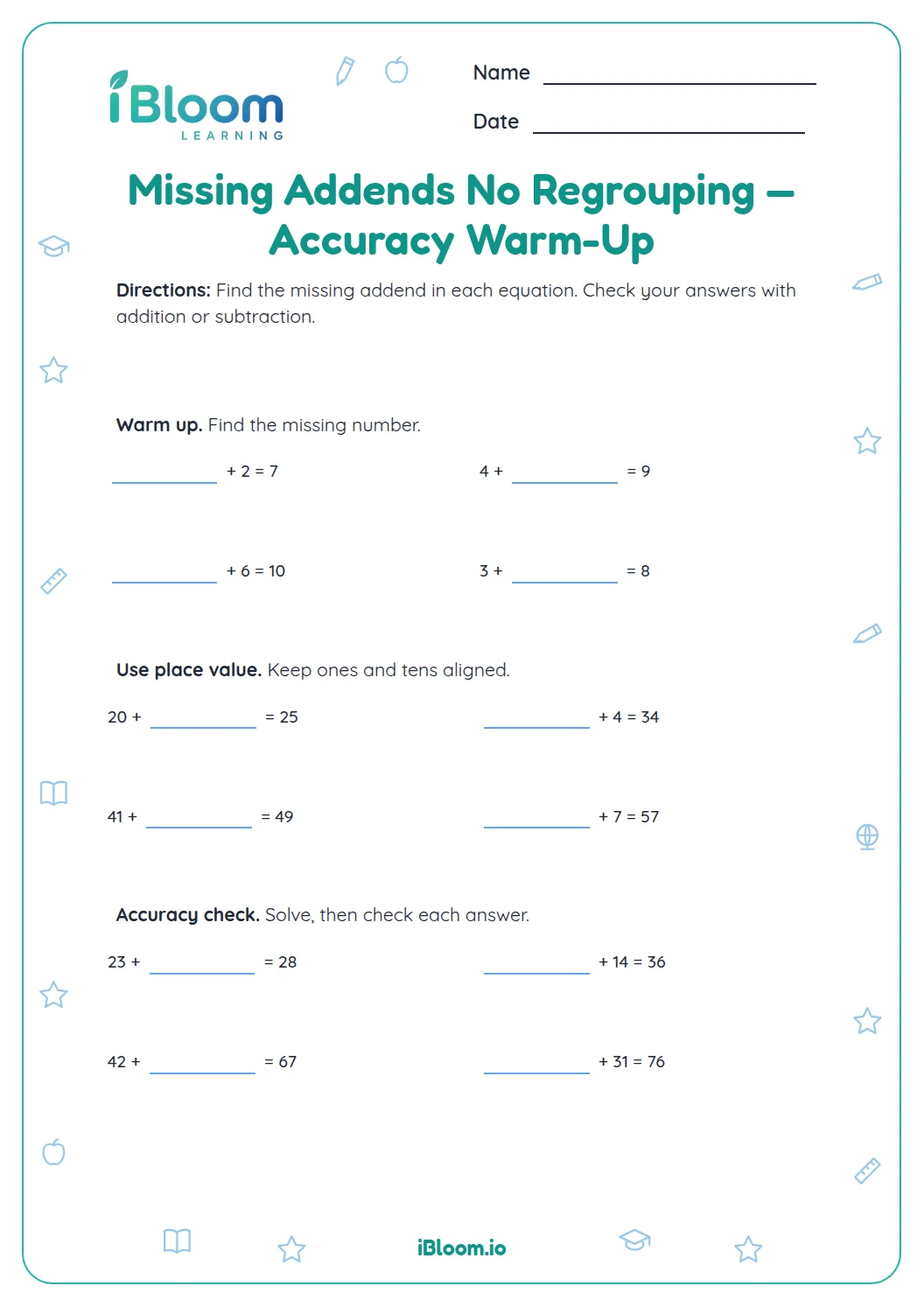
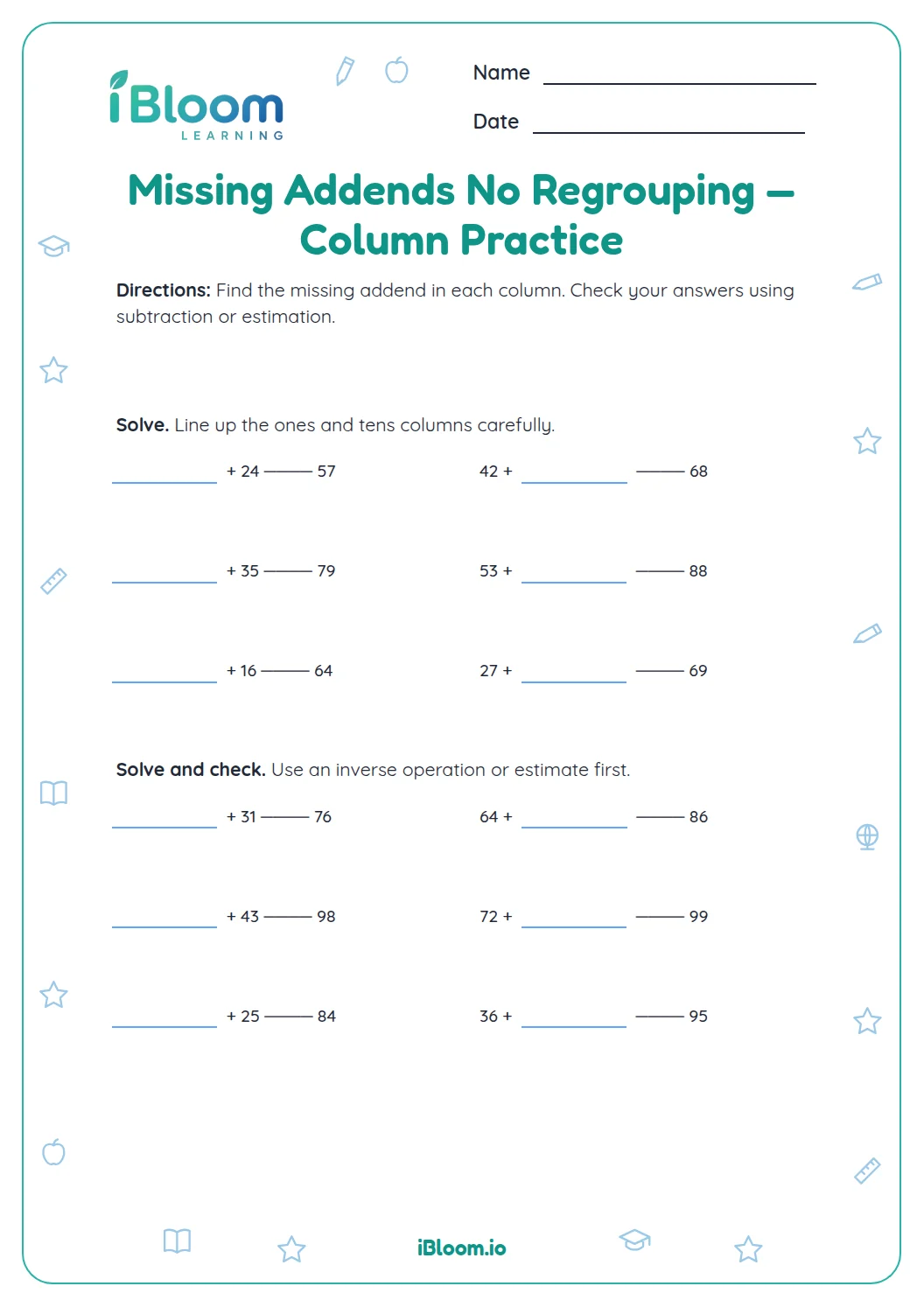
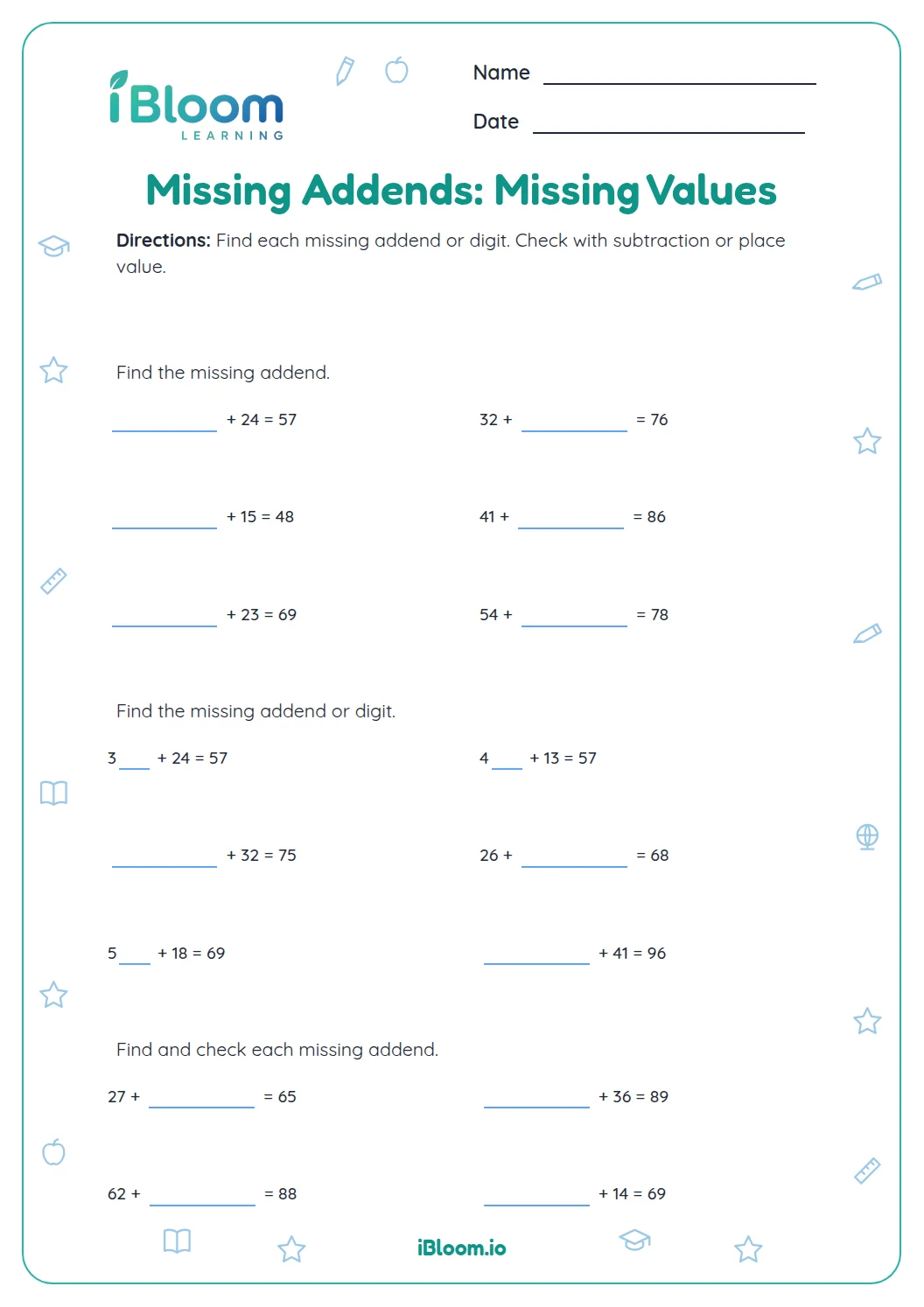
This printable two-digit missing addends worksheet gives Grade 2 and Grade 3 students 20 addition equations to solve. Some equations put the blank first and others put it second, so students use the total and known addend rather than follow one layout. The three parts move from finding a missing part to using subtraction and checking with addition. Every sum stays within 100.
Aligned to 2.NBT.B.5
What does this missing-addend worksheet practice?
Each of the 20 problems is an addition equation with one addend hidden. Students use the total and the known addend to recover the missing part. The blanks move from the second addend to the first, and several sums require regrouping across a ten.
How can subtraction reveal the missing addend?
For 24 + ___ = 61, subtract 24 from 61. Taking away 20 leaves 41, then taking away 4 leaves 37, so the missing addend is 37. Adding 24 + 37 gives 61, which checks the answer.
- 124 + ___ = 61
- 261 − 24 = 37, so the missing addend is 37.
How do students check an answer?
Put the missing number back into the original addition sentence. If the two addends make the printed total, the equation is balanced. This quick check also catches answers found by subtracting the total from the known addend in the wrong order.
How to use this worksheet
- 1{'step': 'Find the total and the addend you know.', 'detail': 'The blank may come before or after the plus sign.'}
- 2{'step': 'Subtract the known addend from the total.', 'detail': 'Keep the larger total first.'}
- 3{'step': 'Use tens and ones.', 'detail': 'Regroup a ten when the ones require it.'}
- 4{'step': 'Write the missing number.', 'detail': 'Place it in the blank.'}
- 5{'step': 'Add to check.', 'detail': 'The two addends should equal the total.'}
Common mistakes and quick fixes
The mistake
Subtracting the total from the known addend.
The fix
Start with the total, then subtract the known addend.
The mistake
Forgetting to regroup when subtracting ones.
The fix
Trade one ten for ten ones and recompute.
The mistake
Assuming the blank is always the second addend.
The fix
Read the equation first; either addend can be missing.
Students use place-value strategies and the relationship between addition and subtraction.
Students use addition and subtraction relationships to find addends within 100.
On this sheet:
Show the official wordingHide the official wording
Fluently add and subtract within 100 using strategies based on place value, properties of operations, and/or the relationship between addition and subtraction.
What to practice next
Make more practice
Questions parents and teachers ask
What is a missing addend?
An addend is a number being added. In 24 + ___ = 61, the missing addend is the number that combines with 24 to make 61. Students can find it by subtracting 24 from 61, then check by adding the two parts.
Does this worksheet include regrouping?
Yes. Several of the 20 equations require trading a ten when subtracting the known addend from the total. Students also see blanks in either addend position, and the answer key lists each missing number so they can check the related addition sentence.
How many problems are on the drill?
There are 20 problems in three parts: six equations in Part A, five in Part B, and nine in Part C. The answer key gives each missing addend. Students can check each result by adding the two addends to see whether they make the printed total.
Should my child add or subtract to find the blank?
Either strategy can work, but subtraction is direct: subtract the addend you know from the total. A child may also count up from the known addend to the total, especially when the difference is small. Adding the answer back is a useful check.
What should students do after this practice?
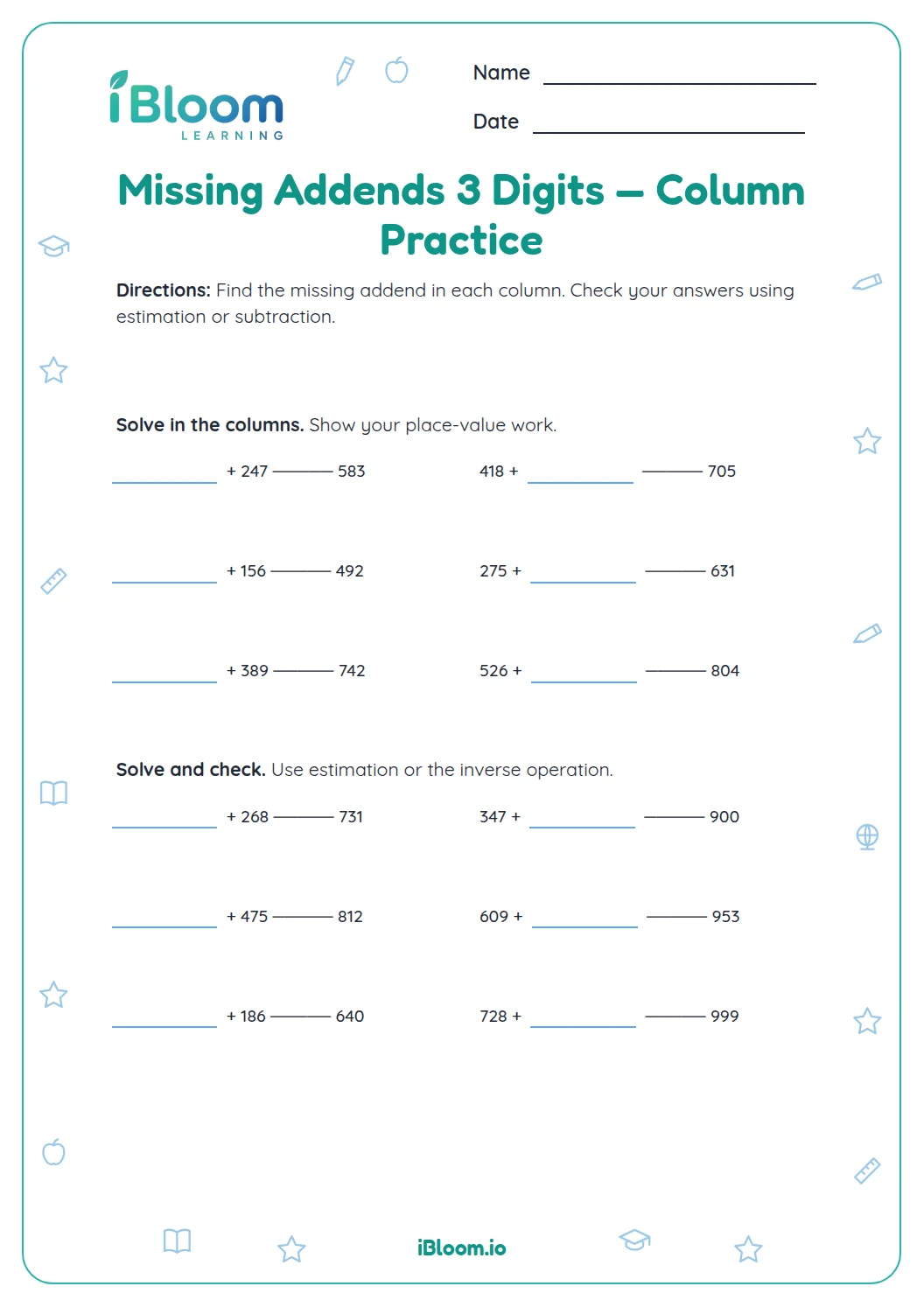
A next step is missing addends with three-digit numbers. Students can also review two-digit addition or try the no-regrouping version to focus on place value accuracy. The answer key makes it easy to spot whether regrouping or the subtraction step needs another look.