

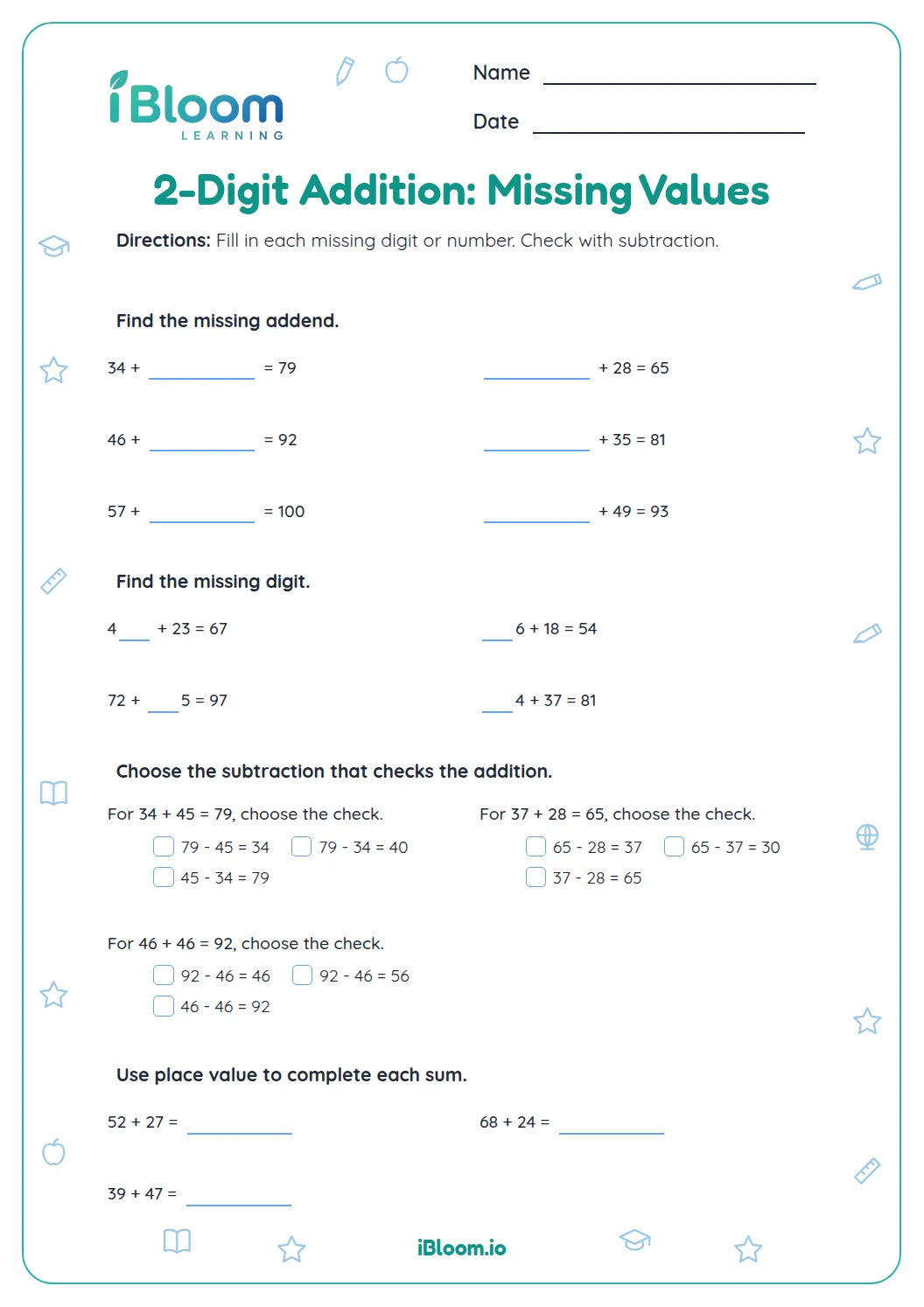
About this worksheet
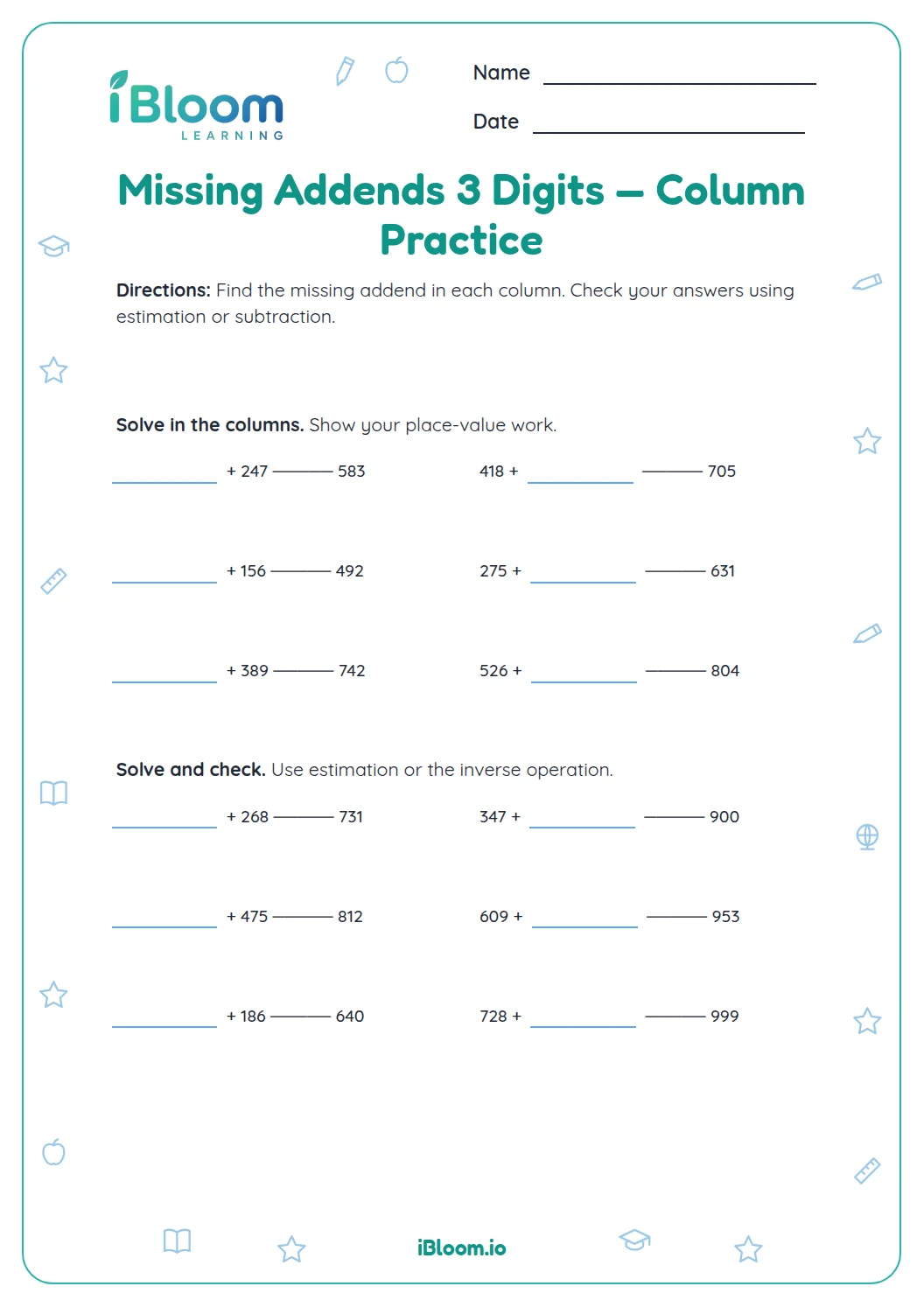
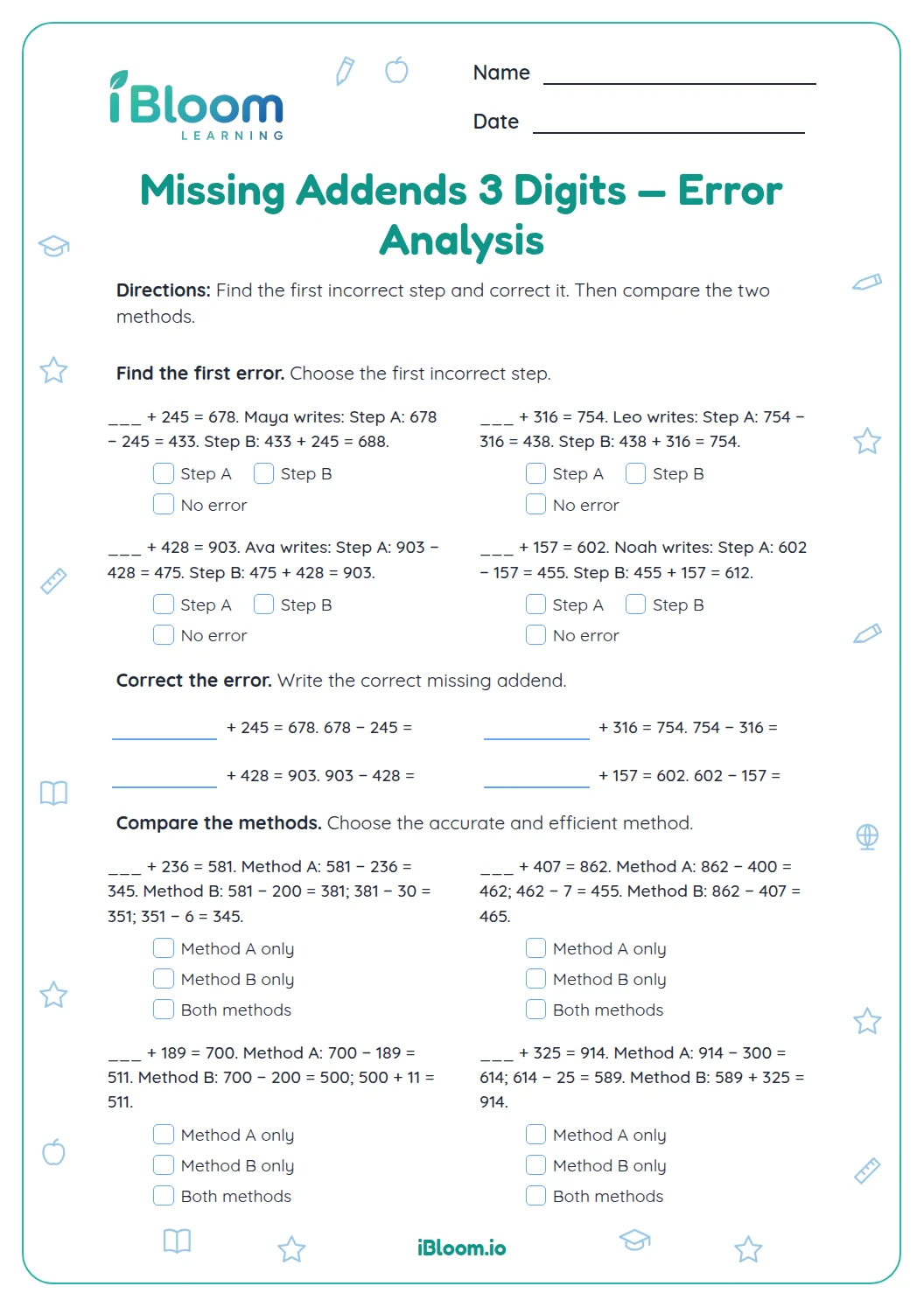
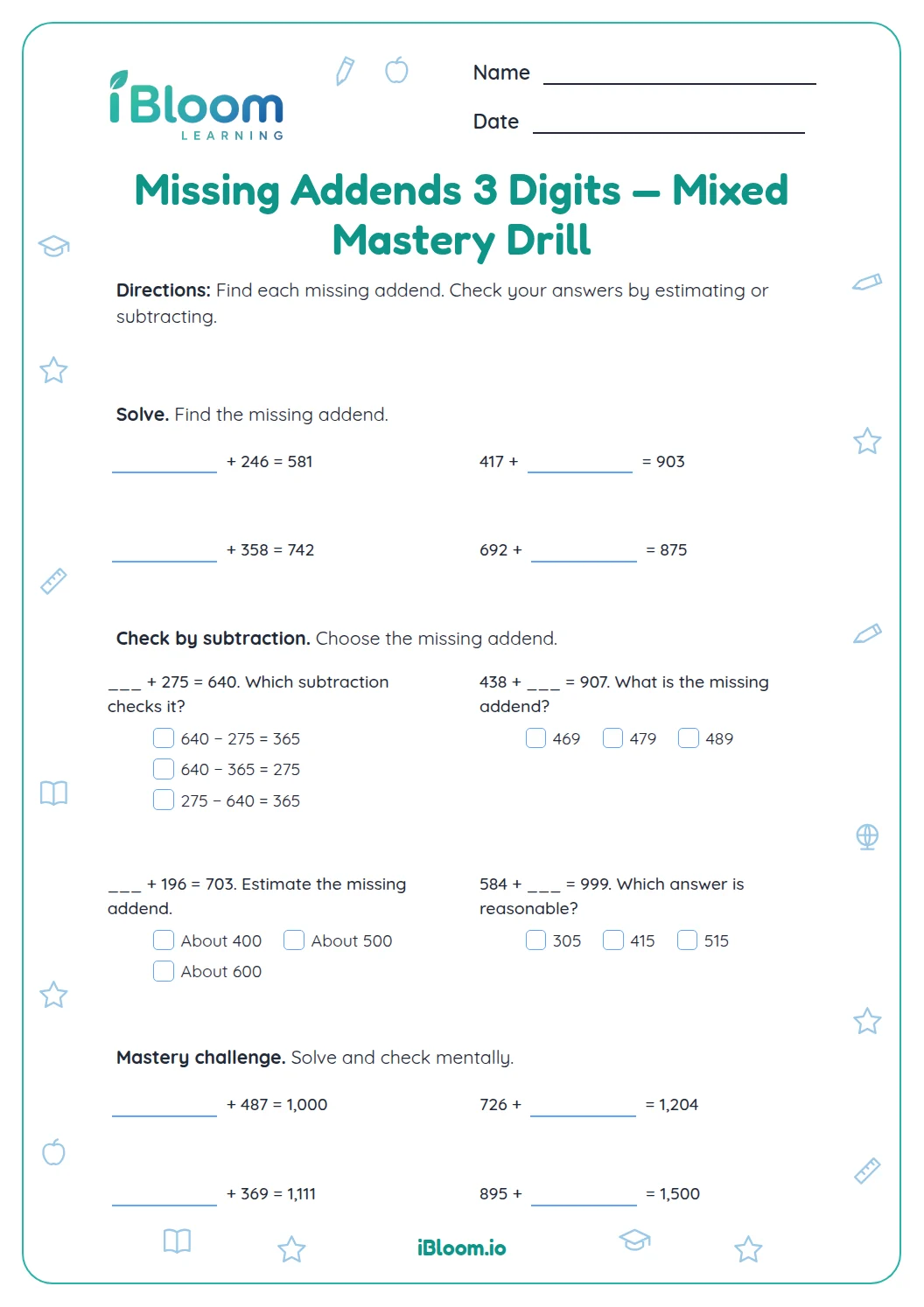
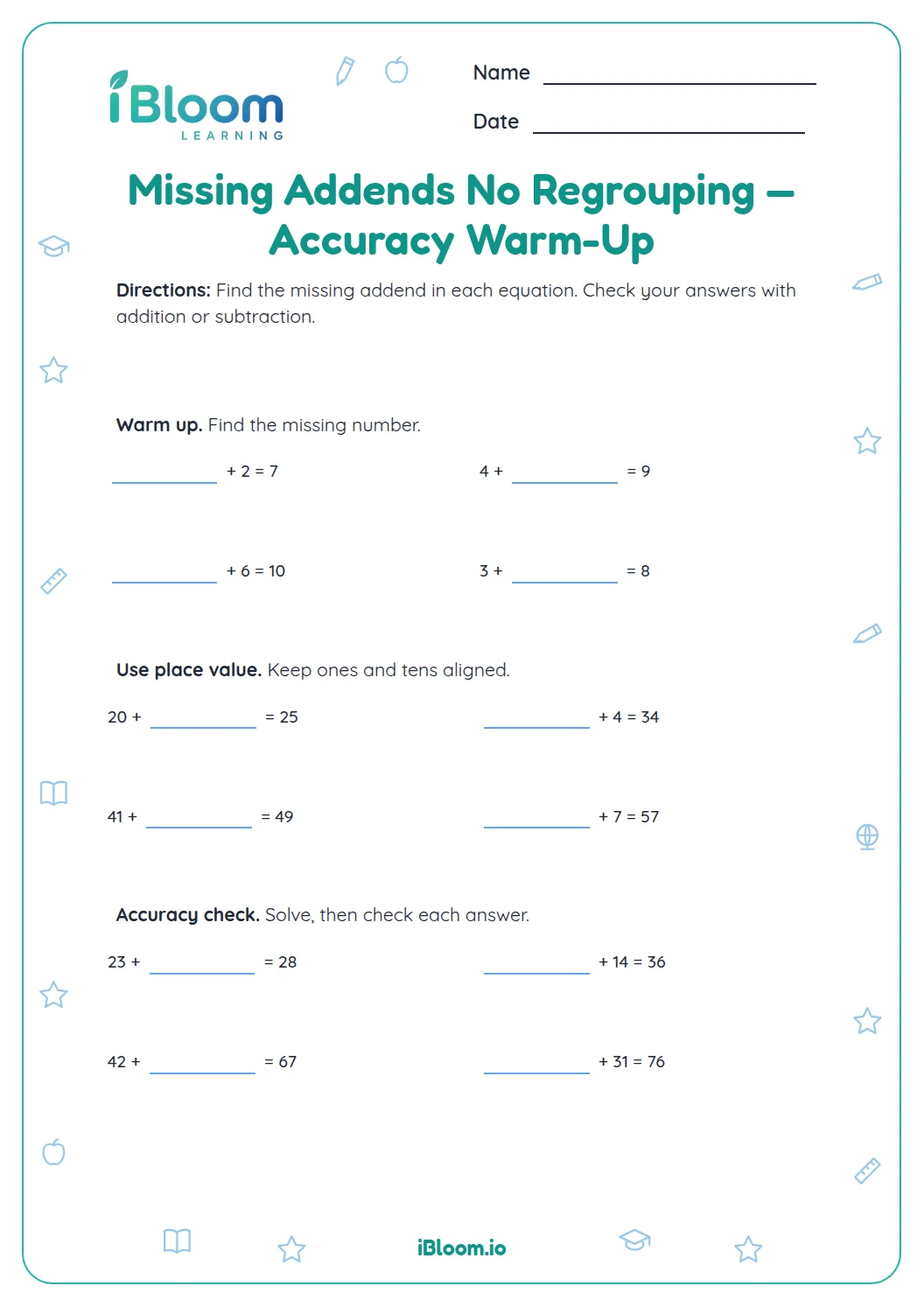
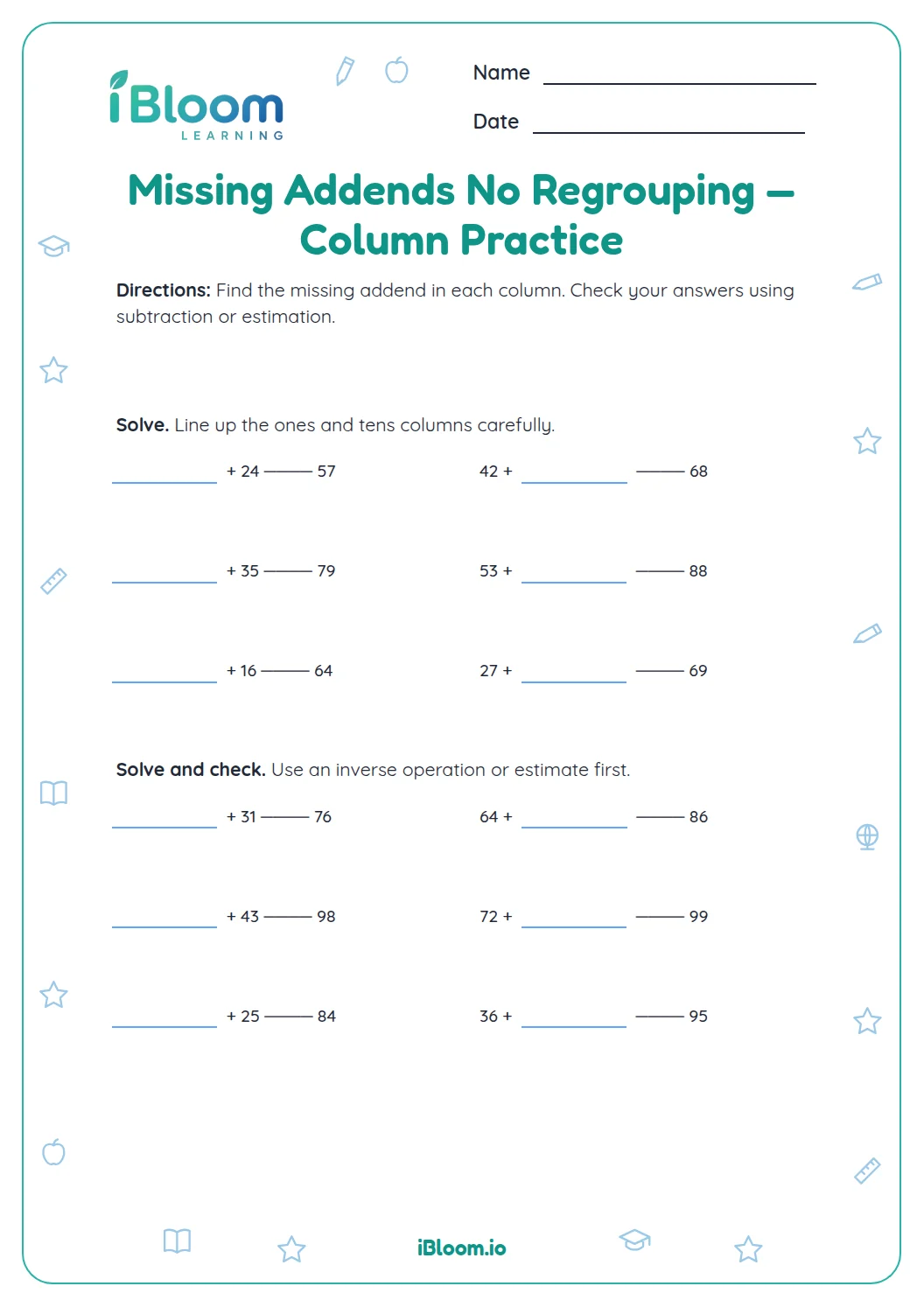
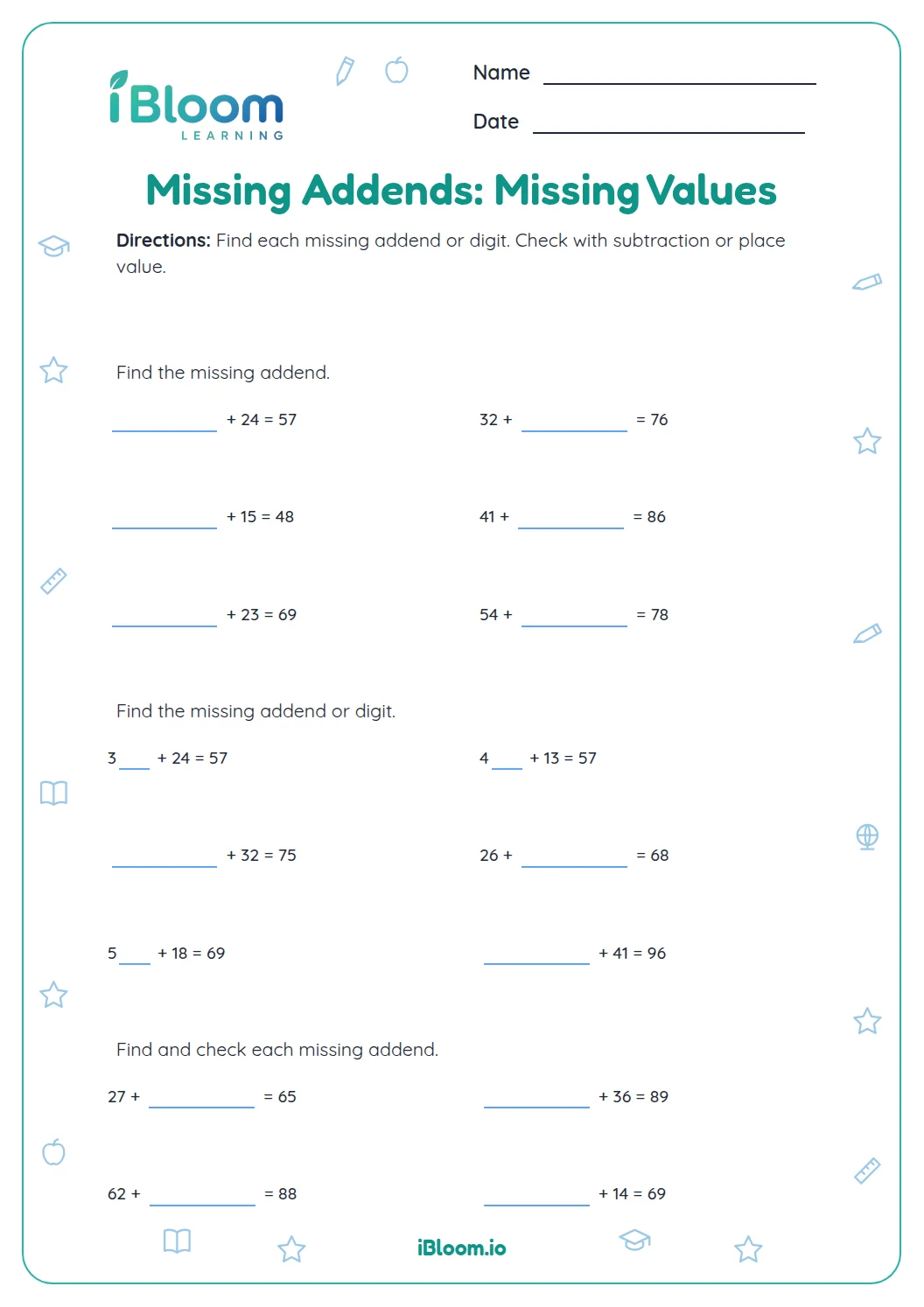
This Grade 3 printable gives learners 20 three-digit addition equations with a blank in different places. Find a missing first or second addend by subtracting from the total; add when the sum is missing. The problems use numbers within 1,000 and invite a check with the inverse operation. It aligns with CCSS 3.NBT.A.2, and a separate two-page answer key lists each result.
Aligned to 3.NBT.A.2
What does each part practice?
Part A mixes missing addends and sums. Part B emphasizes missing first addends, and Part C returns to all three blank positions.
- Part A: six equations with mixed blank positions
- Part B: five equations with a missing first addend or sum
- Part C: nine equations mixing first addends, second addends, and sums
How can you find a missing addend?
Use the total and the addend you know. Subtract the known addend from the total, or count up by hundreds, tens, and ones. Then add your result back to check.
- 1125 + ___ = 359
- 2359 − 125 = 234
- 3Check: 125 + 234 = 359
How do you check the blank’s place?
Read the whole equation before calculating. A blank before the plus sign asks for the first addend; a blank after it asks for the second addend; a blank after the equal sign asks for the sum.
How to use this worksheet
- 1Read the equation and name what the blank represents.
- 2If an addend is missing, subtract the known addend from the total.
- 3If the sum is missing, add the two addends by place value.
- 4Write the number in the blank and check with the opposite operation.
Common mistakes and quick fixes
The mistake
Subtracting the total from the known addend
The fix
Keep the total first: total − known addend gives the missing addend.
The mistake
Adding when the blank is the sum
The fix
Add both addends; the blank after the equal sign is the total.
The mistake
Misreading which addend is missing
The fix
Cover the blank and read the remaining equation aloud before solving.
Common Core alignment
This worksheet practices three-digit addition through place-value reasoning and checking.
Add within 1,000 using place-value strategies and algorithms.
On this sheet: Each equation adds three-digit numbers within 1,000; subtraction can reveal a missing addend.
Show the official wordingHide the official wording
Fluently add and subtract within 1000 using strategies and algorithms based on place value, properties of operations, and/or the relationship between addition and subtraction.
What to practice next
Make more practice
Further reading
Questions parents and teachers ask
How do you find a missing addend?
Subtract the addend you know from the total. For 125 + ___ = 359, calculate 359 − 125 to get 234, then add 125 + 234 to check. The worksheet includes blanks before and after the plus sign, so first identify which addend is missing.
What grades can use this worksheet?
The sheet is labeled for Grades 3–4 and uses three-digit addition within 1,000. Learners find missing addends and sums, then check their work with addition or subtraction. The two-page practice set works as a focused warm-up or independent review.
Are both missing addends and sums included?
Yes. Some equations hide the first addend, some hide the second, and others hide the sum. The position of the blank tells which operation to use. Subtract a known addend from the total to find an addend; add both addends to find a sum.
How many questions and pages are included?
There are 20 equations on two worksheet pages, followed by two answer-key pages. The three parts organize mixed blank positions, missing first addends, and a final mix. The key lists a completed value for every equation, so learners can check each response.
How should a learner check an answer?
For a missing addend, add the found number to the known addend and see whether the total matches. For a missing sum, subtract one addend from the total as a check. For example, 234 + 125 returns 359.