


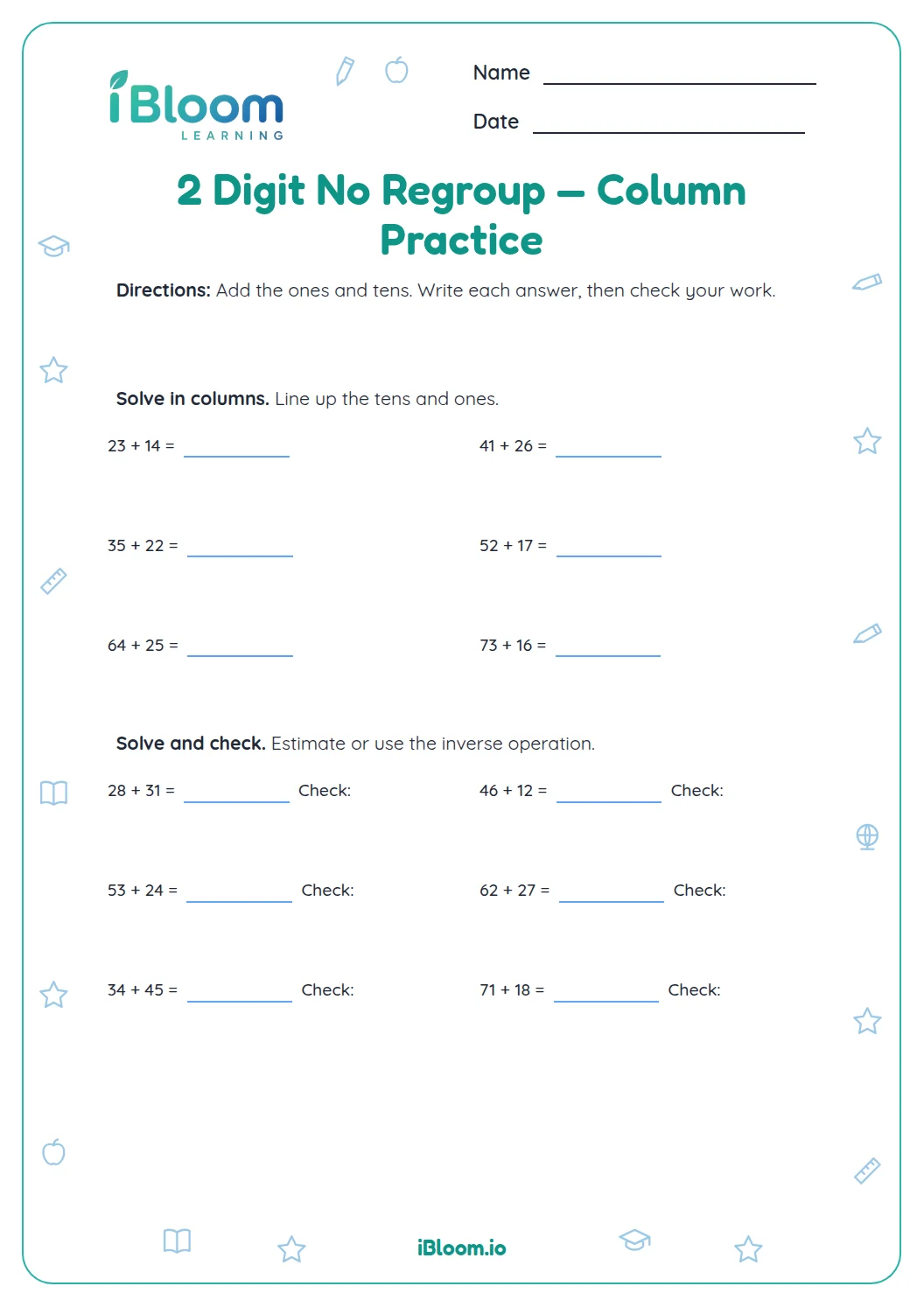
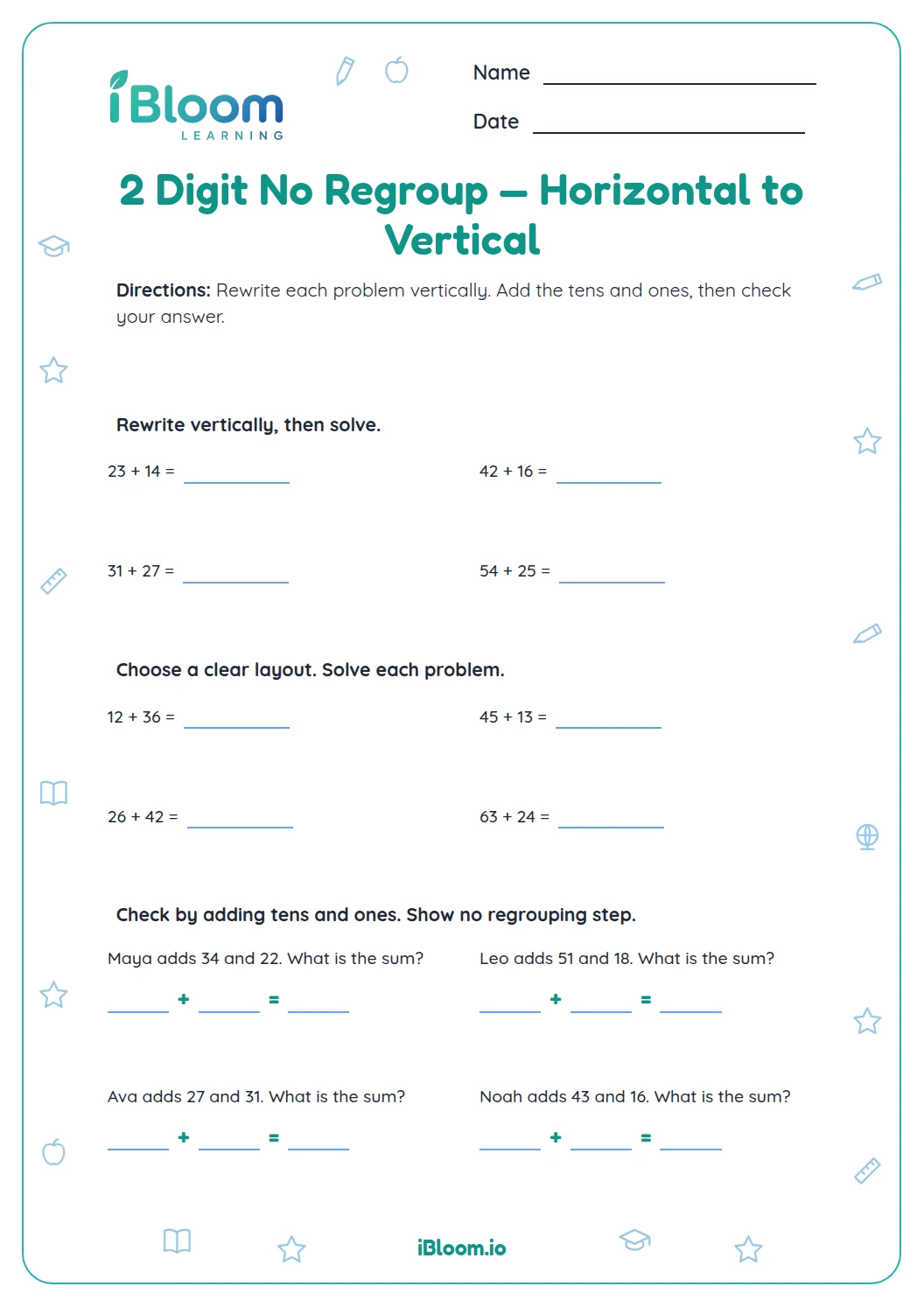
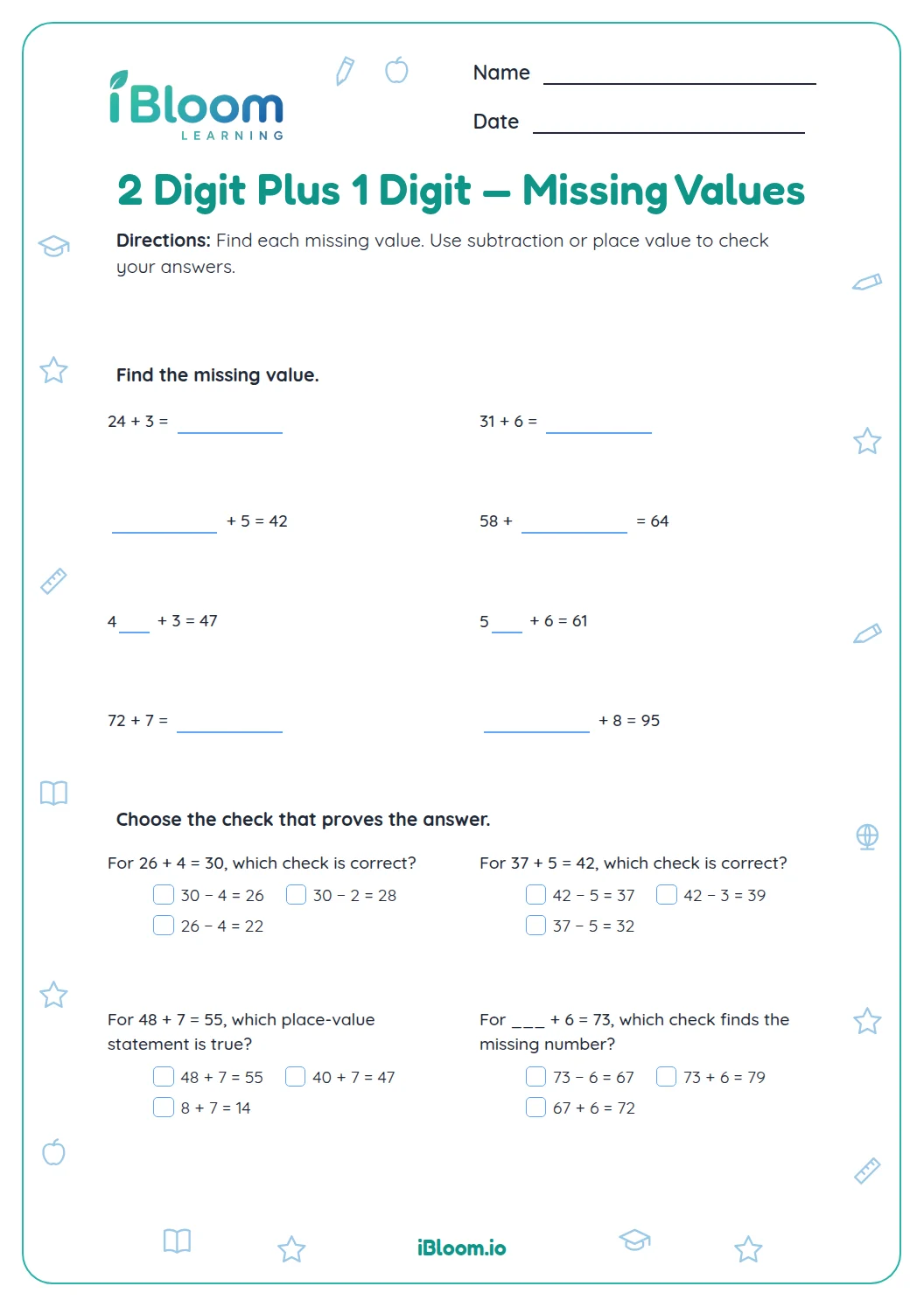
About this worksheet
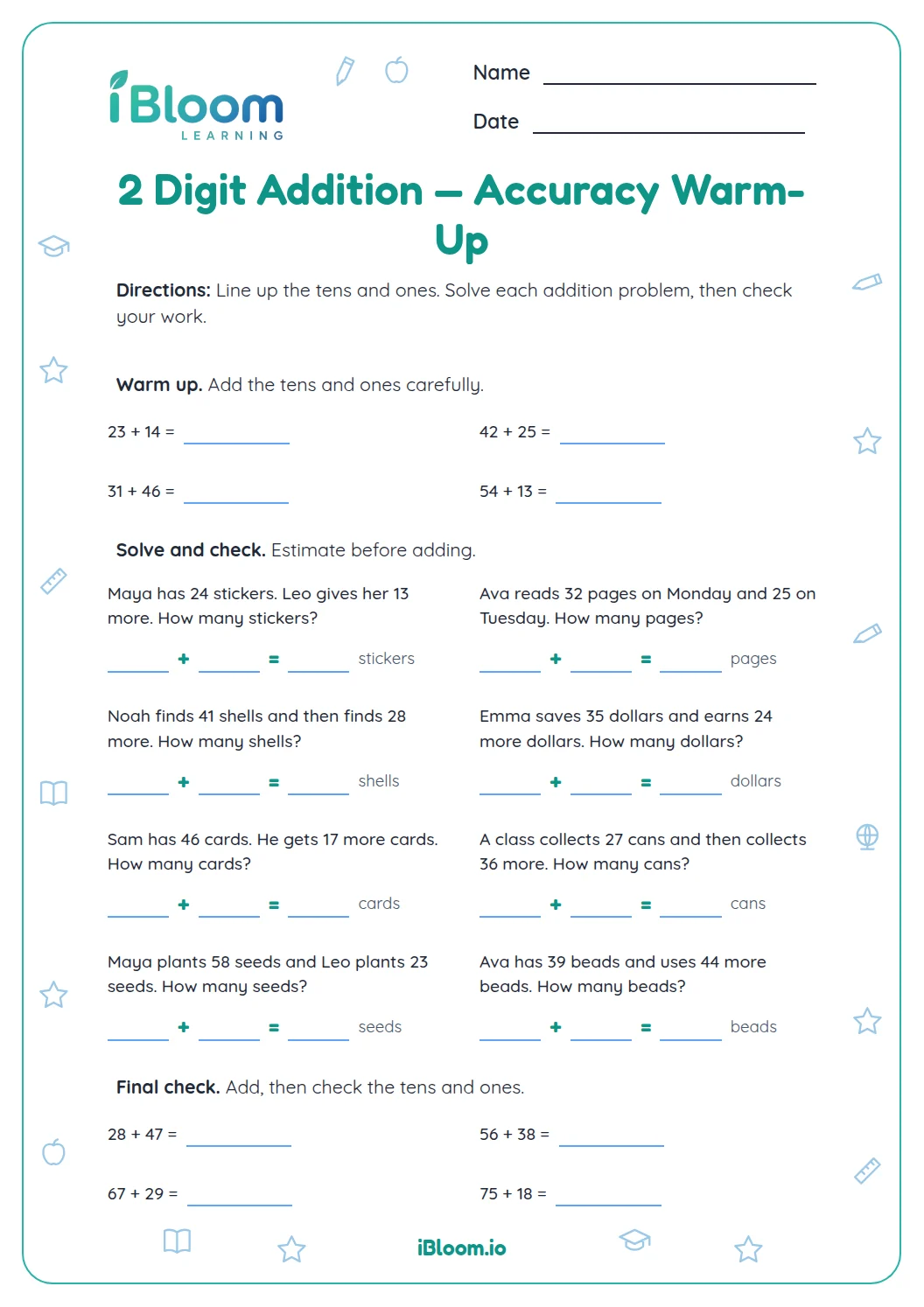
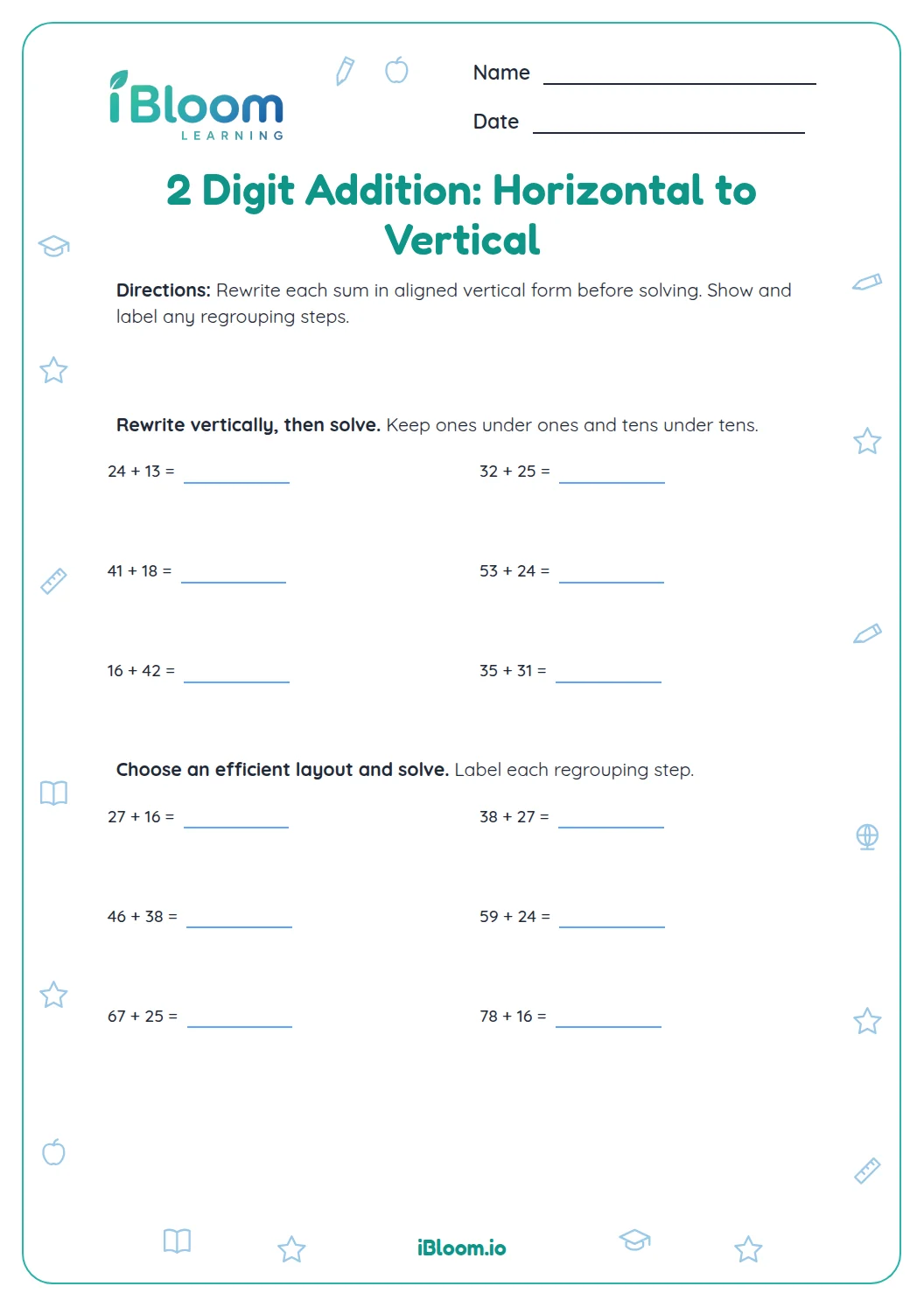
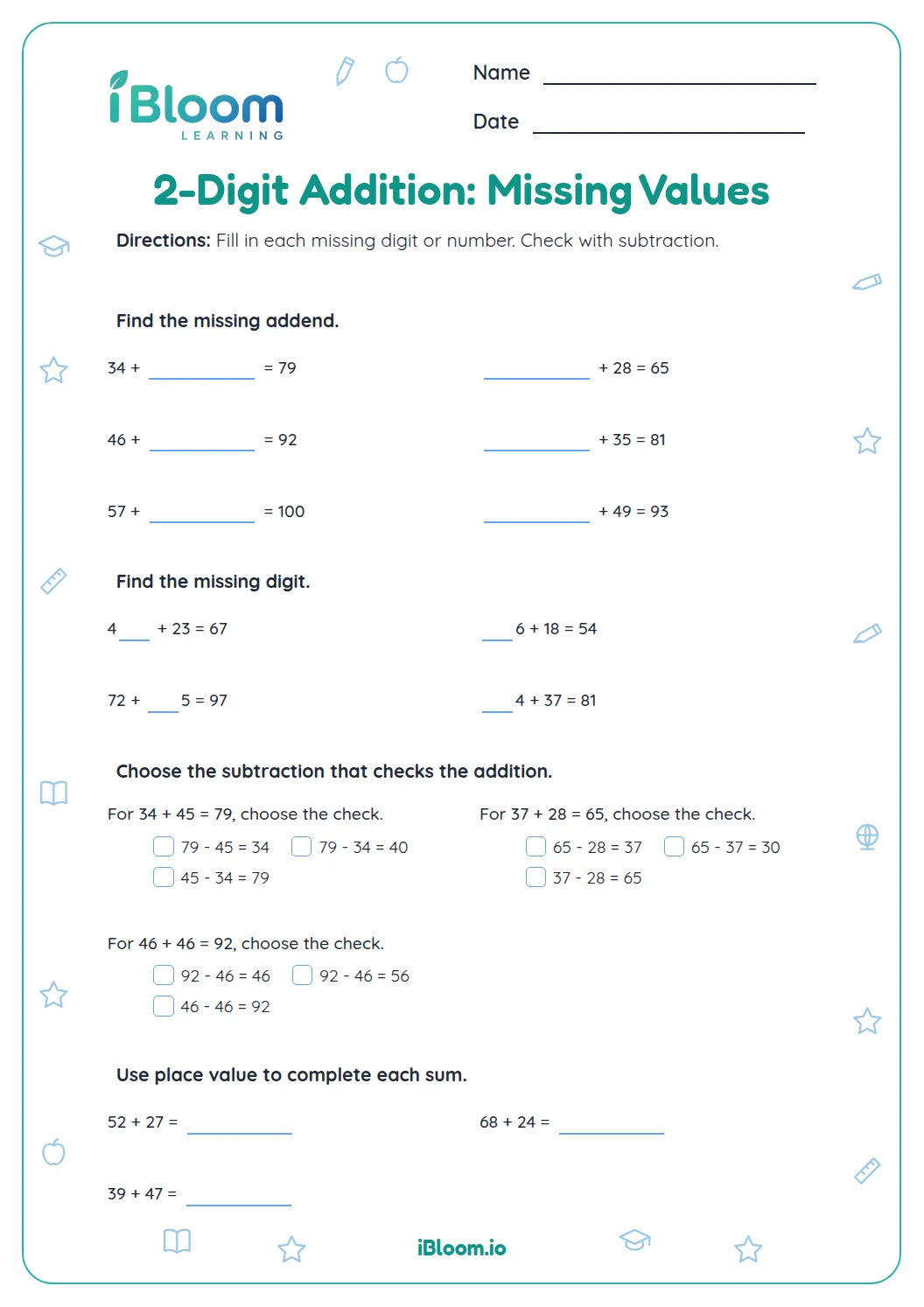
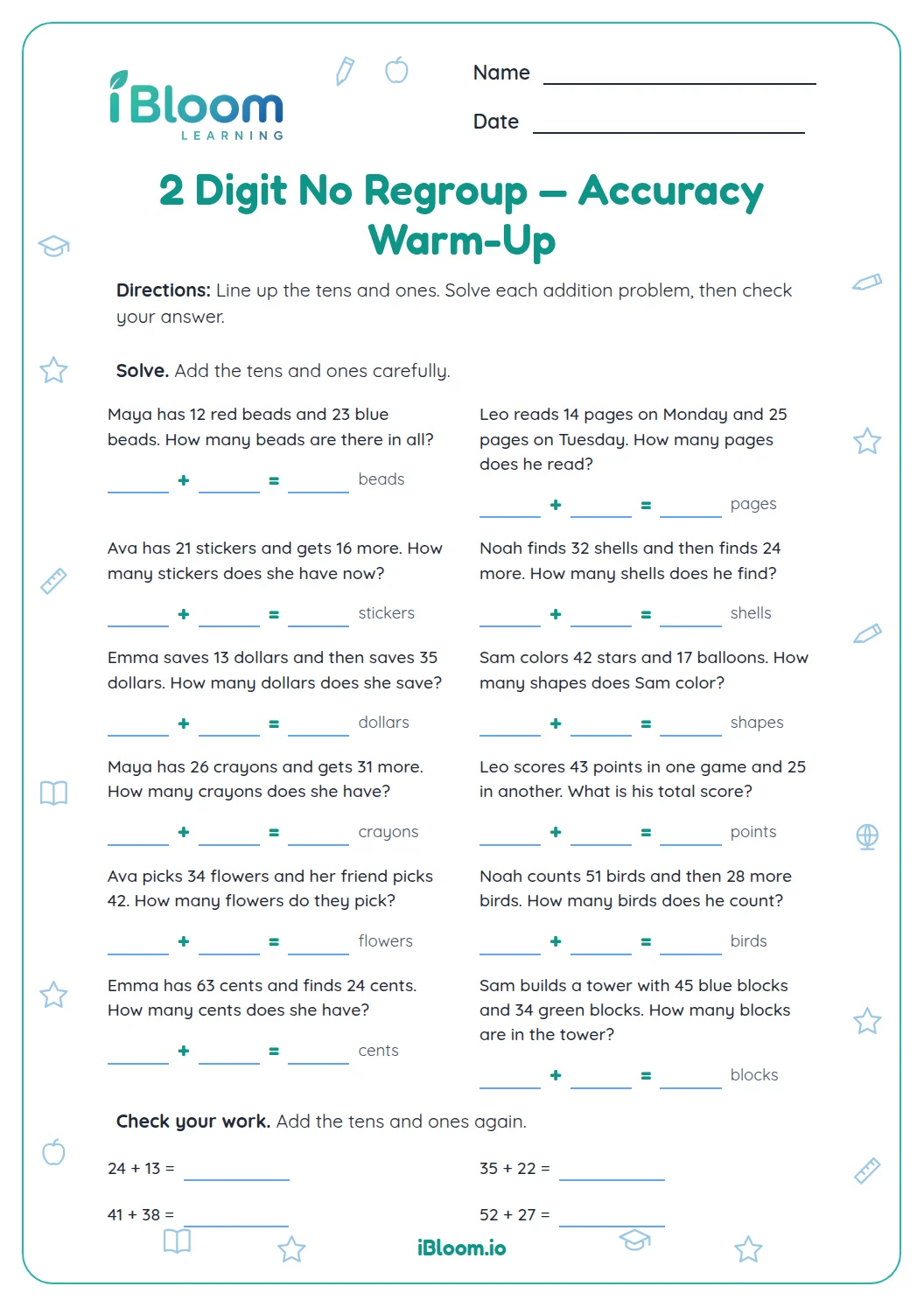
This Grades 3–4 printable is a focused warm-up in horizontal addition of three-digit numbers. It starts with sums that do not require regrouping, moves to regrouping, and finishes with mixed practice. Learners solve 16 equations across four parts on two worksheet pages; a separate two-page answer key provides the sums. The problems practice Common Core 3.NBT.A.2 by adding within 1,000 with place-value strategies and regrouping.
Aligned to 3.NBT.A.2
How can learners work through horizontal addition of three-digit numbers?
This Grade 3 printable is a focused warm-up in horizontal addition of three-digit numbers. It starts with sums that do not require regrouping, moves to regrouping, and finishes with mixed practice. Learners solve 16 equations across four parts on two worksheet pages; a separate two-page answer key provides the sums. The problems practice Common Core 3.NBT.A.2 by adding within 1,000 with place-value strategies and regrouping.
For example, 156 + 287 = ___ The result is 443.
- 1156 + 287 = ___
- 2443
What is included in this horizontal addition of three-digit numbers sheet?
The worksheet has 16 questions arranged in short parts. The separate answer key provides an answer for each item.
- Warm up
- Regroup when needed
- Check each sum
- Show a check
How can an adult support practice?
All 16 problems add two three-digit numbers. The set begins with sums that need no regrouping, then includes regrouping and mixed practice. Learners can rewrite an equation vertically on scrap paper while keeping the printed problem horizontal. No. The opening section provides sums without regrouping, and later sections include sums that do require it. Read the section heading and check each place rather than assuming every equation uses the same steps.
How to use this worksheet
- 1Read each horizontal equation from left to right.
- 2Add the ones digits and regroup a ten when the ones total is 10 or more.
- 3Add the tens digits, including any regrouped ten.
- 4Add the hundreds digits and check that the result is below 1,000.
- 5Use an estimate or a second addition strategy to check selected sums.
Common mistakes and quick fixes
The mistake
Forgetting to carry a ten from the ones place.
The fix
Check whether the ones digits total at least 10.
The mistake
Adding hundreds, tens, and ones as if they were single digits.
The fix
Keep track of each digit’s place value while adding.
The mistake
Making a place-value error in a horizontal problem.
The fix
Rewrite the addends vertically on scrap paper, lining up like places.
Common Core alignment
This worksheet practices 3.NBT.A.2 through add three-digit numbers accurately using place value and regrouping.
Add three-digit numbers using place value and regrouping.
On this sheet: Questions ask learners to add three-digit numbers accurately using place value and regrouping.
Show the official wordingHide the official wording
Fluently add and subtract within 1000 using strategies and algorithms based on place value, properties of operations, and/or the relationship between addition and subtraction.
What to practice next
Make more practice
Questions parents and teachers ask
What kind of addition is on this worksheet?
All 16 problems add two three-digit numbers. The set begins with sums that need no regrouping, then includes regrouping and mixed practice. Learners can rewrite an equation vertically on scrap paper while keeping the printed problem horizontal. The answer key lists all 16 sums, including the final two written answers.
How do I solve 156 + 287?
Add by place value: 6 + 7 = 13, so regroup 10 ones as 1 ten; 5 tens + 8 tens + 1 ten = 14 tens; and 1 hundred + 2 hundreds + 1 hundred = 4 hundreds. The sum is 443. The checked sum is 443, which is close to the estimate 150 + 290.
Does every problem require regrouping?
No. The opening section provides sums without regrouping, and later sections include sums that do require it. Read the section heading and check each place rather than assuming every equation uses the same steps. The warm-up section is followed by regrouping and mixed sums.
How can I check the sums?
Estimate the total first, then compare the exact answer with that estimate. You can also add the numbers vertically on scrap paper and check that the hundreds, tens, and ones were combined correctly. A vertical rewrite helps preserve the hundreds, tens, and ones.
How long does the warm-up take?
About 20 minutes is a useful estimate for all four sections. Learners who are still building accuracy can pause after the opening problems, check their work, and continue with the regrouping section. The sheet moves from no regrouping to regrouping and mixed practice.