

About this worksheet
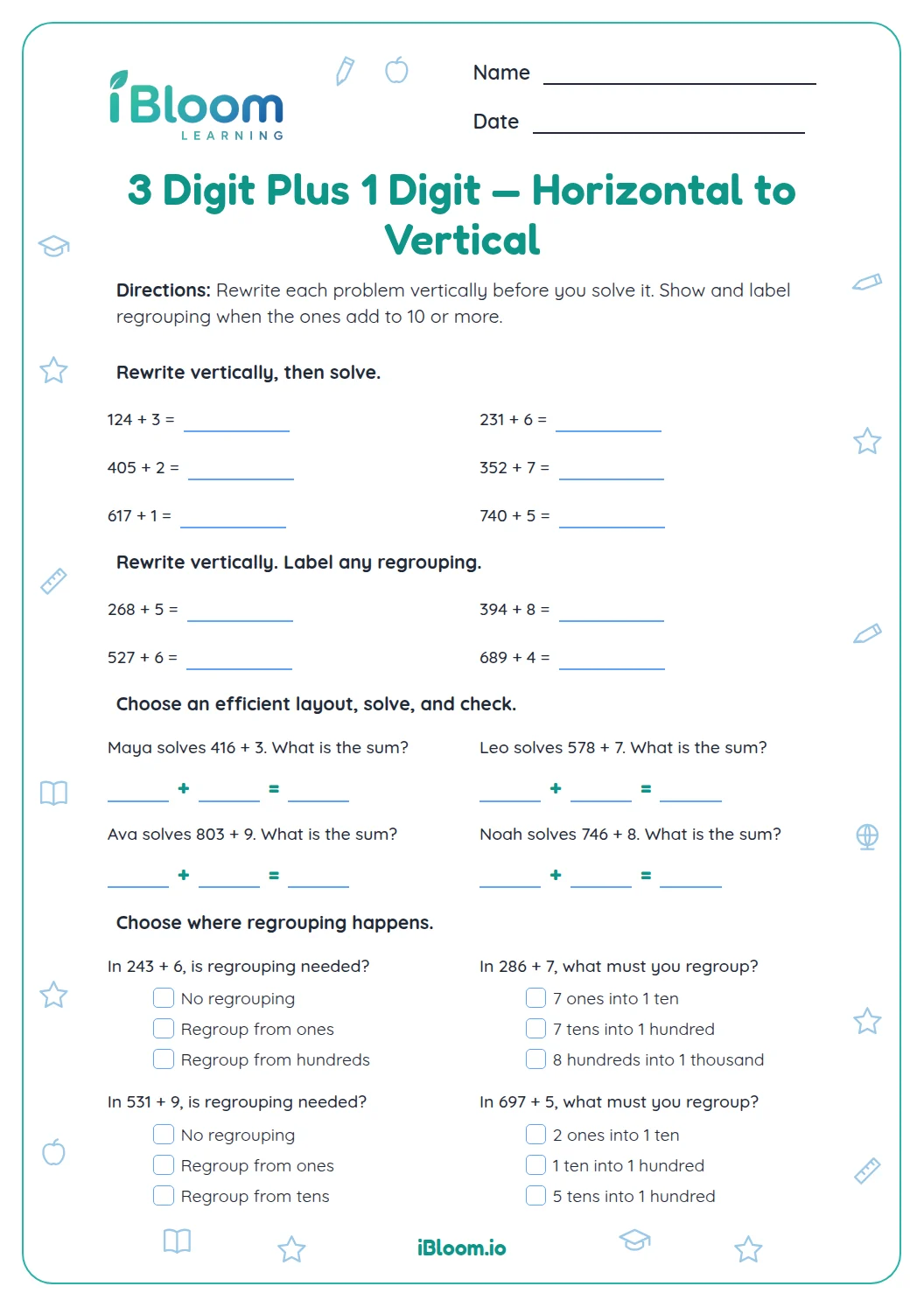
This Grade 2 addition worksheet practices changing horizontal two-digit-plus-one-digit sums into vertical addition. Learners solve 16 number sentences, including sums that require regrouping, then apply the same method to four short stories. It practices CCSS 2.NBT.B.5 by adding within 100 with place-value strategies. A separate two-page answer key gives each sum and story total.
Aligned to 2.NBT.B.5
Where should the one-digit addend go?
Line up the one-digit addend under the ones column, not under the tens. For 24 + 3, place 3 below 4 and add the ones to get 7; the tens digit stays 2.
- 124 + 3
- 2Write 3 under the ones digit 4.
- 3Add 4 + 3 = 7; keep the 2 tens.
- 4The sum is 27.
When do you regroup a ten?
Regroup when the ones add to 10 or more. In 36 + 7, 6 + 7 = 13 ones. Write 3 ones and carry 1 ten, then 3 tens + 1 ten = 4 tens. The sum is 43.
How does the column method work in a story?
Turn the story into an addition sentence first. For 34 books plus 5 books, write 34 + 5, align the ones, and get 39 books. Keep the unit in the answer.
How to use this worksheet
- 1Copy each horizontal sum vertically.
- 2Line up the ones digits.
- 3Add the ones and regroup if the sum is 10 or more.
- 4Add the tens, including any regrouped ten.
- 5For a story, write the addition sentence and include the unit.
Common mistakes and quick fixes
The mistake
Putting the one-digit number under the tens digit.
The fix
Align it under the ones digit before adding.
The mistake
Forgetting to carry a ten when ones total 10 or more.
The fix
Write the ones digit and regroup the extra ten.
The mistake
Adding the tens digit twice after regrouping.
The fix
Add the original tens and the carried ten once each.
Common Core alignment
This worksheet practices the following Common Core skill.
Add within 100 using place-value strategies and models.
On this sheet: Learners add a one-digit number to a two-digit number, regrouping ones when needed.
Show the official wordingHide the official wording
Fluently add and subtract within 100 using strategies based on place value, properties of operations, and/or the relationship between addition and subtraction.
What to practice next
Make more practice
Further reading
Questions parents and teachers ask
What does horizontal to vertical addition mean?
The problem is printed across the page, and the learner rewrites its addends in a column before solving. For 24 + 3, place 3 under the ones digit 4. Add the ones, then keep the 2 tens to make 27.
When should a learner regroup?
Regroup when the ones digits make 10 or more. In 36 + 7, six ones plus seven ones make 13 ones. Write 3 in the ones place and carry 1 ten; then add that ten to the original 3 tens to get 43.
Are there story problems on the sheet?
Yes. The final four questions describe adding books, points, beads, or eggs. Learners write an addition equation, solve it using aligned ones and tens, and include the unit in the answer, such as 39 books. Each story uses the same two-digit plus one-digit addition practiced earlier.
Does the worksheet include an answer key?
Yes. The two-page key lists answers for all 20 questions, including the four story totals. Use it after the learner has rewritten and solved the sums, then review any regrouping step that led to a different total. The key also shows the final totals with their story units.
How can I check that the columns are lined up?
Look down the ones column: the one-digit addend should sit directly under the two-digit number’s ones digit. In 24 + 3, align 3 under 4, not under 2. Then check that any regrouped ten is added to the tens column once.