
About this worksheet
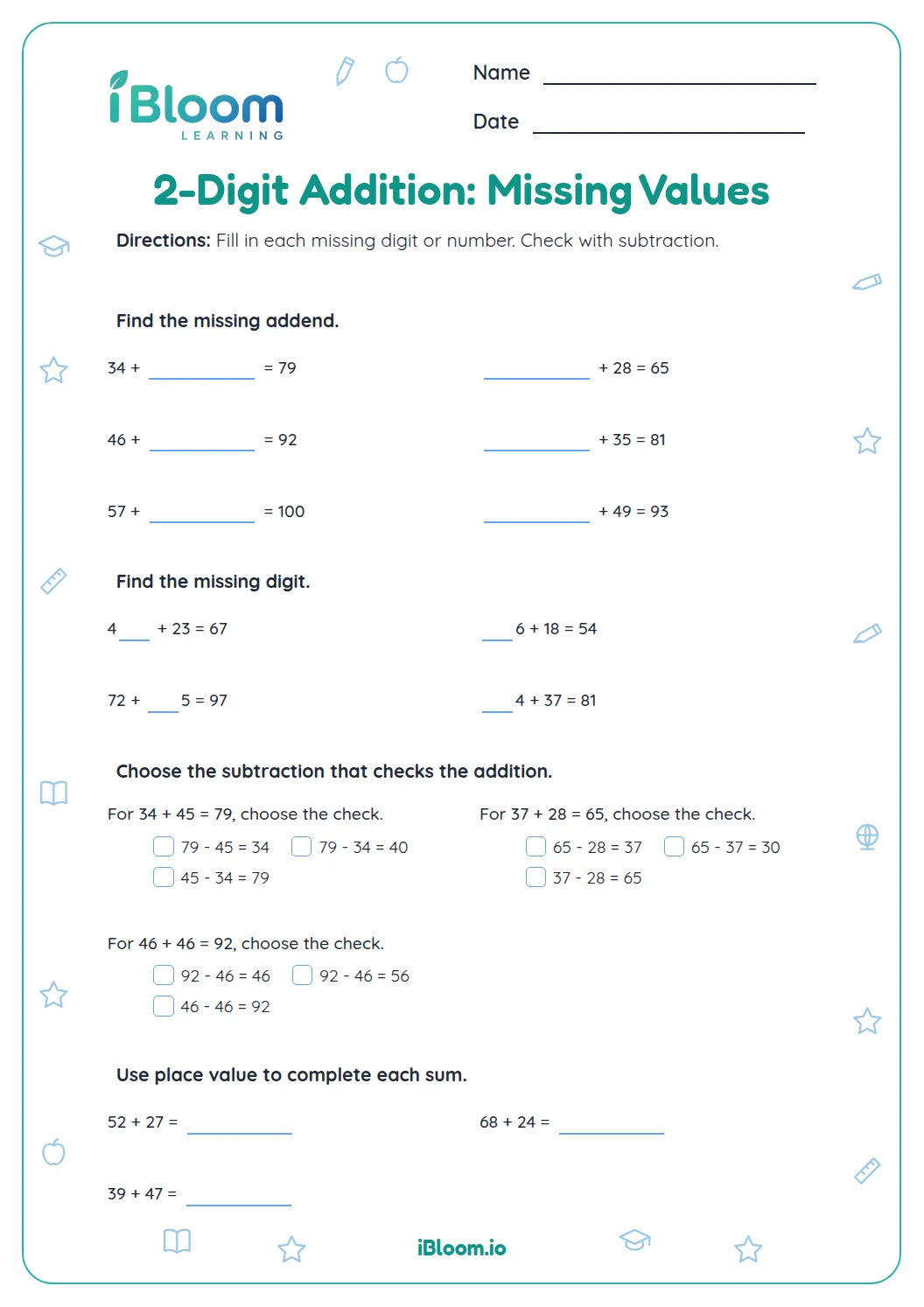
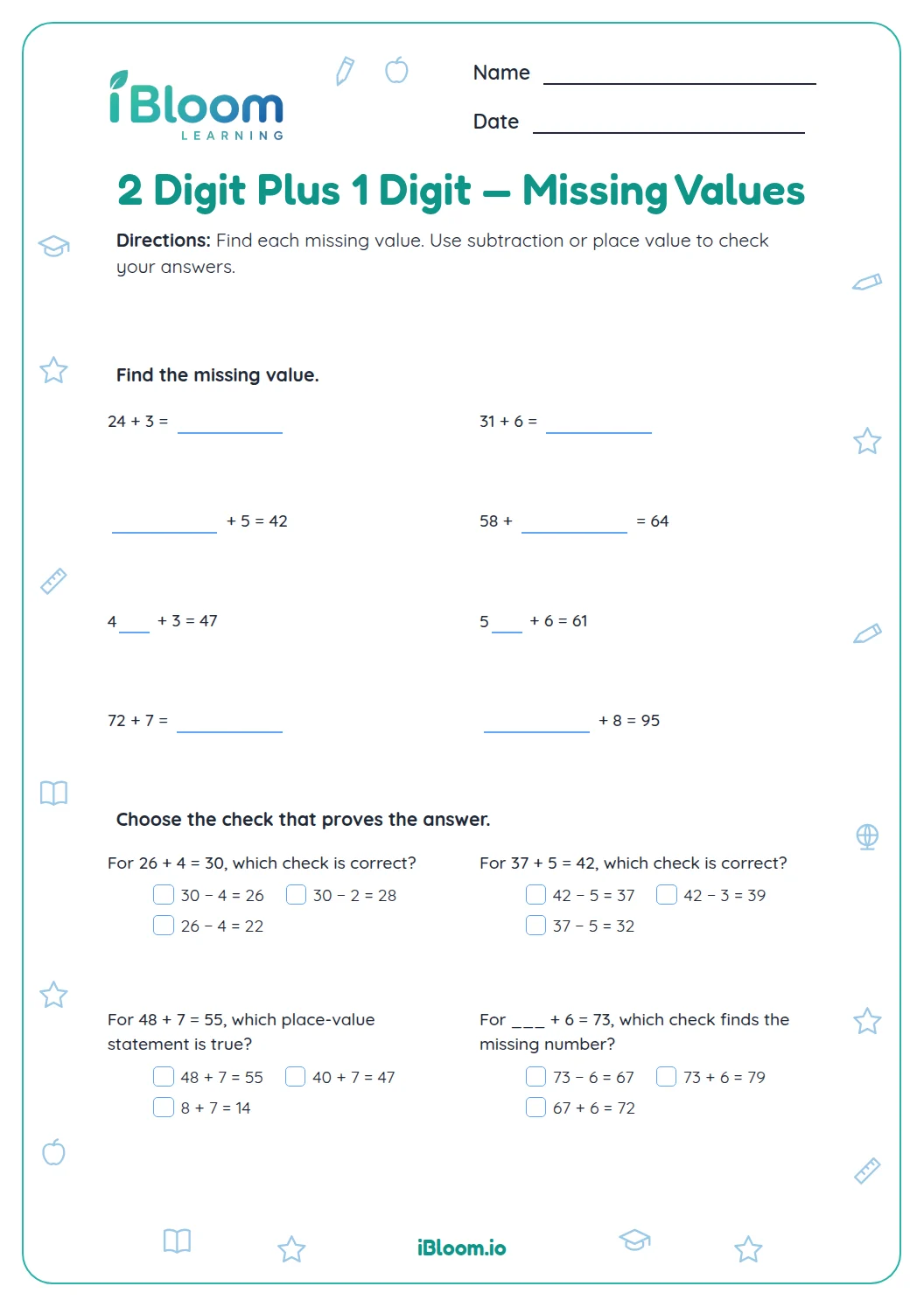
This printable Grade 3 worksheet practices missing addends in three-digit plus one-digit addition. It has 16 equations and 4 short word problems that ask students to find the starting amount, plus a separate answer key for checking each response.
How do you work through missing addends in three-digit plus one-digit equations?
For q2, the equation is ___ + 7 = 475. Subtract 7 from 475: 475 - 7 = 468. Check: 468 + 7 = 475. The blank can hold a three-digit number when the unknown is the first addend.
What does the practice include?
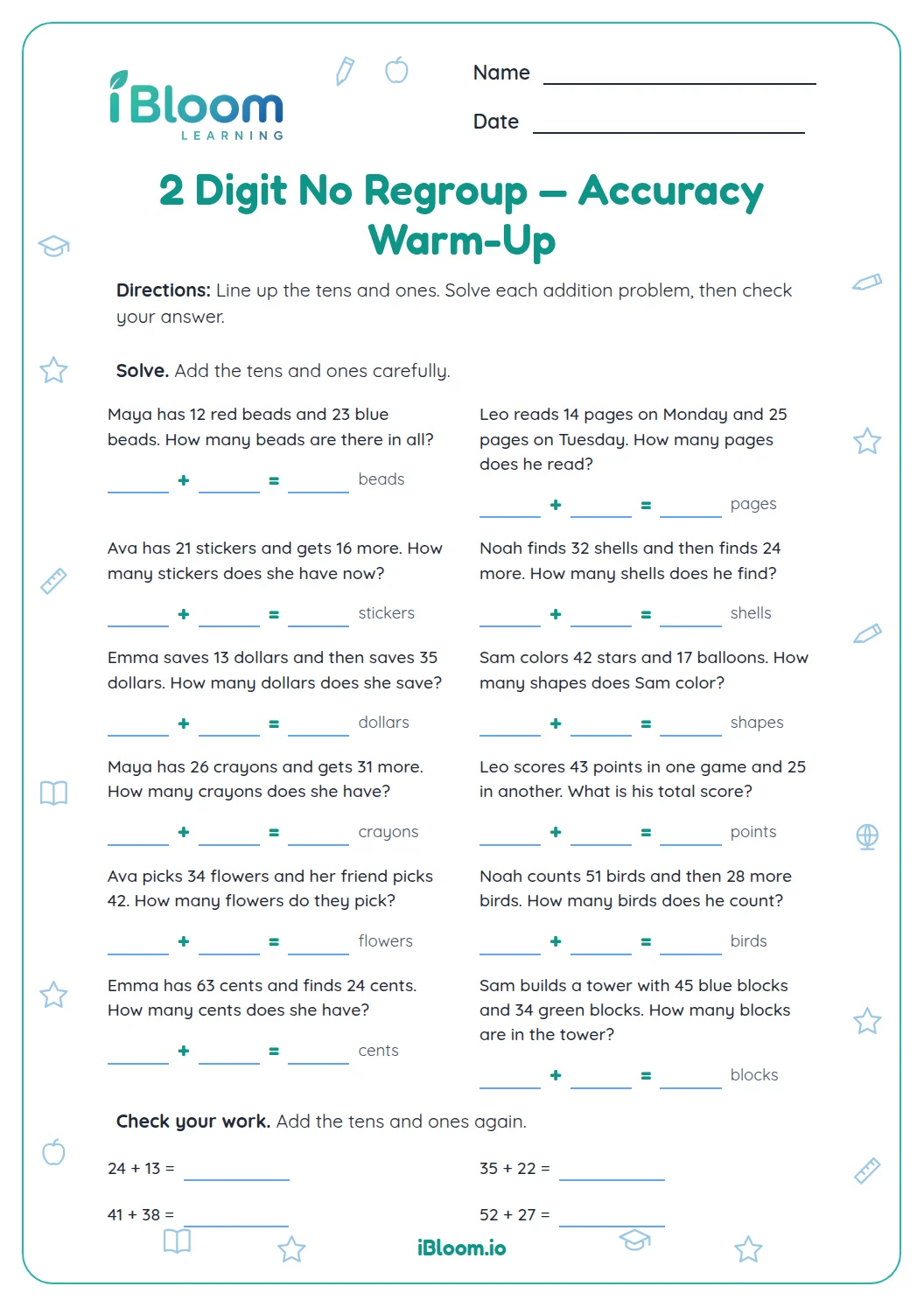
The first 16 items are equations with a missing addend. Four final stories ask students to find a starting amount before one-digit addition; each can be represented with subtraction and checked by adding.
How should students check their work?
After finishing, compare each answer with the key. For a mismatch, reread the exact prompt, redo the step, and explain which clue supports the corrected answer.
A simple way to use this page
- 1Find the total and the addend already given.
- 2Subtract the known addend from the total.
- 3Write the difference in the blank.
- 4Add the two addends to check the total.
- 5Use the key after attempting all equations.
Common mistakes and quick fixes
The mistake
Subtracting the total from the known addend.
The fix
Use total minus known addend to find the missing part.
The mistake
Ignoring the position of the blank.
The fix
The unknown may be a one-digit second addend or a three-digit first addend.
The mistake
Forgetting to check with addition.
The fix
Add the two addends and confirm they make the stated total.
What to practice next
Make more practice
Questions parents and teachers ask
How many questions are on this page?
The worksheet has 20 questions: 16 missing-addend equations and 4 short word problems. In the story problems, students find a starting amount before a one-digit addition. The separate answer key gives the value for every blank and the result for each word problem.
How do you find a missing addend?
Subtract the known addend from the total. For ___ + 7 = 475, calculate 475 - 7 = 468, then check that 468 + 7 equals 475. This inverse-operation check works whether the blank appears before or after the plus sign.
Why are some answers three digits?
When the blank is the first addend and the other addend is one digit, the missing number may be three digits. For ___ + 6 = 533, the missing value is 527 because 527 + 6 = 533.
Does every problem need regrouping?
Some equations require borrowing when subtracting the known addend from the total, while others do not. In each case, use subtraction to find the unknown and addition to verify that the completed equation is true. The final four items use the same idea in short stories.
When should I use the answer key?
Try the equations before looking at the key, then check each missing value. For any mismatch, subtract again and use addition to test the result. The answer key is separate so it can be kept aside during independent practice.