

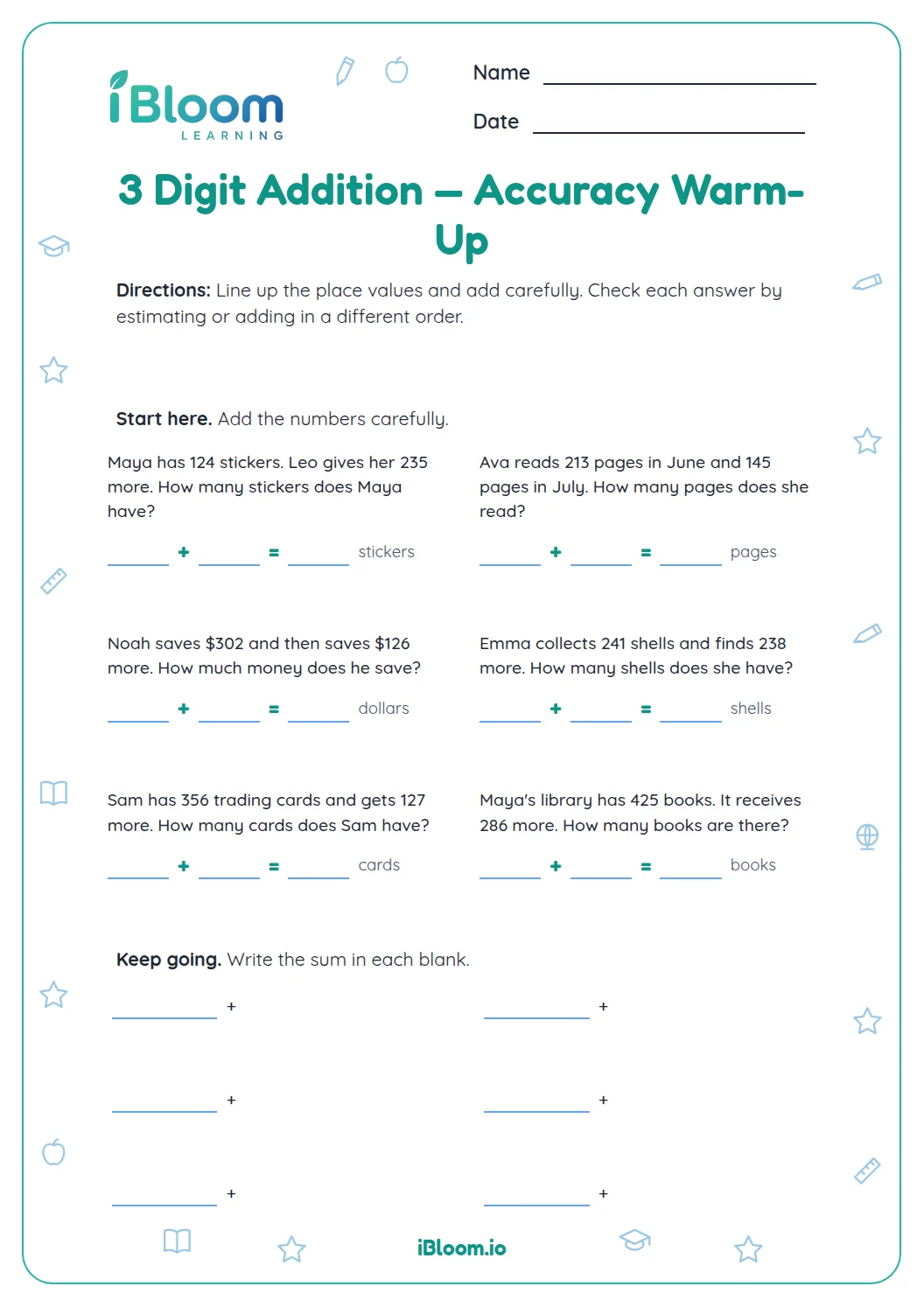
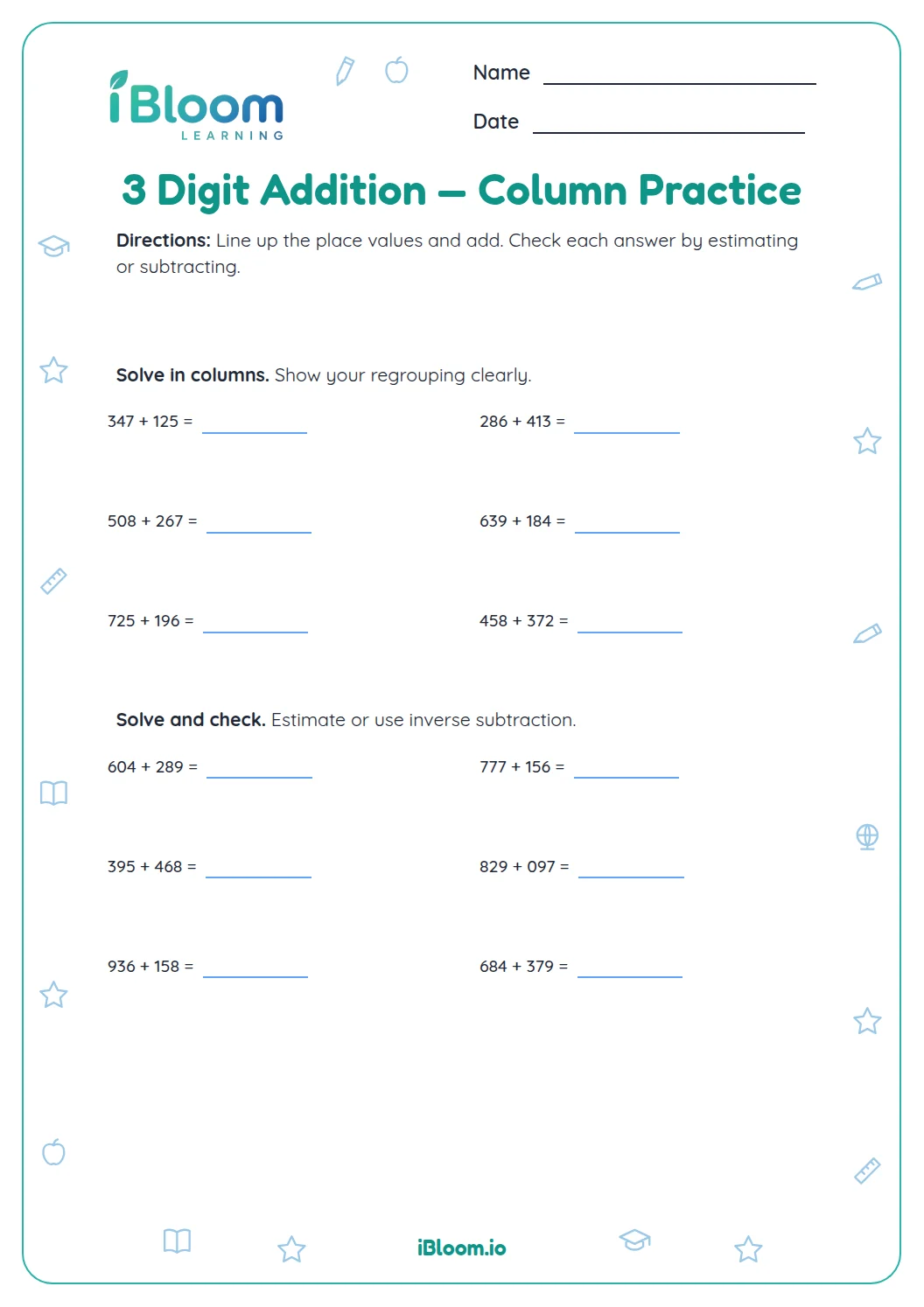
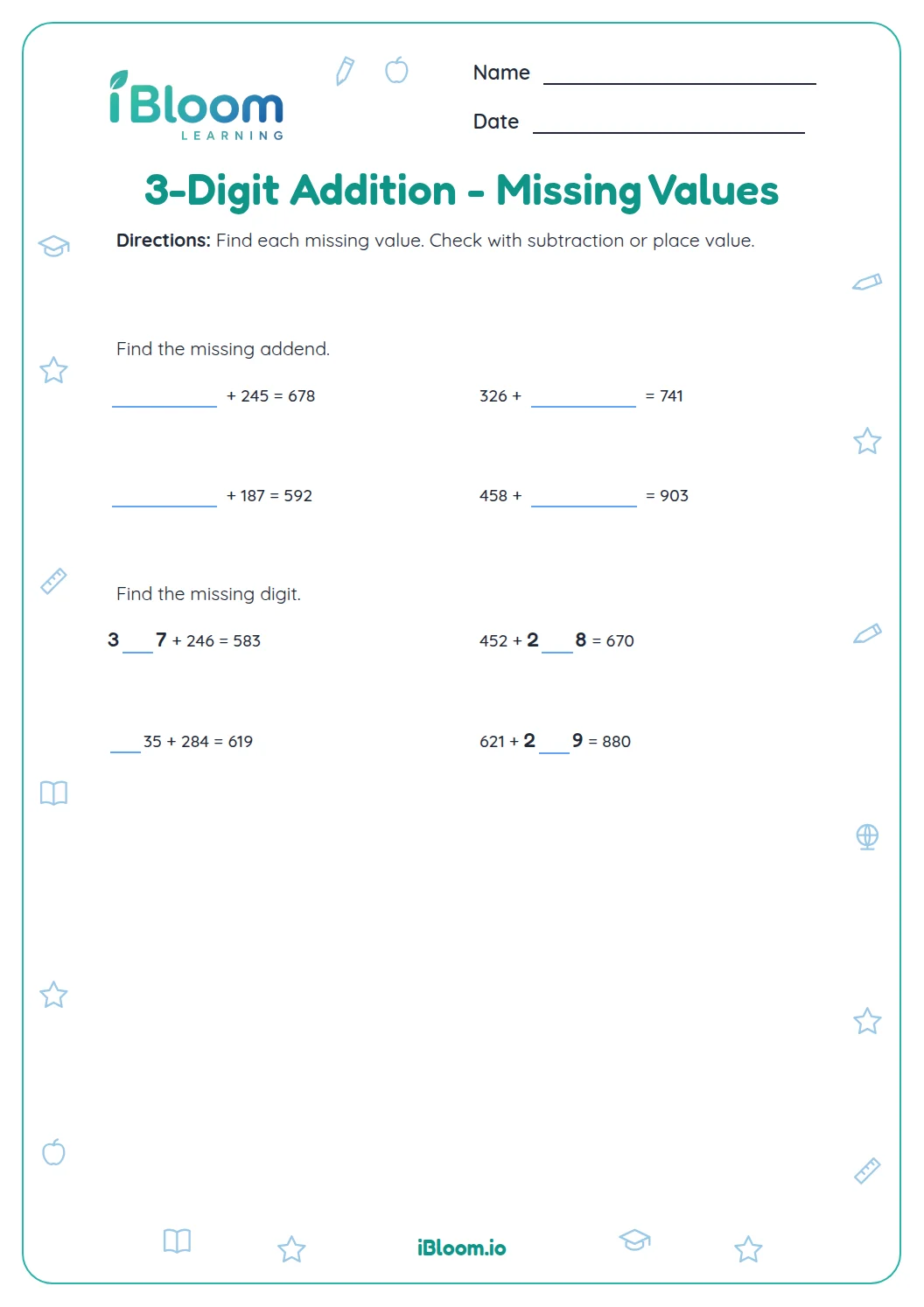


About this worksheet
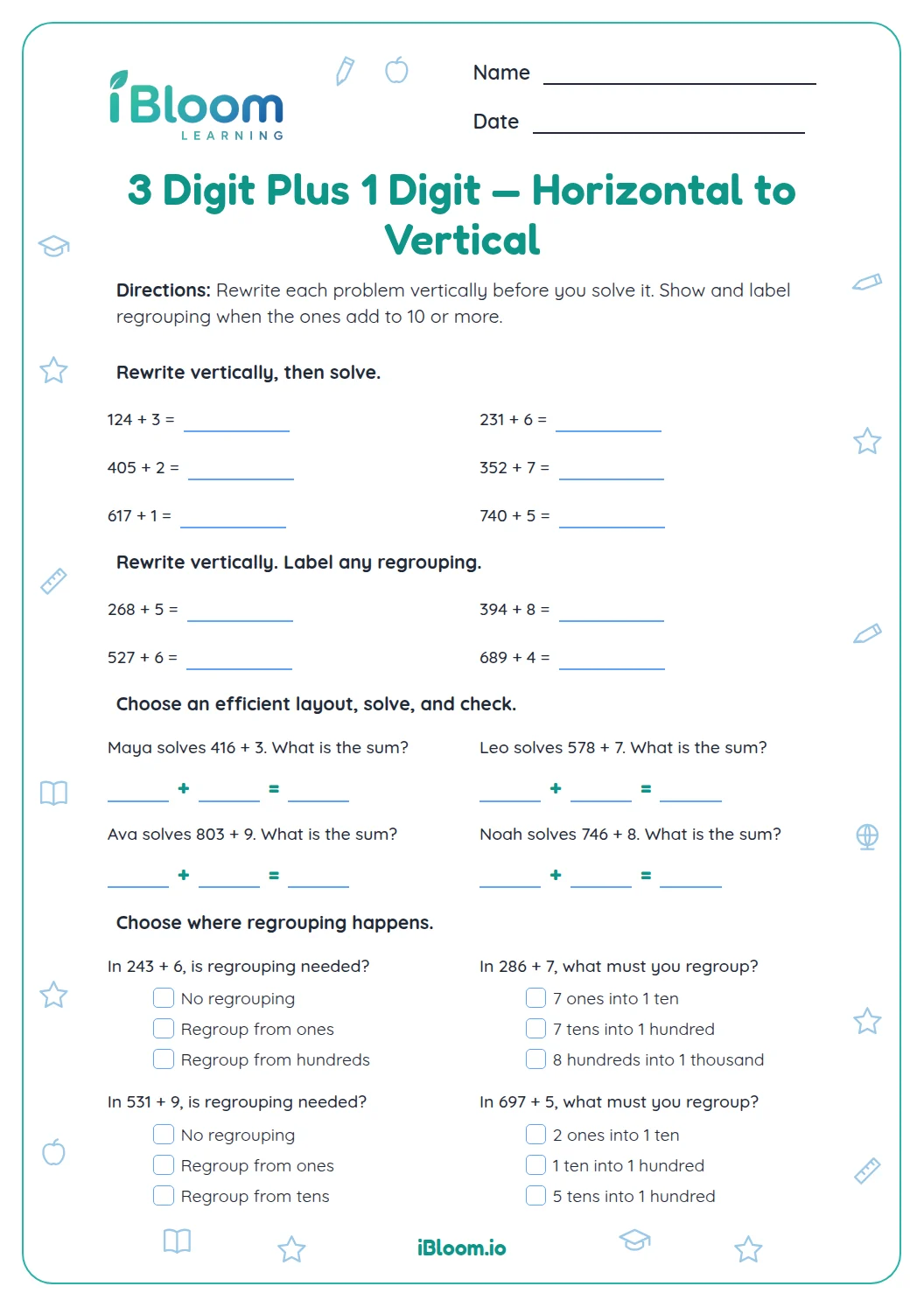
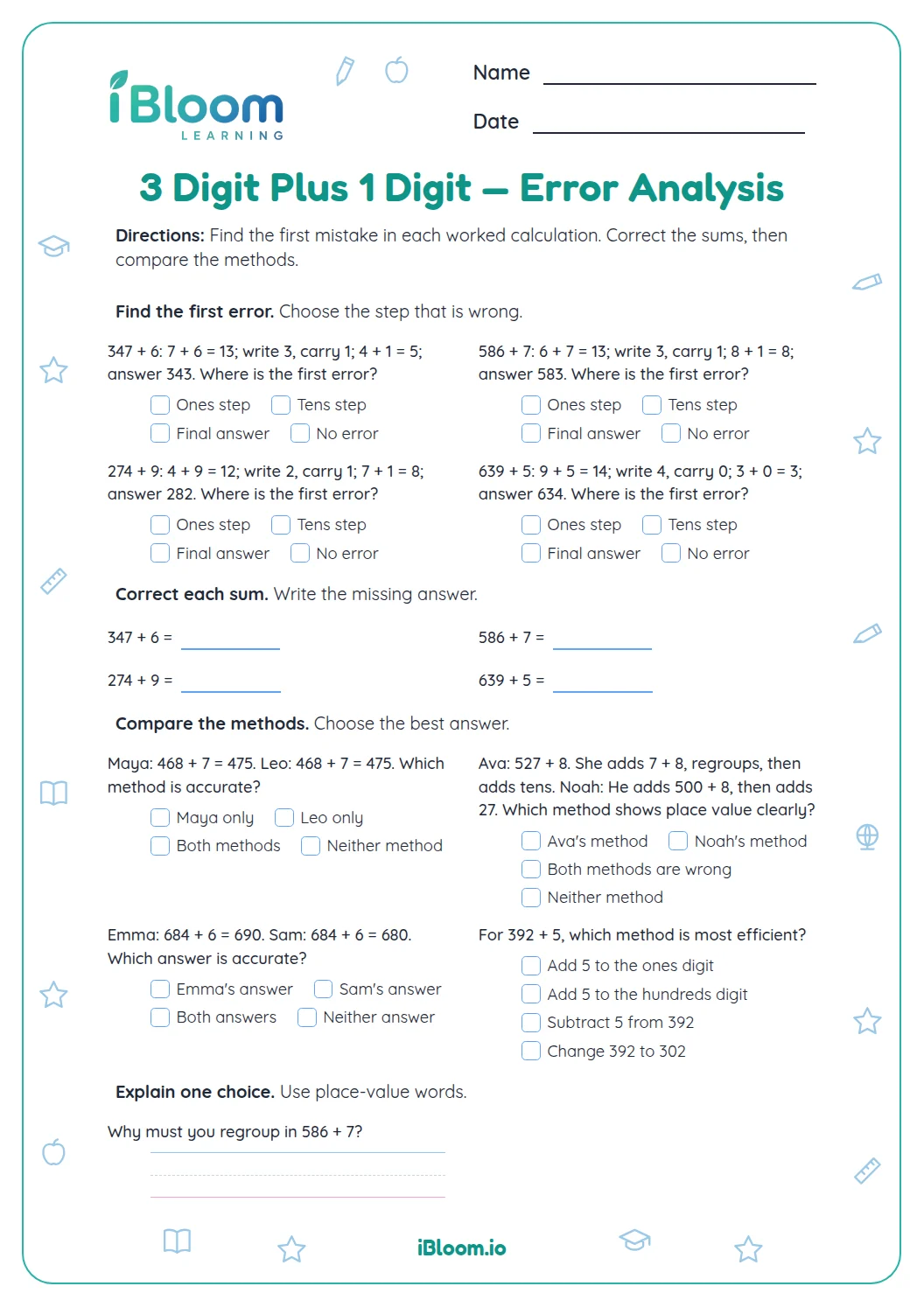
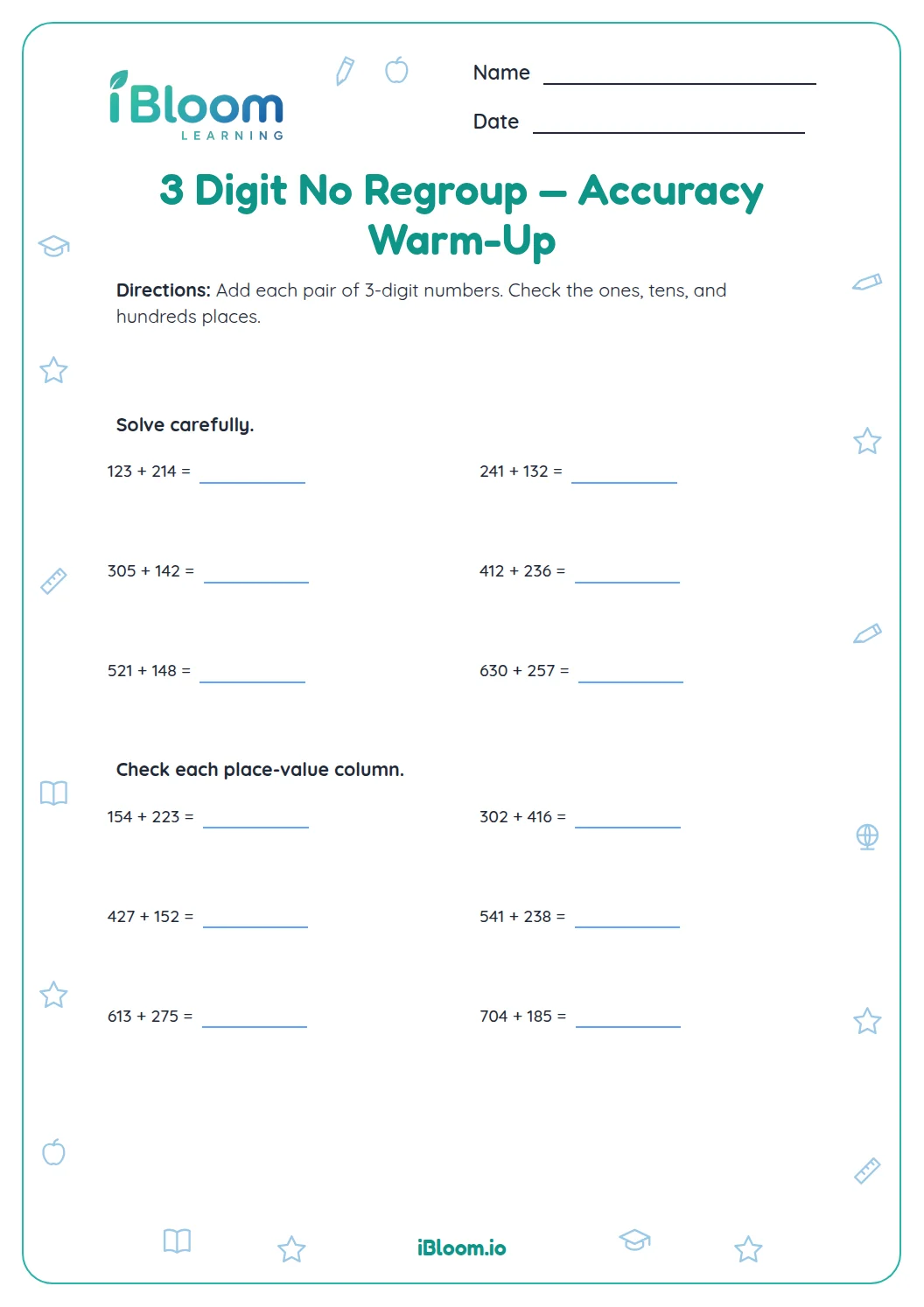
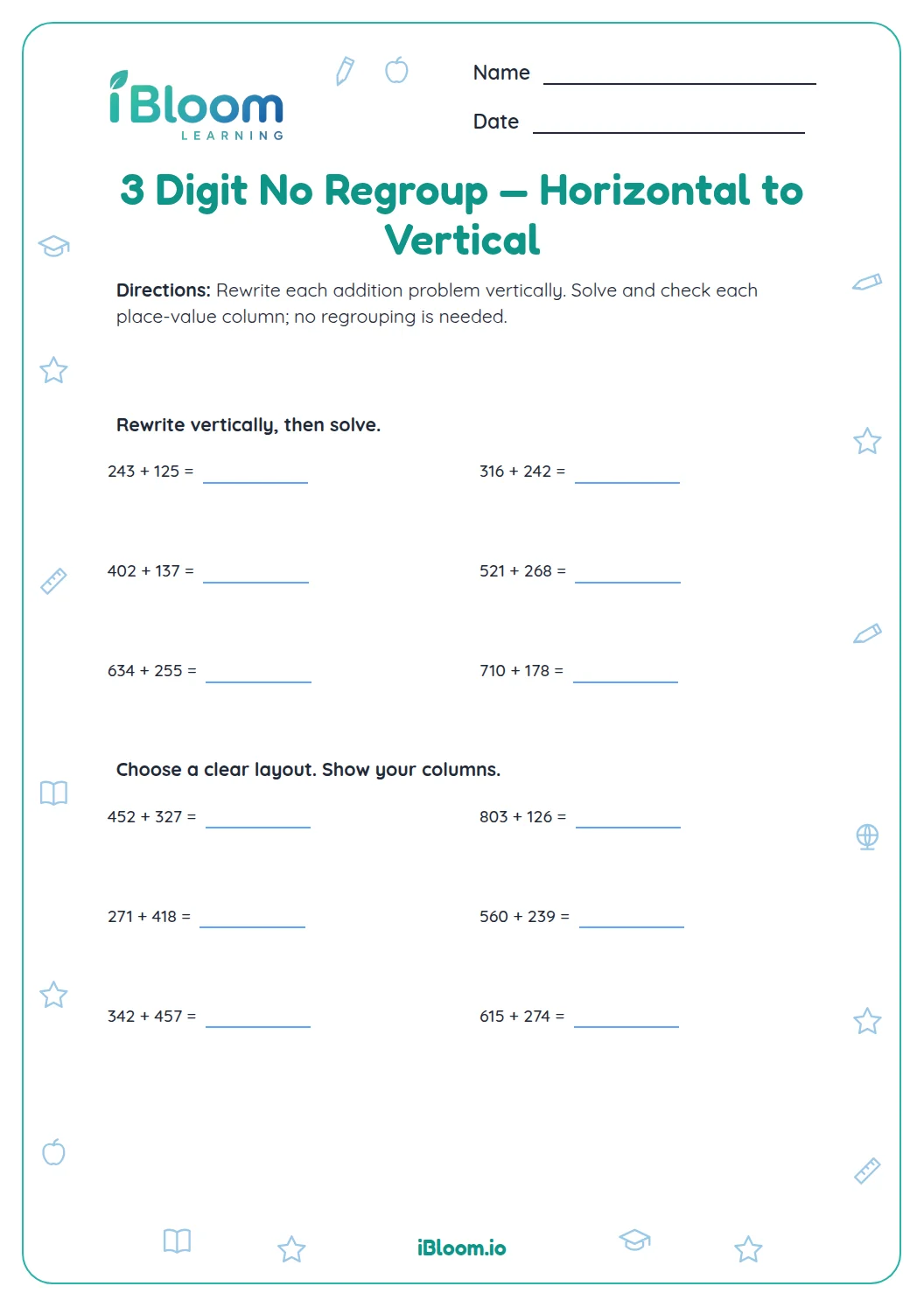
This printable addition drill gives Grade 3 and Grade 4 learners 16 mixed questions with a three-digit number and a one-digit addend throughout. Children solve direct sums, regroup in the ones place when needed, apply addition in two short situations, and check a missing addend and a regrouping explanation. A separate answer key supports quick review.
Aligned to 3.NBT.A.2
What kinds of addition practice are included?
Part A has 11 direct sums, including examples with and without regrouping. Part B finds a missing addend. Part C applies addition in two short stories. Part D checks regrouping in two ways.
- Part A: 11 direct sums
- Part B: 1 missing-addend equation
- Part C: 2 addition story problems
- Part D: 2 regrouping checks
When do you regroup?
When the ones add to ten or more, trade ten ones for one ten. In 278 + 5, the ones make 13. Write 3 ones and add one ten to the tens place. The total is 283.
- 1278 + 5
- 28 + 5 = 13 ones
- 3Regroup 10 ones as 1 ten; 3 ones remain.
- 4278 + 5 = 283
How can you check a three-digit sum?
Estimate the change first: adding a small number should make the total a little larger. Then check the ones place and the regrouped ten. For example, 729 + 4 must be greater than 729, and the ones regroup from 13 to 3 ones and one ten.
How do the story problems work?
Each story describes an amount that increases. Write the starting amount plus the amount added, then find the new total. The units in the answer should match the story, such as books or points.
How to use this worksheet
- 1Line up place values if you write vertically.
- 2Add the ones and regroup one ten when needed.
- 3Keep the hundreds and tens digits in their place.
- 4For a story, identify the start amount and amount added.
- 5Check that adding made the starting amount larger.
Common mistakes and quick fixes
The mistake
Writing a two-digit ones sum in the ones place
The fix
Trade ten ones for one ten, then record the remaining ones.
The mistake
Forgetting to add the regrouped ten to the tens digit
The fix
After regrouping, add one to the tens place before finishing.
The mistake
Choosing a smaller result after addition
The fix
Addition increases the starting amount; estimate that the change is small but positive.
Common Core alignment
The drill uses place-value addition within 1,000.
Use place value and regrouping to add within 1,000.
On this sheet: All computation adds a one-digit number to a three-digit number without exceeding 1,000.
Show the official wordingHide the official wording
Fluently add and subtract within 1000 using strategies and algorithms based on place value, properties of operations, and/or the relationship between addition and subtraction.
What to practice next
Make more practice
Further reading
Questions parents and teachers ask
Does every problem use a three-digit number plus a one-digit number?
The 11 direct sums and missing-addend equation use a three-digit number and a one-digit addend. The two stories also add one-digit amounts to three-digit starting amounts. The final two questions check regrouping decisions and explanations on the same ones-place skill.
What does regrouping mean in these problems?
Regrouping means trading ten ones for one ten when the ones digits total at least ten. In 278 + 5, the ones make 13, so 10 ones become a ten and 3 ones remain. Add that new ten to the tens place.
Why are the answers below 1,000?
Each total on the sheet remains below 1,000. This keeps attention on place value and ones regrouping while practicing the three-digit plus one-digit skill named in the worksheet title. Children still need to check that the total is larger than the starting number.
Can children solve the story problems mentally?
Writing an addition equation can make the quantities easier to track. The answer key includes units so adults can check both the calculation and whether the answer responds to the story. For example, a book problem should end with books.
Is an answer key provided?
Yes. A separate answer key page lists all 16 answers, including units in the two word problems and a regrouping explanation. Use it to check calculations, story units, and where the carried ten belongs after adding the ones digits.
How long should the drill take?
About 15 minutes is a useful starting point. Children who are building accuracy may take longer to line up digits and check regrouping, while fluent learners may finish sooner. Encourage careful work before speed, then check the key.