





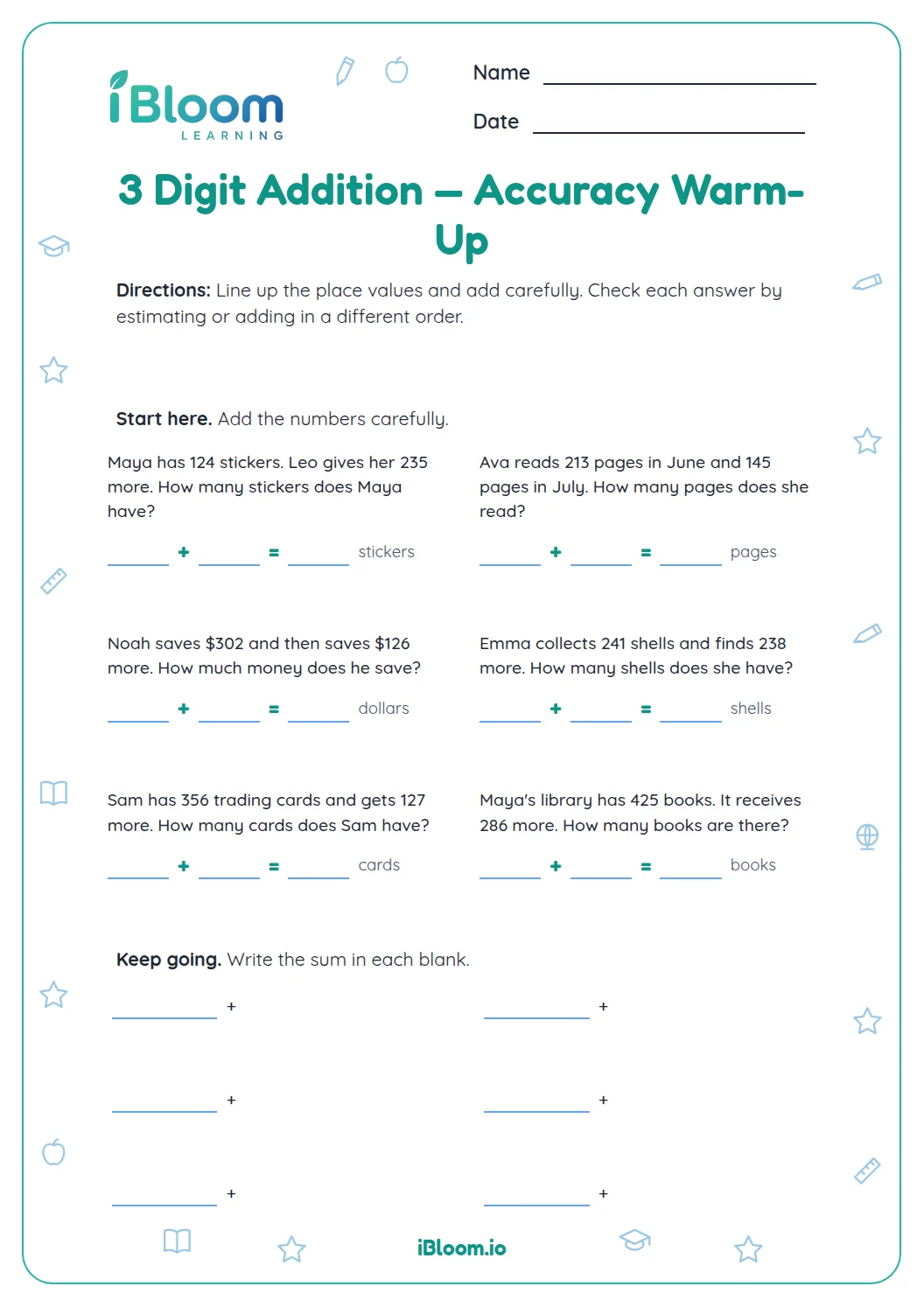
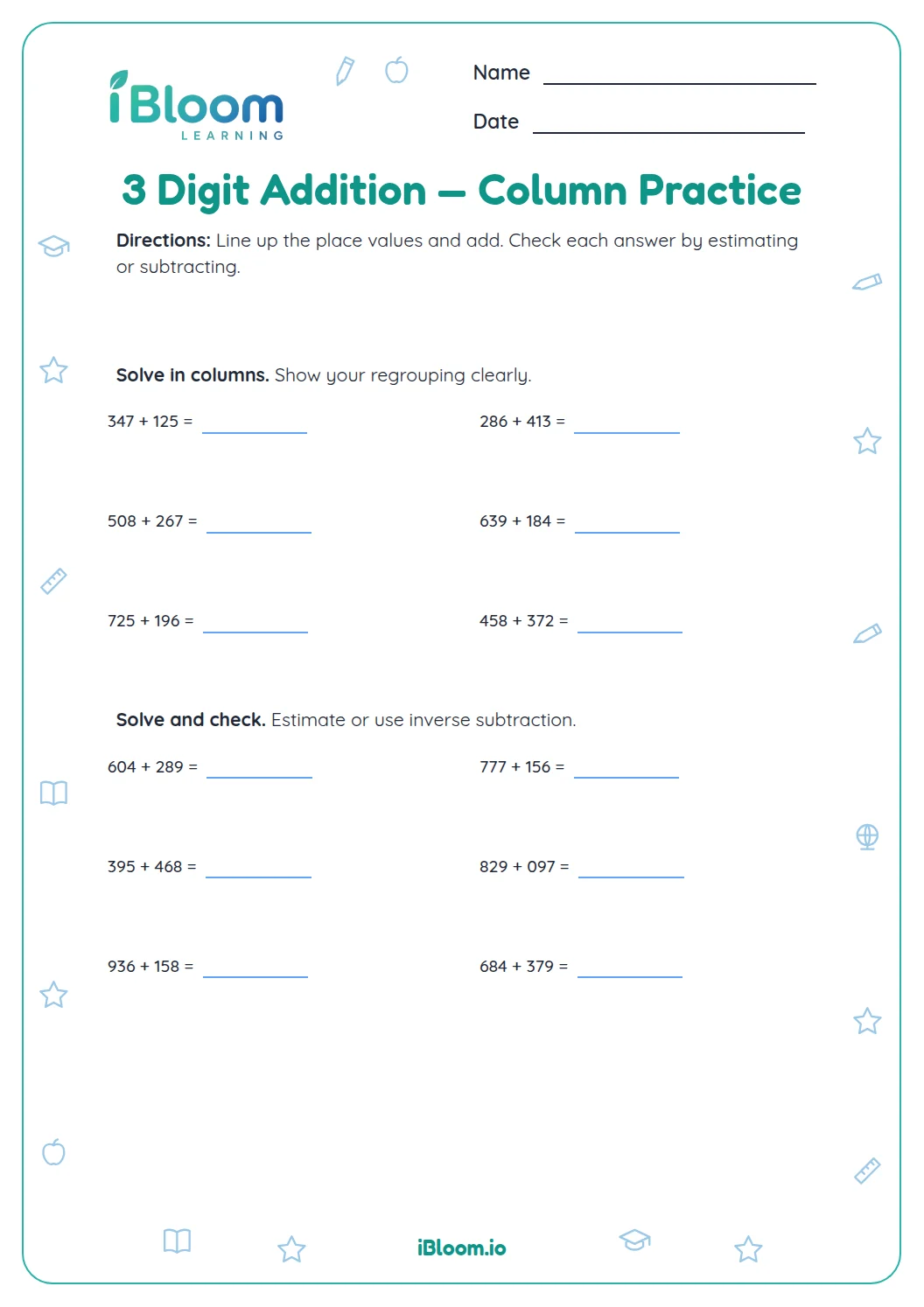
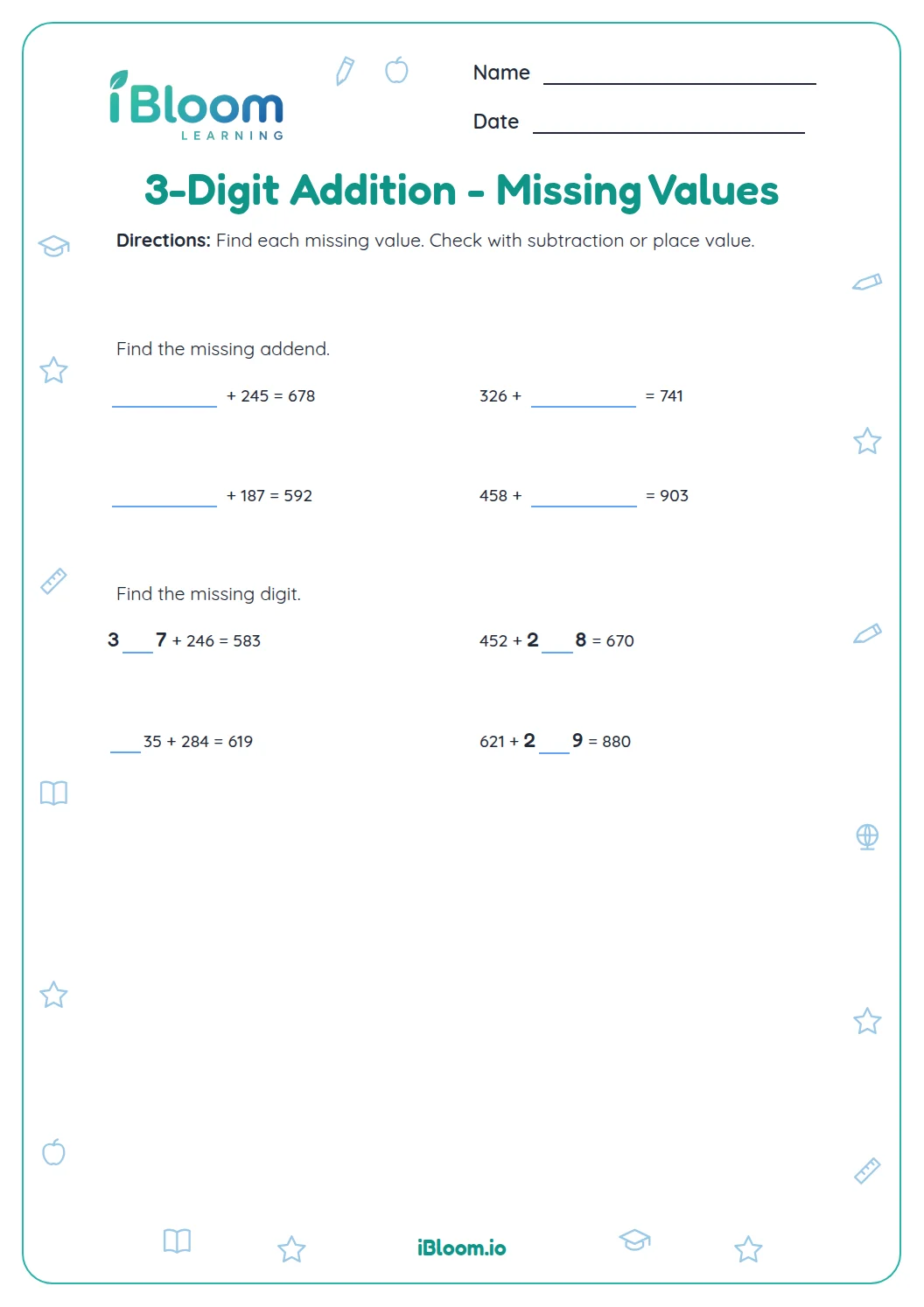
About this worksheet
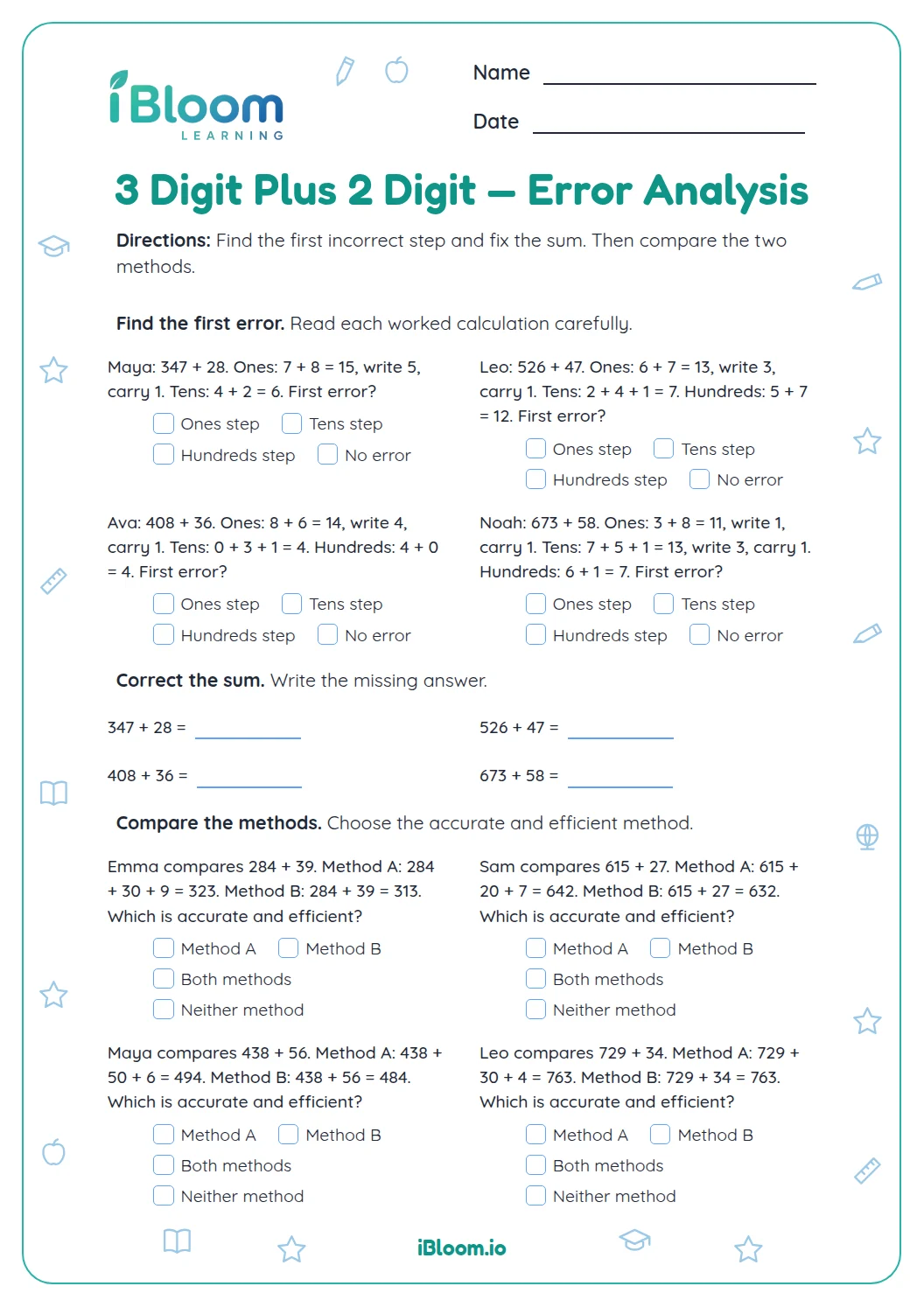
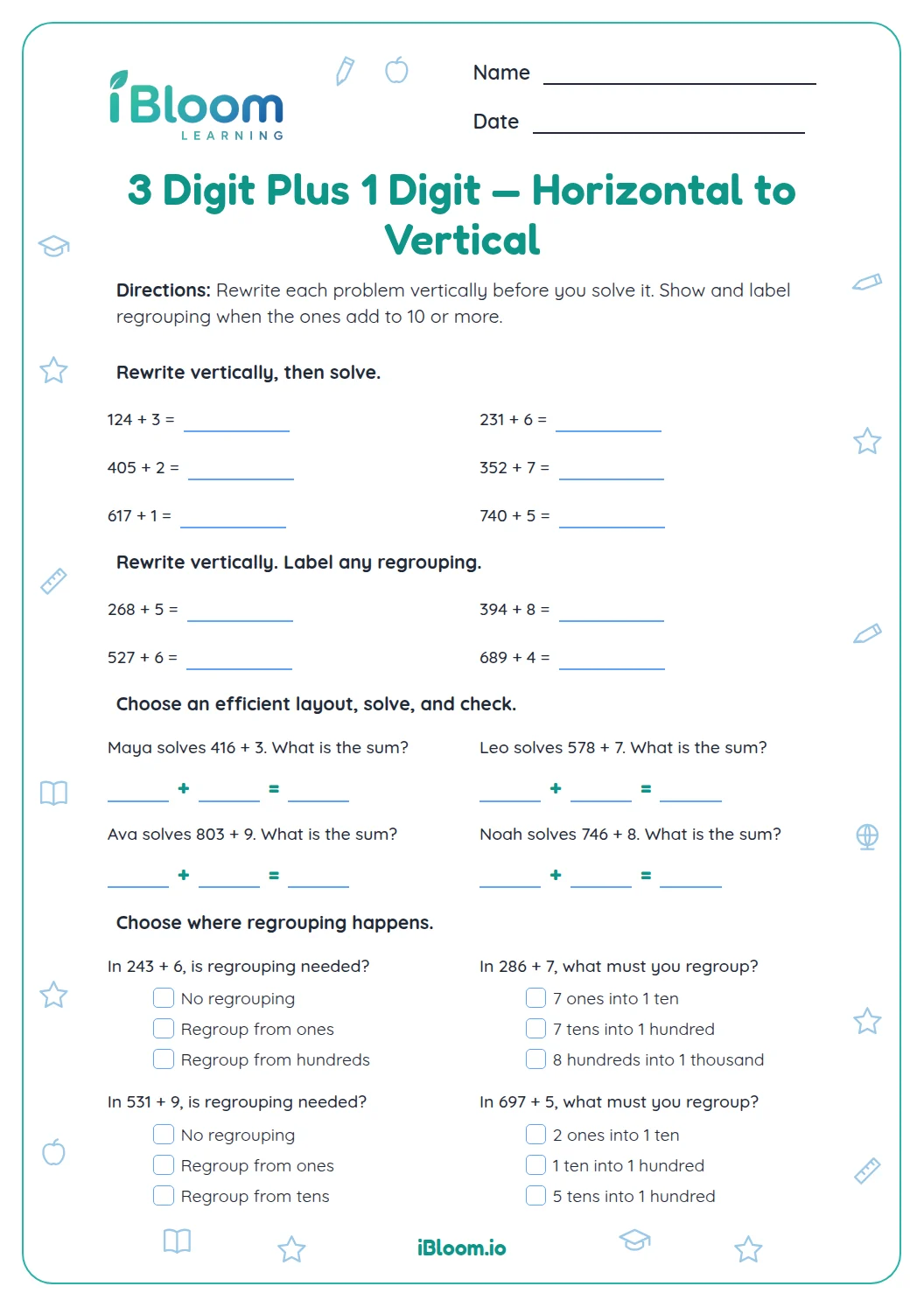
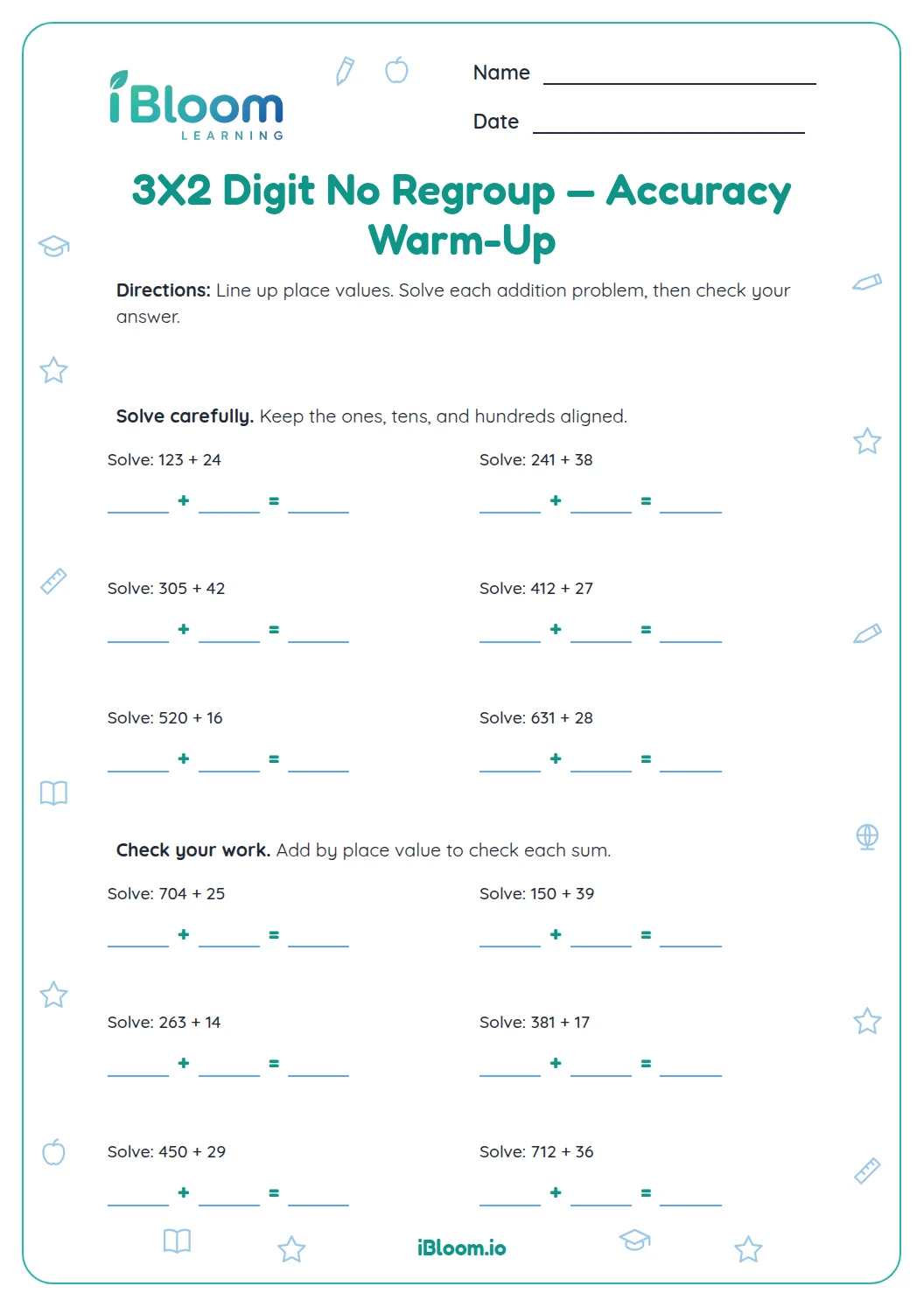
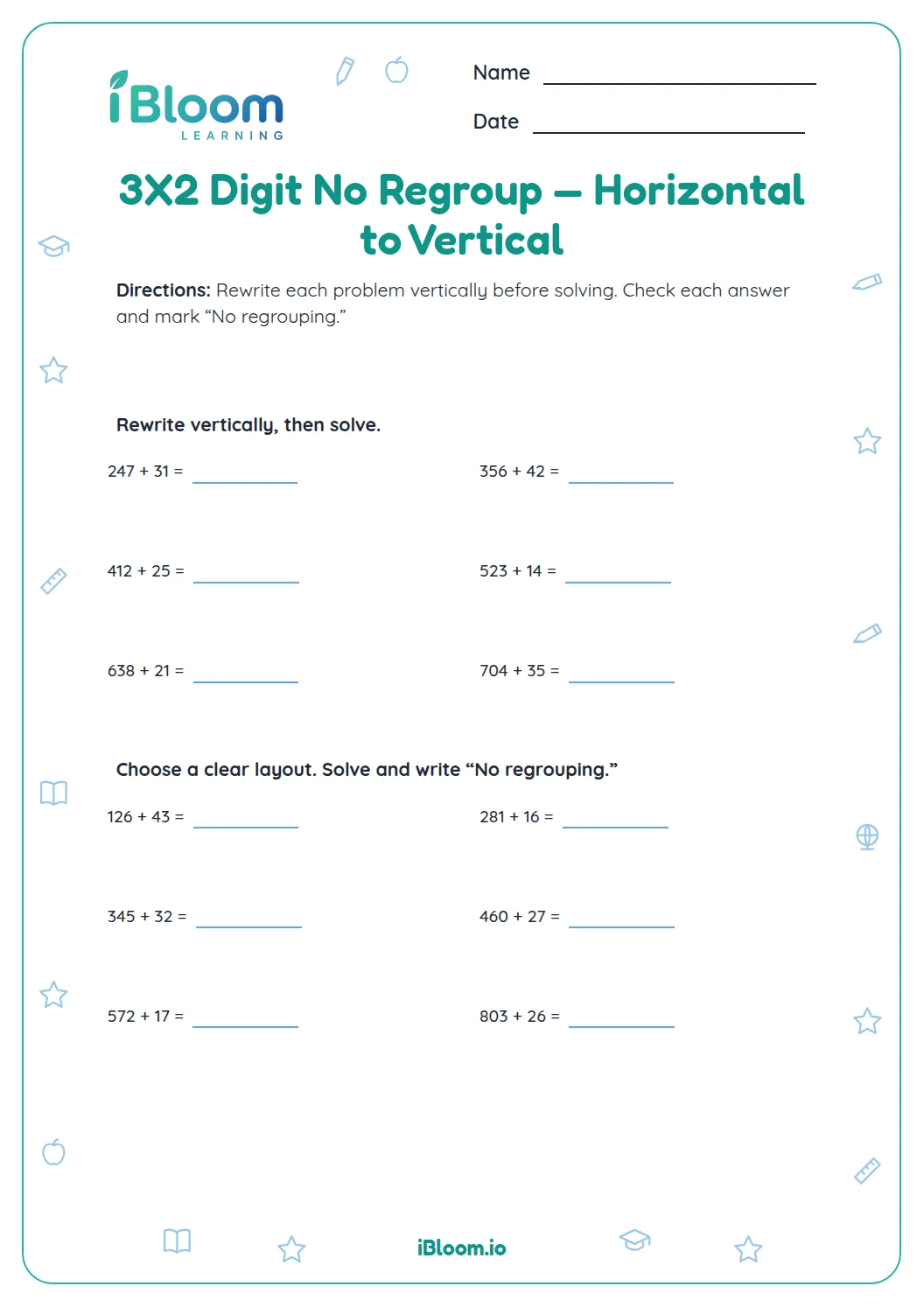
This free addition warm-up gives Grade 3 and Grade 4 students 16 chances to add a two-digit number to a three-digit number. Part A starts with four sums that keep each place value separate. Part B adds eight sums with regrouping in the ones, tens, or both columns. In Part C, students choose the correct total from three choices. The sheet practices CCSS 3.NBT.A.2 through addition within 1,000. Use it before a math lesson or as a short accuracy check, with the separate answer key ready for review.
Aligned to 3.NBT.A.2
Where does the two-digit number go?
Put the ones digit of the smaller number under the ones digit of the larger number. Its tens digit belongs under the tens digit. Leave the hundreds position empty for that addend. For 305 + 14, the 4 lines up with 5 and the 1 lines up with 0.
Part A lets children check this alignment before regrouping adds another step. A sum such as 305 + 14 = 319 also checks that the zero in 305 keeps its place.
What changes when a column totals ten or more?
Ten ones can be exchanged for one ten. Ten tens can be exchanged for one hundred. Record the new unit above the next column, then include it when adding that column. Question 9 needs both exchanges.
- 1268 + 47
- 28 + 7 = 15: write 5 ones and carry 1 ten.
- 36 + 4 + 1 = 11 tens: write 1 ten and carry 1 hundred.
- 42 + 1 = 3 hundreds. The sum is 315.
How can we check accuracy without a timer?
In Part C, solve each addition before looking at the answer choices. The alternatives include totals that lose a regrouped ten or hundred. Asking which column changed helps locate the slip.
After checking the key, redo one missed sum and say each place value aloud. For 648 + 75, the result must be greater than 648, and adding 70 then 5 gives 718 then 723.
Use a nearby ten to check whether a total makes sense. For 268 + 47, round to 270 + 50 = 320. The exact sum, 315, is close to 320. An estimate can catch a large error; recheck the columns for smaller slips.
Use the sheet step by step
- 1Read the plus sign and name the hundreds, tens, and ones in question 1.
- 2Finish Part A, using a vertical layout on scratch paper if useful.
- 3In Part B, mark each regrouped ten or hundred before moving left.
- 4Solve the four Part C sums before choosing a total.
- 5Compare with the key, check each sum with an estimate, and redo any missed addition.
Mistakes to watch for
The mistake
Lining up the 2 in 23 with the hundreds digit in 214.
The fix
Start at the right: 3 belongs under 4, and 2 belongs under 1.
The mistake
Getting 305 for 268 + 47 by forgetting the carried ten.
The fix
Include all three tens amounts: 6 tens + 4 tens + 1 ten = 11 tens.
The mistake
Getting 623 for 648 + 75 by dropping the new hundred.
The fix
After 4 + 7 + 1 makes 12 tens, add the regrouped hundred to the original 6 hundreds.
Common Core alignment
Add within 1,000 using place value and regrouping.
On this sheet: All 16 items add a two-digit number to a three-digit number, with totals below 1,000.
Show the official wordingHide the official wording
Fluently add and subtract within 1000 using strategies and algorithms based on place value, properties of operations, and/or the relationship between addition and subtraction.
What to practice next
Make more practice
Further reading
Questions parents and teachers ask
Does every sum require regrouping?
No. The first four sums keep the ones and tens totals below ten, so children can concentrate on alignment. The next eight include regrouping, and the last four ask children to select the correct sum. This progression makes the change in procedure visible without changing the number sizes.
Should I time this accuracy warm-up?
A timer is optional; begin by checking placement and regrouping. Ask your child to work carefully through the sums and explain one exchange of ten ones for one ten. If you later use a timer, compare accuracy as well as completion time and leave time to correct mistakes.
Why is 268 + 47 equal to 315?
The ones add to 15, which is one ten and five ones. The tens then total 11 because the regrouped ten joins six tens and four tens. Those 11 tens become one hundred and one ten. Together with the original two hundreds, the result is 315.
How should we use the final four questions?
Have your child calculate each sum before choosing an answer. If a choice is wrong, compare the written columns with the chosen total to find the missing ten or hundred. The answer key marks the correct option, so you can check the selection after discussing the computation.
What is included in the printable?
The printable has 16 questions and a separate answer key. Twelve questions ask for a sum, followed by four multiple-choice checks. The numbers include zeros, sums that stay within the same hundred, and sums that cross into the next hundred, giving several ways to check careful place-value work.