
About this worksheet
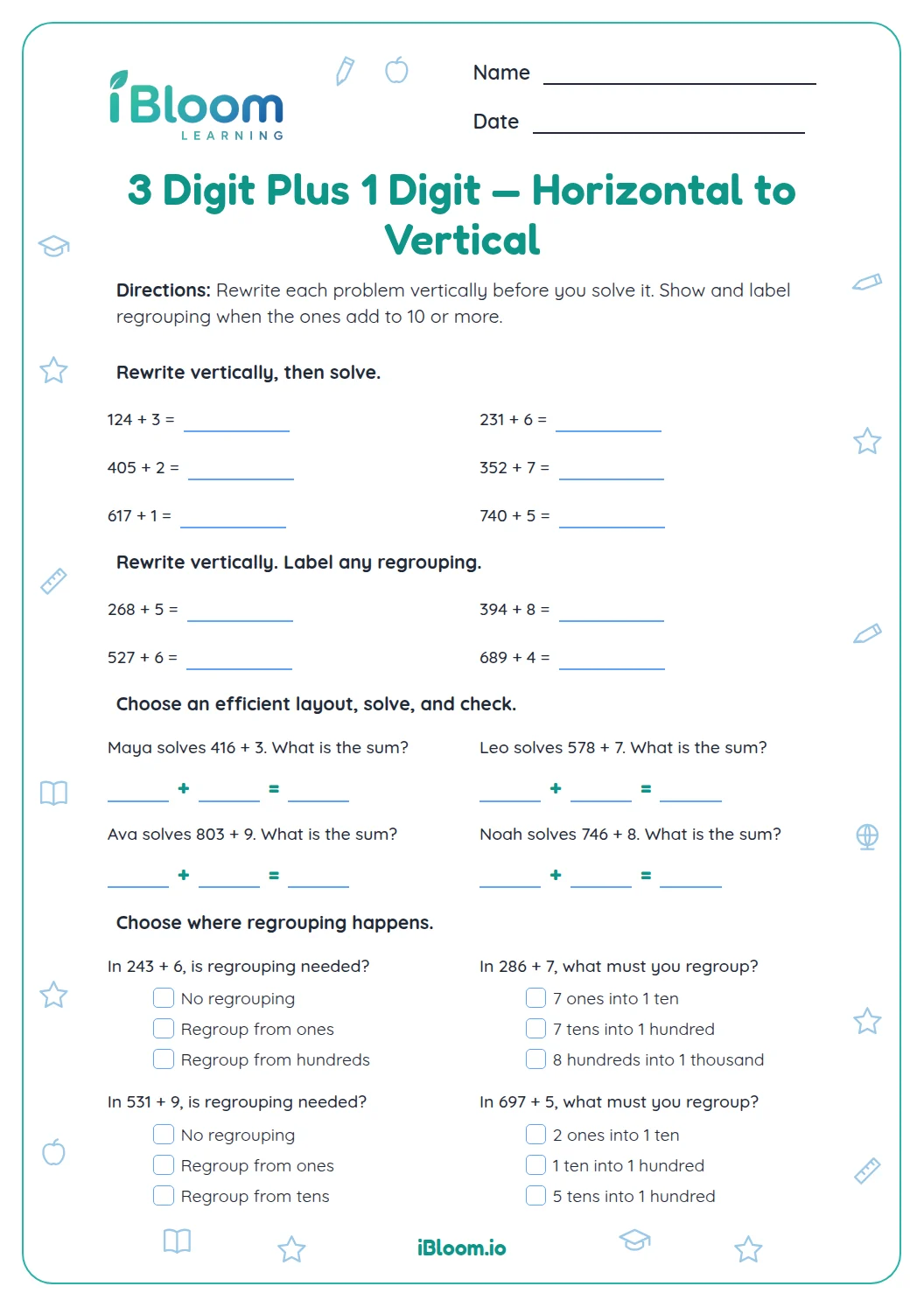
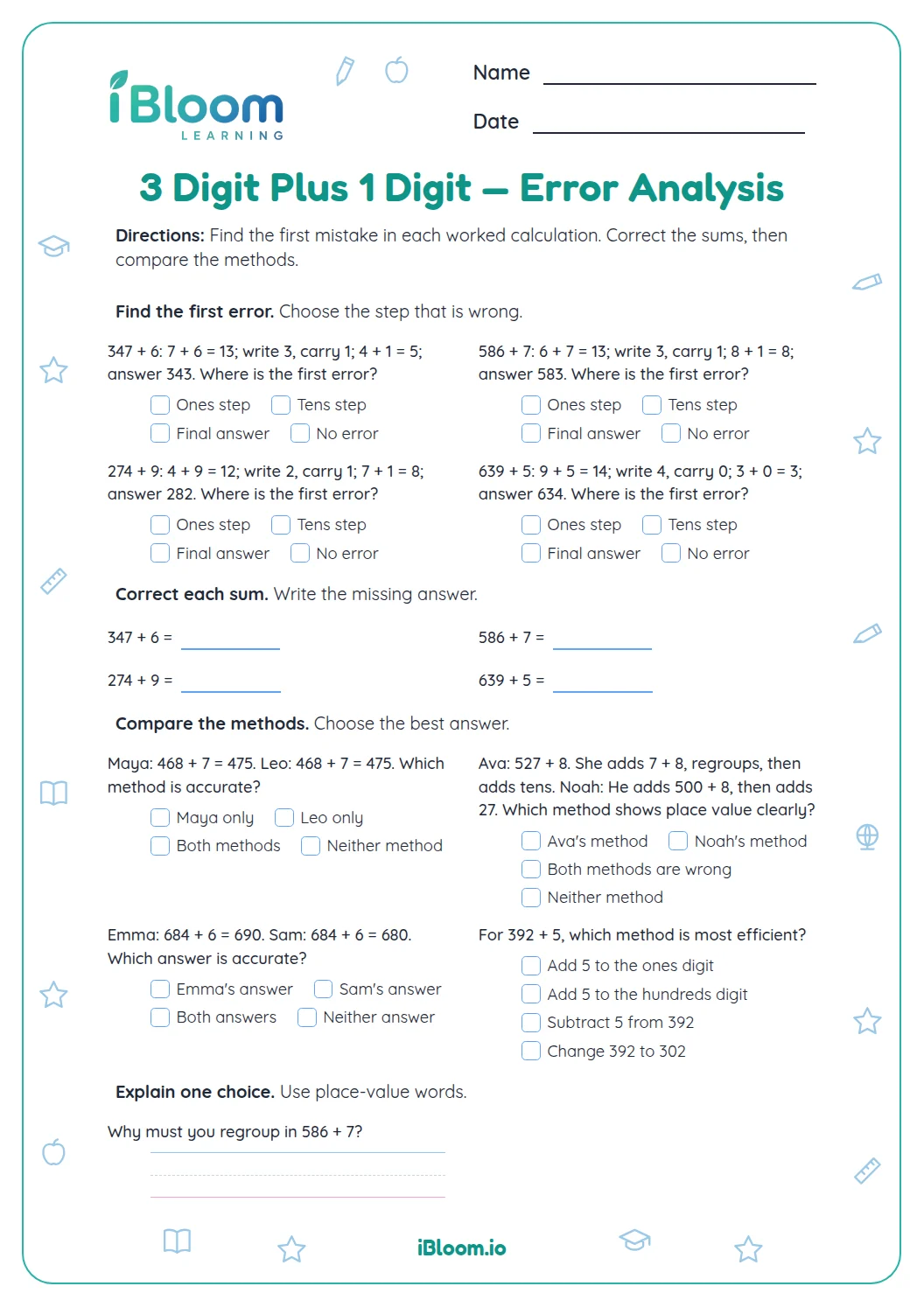
This Grade 3 addition worksheet gives students 16 three-digit plus one-digit problems to solve in column form. The addends vary so children must attend to the ones place and carry a new ten when the ones make ten or more. The working space supports lining up digits and recording regrouping. The practice aligns with CCSS 3.NBT.A.2, which calls for fluently adding and subtracting within 1,000 using strategies and algorithms based on place value. An answer key is included.
Aligned to 3.NBT.A.2
What does this column practice cover?
The problems all combine a three-digit number and a one-digit addend. Some ones digits make a new ten; others do not, so students need to inspect each sum rather than use one memorized carry pattern.
When should a student regroup?
Regroup when the ones add to ten or more. In 247 + 6, the ones are 7 + 6 = 13. Write 3 ones and add 1 ten to the tens place.
- 1 247
- 2+ 6
- 3The ones make 13: write 3 ones and regroup 1 ten.
- 4247 + 6 = 253
How can students check each sum?
Estimate whether the result should be just above the three-digit addend, then add the one-digit number again. Check that a carried ten was added to the tens place.
A clear column method
- 1Write the one-digit number beneath the ones digit.
- 2Add the ones digits first.
- 3If the ones total is 10 or more, write the ones digit and regroup one ten.
- 4Add that regrouped ten to the tens place.
- 5Read the full answer and check it by adding once more.
Common addition slips
The mistake
Putting the one-digit addend under the tens digit.
The fix
Line up the rightmost digits so both addends share the ones column.
The mistake
Writing 13 in the ones place when 7 + 6 = 13.
The fix
Write 3 ones and regroup 1 ten to the tens column.
The mistake
Forgetting the regrouped ten in the tens column.
The fix
Mark the small carried 1 clearly, then include it in the next column.
Common Core alignment
The problems use place-value reasoning and addition within 1,000.
Add within 1,000 using place-value strategies and algorithms.
On this sheet: Each problem adds a one-digit number to a three-digit number, with regrouping recorded by place value.
Show the official wordingHide the official wording
Fluently add and subtract within 1000 using strategies and algorithms based on place value, properties of operations, and/or the relationship between addition and subtraction.
What to practice next
Make more practice
Further reading
Questions parents and teachers ask
How many problems are on this column addition sheet?
There are 16 problems, each adding a one-digit number to a three-digit number. Students solve them in column form, aligning the ones digits and regrouping when the ones total reaches ten or more. The separate key lists all sums.
Does every problem require regrouping?
No. The set includes sums that do and do not require regrouping, so students should check the ones column on every problem. When the ones total reaches ten or more, they write the ones digit and carry one ten.
What does “line up the ones” mean?
The one-digit addend goes directly beneath the rightmost digit of the three-digit number. This aligns ones under ones, so each digit is added in its correct place. Then any regrouped ten can be carried to the tens column.
What is the answer to 247 plus 6?
247 + 6 = 253. The ones add to 13, so the student writes 3 ones and regroups 1 ten. Add that regrouped ten to the tens place to complete the sum, then check by subtracting 6 from 253.
Can this worksheet be timed?
It can be used for a short fluency check after students understand the method, but accuracy and clear place-value setup matter first. The page itself does not require a time limit, and the answer key can be used for review.