


About this worksheet
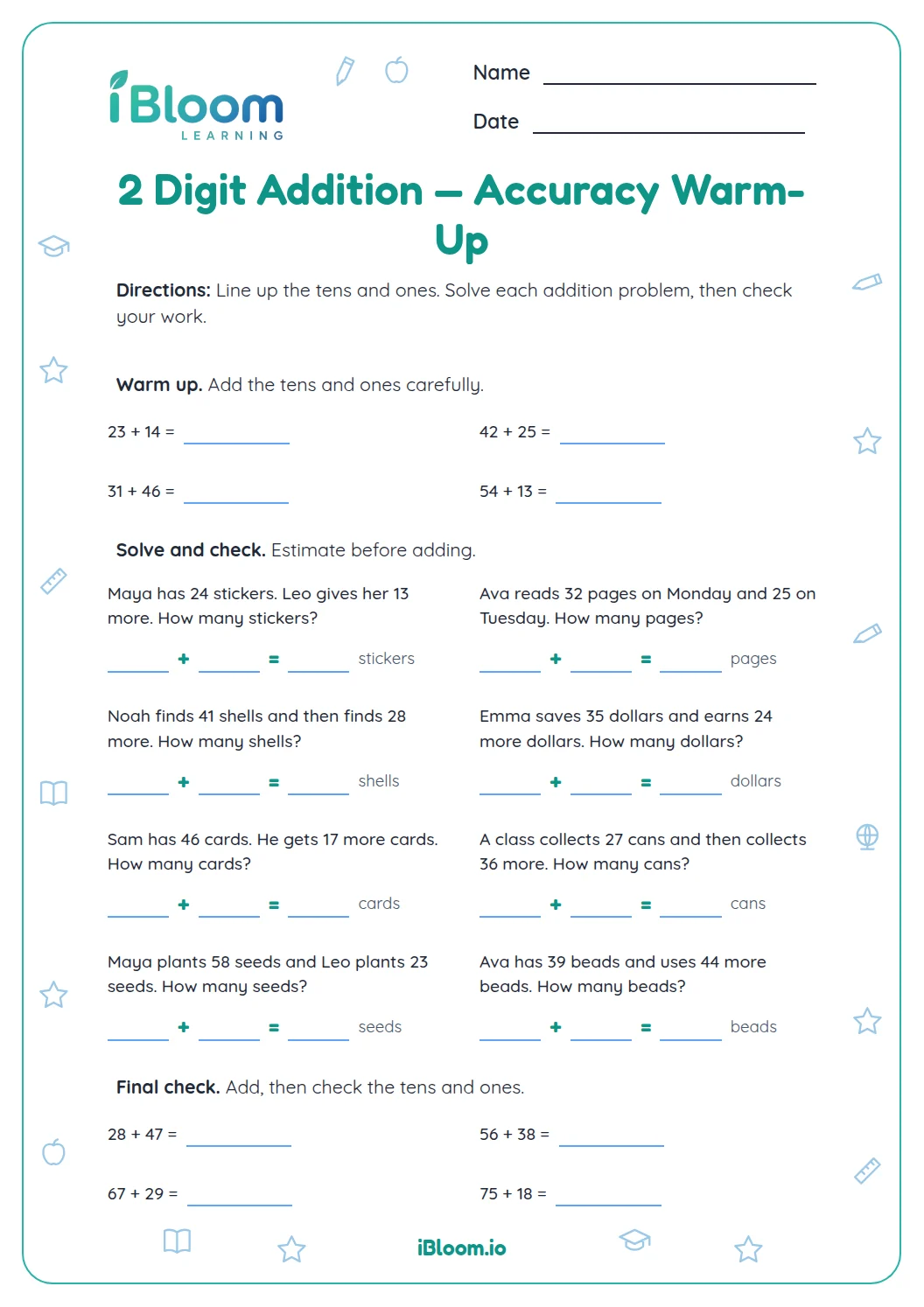
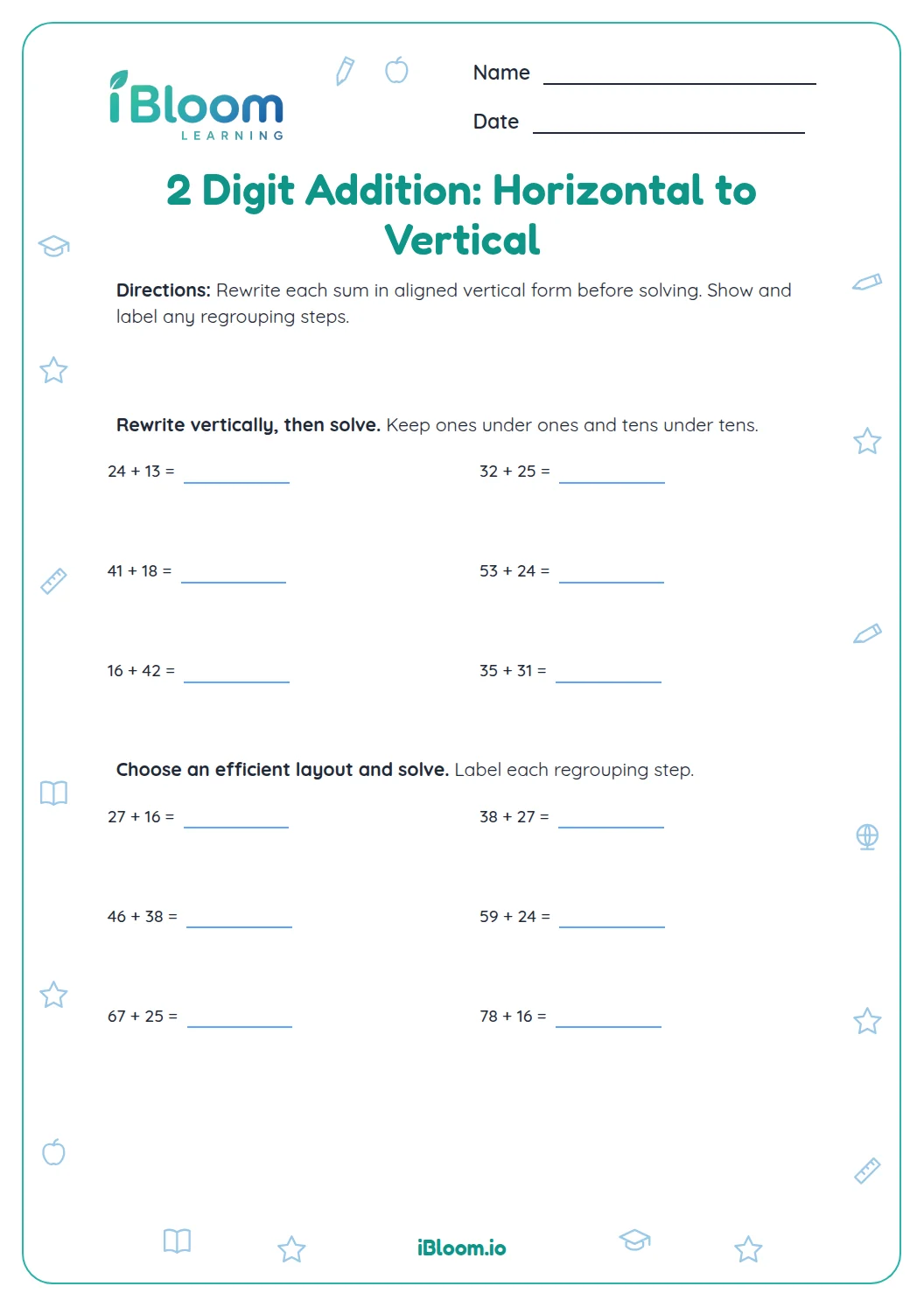
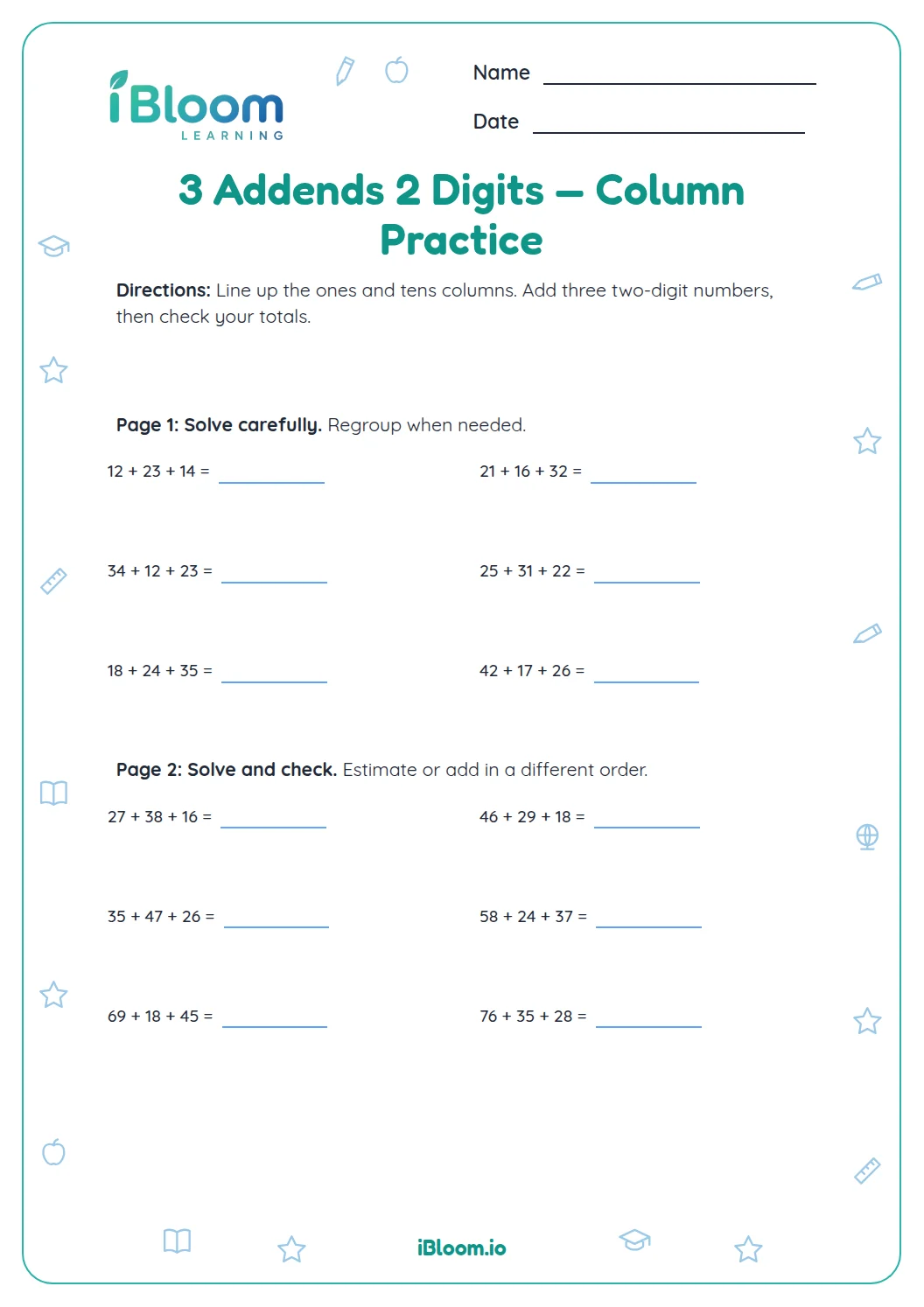
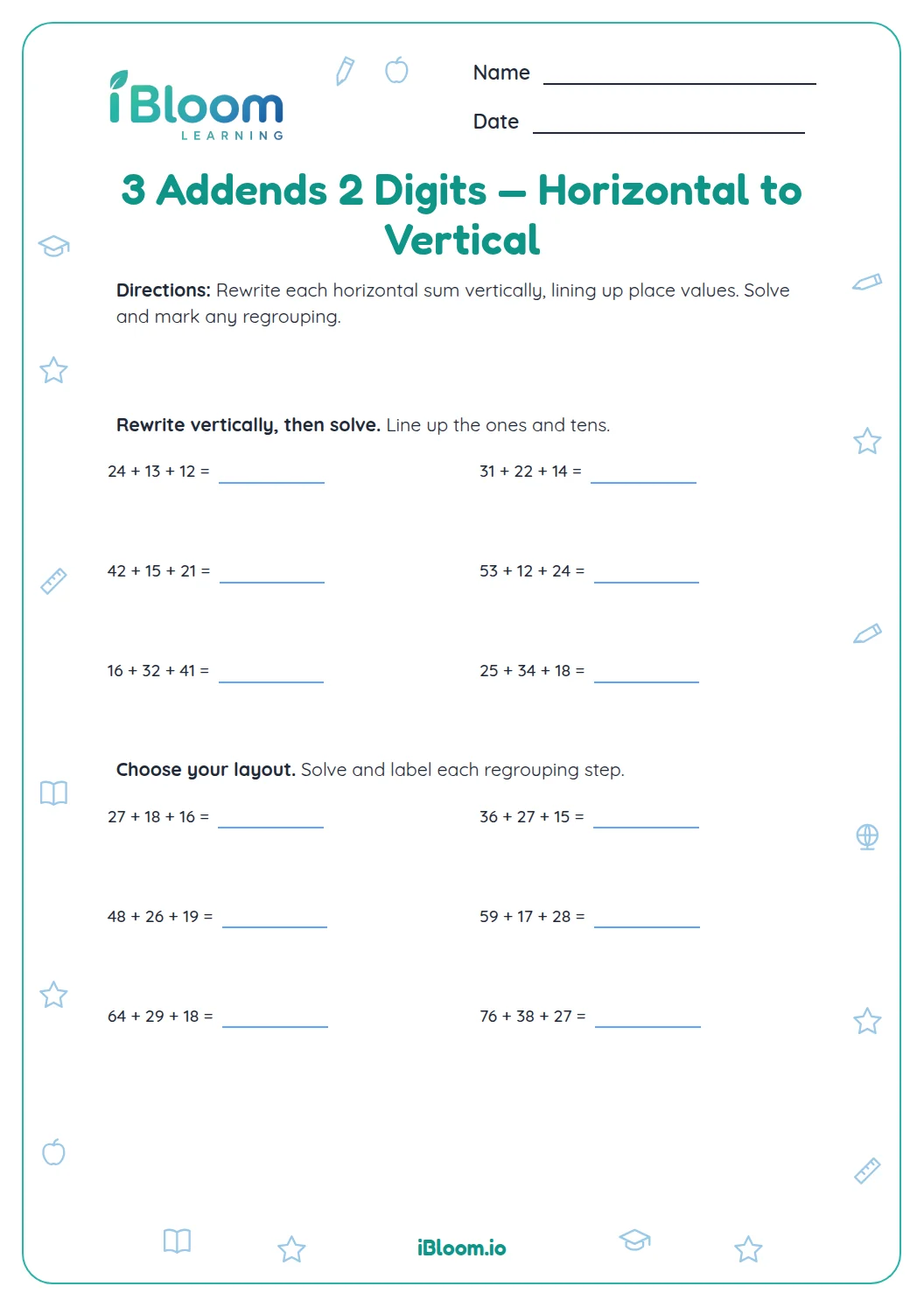
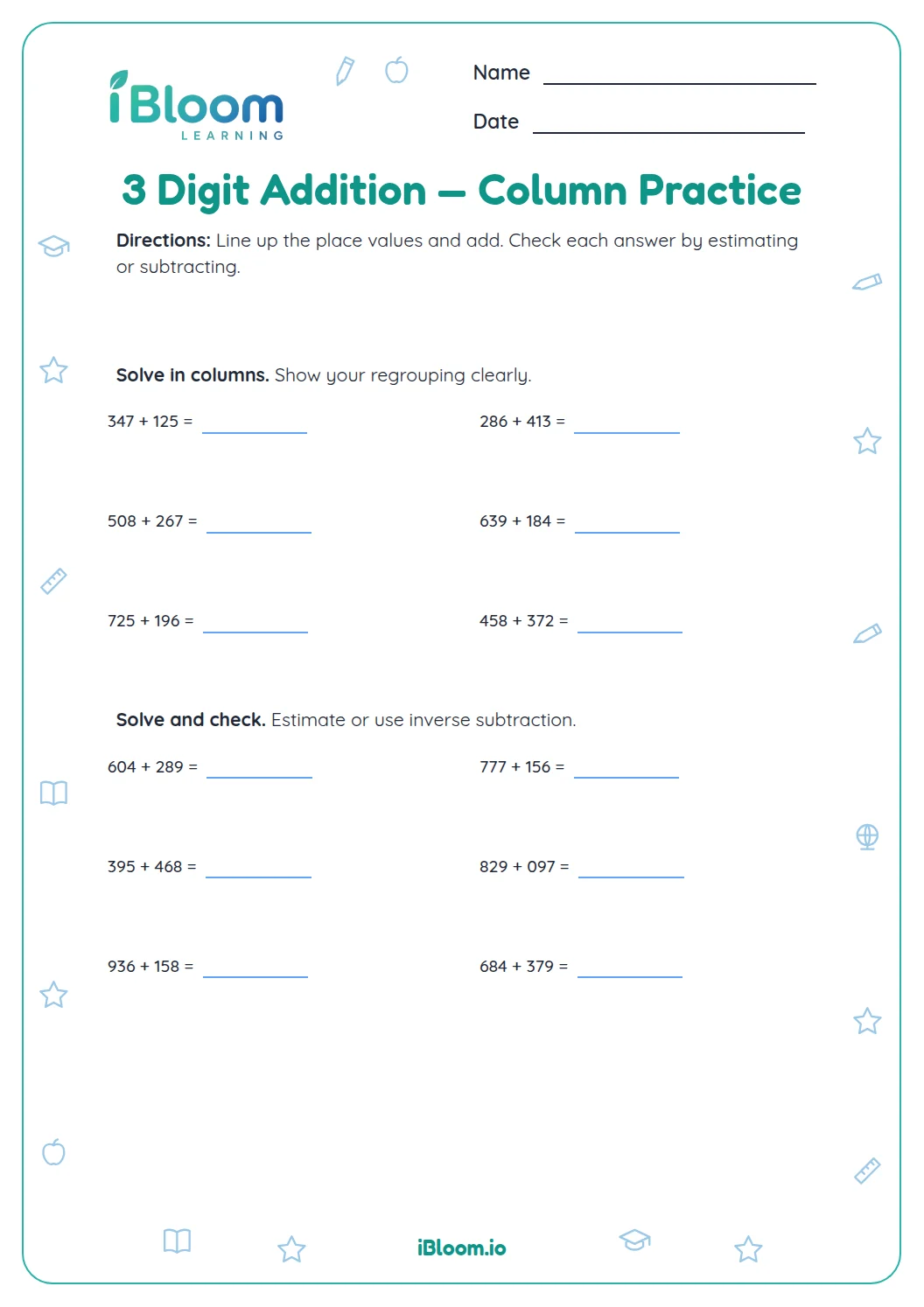
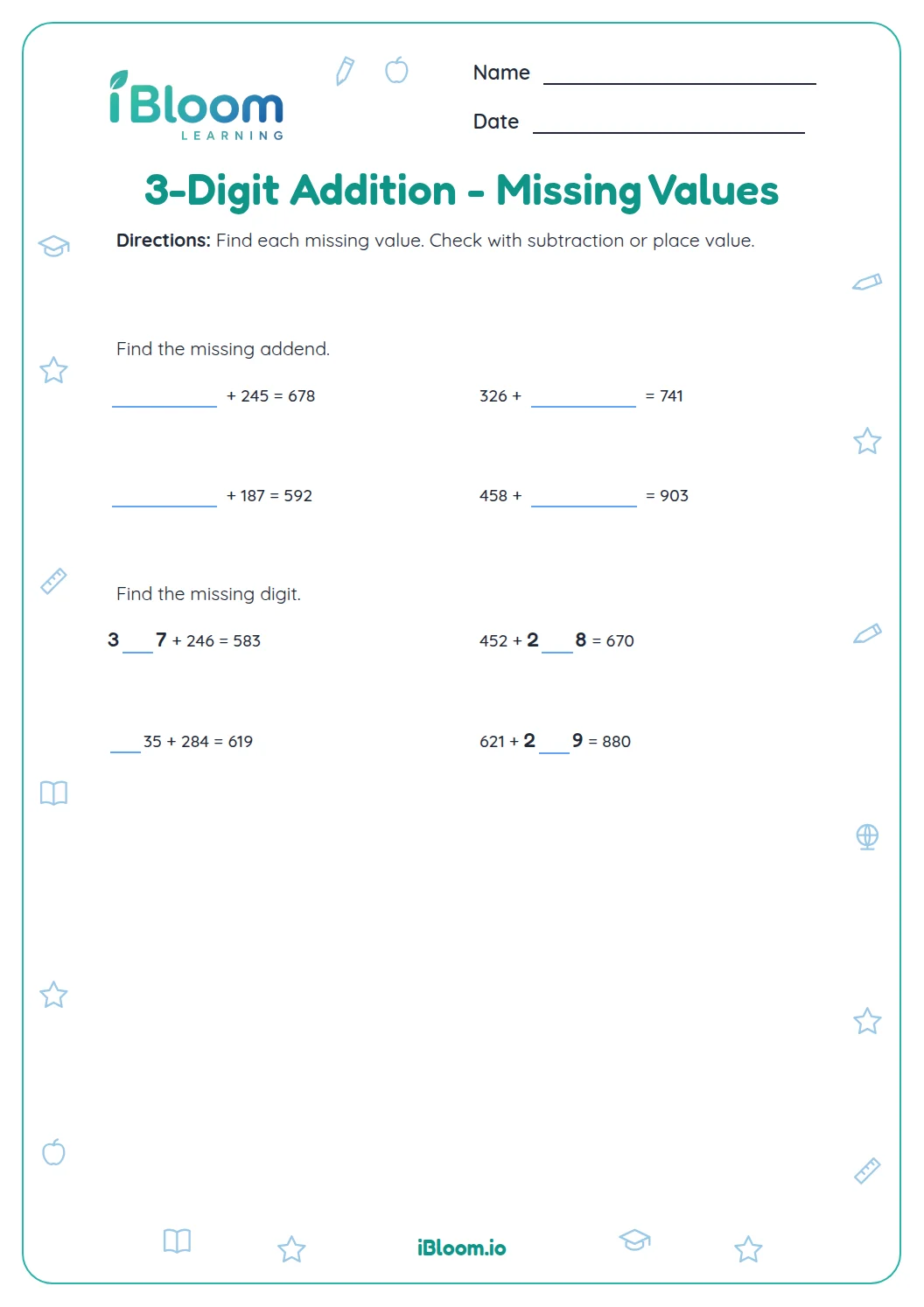
This free printable worksheet gives Grade 2 and Grade 3 students column practice adding two 2-digit numbers, with and without regrouping. Children add six sums that need no regrouping, follow the regrouping steps for 47 + 28, add six more in a column with working space, and fix two friends' mistakes. Every sum stays under 100. It practices Common Core 2.NBT.B.5, and an answer key is included.
Aligned to 2.NBT.B.5
How do you add two 2-digit numbers in columns?
Write the numbers so the ones sit above the ones and the tens above the tens. Add the ones column first, then the tens column. Starting with the ones matters, because ones can make a new ten.
If the ones total 10 or more, write the ones digit and carry the extra ten to the tens column. In 47 + 28, 7 + 8 = 15 ones, which is 1 ten and 5 ones. Write 5 in the ones place, and add the 1 ten to 4 + 2 for 7 tens.
- 147 + 28
- 2Ones: 7 + 8 = 15 ones = 1 ten and 5 ones
- 3Tens: 4 + 2 + 1 = 7 tens
- 447 + 28 = 75
What does regrouping mean, and why does the 1 get carried?
Ten ones are worth the same as one ten, so 15 ones can be traded for 1 ten and 5 ones. The carried 1 is that new ten, and it belongs with the other tens, not with the ones.
Part B walks through one problem in four small steps so children can see where each digit of 75 comes from. Part C then asks them to do the same work on their own six times, and every one of those sums needs a regroup.
What is on this worksheet?
Eighteen questions in four parts, with sums from 37 to 95.
- Part A: six sums to add ones then tens, with no regrouping (such as 23 + 14 and 31 + 57)
- Part B: four steps that break 47 + 28 into ones, regrouping, tens and the final sum
- Part C: six problems with working space and an answer box, each needing a regroup (56 + 29, 38 + 46, 57 + 36, 49 + 37, 68 + 27, 29 + 47)
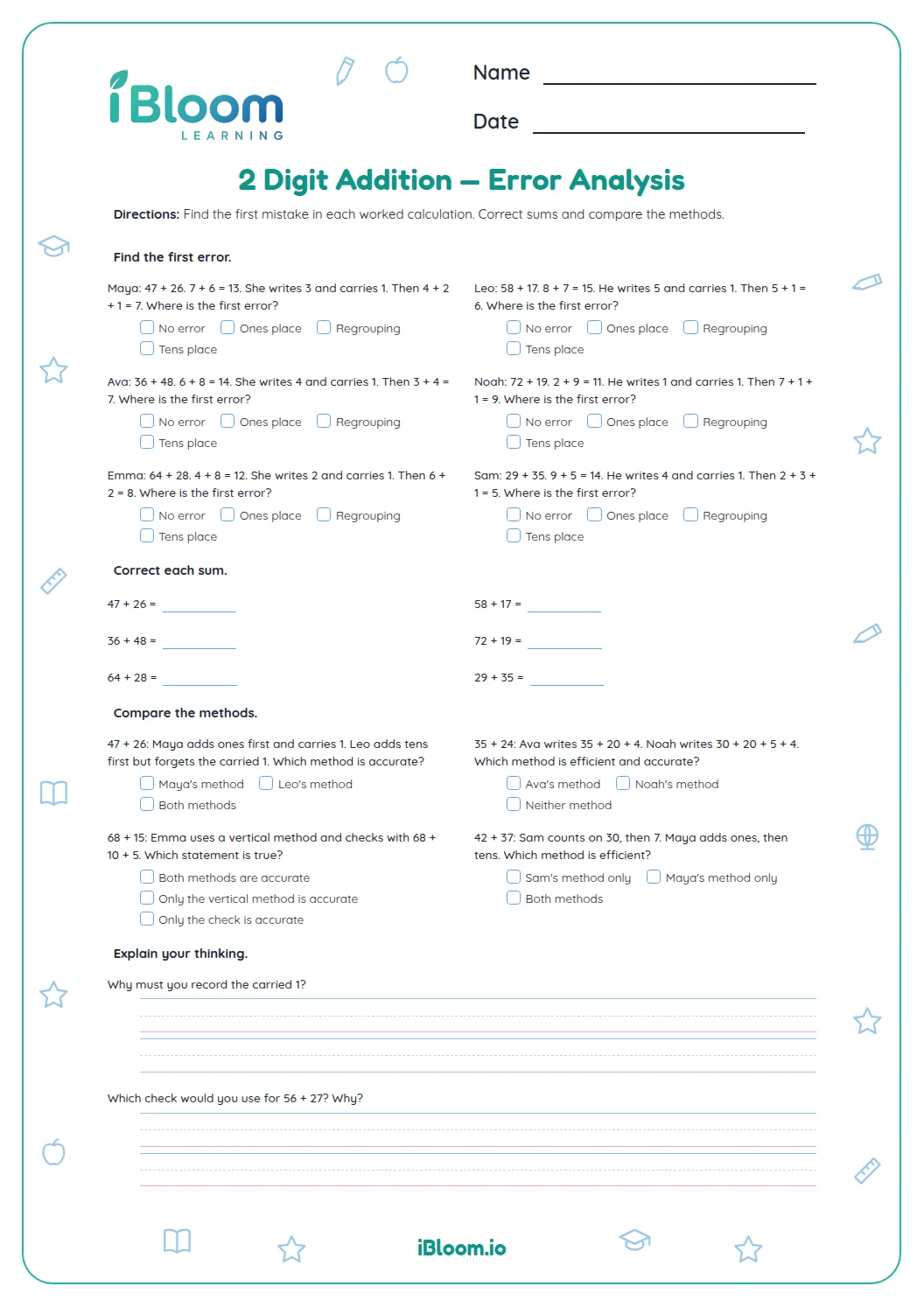
- Part D: two friends' answers to check, each with a forgotten ten
- Answer key on a separate page
How can children check a 2-digit sum?
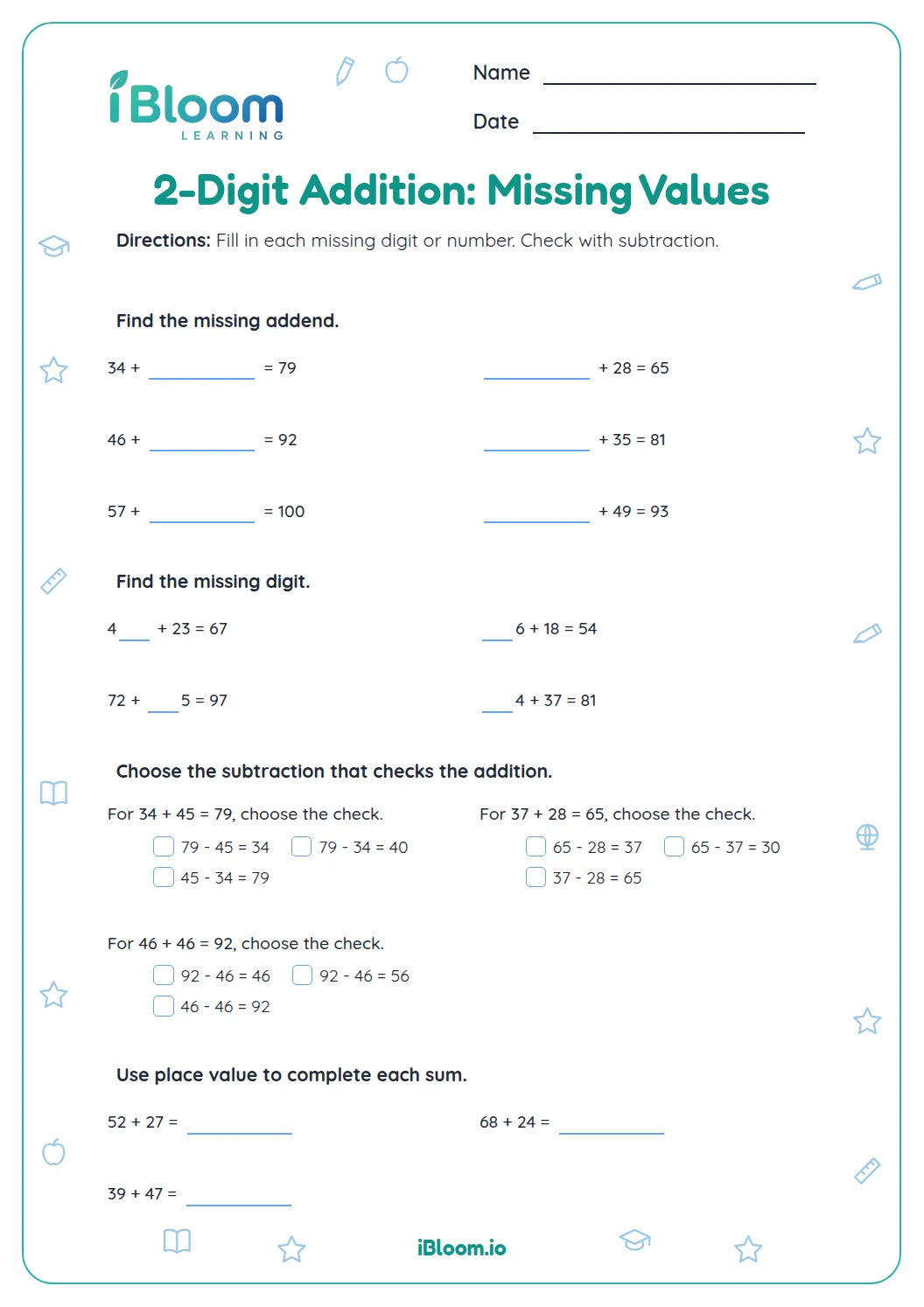
Round to the nearest ten and see whether the answer is close: 63 + 29 is about 60 + 30 = 90, so Maya's 82 is too small. Children can also subtract one addend from the sum, or add the numbers in a different order, to see if the same total comes back.
In Part D, both mistakes have the same cause: the ten made by regrouping was forgotten.
How to use this worksheet at home or in class
- 1Warm up with ten-frames or base-ten blocks: show 7 ones and 8 ones and trade ten of them for one ten rod.
- 2Do question 1 together, saying “ones first, then tens.”
- 3Let your child finish Part A alone, then work through Part B step by step, saying each step aloud.
- 4In Part C, have your child write the numbers in neat columns in the working space, with the carried ten written small above the tens.
- 5Before choosing in Part D, ask: “Is the answer about 90? Did anyone forget the extra ten?”
- 6Mark with the answer key and redo any missed problem with blocks or drawings of tens and ones.
Common mistakes and quick fixes
The mistake
Forgetting the regrouped ten, as in 63 + 29 = 82 or 48 + 25 = 63 (Part D).
The fix
Write the carried 1 above the tens column before adding. Then add three numbers in the tens: 6 + 2 + 1 = 9.
The mistake
Writing both digits of the ones total, such as 47 + 28 = 615.
The fix
Ones can hold only one digit. Write the 5 in the ones place and move the 1 to the tens.
The mistake
Adding all four digits across, such as 23 + 14 as 2 + 3 + 1 + 4.
The fix
Add only digits in the same place: ones with ones (3 + 4) and tens with tens (2 + 1).
Common Core alignment
Most US states use the Common Core standards or a close state version. This Grade 2 standard describes what the sheet practices.
Add within 100 using place value: ones with ones, tens with tens, regrouping when needed.
On this sheet: Every question adds two 2-digit numbers by place value, with sums up to 95.
Show the official wordingHide the official wording
Fluently add and subtract within 100 using strategies based on place value, properties of operations, and/or the relationship between addition and subtraction.
What to practice next
Make more practice
Further reading
Questions parents and teachers ask
What is regrouping in addition?
Regrouping means trading 10 of one place value for 1 of the next. When ones add up to 10 or more, 10 ones become 1 ten. In 47 + 28 the ones make 15, so the answer has 5 ones and one extra ten, which is added to the tens column. Part B walks through this.
Why do we add the ones before the tens?
The ones can make a new ten, and that ten has to be counted with the tens. If children add the tens first, they would need to go back and change the tens after seeing the ones. Starting with the ones means each column is done once, from right to left.
How is this worksheet different from other 2-digit addition drills?
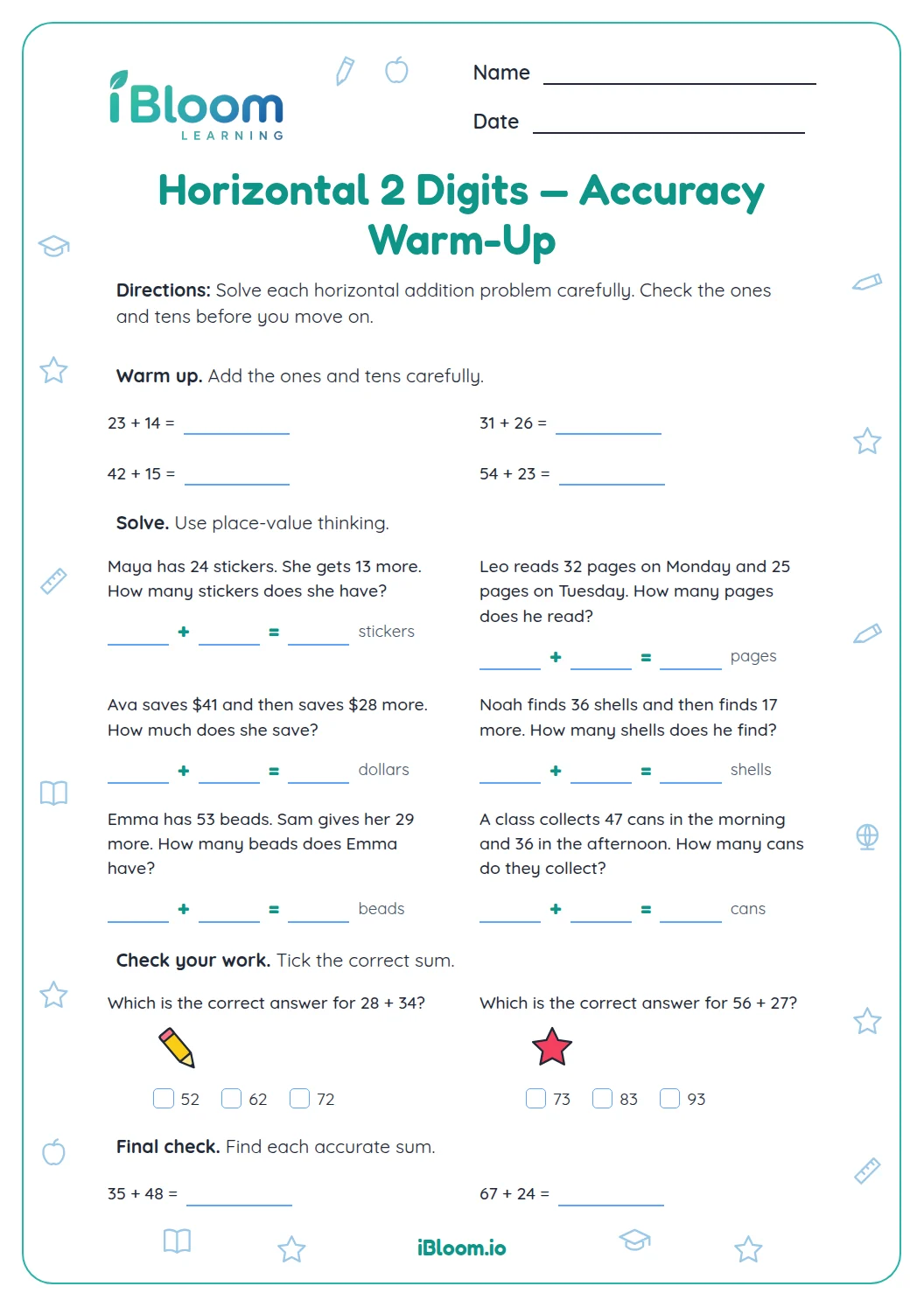
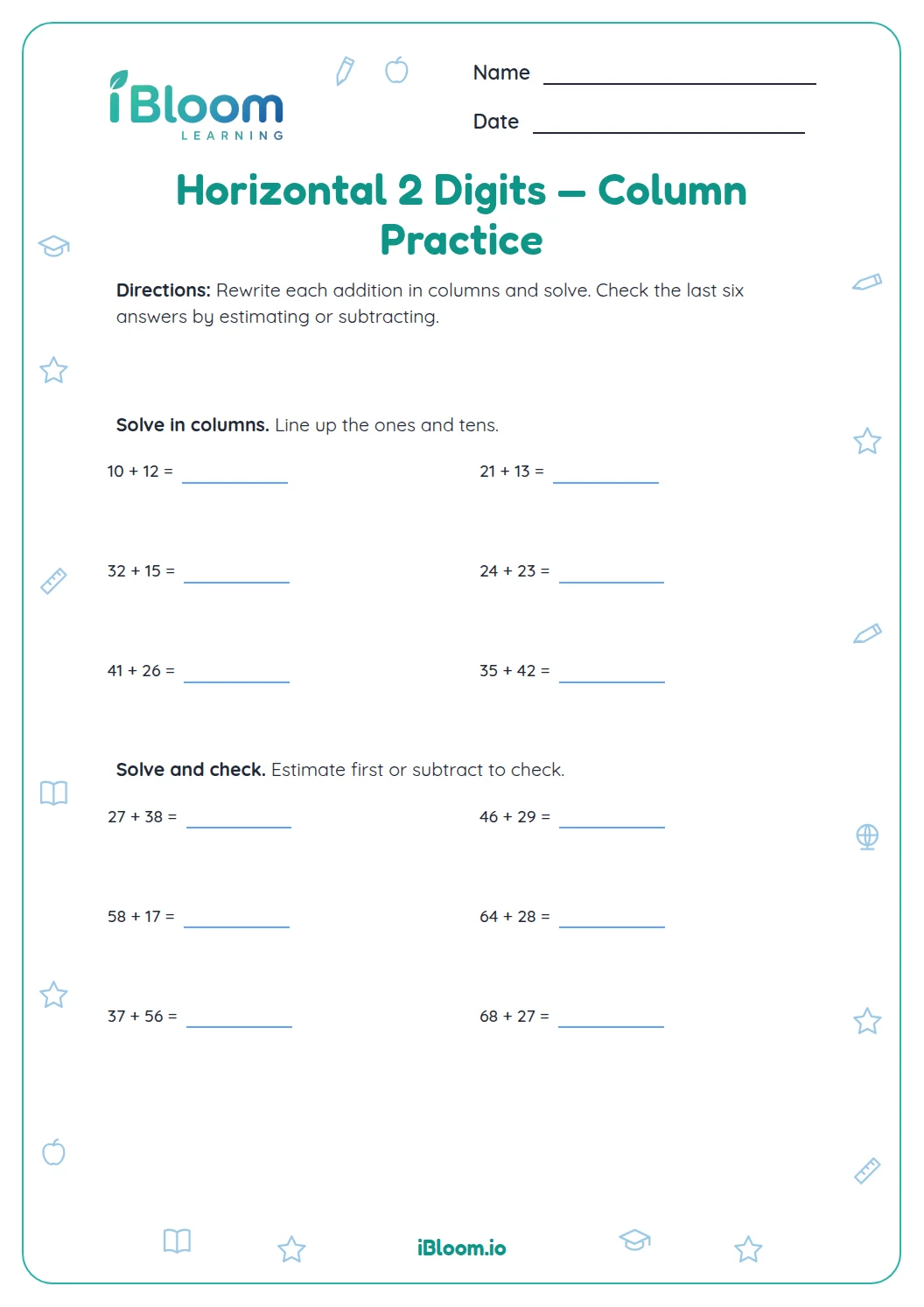
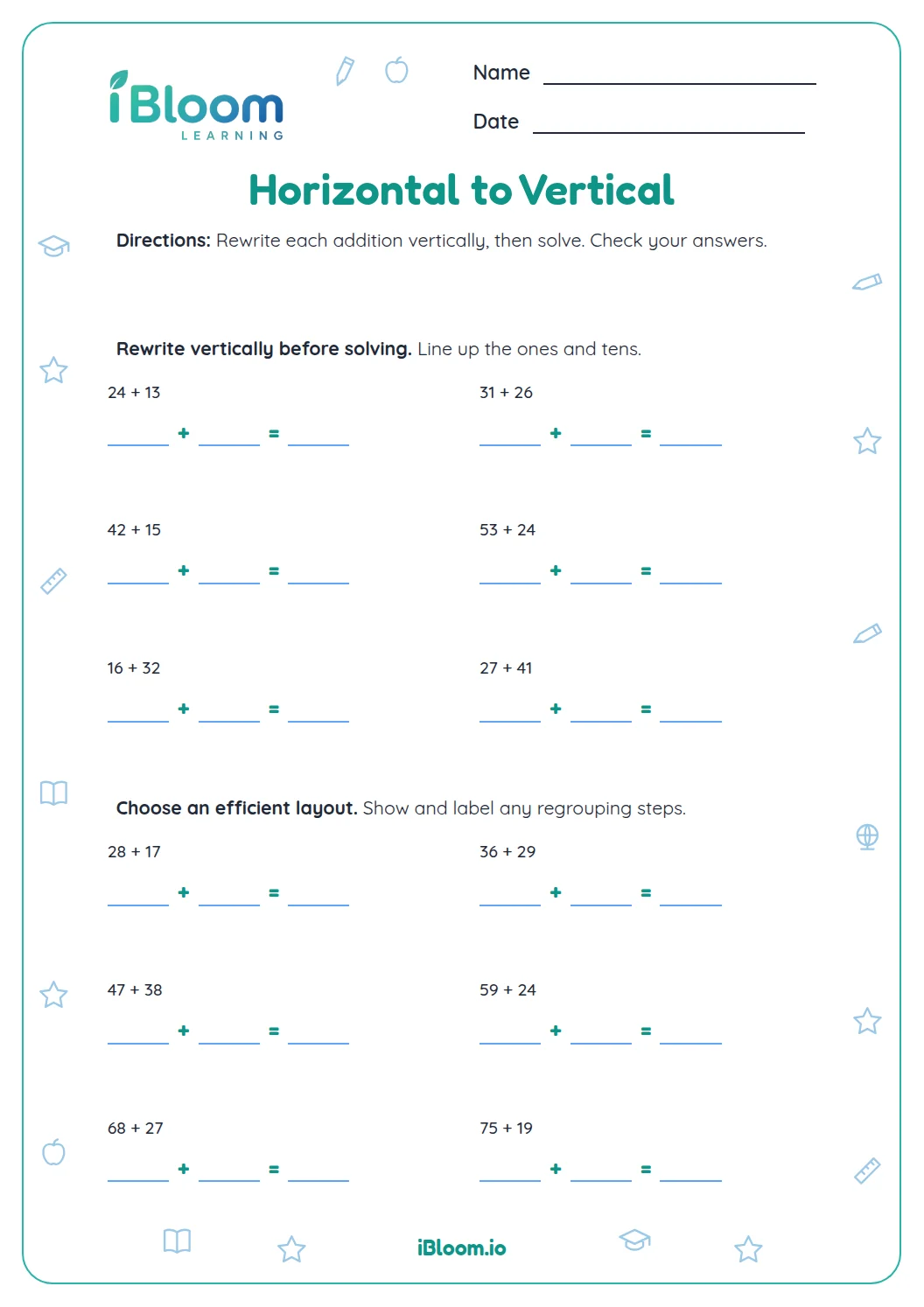
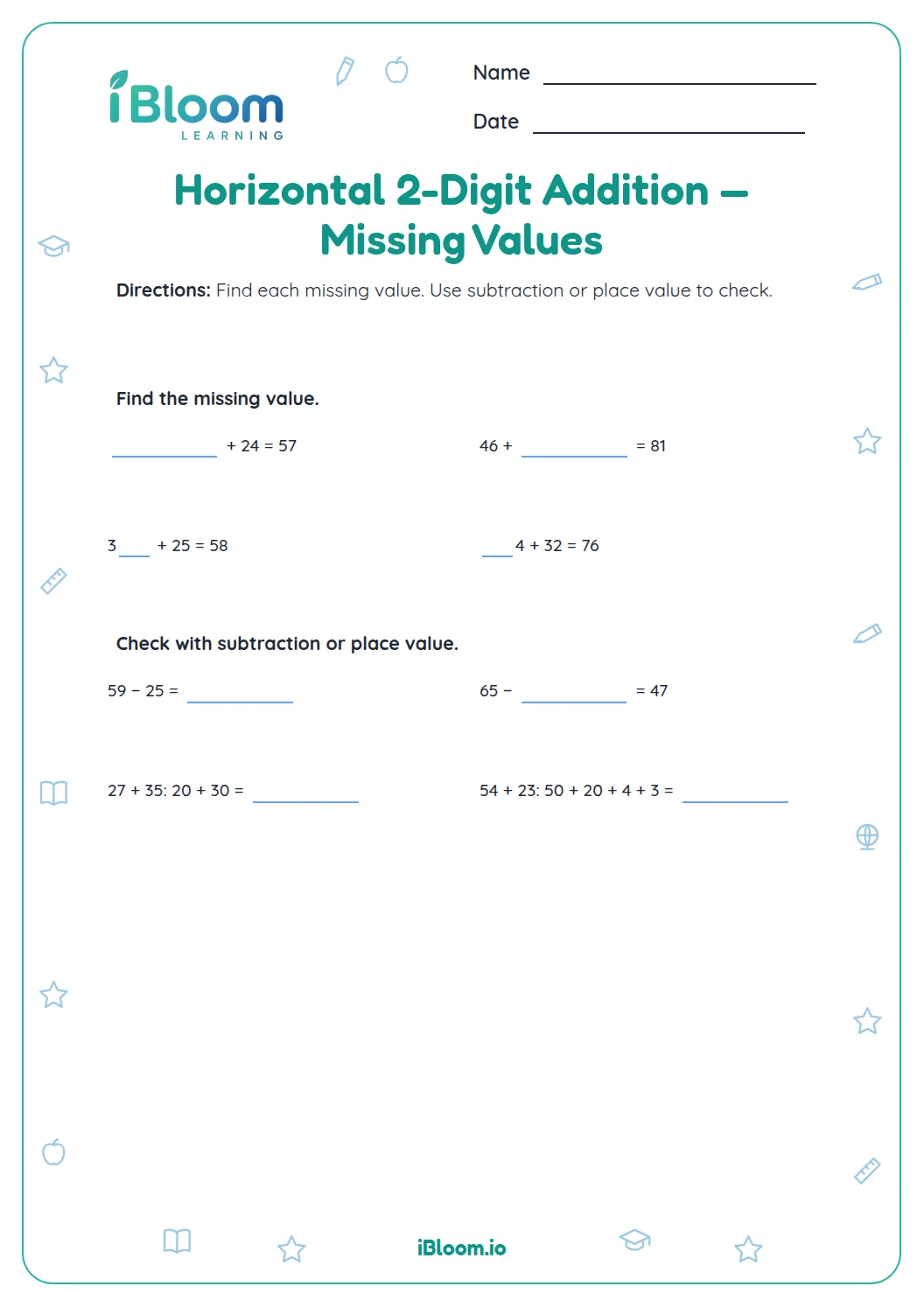
It is built around columns and regrouping. Part B breaks one sum into four small steps, Part C gives working space to write six sums in columns, and Part D shows two answers where a ten was forgotten. Practice with side-by-side sums is on the Horizontal 2 Digits worksheets.
Which questions need regrouping?
Every question from 7 on. The six sums in Part A, questions 1 to 6, have ones that add to 9 or less, so children can practice lining up the columns first. Part B then shows one regroup step by step, and every sum in Parts C and D, such as 68 + 27, makes 10 or more ones.
What is the quickest way to find the mistake in Part D?
Estimate by rounding first. For 63 + 29, think 60 + 30 = 90, so 82 is too small. For 48 + 25, think 50 + 25 = 75, so 63 is too small. Then add again in columns and look for the ten that was forgotten when the ones made more than 9.
Is there an answer key for this worksheet?
Yes. A separate answer key shows every sum, the four regrouping steps for 47 + 28, and the right sums for the two friends' mistakes in Part D. Print the worksheet pages by themselves and keep the key for checking, then redo any missed sum with blocks or a drawing.