


About this worksheet
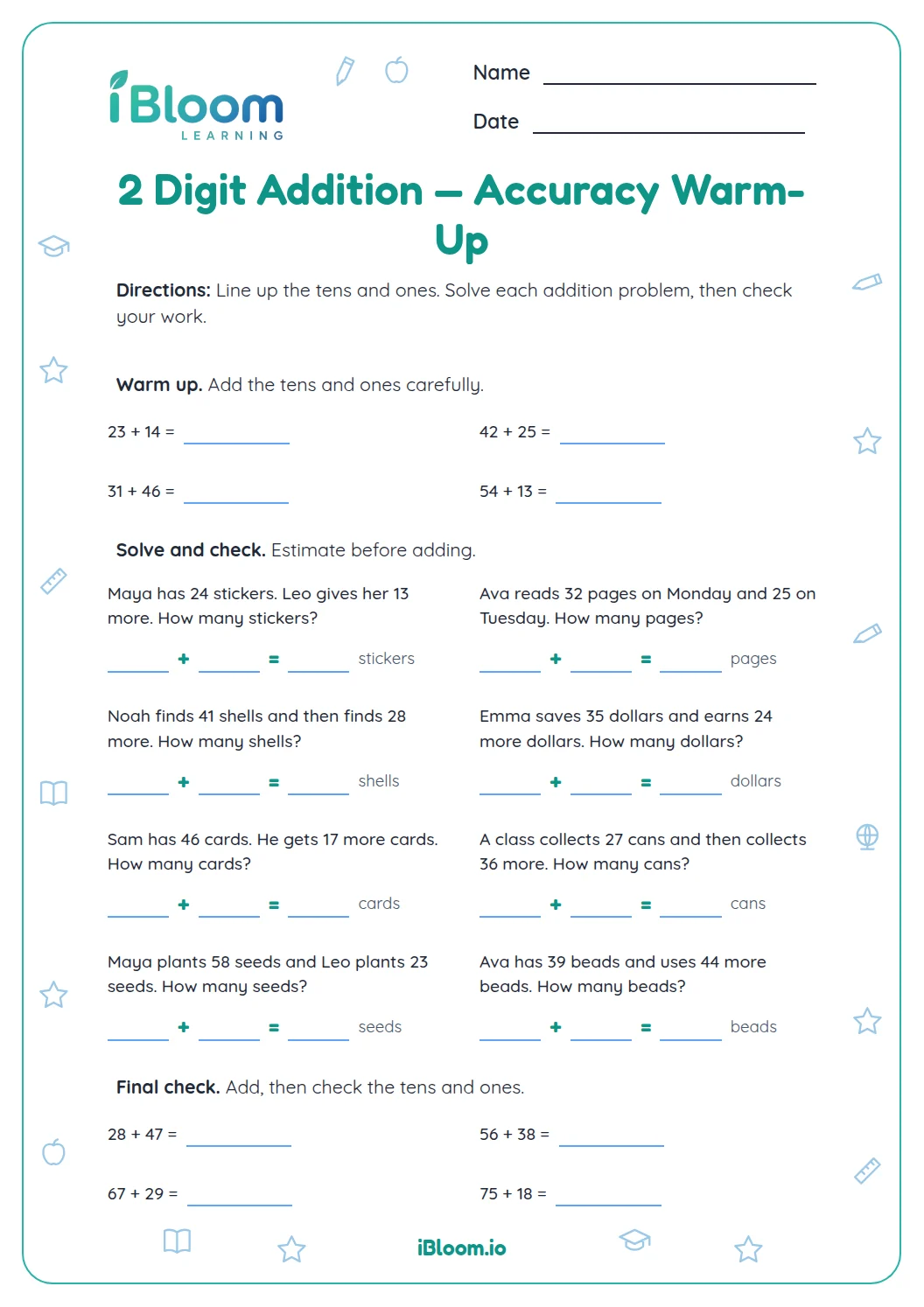
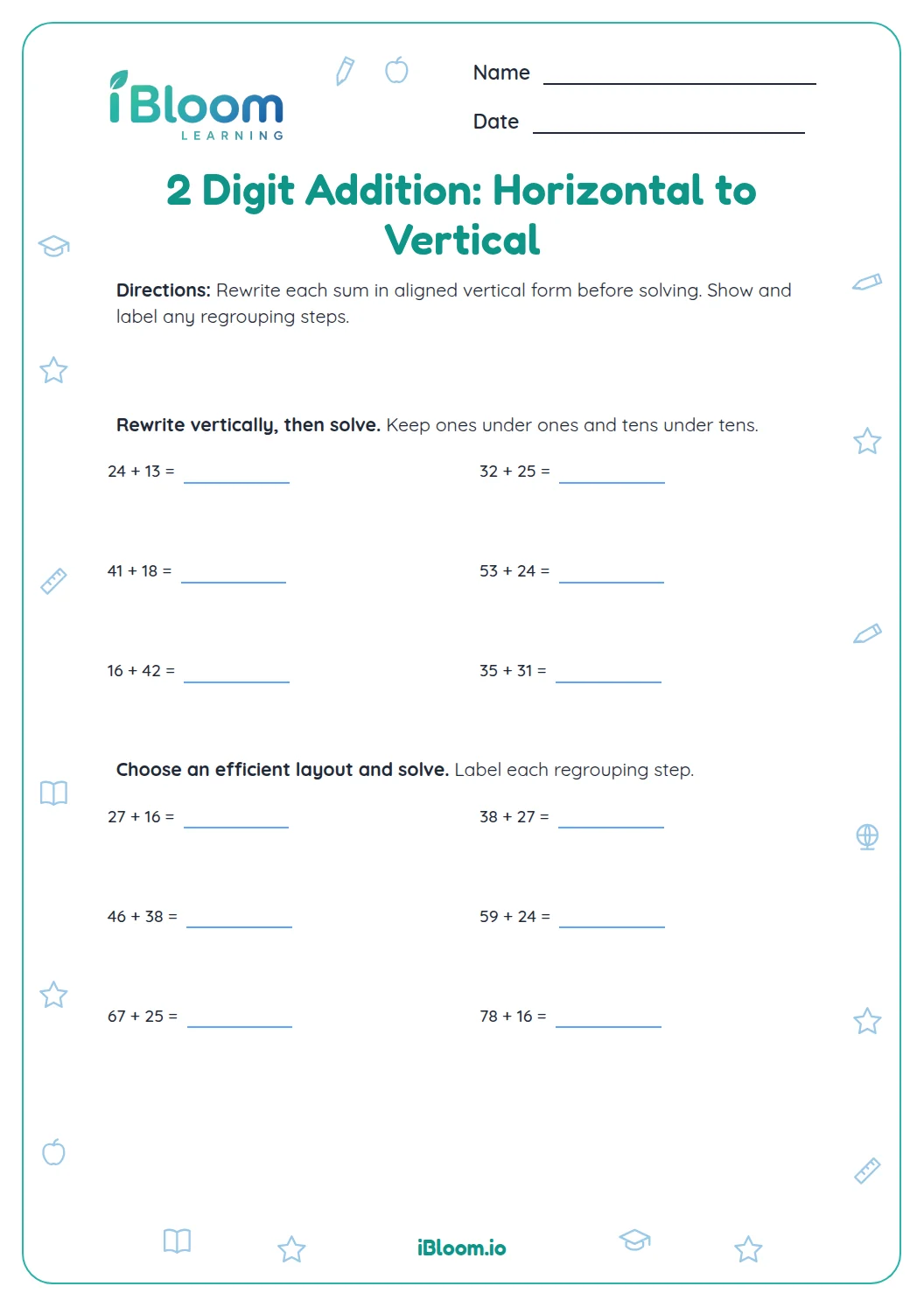
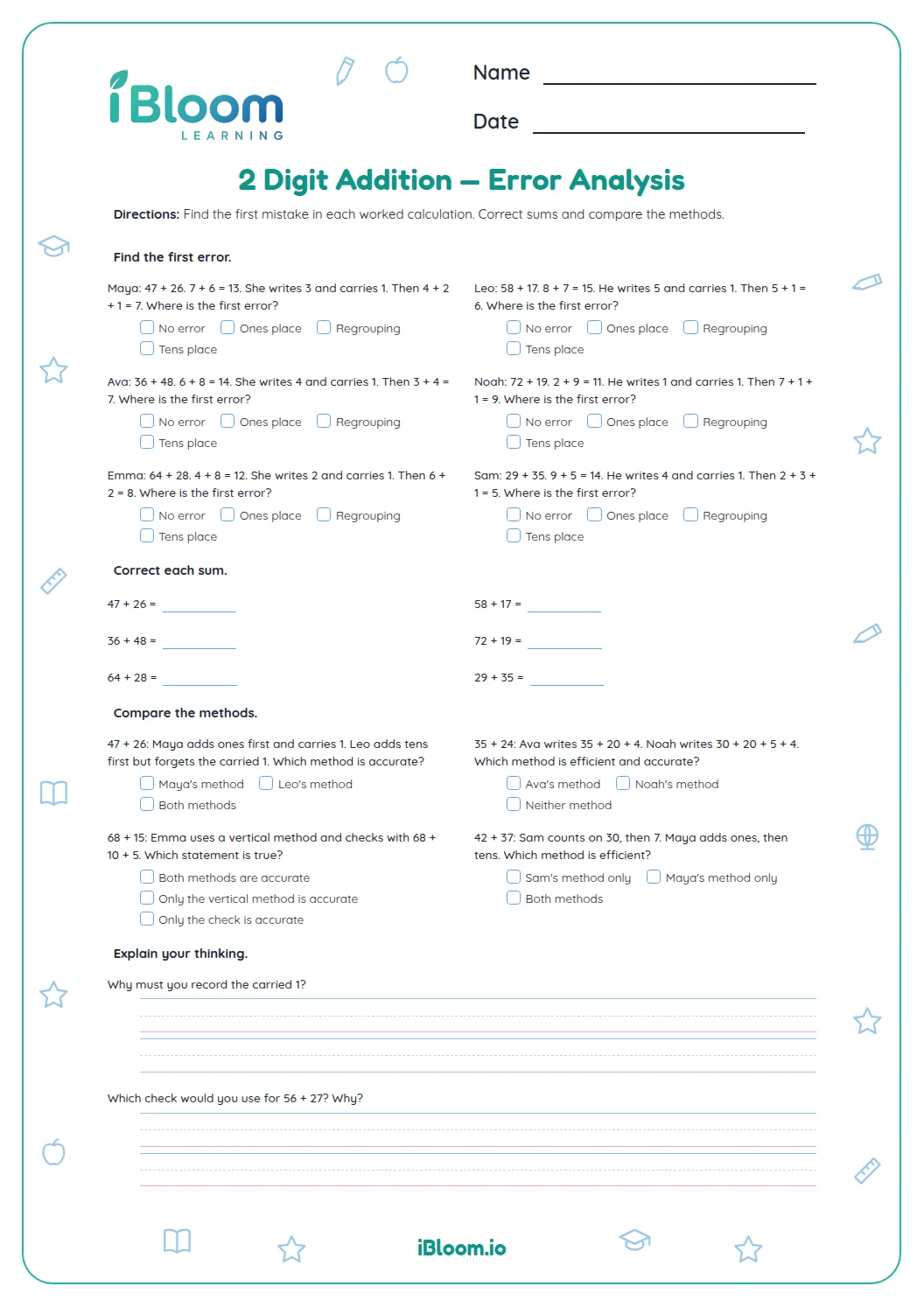
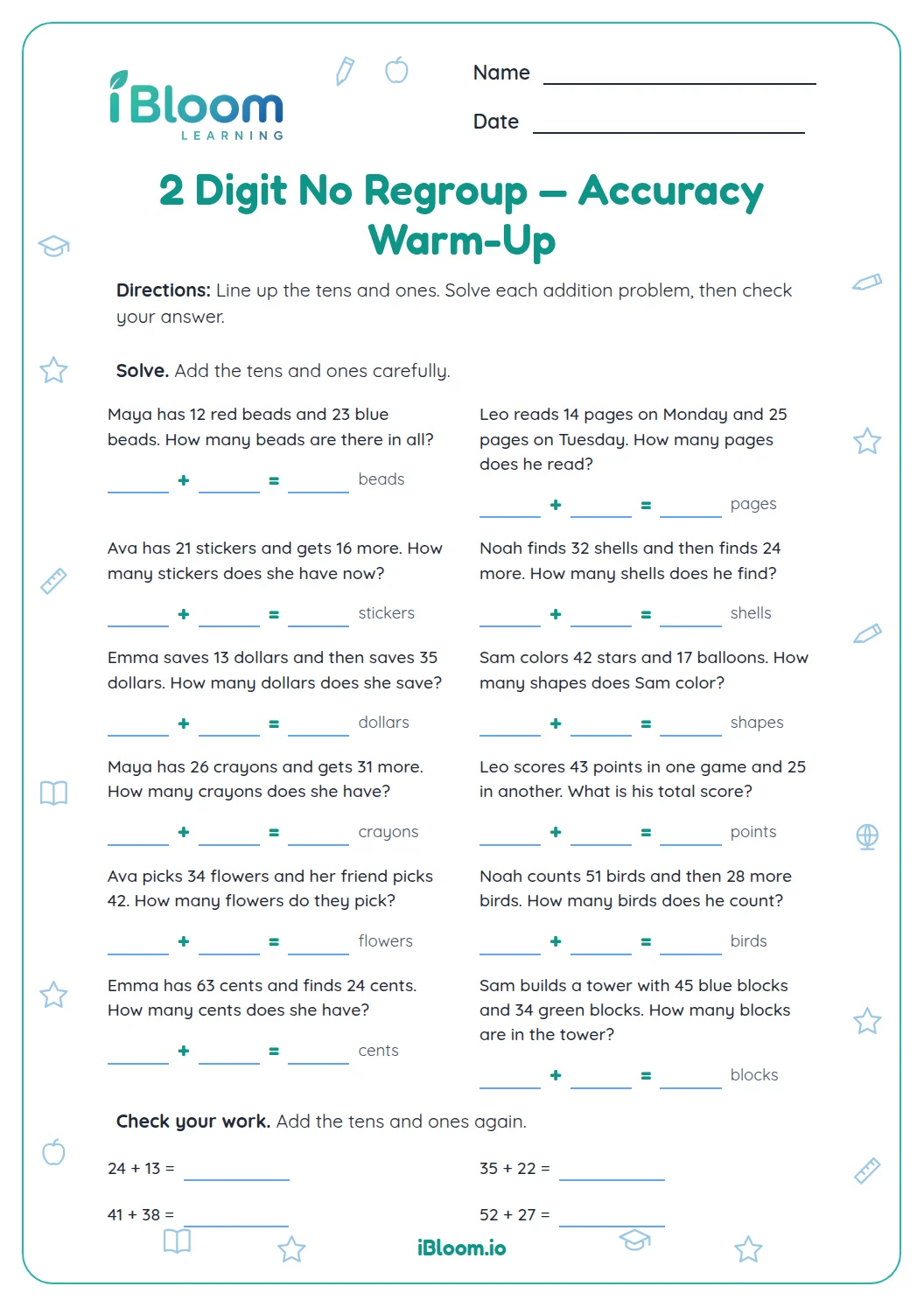
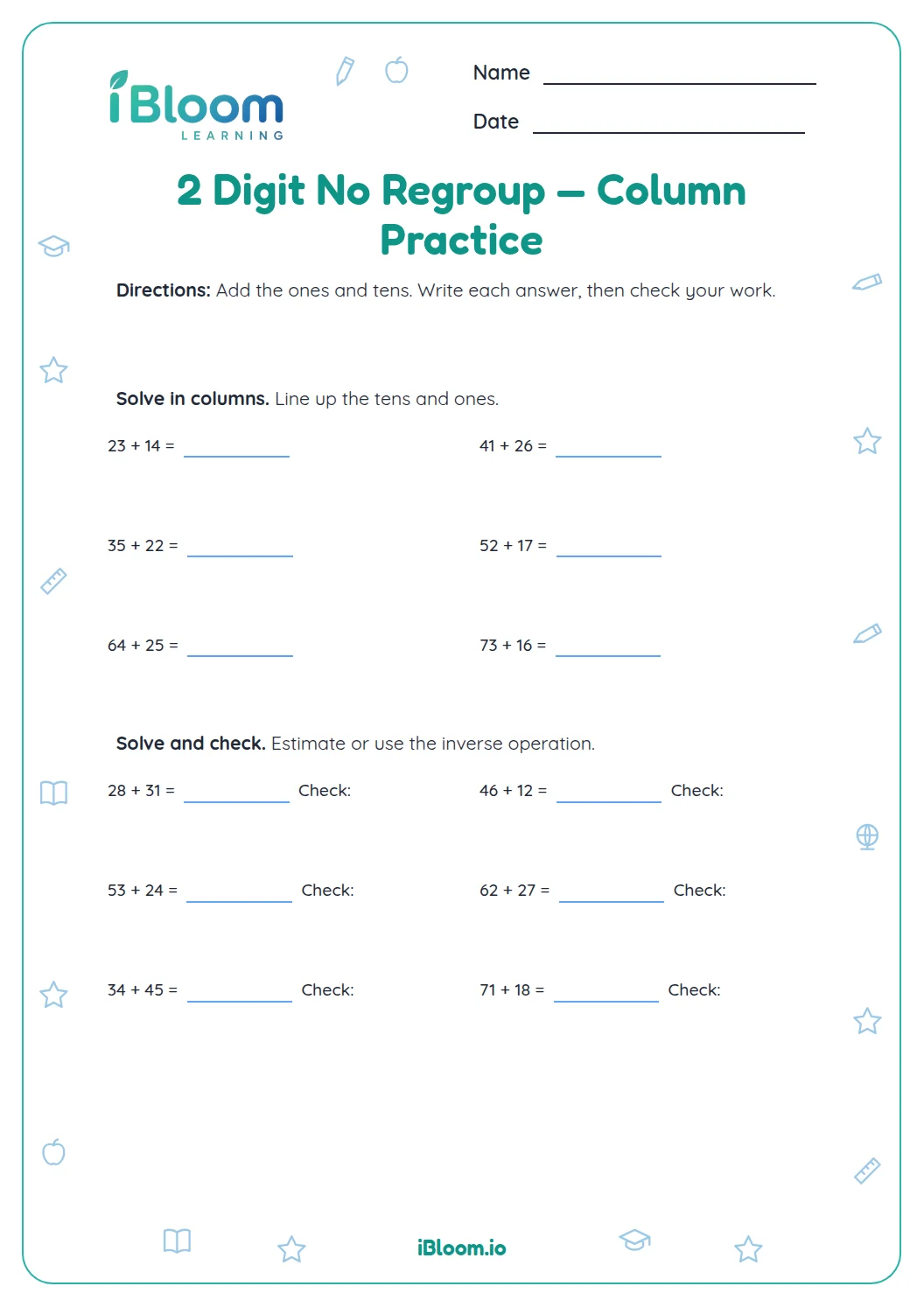
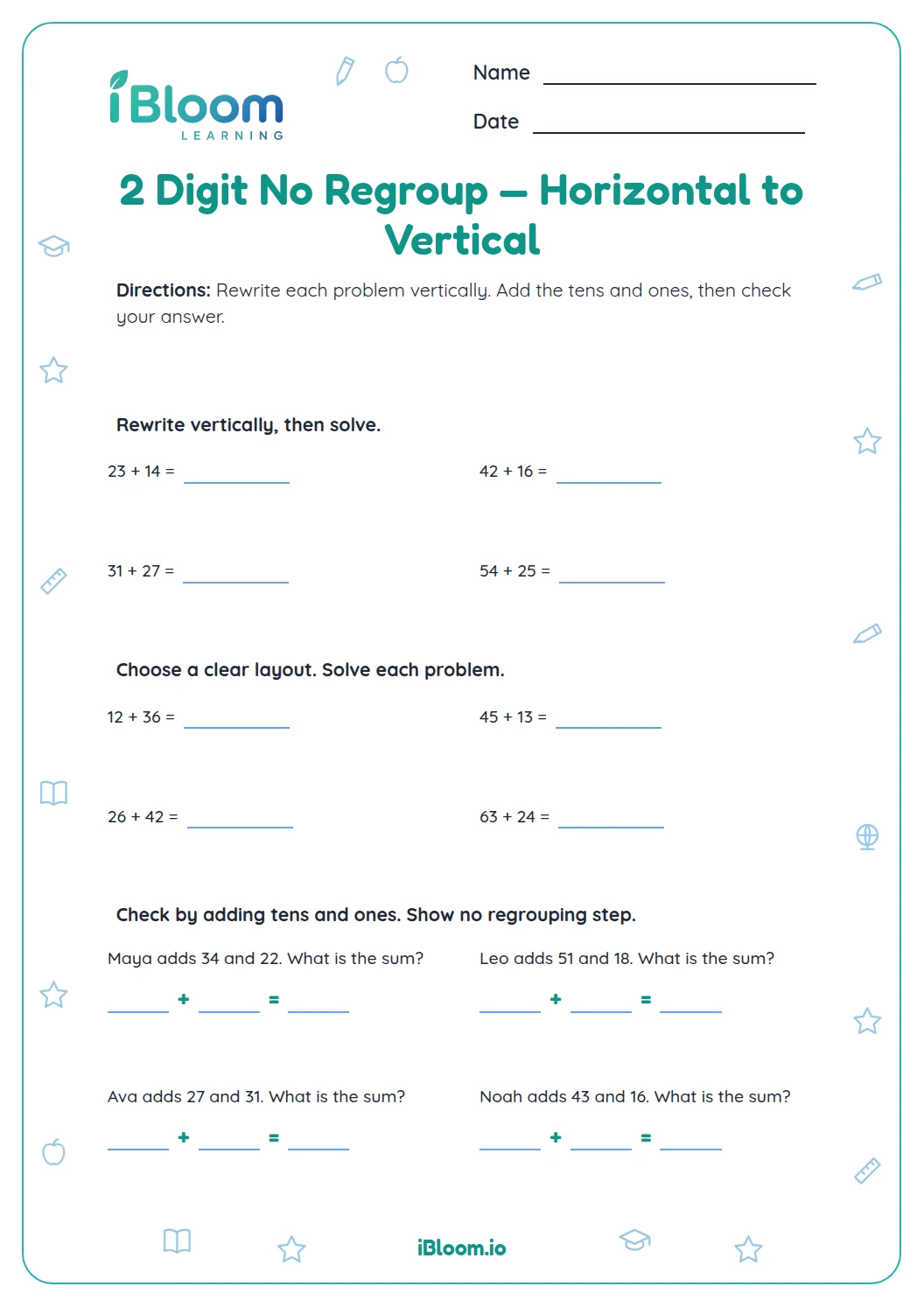
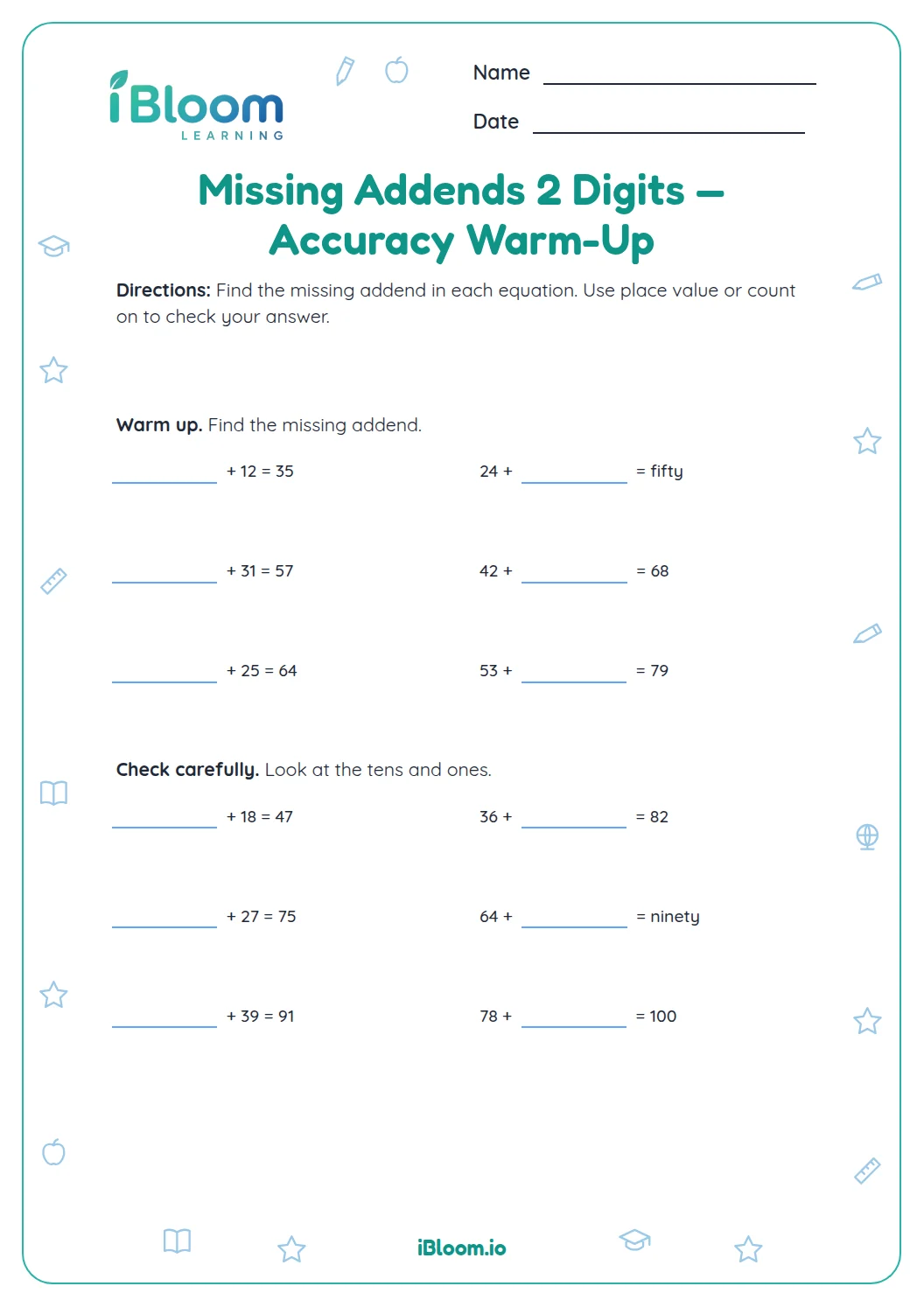
This printable addition drill gives Grades 2–3 students several ways to work with two-digit sums. Students solve direct addition problems, find missing addends, apply addition in short stories, and check or estimate sums. The problems keep sums within 100 and connect addition with place value and subtraction, as described in Common Core 2.NBT.B.5. A separate answer key shows each result and the correct check or estimate.
Aligned to 2.NBT.B.5
How do I add two-digit numbers?
Add the ones and tens, regrouping one ten when the ones total is 10 or more. A quick estimate can help you notice an answer that is far too high or low.
- 128 + 34: 8 + 4 = 12 ones, or 1 ten and 2 ones.
- 220 + 30 + 10 + 2 = 62.
How do I turn a story into an addition equation?
When a story says more items are added to an amount, combine the starting amount and the new amount. Keep the unit in the answer so it is clear what the total counts.
- 124 + 37 = 61.
- 2Maya has 61 stickers now.
How can subtraction find a missing addend?
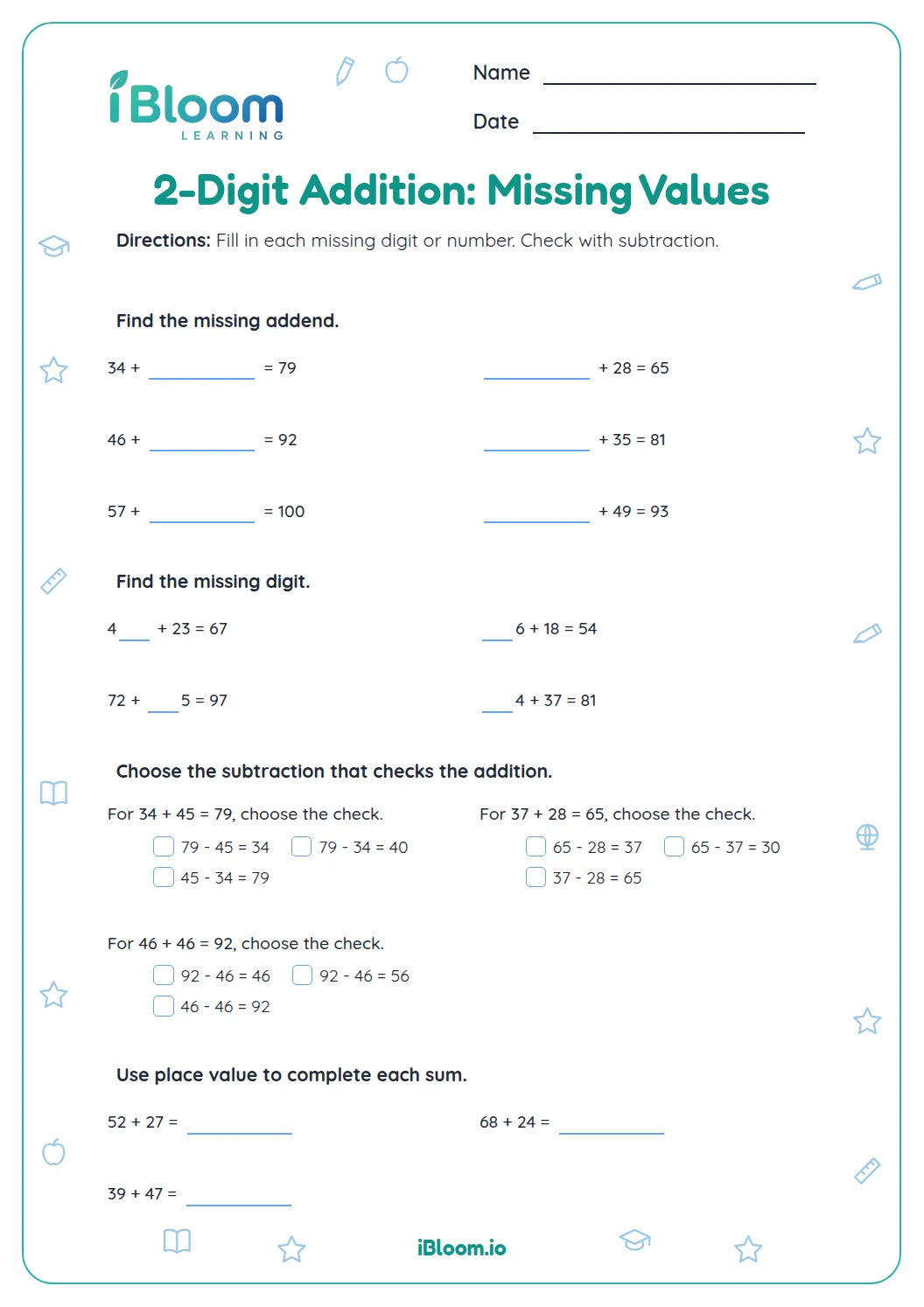
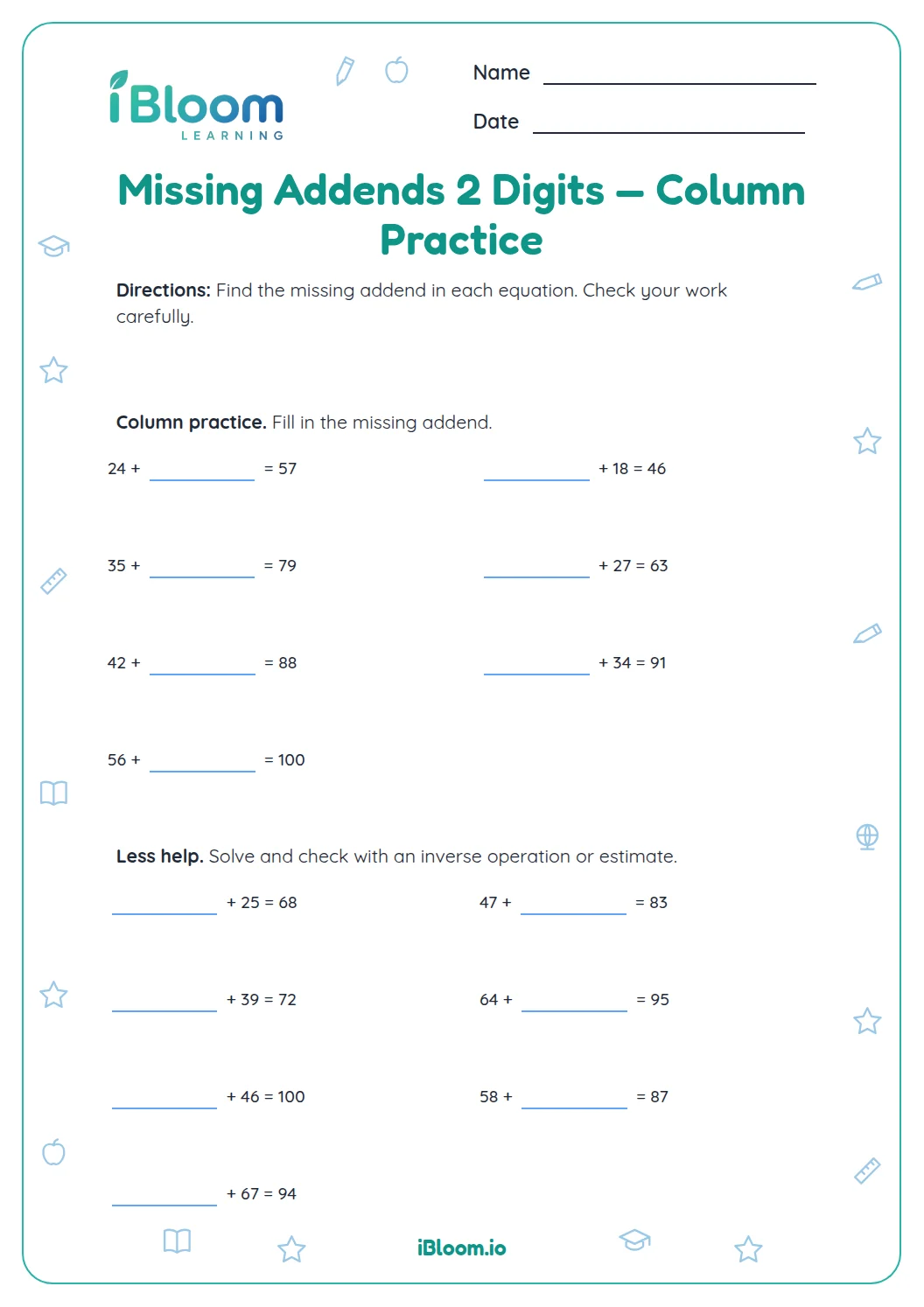
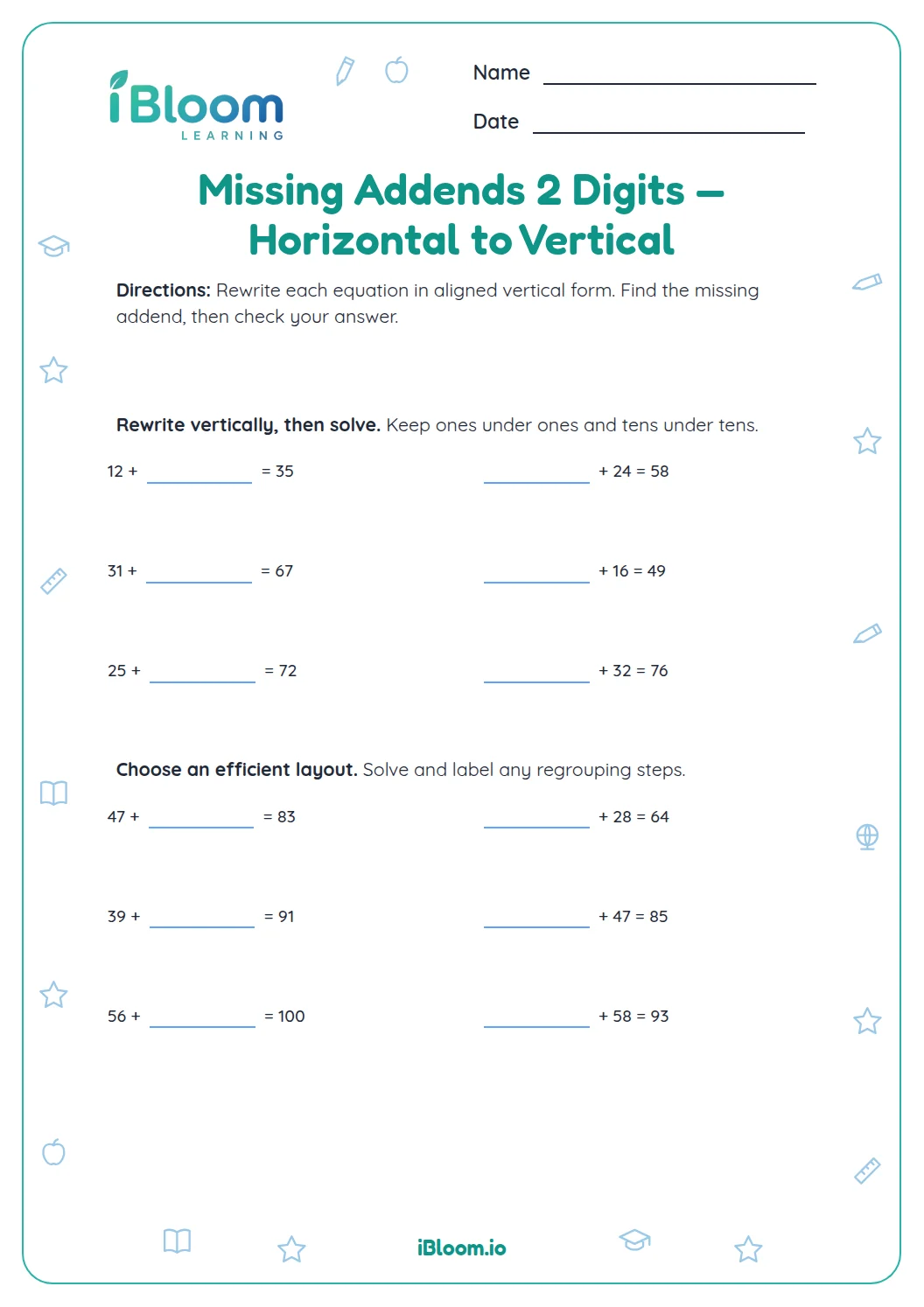
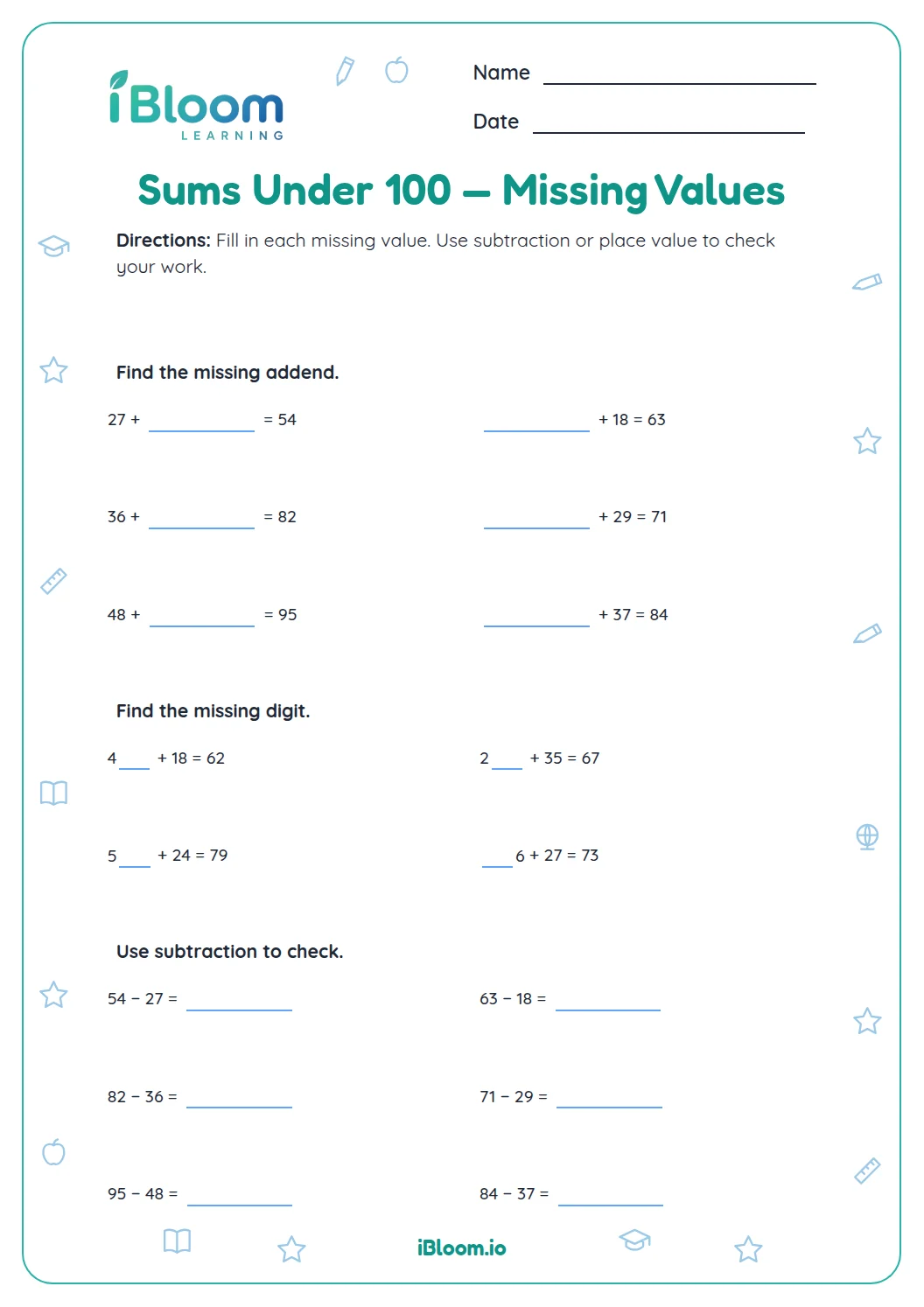
If one addend and the sum are known, subtract the known addend from the sum. Then add the two addends to check the total.
- 171 − 26 = 45.
- 2Check: 45 + 26 = 71.
How can I check or estimate an addition answer?
Use subtraction to find whether a proposed sum is correct. For an estimate, round the addends to nearby tens and compare the result with the choices.
How to use this worksheet
- 1Solve each direct sum by combining ones and tens.
- 2For a story, identify the starting amount and how many more are added.
- 3Find a missing addend by subtracting the known addend from the total.
- 4Check an addition equation with the matching subtraction equation.
- 5Estimate by rounding to nearby tens and choosing the closest total.
Common mistakes and quick fixes
The mistake
Adding the tens but forgetting to regroup the extra ten.
The fix
Combine the ones first, then include any new ten in the tens total.
The mistake
Subtracting the total from the known addend to find a missing part.
The fix
Use total minus known addend, then add to confirm.
The mistake
Rounding each addend in a way that changes the closest estimate.
The fix
Round each number to its nearest ten, then compare the rounded sum with the choices.
Common Core alignment
The sums stay within 100 and use place value and the relationship between addition and subtraction.
Use place value strategies to add within 100 and use subtraction to check a sum.
On this sheet: All sums stay within 100; students add two-digit numbers and use subtraction as an inverse check.
Show the official wordingHide the official wording
Fluently add and subtract within 100 using strategies based on place value, properties of operations, and/or the relationship between addition and subtraction.
What to practice next
Make more practice
Questions parents and teachers ask
Does this page include regrouping?
Yes. Several sums have ones digits that combine to make another ten. Students can add the ones first, regroup when needed, and then combine the tens. The answer key gives the total, and students may use a different accurate place-value strategy.
How can a child check an addition answer?
Subtract one addend from the proposed sum. The result should equal the other addend. For example, if 28 + 34 = 62, then 62 − 34 should equal 28. This inverse check can catch an addition error before moving to the next problem.
What does “missing addend” mean?
One number in an addition equation is unknown. Subtract the known addend from the total to find the missing part. For question 9, subtract 26 from 71 to get 45, then add 45 and 26 to confirm the total is 71.
Can a child use mental math?
Yes. Students may use place value, counting on or another accurate mental strategy. For story problems, they can also write an equation first. An estimate with nearby tens can help them decide whether the exact sum is reasonable.