



About this worksheet
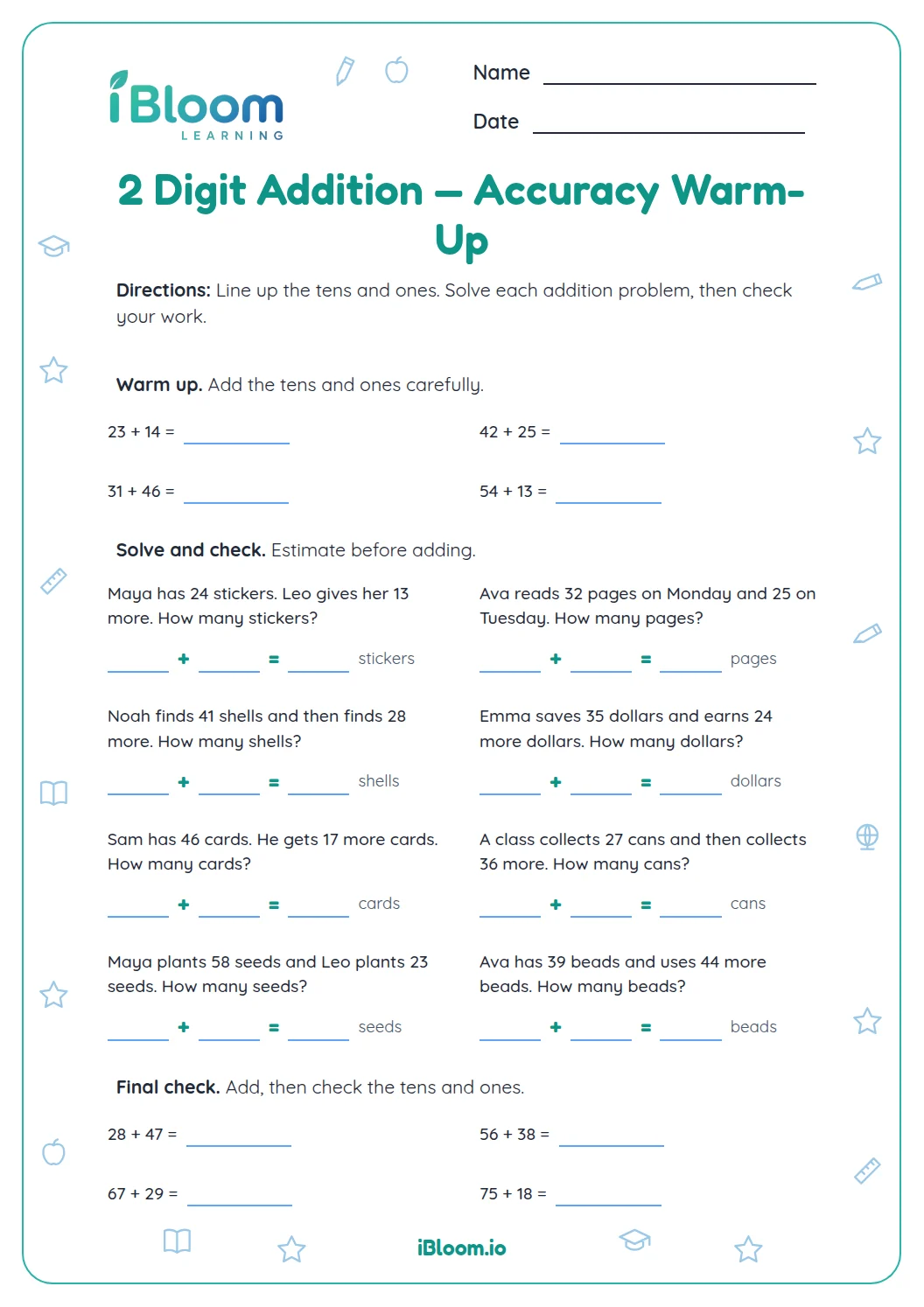
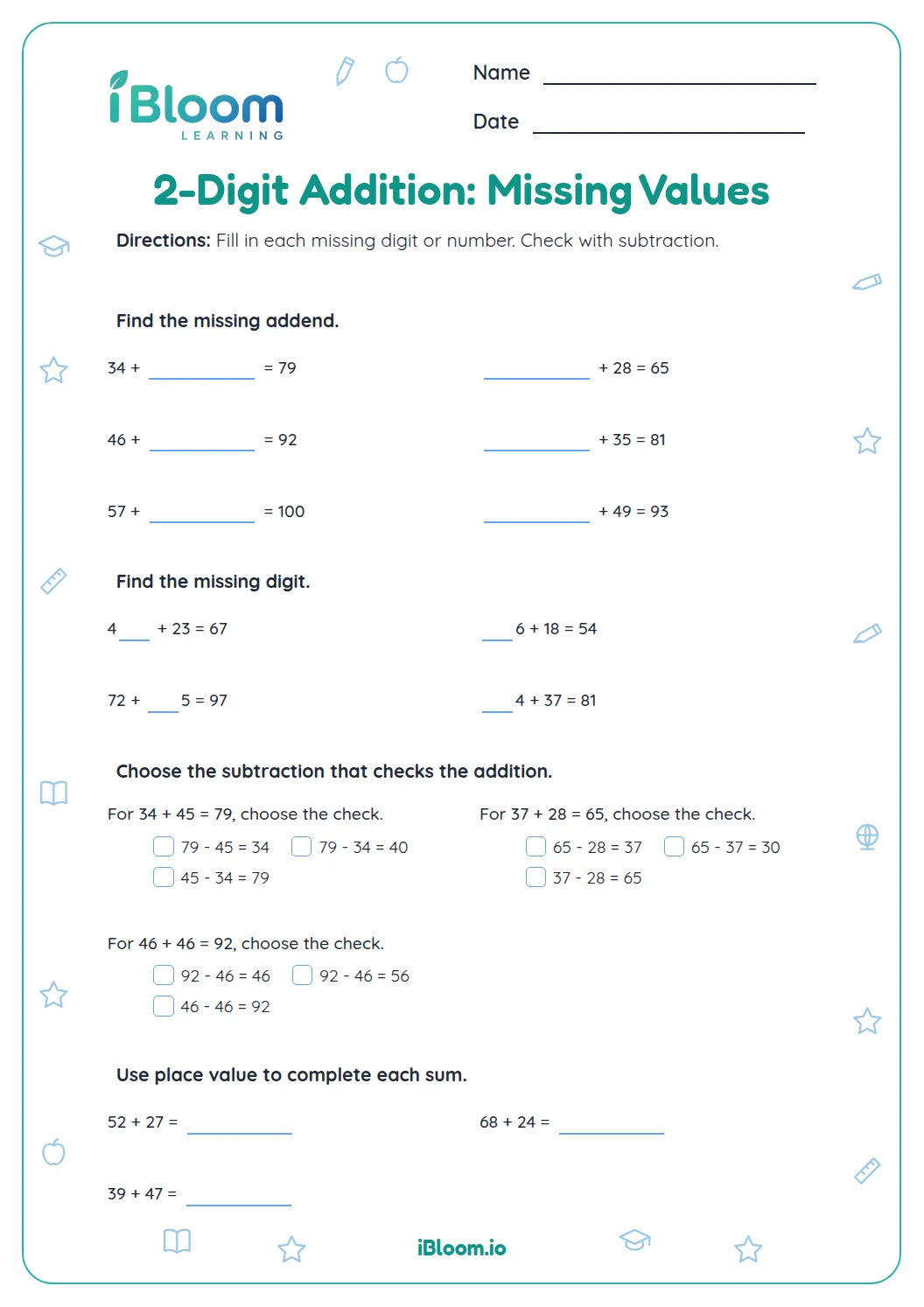
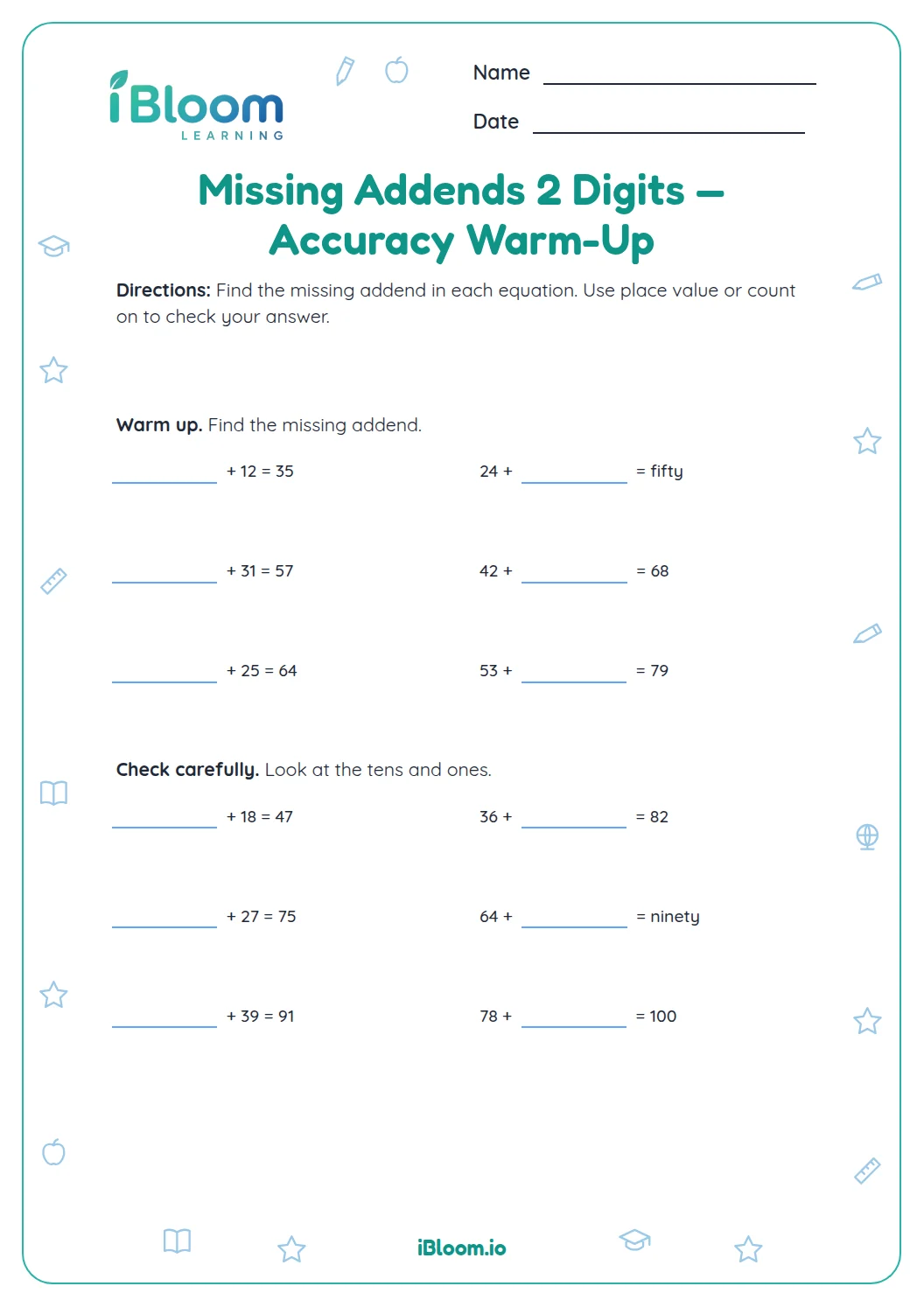
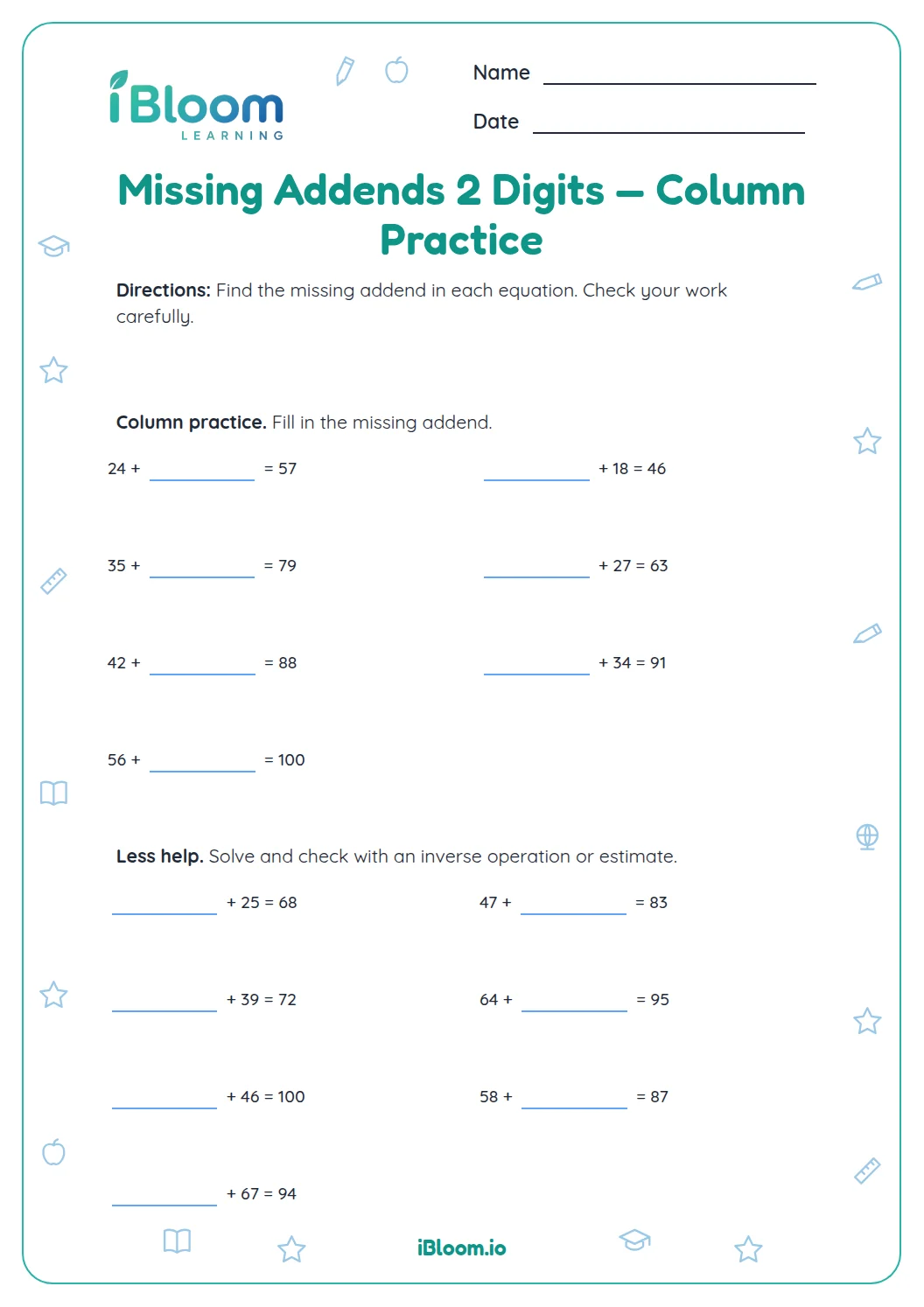
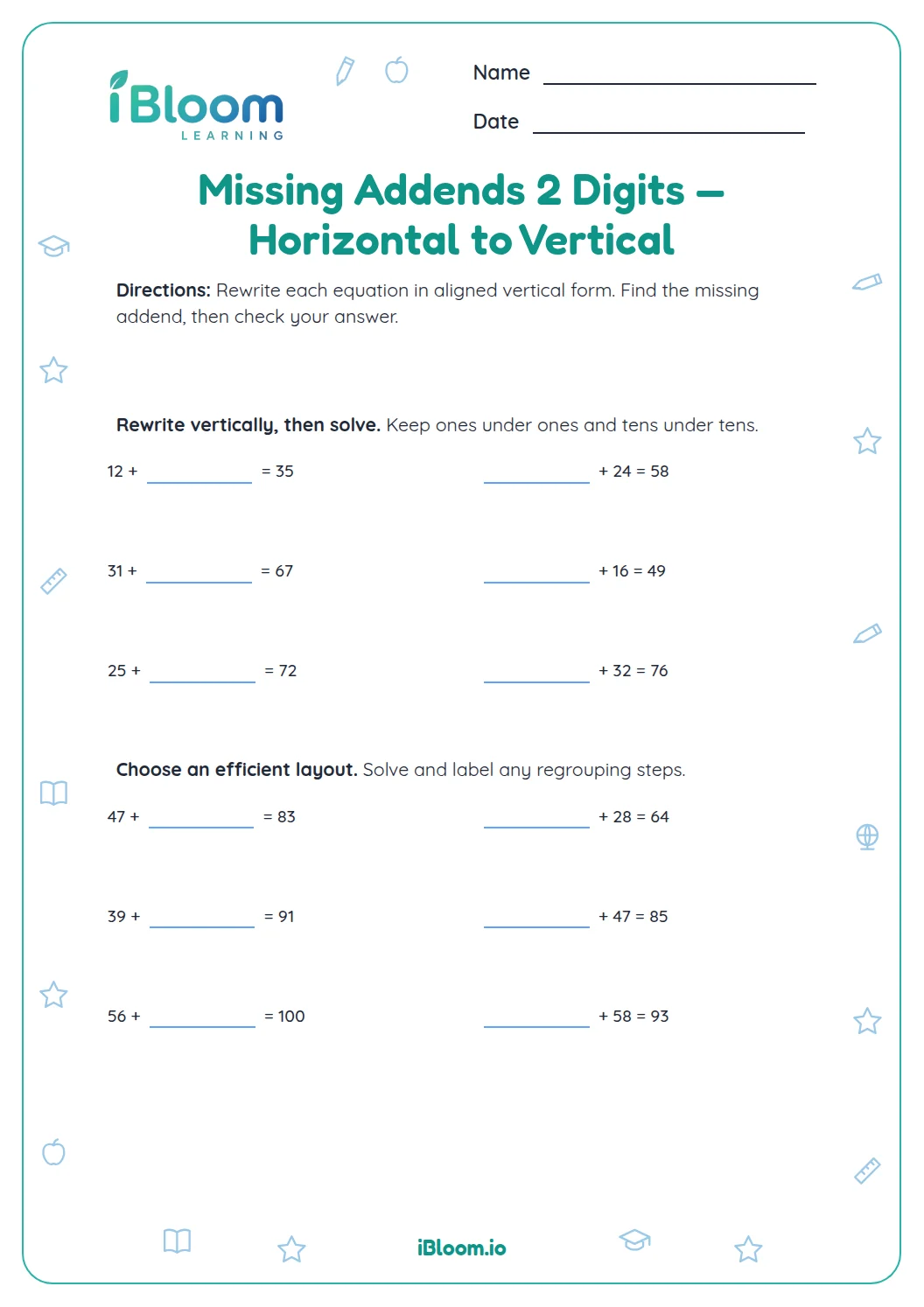
This printable addition warm-up gives learners practice adding numbers with sums under 100. Part A builds accuracy with a mix of regrouping and no-regrouping examples; Part B focuses attention on regrouping; Part C uses short situations that call for addition. It aligns with CCSS 2.NBT.B.5, adding within 100 with place-value strategies. The key shows each sum so a learner can check the work.
Aligned to 2.NBT.B.5
When do you regroup in addition?
When the ones digits total 10 or more, trade 10 ones for 1 ten. In Part A, questions 1, 2, 4, 5, 6, 7, and 8 need that trade; question 3 does not.
- 134 + 25
- 24 ones + 5 ones = 9 ones
- 33 tens + 2 tens = 5 tens
- 434 + 25 = 59
How do you turn a story into an addition sentence?
Look for two amounts that belong together, write an addition sentence, and solve it. In Part C, the story tells two groups of the same kind, such as beads or cans, so addition finds the total.
How can you check a sum?
Add the ones and tens again, or reverse the addends and see whether the total stays the same. Make sure the answer is less than 100, as each problem on this sheet is designed to be.
How to use this worksheet
- 1Read both addends before calculating.
- 2Add the ones digits and regroup 10 ones as 1 ten when needed.
- 3Add the tens digits, including any regrouped ten.
- 4For a story, name the two amounts and write an addition sentence.
- 5Compare each result with the answer key and redo any mismatch.
Common mistakes and quick fixes
The mistake
Adding the tens before recording a new ten from the ones.
The fix
Write the regrouped ten above the tens column before finishing.
The mistake
Treating a story total as the difference between its two groups.
The fix
Ask whether the story combines groups; if so, add both amounts.
The mistake
Writing only the ones digit when a sum reaches 10 or more.
The fix
Keep the ones digit in the ones place and carry the extra ten.
Common Core alignment
This worksheet practices adding within 100 with place-value strategies.
Add within 100 by using place-value strategies and properties.
On this sheet: The number sentences and story sums use two-digit addends and sums within 100.
Show the official wordingHide the official wording
Fluently add and subtract within 100 using strategies based on place value, properties of operations, and/or the relationship between addition and subtraction.
What to practice next
Make more practice
Further reading
Questions parents and teachers ask
What does regrouping mean when adding two-digit numbers?
Regrouping means exchanging 10 ones for 1 ten when the ones digits make 10 or more. For example, in 38 + 26, the ones make 14, so write 4 ones and add 1 ten with the tens. The worksheet includes sums that need this step.
How many addition questions are included?
There are 16 questions: 12 number sentences and 4 short story problems. All sums stay below 100. The answer key follows the worksheet so a learner can try the problems before checking the work. The answer key shows each total so the learner can check the regrouping too.
Should a child show work for the story problems?
Yes. Ask the learner to write an addition equation using the two amounts in the story, then solve it. Naming what each addend represents helps connect the calculation to the situation. This makes it easier to see whether both quantities were included.
What is a good way to check an addition answer?
Add the ones and tens again, or switch the order of the addends and check that the total stays the same. Then compare the result with the separate answer key. Checking the ones and tens separately can help locate an error.
Do all the problems use two-digit addends?
Most number sentences use two-digit addends, and question 1 combines an 18 with a single-digit 7. The four story problems use two groups and ask for their total. Every answer stays under 100, so the same place-value method works across the page.