
About this worksheet
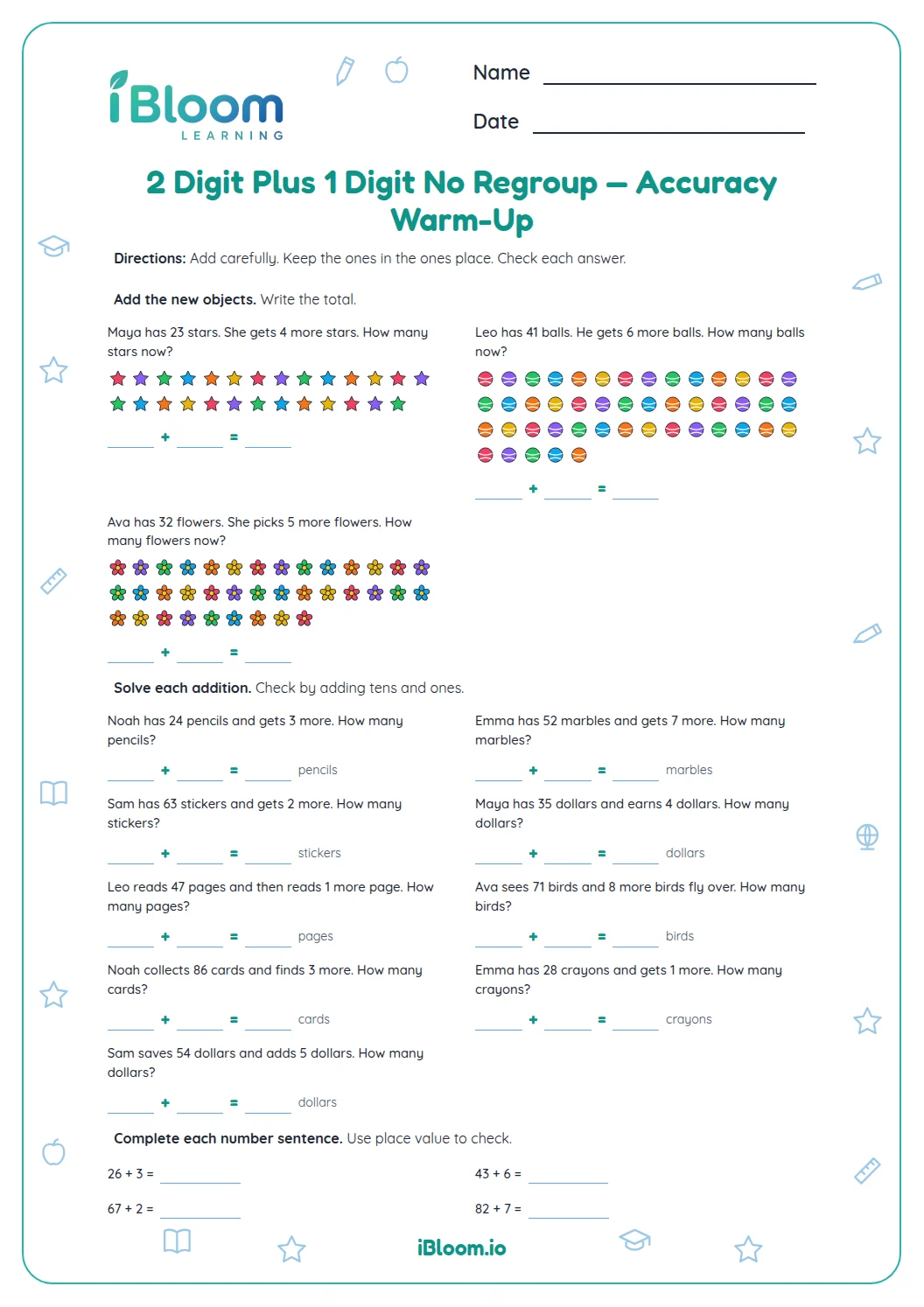
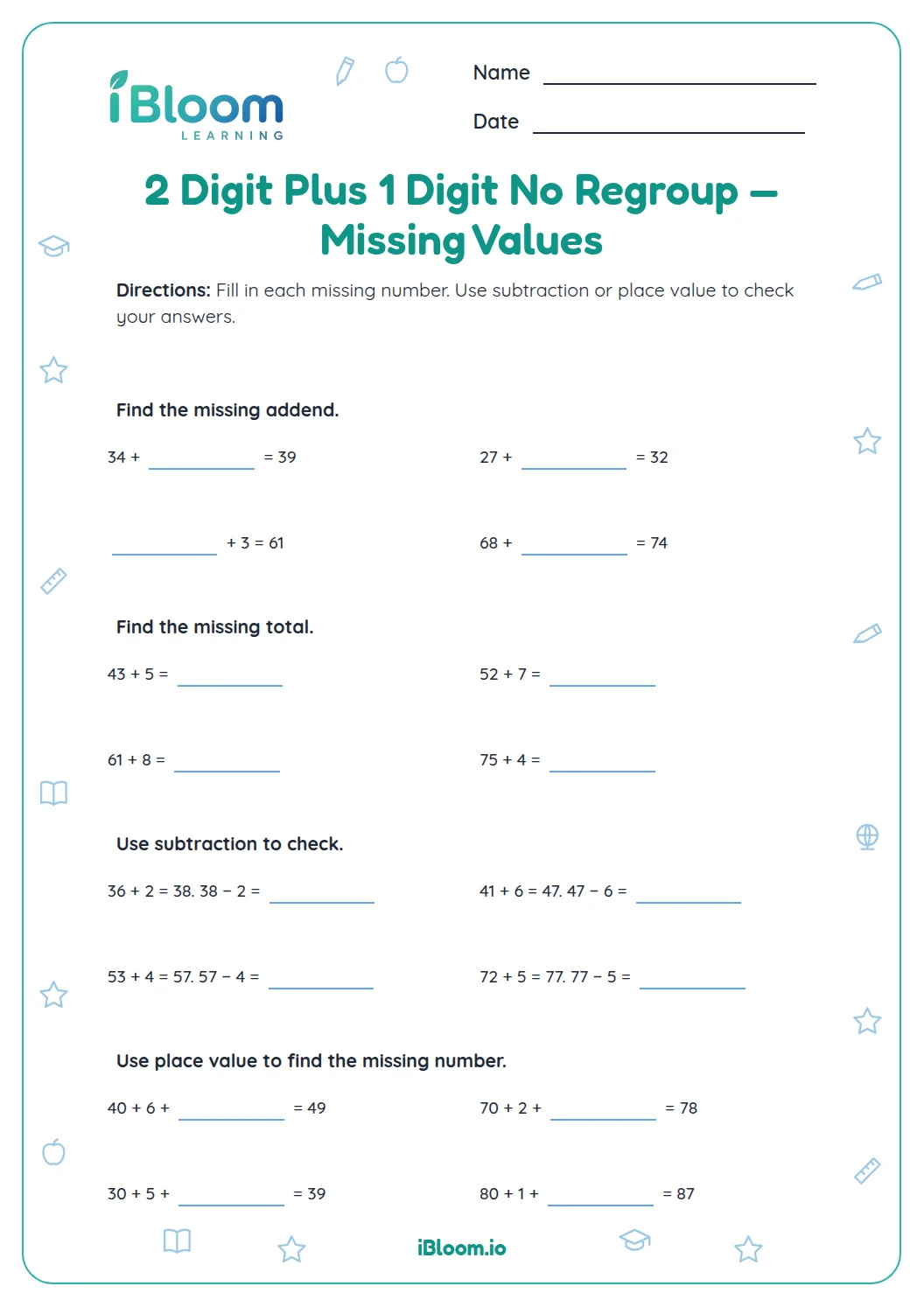
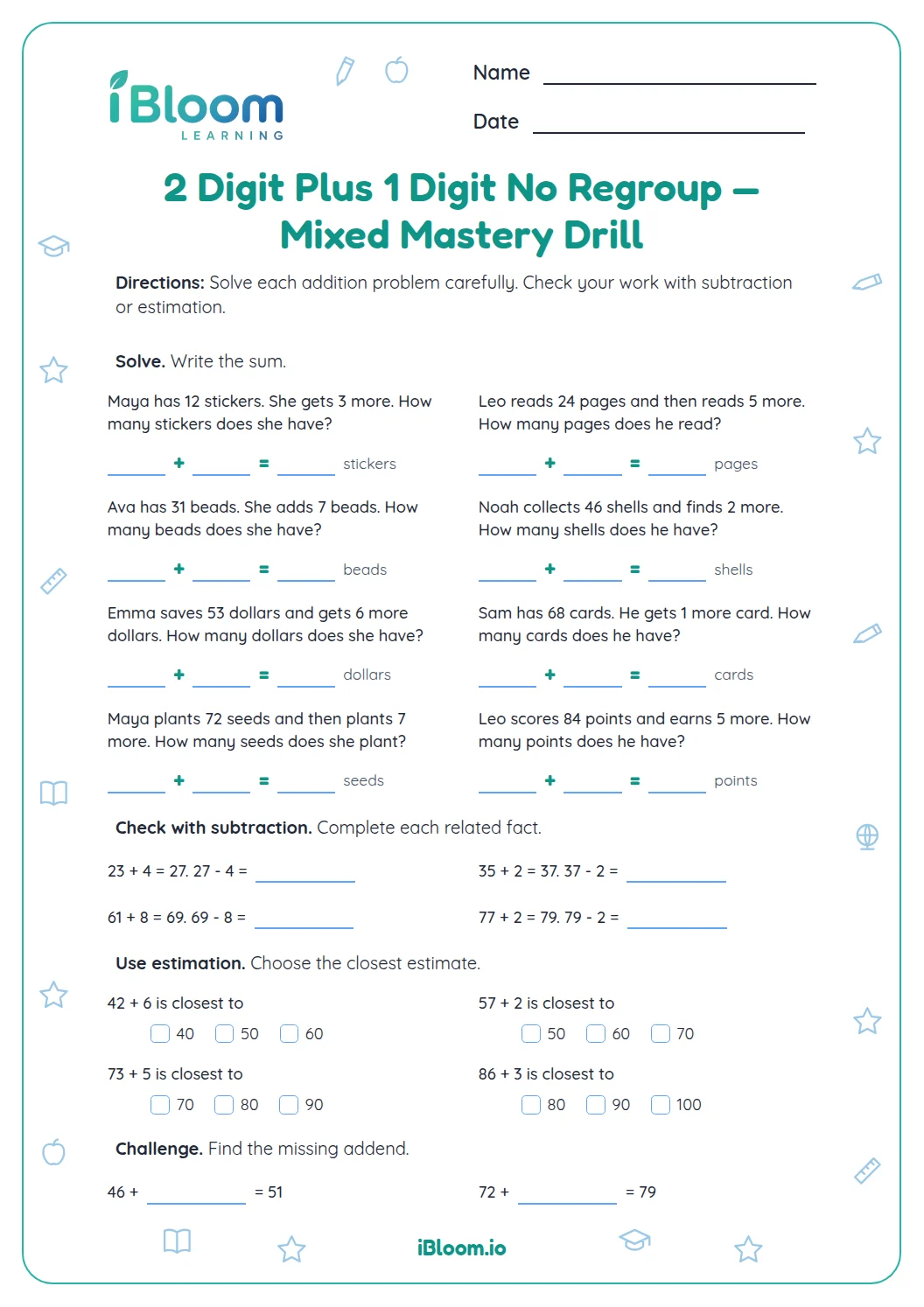
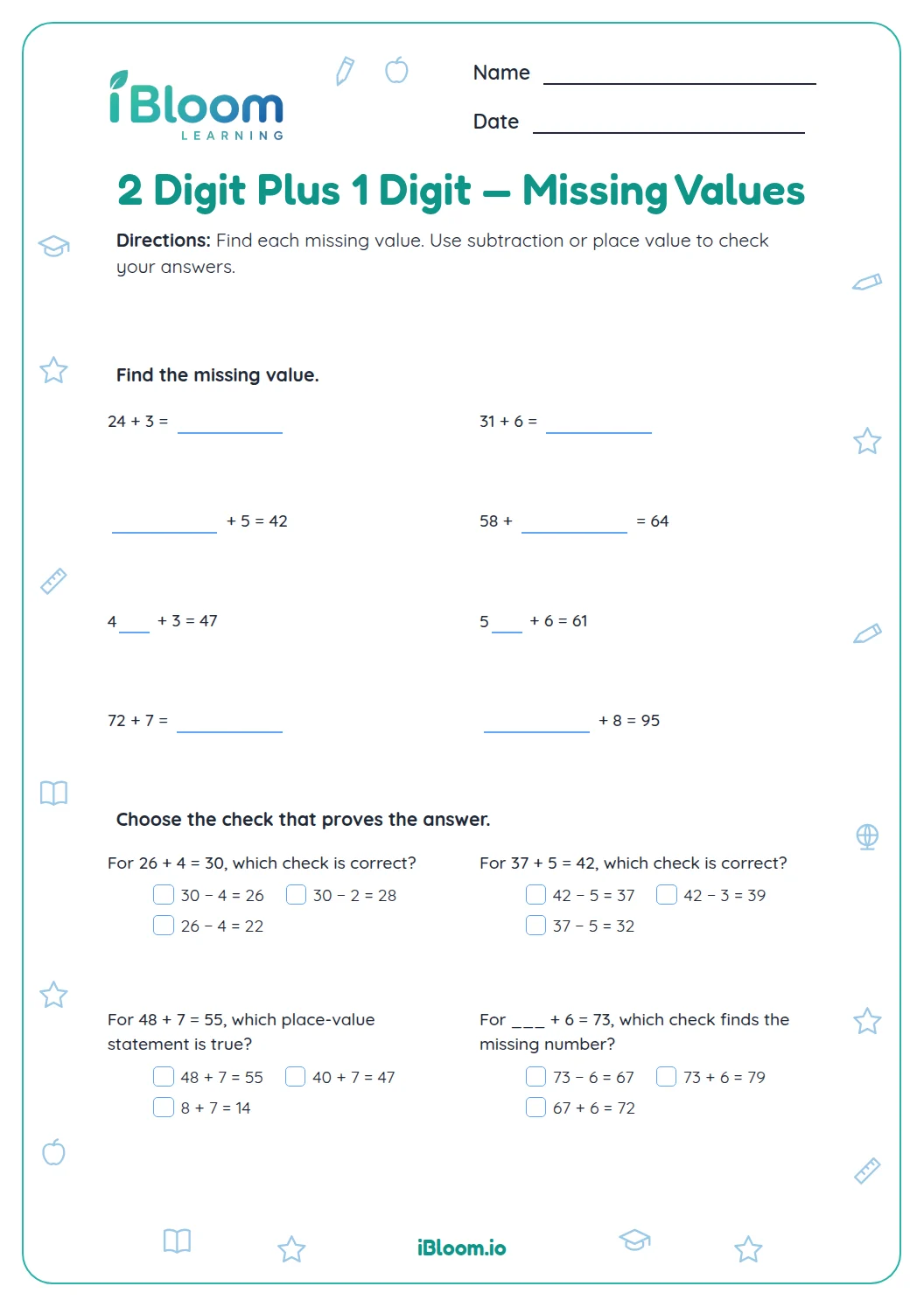
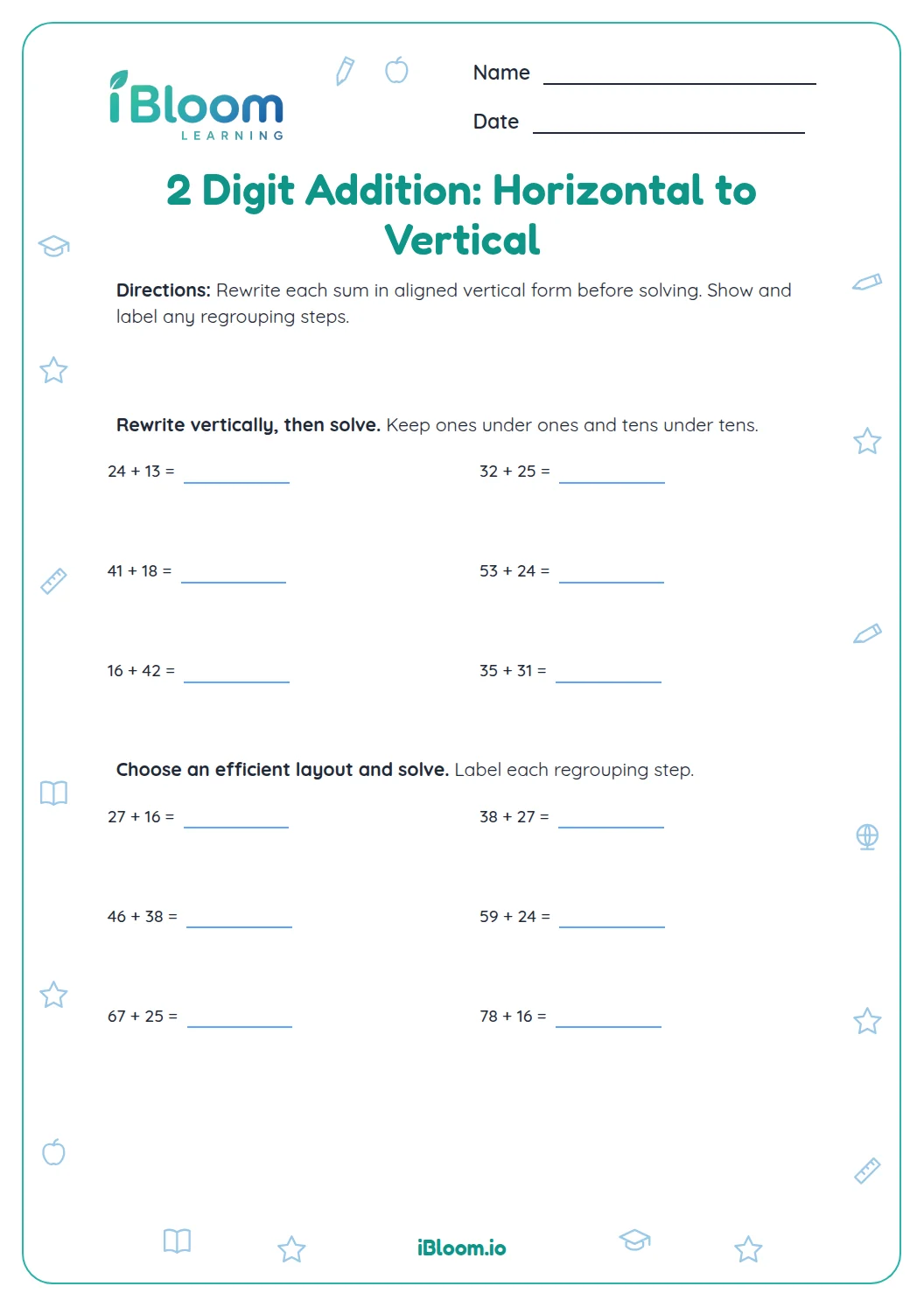
This Grade 2 worksheet helps children rewrite horizontal two-digit plus one-digit addition vertically. Each sum avoids regrouping, so learners can focus on placing the one-digit addend under the ones digit and keeping tens and ones aligned. They solve eight examples, then complete eight more independently. The practice supports place-value addition in CCSS 2.NBT.B.5 and includes a separate answer key.
Aligned to 2.NBT.B.5
Where does the one-digit addend go?
The ones digits must share a column. For 24 + 3, write 24 on top and put 3 under the 4, not under the 2.
Question 1 is a useful model: add 4 ones and 3 ones to make 7 ones, then bring down the 2 tens. The sum is 27.
- 1 24
- 2+ 3
- 3----
- 4 27
- 5The ones column is 4 + 3 = 7; the 2 tens stay in place.
Why does this set avoid regrouping?
In every item, the ones digit plus the one-digit addend is less than 10. Children can focus on the horizontal-to-vertical rewrite and place-value alignment.
Part A gives eight sums to establish the layout. Part B adds eight more sums for independent practice and a quick check of the ones column.
How can a child check the column work?
Read the vertical work back as a horizontal equation. Confirm the ones total matches and the tens digit did not shift columns.
How to rewrite each sum
- 1Copy the two-digit number as the top row.
- 2Write the one-digit addend beneath the ones digit.
- 3Draw or imagine a line under the two addends.
- 4Add the ones column first, then write the tens digit.
- 5Read the answer as a horizontal sum to check it.
Column addition mistakes to catch
The mistake
Writing 3 beneath the 2 in 24 + 3, which changes the place value.
The fix
Line the 3 up beneath the 4 because it represents three ones.
The mistake
Adding 2 tens and 4 ones as if 24 were just 2 + 4.
The fix
Keep the digits in separate columns: 2 tens and 4 ones.
The mistake
Changing the tens digit even though the ones total stays below 10.
The fix
Check the ones sum first. Since it is fewer than 10 in this set, the tens digit remains unchanged.
Common Core alignment
This worksheet practices place-value strategies for adding within 100.
Rewrite two-digit plus one-digit sums vertically and add without regrouping.
On this sheet: Each problem uses a vertical place-value layout for a two-digit number plus ones, with no regrouping needed.
Show the official wordingHide the official wording
Fluently add and subtract within 100 using strategies based on place value, properties of operations, and/or the relationship between addition and subtraction.
What to practice next
Make more practice
Further reading
Questions parents and teachers ask
Why is the one-digit number placed under the ones digit?
The one-digit addend counts ones, so it belongs in the ones column. In 24 + 3, write 3 below the 4. Then 4 ones plus 3 ones make 7 ones, while the 2 tens remain in the tens column.
Does this worksheet include regrouping?
No. Every problem is selected so the ones digits add to fewer than 10. This lets children concentrate on rewriting a horizontal sum vertically and keeping ones and tens aligned before moving to sums that require regrouping. The key shows each correct total.
How many problems are included?
The worksheet has 16 questions in two parts. Each asks the learner to rewrite a horizontal addition problem in columns and solve it. A separate two-page answer key lists the sums so an adult can check the completed vertical work.
What is the answer to 24 + 3?
The answer is 27. In a vertical layout, 3 goes under the 4, so the ones column is 4 + 3 = 7. The 2 tens stay in the tens column. Question 1 uses this example of the alignment and addition routine.
What should I do if a child puts the digits in the wrong columns?
Pause before adding and ask what each digit represents. In 24, the 2 means two tens and the 4 means four ones; the 3 means three ones. Put the one-digit addend under the 4, then solve the ones column first.