

About this worksheet
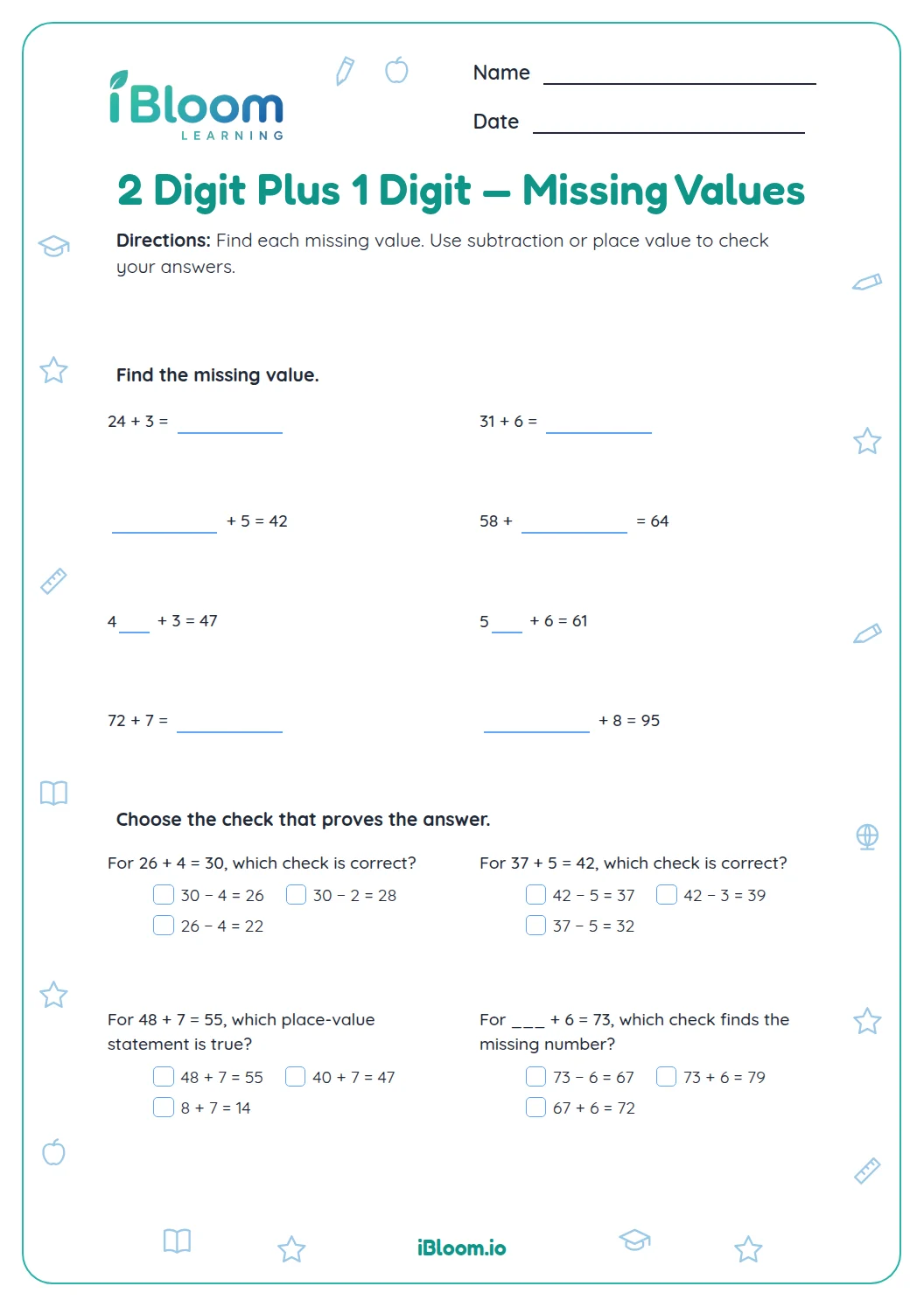
This Grade 1 addition warm-up gives students 16 two-digit plus one-digit equations and four short story problems. Some sums keep the ones below ten; others require composing a new ten. Students can add the ones first, regroup when needed, and check that each total is greater than the starting number. A separate answer key lists all 20 answers. It practices CCSS 1.NBT.C.4.
Aligned to 1.NBT.C.4
What is a reliable way to add a one-digit number?
Start with the ones place. If the ones total is less than ten, keep the tens as they are. If the ones total is ten or more, trade ten ones for one ten.
- 138 + 7
- 28 + 7 = 15 ones
- 3Trade 10 ones for 1 ten: 3 tens + 1 ten + 5 ones
- 438 + 7 = 45
Why do some sums need regrouping?
When the ones digits make at least ten, the ones cannot remain as a single digit. In 38 + 7, the 15 ones become 1 ten and 5 ones, so the total is 45.
How can students catch an addition error?
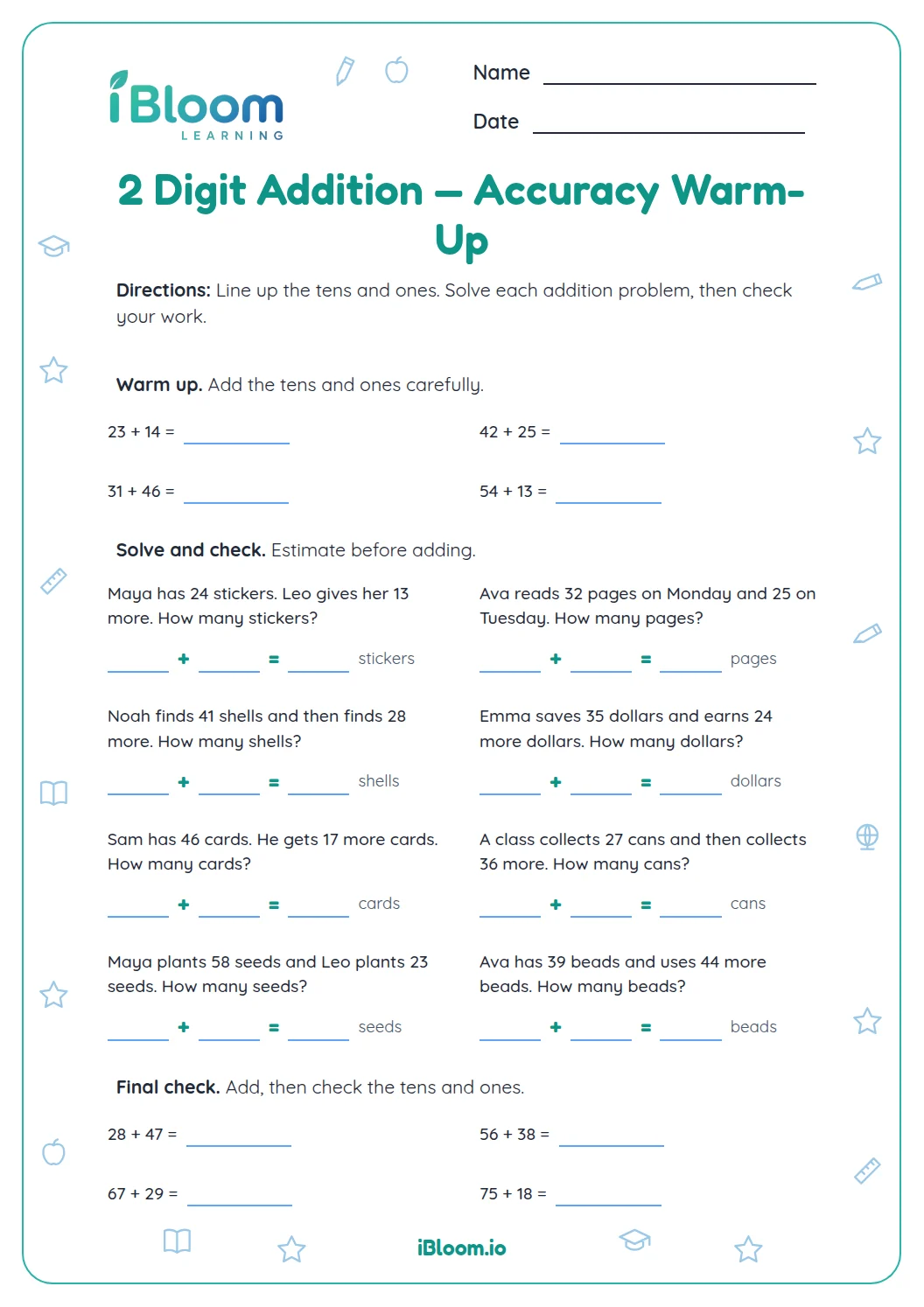
There are 20 questions: 16 equations followed by four short situations about adding more objects, pages, points, or seeds. For the first story, 28 tiles plus 6 more equals 34 tiles.
How to use this worksheet at home or in class
- 1Solve the first few sums slowly and say the ones aloud.
- 2Circle or mark the ones digits mentally before adding.
- 3When the ones total reaches 10, regroup one ten.
- 4Check that the answer is larger than the starting number.
- 5Use the answer key to find a place-value step to review.
Common mistakes and quick fixes
The mistake
Writing 15 in the ones place without regrouping.
The fix
Rename 15 ones as 1 ten and 5 ones.
The mistake
Forgetting to add the regrouped ten.
The fix
Add the new ten to the original tens before writing the total.
The mistake
Adding tens and ones in mismatched places.
The fix
Keep the original tens in the tens place and combine only ones first.
Common Core alignment
This worksheet practices the skill described below.
Add within 100 using place value and the relationship between addition and subtraction.
On this sheet: Students add one-digit addends to two-digit numbers, regrouping when ones total ten or more.
Show the official wordingHide the official wording
Add within 100, including adding a two-digit number and a one-digit number, and adding a two-digit number and a multiple of 10, using concrete models or drawings and strategies based on place value, properties of operations, and/or the relationship between addition and subtraction; relate the strategy to a written method and explain the reasoning used. Understand that in adding two-digit numbers, one adds tens and tens, ones and ones; and sometimes it is necessary to compose a ten.
What to practice next
Make more practice
Further reading
Questions parents and teachers ask
How many problems are in this warm-up?
The sheet has 20 questions: 16 equations and four short word problems. The equations include sums that stay within the same ten and sums that require regrouping. The separate key lists the result for every question. The questions move from quick equations to familiar addition situations.
What does regrouping mean in addition?
Regrouping means renaming ten ones as one ten. In 38 + 7, the ones total 15. That is one ten and five ones, so combine the new ten with the original three tens to make 45. Students may draw base-ten pieces to make the trade visible.
What is a reliable way to check a sum?
First check the ones: add the one-digit addend to the ones digit in the two-digit number. If the result is at least ten, carry or regroup one ten. Then check that the final sum is greater than the starting number, since a positive amount was added.
What is the answer to the first story problem?
The box starts with 28 blue tiles and gets 6 red tiles. Write 28 + 6, then add 8 ones and 6 ones to get 14 ones: one ten and four ones. The total is 34 tiles. Include the unit in the final answer so its meaning is clear.
Should students work mentally or show the steps?
Students may solve mentally if the regrouping steps are secure. If they are still learning, encourage them to mark the ones digits and show when ten ones become one ten. The goal of this warm-up is accurate addition, and the key can help locate a missed place-value step.