



About this worksheet
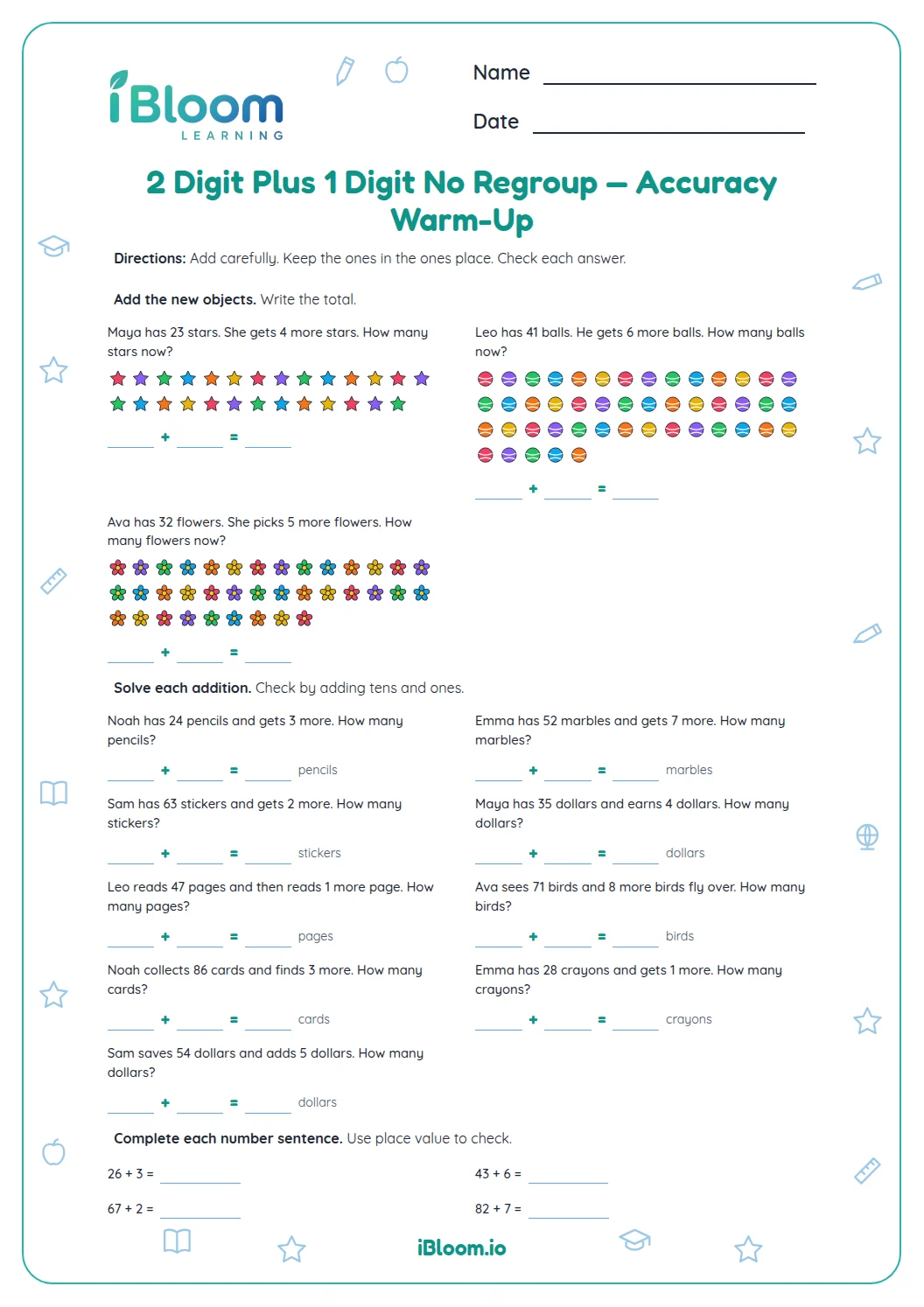
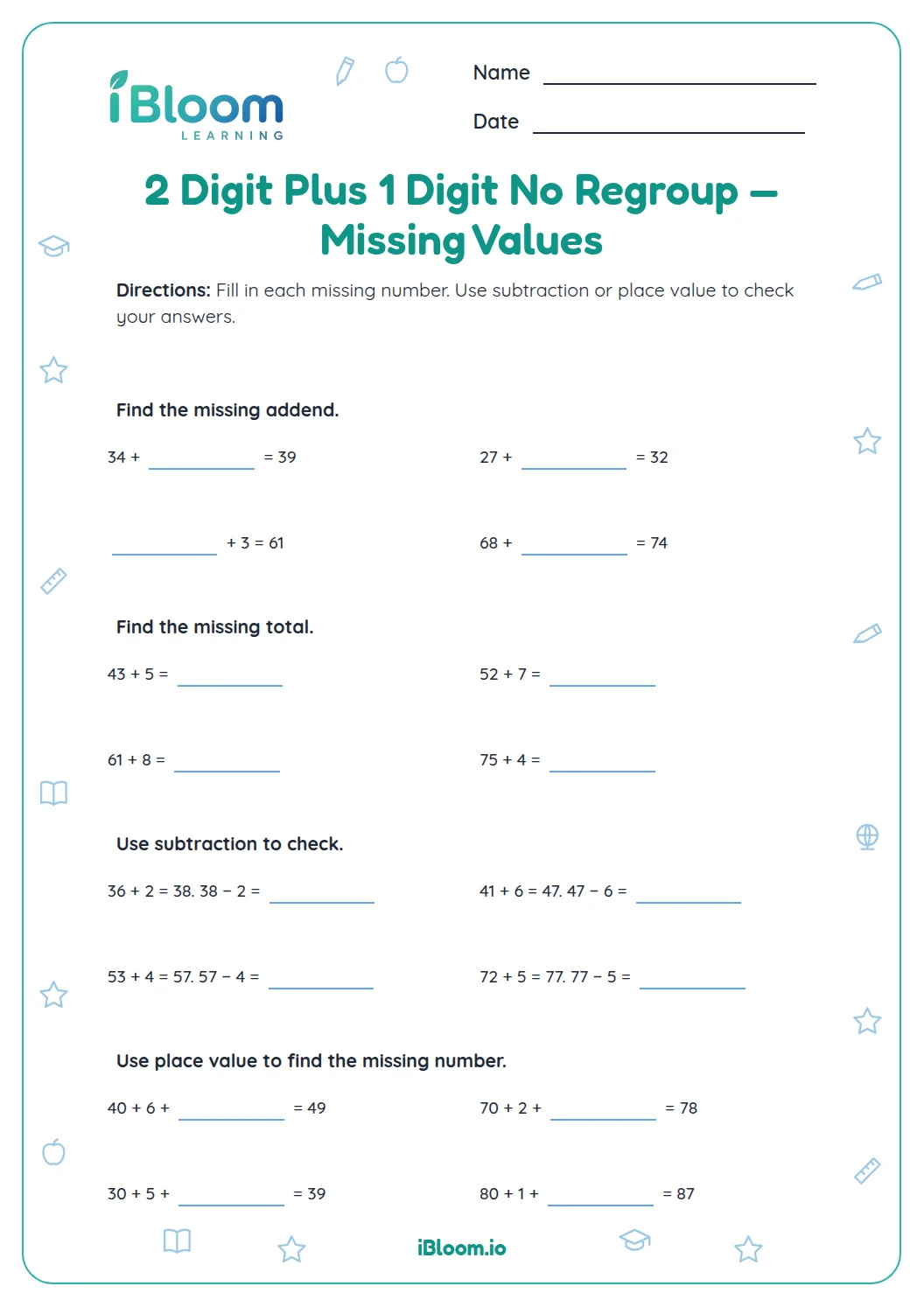
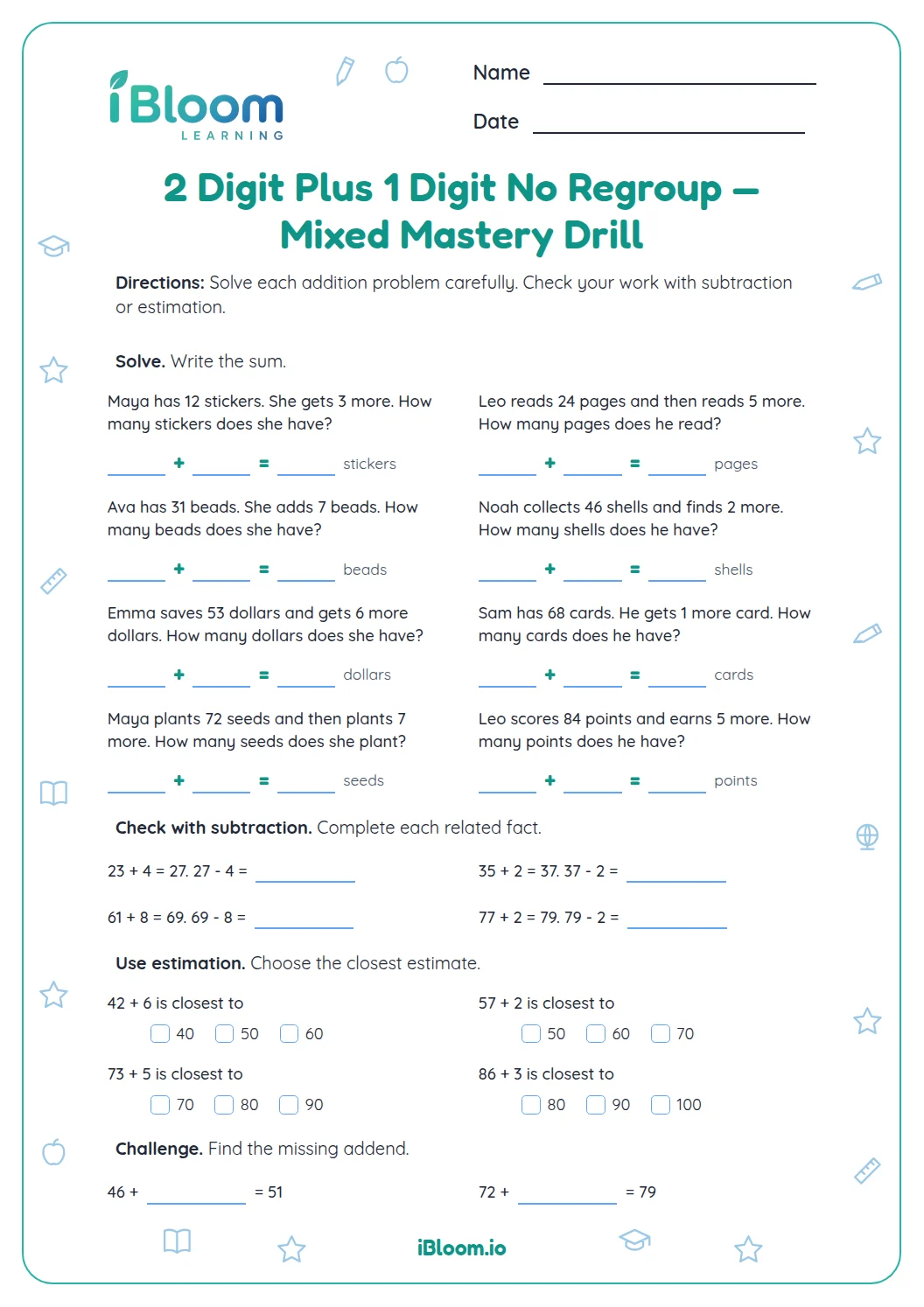
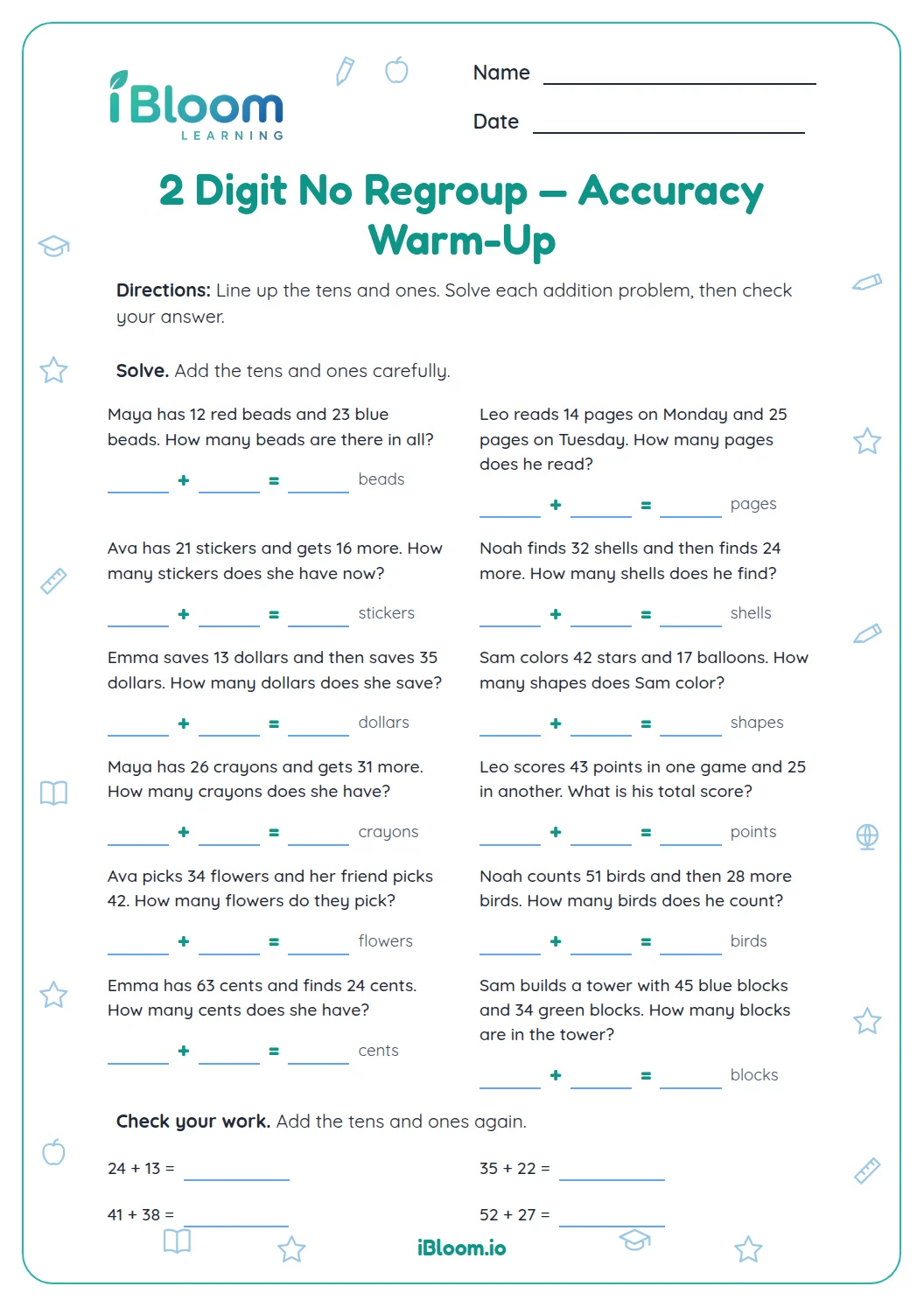
This free addition worksheet for Grades 2–3 asks children to examine someone else’s work before writing their own answers. Twelve questions use a two-digit number plus a one-digit number, with ones totals below ten. Part A asks children to identify errors, check correct work and choose a corrected total; Part B asks children to repair four sums; Part C asks for two explanations of place-value mistakes. Students practice CCSS 2.NBT.B.5 by using tens and ones to check addition within 100. A separate answer key supplies correct totals, judgments and sample explanations. Take time to discuss the mistakes rather than racing through the page.
Aligned to 2.NBT.B.5
What should children check first?
Read the operation sign and identify the value of the one-digit addend. In these questions it represents ones. Add it to the ones digit of the two-digit number, then keep the tens. Every ones total is below ten, so the original tens digit stays the same.
Why is 24 + 3 = 54 a place-value mistake?
Ava’s answer in question 1 acts as though the 3 meant 30. Children can name that error by separating the first number into two tens and four ones. Adding three ones changes the ones count to seven.
- 124 = 2 tens and 4 ones
- 24 ones + 3 ones = 7 ones
- 32 tens and 7 ones = 27
- 4Ava added 3 tens instead of 3 ones. Choose “Added 3 tens.”
How do the parts build an error-checking habit?
The six questions in Part A include three error explanations and two correct examples, so children have to check before deciding that something is wrong. Part B removes the choices and asks for four corrected totals. Part C asks students to describe the value of the digits in two mistakes.
For Liv’s answer, 8 is the correct ones total but an incomplete sum. The missing five tens explain why 58 is correct. A useful response identifies both what was left out and the repaired total.
How to use this worksheet
- 1Read each proposed sum without assuming it is wrong.
- 2Name the tens and ones in the two-digit addend.
- 3Add the ones, keeping the tens in view.
- 4For Part B, use the working grid if needed and write the repaired total in the answer box.
- 5For Part C, explain the misplaced or missing tens and include the correct sum.
- 6Check the key and discuss why Ben’s and Fay’s original answers are correct.
Mistakes to discuss
The mistake
Treating a one-digit addend as tens.
The fix
In 32 + 4, add four ones to two ones; keep the three tens.
The mistake
Writing only the ones total.
The fix
After finding 4 + 4 = 8, bring back the five tens to make 58.
The mistake
Correcting an answer that was already right.
The fix
Recalculate first. Both 52 + 6 = 58 and 72 + 6 = 78 are true.
Common Core alignment
Check addition within 100 by keeping tens and adding ones.
On this sheet: Students evaluate and correct two-digit plus one-digit sums using place value.
Show the official wordingHide the official wording
Fluently add and subtract within 100 using strategies based on place value, properties of operations, and/or the relationship between addition and subtraction.
What to practice next
Make more practice
Further reading
Questions parents and teachers ask
Are all the proposed answers wrong?
No, Ben’s and Fay’s answers in Part A are correct. Their inclusion makes children verify each sum rather than assume that every example contains an error. The remaining examples need correction, and the final two questions ask children to explain the place-value mistake as well as repair it.
Does any question require regrouping?
No, each ones sum is less than ten, so children keep the original tens digit. For example, 46 + 2 has six ones plus two ones, making eight ones. The four tens remain, giving 48. Checking that structure helps children judge whether a proposed answer makes sense.
What is wrong with 54 + 4 = 8?
Eight is only the total of the ones. Liv has added four ones and four ones but left out the five tens already in 54. A complete explanation should restore those tens: five tens and eight ones make 58. The last question asks children to explain that omission.
Can children use counters or base-ten blocks?
Yes, tens rods and ones counters can help make the errors visible. Build 25, then add three individual counters for Kai’s example. The model still has two tens, so 55 cannot be correct. Have the child describe the model before writing the explanation and corrected sum.
Should I time this addition drill?
Use it without a timer when children are learning to explain mistakes. The task includes reading other children’s work, deciding whether it is correct and writing two explanations. Allow about fifteen minutes, with extra discussion if needed. Accuracy and a clear account of the tens and ones are the priorities.