


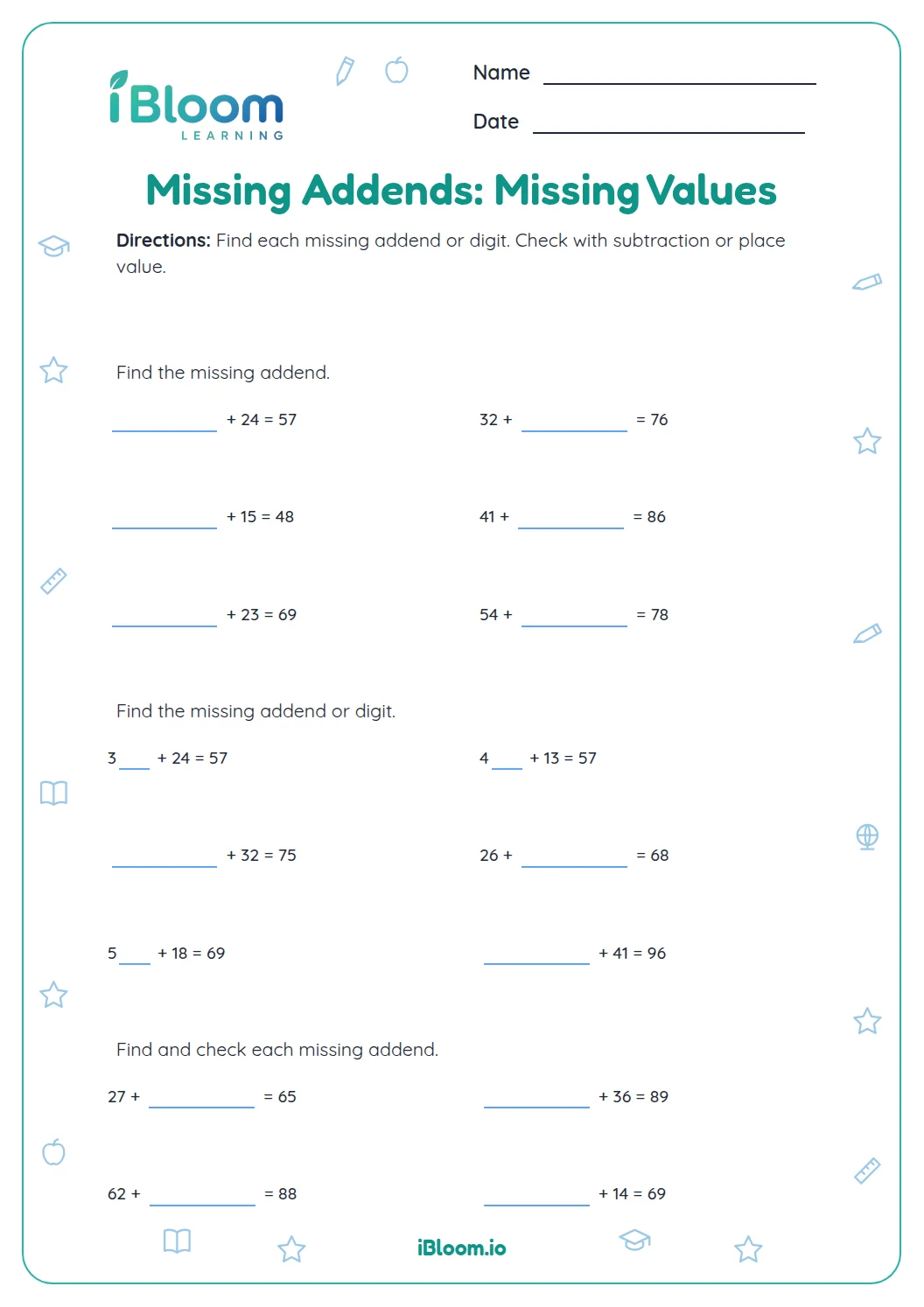
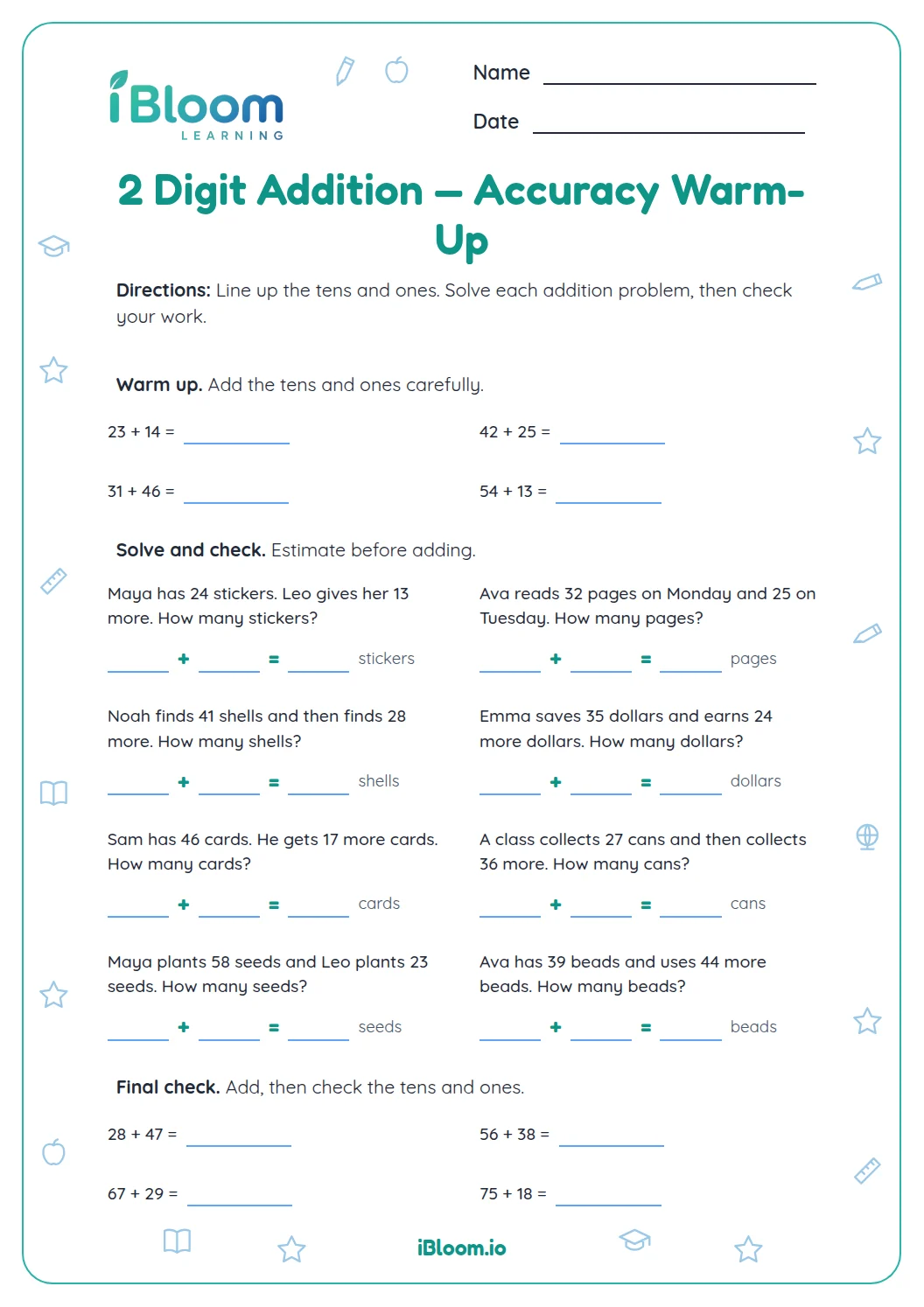
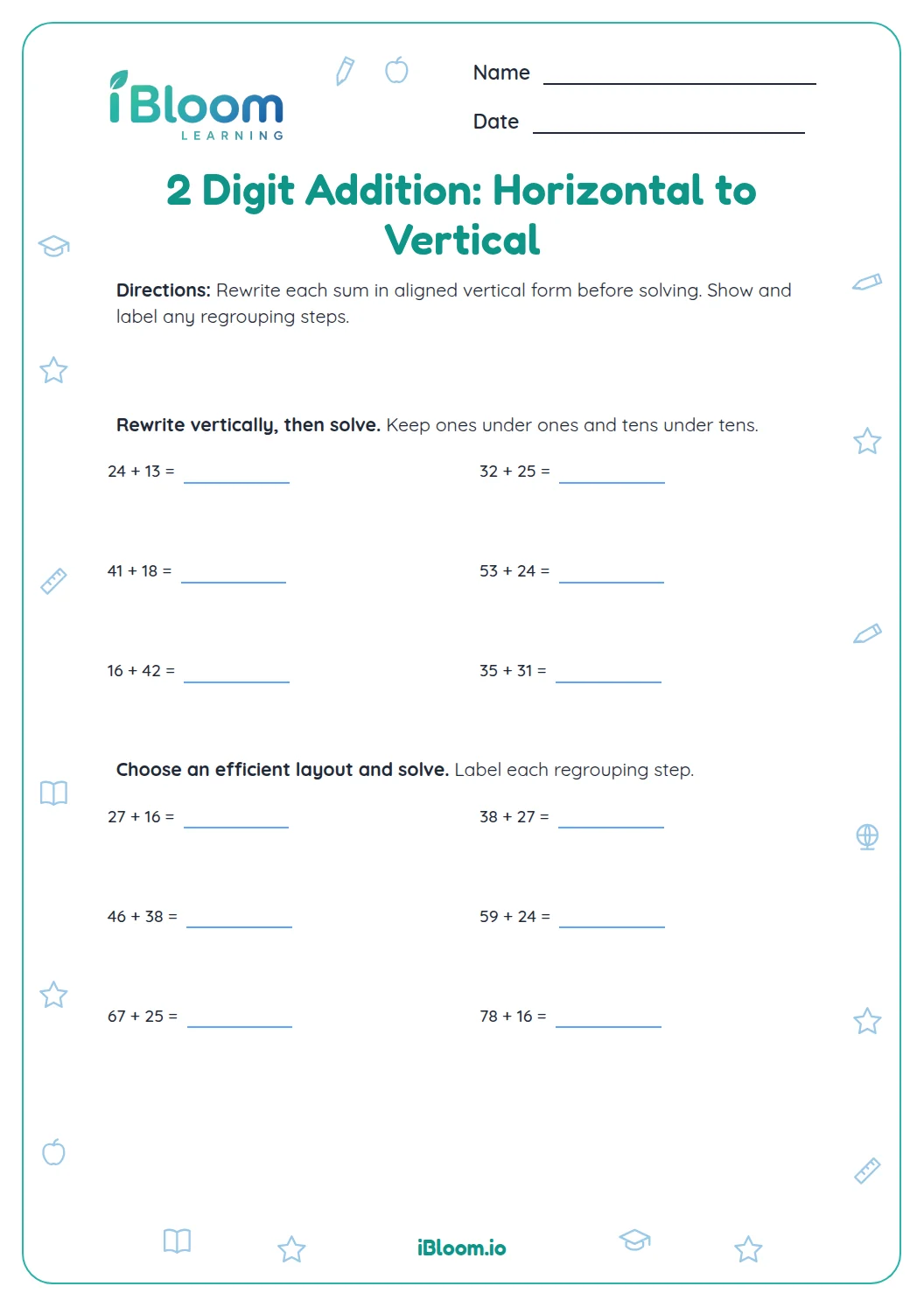
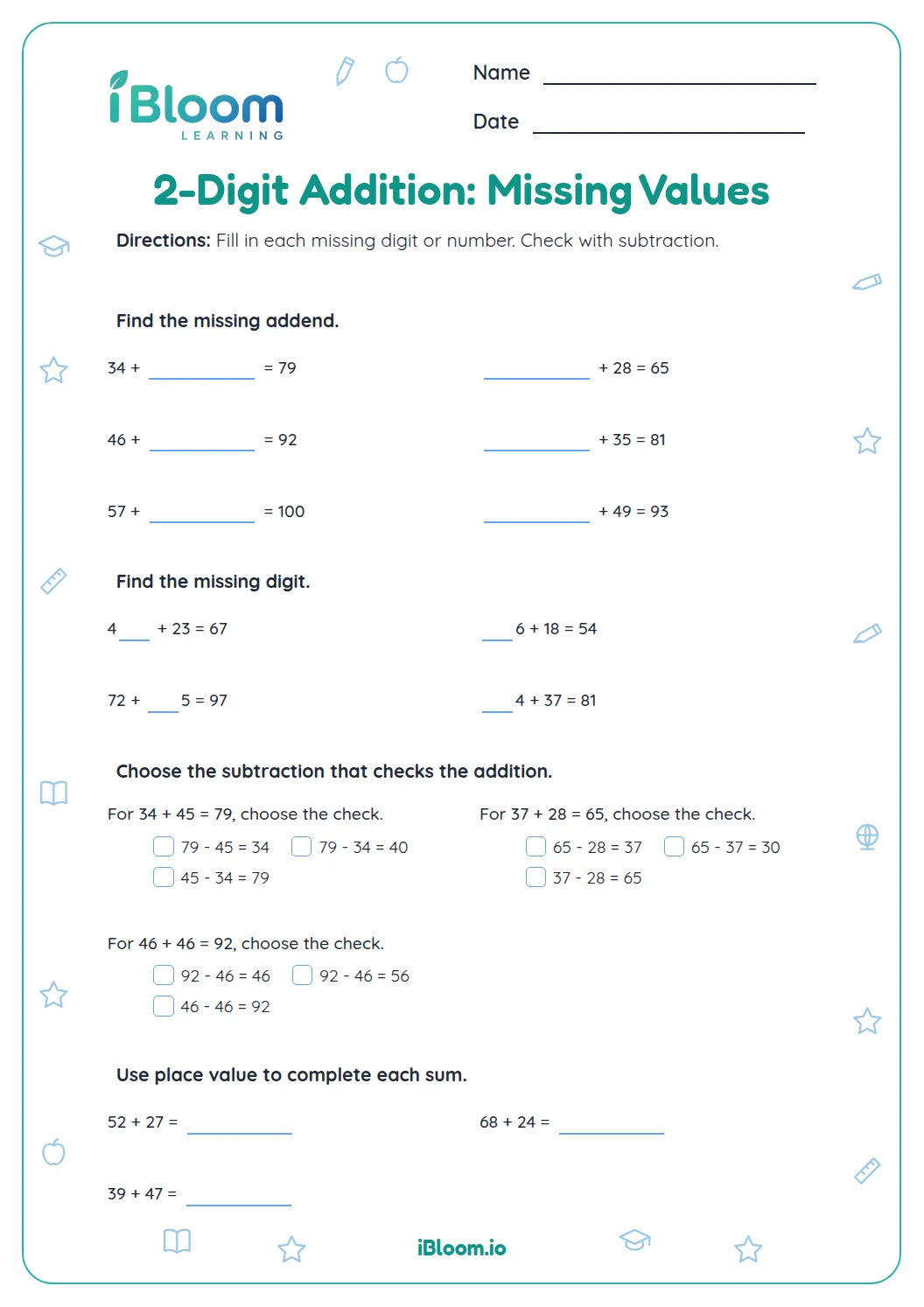
About this worksheet
Find an unknown addend or sum part by using the total and known number. Every addition stays within 100 and avoids regrouping.
Aligned to 2.NBT.B.5
How can you find a missing addend?
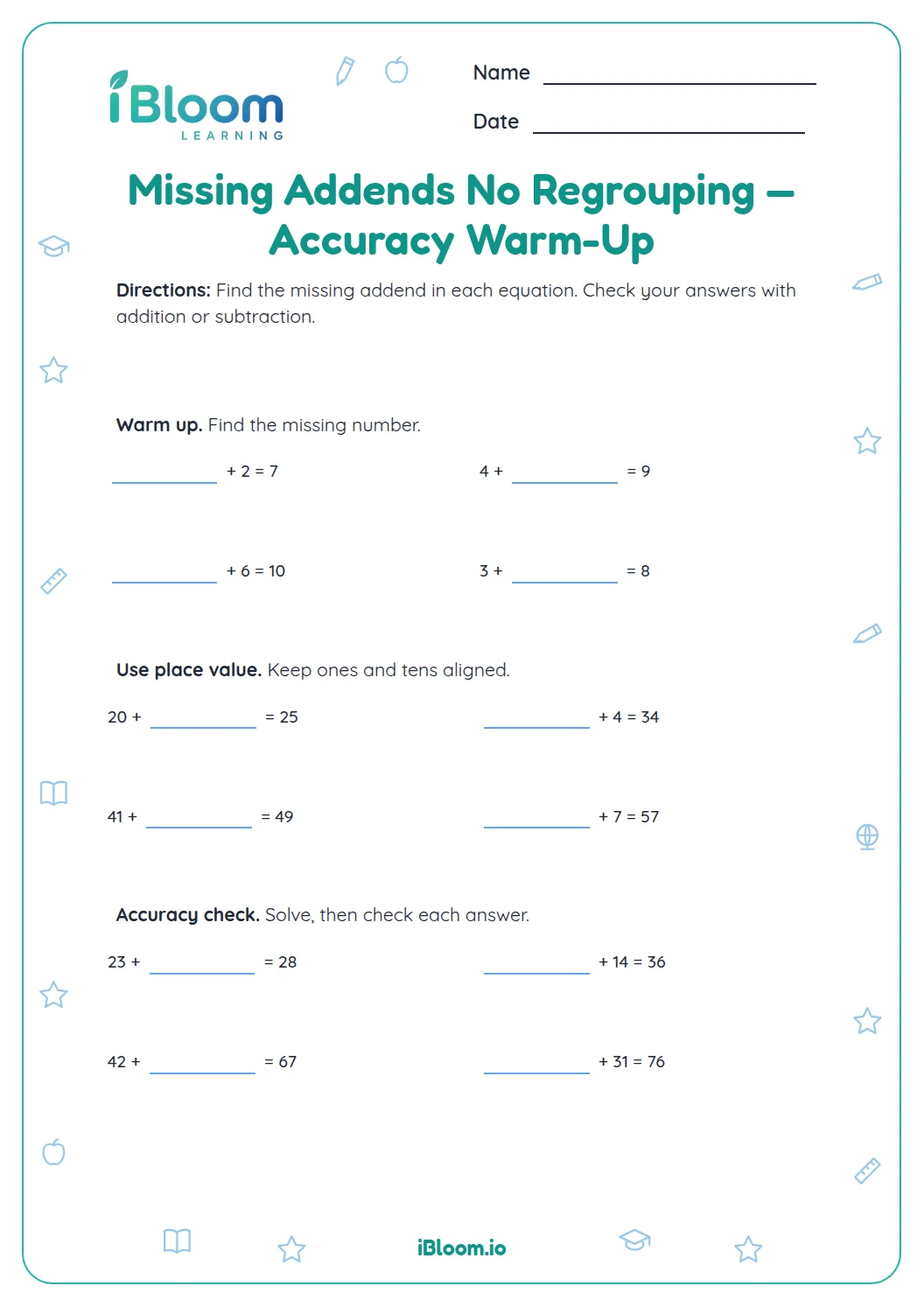
An addition sentence names two parts and a total. In question 1, 23 + ___ = 28, count from 23 to 28: 24, 25, 26, 27, 28. The gap is 5, so 23 + 5 = 28.
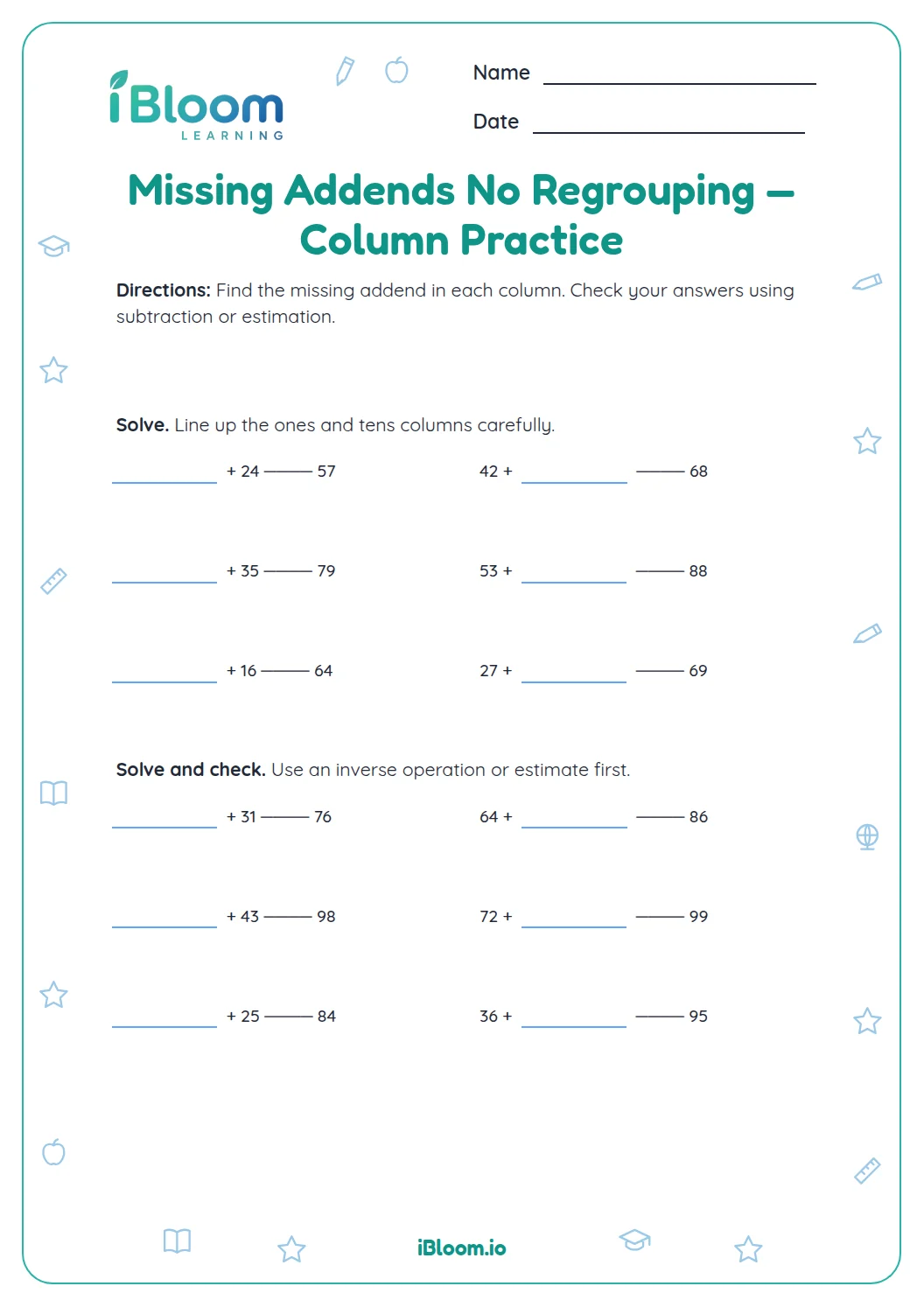
For a missing first addend, use the same relationship. In ___ + 14 = 36, find the number that joins 14 to make 36.
- 123 + ___ = 28
- 228 − 23 = 5
- 3Check: 23 + 5 = 28
What does each part ask you to do?
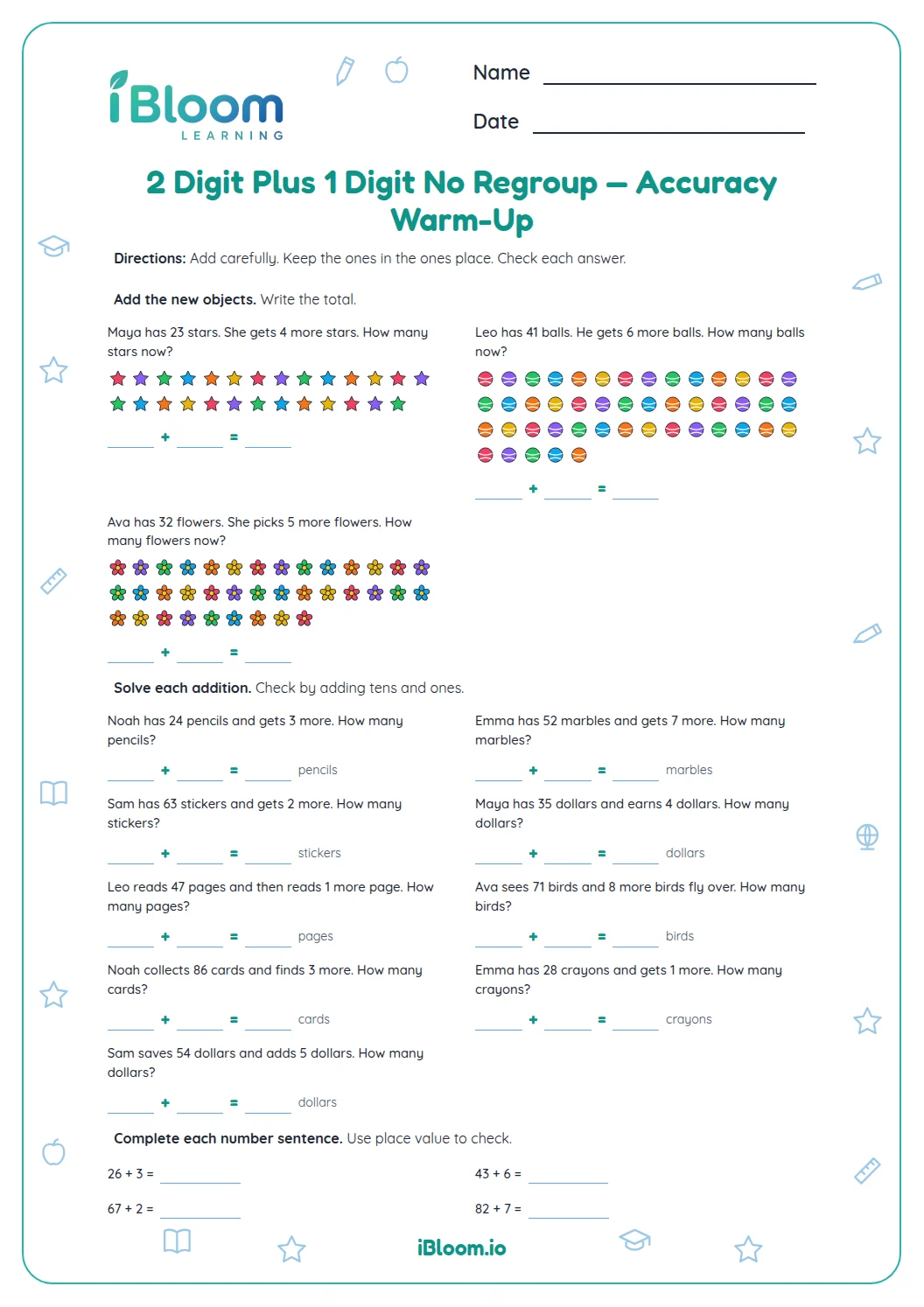
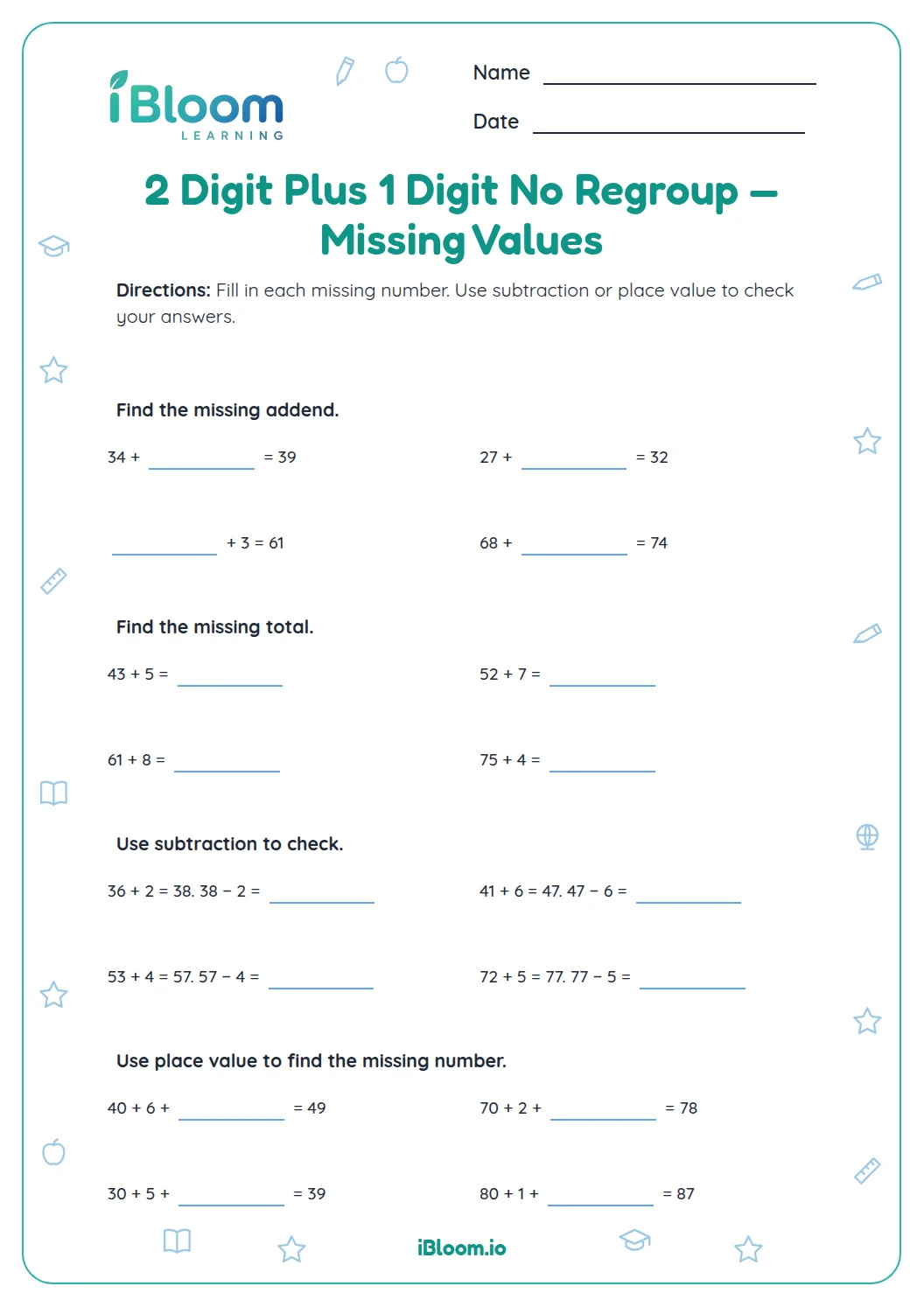
Part A finds a missing addend in two-digit plus one-digit sums. Part B finds the missing sum part in a sentence with a total; some blanks are addends and some are sums. Part C applies addition to two short stories.
Every sum keeps the ones digits below ten, so the ones place does not need regrouping. The stories use book and point totals, with room to write an addition sentence.
How to use this worksheet
- 1Read the direction at the start of each part.
- 2Solve each item and use the space provided for your work.
- 3Check each response against the answer key and revisit any missed item.
Common addition mistakes and fixes
The mistake
Subtracting the smaller digit from the larger digit without checking place value.
The fix
Compare the whole numbers: subtract the known addend from the total to find the missing part.
The mistake
Putting the total in the missing-addend blank.
The fix
Check the sentence: addends go before the equals sign, and their sum goes after it.
The mistake
Stopping before checking the equation.
The fix
Put the missing number back and add to see whether the total matches.
Curriculum alignment
This worksheet practices the listed Common Core skill.
Add within 100 using place value and the relationship between addition and subtraction.
On this sheet: The number sentences and stories use two-digit plus one-digit addition without regrouping and inverse reasoning for missing addends.
Show the official wordingHide the official wording
Fluently add and subtract within 100 using strategies based on place value, properties of operations, and/or the relationship between addition and subtraction.
What to practice next
Make more practice
Further reading
Questions parents and teachers ask
How do I find a missing addend?
Use the total and known addend to find the missing part. For 23 + ___ = 28, count from 23 to 28: the gap is 5. Check by adding 23 and 5 to get 28. Count the difference or subtract the known addend from the total; either method should give the same missing number.
What is the difference between a missing addend and a missing sum?
An addend is one of the numbers being added; the sum is the result. In 46 + ___ = 49, the blank is an addend. In 63 + 5 = ___, the blank is the sum, 68. The blank sits in one of the two addend spots before the equals sign, while the sum belongs after it.
Does the worksheet use regrouping?
No. Each two-digit plus one-digit problem keeps the ones total below ten, so the ones do not regroup. The practice focuses on reasoning about a blank using the total and a known addend. No carrying is needed in these sums, so each ones digit can be added without making another ten.
How many problems are on the sheet?
There are 16 questions in three parts: 14 addition number sentences and two short stories. Two worksheet pages are followed by two answer key pages. The number sentences come first, followed by two short applications with working space and labeled answer boxes.
How can a child check the story problems?
Question 16 starts with 45 points and adds 4 more. Write 45 + 4 = 49, then label the result as points to match the story. An addition check confirms the total and helps catch a copied digit or a mistaken calculation.