

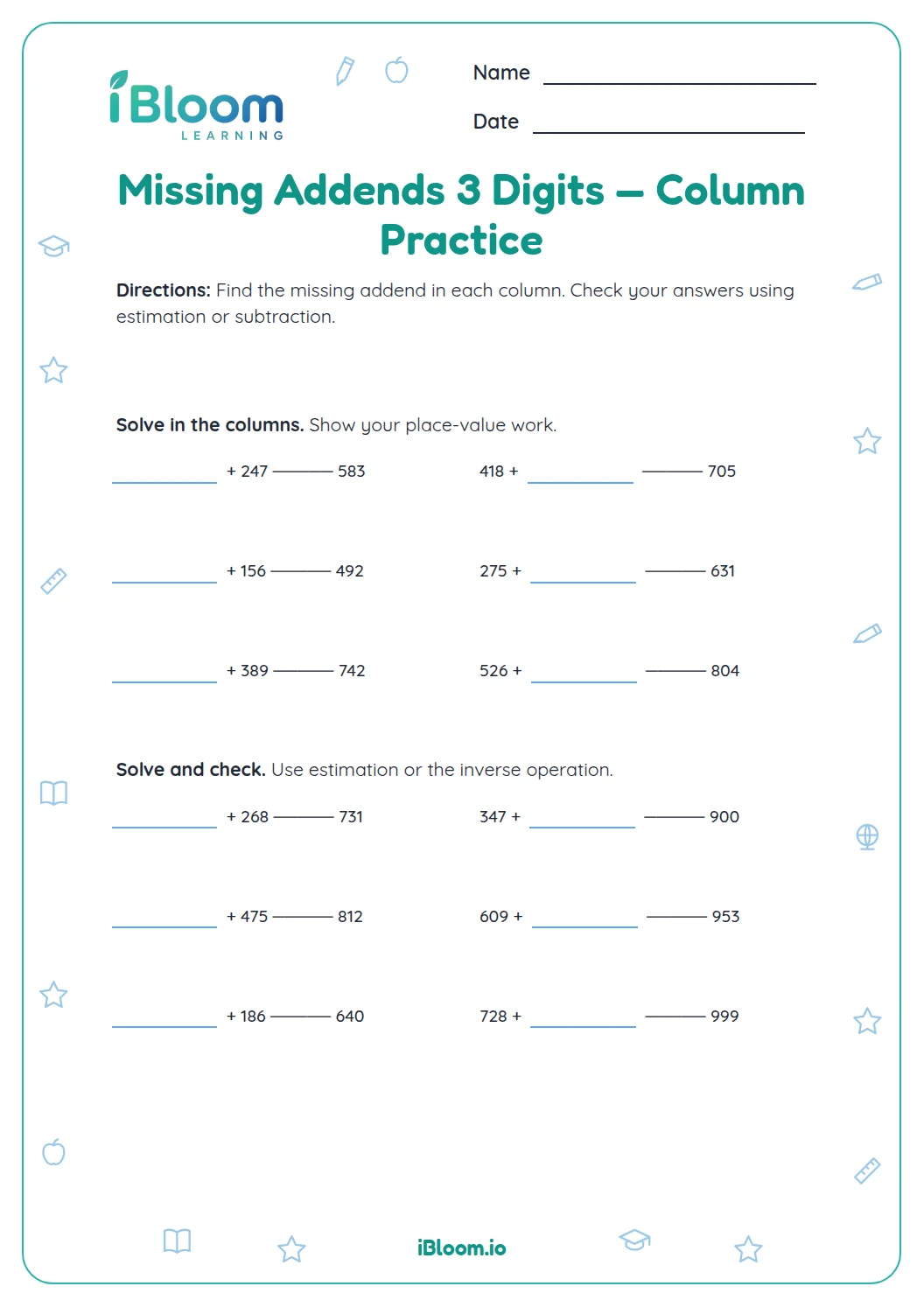
About this worksheet
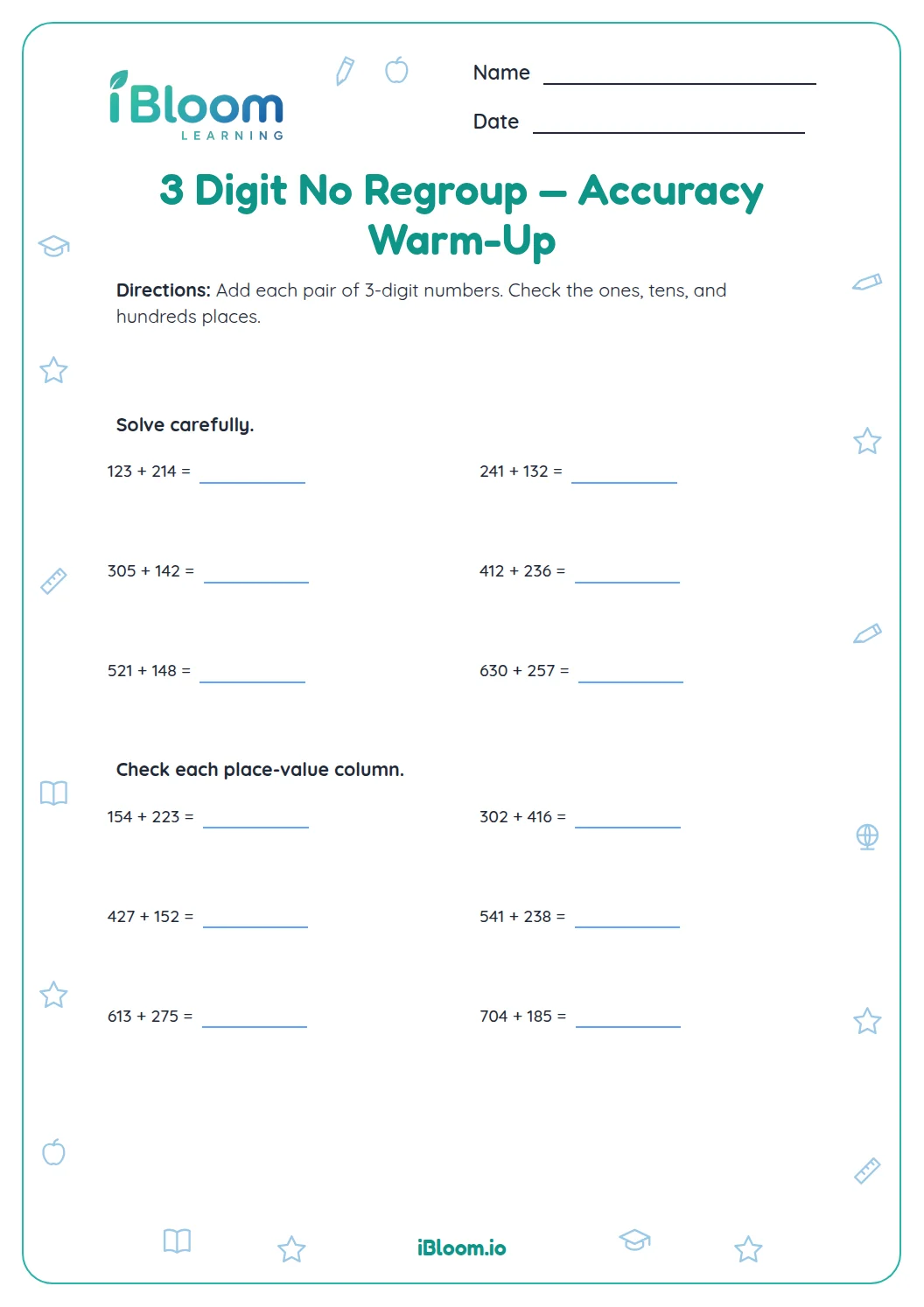
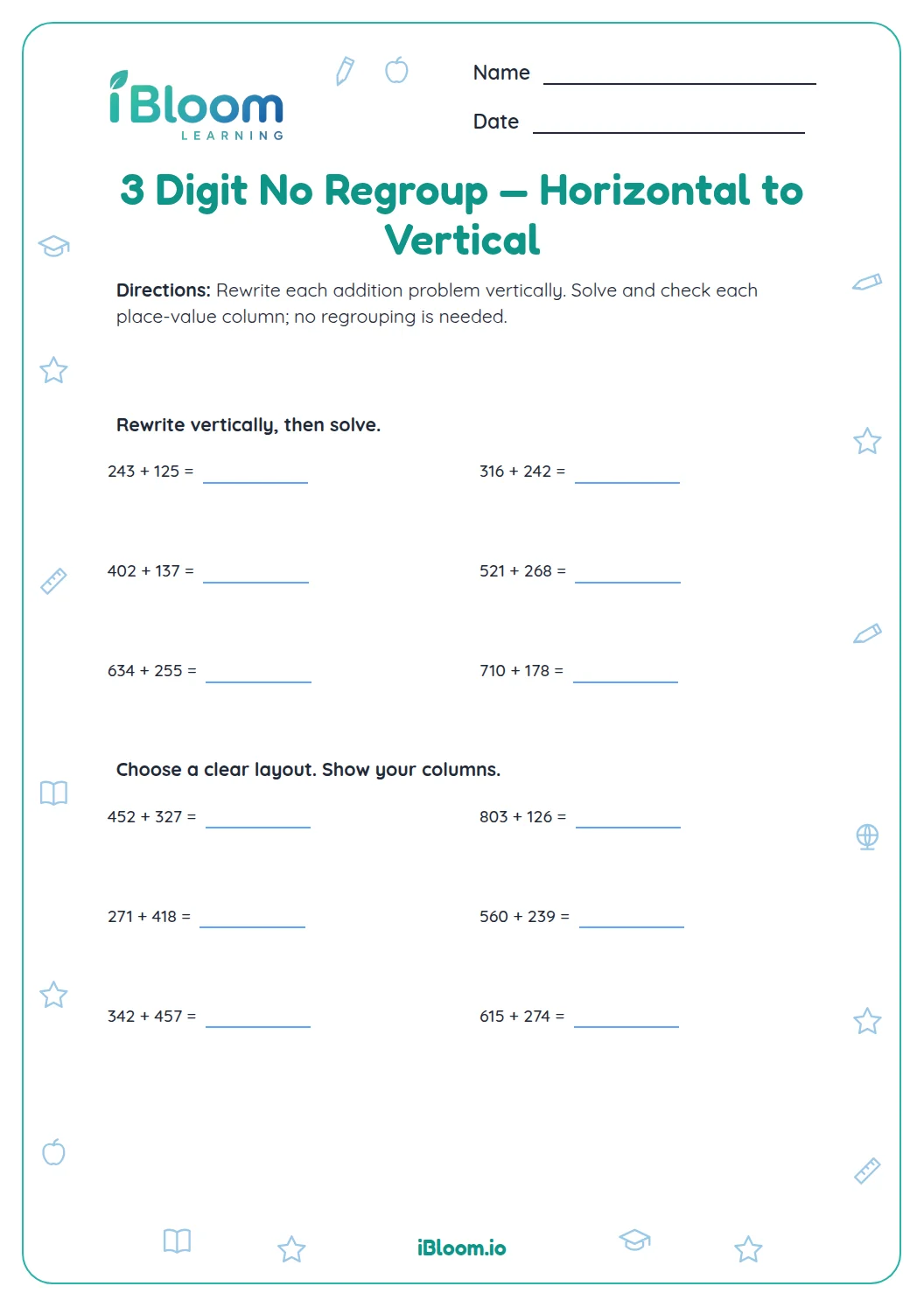
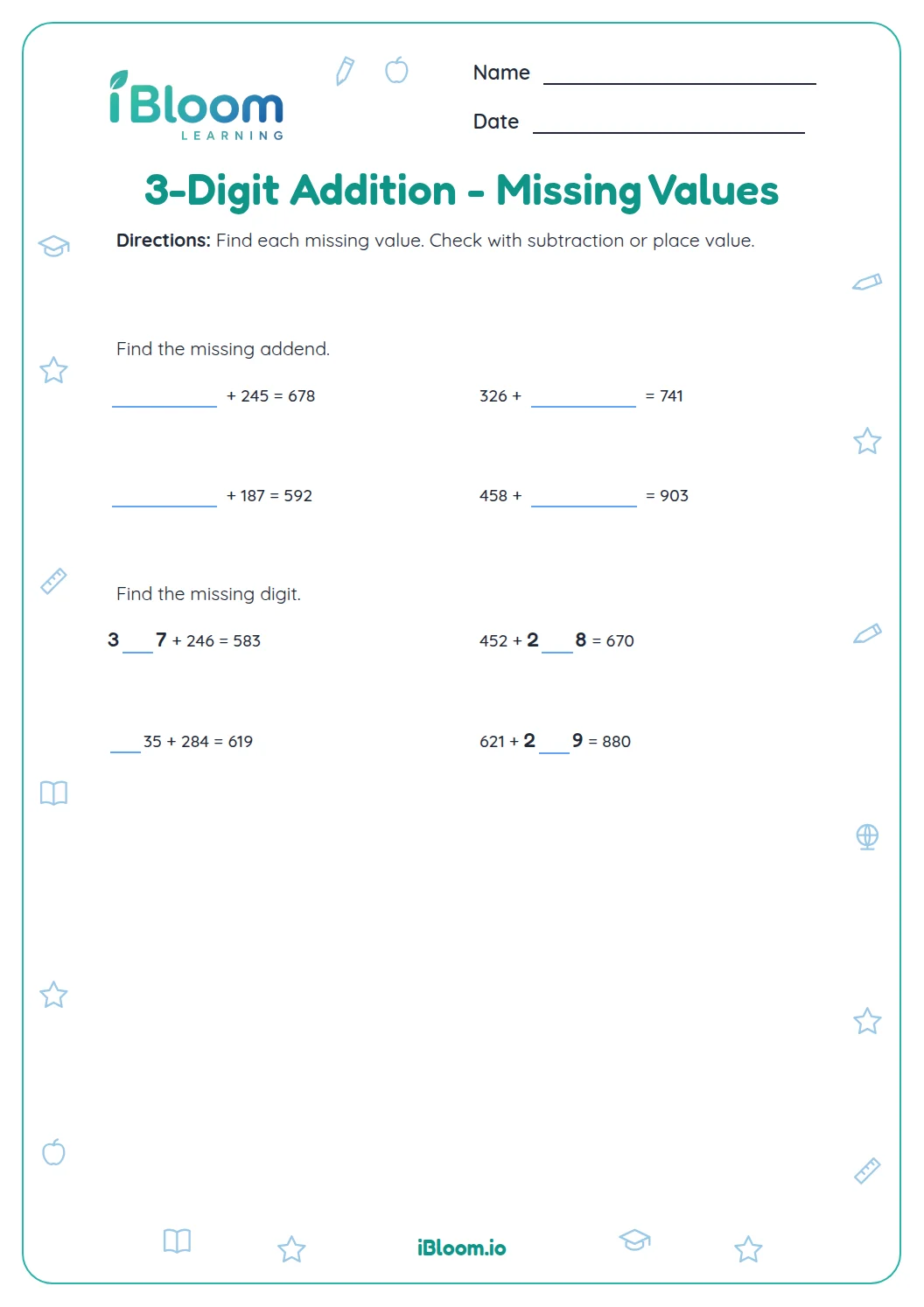
This Grade 3 printable has 16 three-digit addition equations with a missing addend or sum. Learners use place value to solve equations such as 142 + ___ = 365 and 321 + 146 = ___. Every addition is within 1,000 and avoids regrouping. The separate answer key supports checking each equation. The practice aligns with CCSS 3.NBT.A.2.
Aligned to 3.NBT.A.2
How can subtraction reveal a missing addend?
For 142 + ___ = 365, subtract 142 from 365 by place value: 365 − 142 = 223. Check by adding 142 + 223; the sum is 365, so the blank is correct.
How can place value keep the work organized?
Line up hundreds, tens, and ones. In 321 + 146, add 1 + 6 ones, 2 + 4 tens, and 3 + 1 hundreds to get 467.
How can you check a blank?
Put the found number back into the original equation. The two addends should combine to make the stated sum.
How to use this worksheet
- 1Mark the blank as the unknown.
- 2If an addend is missing, subtract the known addend from the sum.
- 3If the sum is missing, add each place-value column.
- 4Substitute the answer to check the equation.
Common mistakes and quick fixes
The mistake
Adding the known addend to the sum.
The fix
Use subtraction to undo addition when an addend is missing.
The mistake
Misaligning digits.
The fix
Keep ones under ones, tens under tens, and hundreds under hundreds.
The mistake
Regrouping despite a no-regrouping problem.
The fix
Check each column: each digit sum here is less than 10.
Common Core alignment
This worksheet practices three-digit addition within 1,000 using place value and missing addends.
Use place-value addition and related subtraction to find missing addends and sums.
On this sheet:
Show the official wordingHide the official wording
Fluently add and subtract within 1000 using strategies and algorithms based on place value, properties of operations, and/or the relationship between addition and subtraction.
What to practice next
Make more practice
Further reading
Questions parents and teachers ask
What types of equations appear?
The sheet has 16 equations with a missing addend or missing sum. Each uses three-digit numbers and addition without regrouping. For an unknown addend, subtract the known addend from the total; for an unknown sum, add the two given addends.
How do I solve 142 + ___ = 365?
Subtract the known addend from the sum: 365 − 142 = 223. Put 223 in the blank and check 142 + 223 = 365. Subtraction undoes addition and keeps the place values aligned. The sum stays fixed while the missing addend is found.
What does without regrouping mean here?
In every sum on this page, each place-value column totals less than ten. Learners can add hundreds, tens, and ones without exchanging ten ones for a ten or ten tens for a hundred. This means each column can be solved without making a new ten or hundred.
How many pages are included?
The worksheet is one page with 16 equations, and the answer key is a separate page. Learners can solve the equations in order and then use the key to check each missing value. There is one worksheet page, followed by its separate answer key.
Which standard does the worksheet practice?
The page practices CCSS 3.NBT.A.2: fluent addition and subtraction within 1,000 using place-value strategies and the relationship between the operations. Finding a missing addend uses subtraction to check an addition equation. Learners can use the inverse relationship to check each missing addend.