

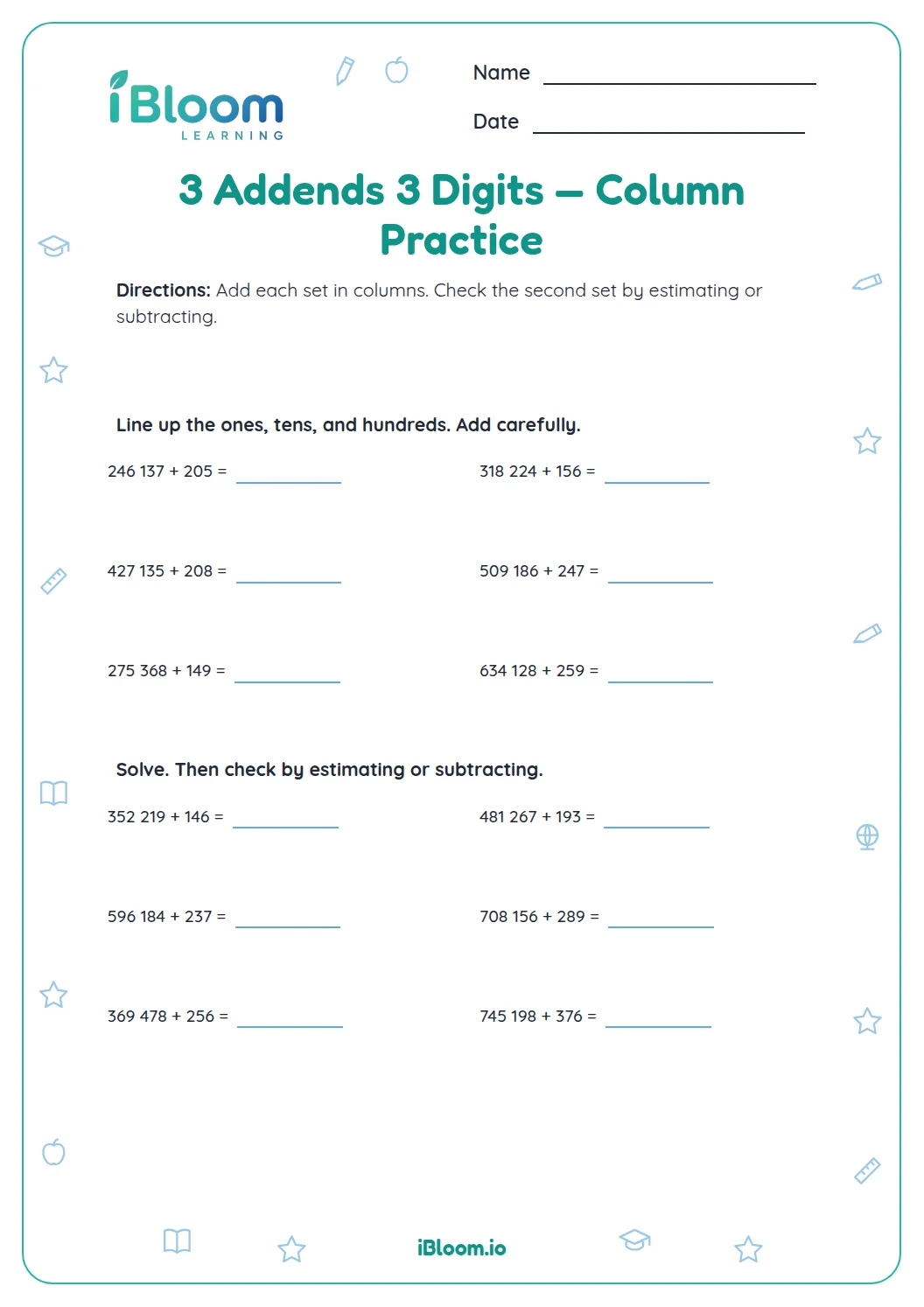
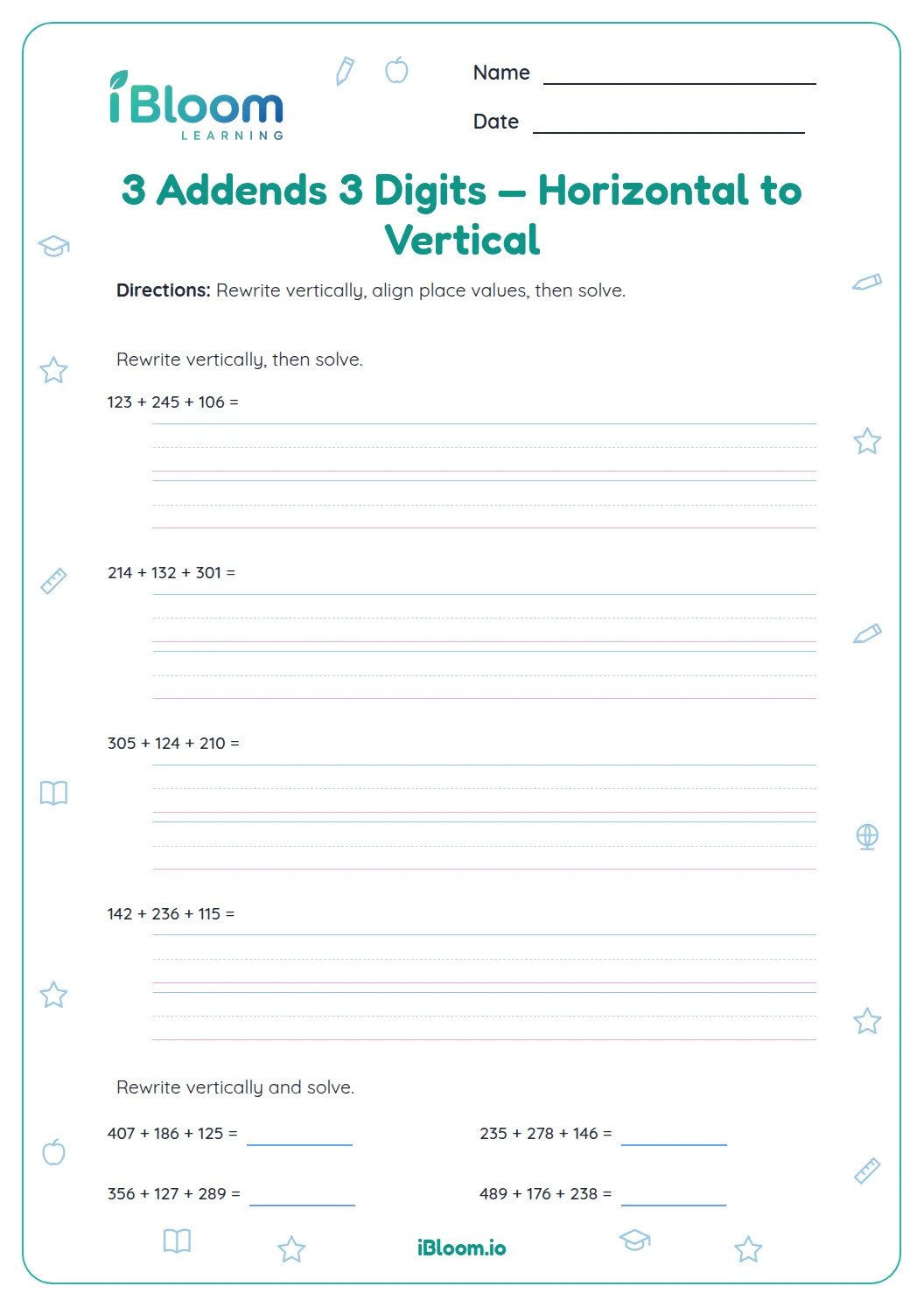
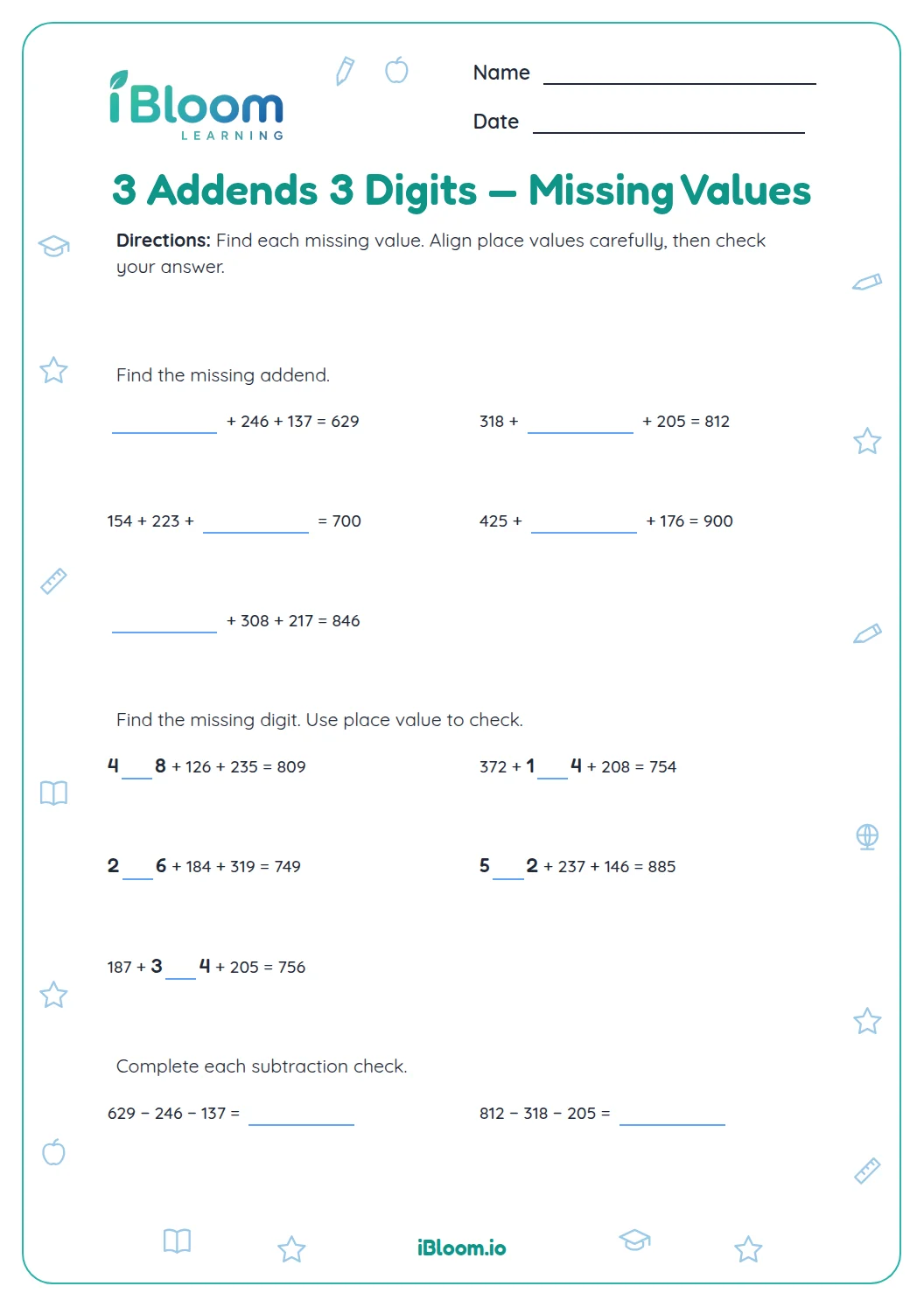
About this worksheet
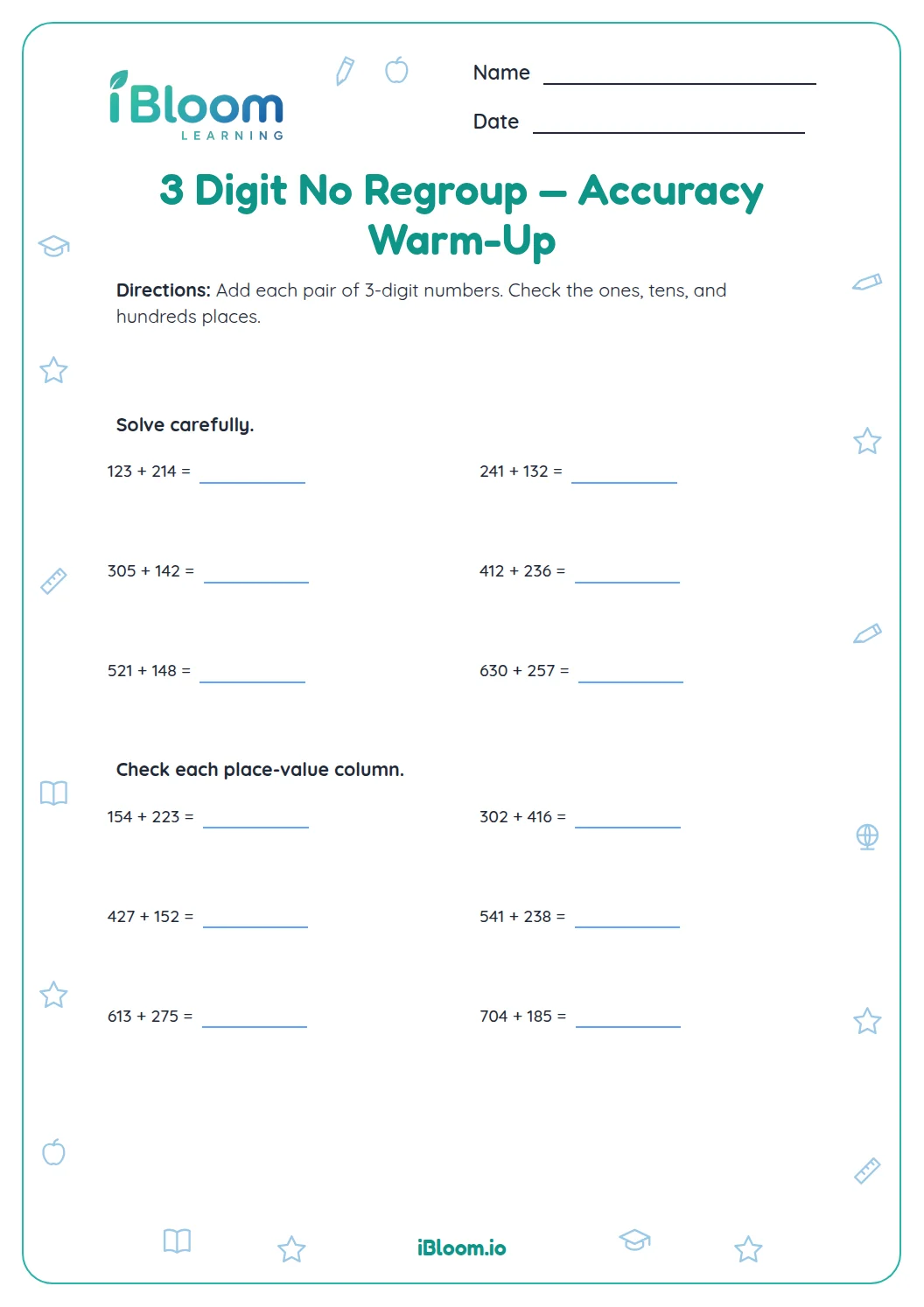
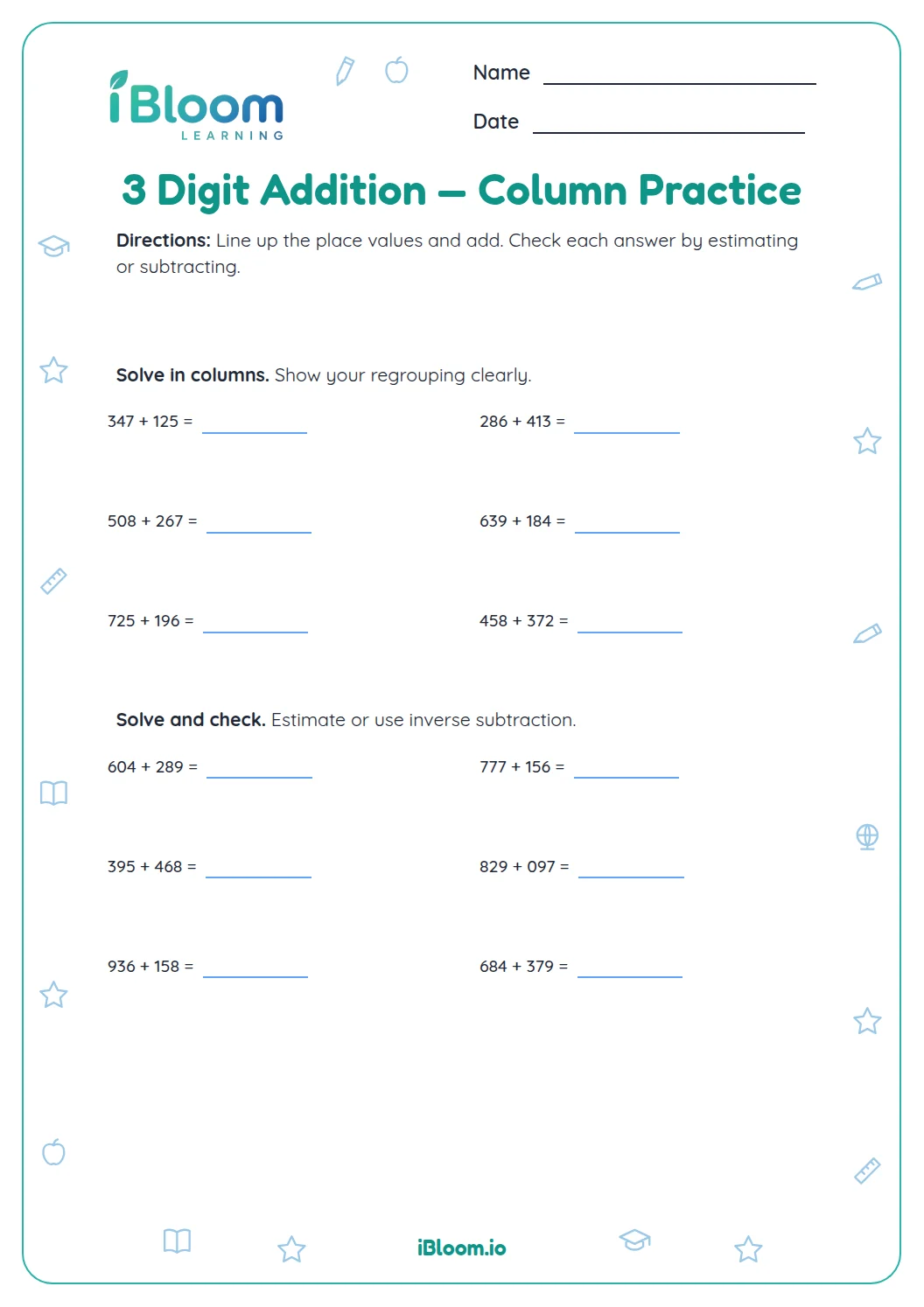
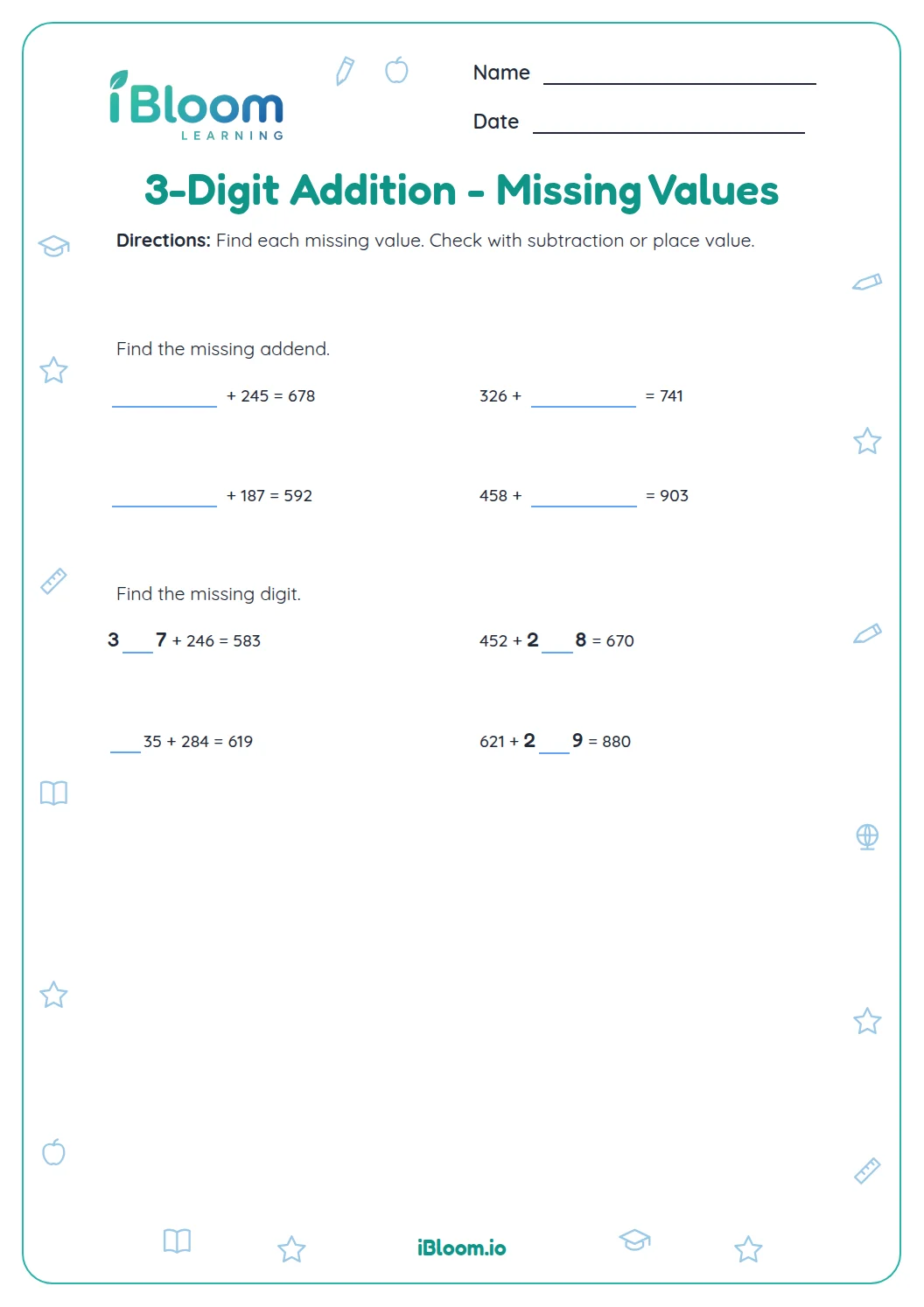
This printable Grade 3 math worksheet gives children 20 opportunities to add three-digit numbers without regrouping. The first group practices straightforward column sums; the next asks children to find missing addends; the final group adds eight more sums for independent checking. Each item is chosen so every place-value column totals less than ten. The work connects to CCSS 3.NBT.A.2, adding within 1,000 using place-value strategies and algorithms. The answer key is provided separately.
Aligned to 3.NBT.A.2
How does no-regrouping addition work?
Add the ones, tens, and hundreds in their own columns. When each column total is 9 or less, write it directly in that place; no ten or hundred needs to be exchanged.
For example, in 234 + 125, ones make 9, tens make 5 tens, and hundreds make 3 hundreds. The sum is 359.
How can a missing addend be found?
Think of the total as the whole and the known addend as one part. Subtract the known addend from the total, or use place value to find what is needed in each column. In 132 + 656, first combine the ones, then the tens and hundreds.
How can a child check each answer?
Add the same two numbers again, starting with a different place or using the opposite order. The addends can switch places without changing the total. Check each column separately so a small place-value slip is easier to catch.
- 1234 + 125
- 2Ones: 4 + 5 = 9
- 3Tens: 3 tens + 2 tens = 5 tens
- 4Hundreds: 2 hundreds + 1 hundred = 3 hundreds
- 5Sum: 359
How to use this worksheet
- 1Line up the hundreds, tens, and ones before starting.
- 2Solve the first group by adding each column independently.
- 3For a missing addend, subtract the known addend from the total.
- 4Recheck each total by adding the same two numbers again.
Common mistakes and quick fixes
The mistake
Combining columns too early and losing track of place value.
The fix
Write ones beneath ones, tens beneath tens, and hundreds beneath hundreds.
The mistake
Writing a digit bigger than 9 in one column.
The fix
Pause: each column in this no-regrouping set should total 0 through 9.
The mistake
Subtracting the total from the known addend for a missing value.
The fix
Use total minus known addend, then add back to confirm.
Common Core alignment
This practice focuses on place-value addition within 1,000.
Add within 1,000 using place-value strategies or algorithms.
On this sheet: All 20 items use place-value addition or the addition-subtraction relationship within 1,000.
Show the official wordingHide the official wording
Fluently add and subtract within 1000 using strategies and algorithms based on place value, properties of operations, and/or the relationship between addition and subtraction.
What to practice next
Make more practice
Further reading
Questions parents and teachers ask
Why are these called no-regrouping sums?
In every problem, the digits in each place add to less than ten. That means a child can write the ones, tens, and hundreds totals in their own columns without exchanging ten ones for a ten or ten tens for a hundred.
Should the numbers be lined up vertically?
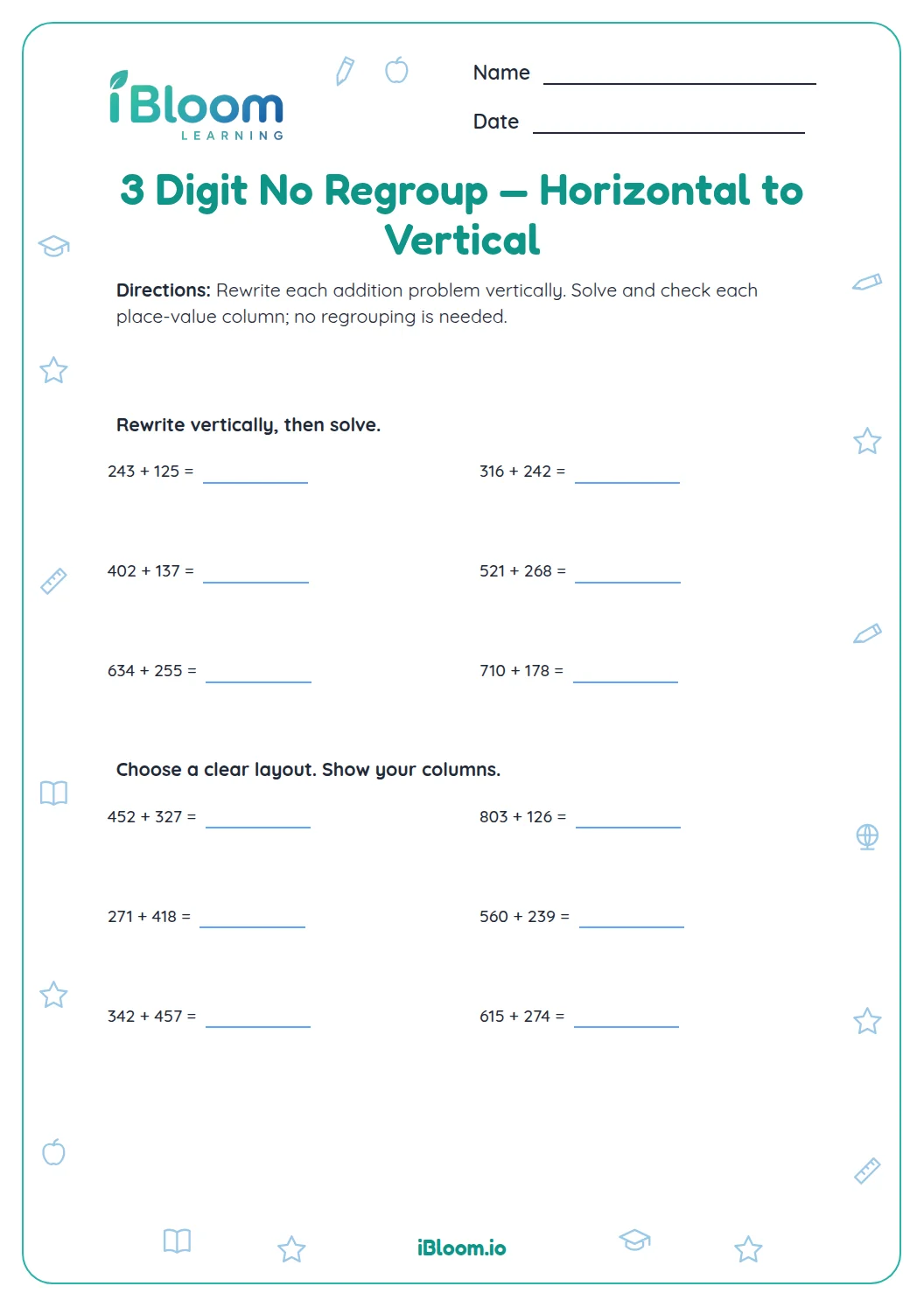
The problems print as number sentences, but lining up the digits can make place value clearer. Have your child write hundreds under hundreds, tens under tens, and ones under ones on scrap paper if that helps. On this page, the blank sits in the addend position, before the equals sign.
What is a missing addend?
A missing addend is one of the numbers being added. In 132 + ___ = 788, subtract 132 from 788 to find 656. Add 132 and 656 to confirm that they make the printed total. This check uses the relationship between addition and subtraction.
How many questions are on the worksheet?
There are 20 number sentences in three groups: eight direct sums, four missing-addend problems, and eight more direct sums. The separate answer key lists all 20 answers so children can check their work. Cover the key while solving, then compare each result and revisit any place-value column that differs.
How can I check for a place-value error?
Ask the child to inspect one column at a time and read the result aloud as hundreds, tens, and ones. Then add the same pair again in a different order; the total should stay the same. Reading the place values aloud helps catch a digit written in the wrong column.