
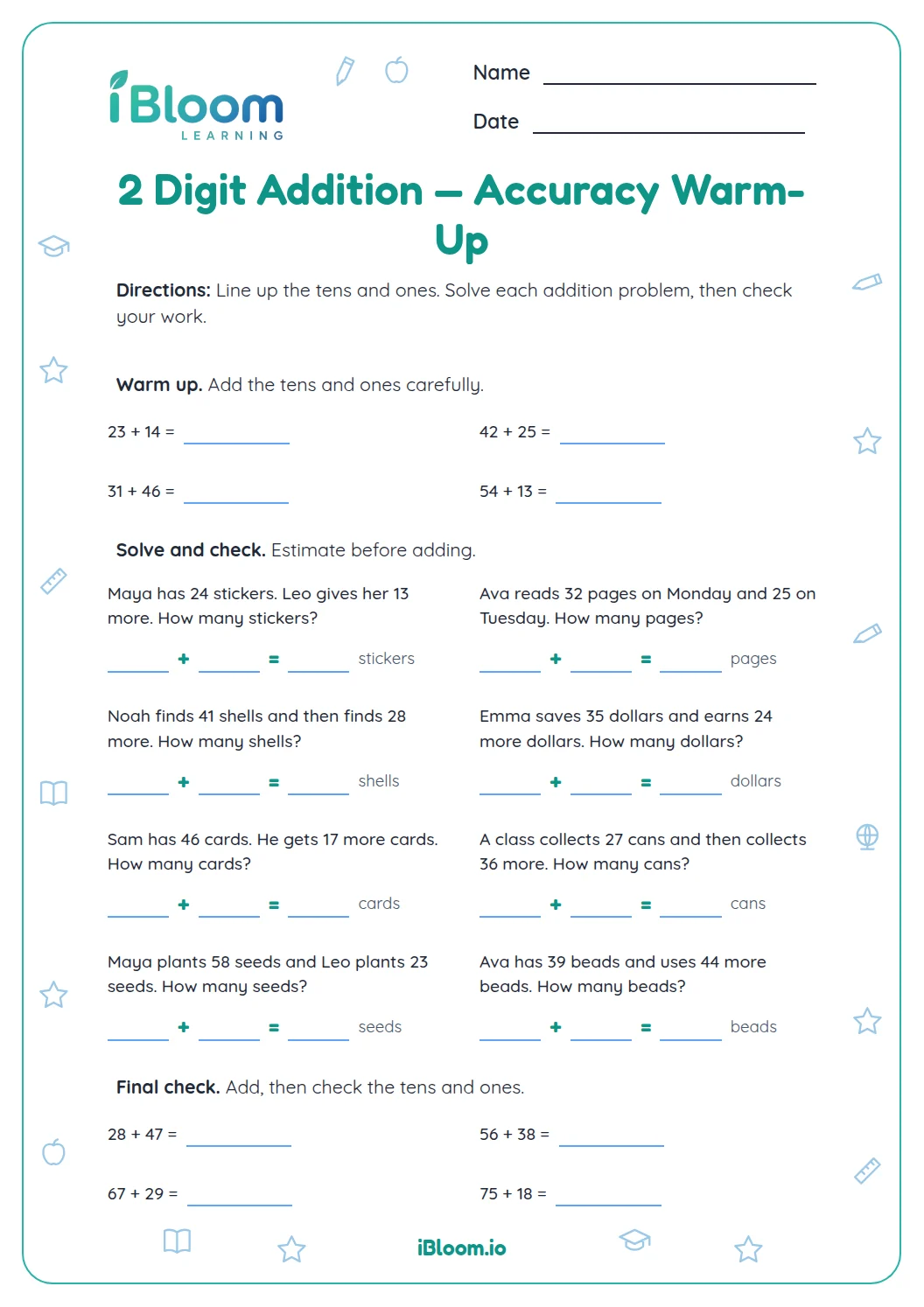
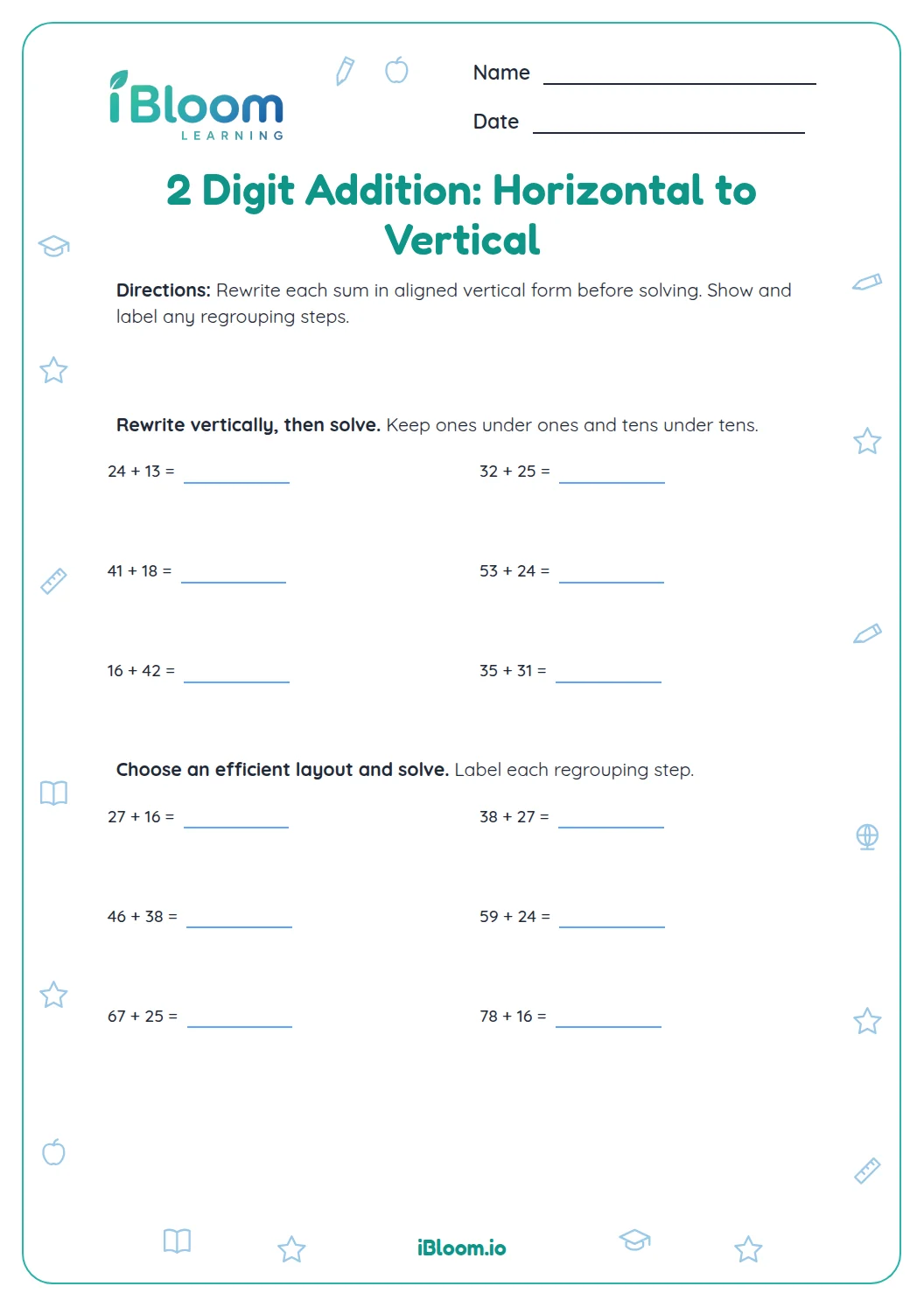
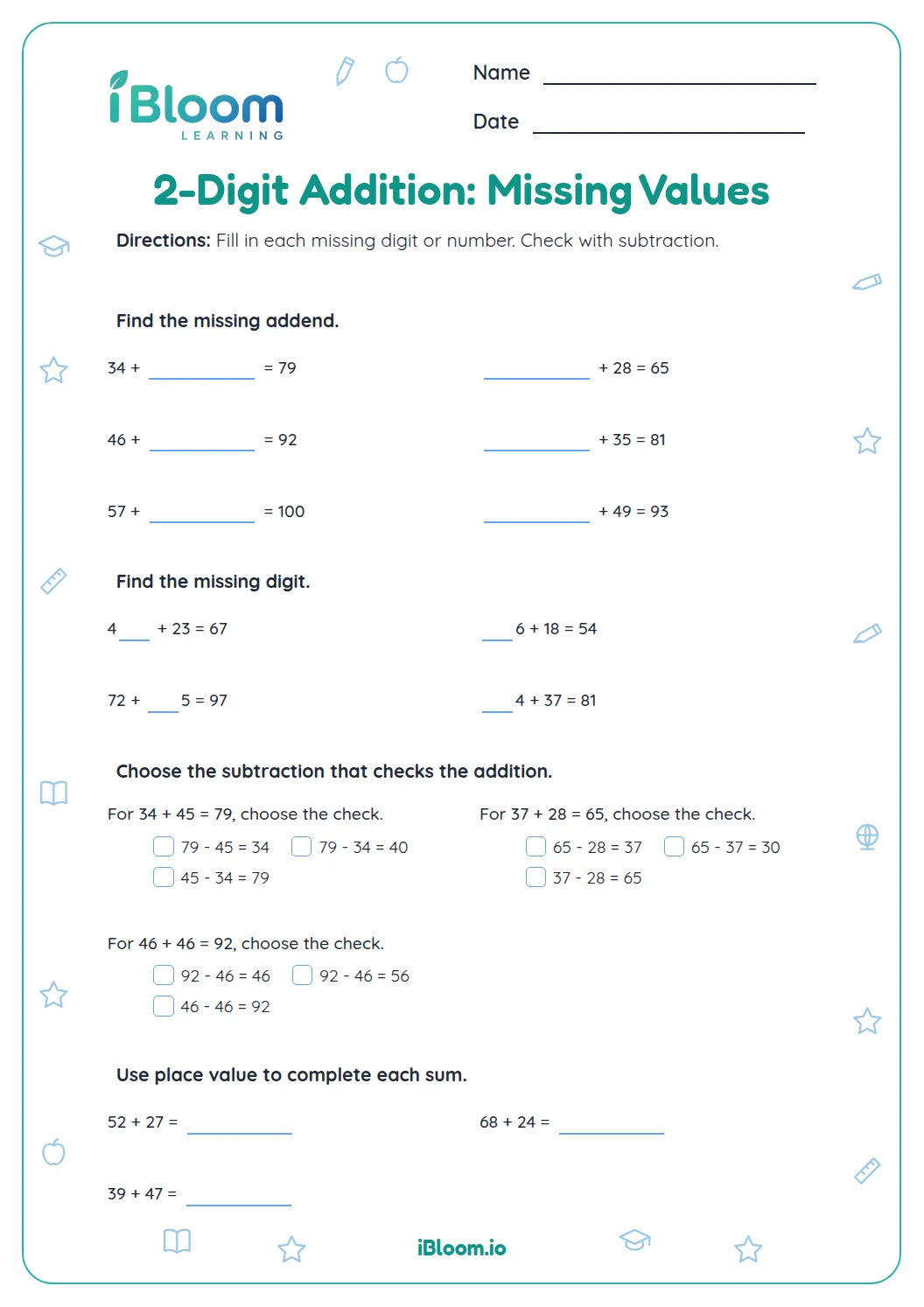
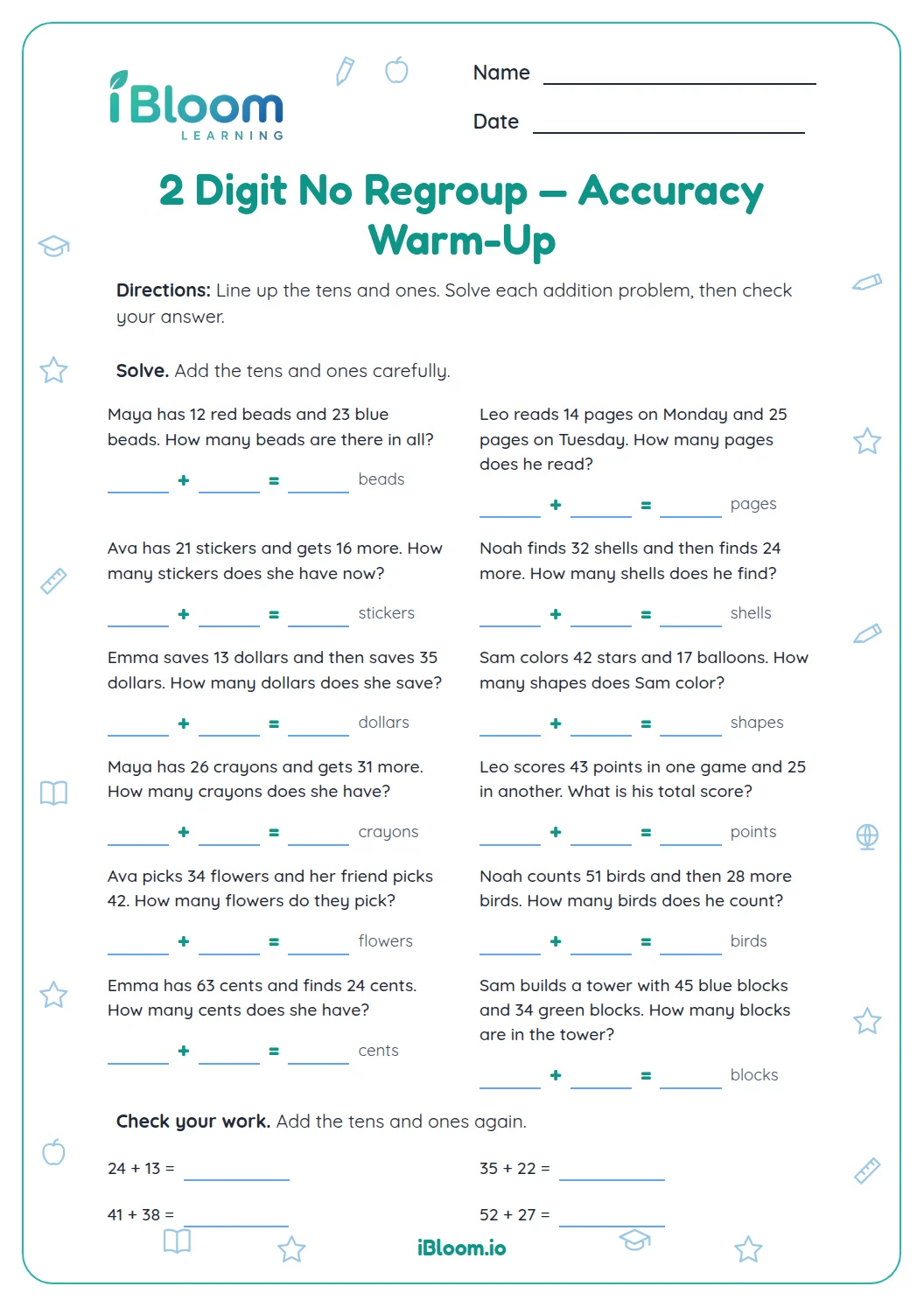
About this worksheet
This free printable is for Grades 3–4 students practicing adding three three-digit addends. It has 20 questions with a separate answer key. The examples build from the core idea to independent practice. CCSS 4.NBT.B.4
Aligned to 4.NBT.B.4
How do you add three three-digit numbers?
Add by place value. Combine the ones, then the tens, then the hundreds, regrouping whenever a column reaches ten. Keep the digits lined up when writing the work.
For question 1, the ones are 8 + 7 + 5 = 20. Write 0 ones and regroup 2 tens before adding the tens and hundreds.
- 1128 + 247 + 315
- 2Ones: 8 + 7 + 5 = 20; regroup 2 tens.
- 3Tens: 2 + 4 + 1 + 2 = 9 tens.
- 4Hundreds: 1 + 2 + 3 = 6 hundreds.
- 5Total: 690.
How can you check a sum?
Estimate first by rounding each addend to the nearest hundred. After finding the exact total, add in a different order or check the column totals. Your answer should be near the estimate.
For question 1, 128 + 247 + 315 is close to 100 + 200 + 300 = 600; the exact sum 690 is reasonable.
What is on this addition drill?
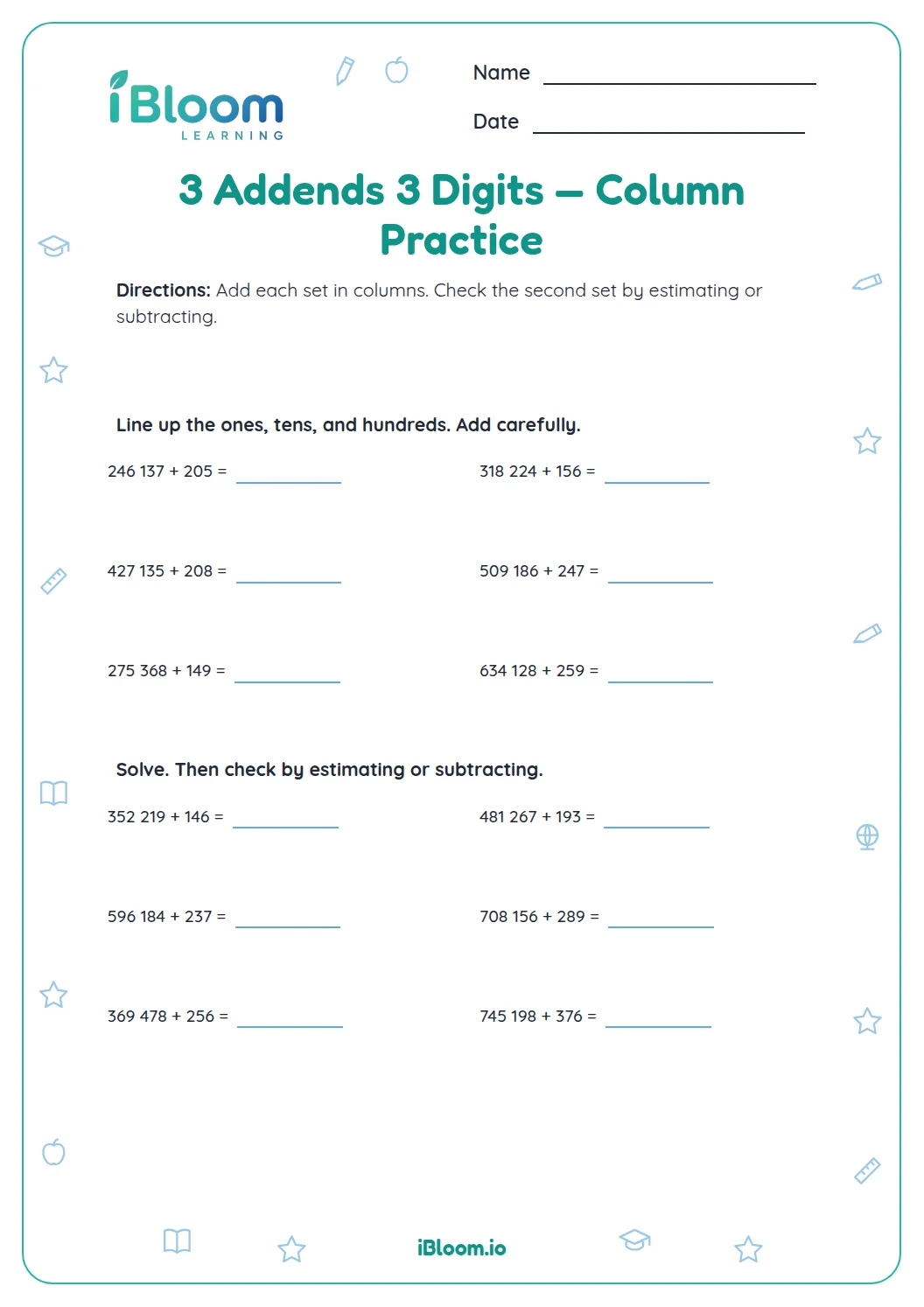
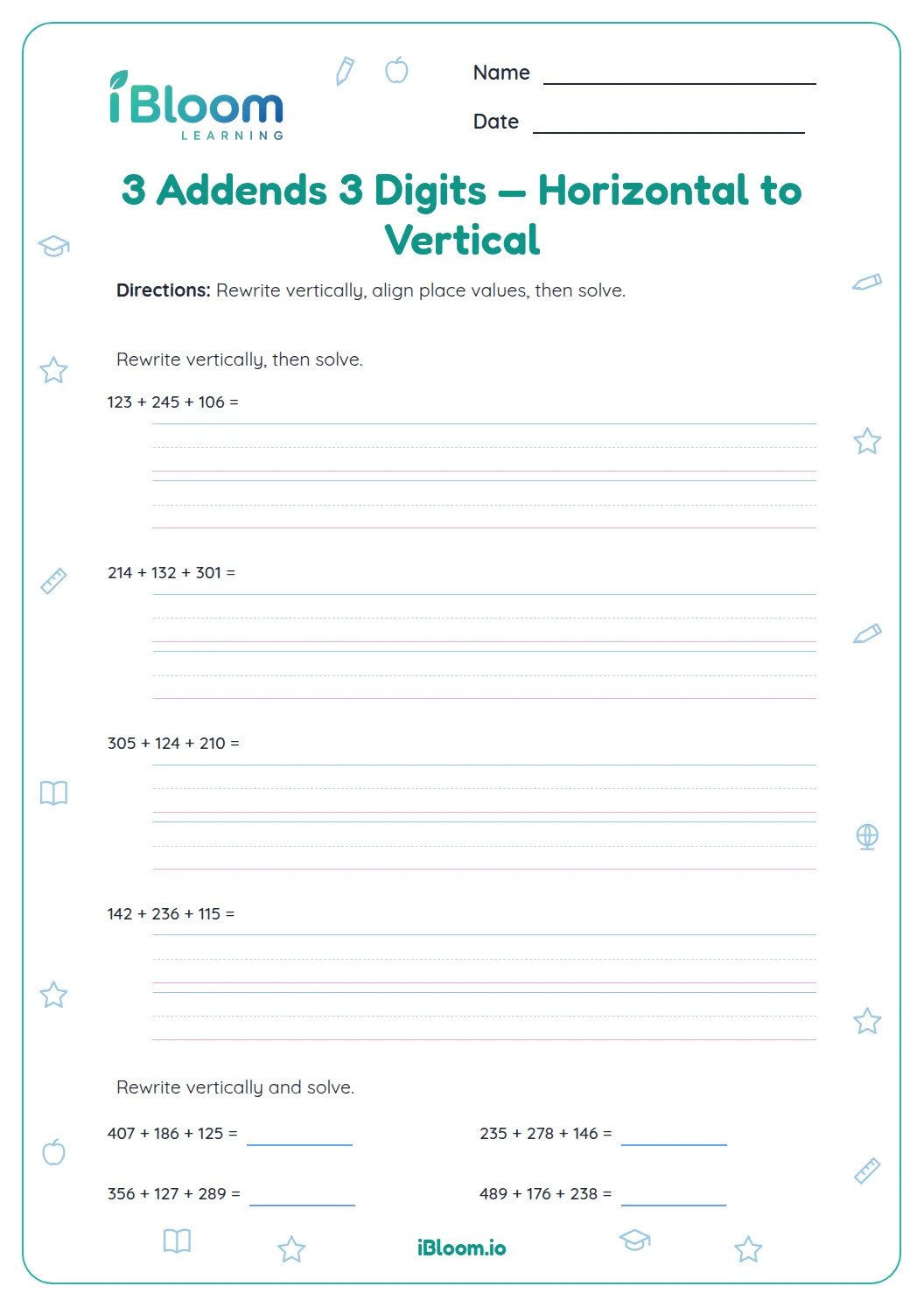
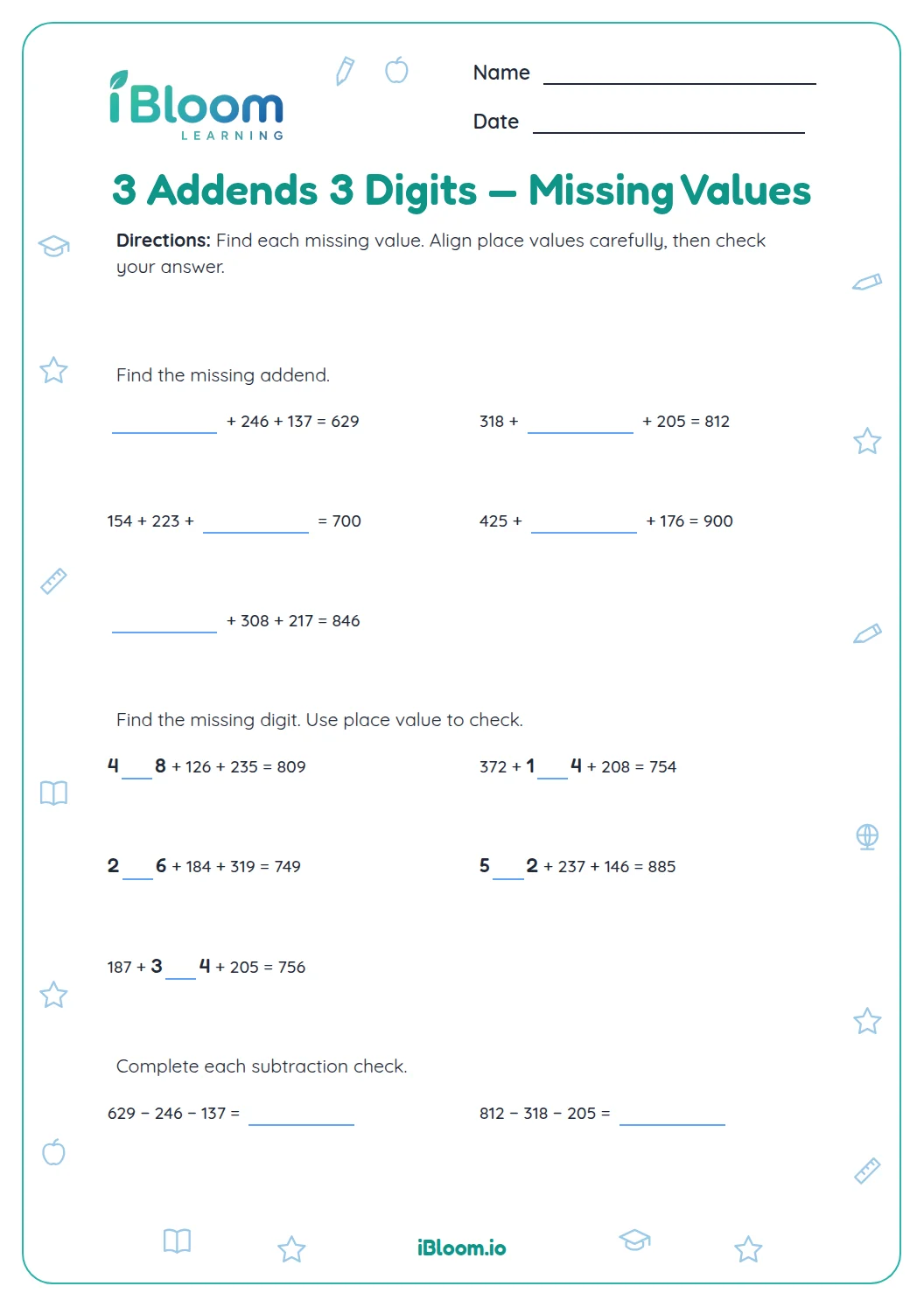
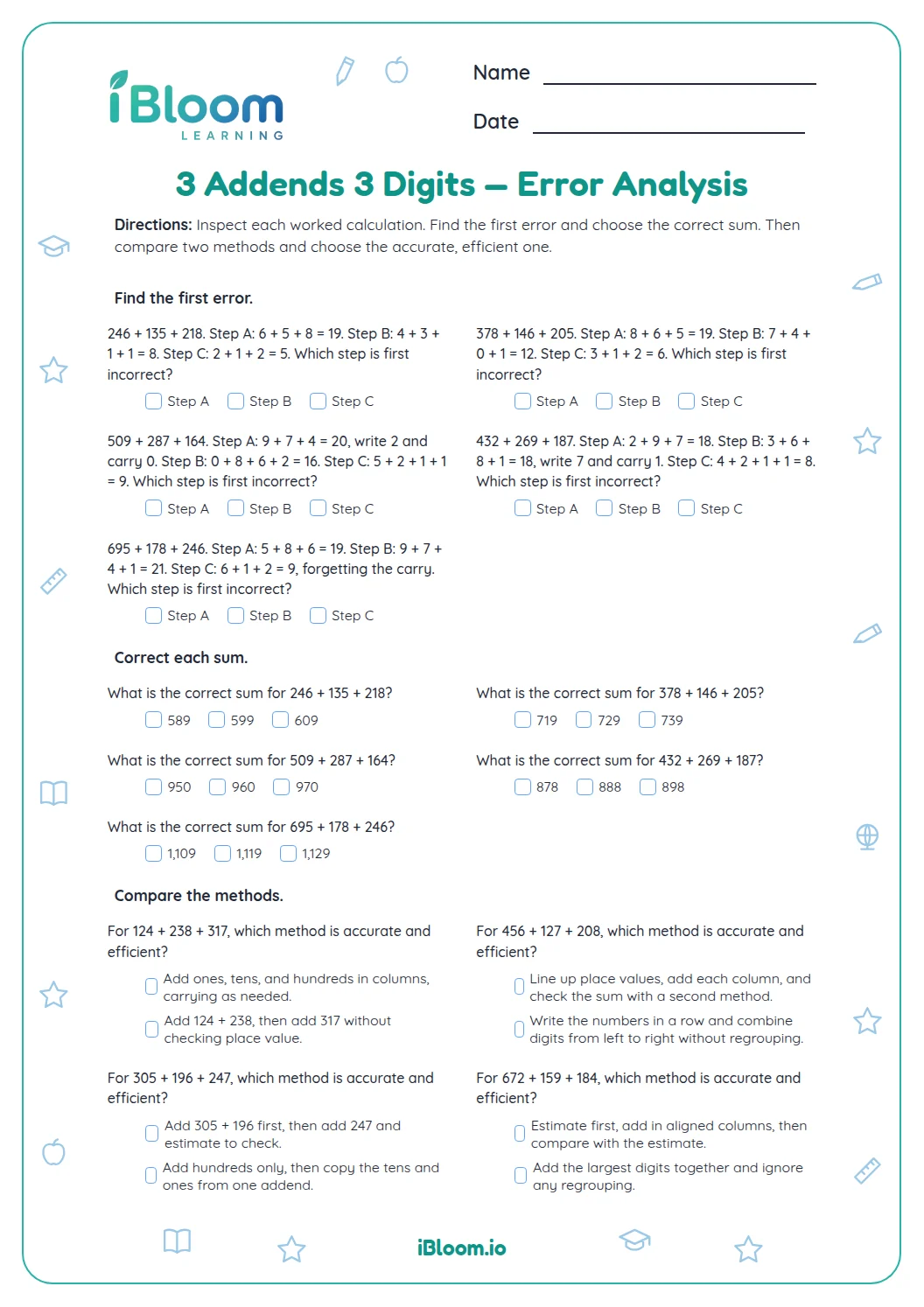
The worksheet has 20 three-addend problems in three parts. Every problem uses three-digit addends, and the answer key lists all 20 checked sums.
- Part A: Questions 1–7 warm up with three addends.
- Part B: Questions 8–10 continue the sums and checking.
- Part C: Questions 11–20 provide more regrouping practice.
How to use this worksheet
- 1Estimate the total by rounding each addend.
- 2Line up hundreds, tens, and ones.
- 3Add the ones and regroup if needed.
- 4Add the tens, including any regrouped ten.
- 5Finish the hundreds and check the total against your estimate.
Common mix-ups and quick fixes
The mistake
Adding only the first two addends.
The fix
Point to each of the three numbers as you add.
The mistake
Forgetting a regrouped ten.
The fix
Carry the extra ten into the tens column before continuing.
The mistake
Misaligning place values.
The fix
Write hundreds under hundreds, tens under tens, and ones under ones.
Curriculum alignment
The sheet practices accurate multi-digit addition with regrouping.
Use the standard algorithm to add multi-digit whole numbers accurately.
On this sheet: Three-digit addends are combined using standard place-value addition.
Show the official wordingHide the official wording
Fluently add and subtract multi-digit whole numbers using the standard algorithm.
What to practice next
Make more practice
Further reading
Questions parents and teachers ask
How many numbers are in each problem?
Each problem has three addends, and all three are three-digit numbers. There are 20 problems across two worksheet pages. The separate two-page answer key lists every total. Have students add one column at a time and show any regrouped ten clearly.
How should students line up the numbers?
Write the addends so the hundreds, tens, and ones are in matching columns. Add each column and regroup when a column totals ten or more. Careful alignment helps prevent mixing tens and hundreds. The key gives the exact total, while estimation helps catch totals that are far off.
What does regrouping mean here?
When a place-value column totals ten or more, trade groups of ten for one unit in the next column. In question 1, the ones total 20, so write 0 ones and carry 2 tens into the tens column. A quick estimate can show whether the answer is close to the expected size.
How can a student check an answer?
Round the three addends to estimate a nearby total, then compare the exact sum with that estimate. Students can also add the numbers in a different order or recompute the columns to check. The sums include regrouping across place-value columns, so careful alignment matters.
Is this practice for Grade 3 or Grade 4?
The worksheet is labeled for Grades 3–4 and practices adding three-digit whole numbers with regrouping. A student should already be comfortable adding by place value; the problems offer repeated practice combining three addends. Students can use the separate answer key after completing all of the problems.
Does the sheet include an answer key?
Yes. The answer key is separate from the practice pages and lists the total for each of the 20 sums. Students can finish the drill before using it to check work and revisit any place-value column that caused an error.