

About this worksheet
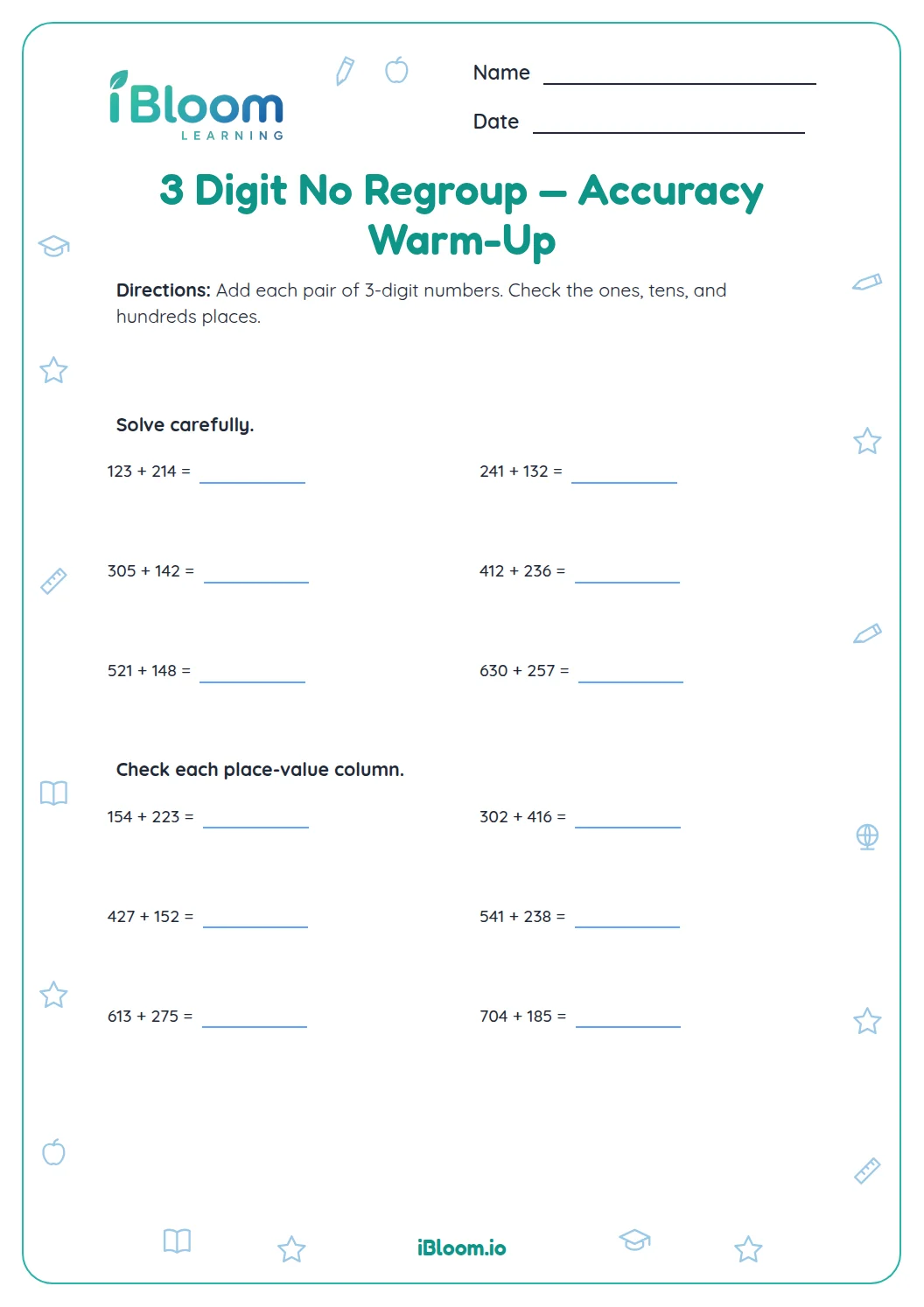
This Grade 3 math worksheet gives students 14 ways to examine three-digit addition without regrouping. They decide whether sample sums are correct, identify the place-value column containing an error, and solve fresh problems. The answer key lists correct totals and error locations. The work practices addition within 1,000 under CCSS 3.NBT.A.2.
Aligned to 3.NBT.A.2
How can you check a sample sum?
Compare the ones, tens and hundreds separately. Since no column sum reaches ten, the answer digit in each place should match that column total.
- 1For 236 + 142, add 6 + 2, 3 + 4 tens, and 2 + 1 hundreds. The ones column should be 8.
How should you correct a wrong column?
Keep the other place values aligned, replace the incorrect digit, then reread the complete sum.
How do you solve a fresh sum?
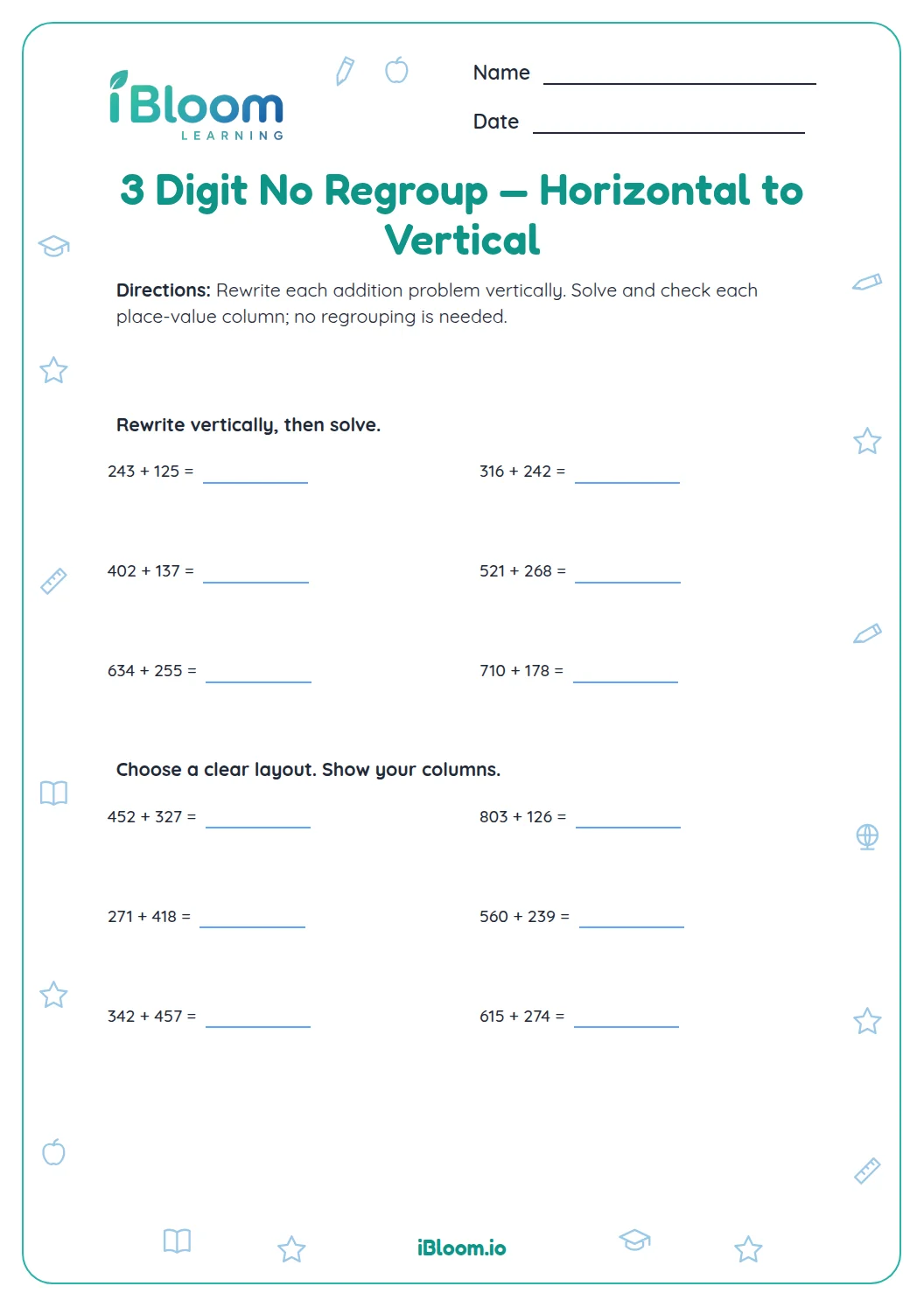
Write each number by place value and add from ones to hundreds. Check each digit before recording the total.
How to use this worksheet
- 1Line up ones, tens and hundreds.
- 2Add the ones digits.
- 3Add the tens digits.
- 4Add the hundreds digits.
- 5Compare each digit when checking a sample answer.
Common mistakes and quick fixes
The mistake
Adding digits from different columns.
The fix
Align the place values before adding.
The mistake
Accepting a plausible-looking total.
The fix
Check every column.
The mistake
Writing a digit in the wrong place.
The fix
Keep hundreds, tens and ones lined up.
Students add within 1,000 using place-value strategies.
Add three-digit numbers using place-value understanding.
On this sheet:
Show the official wordingHide the official wording
Fluently add and subtract within 1000 using strategies and algorithms based on place value, properties of operations, and/or the relationship between addition and subtraction.
What to practice next
Make more practice
Further reading
Questions parents and teachers ask
How many problems are included?
The worksheet contains 14 items. Students verify sample sums, locate the place-value column with an error, and solve new three-digit additions. The answer key provides judgments, error locations, and totals for each problem. Every addition is written without regrouping, so the column sums stay below ten.
What does no regrouping mean here?
Each column adds to less than ten, so no ten ones or ten tens need to be exchanged for the next place. Students can add ones to ones, tens to tens and hundreds to hundreds. The practice keeps attention on accurate place-value addition.
How can a student find an addition error?
Check the ones column first, then the tens and hundreds. Compare each small sum with the digits in the written answer. If one column differs, the student can point to the location of the slip before correcting the total. This keeps the check organized.
Why check one column at a time?
A total can look reasonable and still contain a small digit error. Column-by-column checking makes it easier to see whether the ones, tens or hundreds were added incorrectly. It also reinforces that digits with the same place value belong together.
What is an acceptable explanation for a wrong sum?
For the multiple-choice items, select the place-value column whose digit does not match the correct addition. The key names the intended column. For fresh sums, write the correct total; the page is designed for checking computation rather than a long written explanation.