
About this worksheet
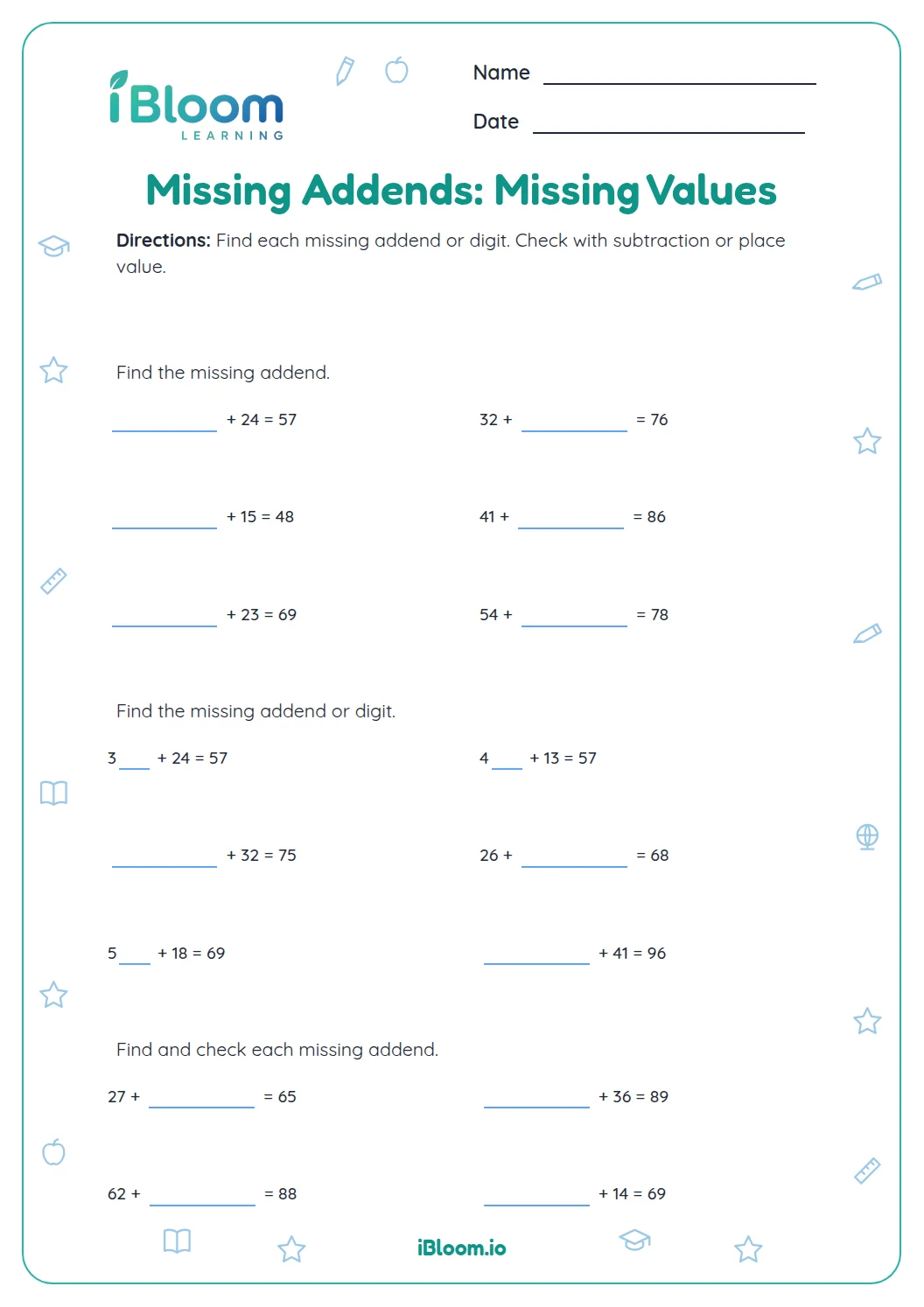
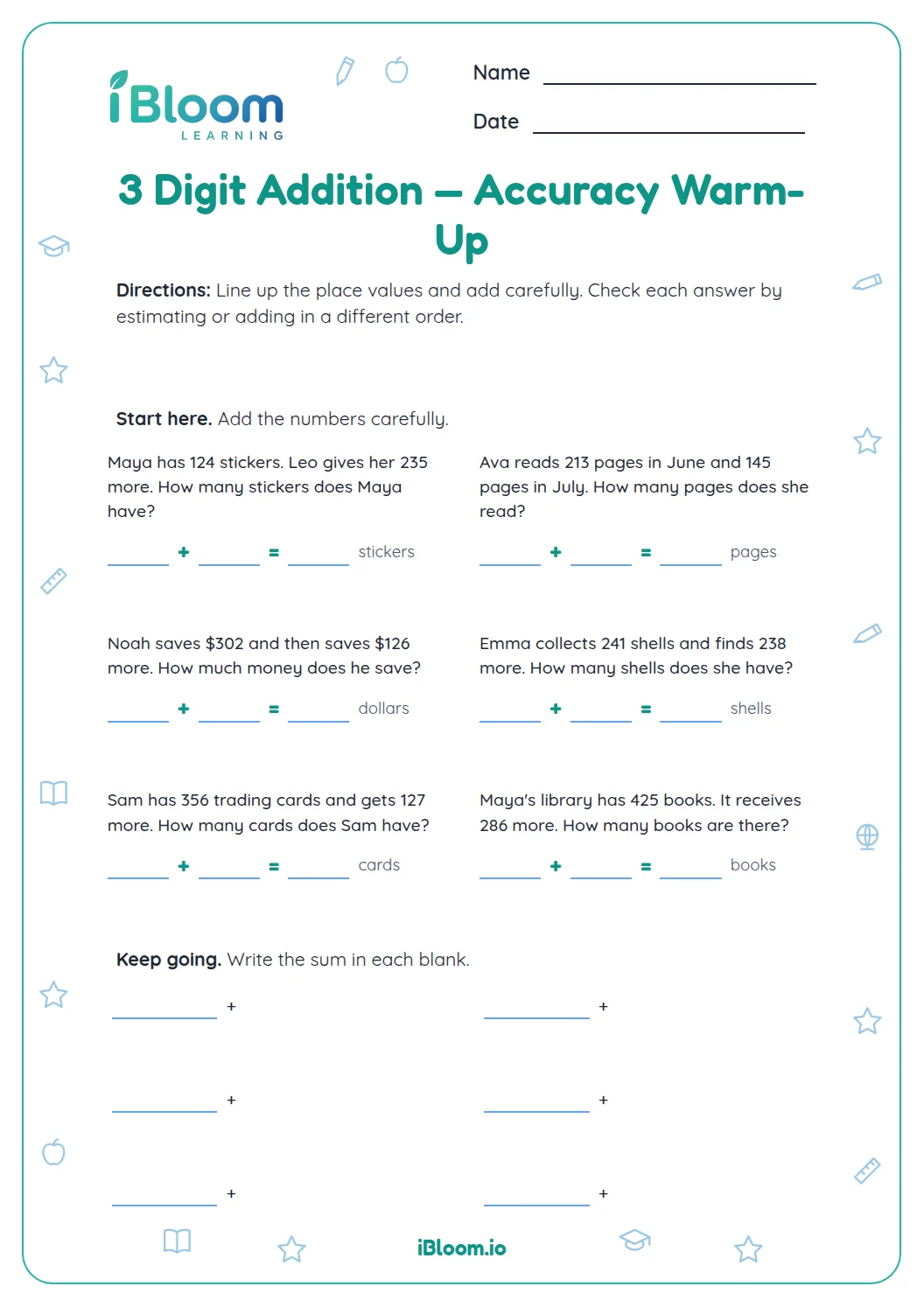
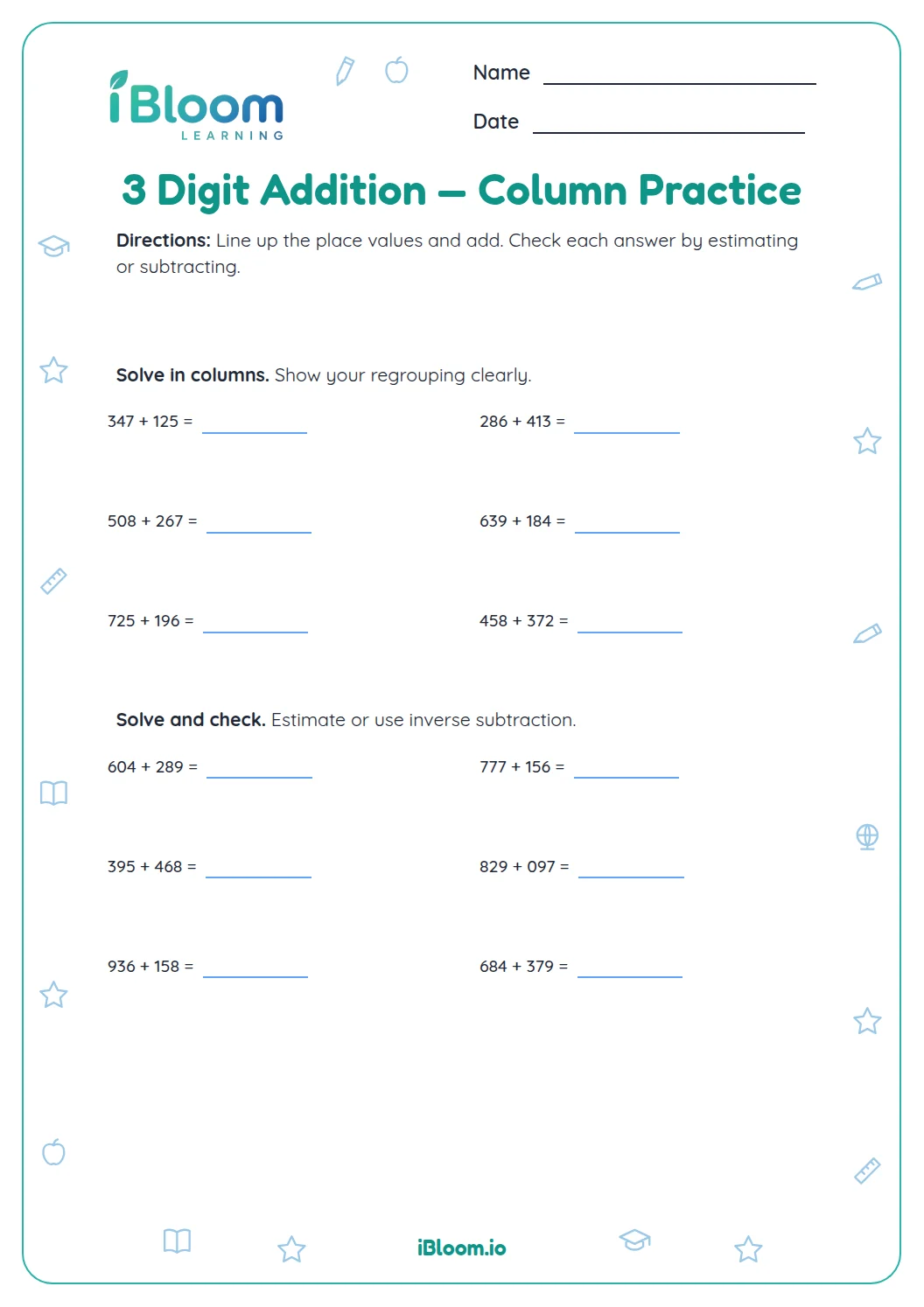
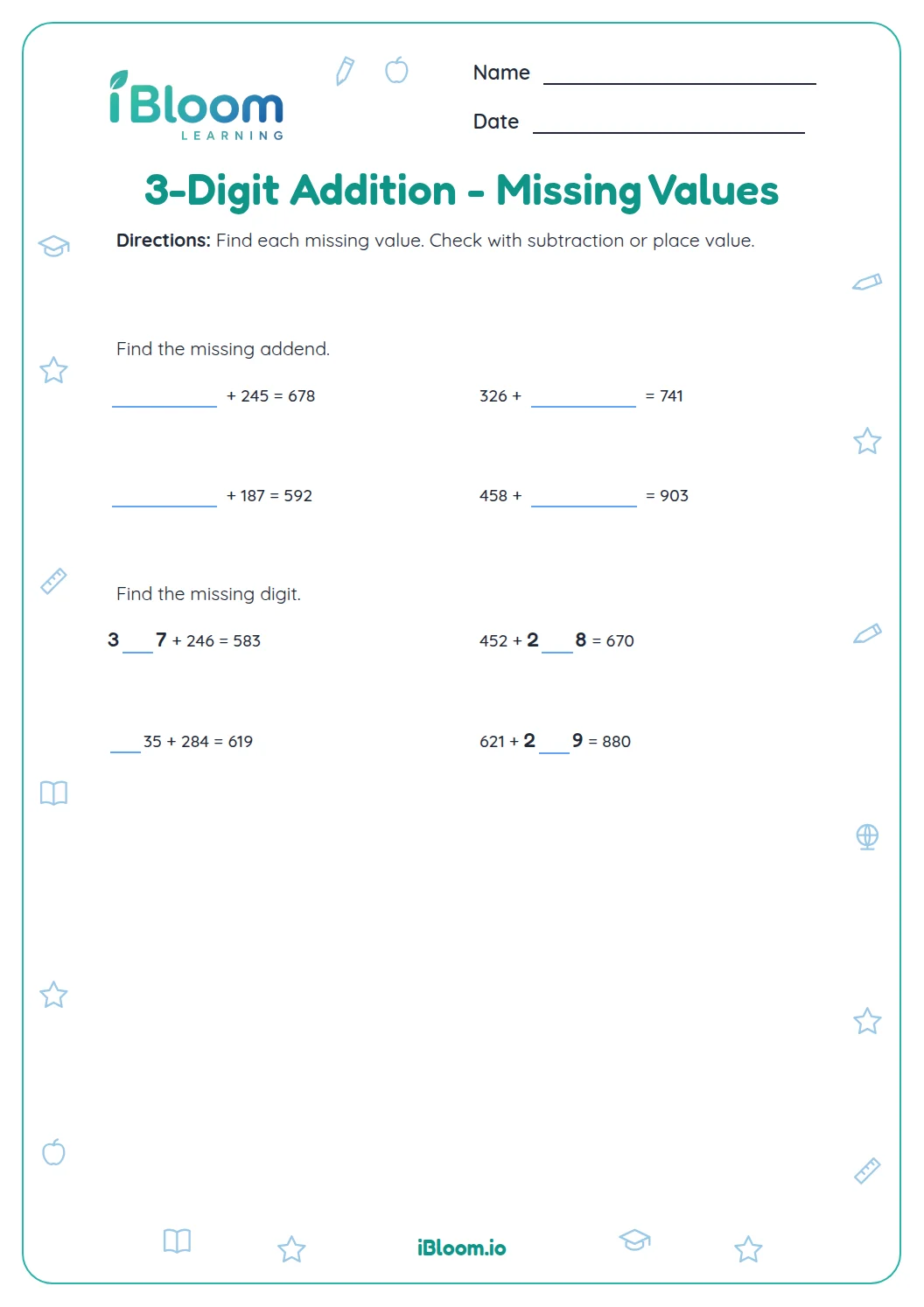
This free two-page worksheet gives Grade 3 and Grade 4 students practice finding the missing addend in three-digit sentences such as ___ + 214 = 538 or 427 + ___ = 893. Part A starts with sentences that need no regrouping, Part B moves to ones where a ten or a hundred must be traded, Part C asks which subtraction finds a missing addend, and Part D has two short stories. It practices Common Core 3.NBT.A.2, using the link between addition and subtraction, and a separate answer key gives every answer.
Aligned to 3.NBT.A.2 and 4.NBT.B.4
What is a missing addend?
An addend is a number being added. In ___ + 214 = 538 the missing addend is the number that, together with 214, makes 538. Children can find it by counting up from 214 to 538, or by using the fact that addition and subtraction undo each other and working out 538 − 214.
Seeing the blank in different places is part of the skill. The blank comes first in some sentences and second in others, so children learn that the order of the addends does not change the sum, and that the same subtraction finds either one.
- 1___ + 128 = 504
- 2Subtract the known addend: 504 − 128
- 3Ones: 4 is less than 8, and there are 0 tens to trade
- 4Trade 1 hundred for 10 tens (5 hundreds become 4), then 1 ten for 10 ones (10 tens become 9)
- 5Ones: 14 − 8 = 6. Tens: 9 − 2 = 7. Hundreds: 4 − 1 = 3
- 6Missing addend: 376
- 7Check: 376 + 128 = 504
Why do some questions need regrouping?
Part A uses totals where every digit is at least as large as the digit being taken away, so no borrowing is needed. Part B uses totals such as 504 and 642, where the ones or tens digit of the total is smaller than the digit in the addend. Children have to trade one ten for ten ones, or one hundred for ten tens, before they can subtract.
Counting up is a good way to check these. From 128 to 200 is 72, from 200 to 500 is 300, and from 500 to 504 is 4, and 72 + 300 + 4 = 376.
What is on this worksheet?
Fourteen questions, in four short parts that grow harder. Every number is within 1,000, so the sheet fits Grade 3 students who are building fluency and Grade 4 students who need a quick review.
- Part A, Find the missing addend: 4 sentences that need no borrowing
- Part B, Regroup to find it: 6 sentences with tens or ones to regroup
- Part C, Check your method: 2 multiple-choice questions about which subtraction to use, with the blank first and then second
- Part D, Missing addends in stories: 2 word problems with working space
How to use this worksheet at home or in class
- 1Warm up with five counters: show 2, hide the other 3 under a cup and ask "2 + ___ = 5," so your child feels what a missing addend is.
- 2Read the first Part A sentence together and ask, "What do we know, and what do we need to find?"
- 3Let your child finish Part A alone, then talk through one Part B question where a ten has to be regrouped.
- 4Before Part C, ask which operation undoes addition, then read the three choices aloud for each question.
- 5For the stories, have your child write a number sentence with a blank before solving it.
- 6Check with the answer key and ask your child to add the answer back to the known addend for any missed question.
Common mistakes and quick fixes
The mistake
Adding the two numbers shown, such as 214 + 538 = 752, instead of finding the missing one.
The fix
Point to the total after the equals sign. It is the biggest number, so the missing addend must be smaller than it.
The mistake
Subtracting the smaller digit from the larger in each column, so 504 − 128 comes out as 424 instead of 376.
The fix
Remind your child that the top number is the total. If the digit on top is smaller, regroup instead of flipping the digits.
The mistake
Forgetting to check, so a wrong answer stays on the page.
The fix
Add the answer to the known addend. If the sum does not match the total, rework the subtraction.
Common Core alignment
Most US states use the Common Core standards or a close state version. This sheet practices the three-digit addition and subtraction standards below.
Add and subtract within 1,000, using place value and how addition and subtraction relate.
On this sheet: Every question finds a missing three-digit addend by subtracting or counting up, then checks by adding.
Show the official wordingHide the official wording
Fluently add and subtract within 1000 using strategies and algorithms based on place value, properties of operations, and/or the relationship between addition and subtraction.
Add and subtract multi-digit whole numbers with the standard algorithm.
On this sheet: The regrouping questions in Parts B and D use the column subtraction method with borrowing.
Show the official wordingHide the official wording
Fluently add and subtract multi-digit whole numbers using the standard algorithm.
What to practice next
Make more practice
Further reading
Questions parents and teachers ask
What is a missing addend?
A missing addend is the number left out of an addition sentence. In ___ + 214 = 538, the first sentence on this sheet, the missing addend is 324, because 324 + 214 = 538. Children can find it by subtracting the known addend from the total, or by counting up from the known addend to the total.
Why does the blank move around on the sheet?
The blank sits first in some sentences and second in others so children do not learn only one pattern. Addition works in either order, so 427 + ___ = 893 and ___ + 427 = 893 have the same answer, and the same subtraction, 893 − 427, solves both of them.
What are the answers to Part C?
The answers are 603 − 219 and 912 − 475. In both, the total is the biggest number, so it comes first, and taking away the known addend leaves the missing one. It does not matter whether the blank comes first or second. The answer key shows all 14 answers, including the two stories.
Do children have to use the standard algorithm?
No. Column subtraction with borrowing works well, but counting up, number lines and place value strategies are fine too. The standard asks for strategies based on place value and on the relationship between addition and subtraction, so any method that gets and checks the answer is welcome.
Is this sheet for Grade 3 or Grade 4?
It suits both. Grade 3 students use it to build fluency with three-digit sums and differences, and Grade 4 students can use it as a quick review before larger numbers. All numbers stay within 1,000, and the stories use everyday amounts like books and dollars.
How long does the sheet take, and is there an answer key?
Most children finish in about 15 minutes. Yes, the answer key has its own pages listing the missing number for every sentence, the correct choice in Part C and the answers to the two stories, so you can check quickly and spot which step went wrong.