



About this worksheet
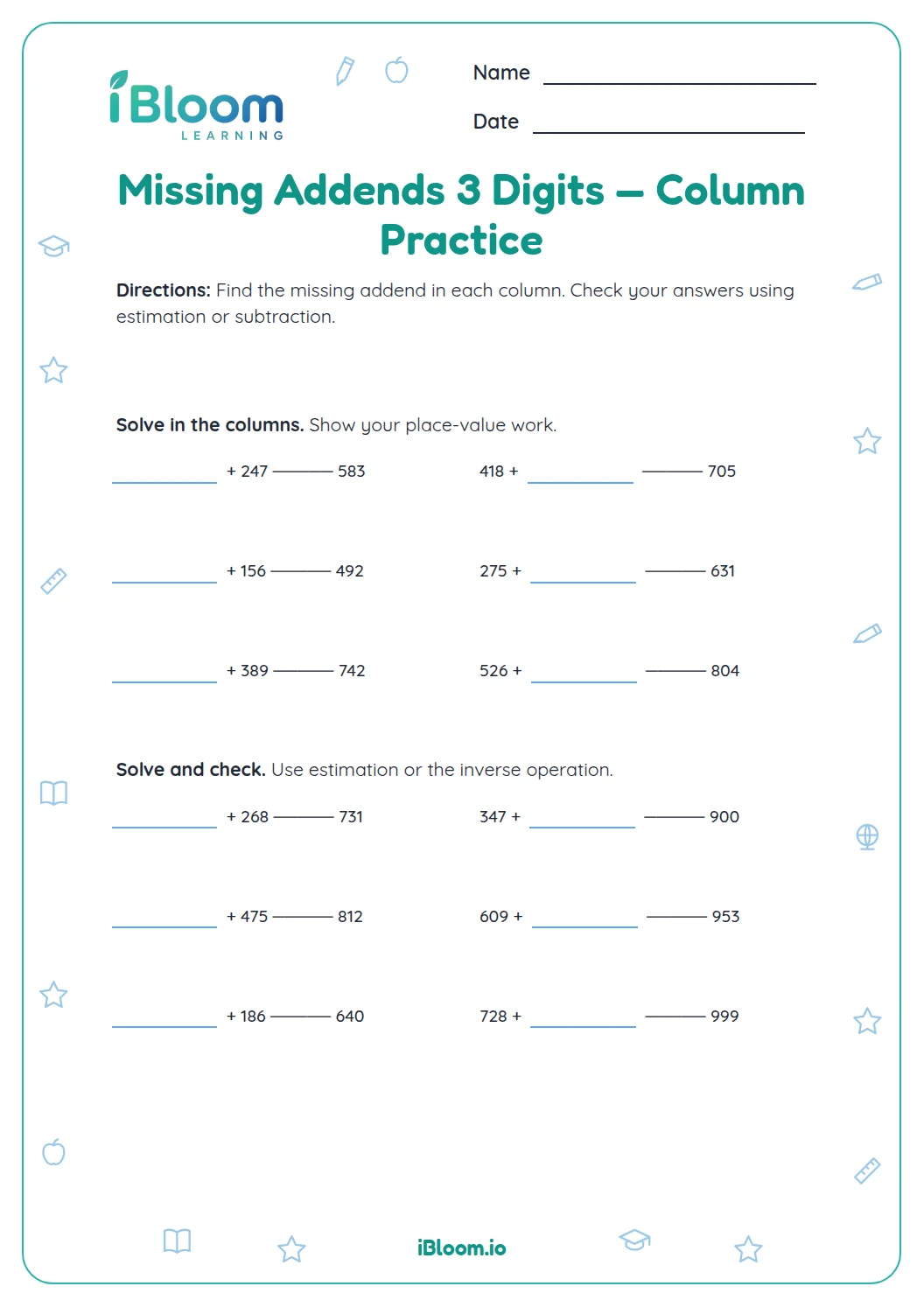
This free printable worksheet asks Grade 4 students to find missing values in four-digit addition; Grade 5 students can use it for review. Parts A–C contain 12 missing whole addends, progressing from no regrouping to regrouping across zeros. Part D adds five equations with one missing digit. Children set out their calculations in columns on separate paper, then check the completed sums. The 17 questions practice Common Core 4.NBT.B.4 through the standard algorithm for multi-digit addition and subtraction. A separate answer key gives every missing addend and digit.
Aligned to 4.NBT.B.4
What is missing in these equations?
In Parts A–C, each blank replaces an entire four-digit addend. Some come first, as in ___ + 2,314 = 6,859, and others come second. The total is always on the right of the equals sign.
Part D changes the task: each blank replaces just one digit. For 4,2___6 + 1,735 = 5,941, subtracting 1,735 from 5,941 gives 4,206, so the missing tens digit is 0. Add 4,206 and 1,735 to check.
How does subtraction find the missing value?
The total contains both addends. Taking away the known addend leaves the missing one. Align ones under ones and thousands under thousands before subtracting, then use addition to verify the result.
- 12,648 + ___ = 6,205
- 26,205 − 2,648 = 3,557
- 3Check: 2,648 + 3,557 = 6,205
- 4Write 3,557 in the blank.
How do we regroup when the total has zeros?
For 3,758 + ___ = 8,000, rewrite 8,000 as 7 thousands, 9 hundreds, 9 tens and 10 ones. That gives each column enough to subtract 3,758 and leaves 4,242.
Record each exchange instead of trying to hold it in memory. When checking by addition, keep any carried ten or hundred above its own column so it is included once.
How to use this worksheet
- 1Locate the total to the right of the equals sign.
- 2Write the total above the known addend on separate paper, lining up place values.
- 3Subtract, recording regrouped digits above the correct columns.
- 4Write the whole missing addend in Parts A–C, or just the missing digit in Part D.
- 5Add both addends and compare the result with the printed total.
Mistakes to check and how to fix them
The mistake
Adding 2,648 and 6,205 to fill the blank.
The fix
The total is already 6,205. Subtract 2,648 to find the other part.
The mistake
Changing a zero to 10 without reducing the place to its left.
The fix
Record both sides of every exchange; one higher unit becomes ten lower units.
The mistake
Treating the first-position blank as the total.
The fix
In ___ + 2,314 = 6,859, 6,859 is the total. Subtract 2,314 to find 4,545.
Common Core alignment
Use column subtraction to find missing addends, then check with four-digit addition.
On this sheet: Children calculate twelve missing addends and five missing digits, checking with column addition and subtraction.
Show the official wordingHide the official wording
Fluently add and subtract multi-digit whole numbers using the standard algorithm.
What to practice next
Make more practice
Further reading
Questions parents and teachers ask
Are the blanks whole numbers or individual missing digits?
Both appear on this worksheet. Parts A–C have 12 blanks for whole four-digit addends, such as 3,557 in 2,648 + ___ = 6,205. Part D has five blanks for single digits. Read the part directions before calculating, then check that the completed addition equation is true.
Does this worksheet include regrouping?
Yes, Parts B and C require regrouping when subtracting to find missing addends. Part A starts with four equations that need no regrouping. Part D uses missing digits, so children also track place values and carries. Record each exchange above its column, then check the completed sum.
What is missing in 3,758 + ___ = 8,000?
The missing addend is 4,242. Subtract 3,758 from 8,000, regrouping across the zero columns. Then add 3,758 and 4,242 to check that the result is 8,000. Writing both calculations in columns makes the changes in the ones, tens and hundreds easier to follow.
Why does the blank sometimes come first?
Changing the blank position helps children focus on the relationship between the parts and total. In ___ + 2,314 = 6,859, the missing part is still found by subtraction. Read the complete equation aloud after filling it in to check that both addends make the stated total.
Should my child use the answer key while calculating?
Keep the key for checking after an attempt. Ask the child to verify each missing number by adding it to the known addend first. If that sum differs from the printed total, inspect the column alignment and regrouping marks, then compare the corrected result with the key.