



About this worksheet
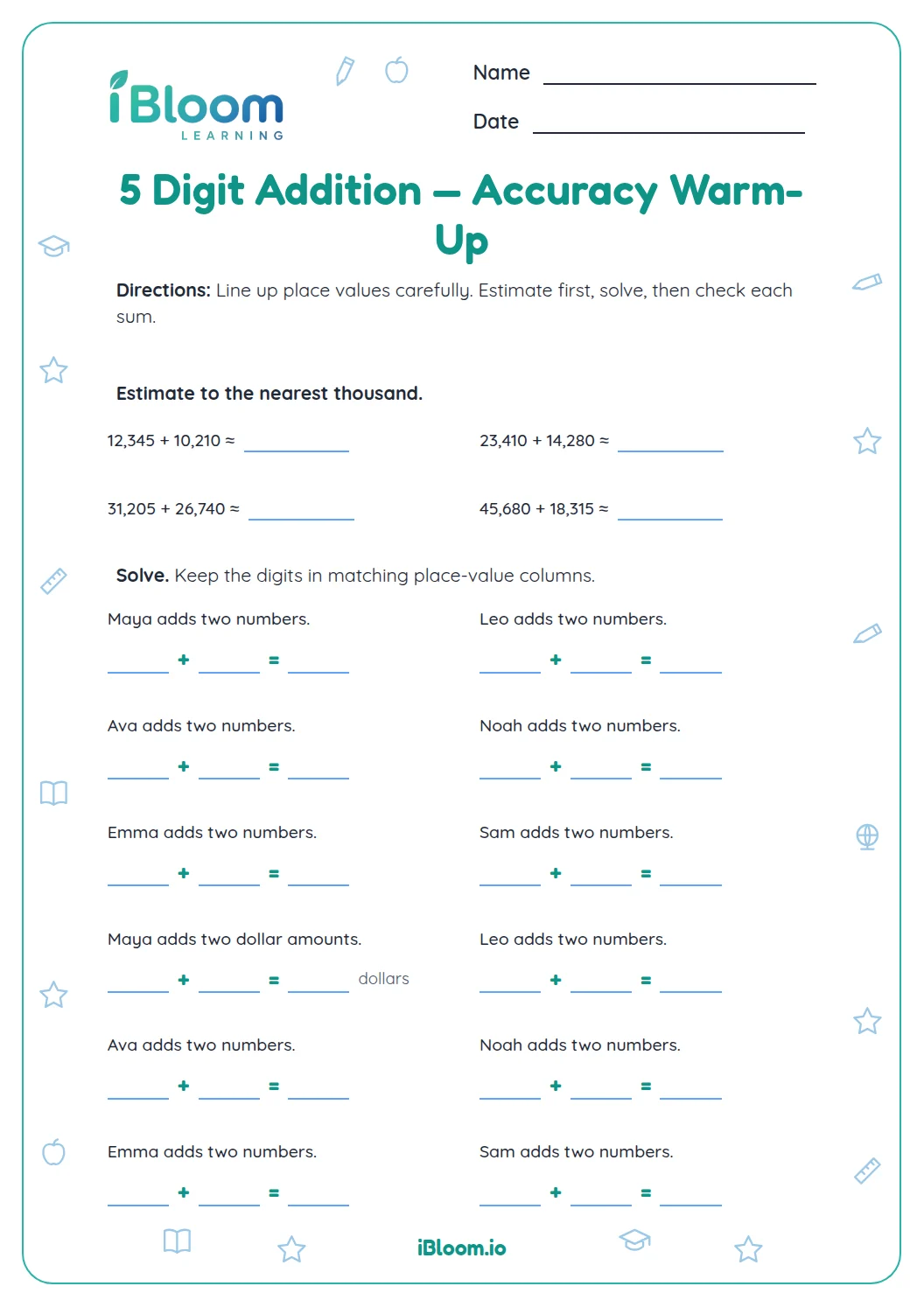
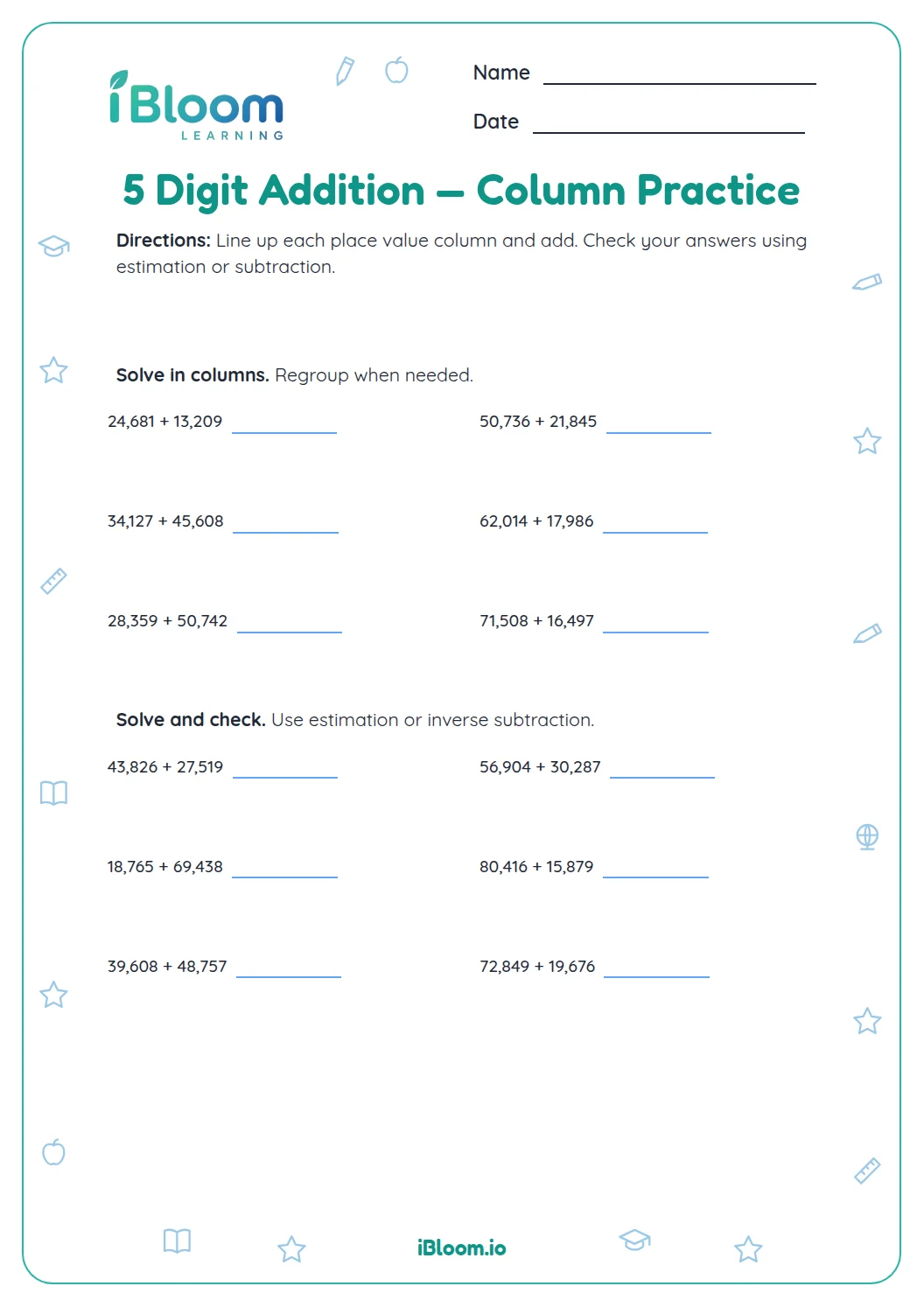
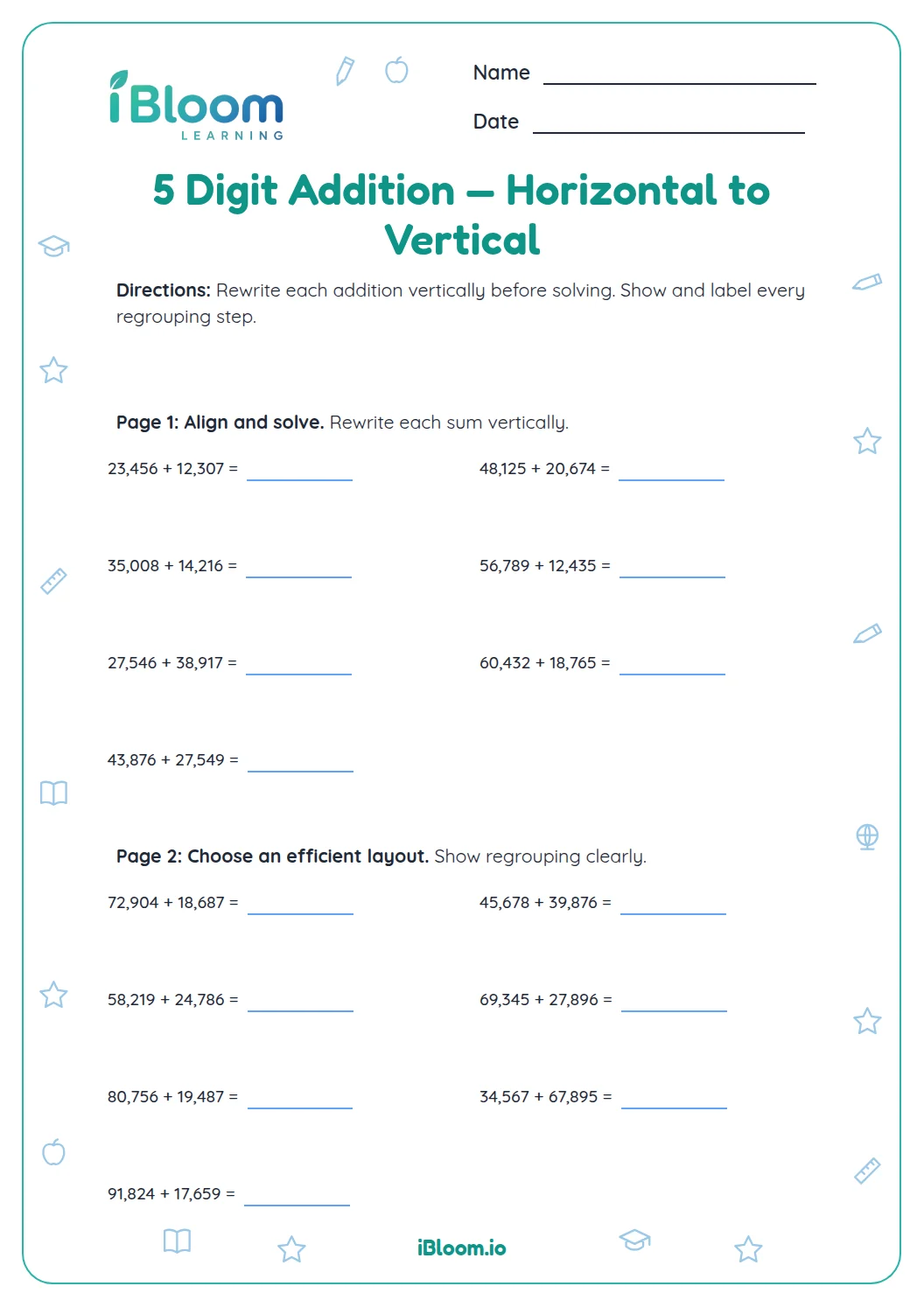
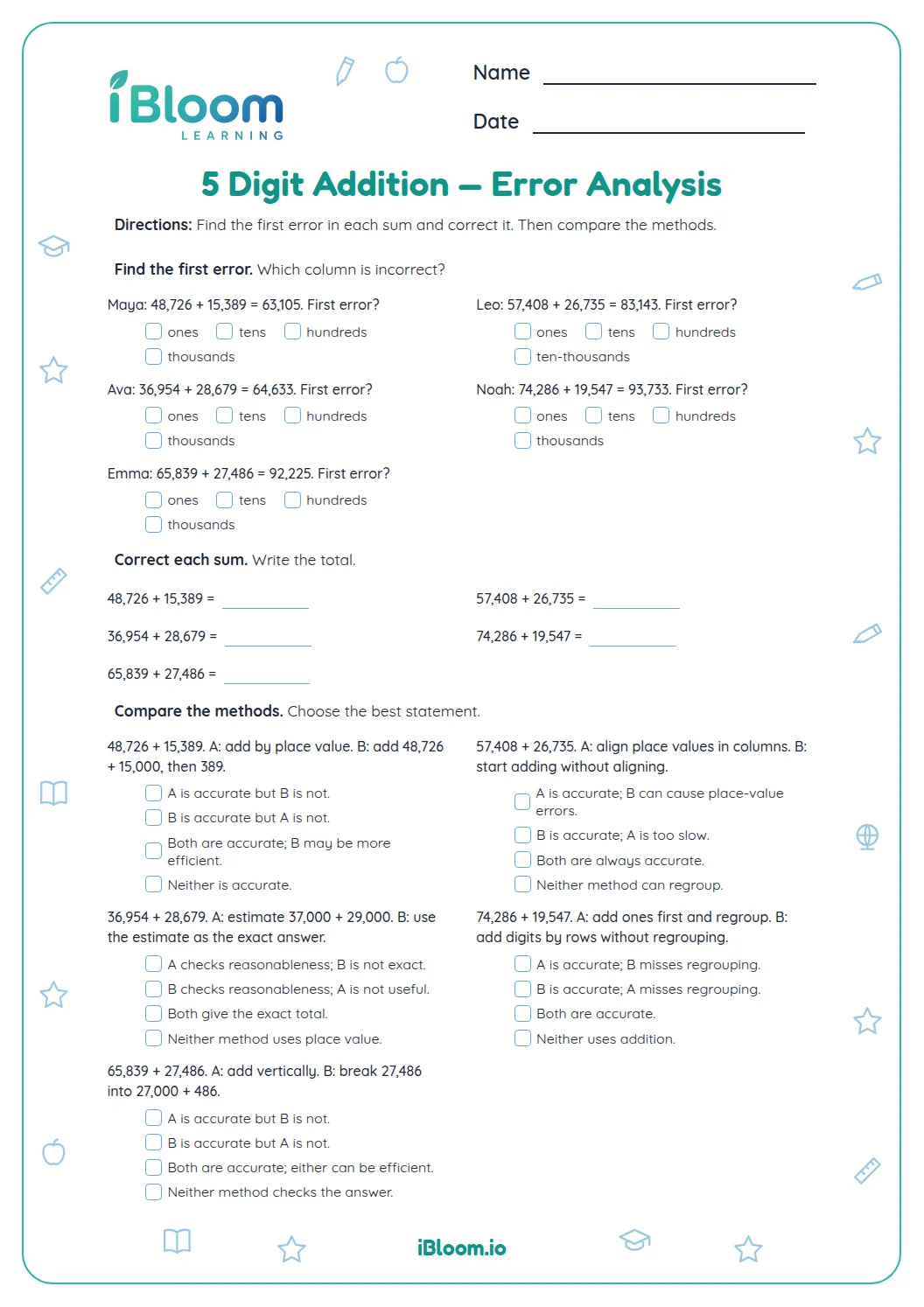
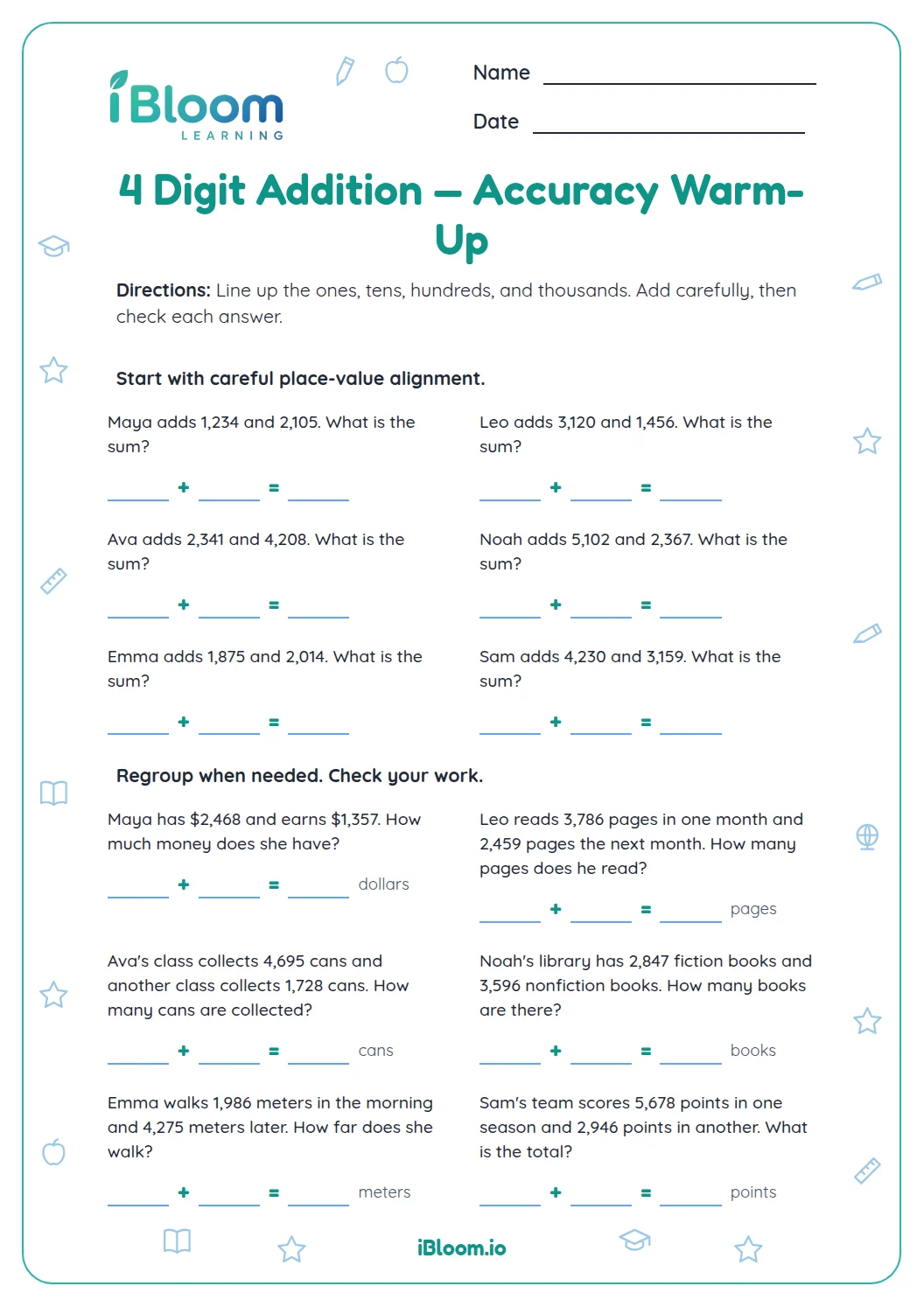
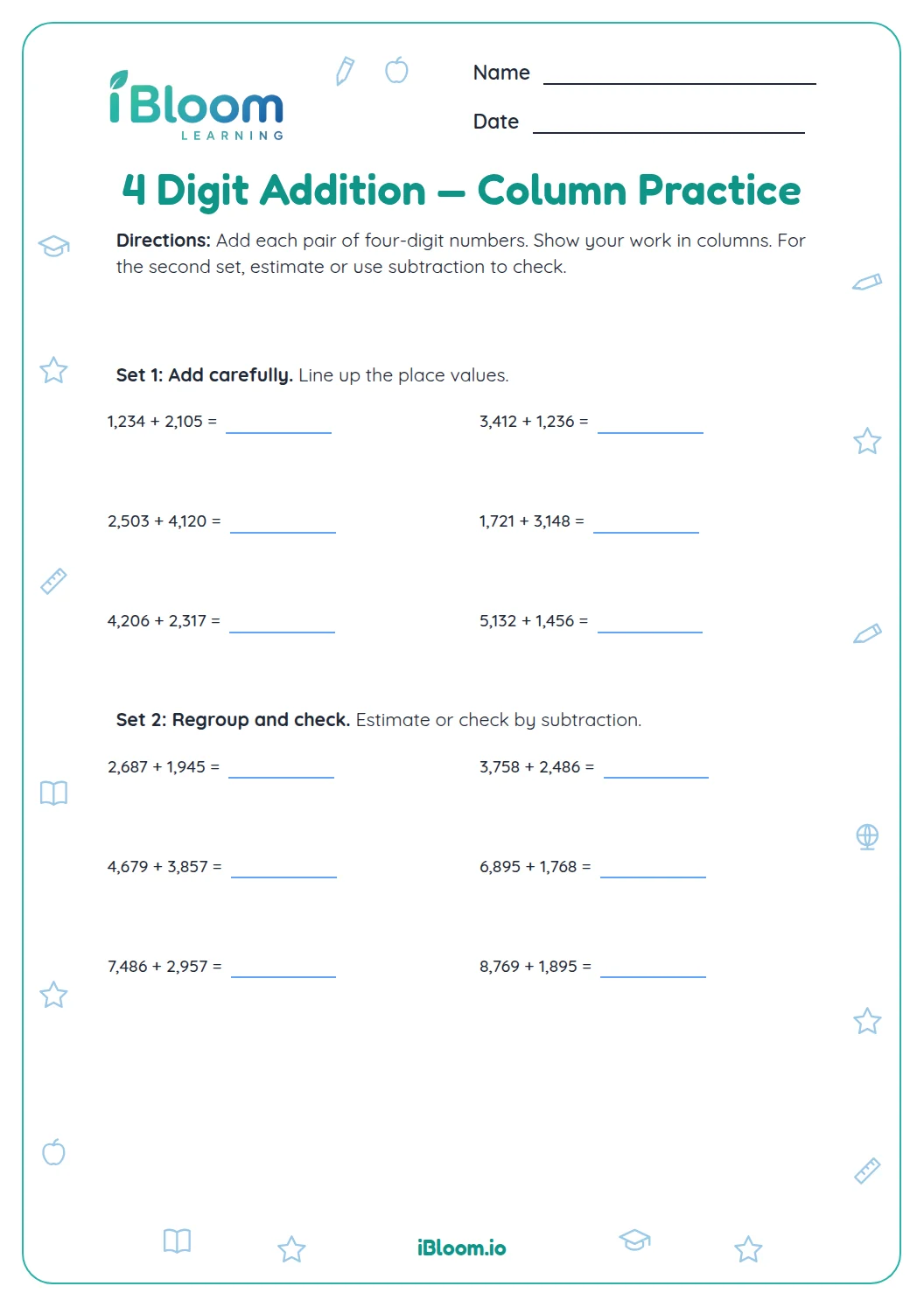
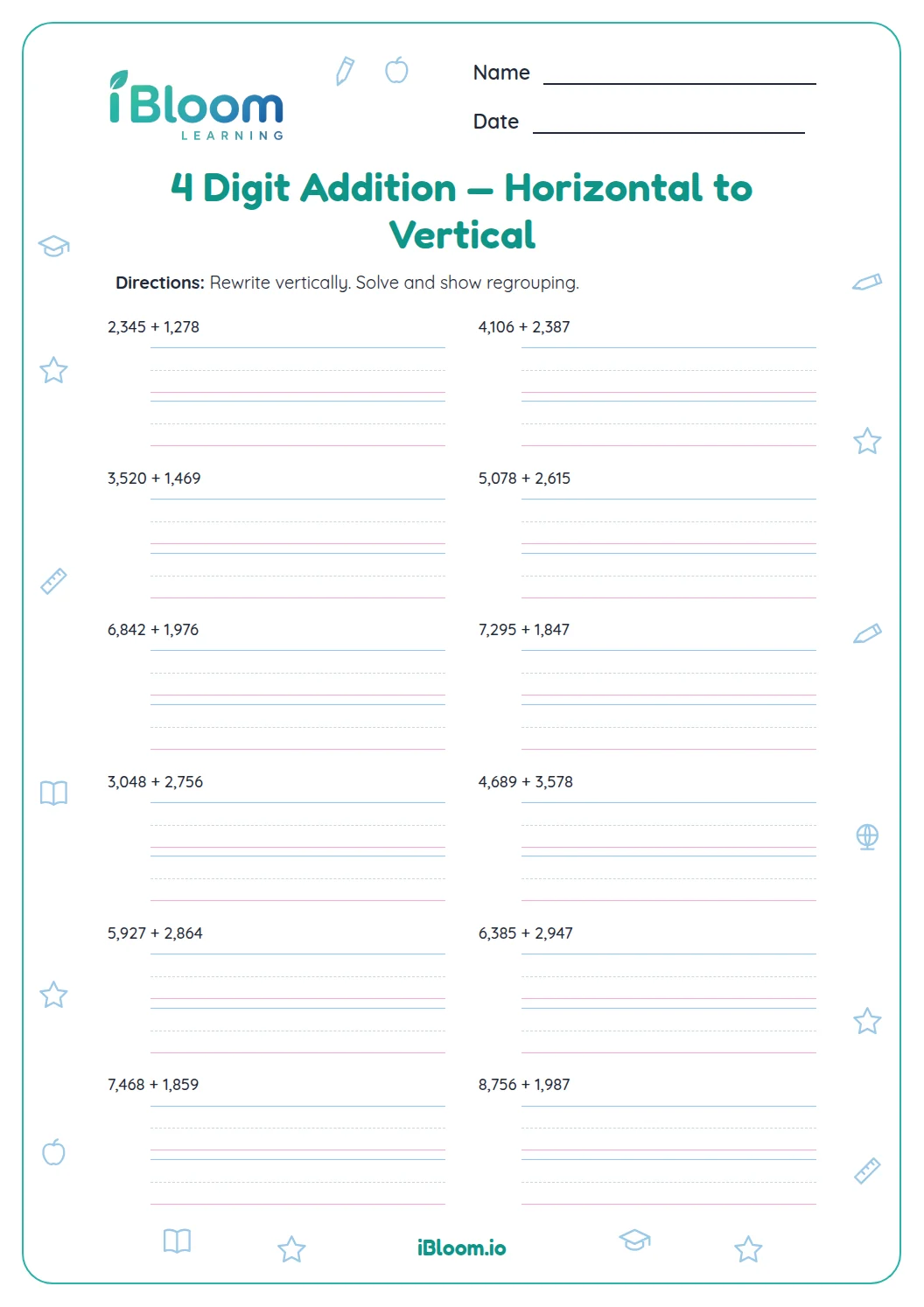
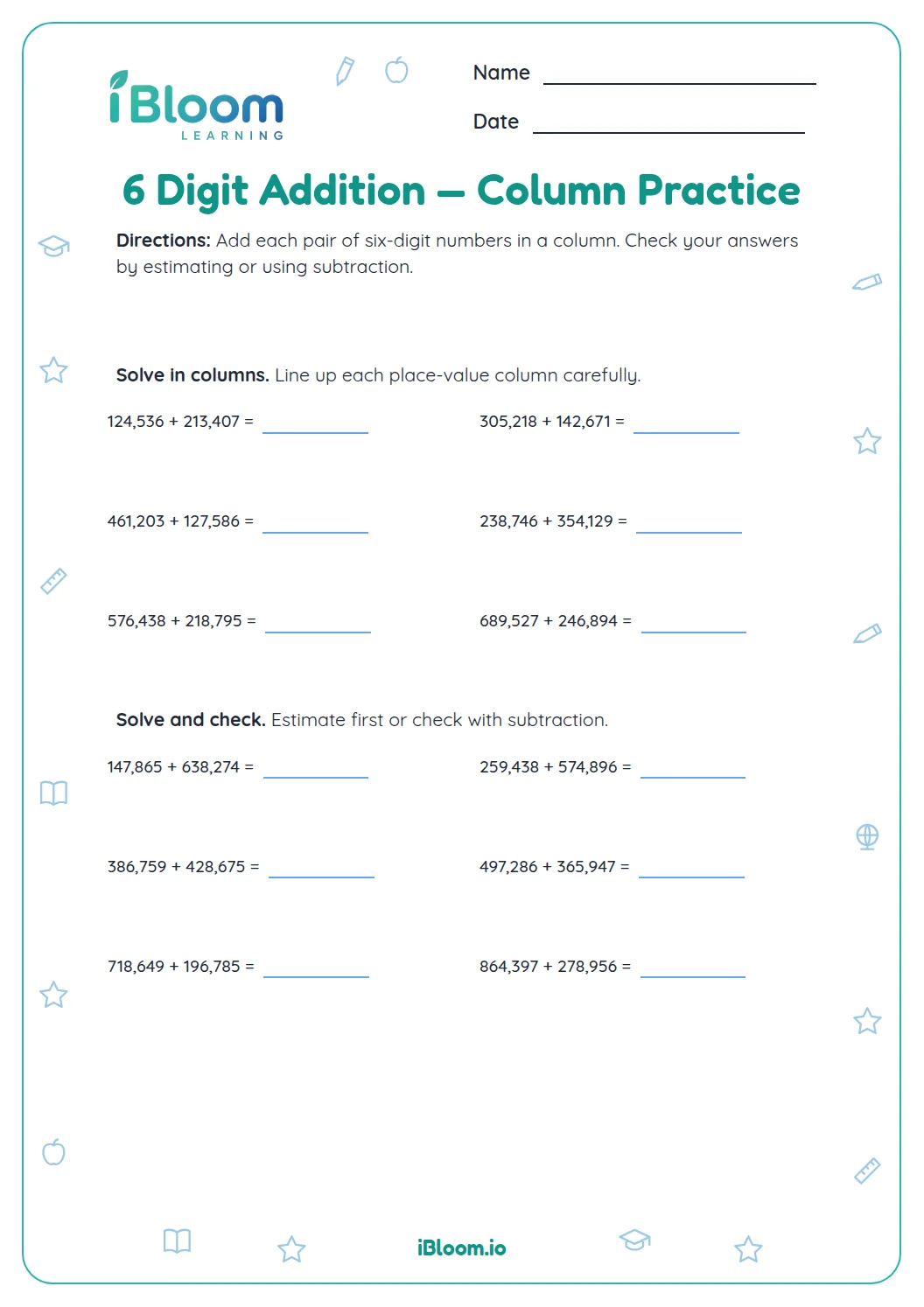
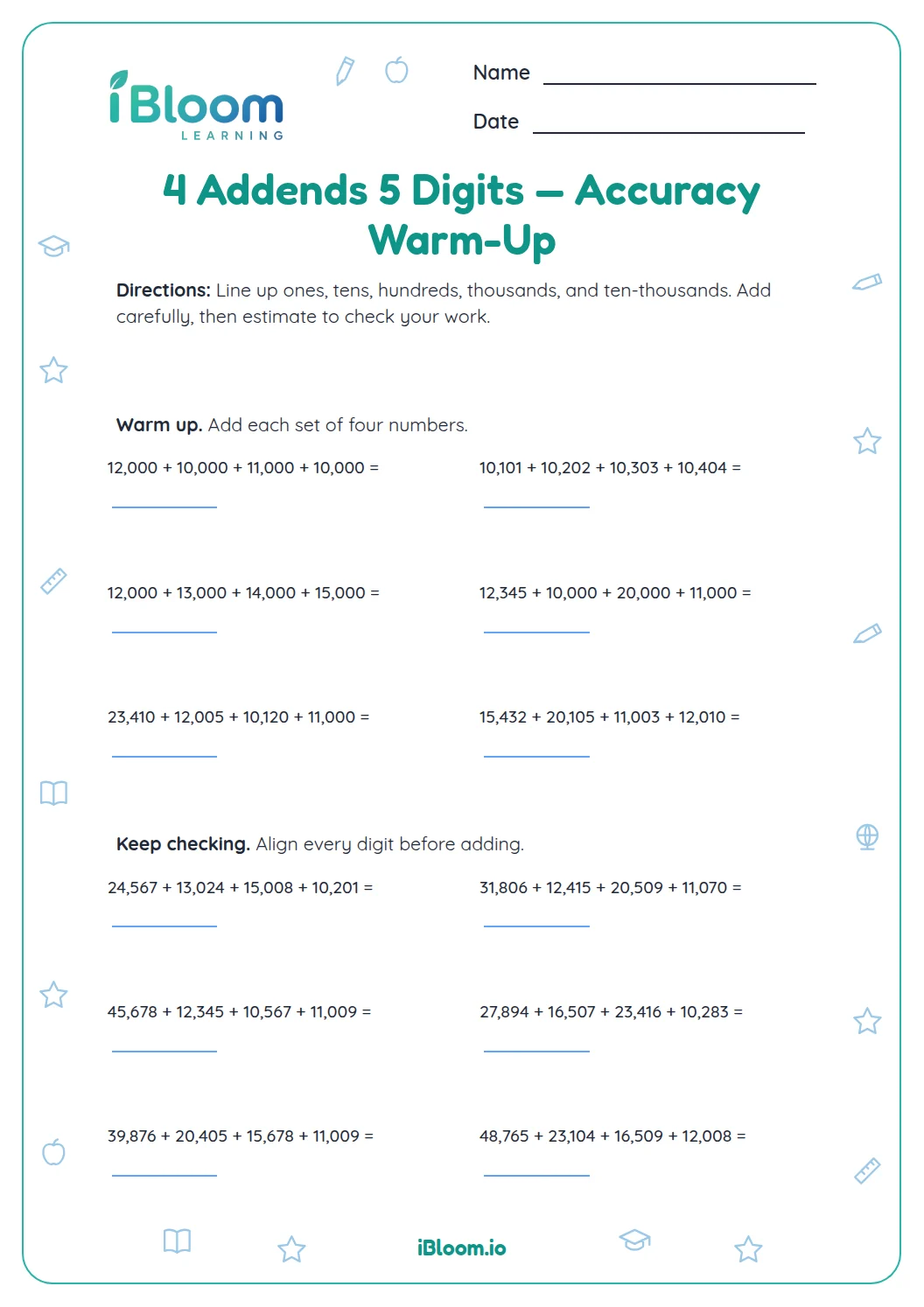
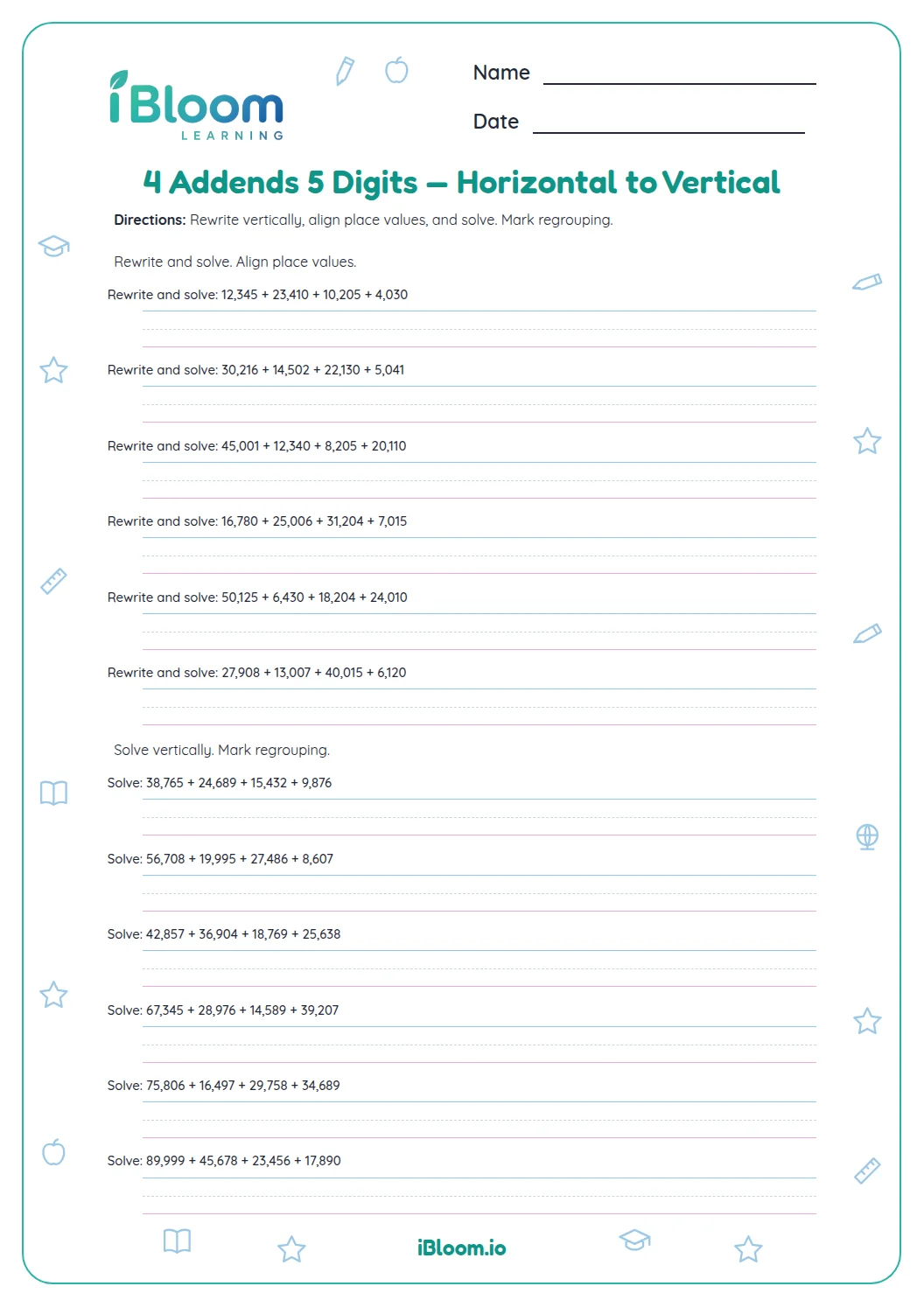
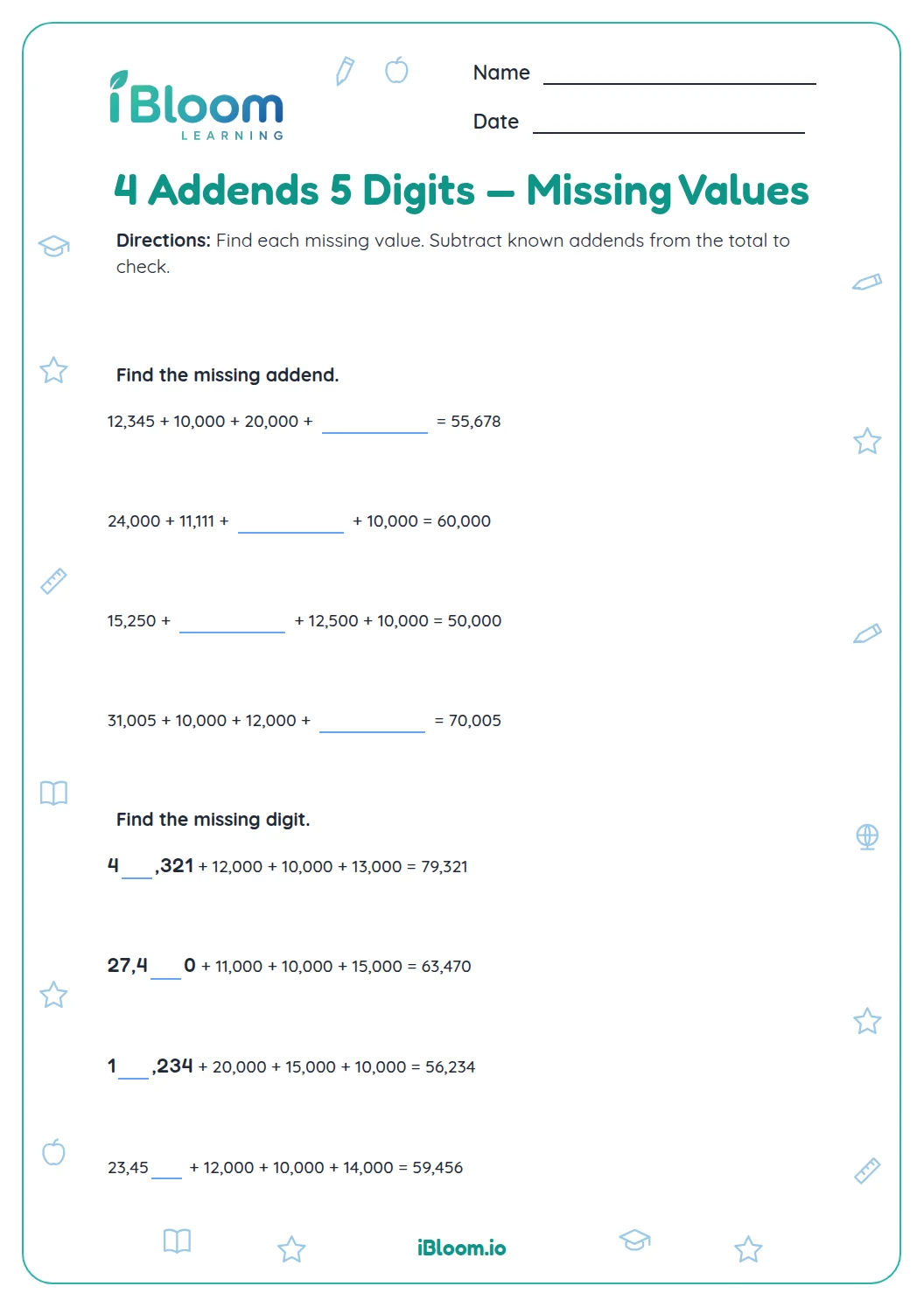
This printable is for Grade 5 learners practicing five-digit addition and missing values. Across three parts, children find a missing addend, complete a sum, and solve a final set that includes regrouping across several places. The equations preserve the place-value structure of five-digit addition, so students can use the standard algorithm or reason from the known total. It aligns with CCSS 4.NBT.B.4, which calls for fluent multi-digit addition and subtraction using the standard algorithm. The printable includes 16 questions and a separate answer key.
Aligned to 4.NBT.B.4
How do you find a missing addend?
Think of addition as a relationship between two addends and a total. When one addend is hidden, subtract the known addend from the total. Keep each digit aligned by place value.
- 134,582 + ___ = 71,906
- 2Subtract: 71,906 − 34,582 = 37,324
- 3Check: 34,582 + 37,324 = 71,906
Where does regrouping happen?
Add from the ones place toward the ten-thousands place. When a column totals ten or more, write the ones digit and carry the tens into the next column. Use the same careful alignment when subtracting to recover a missing addend.
What is on the worksheet?
Part A asks for missing addends. Part B asks for missing totals. Part C mixes both forms and includes a regrouping problem with an incomplete addend. Each answer is a whole number.
How to use this worksheet
- 1Read the equation and mark which number is missing.
- 2Line up ones under ones, tens under tens, and so on.
- 3For a missing addend, subtract the known addend from the total.
- 4For a missing total, add from right to left and regroup.
- 5Check each answer in the original equation before using the key.
Common mistakes and quick fixes
The mistake
Subtract the total from the known addend.
The fix
Use total minus known addend, then add your result back to check.
The mistake
Misaligning a digit by one place.
The fix
Write the numbers in columns before calculating.
The mistake
Forgetting a carry in the next column.
The fix
Record each carry above the next place and include it in that column.
Common Core alignment
Add multi-digit whole numbers accurately, including sums that require regrouping.
On this sheet: The sum questions use the standard algorithm, and the missing-addend questions apply the inverse operation.
Show the official wordingHide the official wording
Fluently add and subtract multi-digit whole numbers using the standard algorithm.
What to practice next
Make more practice
Further reading
Questions parents and teachers ask
How many problems are on this worksheet?
There are 16 problems in three parts. Ten ask for a missing addend, and six ask for a missing sum. Each equation uses five-digit addition, with regrouping across place-value columns so learners can practice careful alignment. Check by adding the two addends to recover the stated total.
Does the worksheet include regrouping?
Yes. The addends and totals include regrouping in multiple place-value columns. Children should record each carry as they work, then check that the completed equation is true by adding or subtracting in the reverse direction. A written carry mark helps keep each column organized.
What should a learner do when an addend is missing?
Subtract the known addend from the total. For 34,582 + ___ = 71,906, calculate 71,906 − 34,582 to get 37,324, then add 34,582 and 37,324 to verify the total. Subtracting provides a quick independent check of the missing value every time.
Can children solve these without the standard algorithm?
They may use any accurate strategy that preserves place value, including expanded form or compensation. The standard algorithm is a clear method for keeping the ones, tens, hundreds, thousands, and ten-thousands organized. Expanded form is another way to keep each place clear.
Is an answer key included?
Yes. The answer key is separate from the two worksheet pages and lists all 16 missing values. Encourage children to check a wrong answer by substituting it into the original addition equation and confirming both sides match. The key supports self-checking after each part.