


About this worksheet
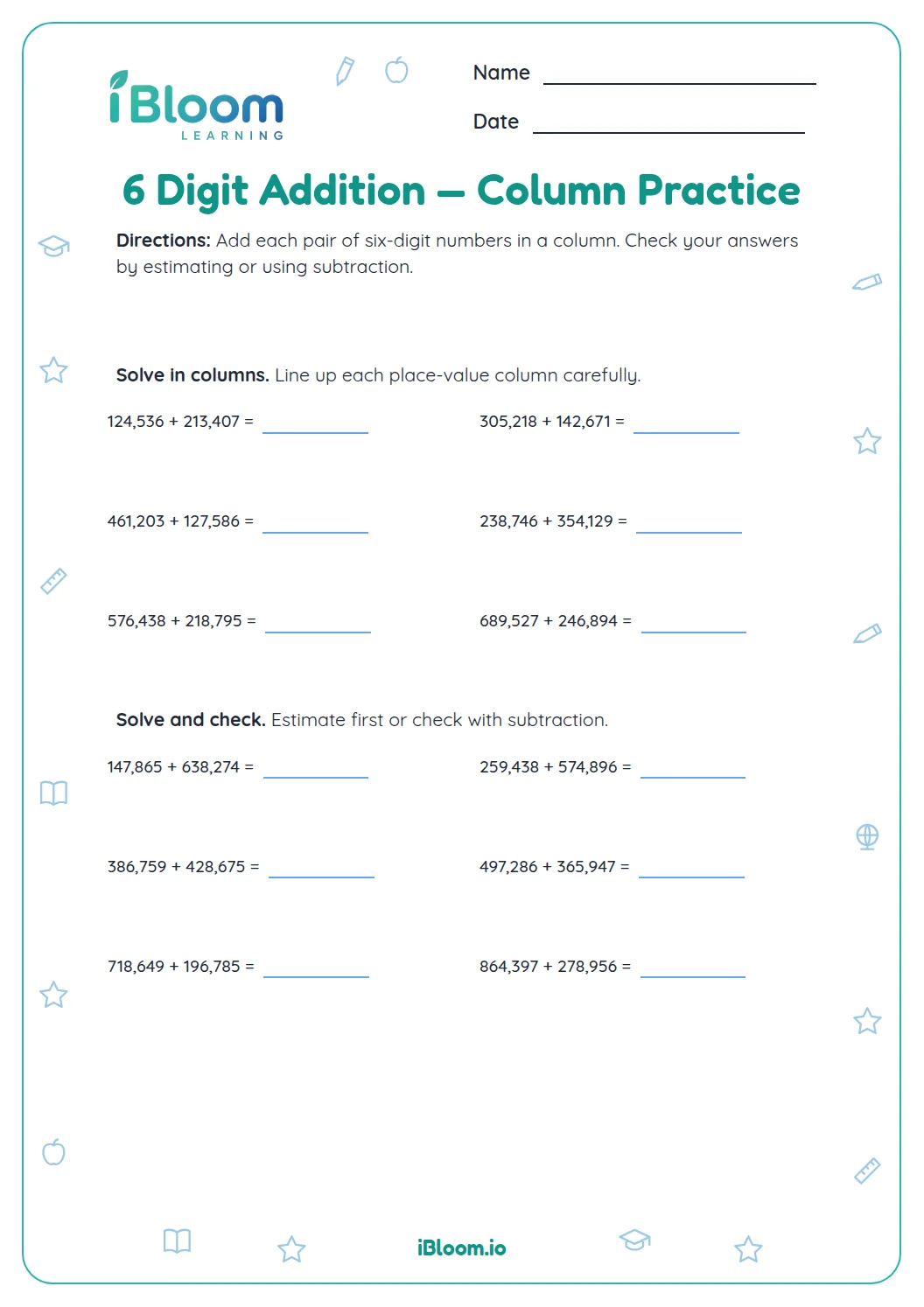
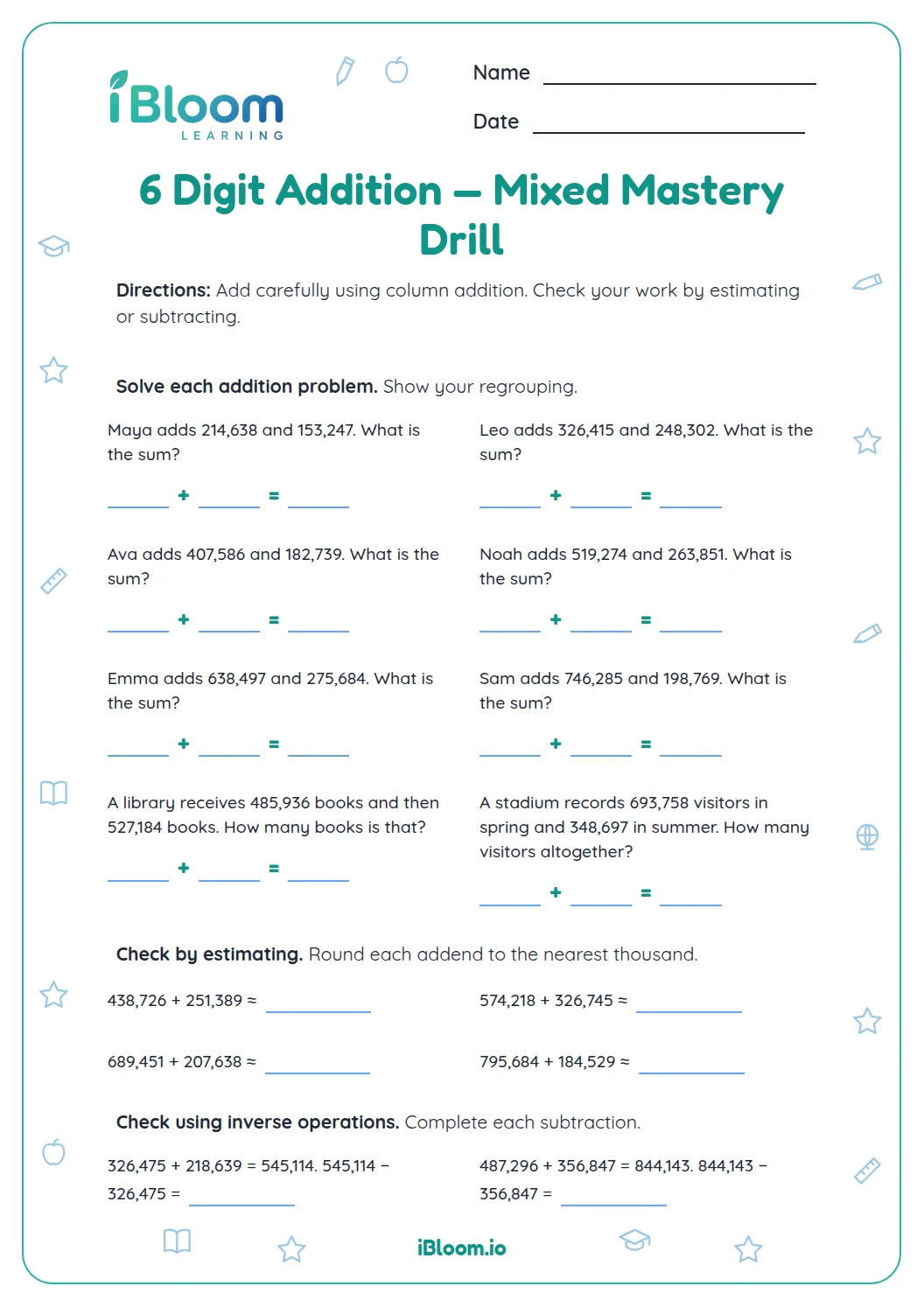
This two-page printable is for learners practicing six-digit addition. It has 14 problems: four sums without regrouping, four that require regrouping, two short addition stories, and four more sums for a careful check. The work centers on lining up place values and carrying each regrouped ten into the next place. The sheet practices the standard algorithm described in CCSS 4.NBT.B.4, with six-digit addends. A separate two-page answer key is provided.
Aligned to 4.NBT.B.4
What kinds of sums are on the sheet?
The first four items use six-digit addends without regrouping. The next four include regrouping, followed by two short contexts and four more sums. Each item has a single total to find.
- Part A: four sums without regrouping
- Part B: four sums with regrouping
- Part C: two addition stories
- Part D: four independent sums
How can you check a six-digit sum?
Add one place at a time, starting with the ones. When a place totals ten or more, write the ones digit and carry the tens digit to the next place. Then estimate the total to see whether its size makes sense.
- 1268,457 + 386,729
- 27 + 9 = 16; write 6 and carry 1
- 35 + 2 + 1 = 8
- 4Continue through the hundred-thousands place
- 5Total: 655,186
How should learners use the answer key?
Work through the parts in order and keep each digit in its place-value column. Check a missed problem by adding again one column at a time; for a story, make sure the total answers how many there are altogether.
How to use this worksheet
- 1Read each part heading before beginning its sums.
- 2Line up ones, tens, hundreds, thousands, ten-thousands and hundred-thousands.
- 3Regroup to the next place whenever a column total reaches ten.
- 4For each story, identify the two amounts being combined.
- 5Check each answer against the key and redo any missed column.
Check these common slips
The mistake
Forgetting to carry a ten after a column totals 10 or more.
The fix
Write the carried digit above the next place before adding that column.
The mistake
Shifting one addend so digits land in the wrong columns.
The fix
Align the rightmost digits first; both ones places should line up.
The mistake
Adding only one amount in a story.
The fix
Underline both quantities and check that the question asks for their combined total.
Curriculum alignment
This worksheet practices the standard below through its printed problems.
Add multi-digit whole numbers accurately using place value and the standard algorithm.
On this sheet: Every item asks learners to add whole numbers with six digits, using place-value alignment and regrouping.
Show the official wordingHide the official wording
Fluently add and subtract multi-digit whole numbers using the standard algorithm.
What to practice next
Make more practice
Further reading
Questions parents and teachers ask
How many questions are on the worksheet?
There are 14 questions across four parts. Twelve are six-digit addition equations and two are short stories that ask for a combined total. The separate answer key has the sum for every problem, so a parent or teacher can check the work without solving each item again.
Does this worksheet include regrouping?
Yes. The first four sums can be added without regrouping, and the next four require it. The final four sums give another chance to practice careful column addition. In every problem, align digits by place value and carry a ten into the next column when needed.
What does the worksheet’s standard mean here?
CCSS 4.NBT.B.4 describes adding and subtracting multi-digit whole numbers with the standard algorithm. This page practices its addition skill with six-digit addends. The six-digit range is the worksheet’s chosen practice range; each problem still asks learners to use place-value columns and accurate regrouping.
How should my child check a sum?
First check each column, including every carried digit. Then estimate by rounding both addends to nearby hundred-thousands or ten-thousands. The exact total should be close to that estimate. For a story problem, read the question again to make sure the answer is a total number of books or cans.
How long should this practice take?
Plan for about 20 minutes, with extra time if your child writes out every column. The page is a warm-up, so accuracy matters more than speed. If a regrouping step is missed, redo that column carefully before moving on.
Is there a separate answer key?
Yes. The answer key is provided separately and covers all 14 problems on two pages. It lists exact totals for the sums and story problems. Have learners finish the sheet before using the key, then return to any item where a place-value column needs correcting.