
About this worksheet
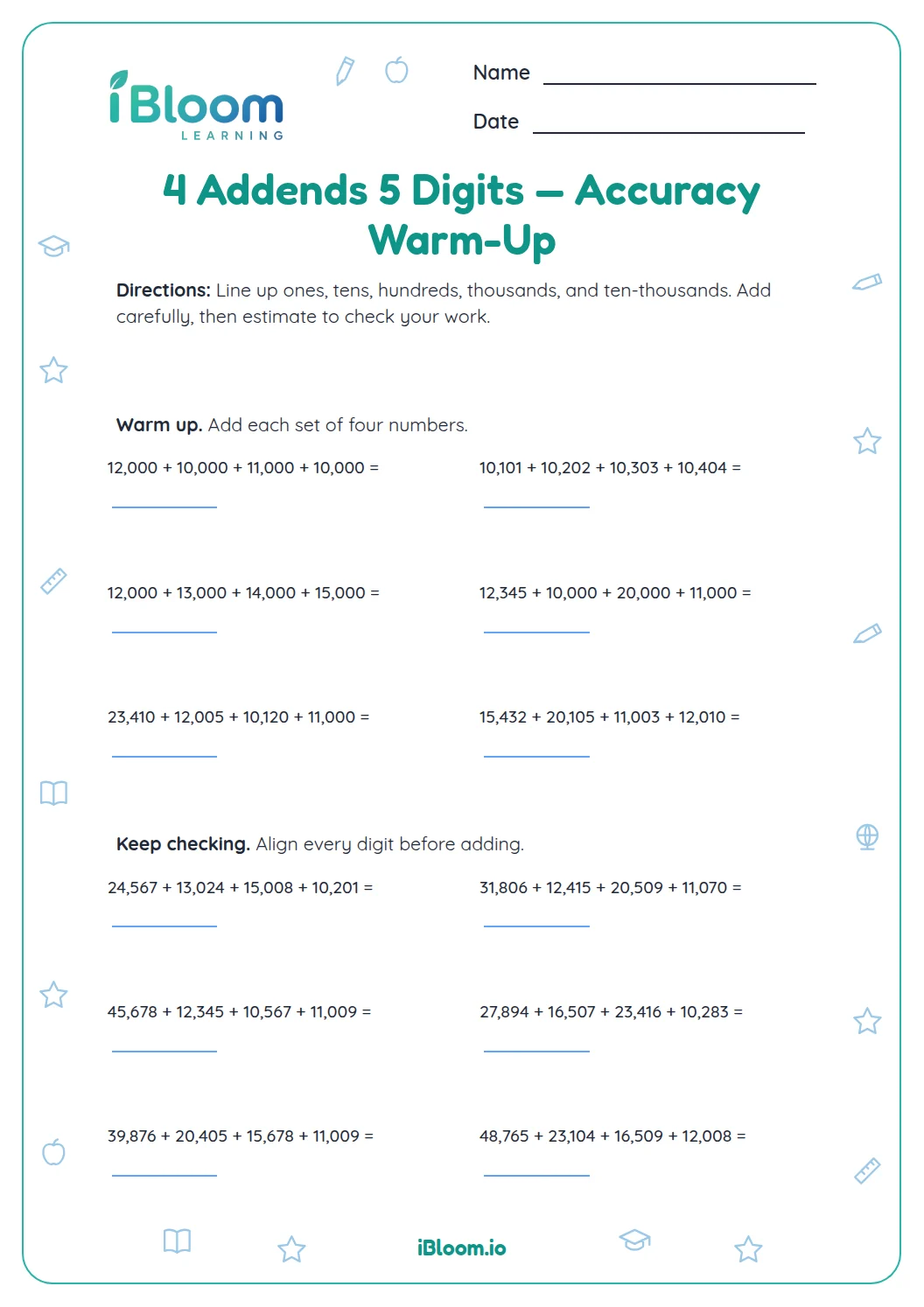
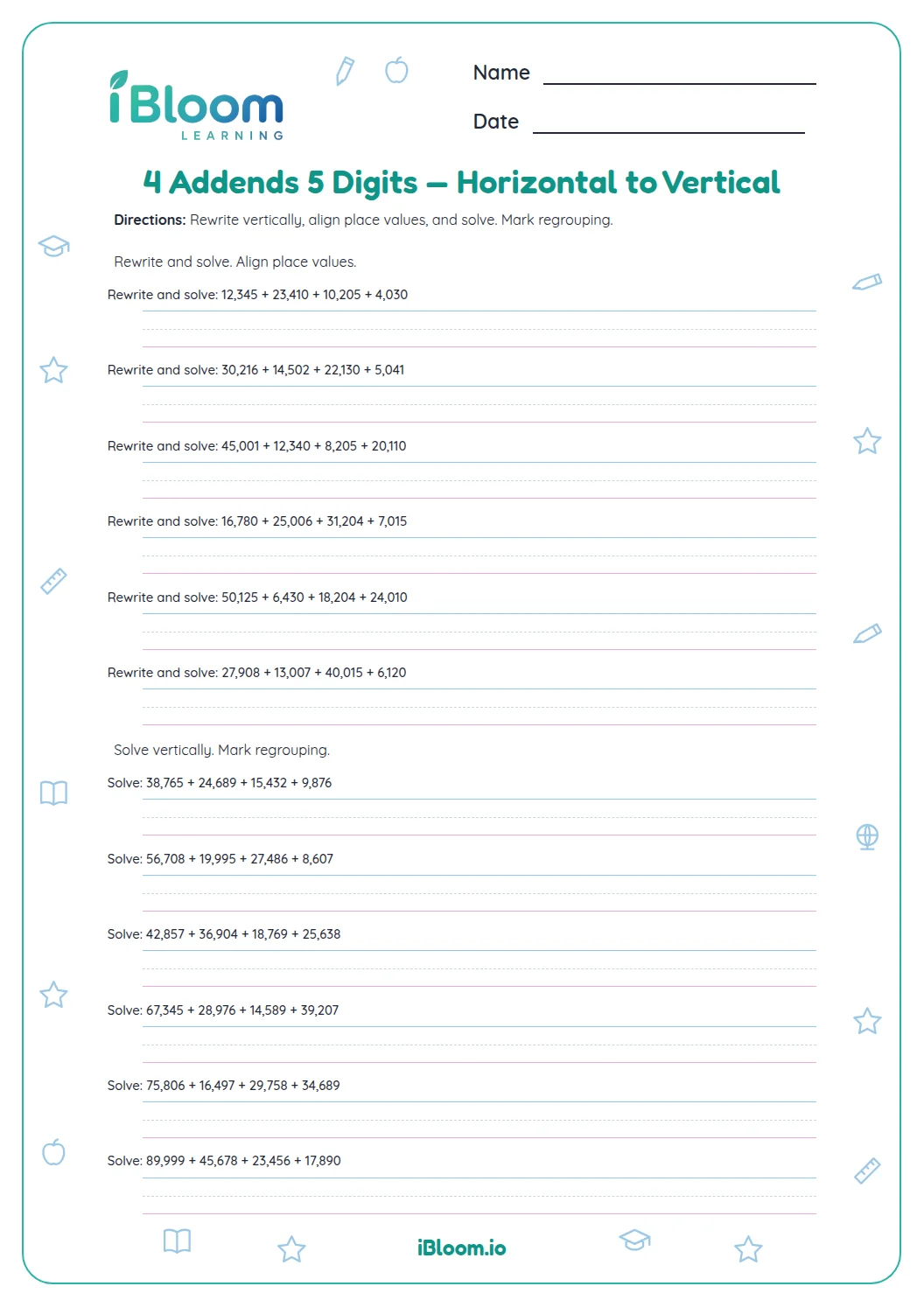
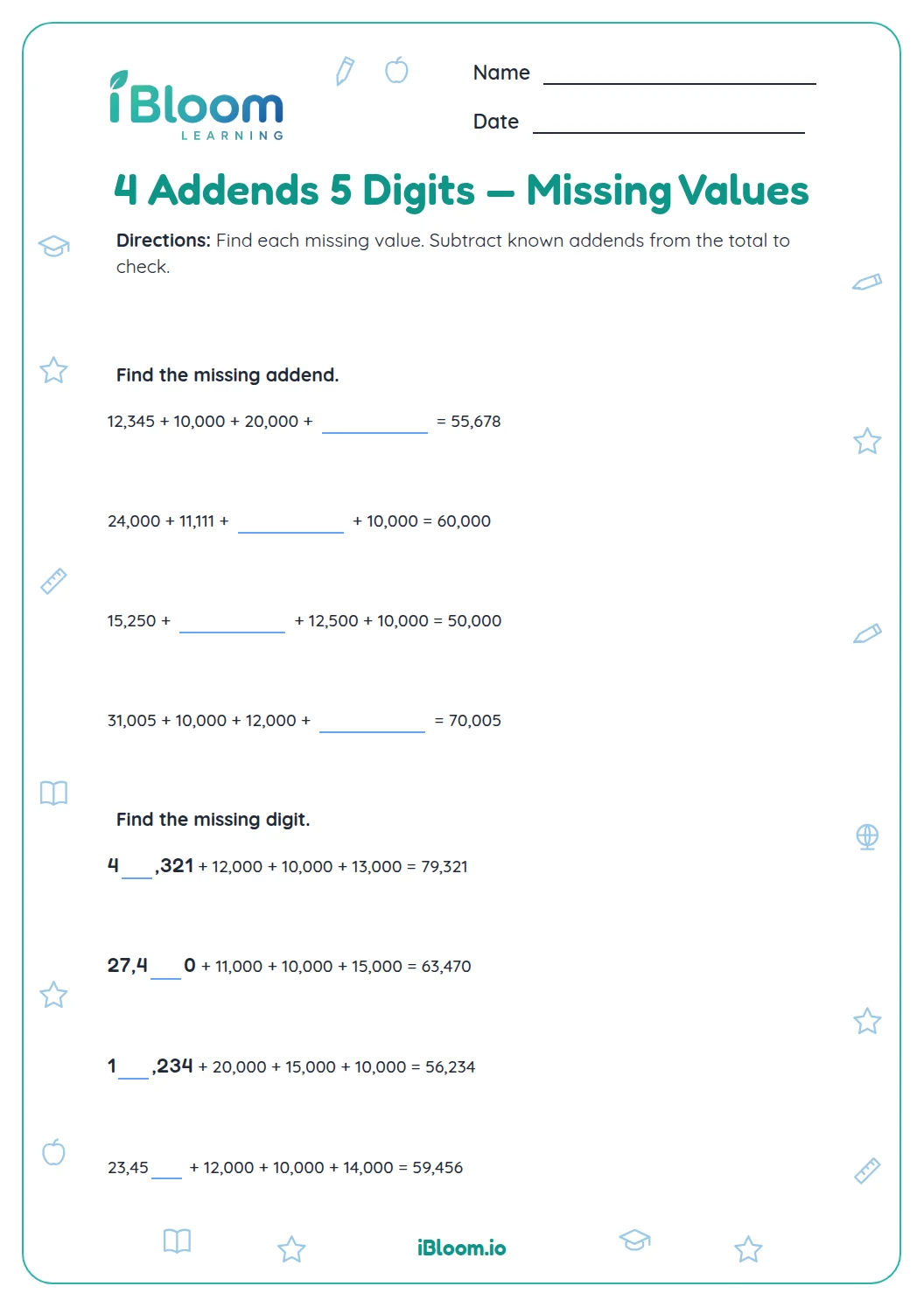
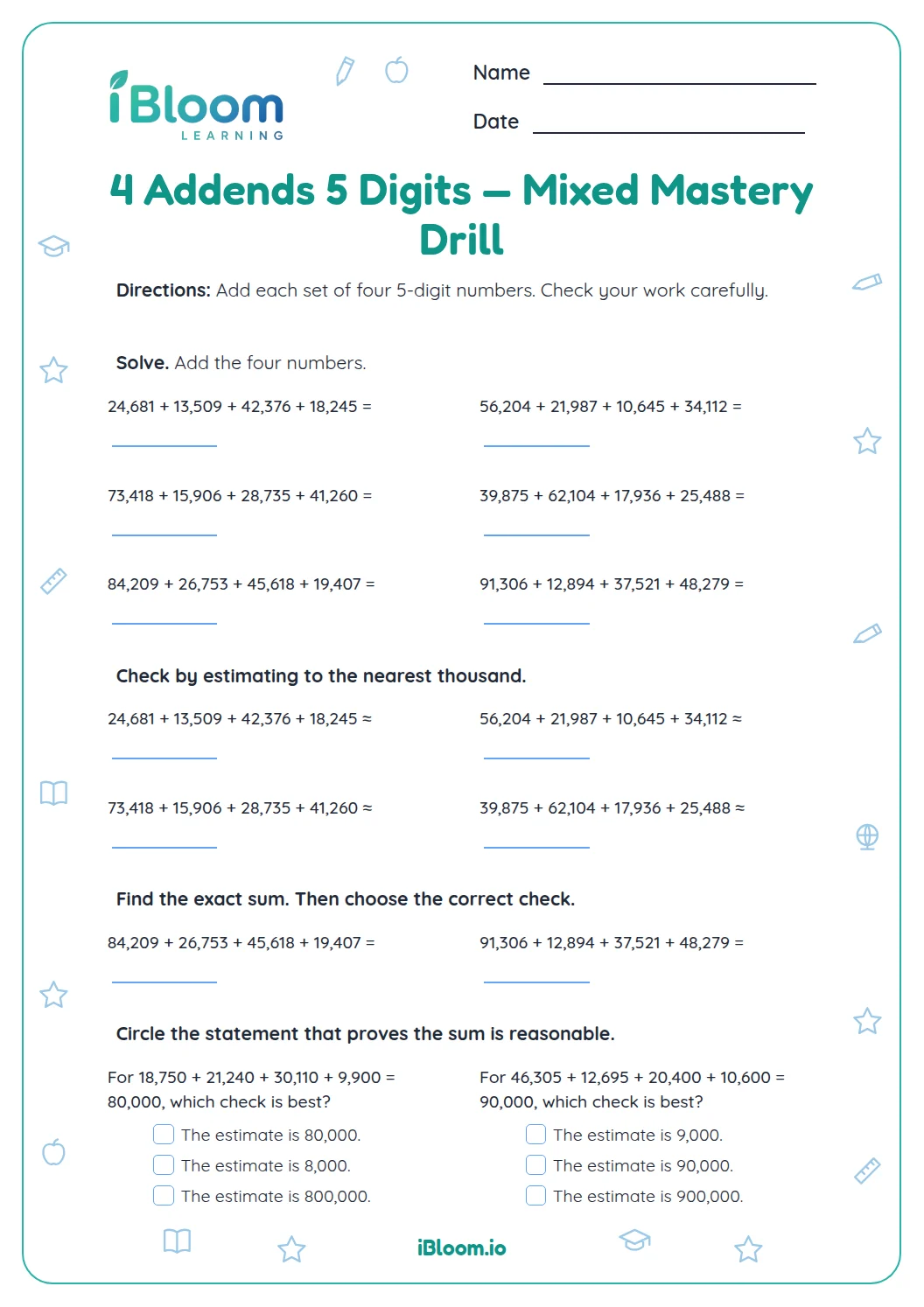
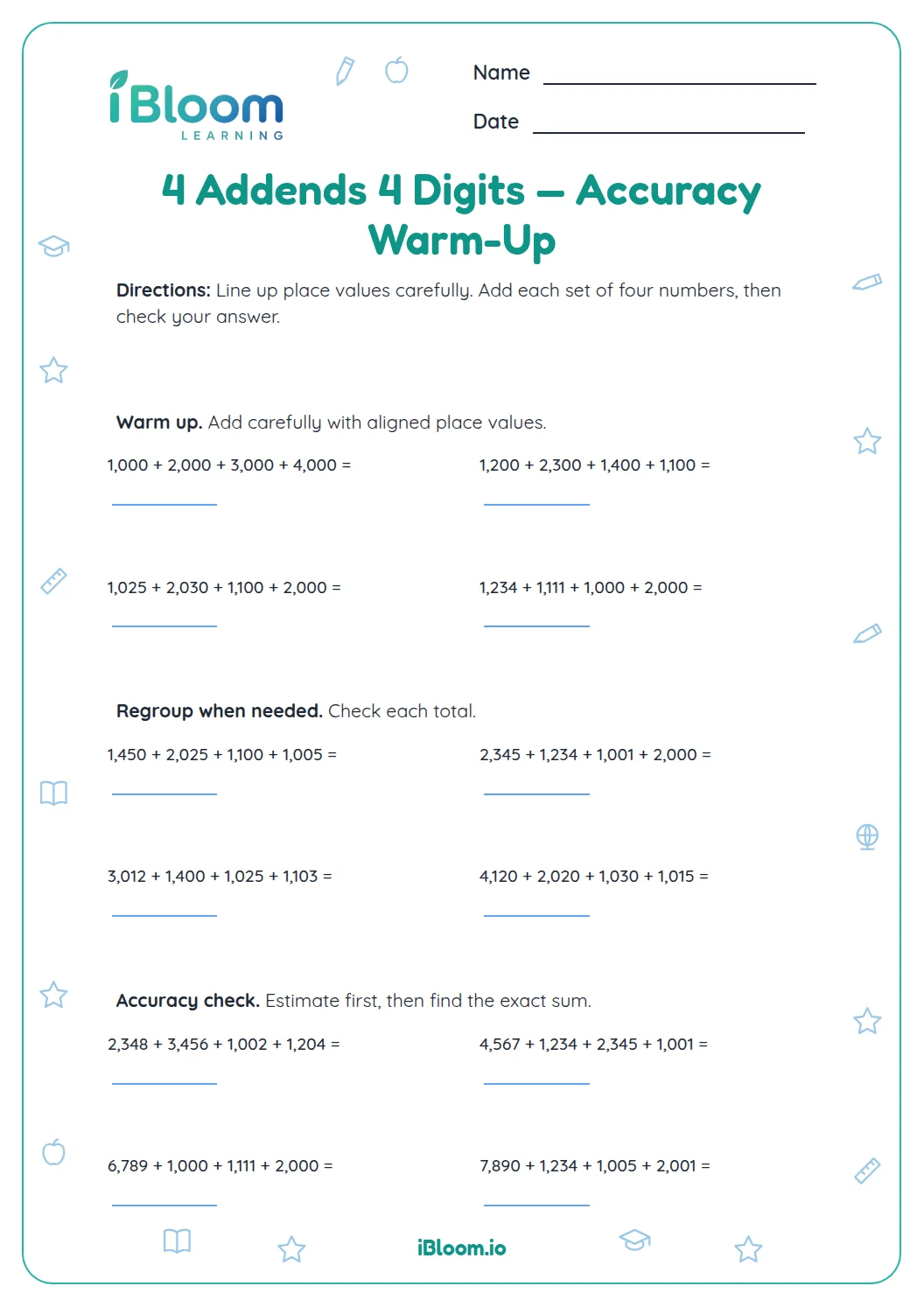
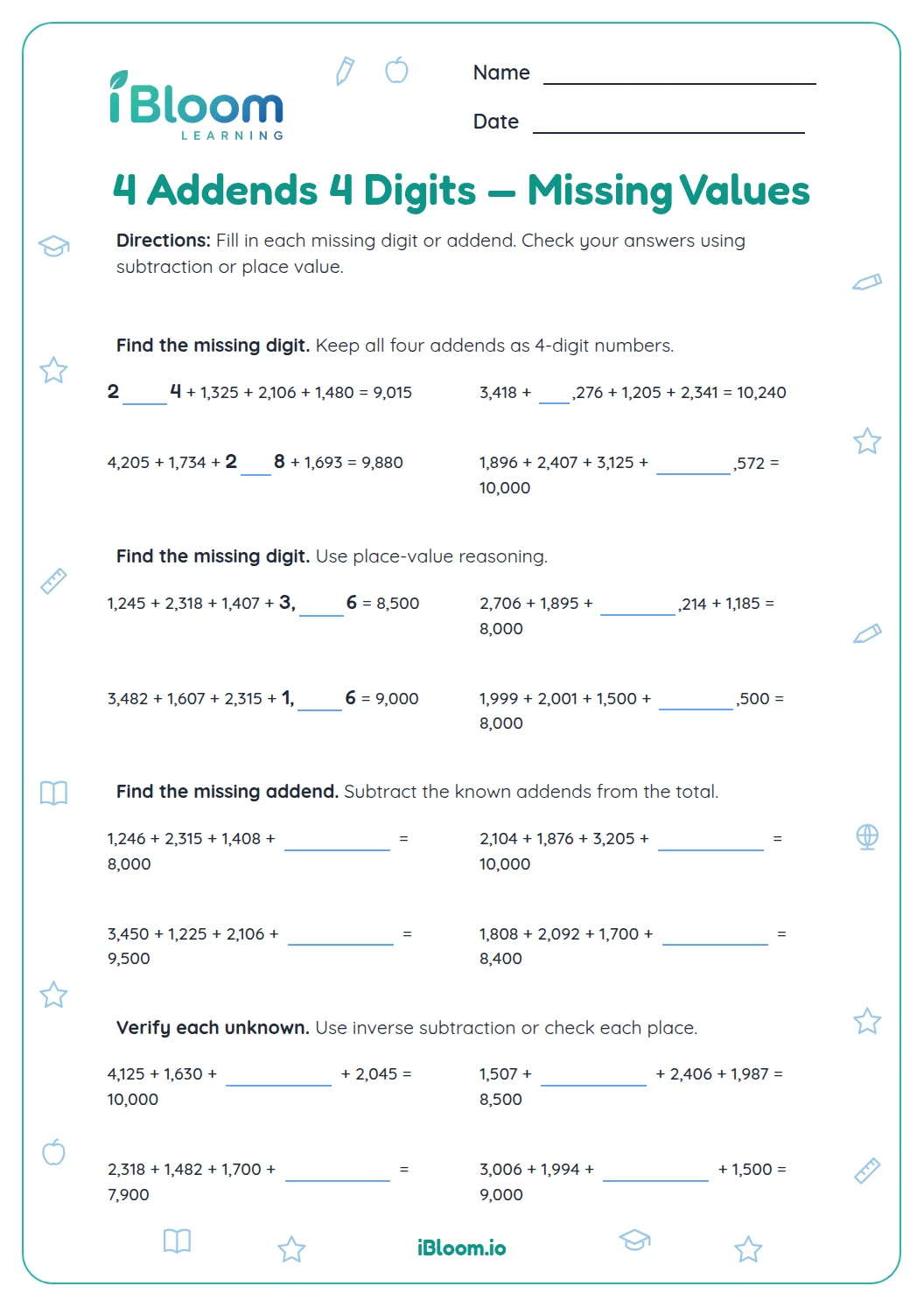
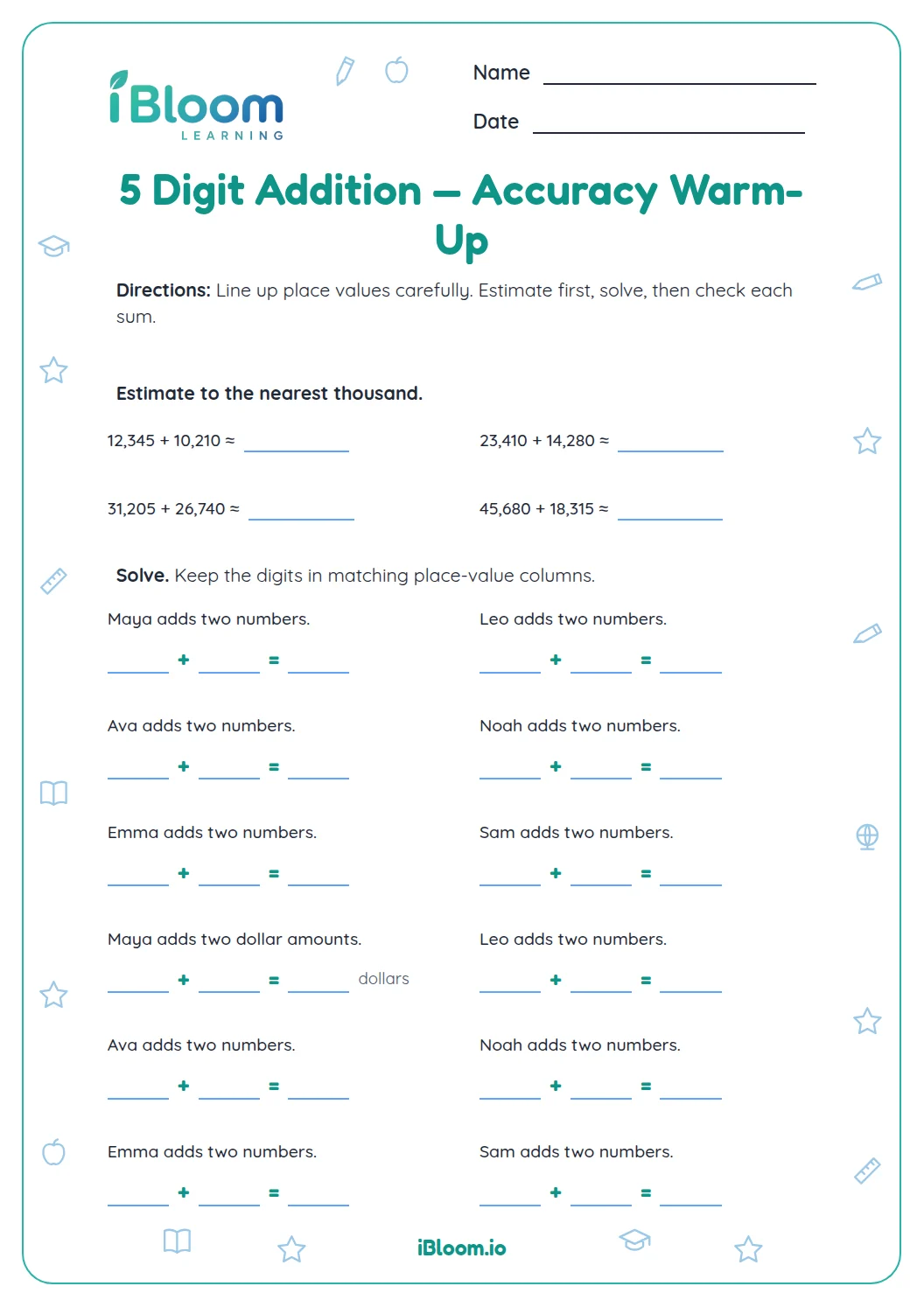
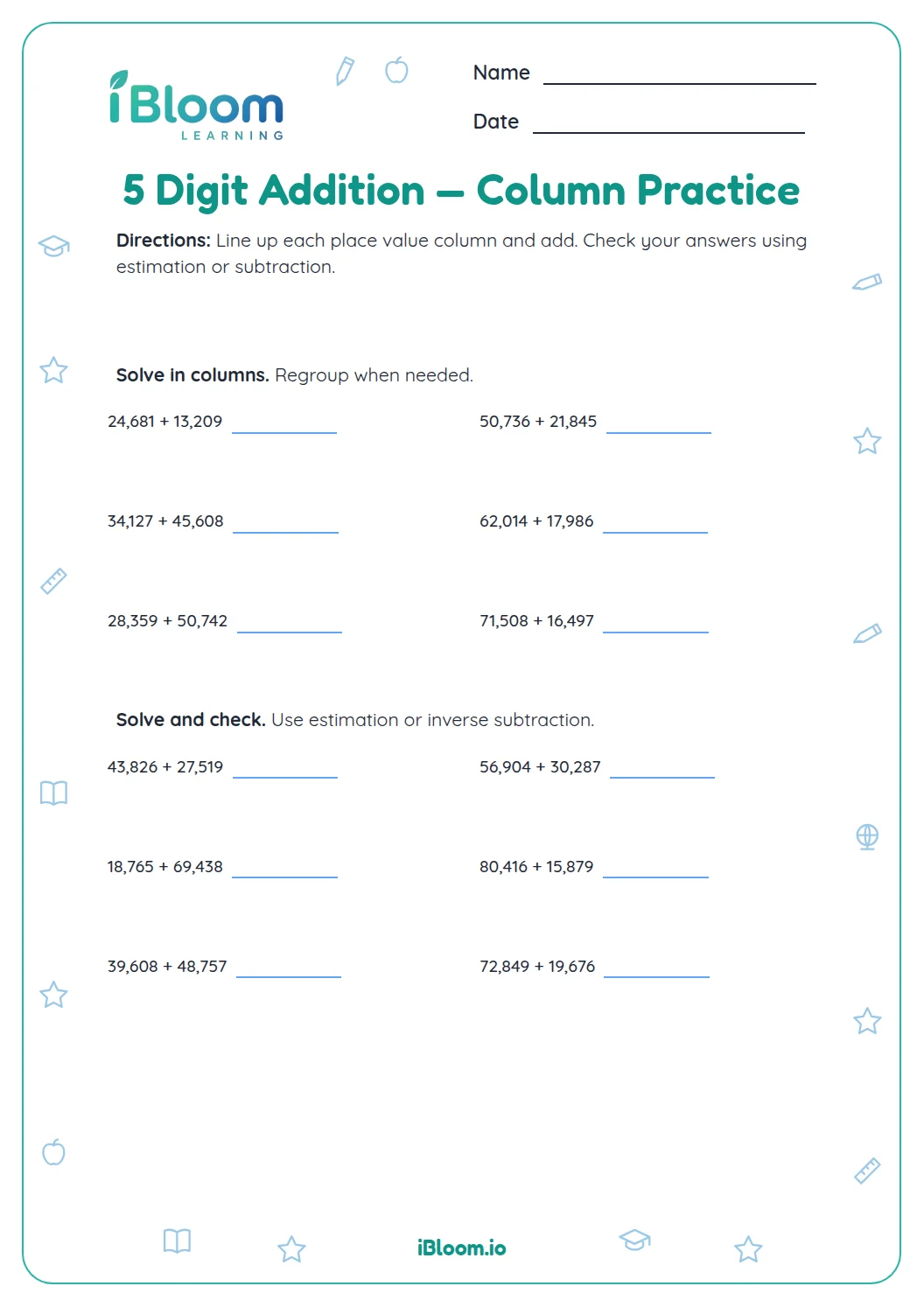
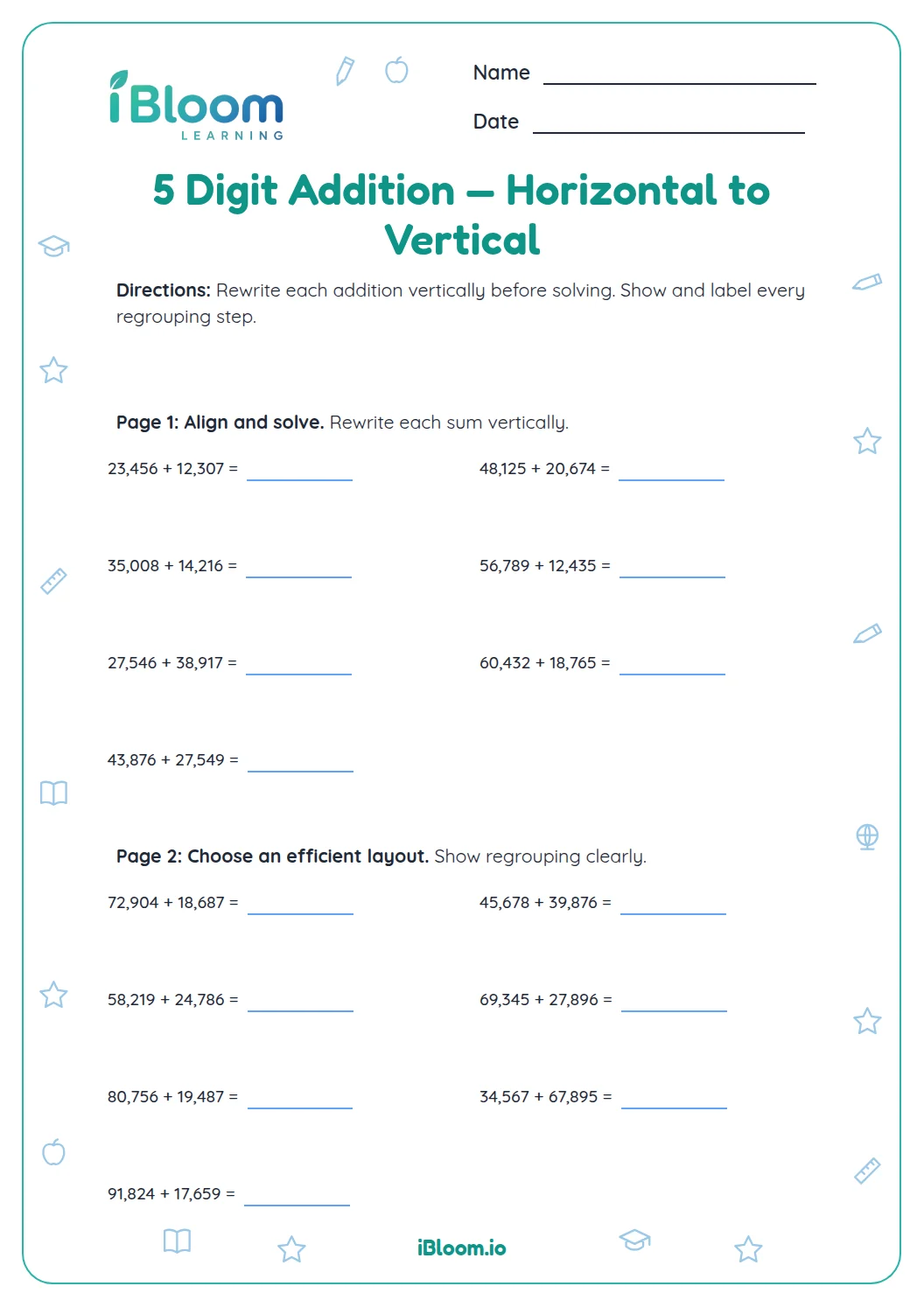
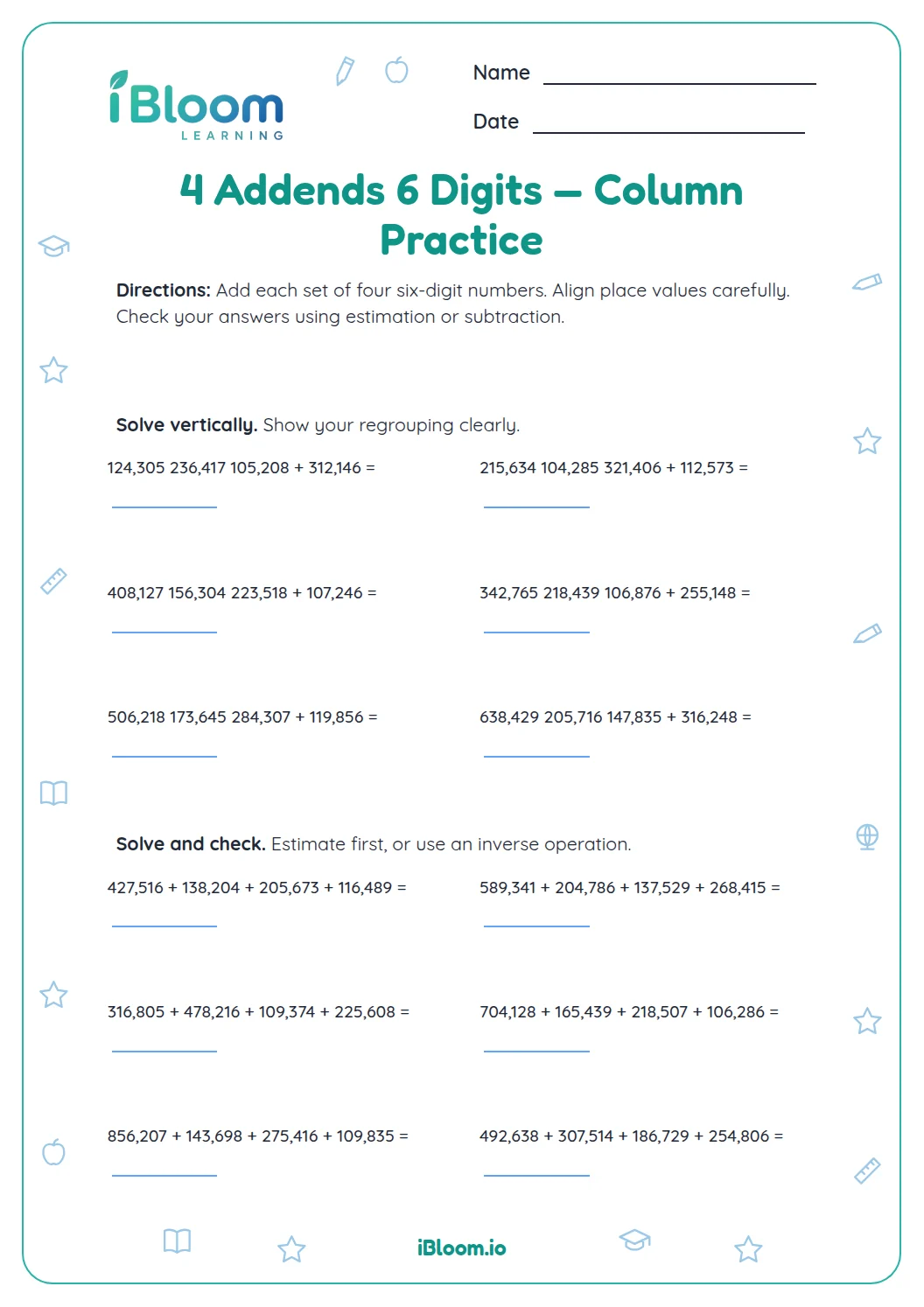
This printable Grade 5–6 drill gives students 14 four-addend problems: four exact sums using four five-digit addends and ten estimates using four five-digit addends rounded to the nearest thousand. Each item is a compact number sentence, so students can use the page efficiently and show column work on separate paper if they wish. The practice connects multi-digit addition and place value to Common Core 4.NBT.A.3 and 4.NBT.B.4. A separate answer key lists each total.
Aligned to 4.NBT.A.3 and 4.NBT.B.4
How do students add four five-digit numbers?
Line up ones under ones, tens under tens, and each larger place beneath its match. Add from right to left, writing the digit in each place and carrying any extra tens, hundreds, or thousands. The short answer line is for the total; students can show column work on separate paper.
What can a carry look like with four addends?
A column can total more than 19 when four digits are added. Keep the ones digit in that place and carry the remaining tens into the next column. Question 1 is a worked example using four five-digit addends.
- 112,345 + 23,456 + 10,111 + 14,222
- 2Ones: 5 + 6 + 1 + 2 = 14; write 4, carry 1.
- 3Tens: 4 + 5 + 1 + 2 + 1 = 13; write 3, carry 1.
- 4The full total is 60,134.
How do students estimate a four-addend total?
For each Part B item, round every addend to the nearest thousand and then add those rounded values. This gives a quick size check for the total. For question 9, 60,408 + 15,207 + 18,305 + 16,080 rounds to 60,000 + 15,000 + 18,000 + 16,000 = 109,000.
How to use this worksheet
- 1Align the four addends by place value on paper.
- 2Add the ones column and carry its extra tens.
- 3Continue left, adding each carry once.
- 4For Part B, round each addend to the nearest thousand.
- 5Compare exact sums and estimates with the separate key.
Mistakes to check and how to help
The mistake
Carrying 1 whenever a column total is greater than 9.
The fix
For a total of 26, record 6 and carry 2; the carry counts complete groups of ten.
The mistake
Leaving one of the four addends out when copying.
The fix
Count four rows before adding and compare each row with the prompt.
The mistake
Stopping after the ten-thousands digit even when a carry remains.
The fix
Write the remaining carry in the hundred-thousands place; question 8 has a six-digit total.
Common Core alignment
Round each multi-digit addend to the nearest thousand before estimating its total.
On this sheet: Ten estimates round all four addends to the nearest thousand before adding.
Show the official wordingHide the official wording
Use place value understanding to round multi-digit whole numbers to any place.
Use column addition and regrouping to add four five-digit whole numbers.
On this sheet: Each problem asks students to align four addends by place value and use the standard addition algorithm.
Show the official wordingHide the official wording
Fluently add and subtract multi-digit whole numbers using the standard algorithm.
What to practice next
Make more practice
Further reading
Questions parents and teachers ask
Does the worksheet provide room for column work?
Each problem has a short answer line, so students can set up the four addends on separate paper. Align all ones, tens, hundreds, thousands, and ten-thousands before adding. That keeps the printed worksheet compact while leaving room to show each regrouping step.
Can a carry be greater than one?
Yes. Four digits in a place can add to more than 19, so the carry may be two or three. In question 1, the ones total is 14: write 4 in the ones place and carry 1 ten to the tens column.
Why can a total have six digits?
Four five-digit addends can sum to more than 99,999. Question 1 totals 60,134, while other combinations can produce a hundred-thousands digit. Leave room to the left when setting up a sum and record the last carry as part of the answer.
How should students estimate each total?
Round each of the four addends to the nearest thousand, then add the rounded values. For question 9, the rounded numbers are 60,000, 15,000, 18,000, and 16,000, for an estimate of 109,000. The estimate checks the size of the total.
What does the answer key include?
The key lists four exact sums and ten estimates rounded to the nearest thousand. For an exact sum, compare each place and carry with the student’s work. For an estimate, check that each addend was rounded first and that the rounded values were then added.