

About this worksheet
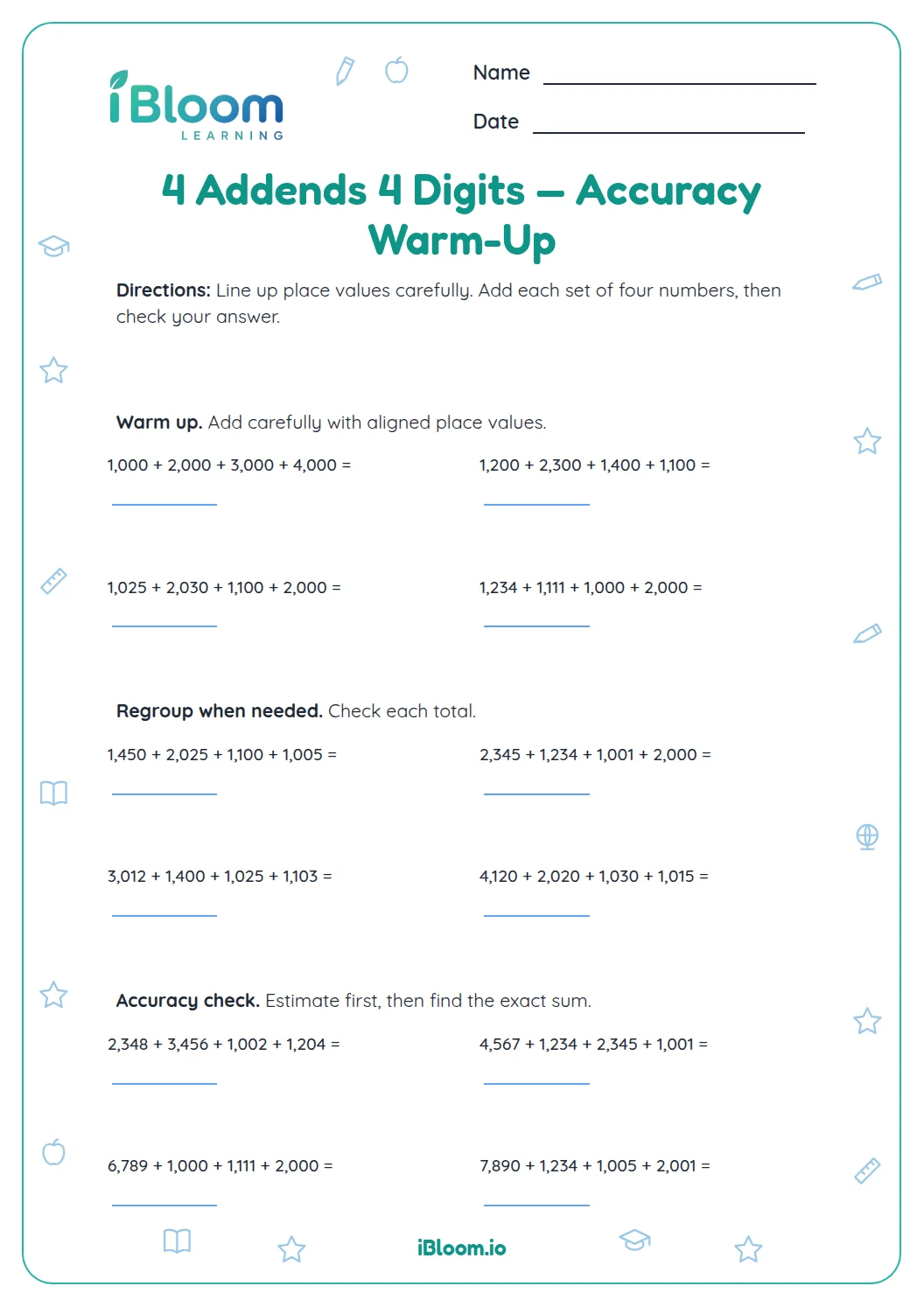
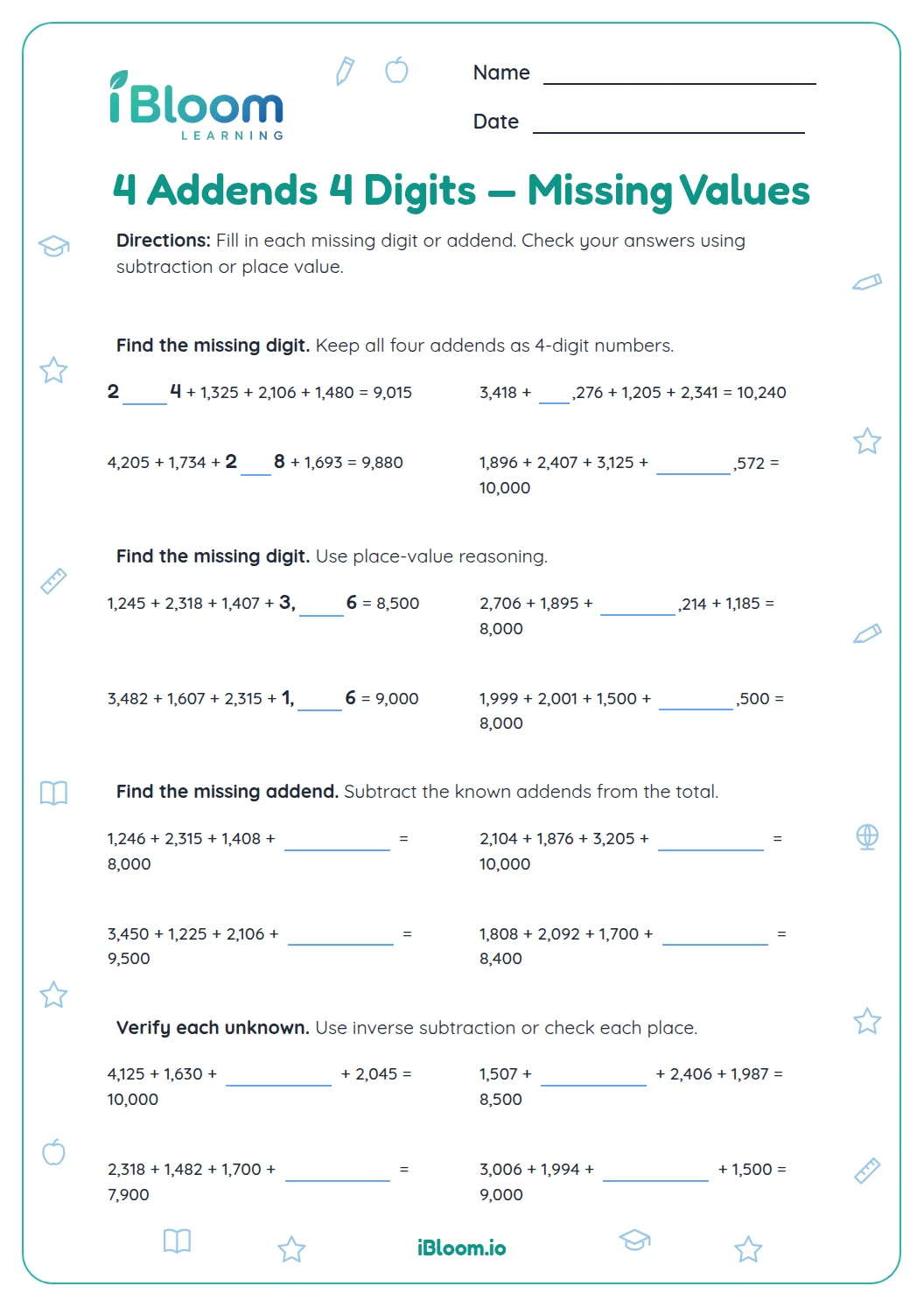
This printable gives Grades 4–5 learners 16 column-addition problems, each with four four-digit addends. Children align place values, regroup column totals, and check each sum. The included answer key lists the totals. The practice connects to CCSS 4.NBT.B.4.
Aligned to 4.NBT.B.4
Where do you start adding?
Write each addend so its ones, tens, hundreds, and thousands digits line up. Add from right to left, carrying each group of ten to the next column.
How do you regroup a column total?
In question 1, the ones digits total 22. Write 2 in the ones place and regroup 2 tens, then add those tens in the next column.
- 11,245 + 2,367 + 3,184 + 1,456
- 2Ones: 5 + 7 + 4 + 6 = 22
- 3Write 2 ones and regroup 2 tens
- 4Continue through thousands: 8,252
How can you check a large sum?
Add a pair of addends first, then add the other pair, and compare that result with the column total. An estimate also helps spot a misplaced digit.
How to use this worksheet
- 1Line up ones, tens, hundreds, and thousands.
- 2Add the ones digits first.
- 3Write the ones digit and regroup any tens.
- 4Repeat across the columns, including each regrouped amount.
- 5Estimate or add pairs to check the total.
Common mistakes and quick fixes
The mistake
Check the operation or unit before answering.
The fix
Reread the prompt and keep the unit with the result.
The mistake
Skip a step in the process.
The fix
Write each step clearly before checking the answer.
The mistake
Use one detail to describe the whole task.
The fix
Check that your answer fits the full question.
Common Core alignment
This sheet practices the listed skill through its worksheet questions.
Use the standard algorithm to add four multi-digit numbers.
On this sheet: Grades 4–5
Show the official wordingHide the official wording
Fluently add and subtract multi-digit whole numbers using the standard algorithm.
What to practice next
Further reading
Questions parents and teachers ask
How do you add four four-digit numbers?
Line up all four addends by place value and add from right to left. Regroup each group of ten into the next column. This sheet has 16 problems and a separate answer key with the correct totals. An adult can read the prompt aloud and review the choices with the learner.
What does regrouping mean here?
When a column total is ten or more, write its ones digit and carry the tens to the next column. In question 1, the ones total 22, so write 2 and regroup 2 tens. Continue adding those tens with the next column.
How can a learner check a sum?
Estimate the total first, then add two addends together and the other two together. Combine those pair totals and compare with the column method. The answer key provides a final check for each of the 16 problems. An adult can read the prompt aloud and review the choices with the learner.
How many problems and pages are included?
There are 16 four-addend problems on two worksheet pages. The separate answer key also uses two pages. Problems ask learners to align four-digit numbers, regroup where needed, and find each total. An adult can read the prompt aloud and review the choices with the learner.
Why should the digits be aligned?
Each column must contain digits with the same place value: ones under ones, tens under tens, hundreds under hundreds, and thousands under thousands. Careful alignment keeps each regrouped amount in the right column and helps prevent an incorrect sum. An adult can read the prompt aloud and review the choices with the learner.