


About this worksheet
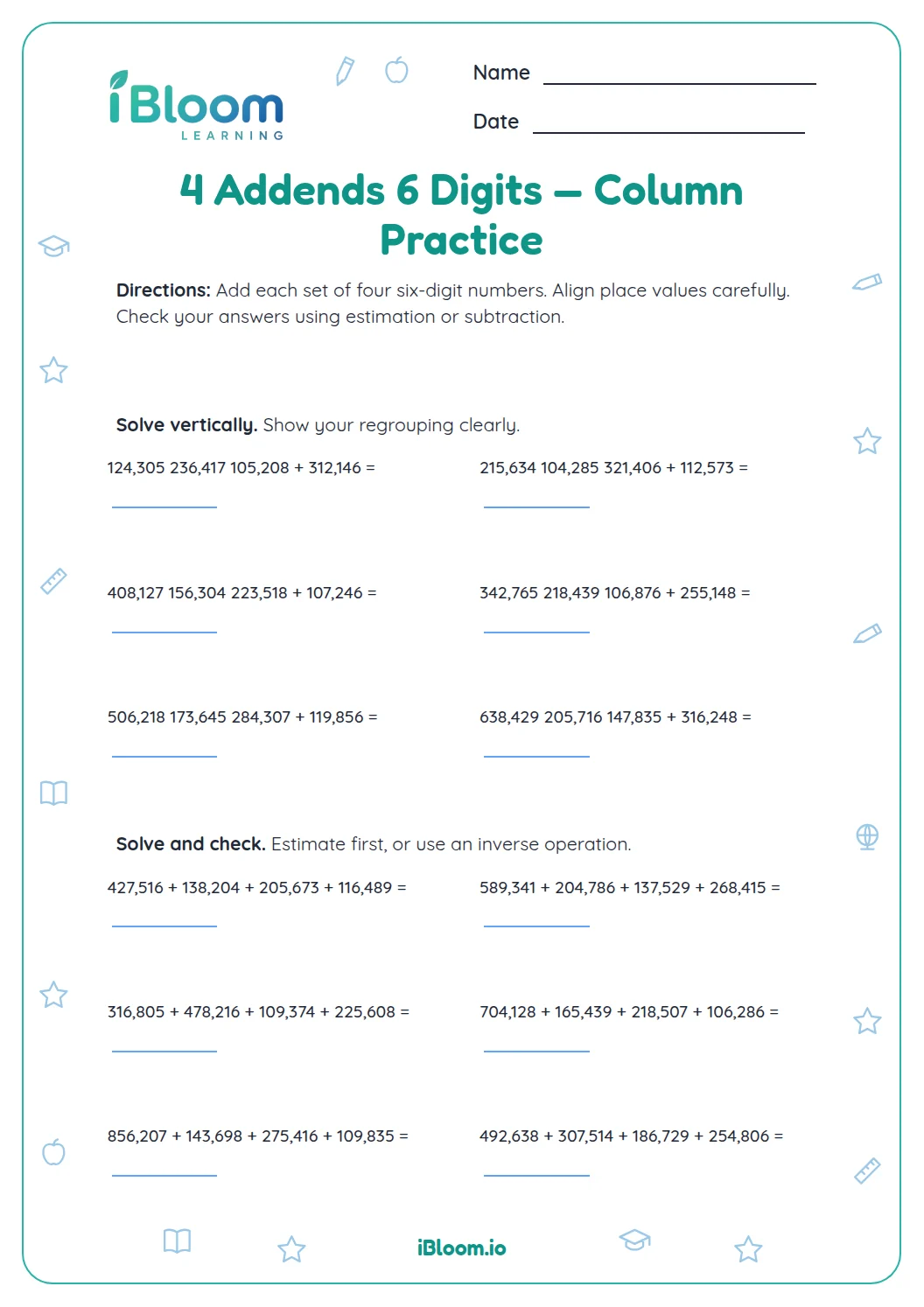
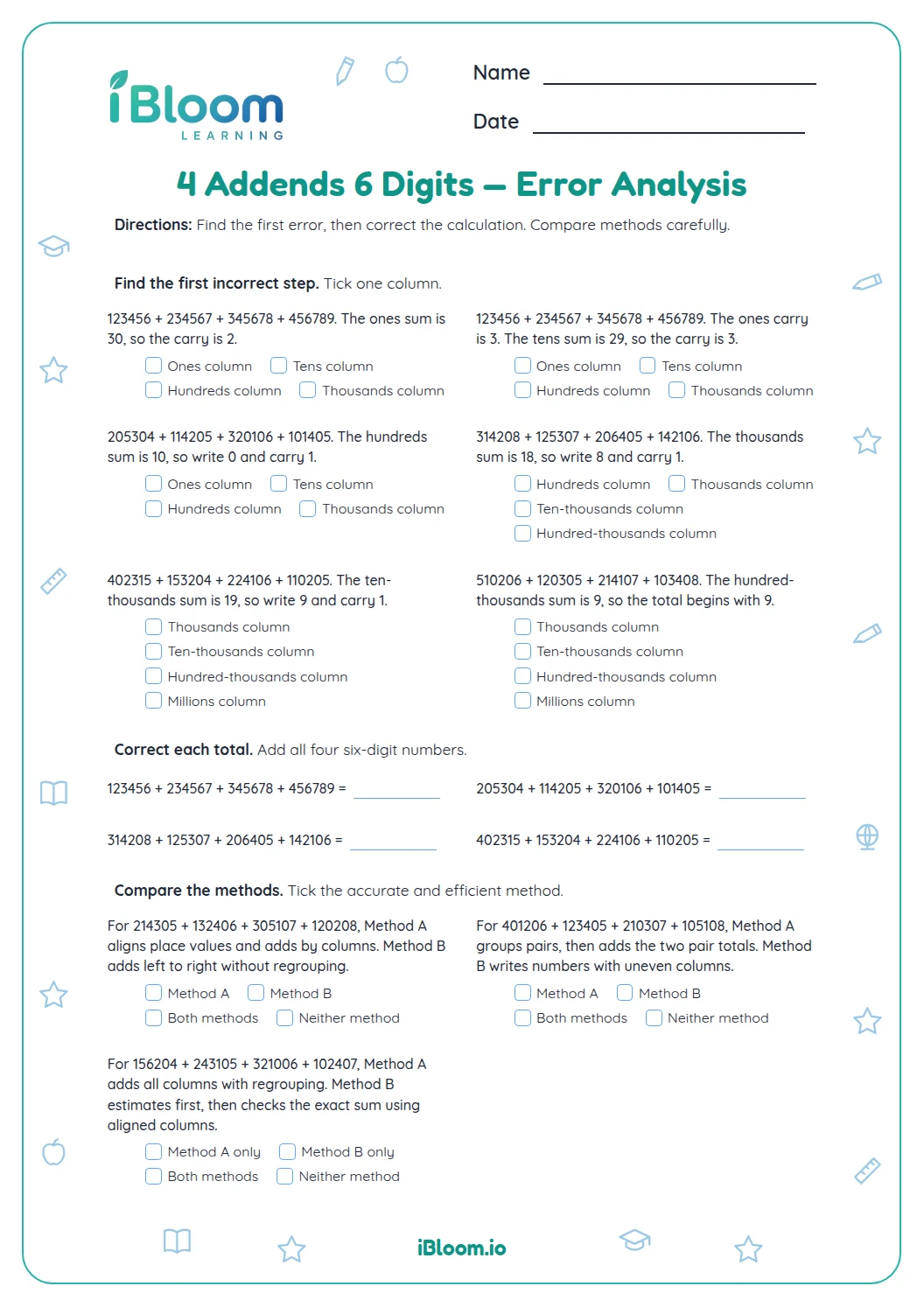
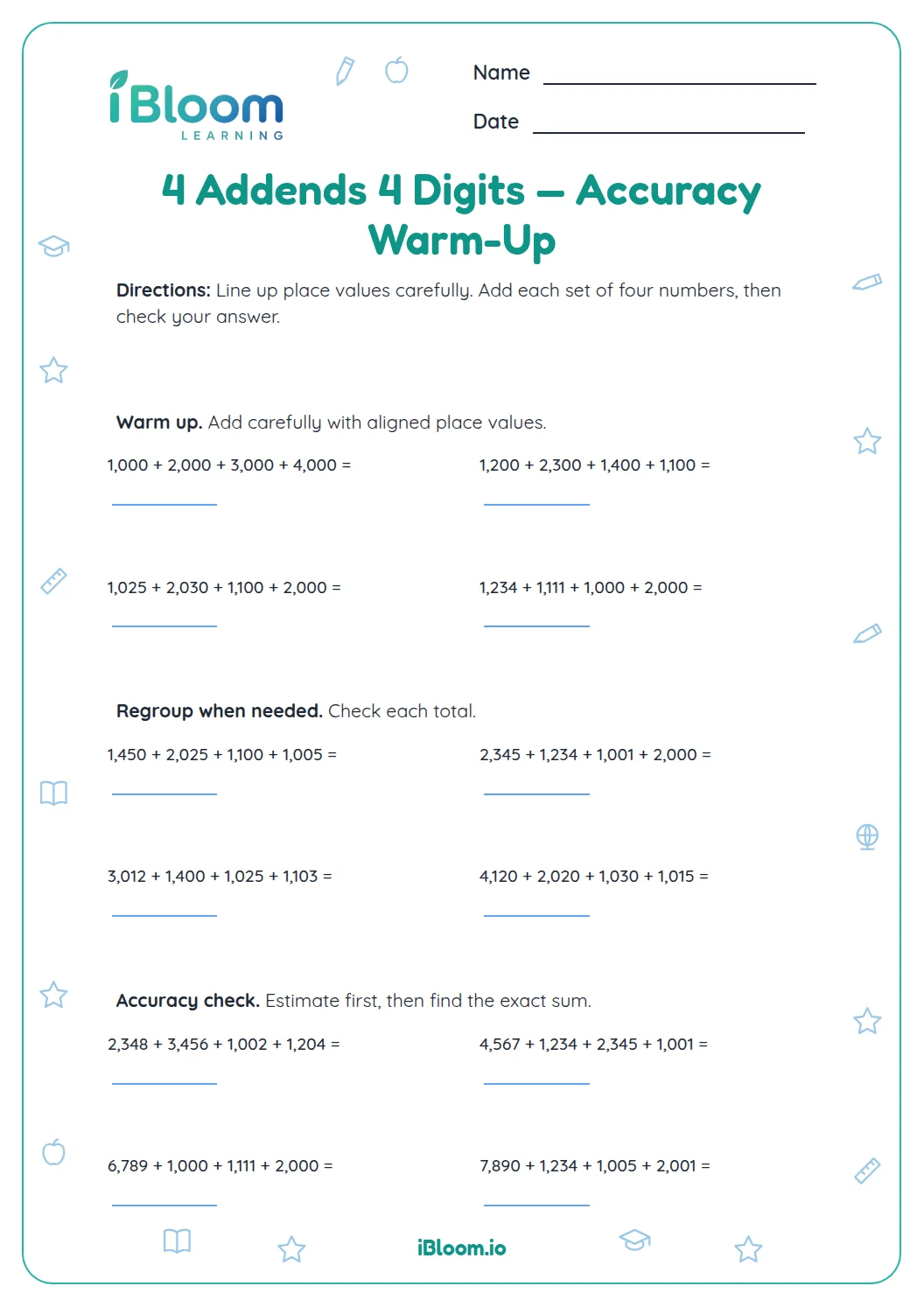
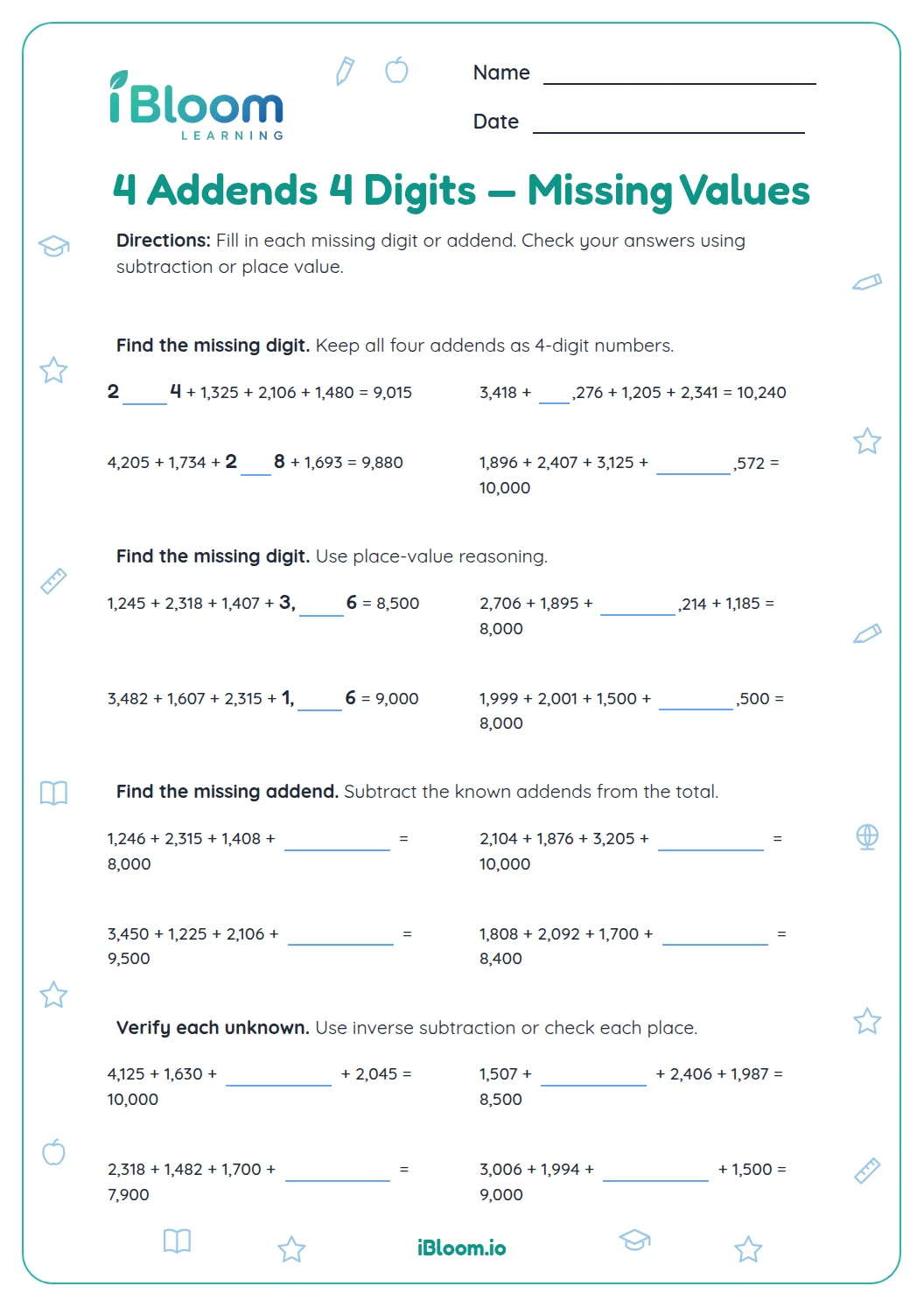
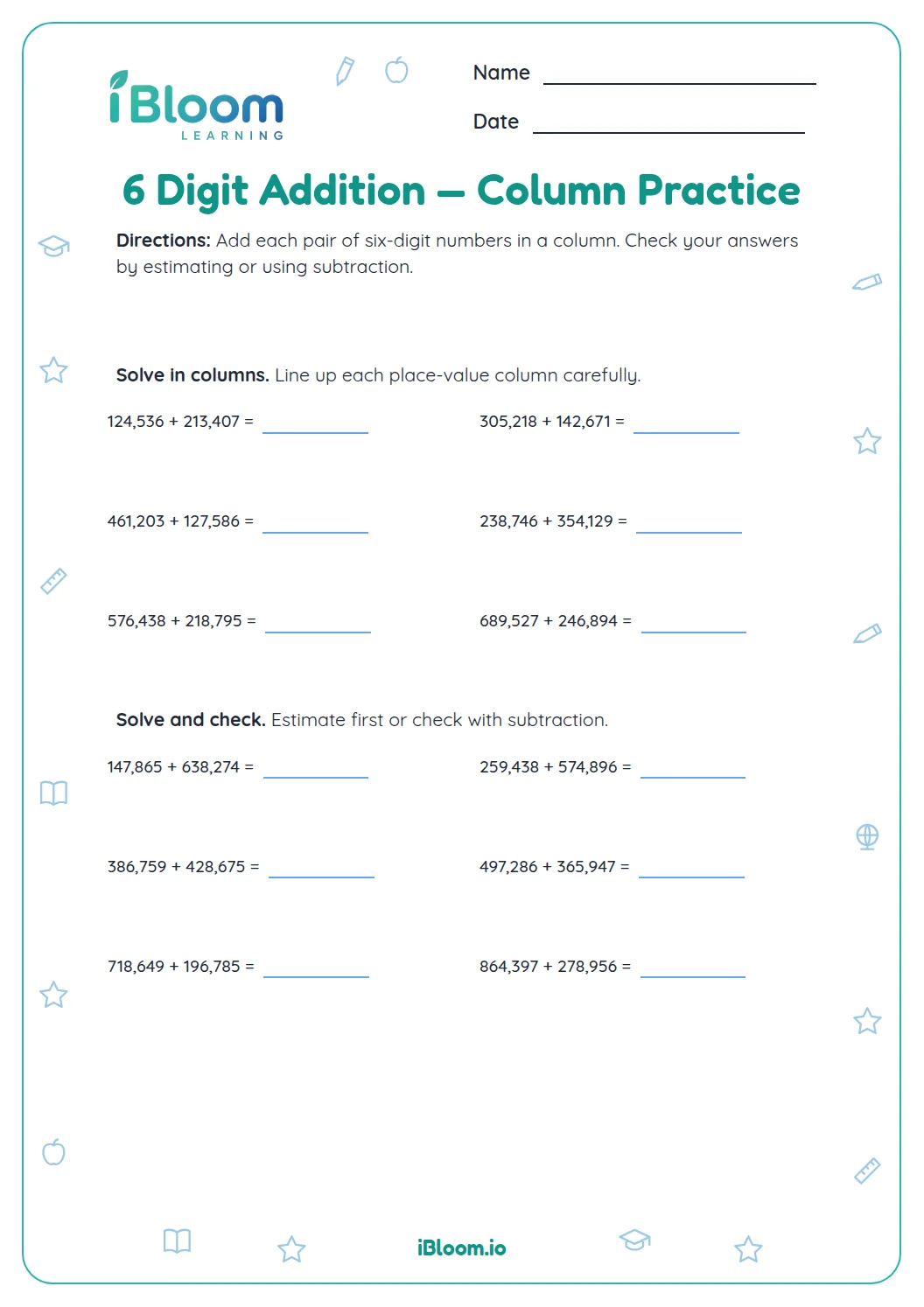
This printable addition drill gives Grade 5–6 students practice rewriting four six-digit addends in vertical form. They align place values, add across columns with regrouping, and verify totals by grouping addends differently. The 16 problems include generous setup space across three worksheet pages, followed by a separate answer key.
Aligned to 4.NBT.B.4
Why align digits by place value?
Vertical addition works when each place is combined with the same place in every addend. Ones belong in the ones column and hundred-thousands belong in the hundred-thousands column. A single misaligned digit changes its value and the total.
- 1For q1, write 125,304, 213,478, 106,219, and 342,587 in aligned place-value columns before adding.
How do you regroup across several addends?
Add one column at a time. Record the ones digit of the column total and carry the tens into the next column. Four addends can produce a carry greater than one, so add the carried amount to the next column’s digits.
- 1In q7, add each column from right to left and record carries above the next place.
How can a second method verify a total?
Group the addends in pairs, find each pair sum, then add those two results. Addition can be grouped this way without changing the total. Compare the result with the vertically calculated sum.
- 1For q12, compare the column total with the sum of (284,691 + 316,207) and (105,938 + 219,456).
How to use this worksheet
- 1Copy one addend per line.
- 2Align all digits in matching place-value columns.
- 3Add the ones column and record any carry.
- 4Continue left, including carried amounts in each column.
- 5Estimate or regroup the addends to check the total.
Common mistakes and quick fixes
The mistake
Starting the numbers at the left edge instead of aligning place values.
The fix
Line up the final digits in the ones column.
The mistake
Forgetting to include a carry in the next column.
The fix
Write each carry above the next column before continuing.
The mistake
Writing a two-digit column total in one column.
The fix
Keep the ones digit below and carry the tens to the next place.
Common Core alignment
These standards describe the reading, language, or math work practiced on this page.
Add multi-digit whole numbers accurately with the standard algorithm.
On this sheet: Students align six-digit addends and use the standard algorithm to find sums.
Show the official wordingHide the official wording
Fluently add and subtract multi-digit whole numbers using the standard algorithm.
What to practice next
Make more practice
Further reading
Questions parents and teachers ask
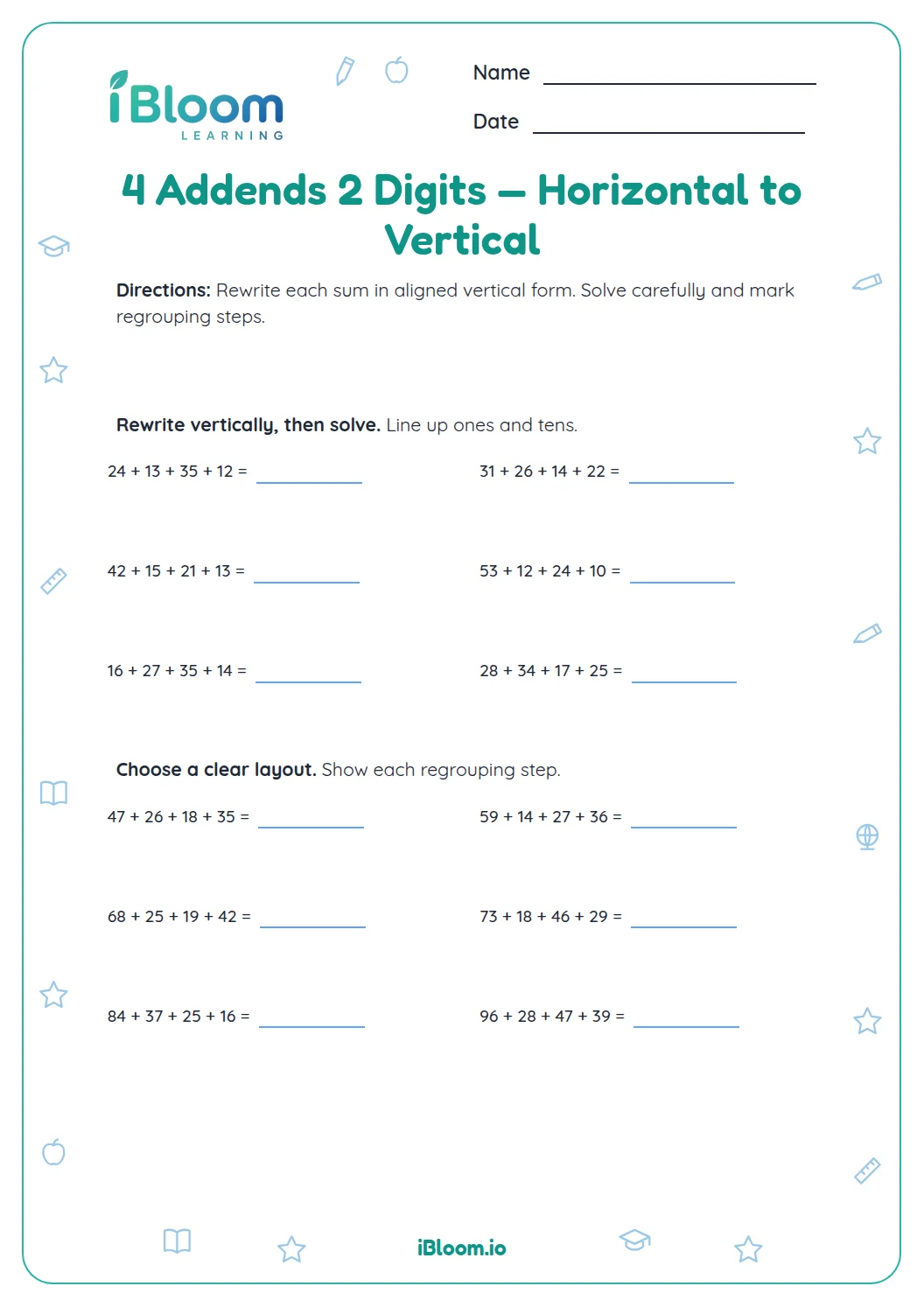
How do I change a horizontal sum to vertical form?
Write each six-digit addend on its own line and align the ones digits in one column. Then tens, hundreds, and each larger place will line up automatically. Add from right to left, recording each carry above the next column before continuing.
Why are there four addends in each problem?
Each question asks students to combine four six-digit whole numbers, so every place-value column contains four digits before any carries are added. Keeping all four rows aligned makes it easier to track the column total and regroup accurately.
What is regrouping in addition?
When a column total is ten or more, write its ones digit in that place and carry the remaining tens into the next column. For example, a total of 17 contributes 7 in the current place and 1 ten to the next place.
How can students check a large sum?
Add the four values again using a different grouping, such as the first two addends and last two addends. Add those pair totals and compare the result with the column algorithm. An estimate can also show whether the answer is in a reasonable range.
How many sums and pages are included?
The sheet has 16 four-addend sums in three parts: six setup-and-solve items, five regrouping items, and five checks. The worksheet spans three pages so students have room to set up the numbers vertically. A separate three-page answer key lists every total.