


About this worksheet
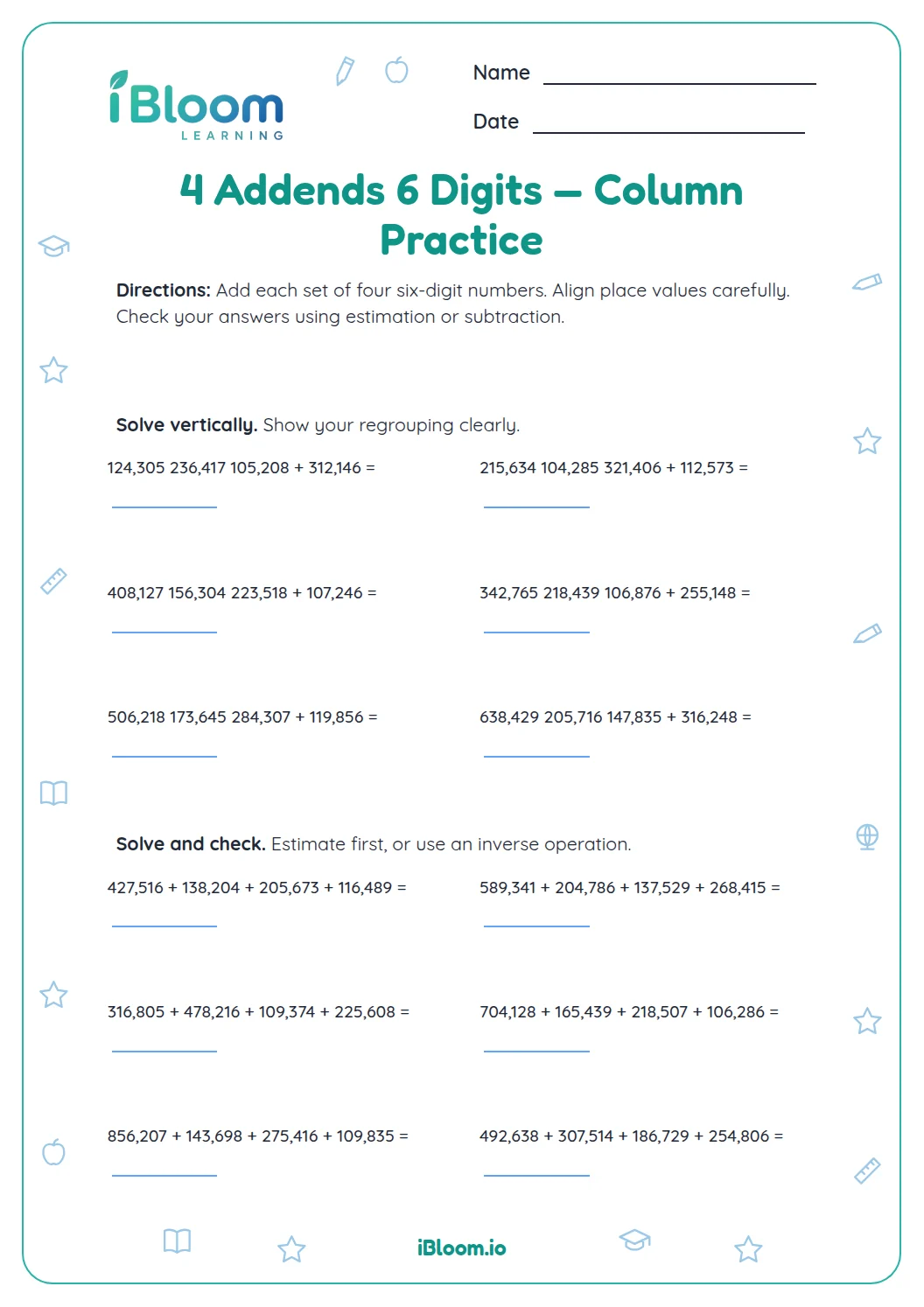
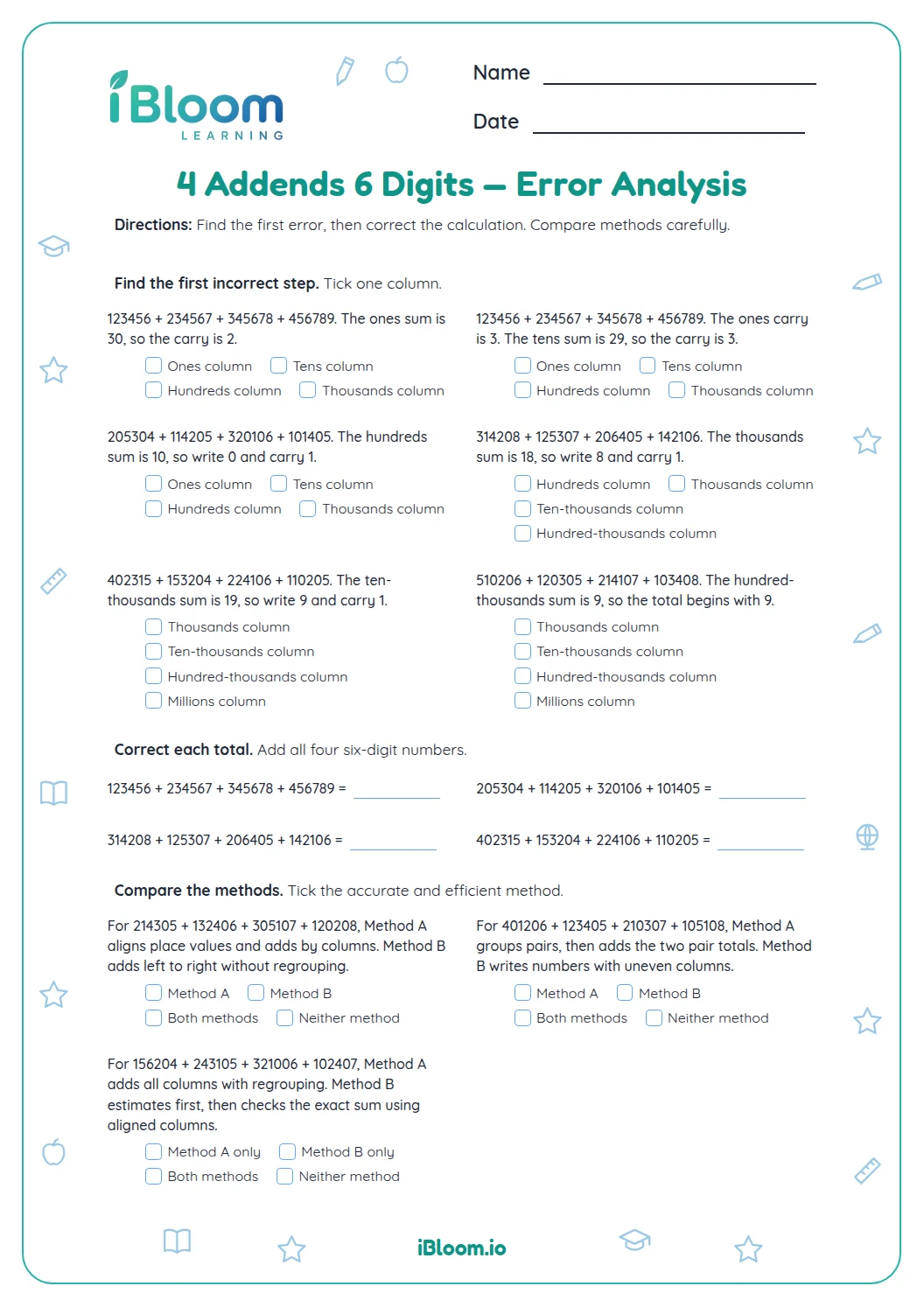
This printable gives Grades 5–6 students 16 problems with four six-digit addends. The practice returns to the earlier sheet’s three methods: find exact sums, estimate by rounding each addend to the nearest thousand, and check totals with inverse subtraction. Two final choices ask students to identify a useful operation and rounding place. A separate answer key lists every result. The addition and subtraction practice aligns with Common Core 4.NBT.B.4.
Aligned to 4.NBT.B.4
How should students add four six-digit numbers?
Line up all addends by place value and add from the ones column through the hundred-thousands column. Record each carry before moving left. Questions 1–6 ask for exact totals with different regrouping patterns.
- 1184,726 + 295,413 + 367,805 + 126,948
- 2184,726 + 295,413 = 480,139
- 3367,805 + 126,948 = 494,753
- 4480,139 + 494,753 = 974,892
How can an estimate help check a total?
Round each addend to the nearest thousand, then add the rounded values. This gives a nearby estimate, not the exact sum. For question 7, the addends round to 185,000, 295,000, 368,000, and 127,000, for an estimate of 975,000.
How does subtraction check the addition?
Subtract three addends from the total; the amount left should be the fourth addend. Questions 11–14 use this inverse relationship. If the leftover value is different, recheck the addition or the subtraction steps.
How to use this worksheet
- 1Line up every digit by its place value.
- 2Add each column and record carries.
- 3Round each addend to the nearest thousand for an estimate.
- 4Subtract the known addends from a total for an inverse check.
- 5Compare the exact sum with the estimate and check the leftover addend.
Common mistakes and quick fixes
The mistake
Rounding only the final total when the prompt asks for an addend estimate.
The fix
Round all four addends first, then add those rounded values.
The mistake
Dropping a carry in the exact sum.
The fix
Write each carry above the next column before adding it.
The mistake
Subtracting a different set of addends than the total contains.
The fix
Match the three subtracted addends to the expression, then check that the fourth remains.
Common Core alignment
This worksheet gives practice with the stated skill.
Add multi-digit whole numbers and check totals with inverse subtraction.
On this sheet: The sheet practices four-addend sums, rounded estimates, and inverse subtraction checks.
Show the official wordingHide the official wording
Fluently add and subtract multi-digit whole numbers using the standard algorithm.
What to practice next
Make more practice
Further reading
Questions parents and teachers ask
What methods are included in this mixed mastery drill?
The 16 questions include exact four-addend sums, estimates made by rounding each addend to the nearest thousand, inverse subtraction checks, and two choices about which method to use. The parts revisit the solve, estimate, and check routine shown on the earlier sheet.
How do students estimate a four-addend total?
Round each addend to the nearest thousand, then add those rounded numbers. For question 7, the addends round to 185,000, 295,000, 368,000, and 127,000, which total 975,000. The estimate helps check whether the exact answer is reasonable, though it is not the exact sum.
How does inverse subtraction check a sum?
Start with the total and subtract three of the four addends. The amount left should equal the fourth addend. For example, subtracting three addends from 974,892 leaves 126,948, the fourth addend in question 1. This provides an independent check on the addition.
How many questions are on the sheet?
There are 16 questions: six exact sums, four rounded estimates, four inverse subtraction checks, and two method choices. A separate answer key lists the totals, estimates, and missing addends. Learners can check one part at a time after completing its calculations.
What should students do if the estimate and exact sum seem far apart?
Check the rounding first, then recompute the exact sum by place-value column. An estimate will not usually match the exact answer, but it should be nearby. A large difference can point to a missed carry, a copied digit, or a rounding error.