


About this worksheet
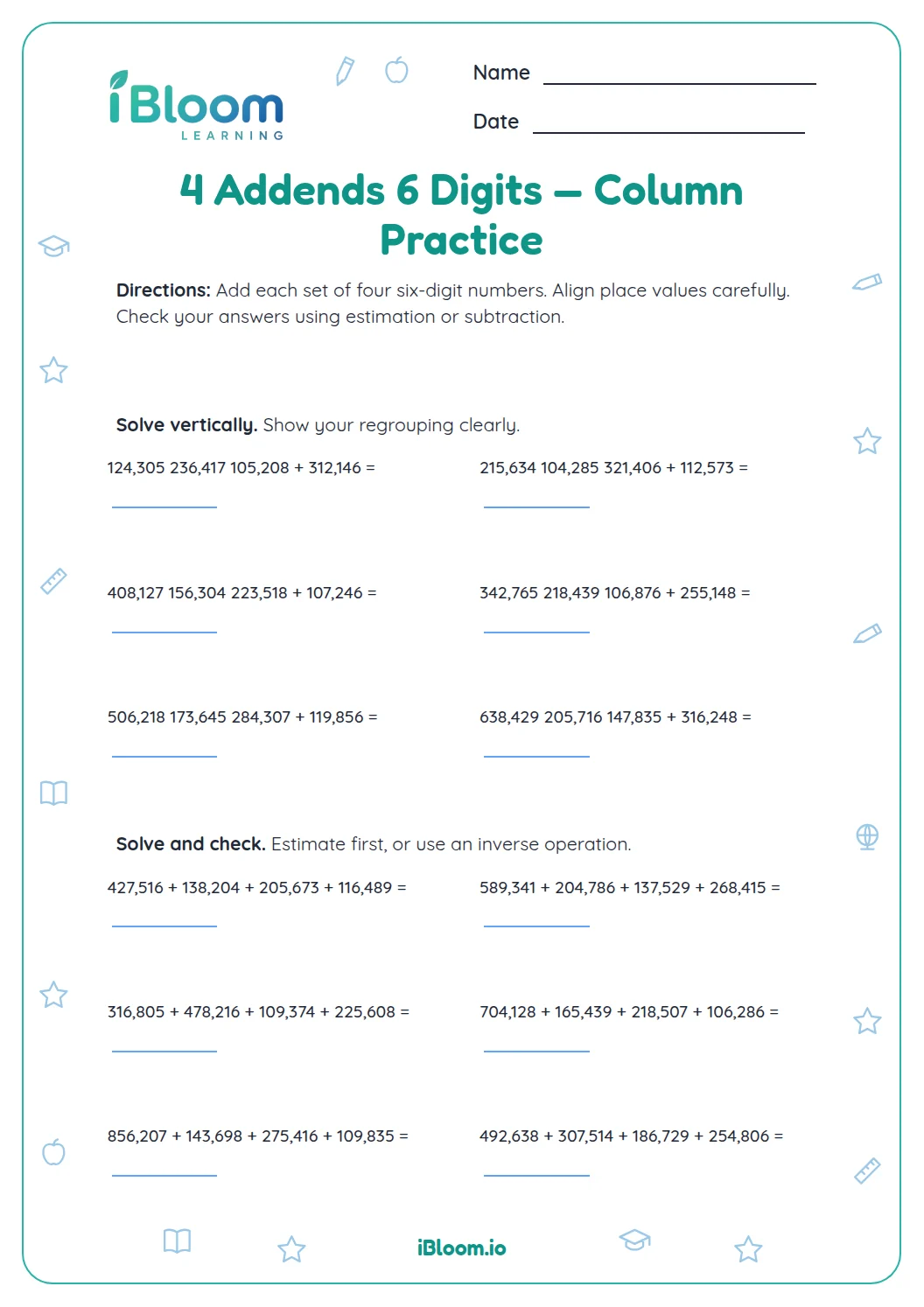
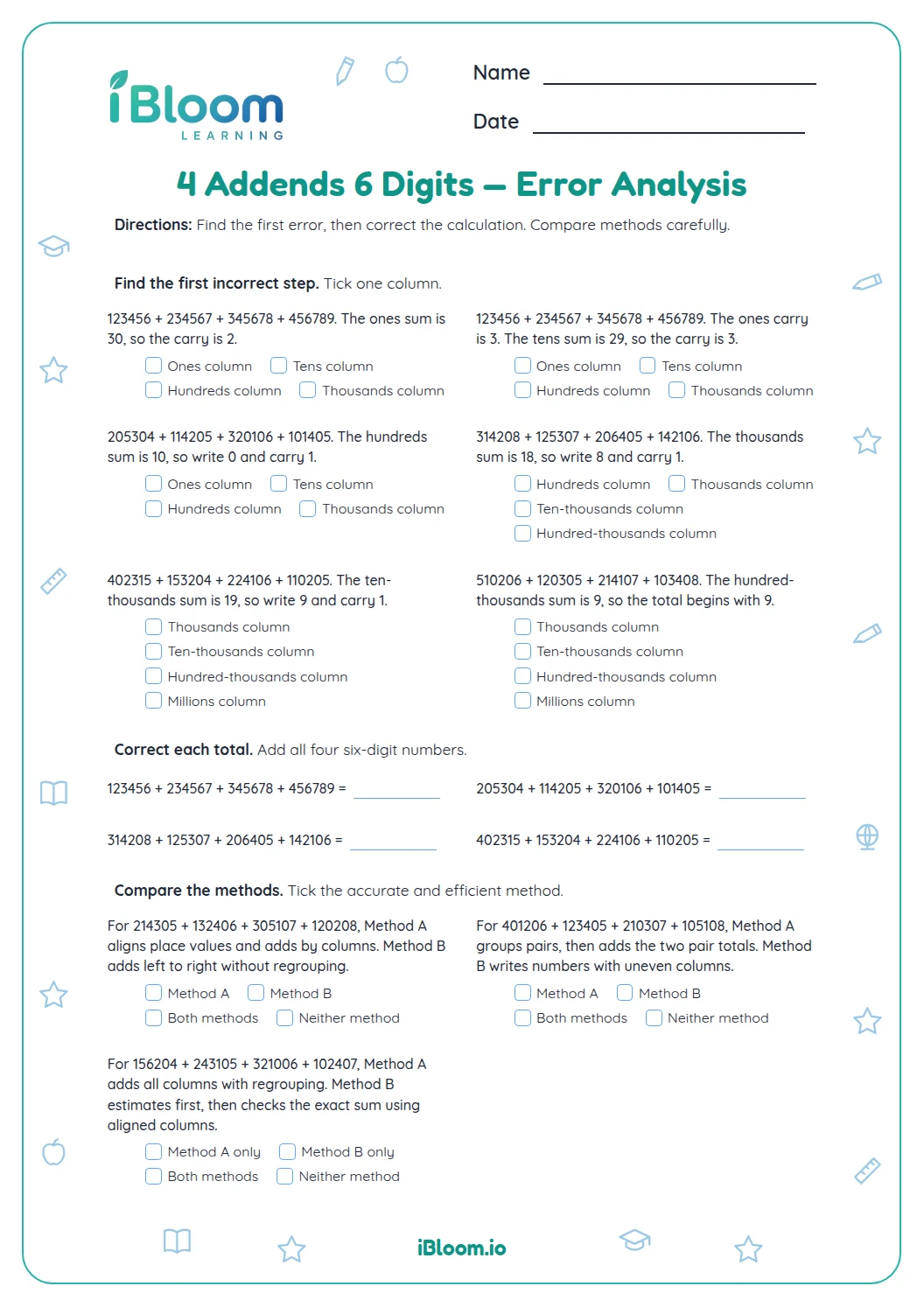
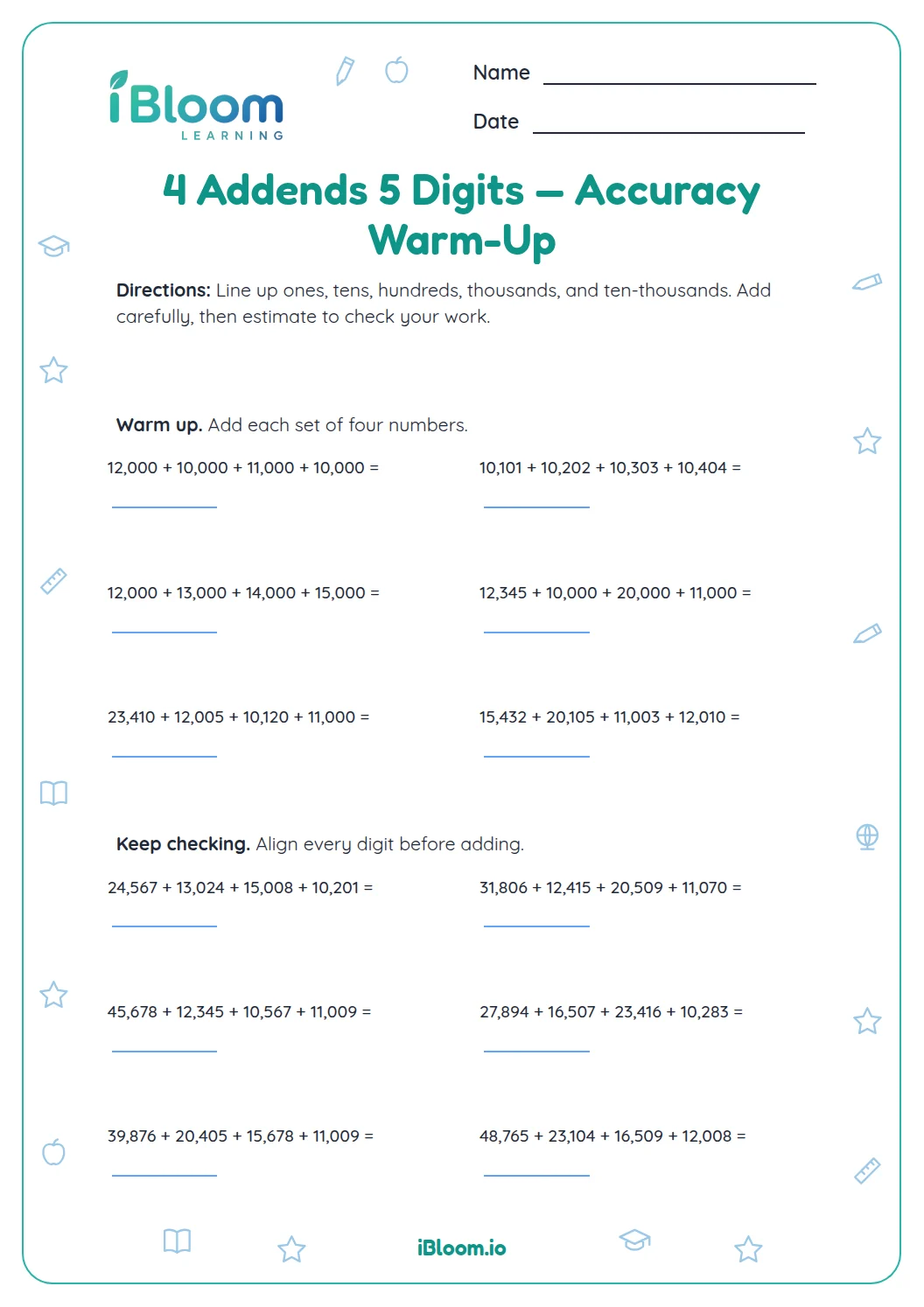
This printable accuracy warm-up gives Grades 5–6 students 16 sums, each made from four six-digit addends. The worksheet groups the work into three short sets, encouraging students to line up place values, combine all four addends, and check the final total. A separate key gives each sum. The practice aligns with the Common Core standard for adding multi-digit whole numbers with the standard algorithm.
Aligned to 4.NBT.B.4
How should a student set up four addends?
Write each six-digit addend so the ones, tens, hundreds and larger places line up. Add from the ones place toward the left, regrouping when a column total reaches ten. The equations leave room to organize the calculation.
Question 1 is 132,405 + 246,371 + 105,809 + 387,216. Keep each column aligned before combining the digits; its total is 871,801.
How can a student check a large sum?
After adding, regroup the addends in a different order and check whether the same total appears. Estimating the size of the sum also catches a misplaced digit: four numbers in the hundreds of thousands should produce a total in the hundreds of thousands or millions.
A check should use the original four addends and preserve their place values. If a result changes when grouped differently, revisit the column where the totals diverged.
Why use several addends in one problem?
Several addends call for repeated place-value addition. Students must carry correctly from one column and keep track of all four numbers, not stop after the first pair. The three worksheet parts provide a short pause between sets.
Use the key after solving to locate any column that needs a second look; do not rely only on whether the final number seems plausible.
How to use this worksheet
- 1Set up the four numbers with each place value in its own column.
- 2Add the ones digits and regroup when needed.
- 3Continue through the larger places, carrying each regrouped ten.
- 4Check that every one of the four addends was included.
- 5Re-add in a different order or estimate, then compare with the key.
Common mistakes and quick fixes
The mistake
Skipping one addend while copying the problem.
The fix
Count four lines of addends before starting and compare them with the prompt.
The mistake
Writing a carried ten in the wrong column.
The fix
Mark each regroup above the next place and include it in that column’s total.
The mistake
Stopping after adding only the first pair.
The fix
Point to each addend as it is included, then check all four against the prompt.
Common Core alignment
These standards describe the writing and language skills practiced on this sheet.
Use the standard algorithm to add multi-digit whole numbers fluently.
On this sheet: Each item asks for a sum of four six-digit whole-number addends; written work supports careful place-value addition.
Show the official wordingHide the official wording
Fluently add and subtract multi-digit whole numbers using the standard algorithm.
What to practice next
Make more practice
Further reading
Questions parents and teachers ask
How many problems are on this warm-up?
There are 16 addition equations, divided into three sets. Every equation has four six-digit addends, so the student practices keeping several place values aligned at once. The key lists the exact total for each problem, and the work space is intended for the student’s written calculation.
Should students add in columns?
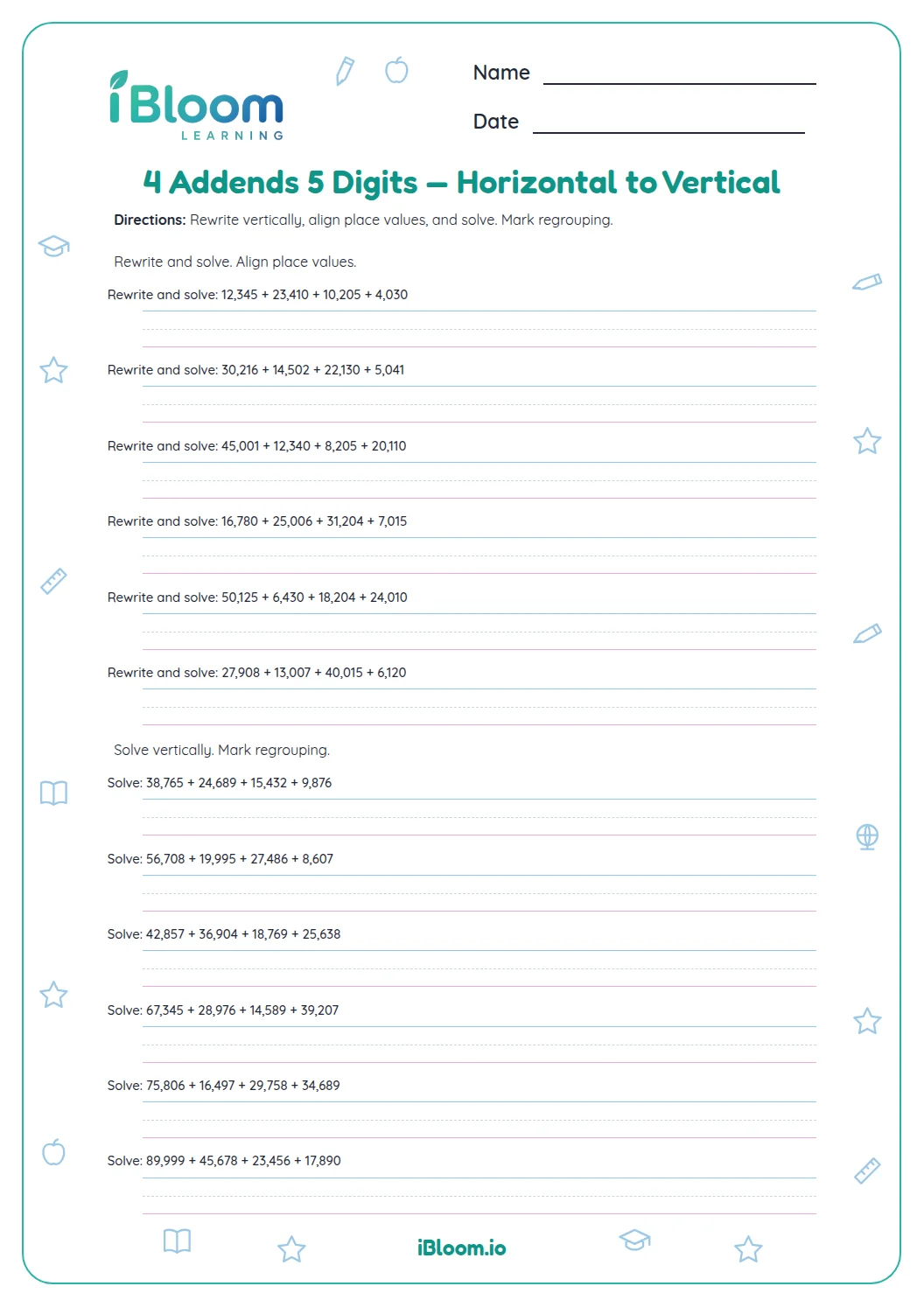
Yes. Align the ones digits, then the tens, hundreds and larger places before adding. The printed prompt is horizontal, but students can set it up vertically in the work area. That makes regrouping visible and helps prevent one addend from shifting into the wrong place.
How can a student check a total?
Re-add the same four values in a different order, then compare the result. A quick estimate also helps: four addends near two hundred thousand should total near eight hundred thousand. Use the answer key to find the exact sum after doing the calculation.
Why are there four addends in each question?
Combining four values gives practice tracking multiple addends through place-value addition. The student must include each number and keep the columns aligned through regrouping. The three worksheet sections break the 16 calculations into manageable sets while keeping the same four-addend skill.
Which grade standard does this practice connect to?
The sheet connects to 4.NBT.B.4, which calls for fluently adding and subtracting multi-digit whole numbers with the standard algorithm. This page applies multi-digit addition to four six-digit addends in each calculation. The answer key can help identify which totals need another column-by-column check.