



About this worksheet
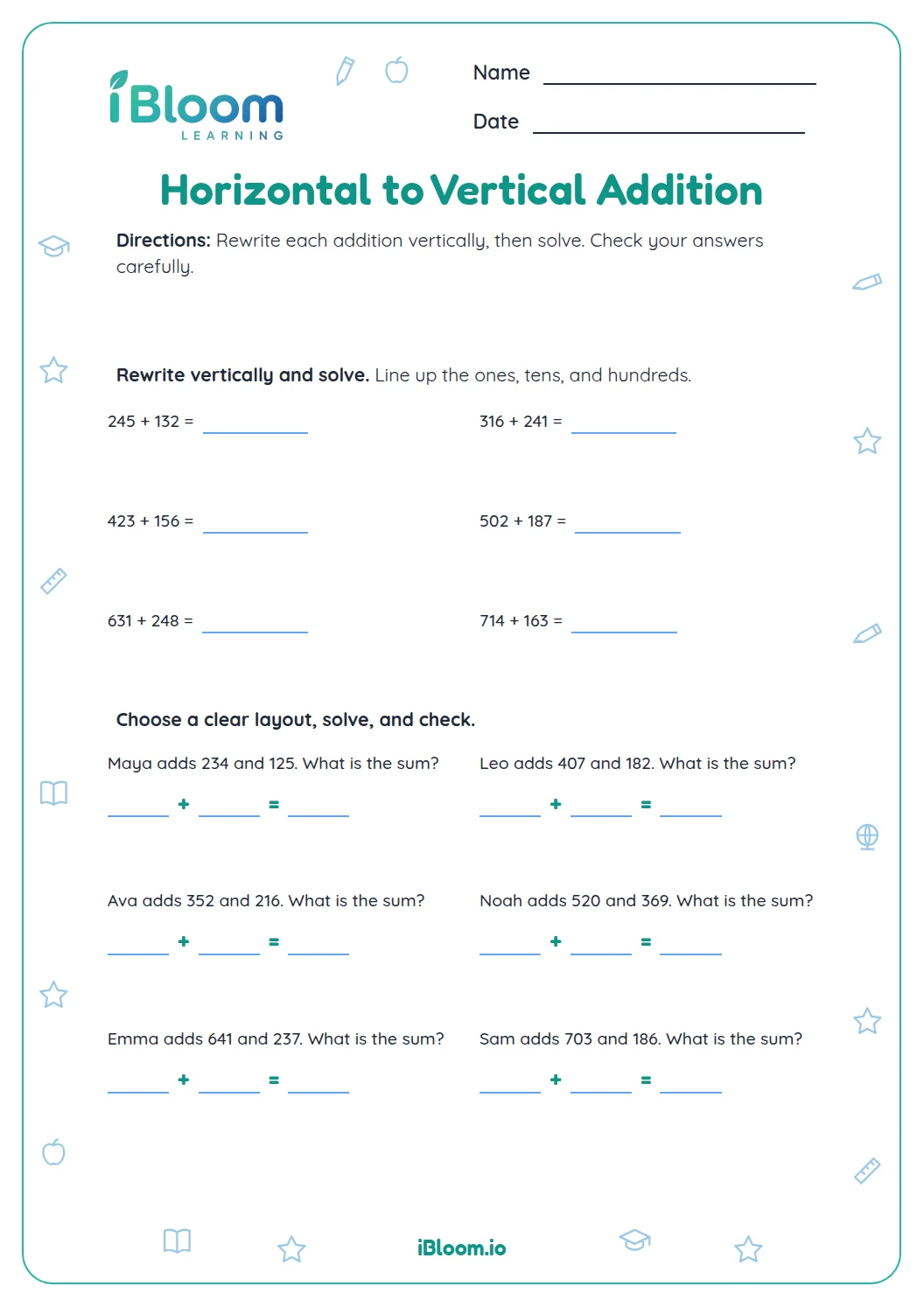
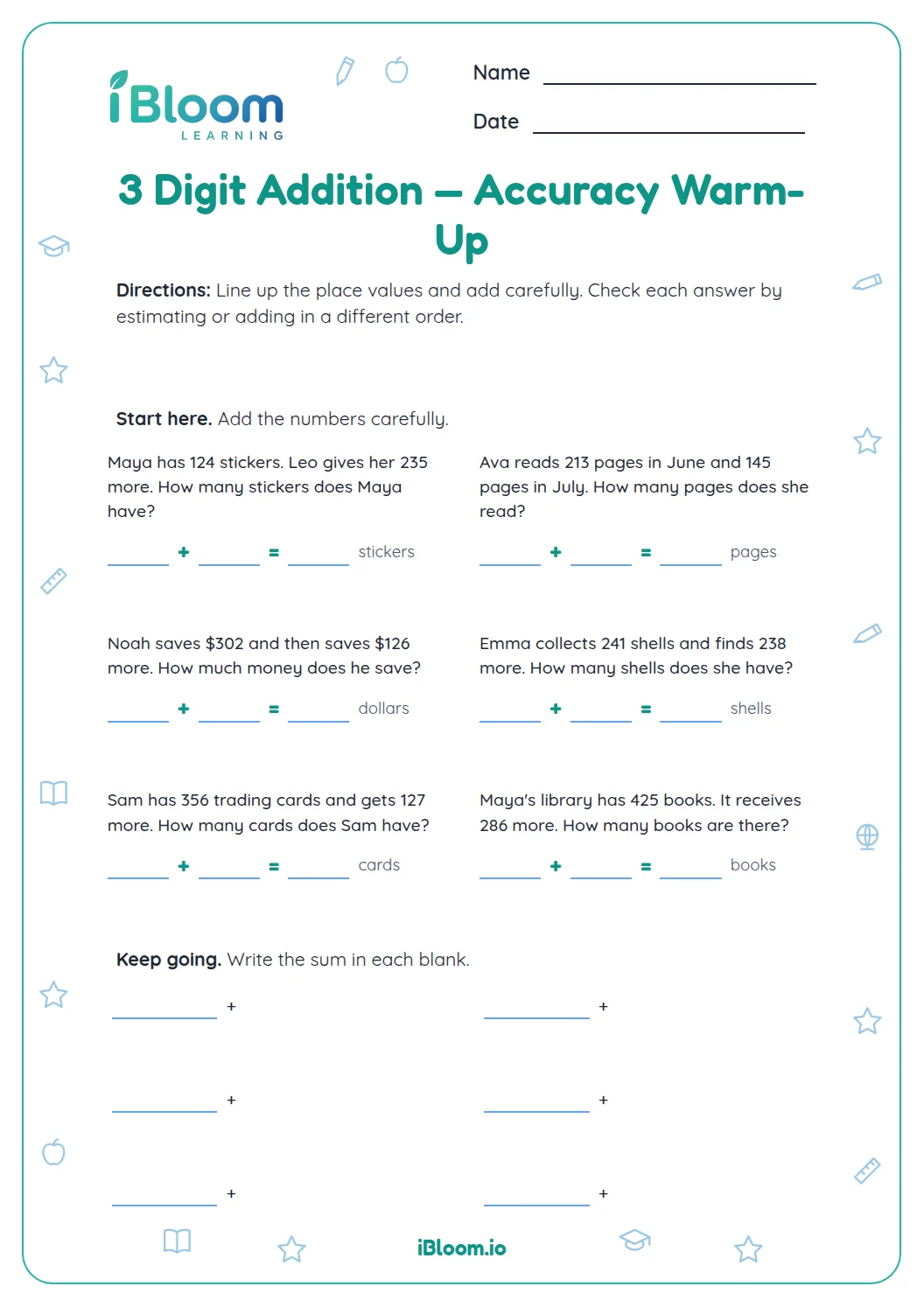
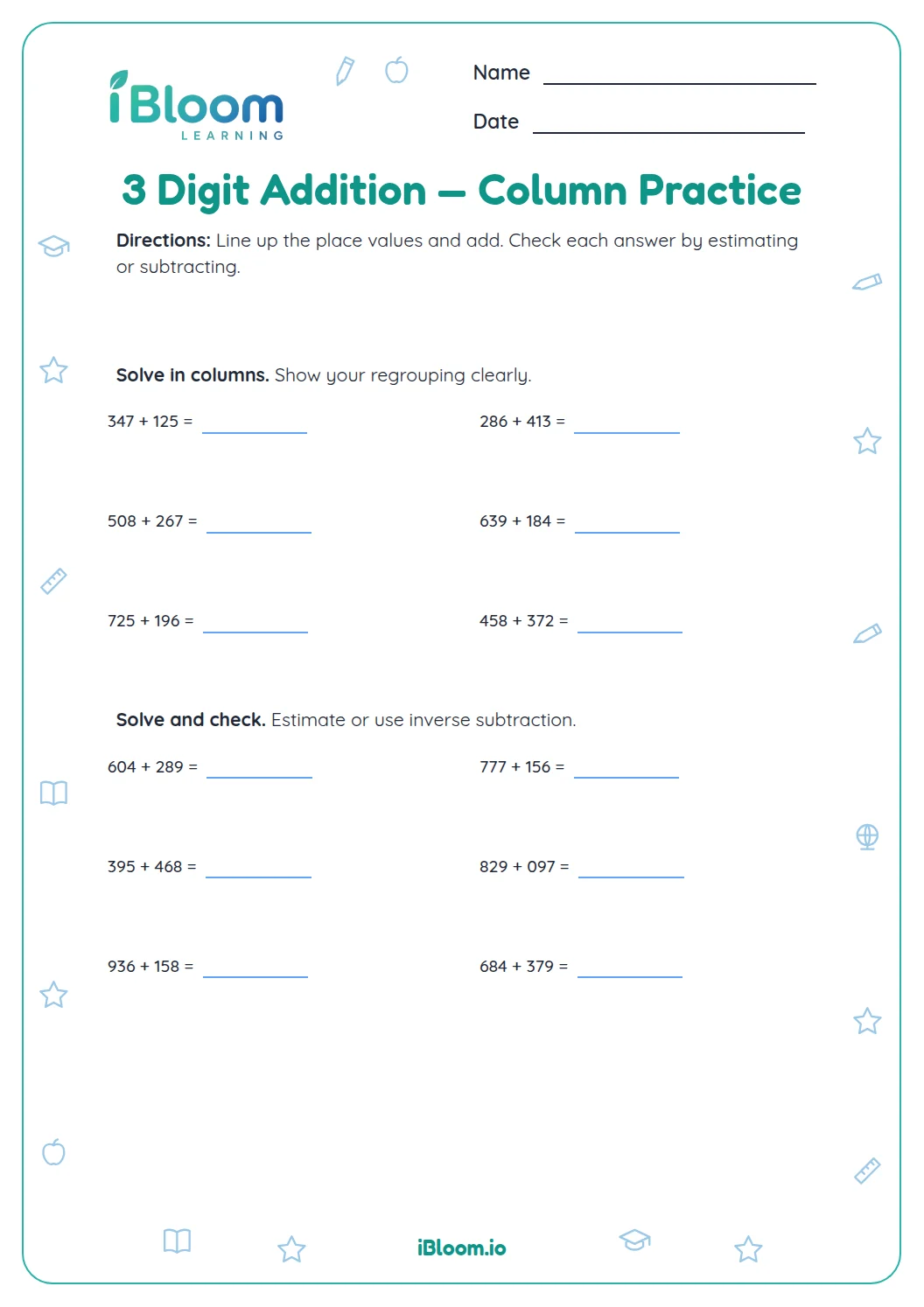
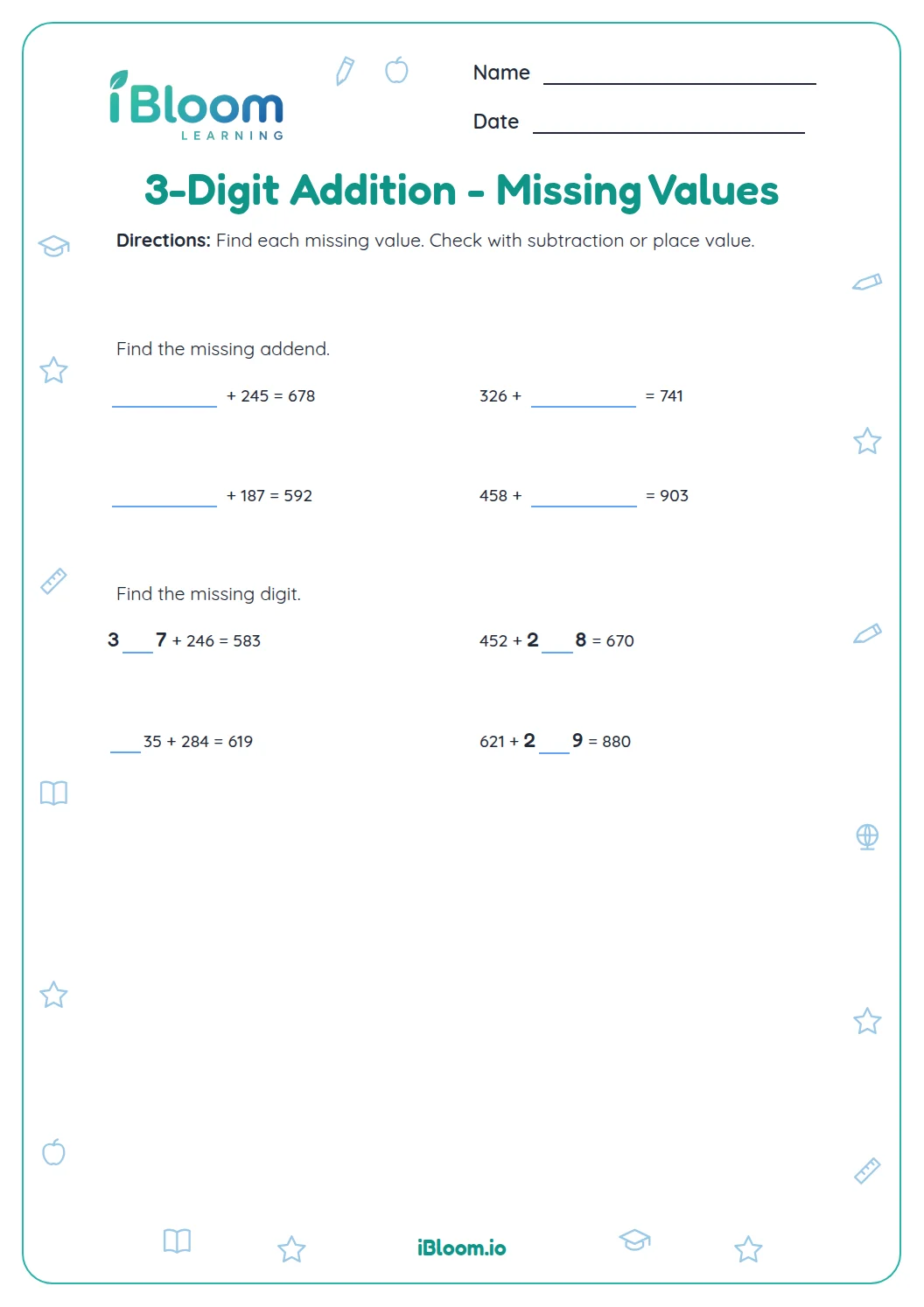
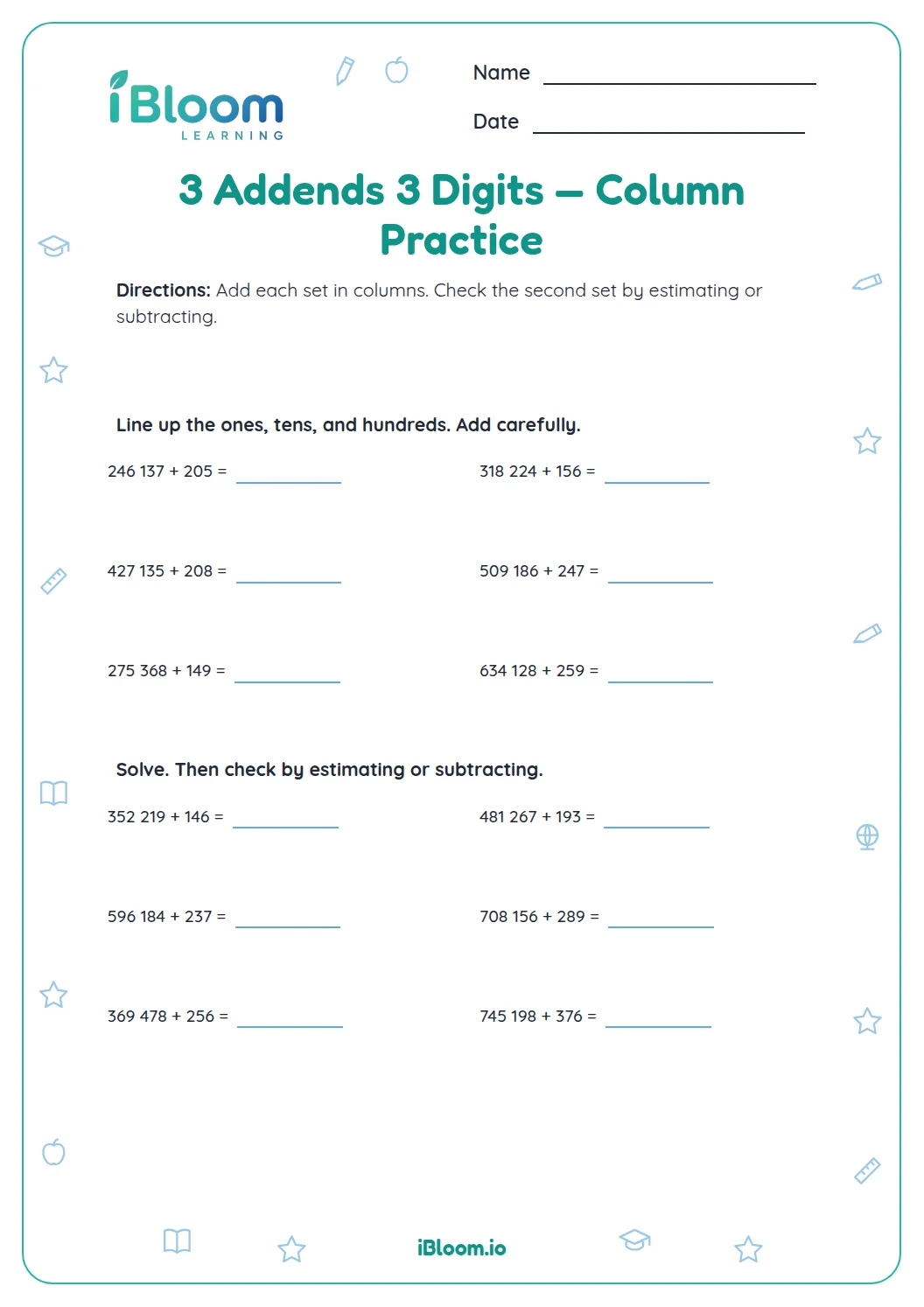
This free printable addition drill gives Grade 3 and Grade 4 students 20 horizontal problems with three-digit numbers. Part A has eight sums with and without regrouping. Part B asks for two estimates to the nearest hundred and two subtraction checks. Part C hides an addend in four equations, and Part D asks students to correct four wrong totals. Every addition total is within 1,000. The sheet practices CCSS 3.NBT.A.2 through place-value addition, estimation and the relationship between addition and subtraction. Students can work mentally or rewrite a problem in columns on scratch paper. A separate answer key makes it easy to check each section.
Aligned to 3.NBT.A.2
How do you regroup when the problem is horizontal?
Read both addends before choosing a method. For 268 + 157, the ones make 15: write 5 ones and carry 1 ten. The tens then make 12 tens, so carry 1 hundred. The final hundreds total is 4.
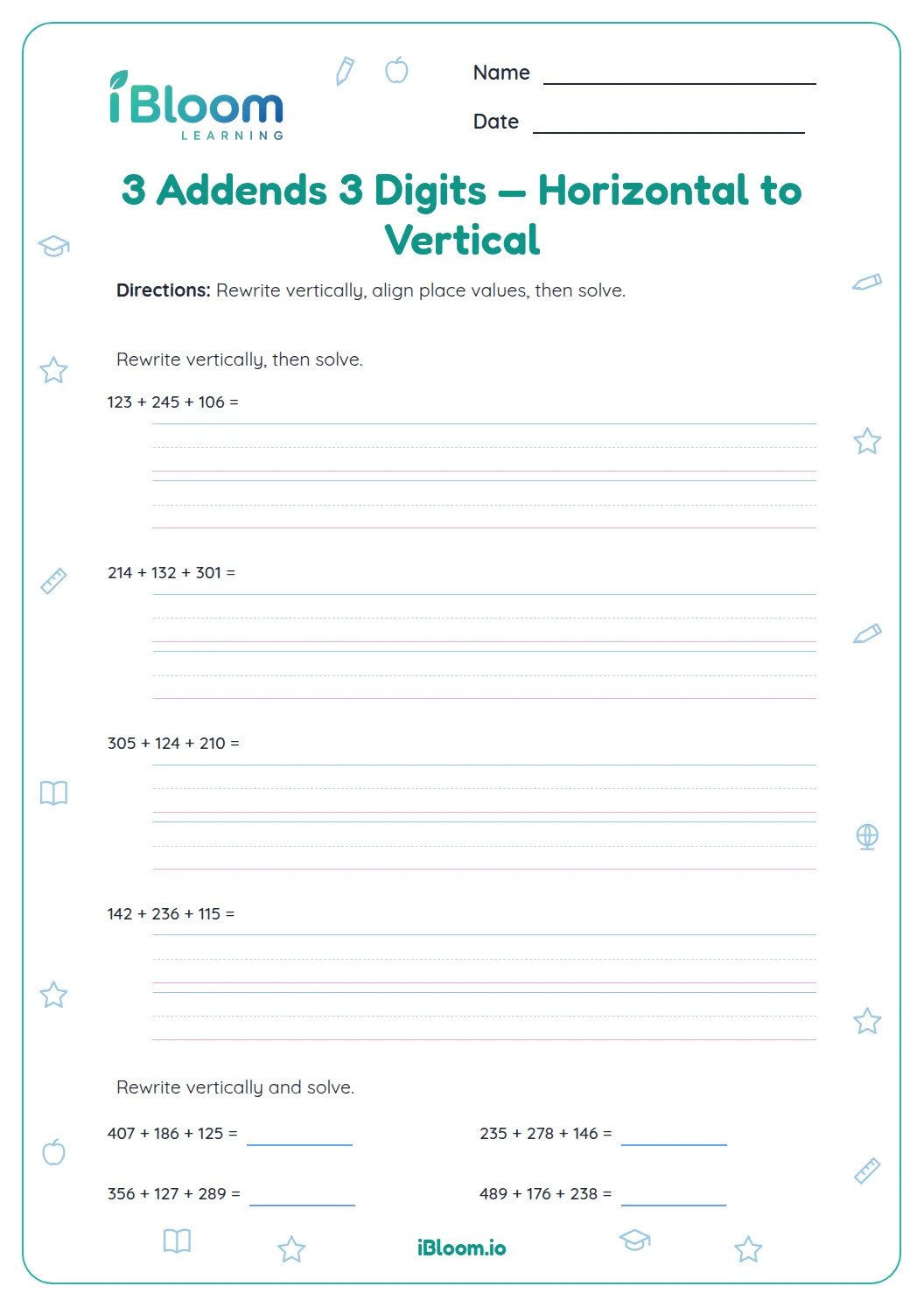
A horizontal layout is a way to present the problem. Students can still use columns, expanded form or a mental strategy that keeps track of each place.
- 1268 + 157
- 28 + 7 = 15 ones → 5 ones and 1 ten
- 36 + 5 + 1 = 12 tens → 2 tens and 1 hundred
- 42 + 1 + 1 = 4 hundreds
- 5268 + 157 = 425
How can estimation and subtraction check a sum?
Part B keeps the addition horizontal while using two ways to check its size and accuracy. Estimate 340 + 250 to the nearest hundred: 590 rounds to 600. For 475 + 125 = 600, subtract 125 from 600; the result should be 475.
A close estimate can catch a total that is far too large or small. Subtraction checks whether the exact addition equation is balanced.
- 1340 + 250 = 590, which rounds to 600
- 2600 − 125 = 475, so 475 + 125 = 600 checks
How do you find a missing addend?
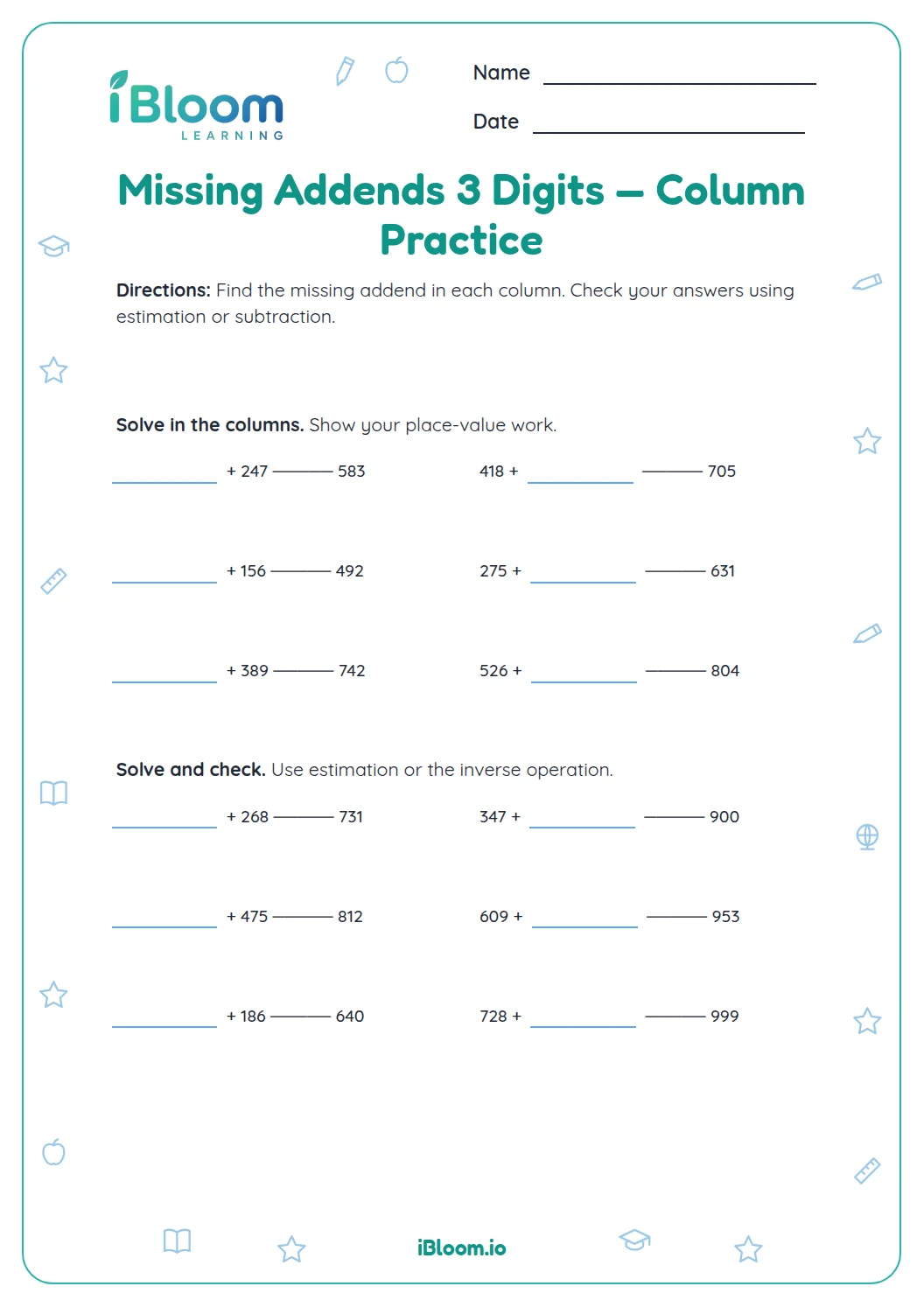
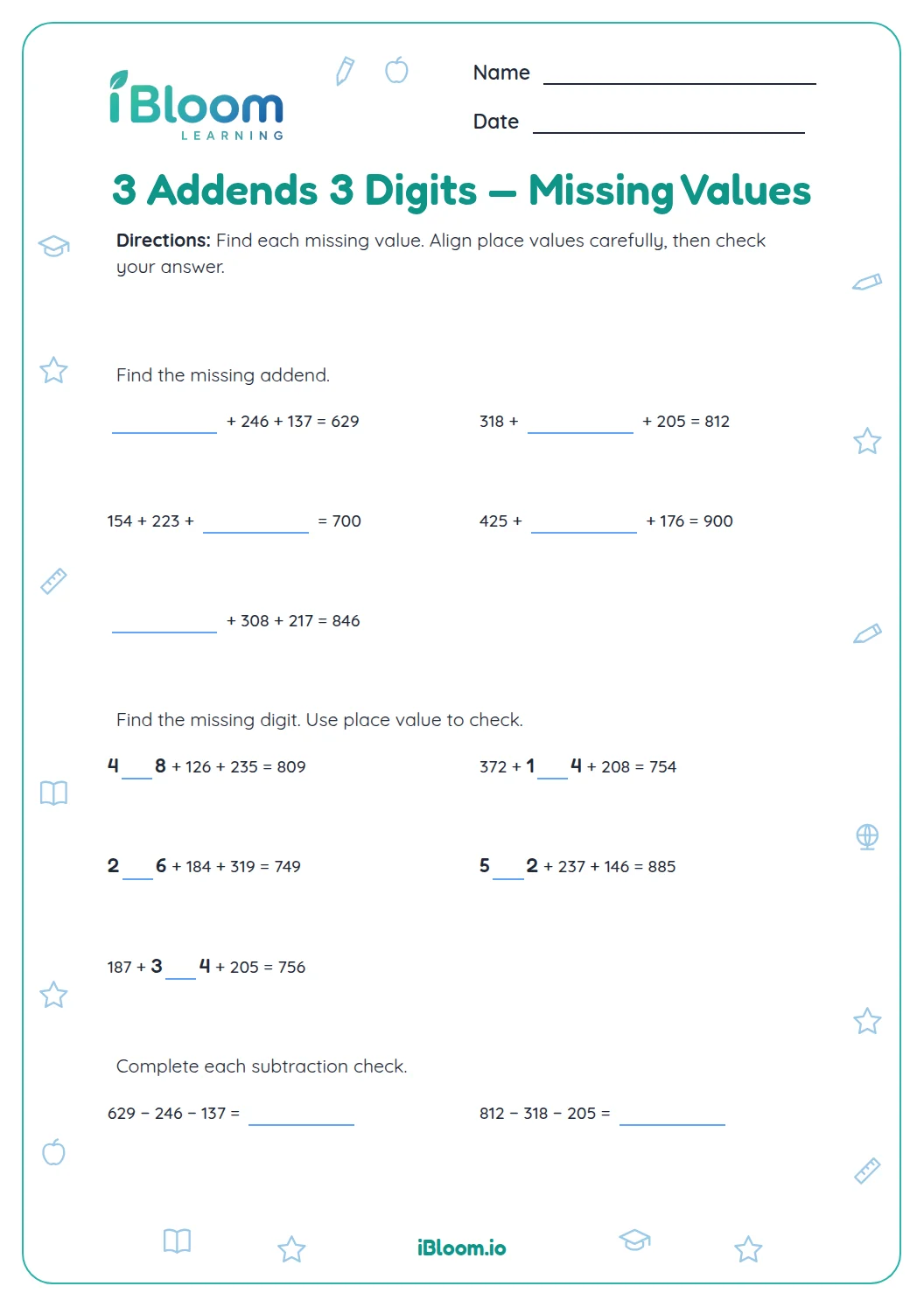
Part C keeps the total visible and hides one addend. In 246 + ___ = 681, subtract 246 from 681 to get 435. Then add 246 and 435 to check that they make 681.
The blank moves from the second position to the first, so students need to read the whole equation instead of adding every visible number.
What makes this a mixed mastery drill?
Part A includes zero digits and several kinds of regrouping. Part B revisits estimating and checking by subtraction. Part C connects addition to subtraction, and Part D presents plausible errors, such as 346 + 278 = 614, which misses the ten carried from the ones.
All four error-check prompts say the displayed total is wrong. Students select the correct total from three choices and can explain the place-value slip aloud.
A careful drill routine
- 1Solve the first two sums without a timer.
- 2Use columns on scratch paper whenever you need to track a carried digit.
- 3Round each Part B estimate to the nearest hundred, then use subtraction to check the two exact sums.
- 4Check each missing addend by adding it to the known addend.
- 5For each wrong total, solve independently before reading the choices, then review missed place-value steps with the key.
Mistakes to notice and how to help
The mistake
Writing 415 for 268 + 157.
The fix
Include the ten from 8 + 7 when adding the tens: 6 + 5 + 1 = 12.
The mistake
Adding 246 and 681 to fill 246 + ___ = 681.
The fix
The known total is 681. Subtract the known addend, then check by adding.
The mistake
Dropping the zero in 407 when rewriting a problem.
The fix
Place 4 in hundreds, 0 in tens and 7 in ones before adding.
Curriculum alignment
Add three-digit numbers and use subtraction to find missing addends within 1,000.
On this sheet: Students add by place value, recover missing addends and correct regrouping errors.
Show the official wordingHide the official wording
Fluently add and subtract within 1000 using strategies and algorithms based on place value, properties of operations, and/or the relationship between addition and subtraction.
What to practice next
Make more practice
Further reading
Questions parents and teachers ask
Are all the answers within 1,000?
Yes, every completed addition equation has a total within 1,000. The sheet uses three-digit addends, including numbers with a zero in the tens or ones place. Part B also asks for rounded estimates and subtraction checks, so students can judge whether a sum is reasonable and verify exact totals.
Does my child have to do these problems mentally?
No, students can use mental strategies or write the addends in columns on scratch paper. The printed questions stay horizontal so students practice reading that format. For regrouping, ask your child to explain where the carried ten or hundred goes before writing the final total.
How should we check the missing addends?
Add the answer back to the known addend and compare it with the printed total. For question 13, 246 + 435 must equal 681. This second step helps reveal subtraction slips and confirms that the blank was treated as an addend, not as the total.
Why are some totals deliberately wrong?
Part D asks students to identify a correct sum after seeing a wrong one. For example, 346 + 278 is shown with 614, a total that misses a carried ten. Recomputing gives 624. Use the wrong answer to discuss which place changed and why.
Should this worksheet be timed?
Timing is optional; begin by checking accuracy. The twenty questions include estimates, subtraction checks, missing addends and error checks, so they call for more than repeating one calculation routine. Allow about fifteen minutes, then review any missed items and have the student explain one useful strategy.