





About this worksheet
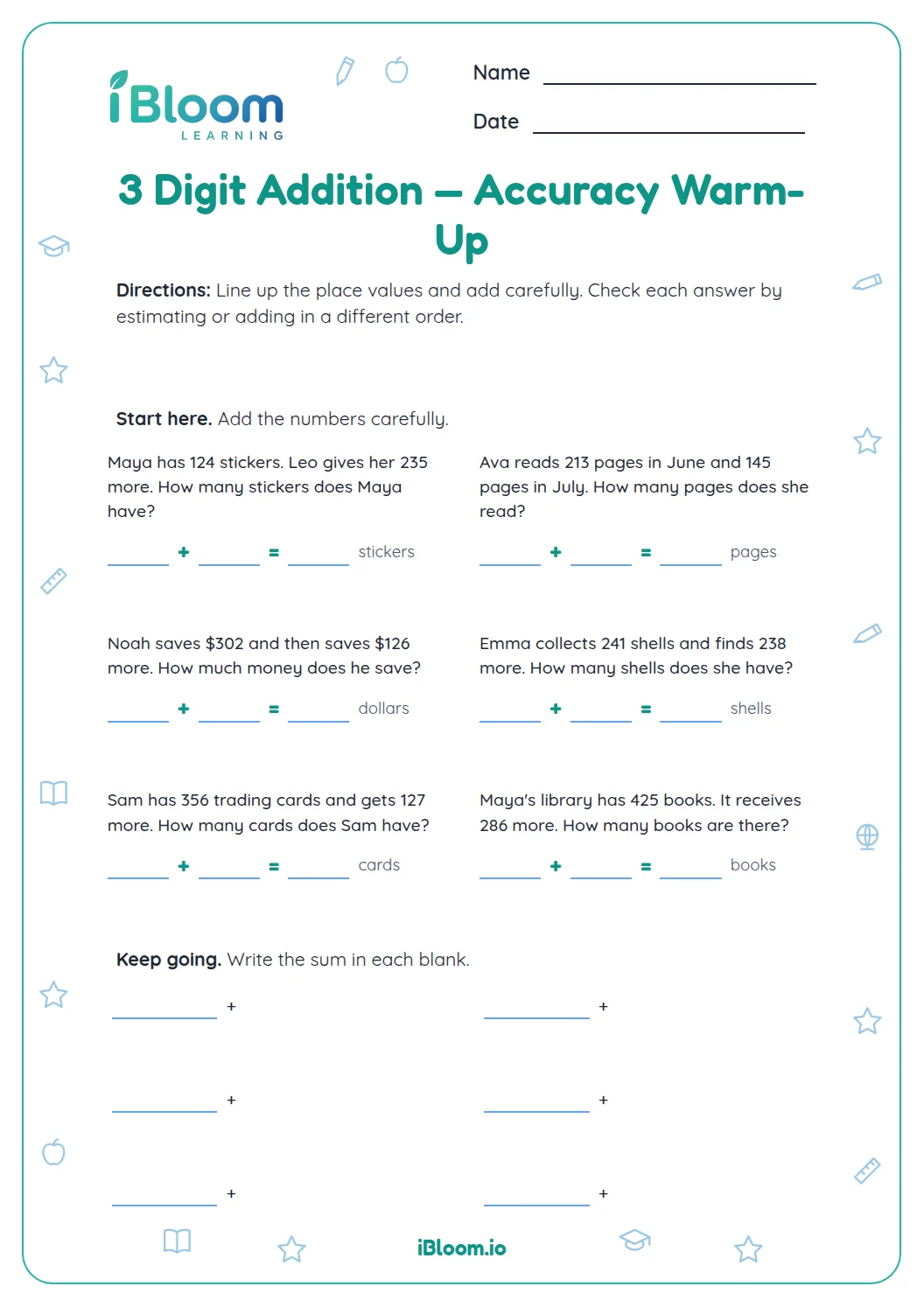
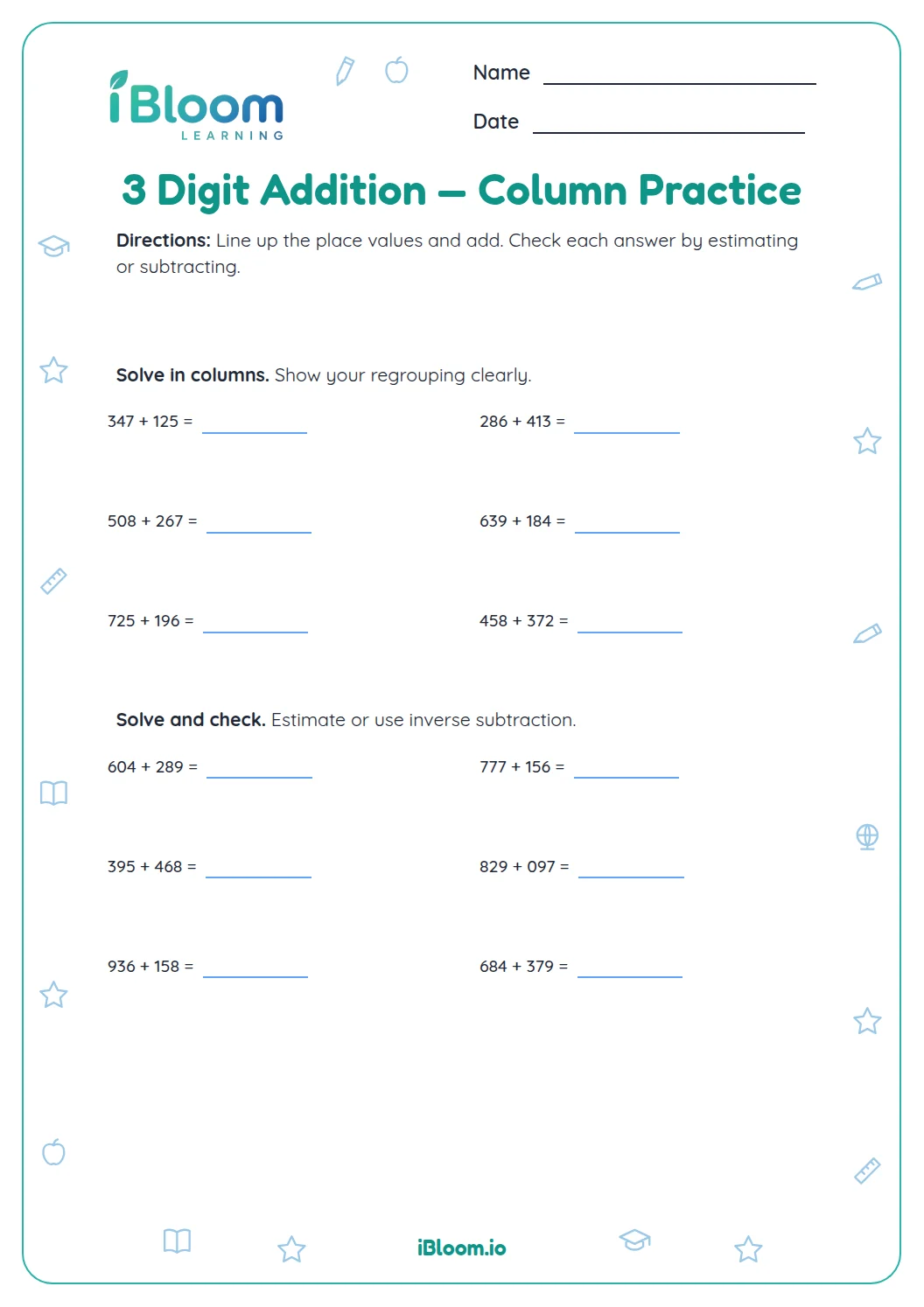
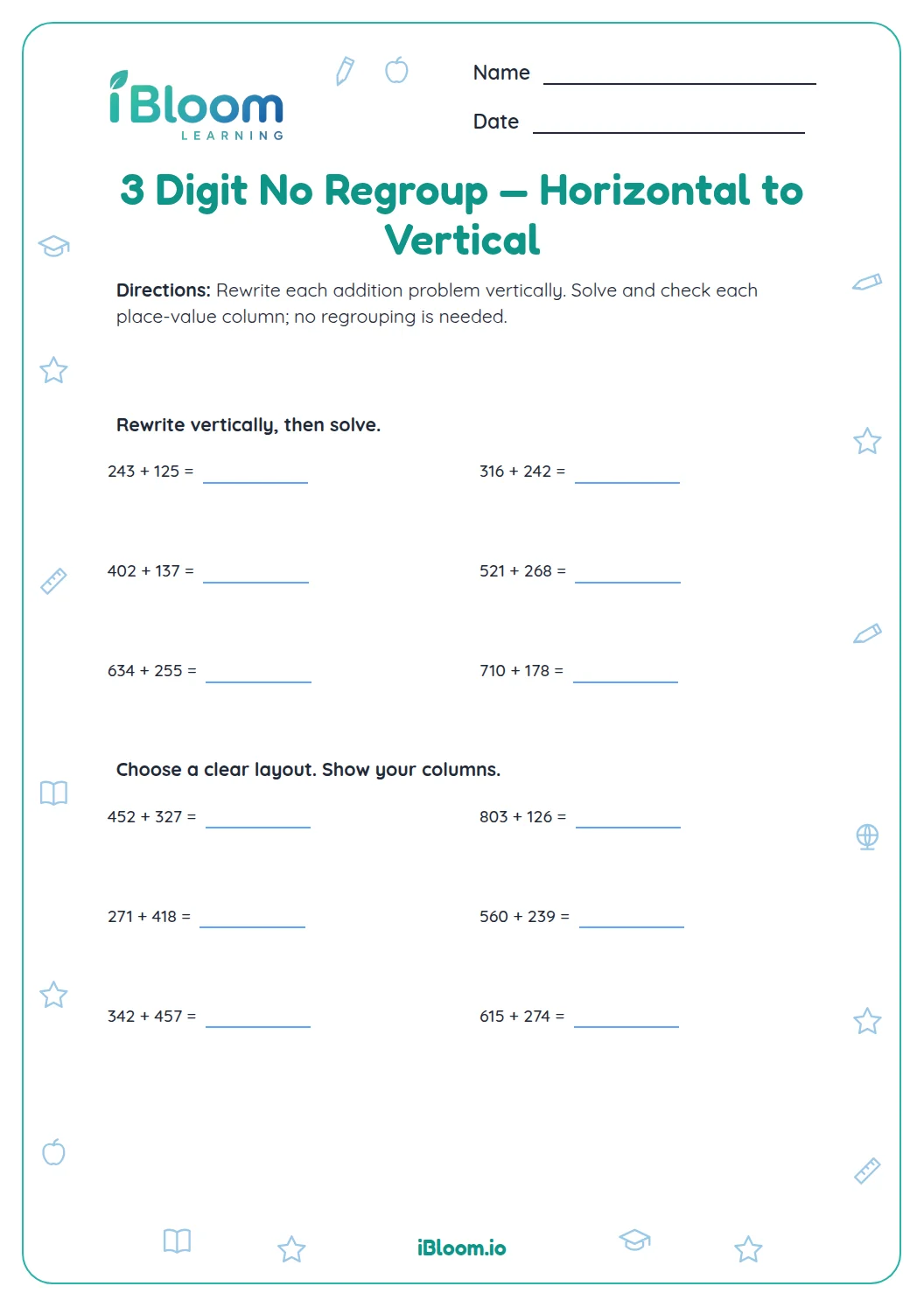
This printable gives Grade 3 learners sixteen horizontal three-digit sums to rewrite and solve in columns. The set includes regrouping in different place values, including some sums that carry across more than one column. Learners align ones, tens, and hundreds, then add from right to left. The practice aligns with CCSS 3.NBT.A.2 and includes a separate answer key.
Aligned to 3.NBT.A.2
Why rewrite a horizontal sum in columns?
Vertical columns keep matching place values together. In 247 + 136, line up the ones, tens, and hundreds before adding. Start with the ones so any regrouped ten can move into the tens column.
- 1 247
- 2+ 136
- 3-----
- 4Ones: 7 + 6 = 13; write 3, regroup 1 ten.
- 5Tens: 4 + 3 + 1 = 8. Hundreds: 2 + 1 = 3.
- 6Answer: 383
When does a learner regroup?
Whenever a column total is 10 or more, keep the ones digit in that column and carry the extra ten to the next place. Some problems require regrouping more than once, so keep the carried digit visible until it is added.
How can the total be checked?
Estimate by rounding each addend to a nearby hundred, then compare the estimate with the exact sum. For example, 247 + 136 is about 400, so 383 is a reasonable total. Re-add the columns if the result is far from the estimate.
How to complete column practice
- 1Copy the first addend with ones, tens, and hundreds in separate columns.
- 2Write the second addend directly below it.
- 3Add the ones and regroup when the total is 10 or more.
- 4Add the tens, including any regrouped ten, then add the hundreds.
- 5Estimate or add again to check the answer.
Place-value slips to avoid
The mistake
Writing the second number one space too far left.
The fix
Align digits by place value, not by the first digit in each number.
The mistake
Forgetting to add a carried ten into the tens column.
The fix
Write the regrouped 1 above the tens digit and include it.
The mistake
Writing 13 in the ones column after 7 + 6.
The fix
Write 3 ones and regroup 1 ten.
Common Core alignment
This sheet gives focused practice with the standard below.
Add three-digit numbers using place value and strategies based on properties of operations.
On this sheet: Every item adds two three-digit numbers; several require regrouping across place values.
Show the official wordingHide the official wording
Fluently add and subtract within 1000 using strategies and algorithms based on place value, properties of operations, and/or the relationship between addition and subtraction.
What to practice next
Make more practice
Further reading
Questions parents and teachers ask
Why are the problems written horizontally?
The horizontal form gives children practice translating a standard addition expression into vertical columns. The directions ask learners to align place values before calculating, which makes the connection between both formats explicit. Column setup is the main practice: the prompt begins horizontally, and learners translate it into a vertical sum.
Do all problems require regrouping?
The worksheet includes a mix of sums. Some columns add to less than ten, while others require regrouping in ones, tens, or more than one place. This helps learners practice deciding when to carry. There is a mix of column totals, including ones that stay below ten and ones that require carrying.
Which place value should a child add first?
Start with the ones column, then move to tens and hundreds. This order lets a regrouped ten or hundred move to the next column where it belongs. Adding ones first shows whether an extra ten needs to move into the tens column. Then the learner adds the carried digit with the tens before moving to hundreds.
How can a child check a three-digit sum?
Estimate by rounding the addends to nearby hundreds, then compare the estimate with the exact result. A second addition check can also catch a missed regrouping digit or a place-value alignment error. Rounding gives a fast reasonableness check, while a second exact addition can confirm the carries.
What standard does the sheet practice?
The sixteen questions practice adding within 1,000 with strategies and algorithms based on place value, aligned with CCSS 3.NBT.A.2. Each problem uses two three-digit addends and gives working room for column setup. Three-digit addends and regrouping practice align with the Grade 3 place-value addition standard. The prompts are horizontal, but the requested work is vertical column addition.
Does the page include a separate key?
Yes. The key lists the total for every sum. Learners should still show their column work on the worksheet so they can review where regrouping happened if an answer does not match. The key gives the totals; the learner’s written setup shows whether the digits were aligned and regrouped correctly.