


About this worksheet
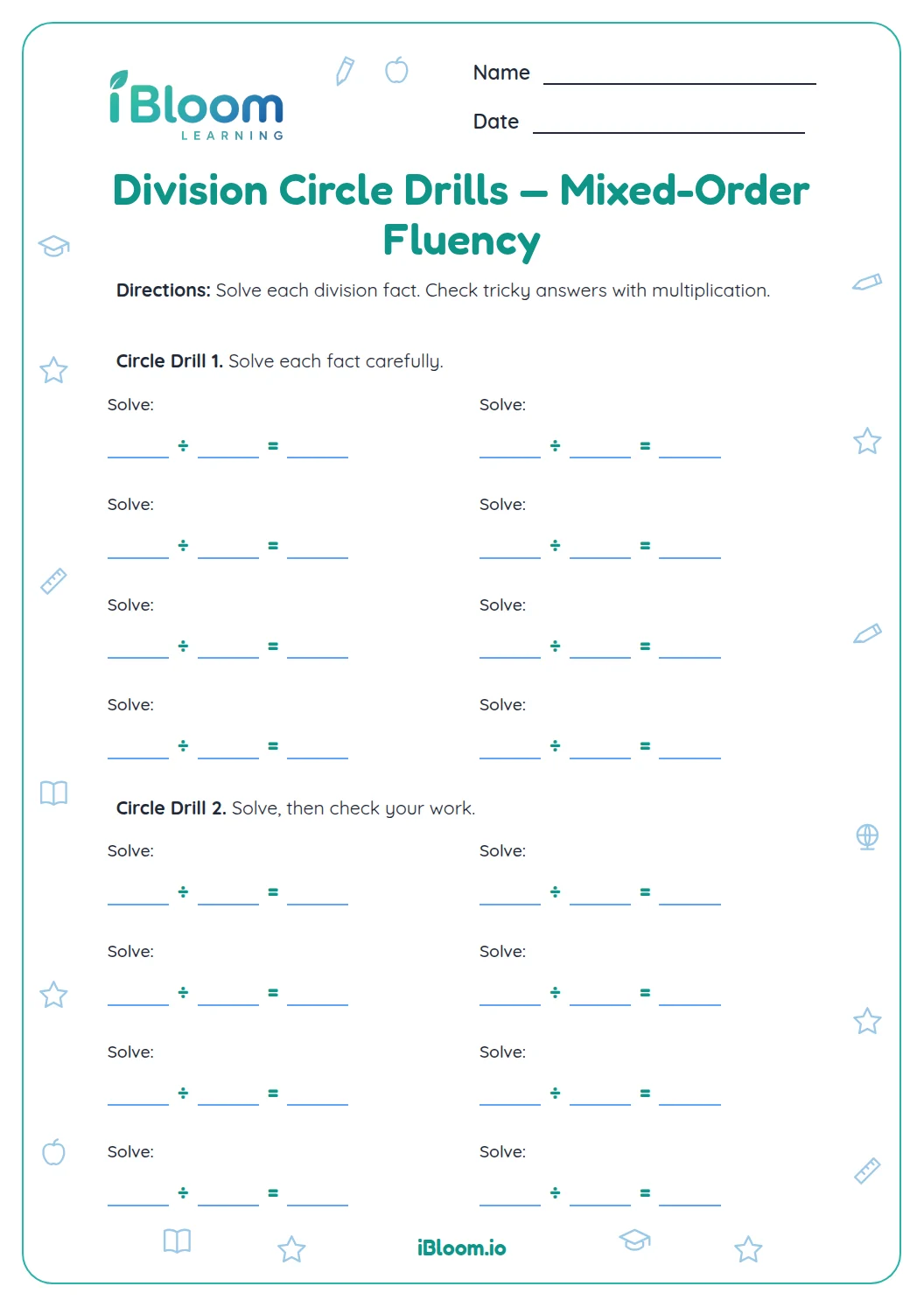
This Grade 3 printable uses two division circles and 12 short equations to practice 32 missing-dividend facts. In each circle, the center is the quotient and each outer number is a divisor. Multiply to find each dividend, then divide to check. The separate answer key lists every product.
Aligned to 3.OA.C.7
How does a circle model a division fact?
Each circle gives one quotient in its center and four divisors around the edge. Multiply the center by an outer divisor to find the missing dividend for that spoke.
How can multiplication check the dividend?
Divide each product by the same outer number used to make it. The result should match the center quotient.
How does multiplication check a division fact?
The center is the quotient and an outer number is the divisor. Multiply them to recover the missing dividend.
- 1Center quotient: 3; outer divisor: 4
- 23 × 4 = 12
- 3Check: 12 ÷ 4 = 3
How to use this worksheet
- 1Read the quotient in a circle center or equation.
- 2Pair the quotient with its divisor.
- 3Multiply to find the missing dividend.
- 4Divide by the same divisor to check.
- 5Compare each answer with the key.
Common mistakes and quick fixes
The mistake
Using an outer divisor as the quotient.
The fix
Keep the center number as the quotient for every spoke in that circle.
The mistake
Multiplying the center by a different spoke than the one being answered.
The fix
Pair each outer divisor with the center, then write the product beside that divisor.
The mistake
Checking a product with a different divisor.
The fix
Divide the product by the same outer number; the result should be the center.
Curriculum alignment
This worksheet practices the following Common Core skill.
Use multiplication and division facts within 100 and their inverse relationship.
On this sheet: Students multiply a divisor by the quotient to find each dividend, then verify with division.
Show the official wordingHide the official wording
Fluently multiply and divide within 100, using strategies such as the relationship between multiplication and division (e.g., knowing that 8 × 5 = 40, one knows 40 ÷ 5 = 8) or properties of operations.
What to practice next
Make more practice
Questions parents and teachers ask
How many facts are in the circles?
There are four circle drills with four outer numbers each, for 16 division facts. Each outer number is paired with the quotient shown in the center. Multiply that pair to find the missing dividend, then check it by dividing. This inverse relationship works for each spoke in a circle.
How do I find a missing dividend?
Multiply the divisor by the quotient. For a quotient of 3 and divisor of 4, the missing dividend is 12 because 12 ÷ 4 = 3. For example, with a center of 3 and an outer number of 4, the missing dividend is 12 because 12 divided by 4 equals 3.
How can I check each answer?
Divide the product by the outer number. The result should match the center number in that circle. The center stays the same through one circle, while the divisor changes at each point. Keep each product paired with its outer number when writing answers.
What does the circle center mean?
The center is the quotient for every fact in that circle. Each number around it is a divisor, and the student finds the dividend. A correct product divides evenly by its outer number and returns the center quotient. This inverse check works for every fact in the drill.
Does the answer key list the facts in order?
Yes. It lists the four missing dividends for each circle in the same order as the outer numbers appear. The answer key lists the products for each circle. Check them in the same order as the outer numbers, then revisit any fact that does not divide back to the center.