




About this worksheet
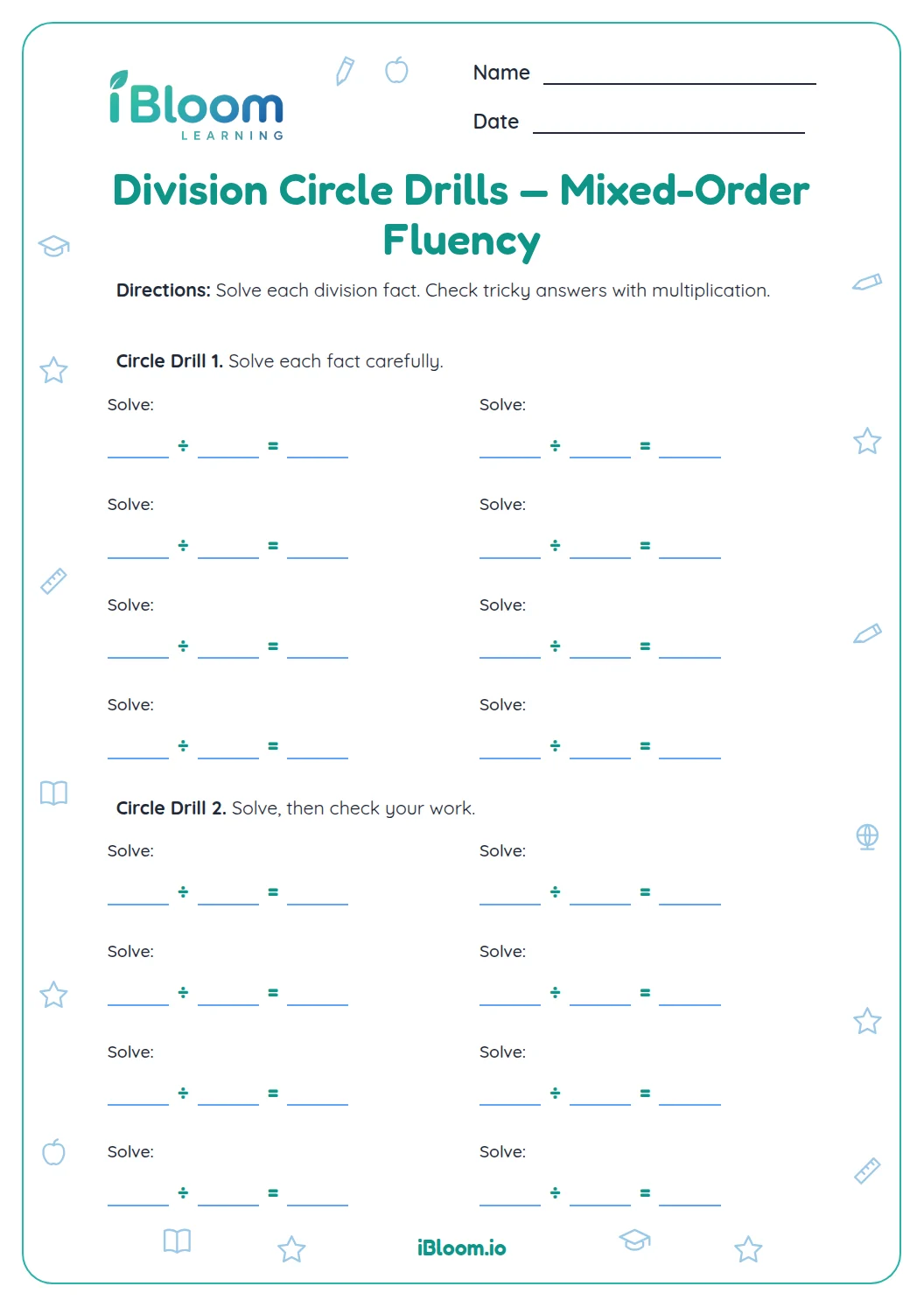
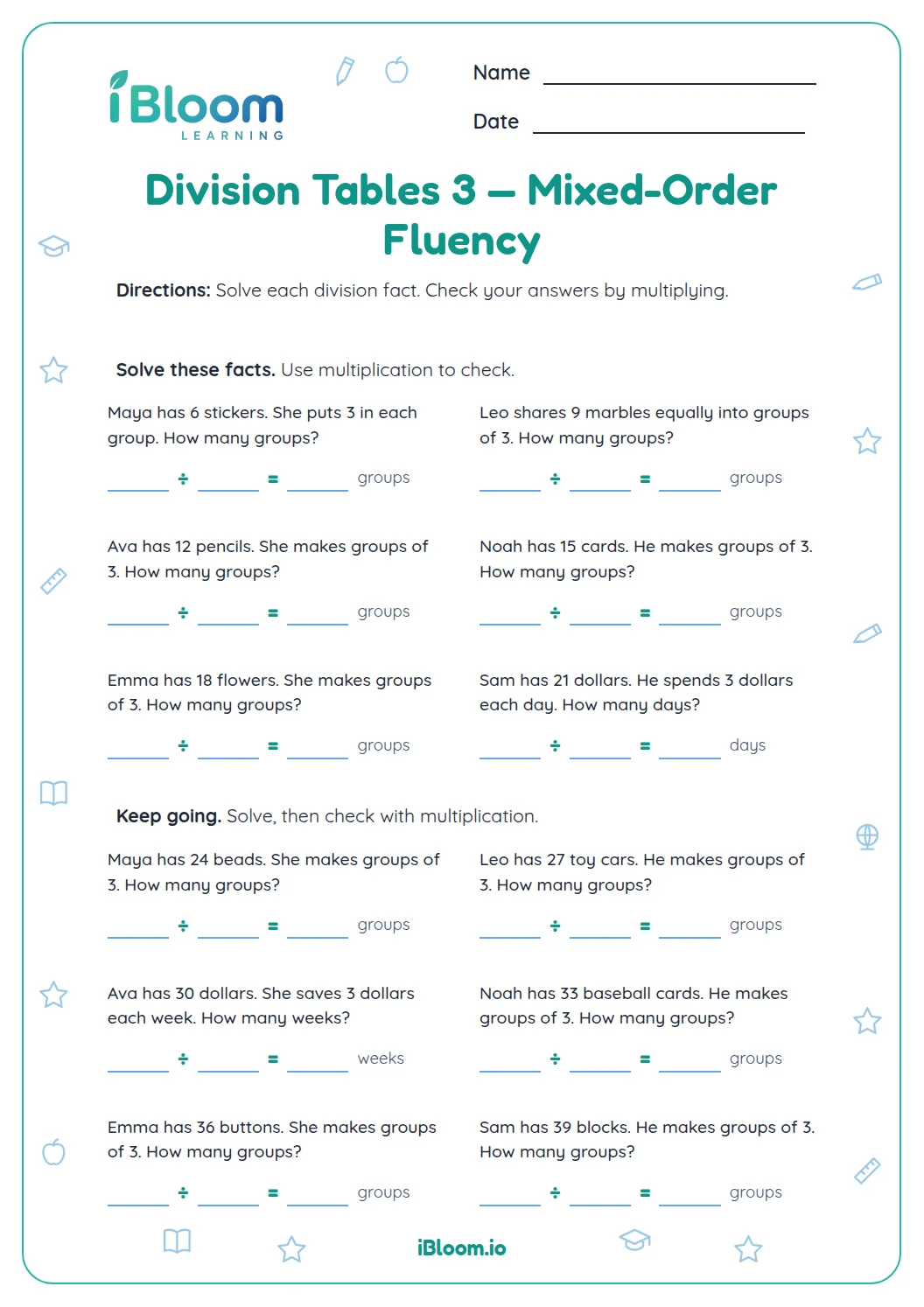
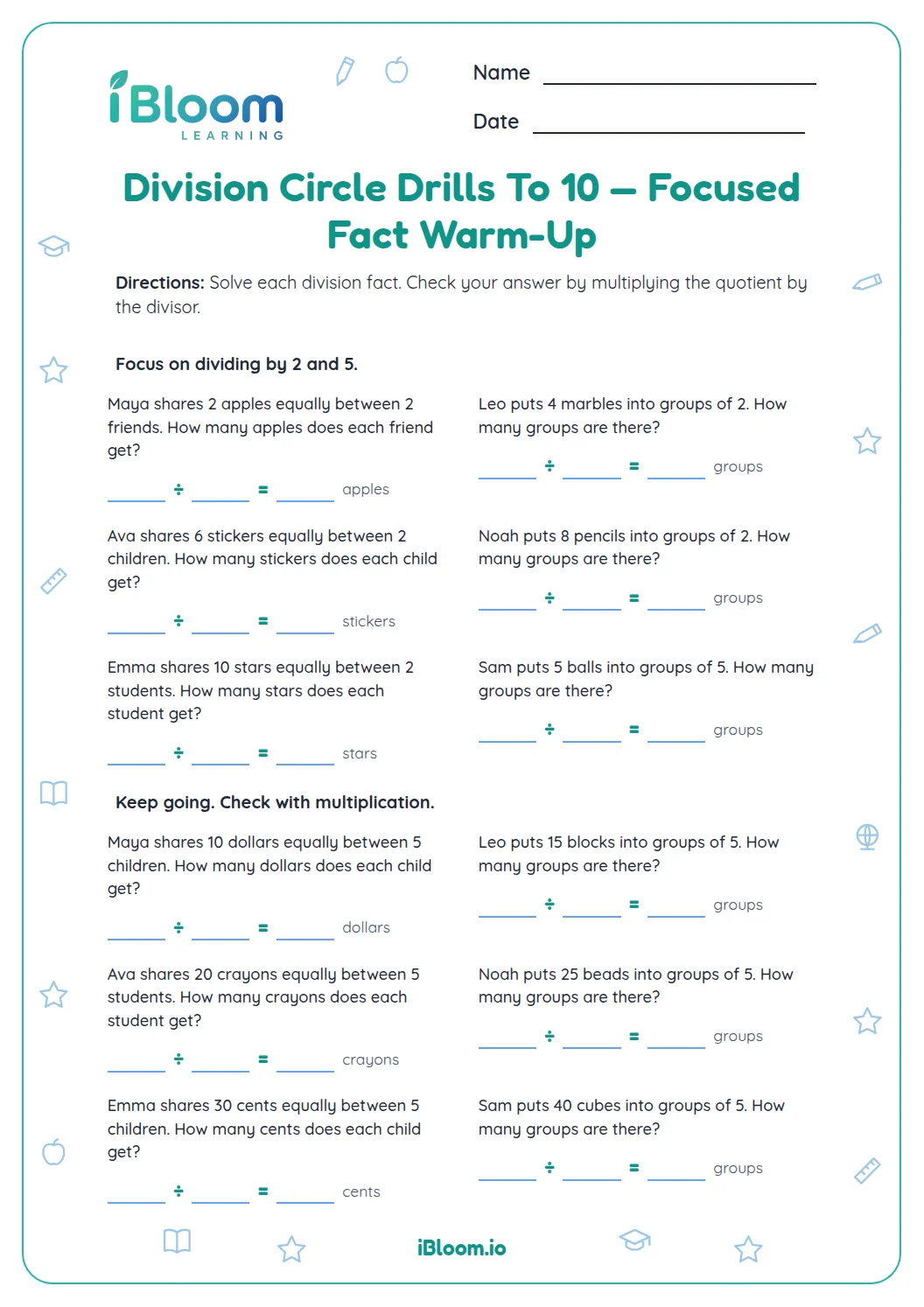
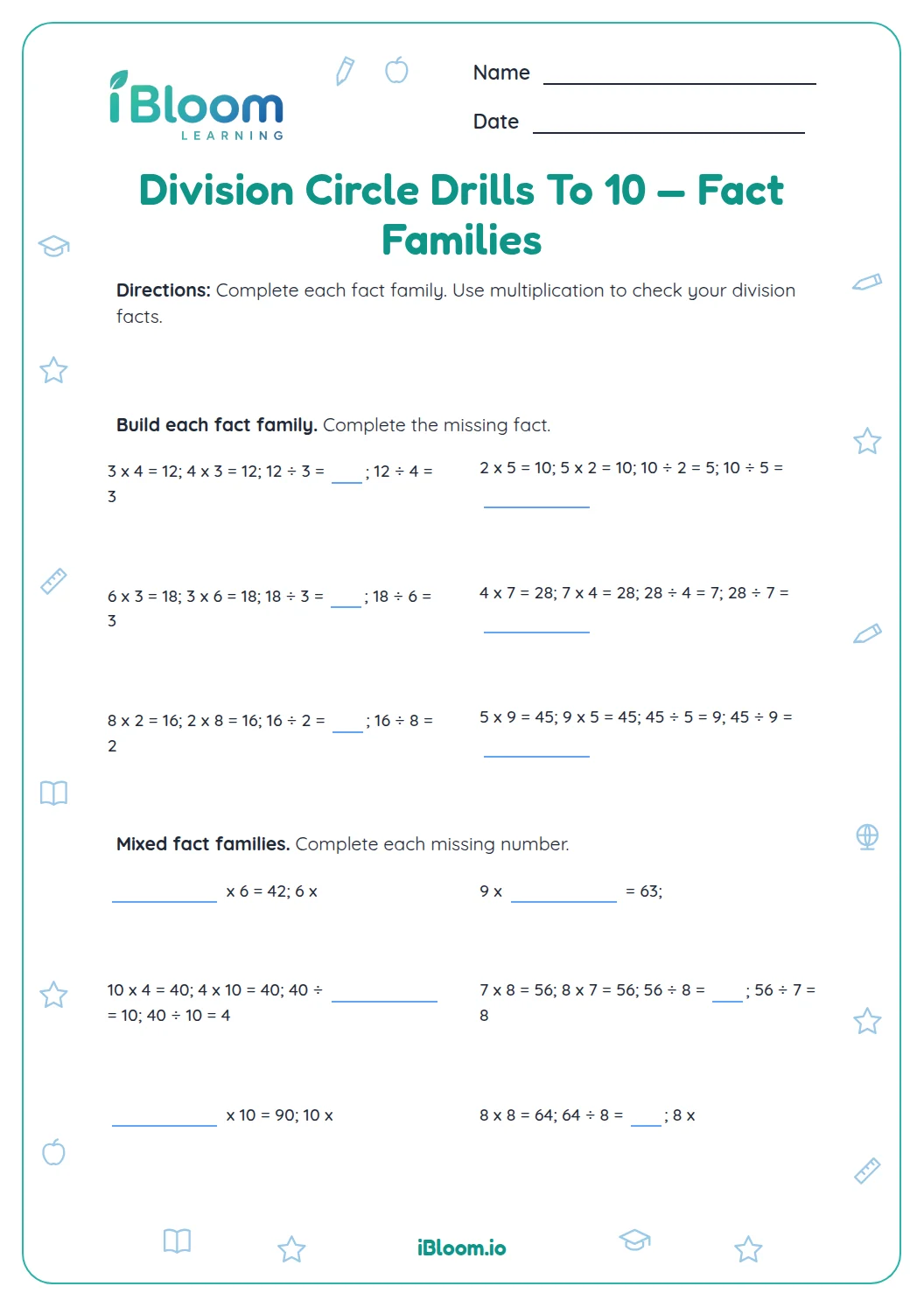
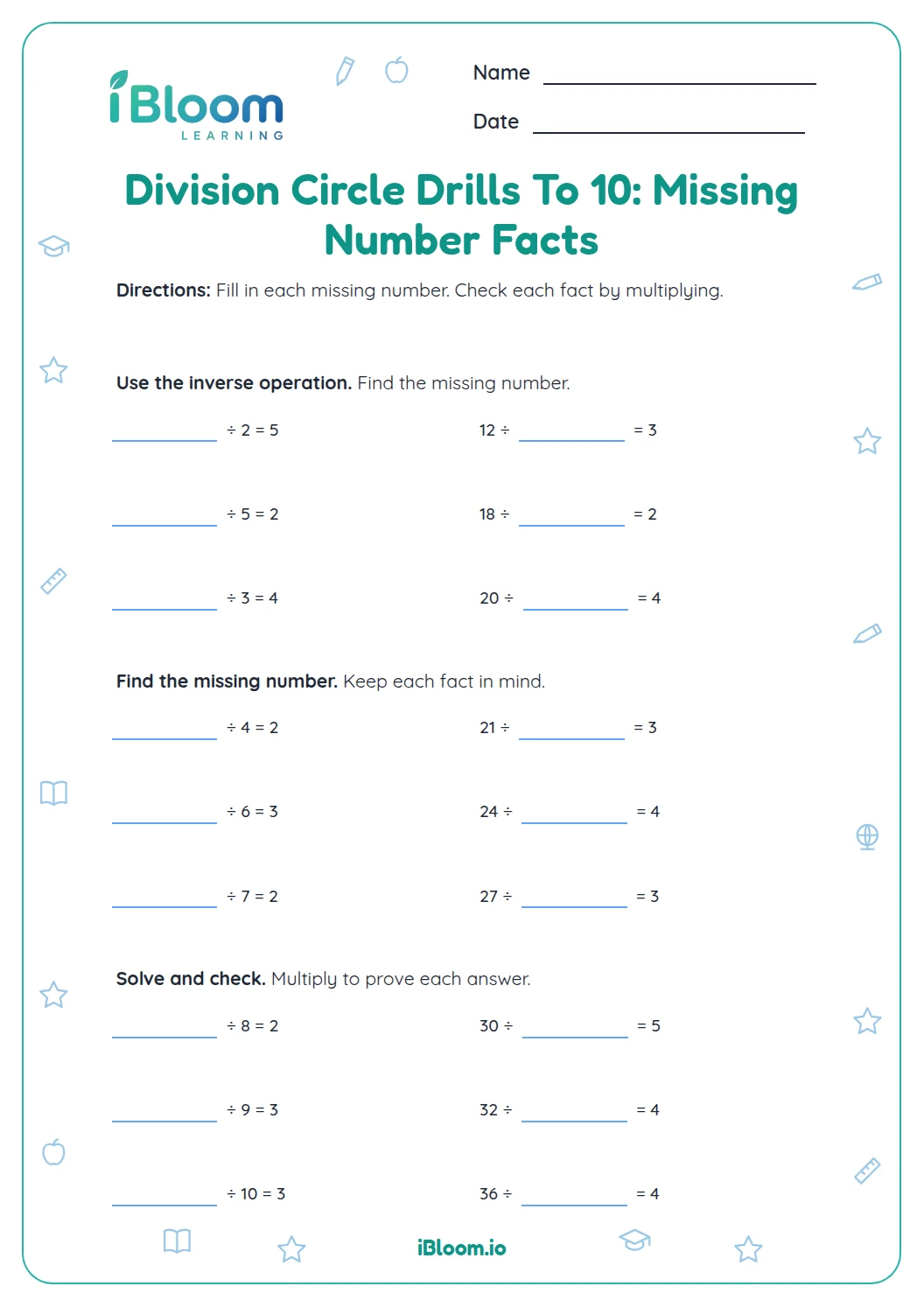
This free printable worksheet gives Grades 3–4 learners practice finding quotients and checking division with multiplication. It has 17 questions in four parts: equal-sharing stories, quick quotient facts, and a final set for applying known multiplication facts. The original sheet used sharing stories; this version pairs that method with direct fact practice and space to work.
Aligned to 3.OA.C.7
How does a division circle drill work?
Division asks how many are in each equal group or how many equal groups can be made. For example, 6 ÷ 2 = 3 means six items shared equally between two groups gives three in each group.
Use multiplication to check: 3 × 2 returns to 6.
How can related facts make division easier?
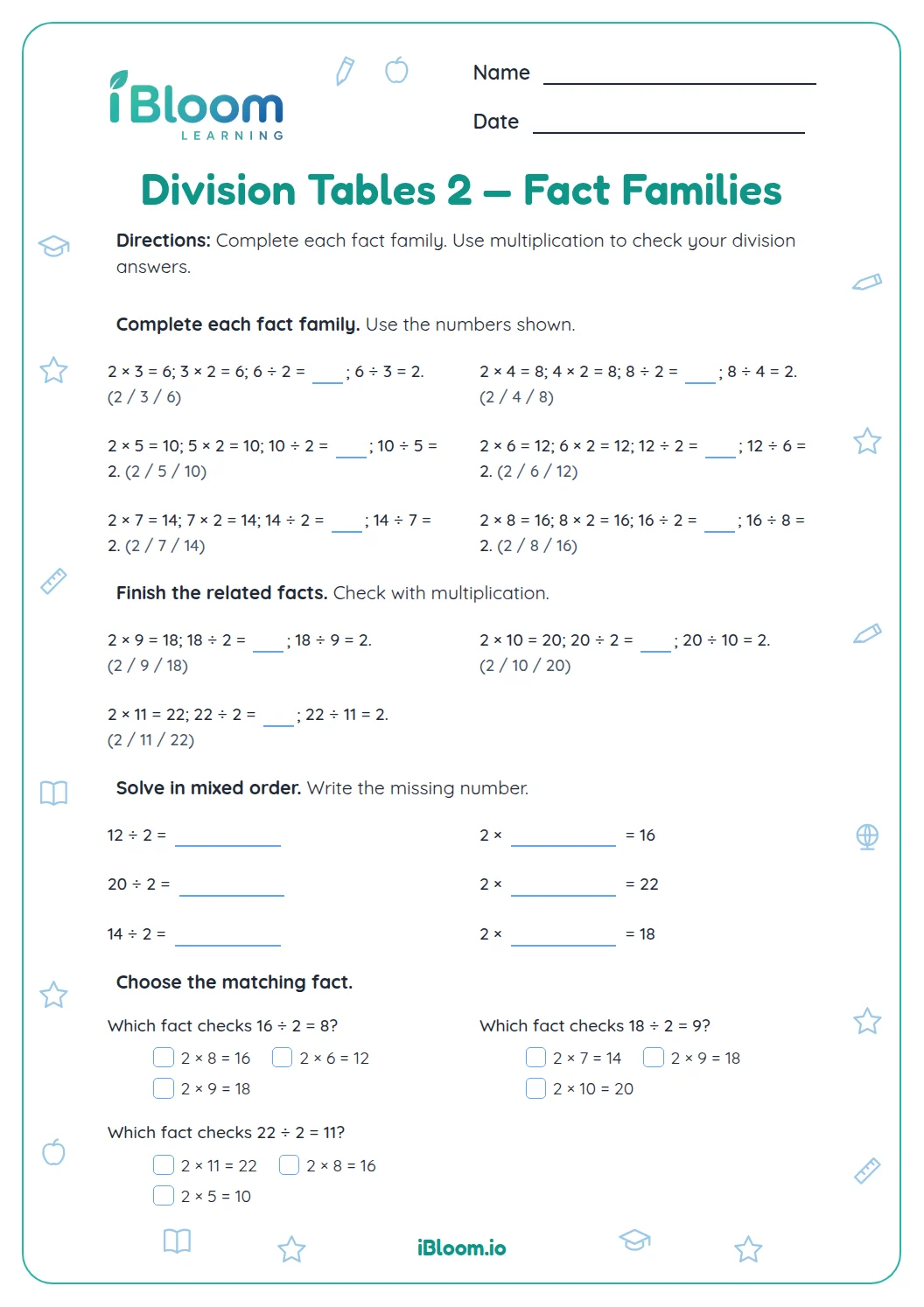
A multiplication fact can unlock its division partner. If 7 × 6 = 42, then 42 ÷ 6 = 7 and 42 ÷ 7 = 6. The final facts ask learners to use that relationship while finding quotients.
What is on the two-page sheet?
There are 17 questions in four parts. Parts A and D have five equal-sharing word problems; Parts B and C have twelve quotient facts. The answer key gives each quotient and the answers in order.
How to use this worksheet
- 1Complete one circle at a time, following the printed outside numbers.
- 2Say the matching multiplication fact to check a quotient.
- 3Work through the six quick facts before moving to the last set.
- 4Review any missed fact by writing its multiplication partner.
Common mistakes and quick fixes
The mistake
Dividing in the wrong direction, such as 3 ÷ 6 for a 6 ÷ 3 fact.
The fix
Read the center number first, then divide it by the outside number.
The mistake
Skipping one number in the circle.
The fix
Track each outside number with a finger and write answers in order.
The mistake
Mixing up 42 ÷ 6 and 42 ÷ 7.
The fix
Use the known product 6 × 7 = 42 to check both facts.
Common Core alignment
This worksheet practices the skill described in the standards below.
Recall and use related multiplication and division facts to solve division facts.
On this sheet: Recall and use related multiplication and division facts to solve division facts.
Show the official wordingHide the official wording
Fluently multiply and divide within 100, using strategies such as the relationship between multiplication and division (e.g., knowing that 8 × 5 = 40, one knows 40 ÷ 5 = 8) or properties of operations. By the end of Grade 3, know from memory all products of two one-digit numbers.
What to practice next
Make more practice
Further reading
Questions parents and teachers ask
How do I read a division circle?
Start with the number in the center and divide it by each number around the circle. For example, a center of 6 and an outside 3 gives 6 ÷ 3 = 2. The key lists each circle’s answers in the same order as the outside numbers.
How many questions are included?
The worksheet has 15 questions: three circle drills and twelve single division facts. The circle answers are grouped in order, and the final two parts provide space for individual quotient answers. This gives the learner another chance to explain the idea clearly.
How can multiplication check division?
Multiply the quotient by the divisor. For 42 ÷ 7 = 6, check 6 × 7 = 42. If the product returns to the starting dividend, the division fact is consistent. This gives the learner another chance to explain the idea clearly.
Should a child race through the facts?
Accuracy comes first. Let the learner solve the facts at a comfortable pace, then revisit a missed fact with its multiplication partner. The page is a warm-up, so a timer is optional and is not needed to complete it. This gives the learner another chance to explain the idea clearly.
What comes after this page?
A learner can continue with a single division table, such as the 2 or 3 facts, then return to mixed division circles. The linked next pages keep practice on related facts before widening the divisor range. This gives the learner another chance to explain the idea clearly.
Is there an answer key?
Yes. A separate answer key gives the quotient for each single fact and the ordered results for each circle. For a circle, compare answers from left to right with the numbers around its edge. This gives the learner another chance to explain the idea clearly.