



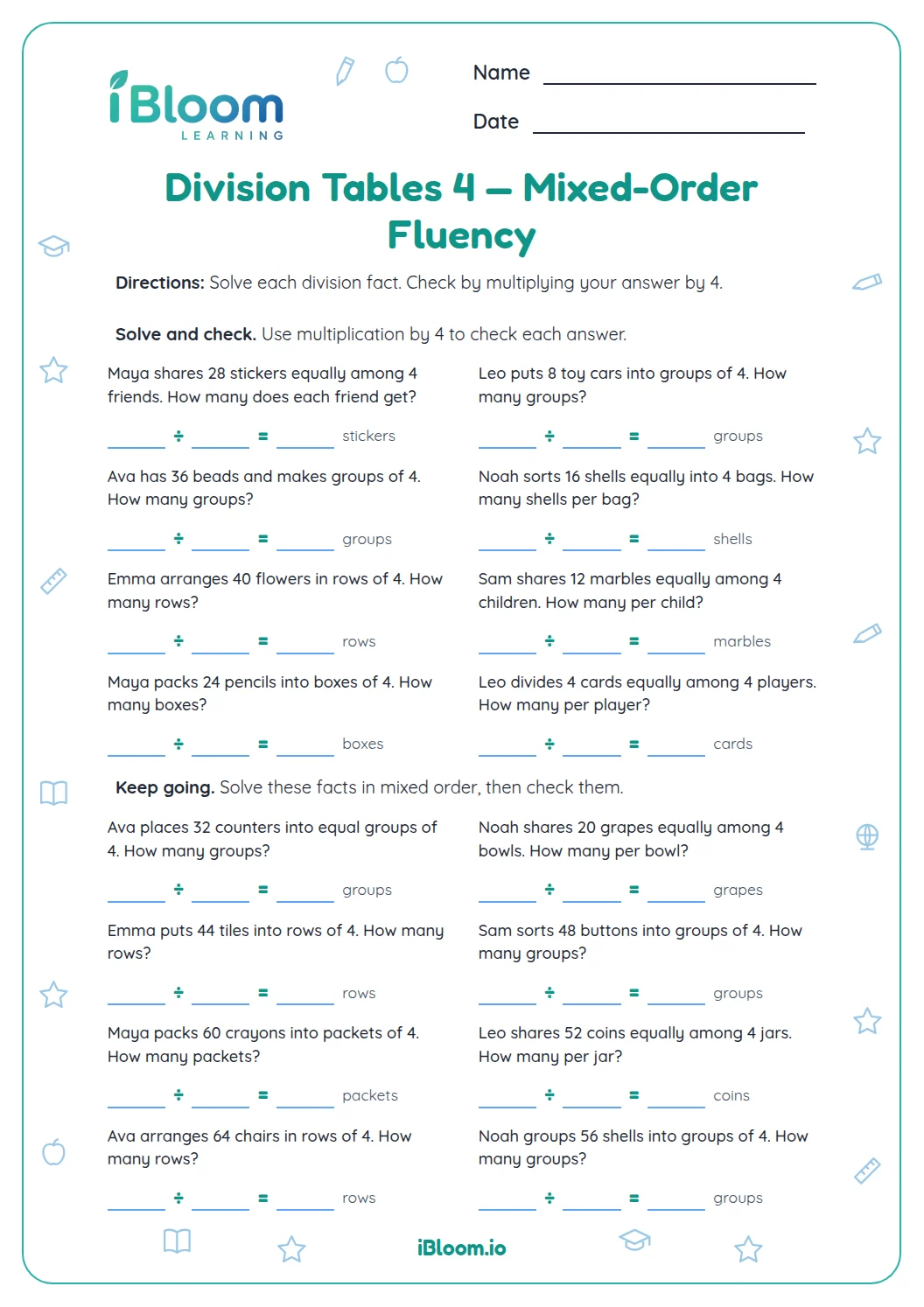
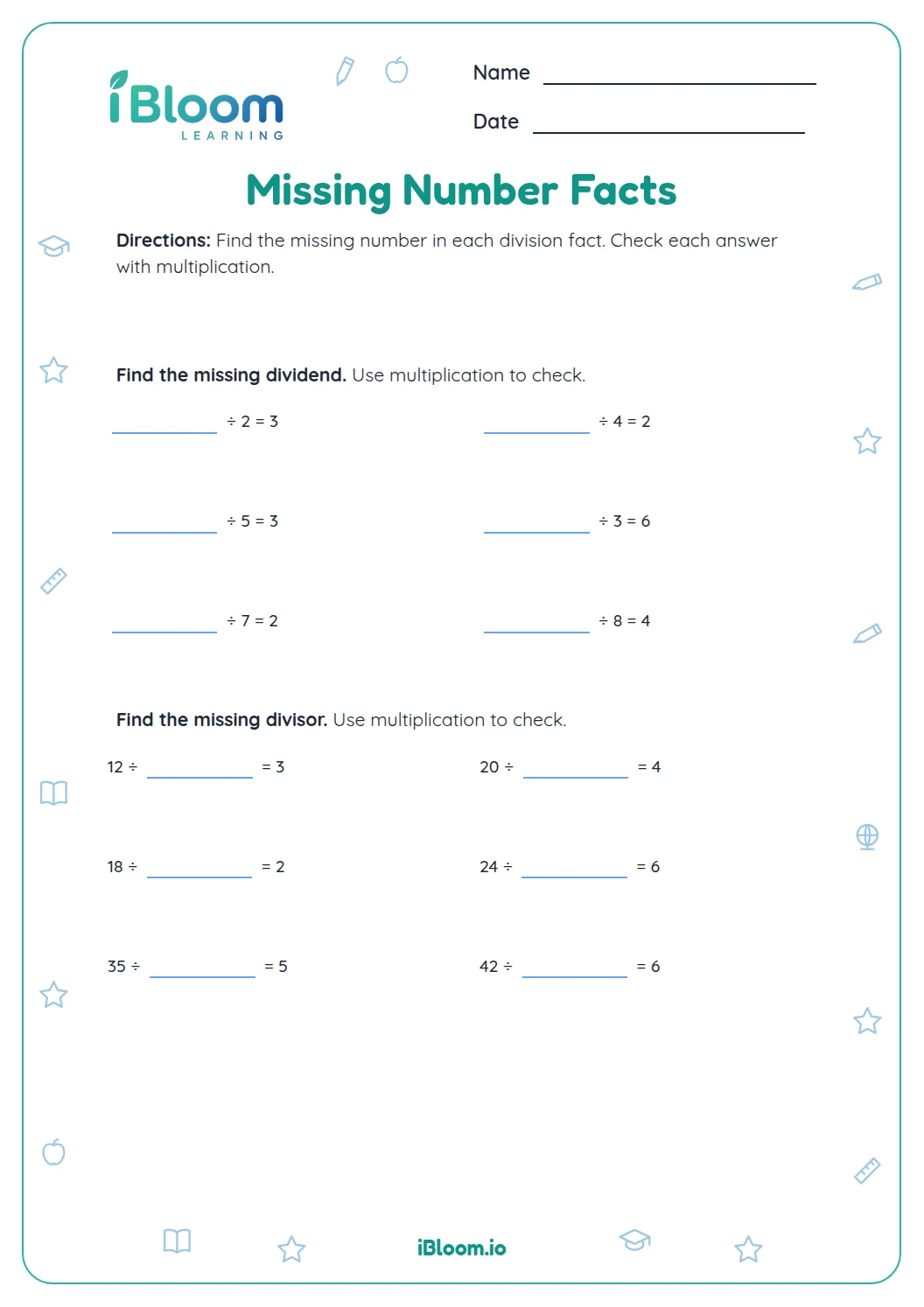
About this worksheet
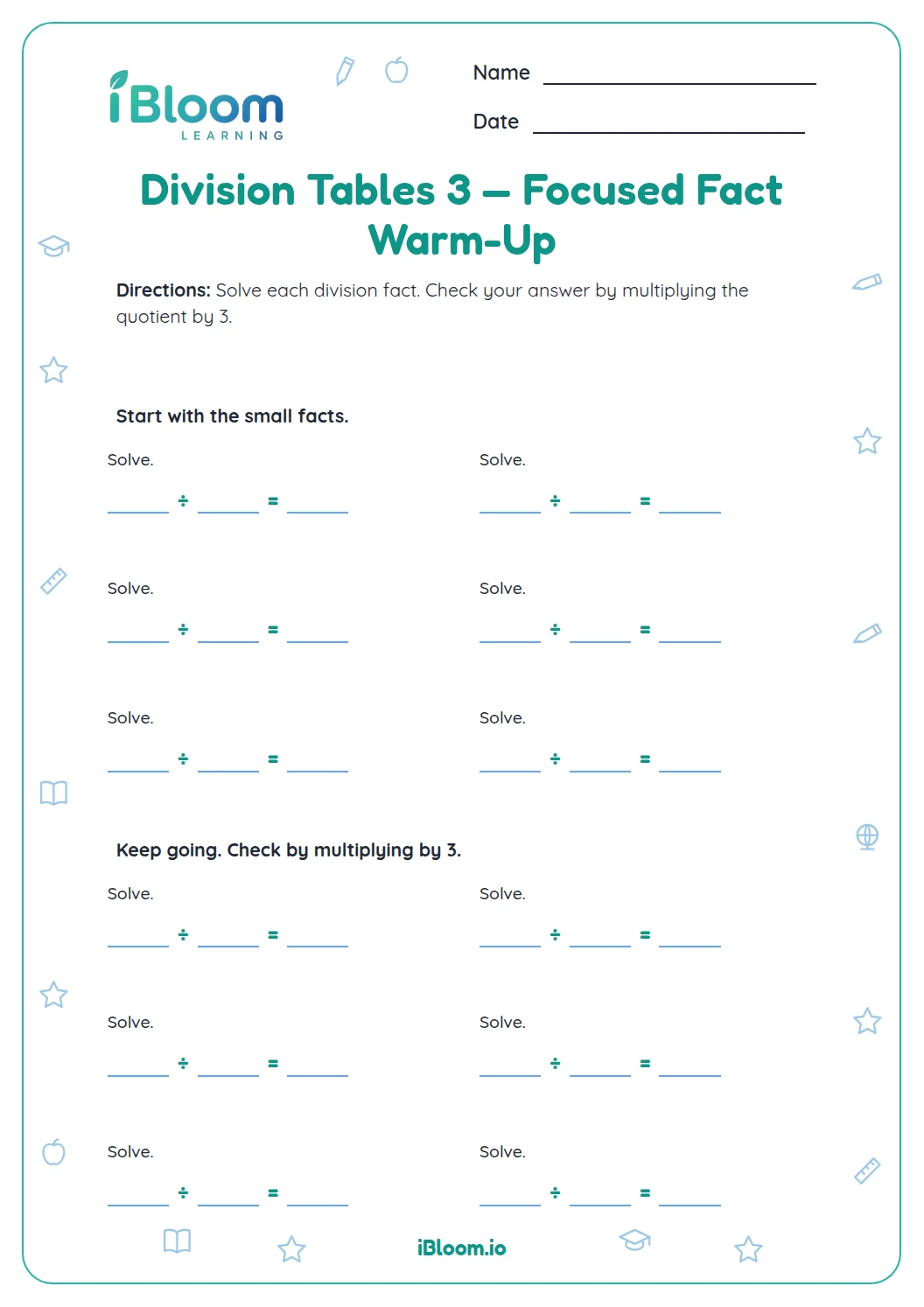
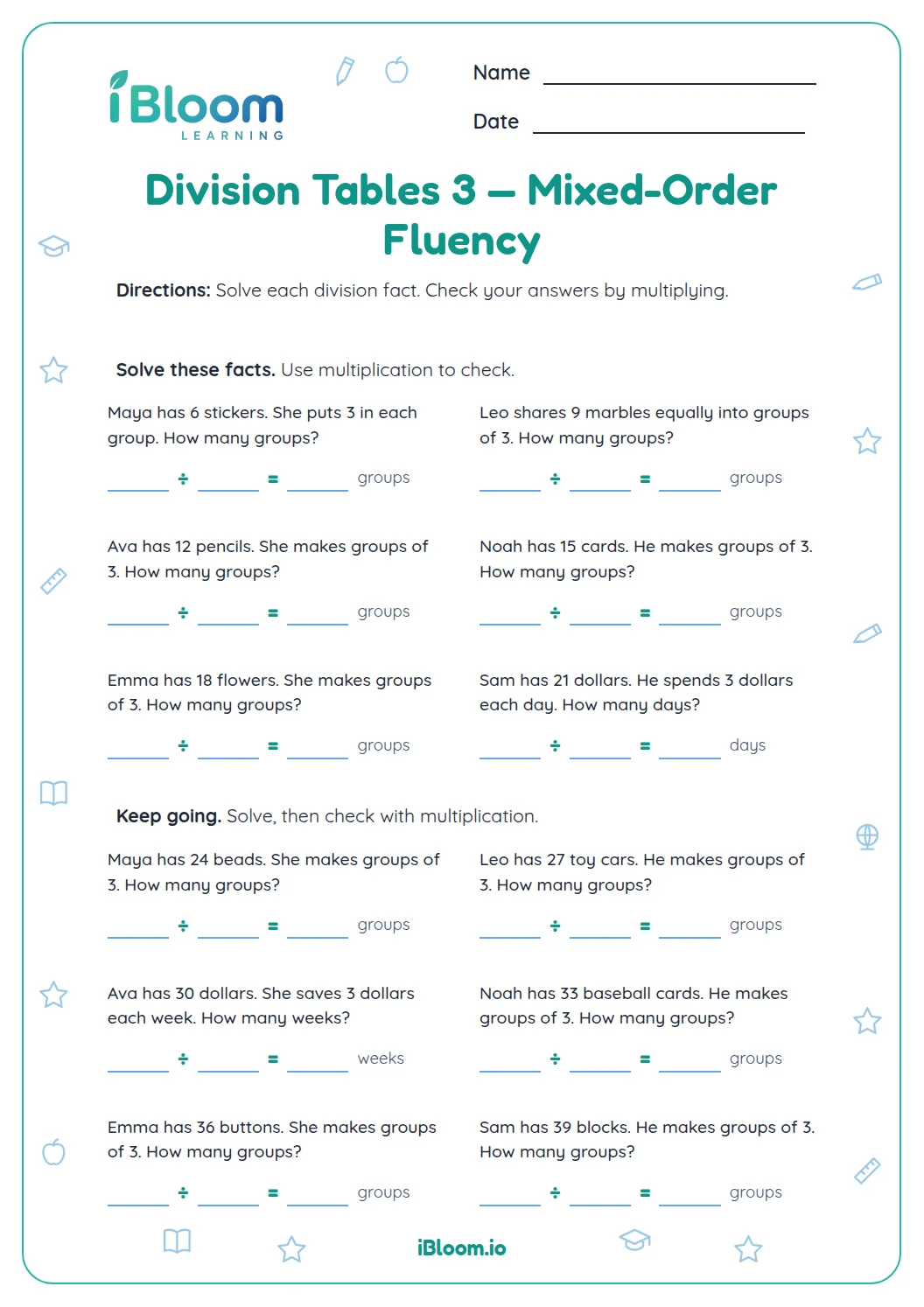
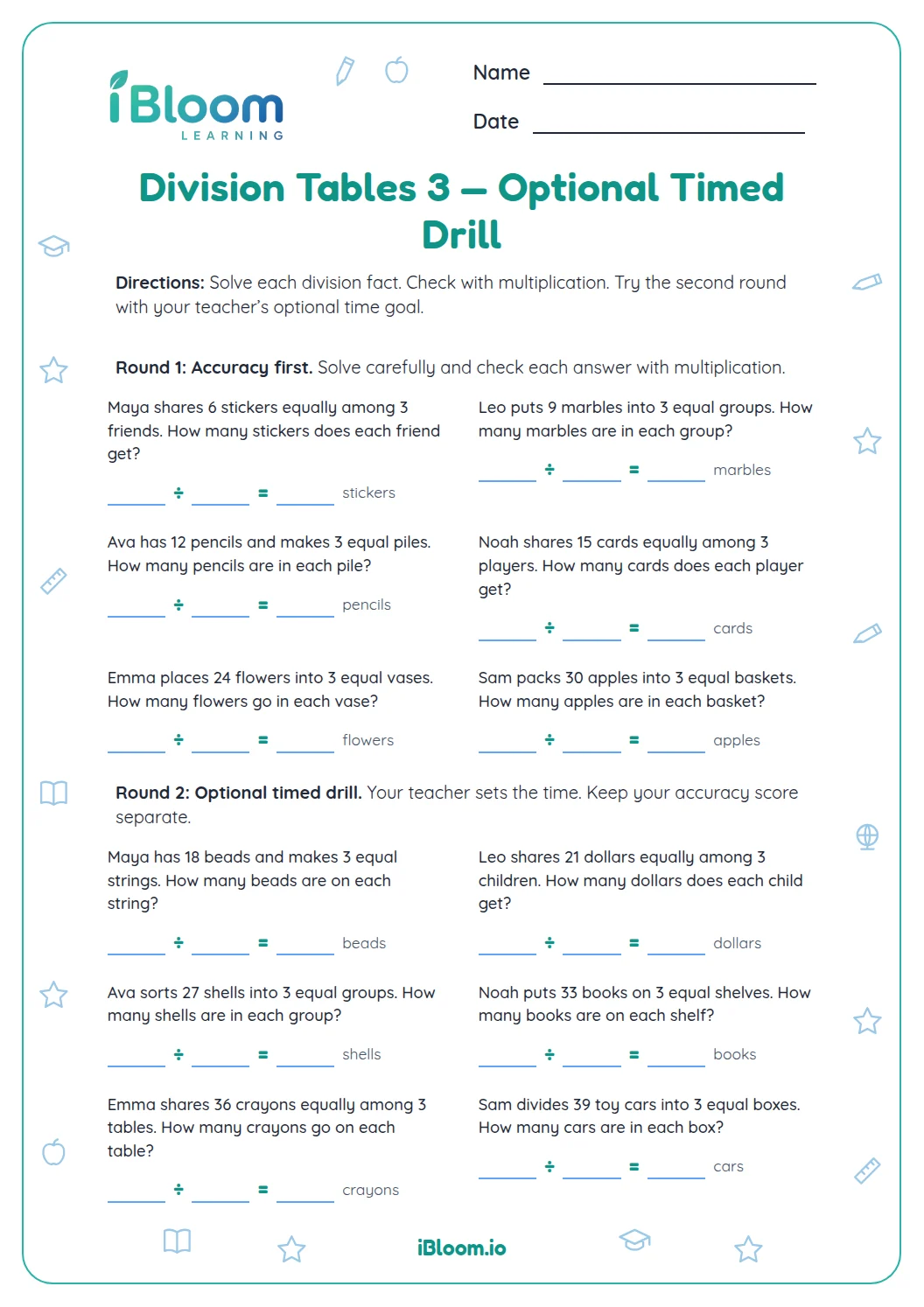
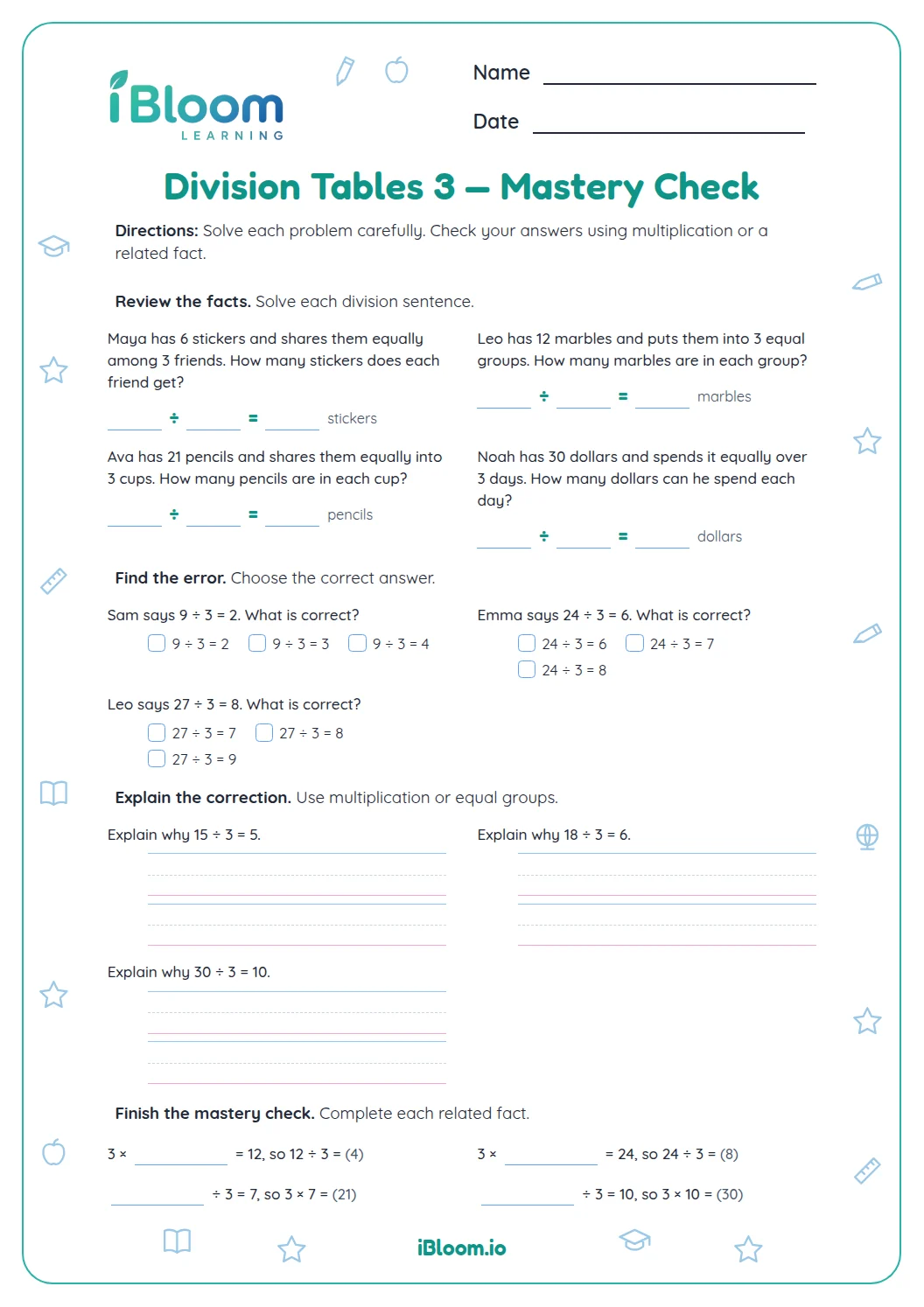
This free printable worksheet is for Grade 3 learners practicing missing factors, dividends, and divisors in multiplication and division facts for 3. It has 25 number sentences: 9 missing factors, 8 missing dividends, and 8 missing divisors. It practices CCSS 3.OA.C.7 through related multiplication and division facts. A separate answer key lets learners check the work.
Aligned to 3.OA.C.7
How can multiplication help with a missing factor?
For 3 × ___ = 18, use the matching division fact 18 ÷ 3 to find 6. Multiplication and division provide a way to check one another.
- 13 × ___ = 18
- 218 ÷ 3 = 6
How do you find a missing dividend?
In ___ ÷ 3 = 7, multiply 7 by 3 to find the dividend, 21. Check by dividing 21 by 3.
How do you find a missing divisor?
For 27 ÷ ___ = 3, ask what number multiplied by 3 makes 27. The missing divisor is 9.
How to use this worksheet
- 1Read which number is missing in the number sentence.
- 2For a missing factor, use the related division fact.
- 3For a missing dividend, multiply the quotient by 3.
- 4For a missing divisor, find the factor that pairs with the quotient.
- 5Check the completed fact with the inverse operation.
Common mistakes and quick fixes
The mistake
Using the quotient as the missing dividend.
The fix
Multiply the quotient by 3 to find the total dividend.
The mistake
Dividing by the quotient to find a missing divisor.
The fix
Ask what number times the quotient equals the dividend.
The mistake
Writing the answer in the wrong blank.
The fix
Identify whether the factor, dividend, or divisor is missing first.
Common Core alignment
Use related multiplication and division facts to find missing numbers within 100.
On this sheet: The questions practice missing factors, dividends, and divisors in division and multiplication facts for 3.
Show the official wordingHide the official wording
Fluently multiply and divide within 100, using strategies such as the relationship between multiplication and division (e.g., knowing that 8 × 5 = 40, one knows 40 ÷ 5 = 8) or properties of operations. By the end of Grade 3, know from memory all products of two one-digit numbers.
What to practice next
Make more practice
Further reading
Questions parents and teachers ask
What does the division facts by 3 sheet practice?
The sheet has 25 number sentences using the 3 facts. Eight ask for a missing multiplication factor, eight for a dividend, and nine for a divisor. The answer key lists the number that makes each sentence true. The three groups let learners focus on one blank position at a time.
How can multiplication check a division answer?
Use the quotient and divisor as factors. For example, if 18 ÷ 3 = 6, then 6 × 3 = 18. The matching multiplication fact confirms that the division sentence is correct. Learners can use this check after completing each item, even when the blank is in a different position.
How do I find a missing dividend?
Multiply the quotient by the known divisor. In ___ ÷ 3 = 7, compute 7 × 3 to get 21. Then check that 21 ÷ 3 equals 7. This keeps the relationship between the three numbers visible and helps verify the missing dividend.
How do I find a missing divisor?
Find the number that multiplied by the quotient gives the dividend. In 27 ÷ ___ = 3, ask what number times 3 equals 27; the missing divisor is 9. Check by dividing 27 by 9 to see whether the quotient is 3.
Are all the questions about dividing by 3?
Each number sentence uses a fact from the 3 times table, but the missing number changes. Some questions have a missing factor, some a dividend, and some a divisor, so read the location of the blank carefully. Each section groups one kind of missing number together.
How long does the worksheet take?
About 10 to 15 minutes is a useful estimate for 25 short facts. Learners can complete one group at a time and check with the inverse operation. The separate key makes it easy to review any missed fact and notice which blank type needs more practice.