

About this worksheet
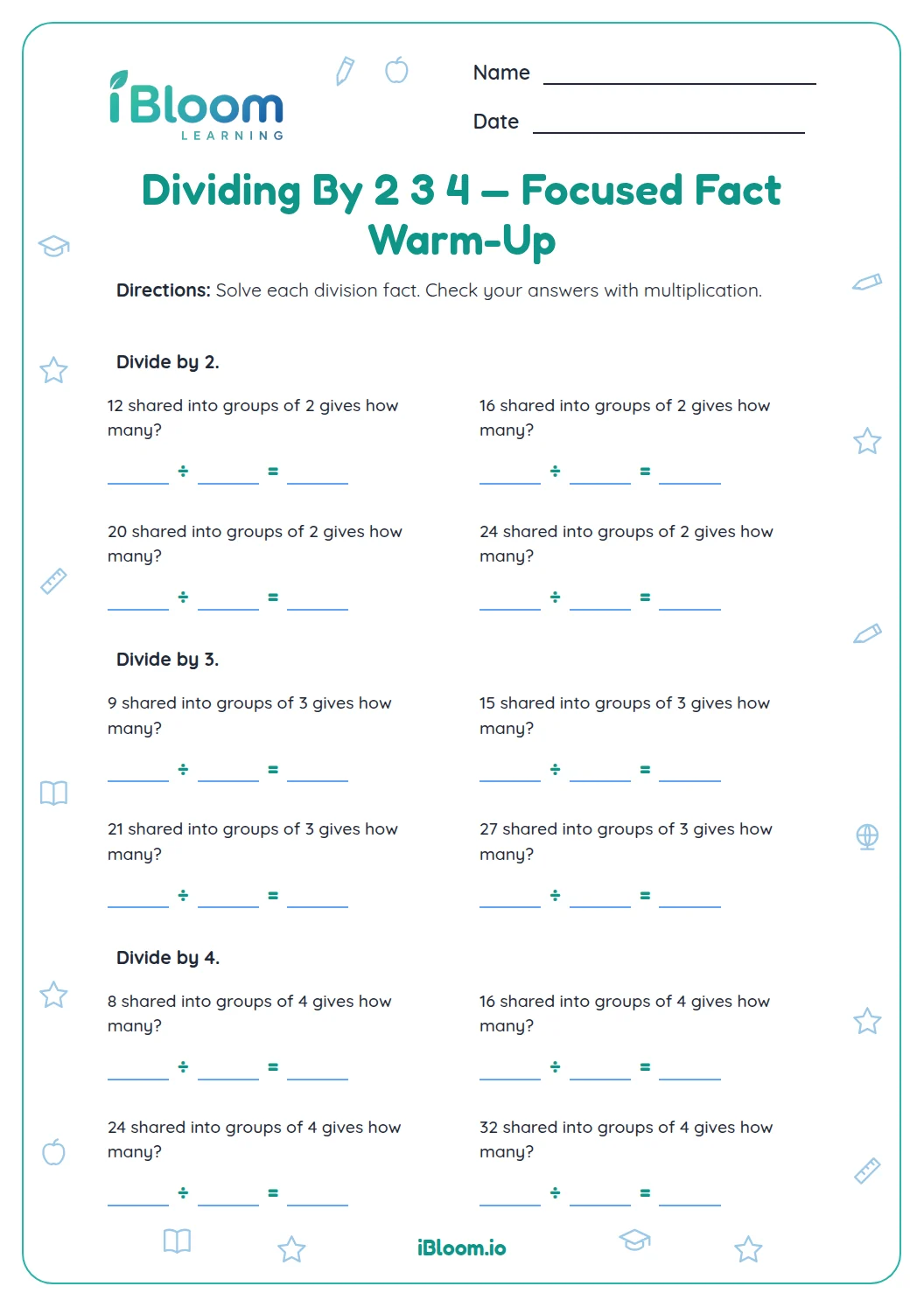
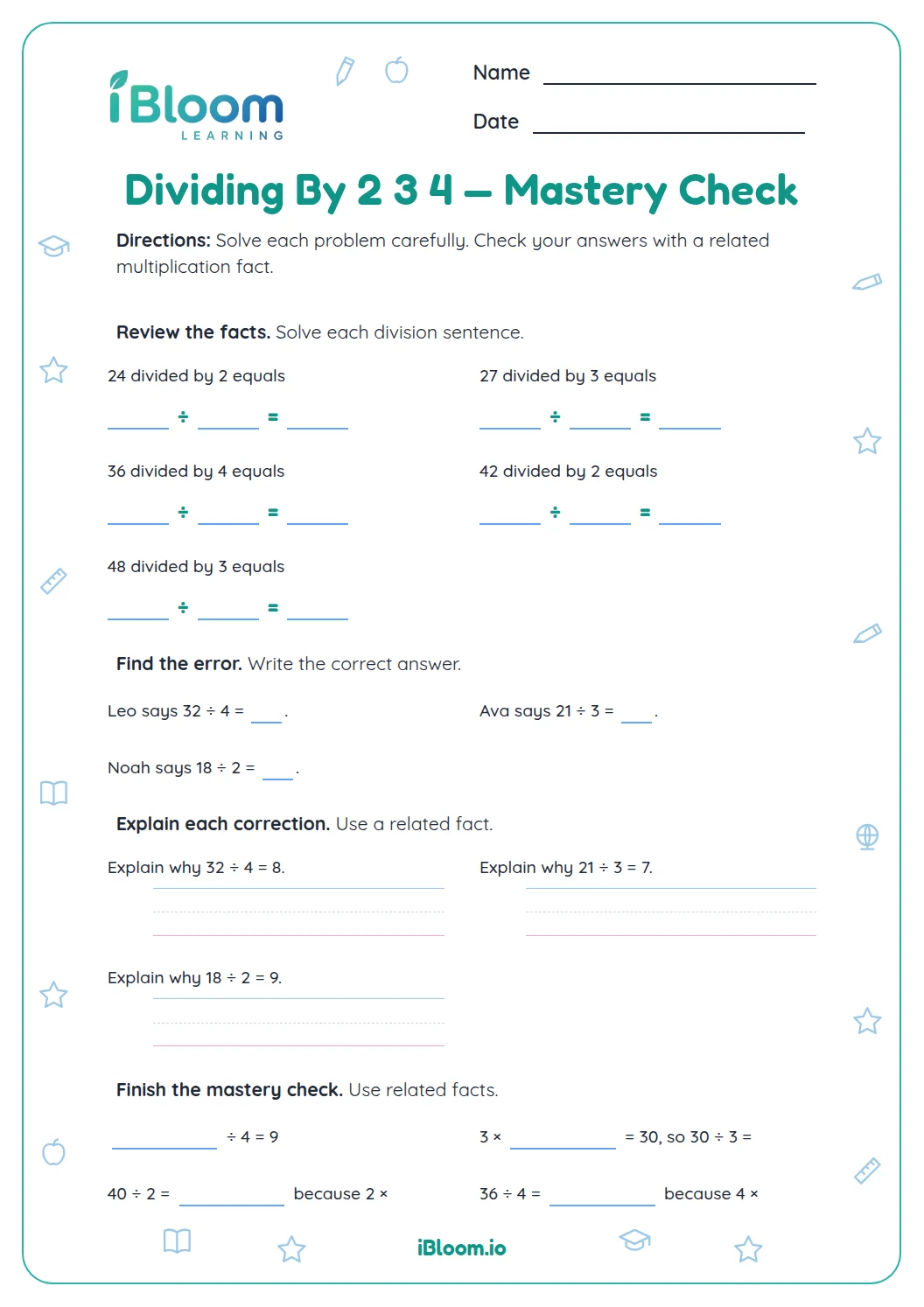
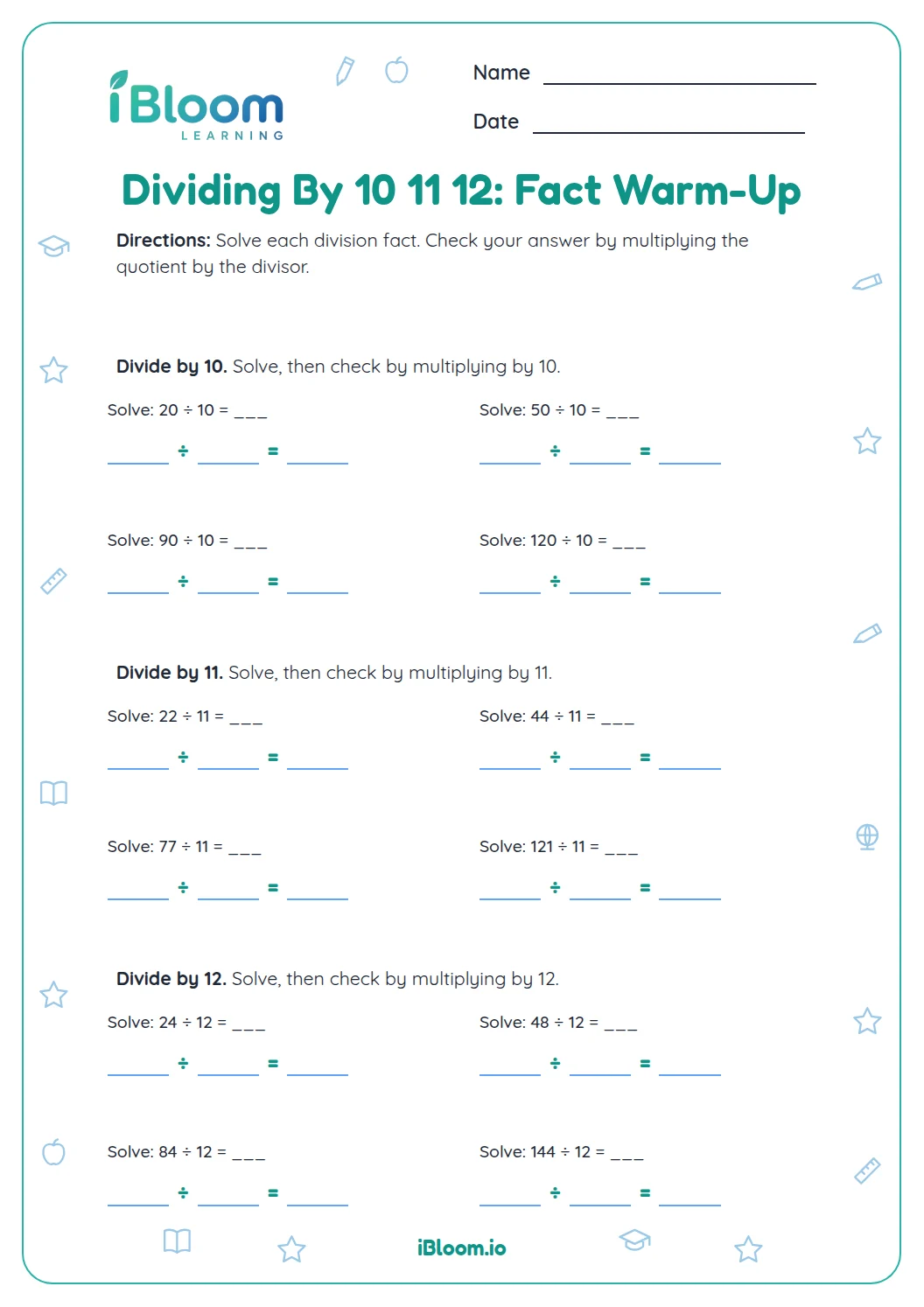
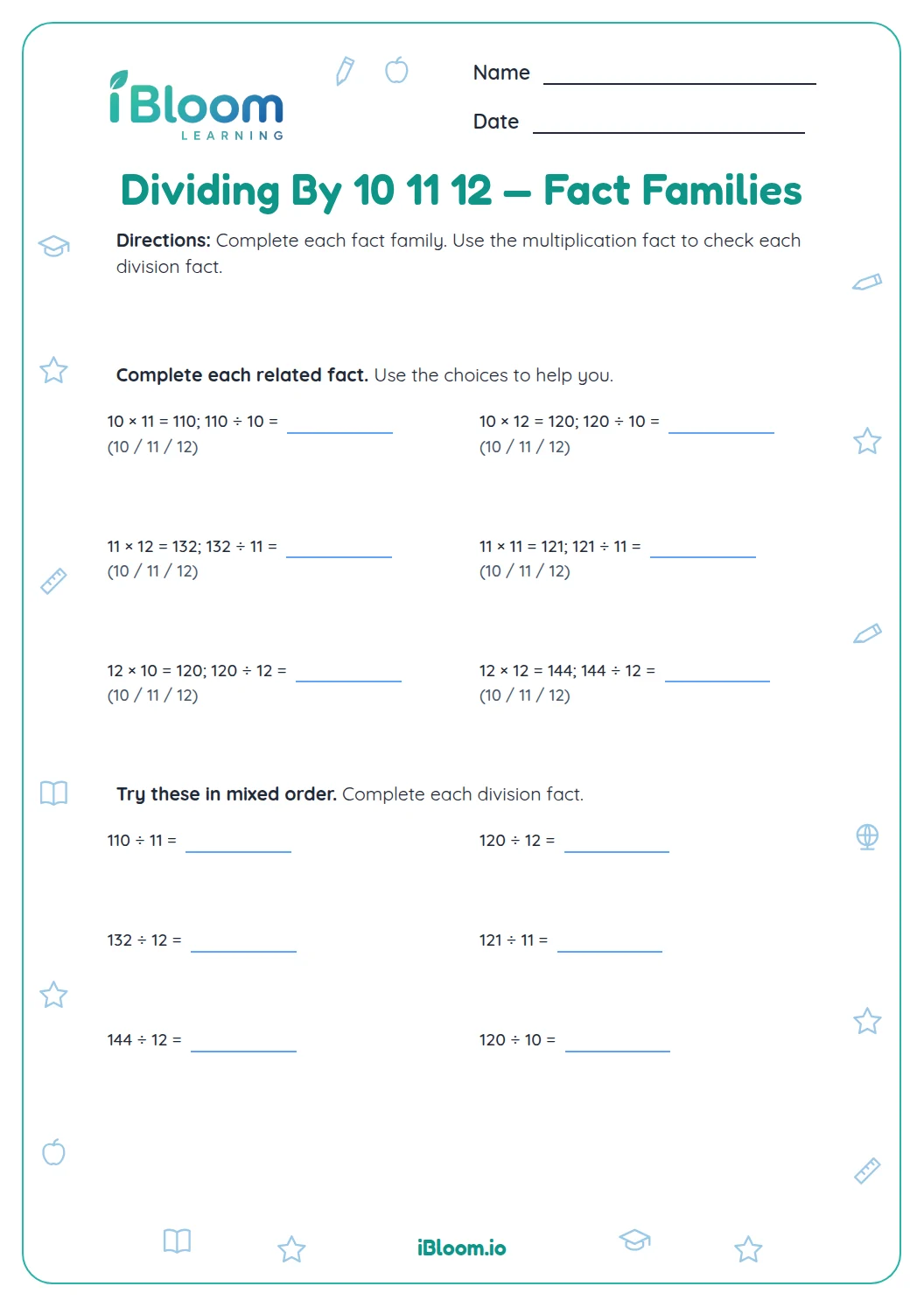
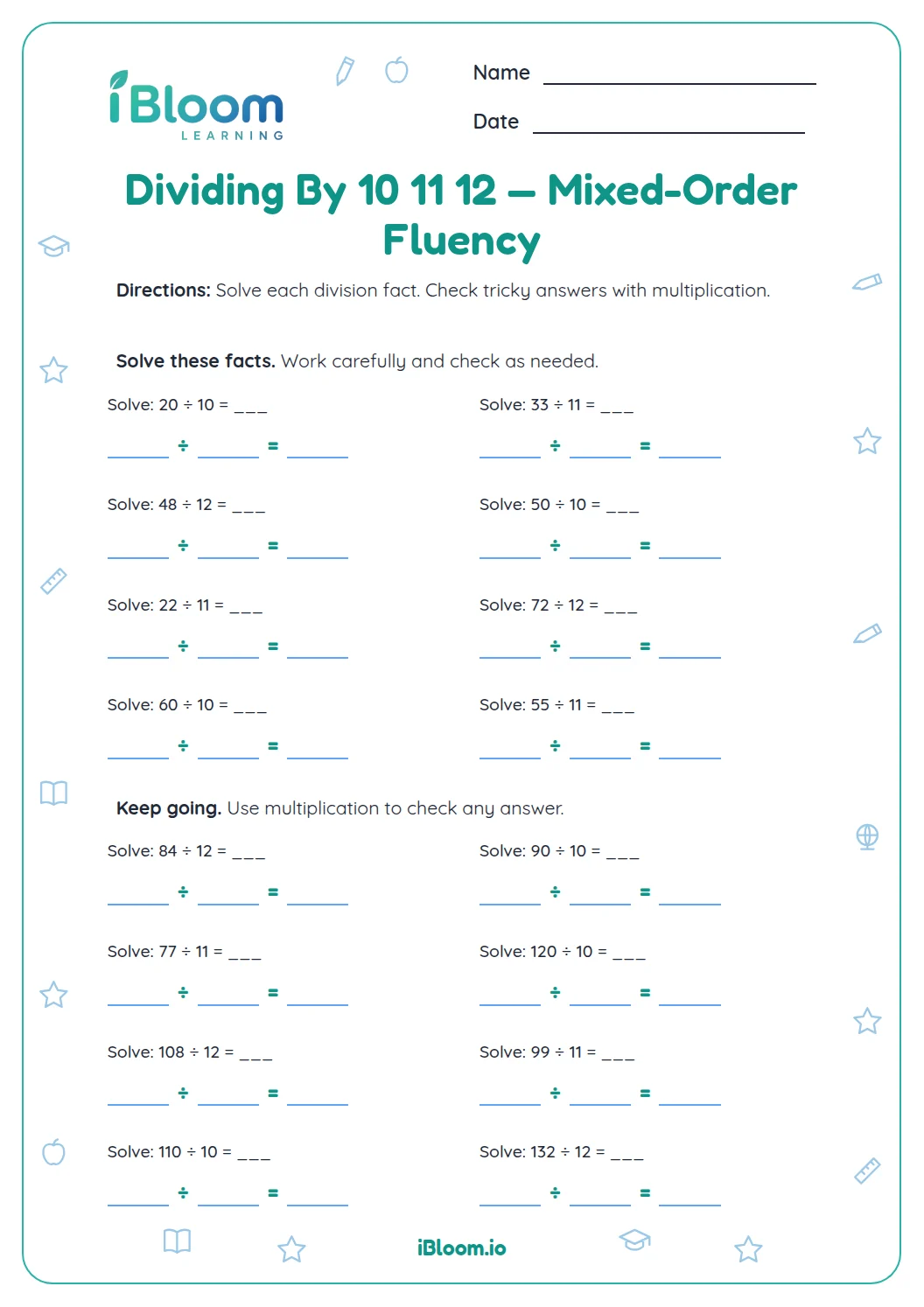
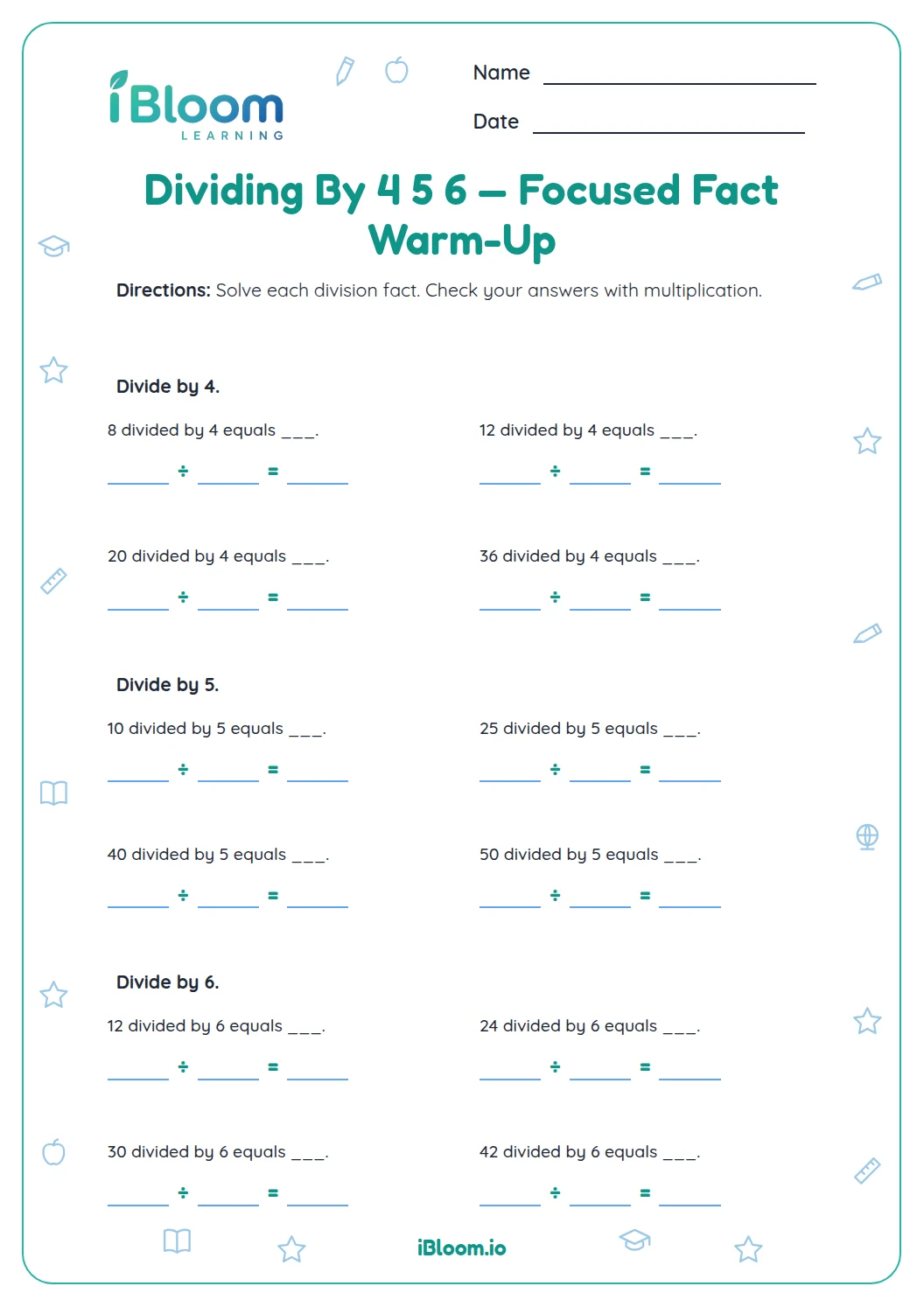
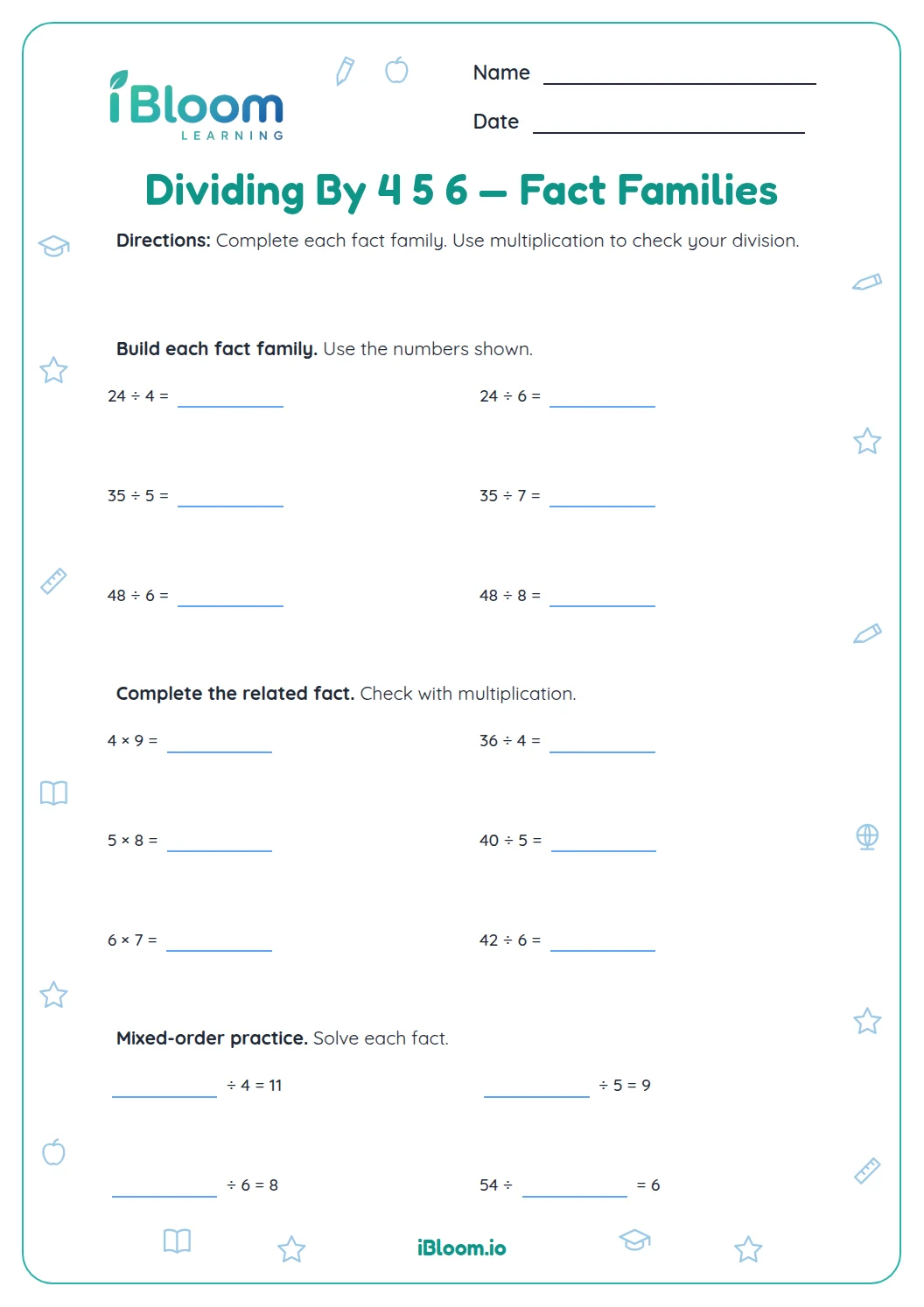
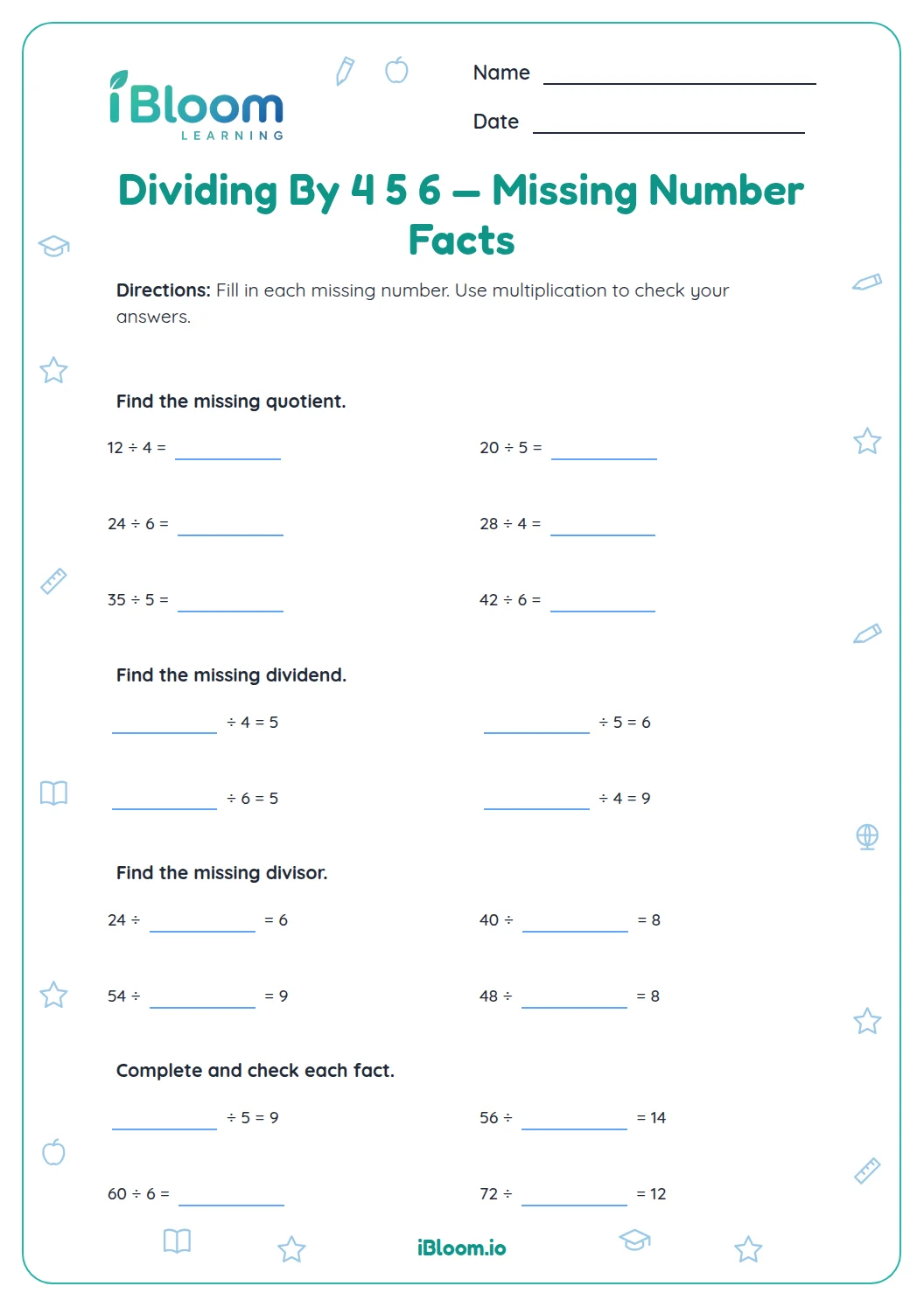
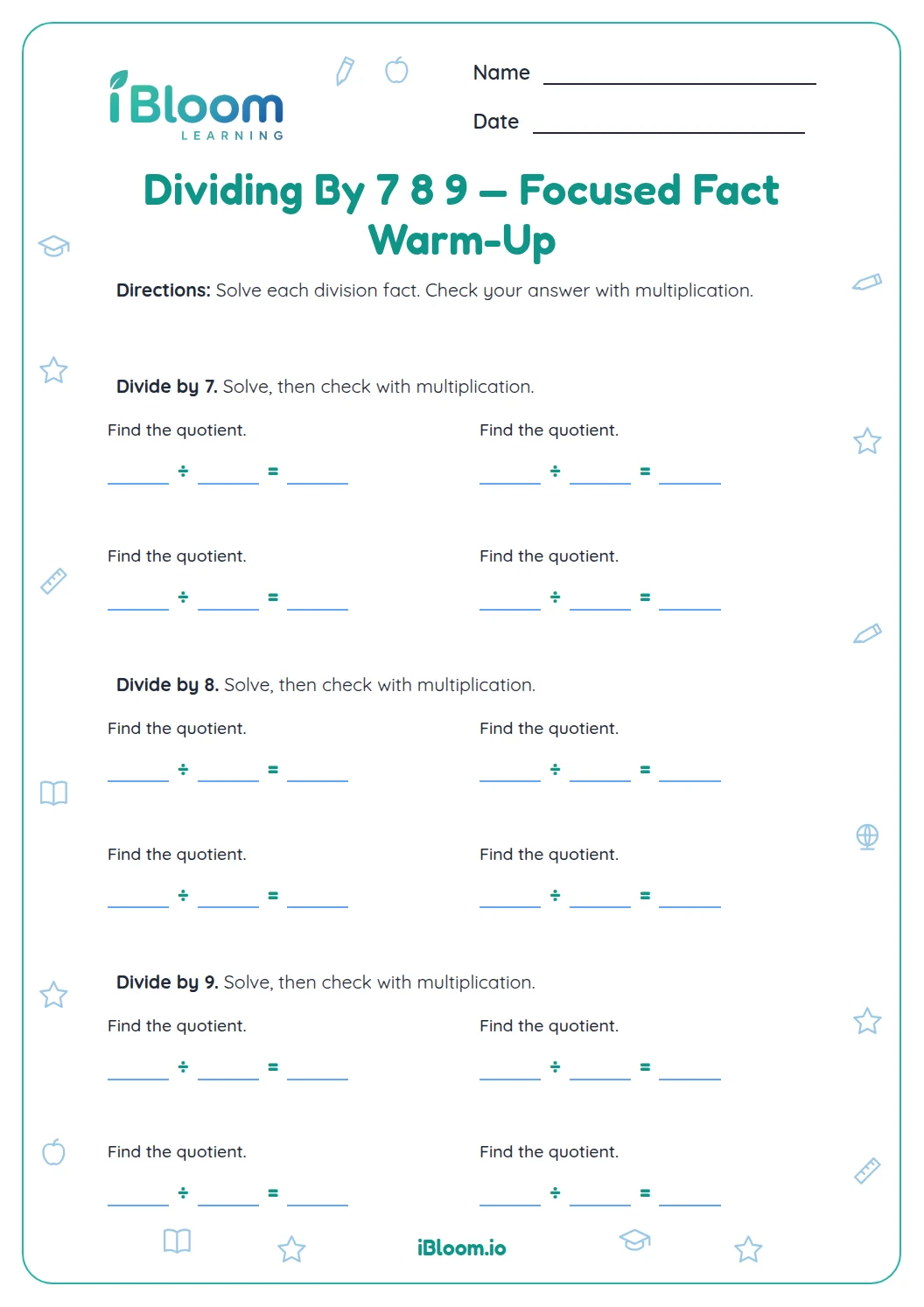
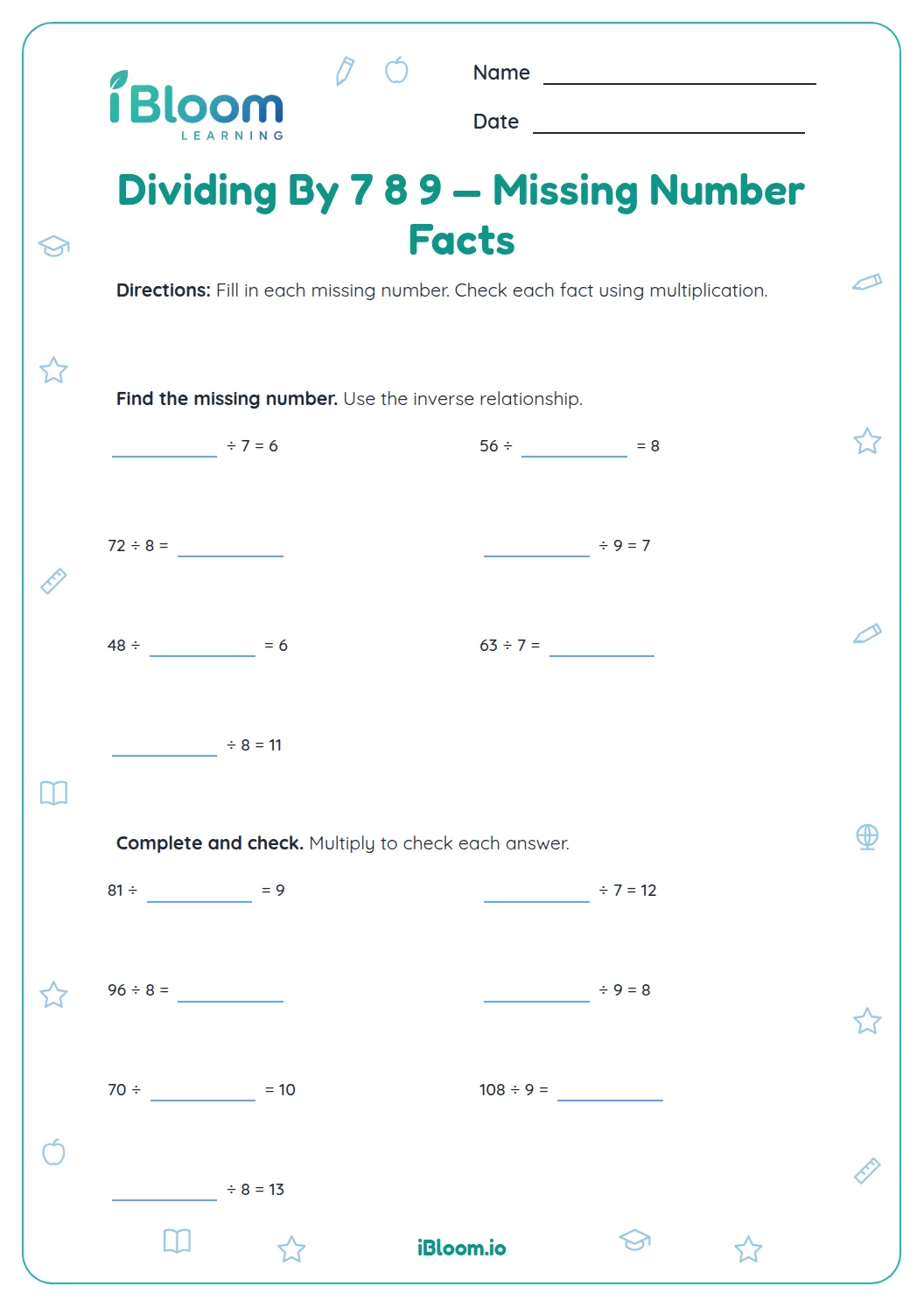
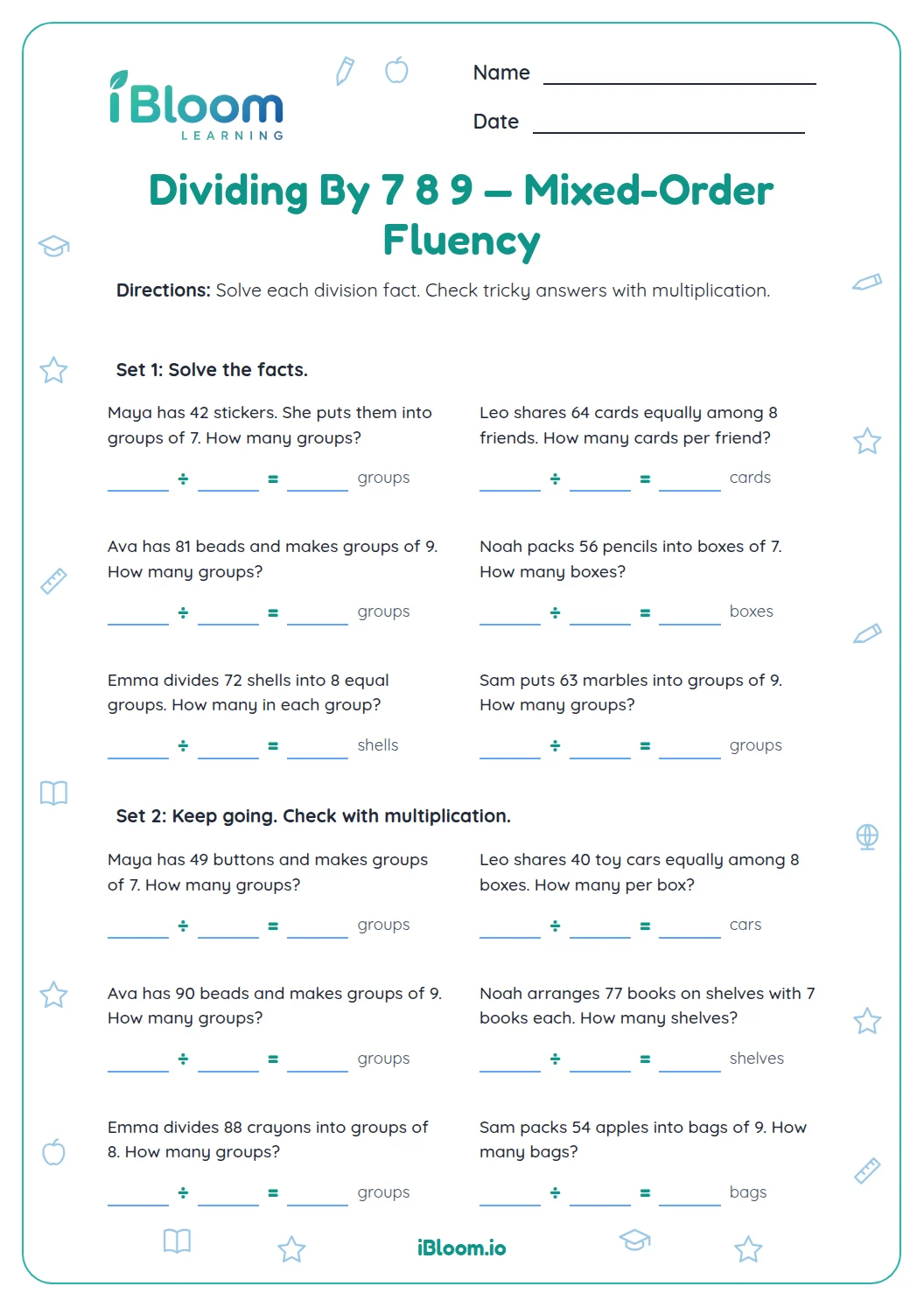
This free printable worksheet gives students in Grades 3–4 mixed-order practice dividing by 2, 3, and 4. It has 16 short number sentences, including facts with different quotient sizes, so students must attend to both numbers in each equation. Students can check a quotient by multiplying it by the divisor. The practice connects to Common Core 3.OA.C.7, fluently multiplying and dividing within 100. A separate answer key is included.
Aligned to 3.OA.C.7
What is on the worksheet?
All 16 questions are division equations with one missing quotient. The divisors 2, 3, and 4 appear in mixed order, and dividends are chosen to give whole-number answers.
- 132 ÷ 4 = 8
- 2Check: 8 × 4 = 32
How does multiplication check division?
A division fact asks how many equal groups, or how many in each group. Multiplication reverses that relationship: quotient × divisor should return the dividend.
How can practice stay useful?
Have the learner mark facts that took extra thought, then say the matching multiplication fact aloud. A second short pass can focus on those marked facts.
How can you use this worksheet?
- 1Read both numbers before calculating.
- 2Solve each equation and write one quotient in its blank.
- 3For a fact that feels uncertain, build equal groups or count by the divisor.
- 4Check by multiplying the quotient and divisor.
- 5Use the answer key to choose facts for a quick retry.
What slips should you watch for?
The mistake
Using the divisor as the quotient without checking.
The fix
Multiply the proposed quotient by the divisor; the product must be the dividend.
The mistake
Mixing up a nearby fact, such as 24 ÷ 3 and 24 ÷ 4.
The fix
Say the divisor aloud, then recall or build that many equal groups.
The mistake
Writing the dividend again as the answer.
The fix
Ask how many groups or how many in each group; the quotient is the missing count.
Common Core alignment
This practice connects directly to the skills described in the Common Core standards.
Recall and use multiplication and division facts within 100.
On this sheet: Recall and use multiplication and division facts within 100.
Show the official wordingHide the official wording
Fluently multiply and divide within 100, using strategies such as the relationship between multiplication and division (e.g., knowing that 8 × 5 = 40, one knows 40 ÷ 5 = 8) or properties of operations. By the end of Grade 3, know from memory all products of two one-digit numbers.
What to practice next
Make more practice
Further reading
Questions parents and teachers ask
What facts are on this worksheet?
The page has 16 division facts using divisors 2, 3, and 4. The facts are mixed together, so students need to read the divisor each time instead of completing a block of one kind. Ask the learner to explain the clue or operation used, then compare the completed response with the separate answer key.
What grade is this worksheet for?
It is labeled for Grades 3–4 and practices division facts with whole-number quotients. Grade 3 students can use multiplication relationships to check each division fact; Grade 4 students can use it for a quick fluency review. Ask the learner to explain the clue or operation used, then compare the completed response with the separate answer key.
How can my child check a quotient?
Multiply the quotient by the divisor. For example, if 32 ÷ 4 is answered as 8, check that 8 × 4 equals 32. If the product does not match the dividend, revisit the fact. Ask the learner to explain the clue or operation used, then compare the completed response with the separate answer key.
Does the worksheet include an answer key?
Yes. A separate answer-key page lists all 16 quotients in question order. Students can complete the page first, then use the key to find which facts need another round of practice. Ask the learner to explain the clue or operation used, then compare the completed response with the separate answer key.
Can students use counters?
Yes. Small groups of counters can show equal sharing for an unfamiliar fact, such as placing 28 counters into 4 equal groups. Once each group has 7, connect the model to 28 ÷ 4 = 7. Ask the learner to explain the clue or operation used, then compare the completed response with the separate answer key.