




About this worksheet
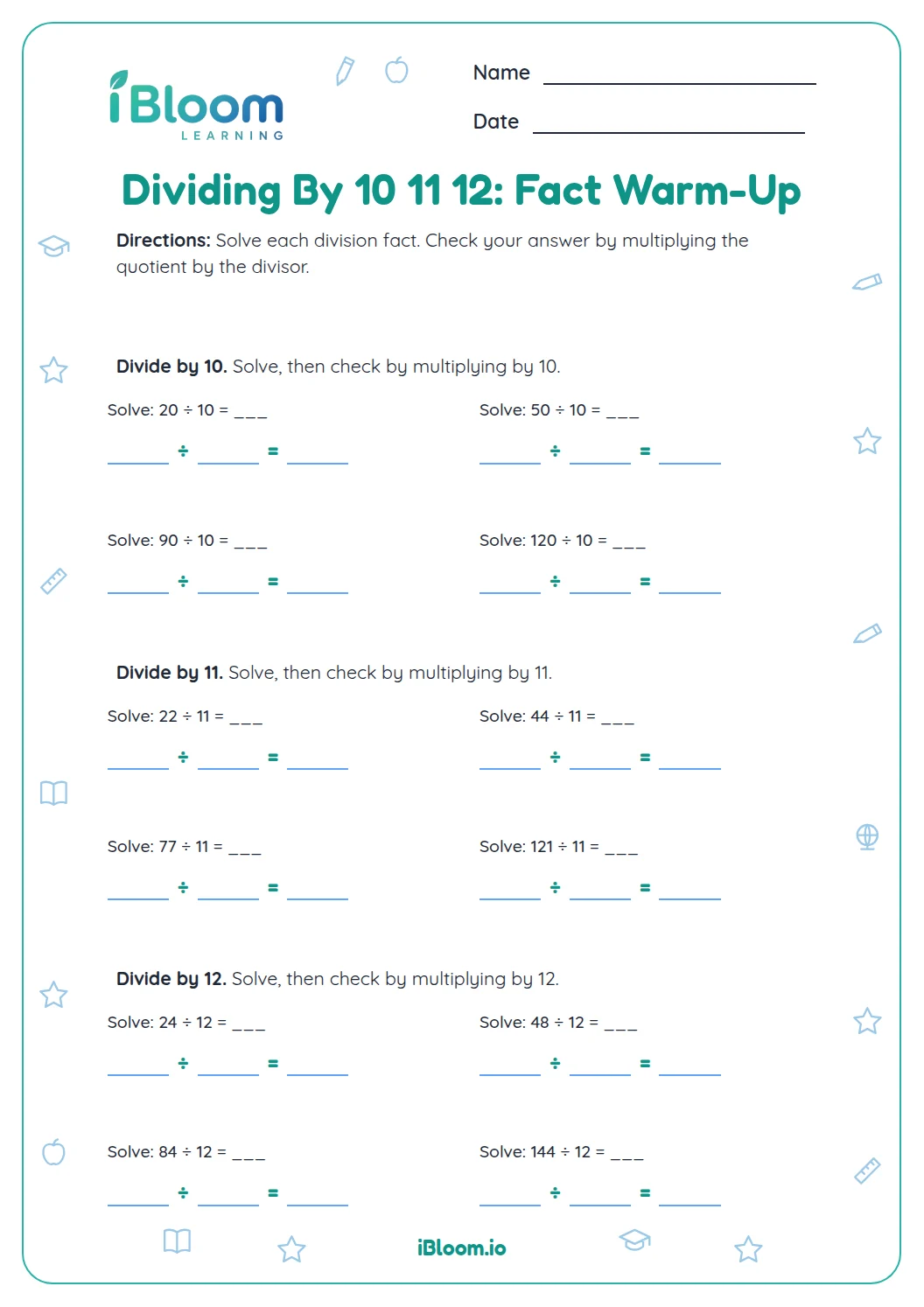
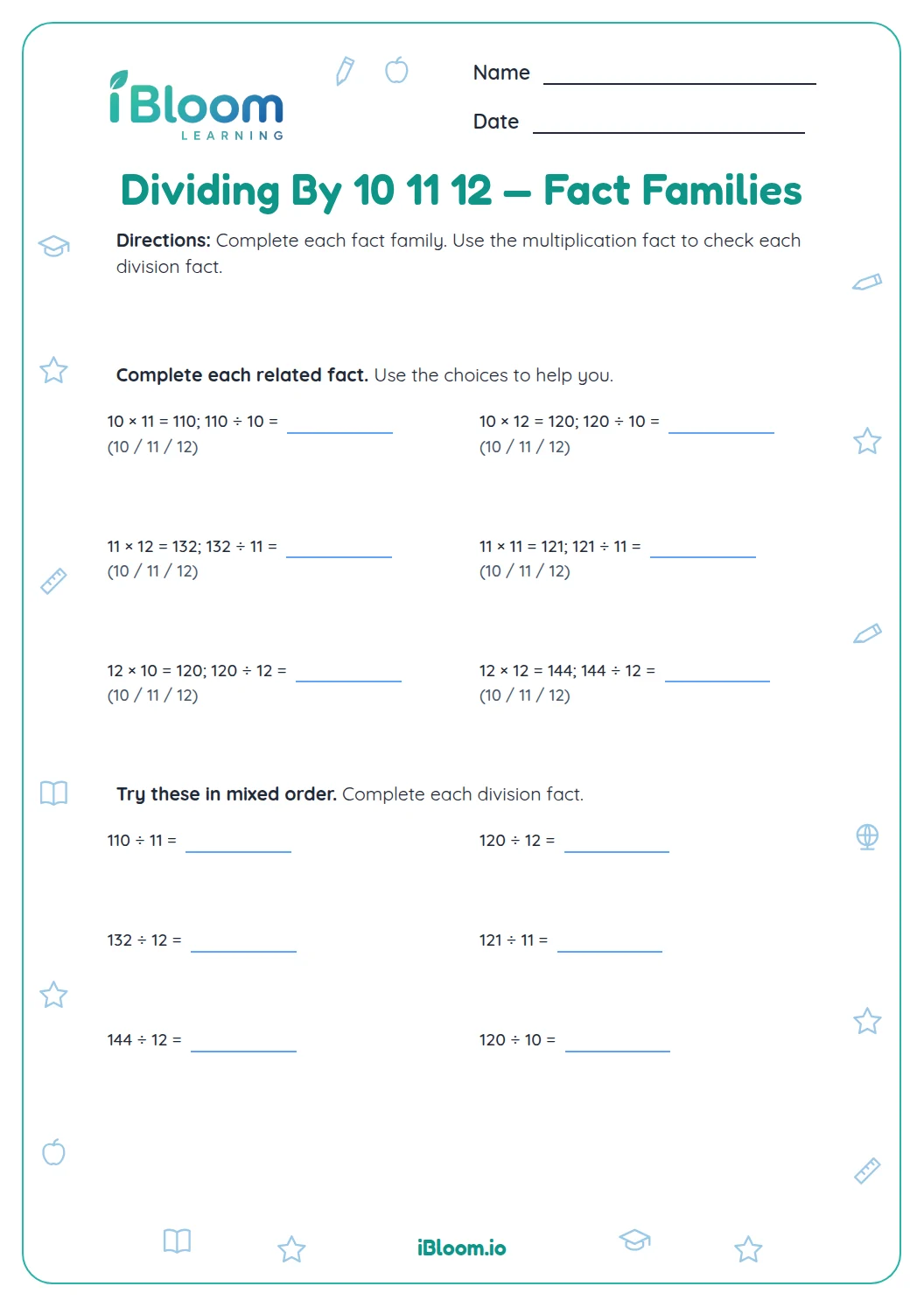
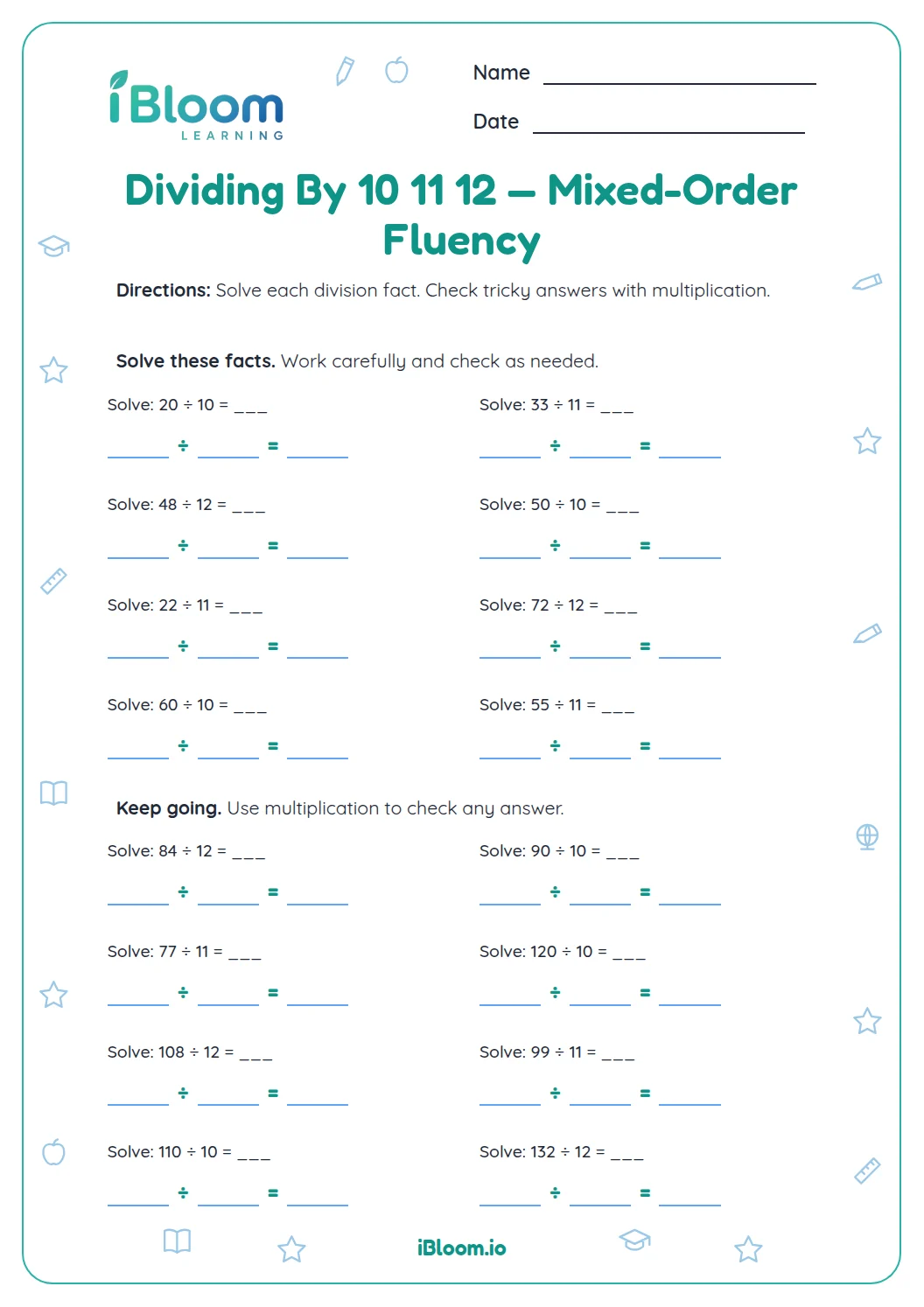
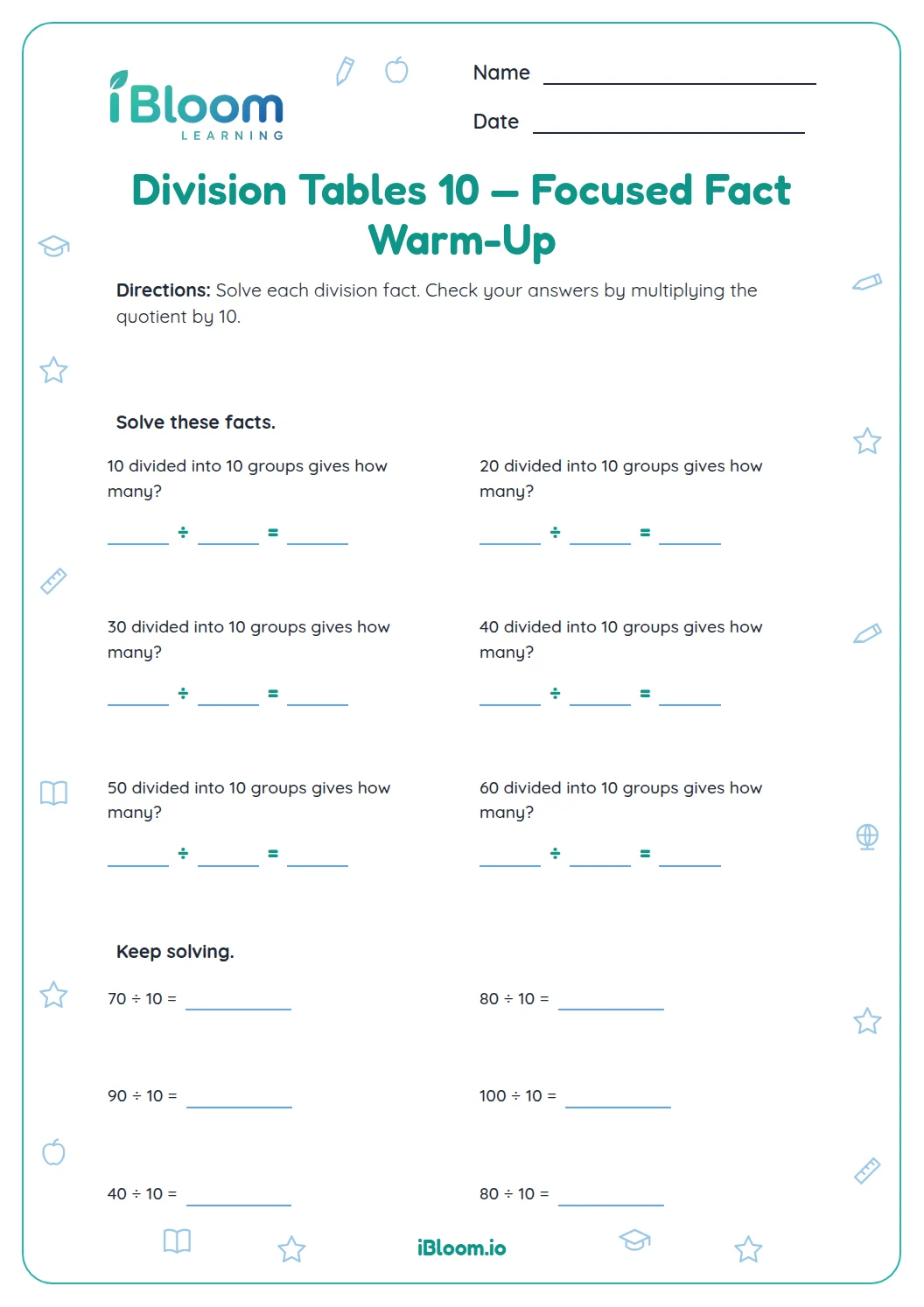
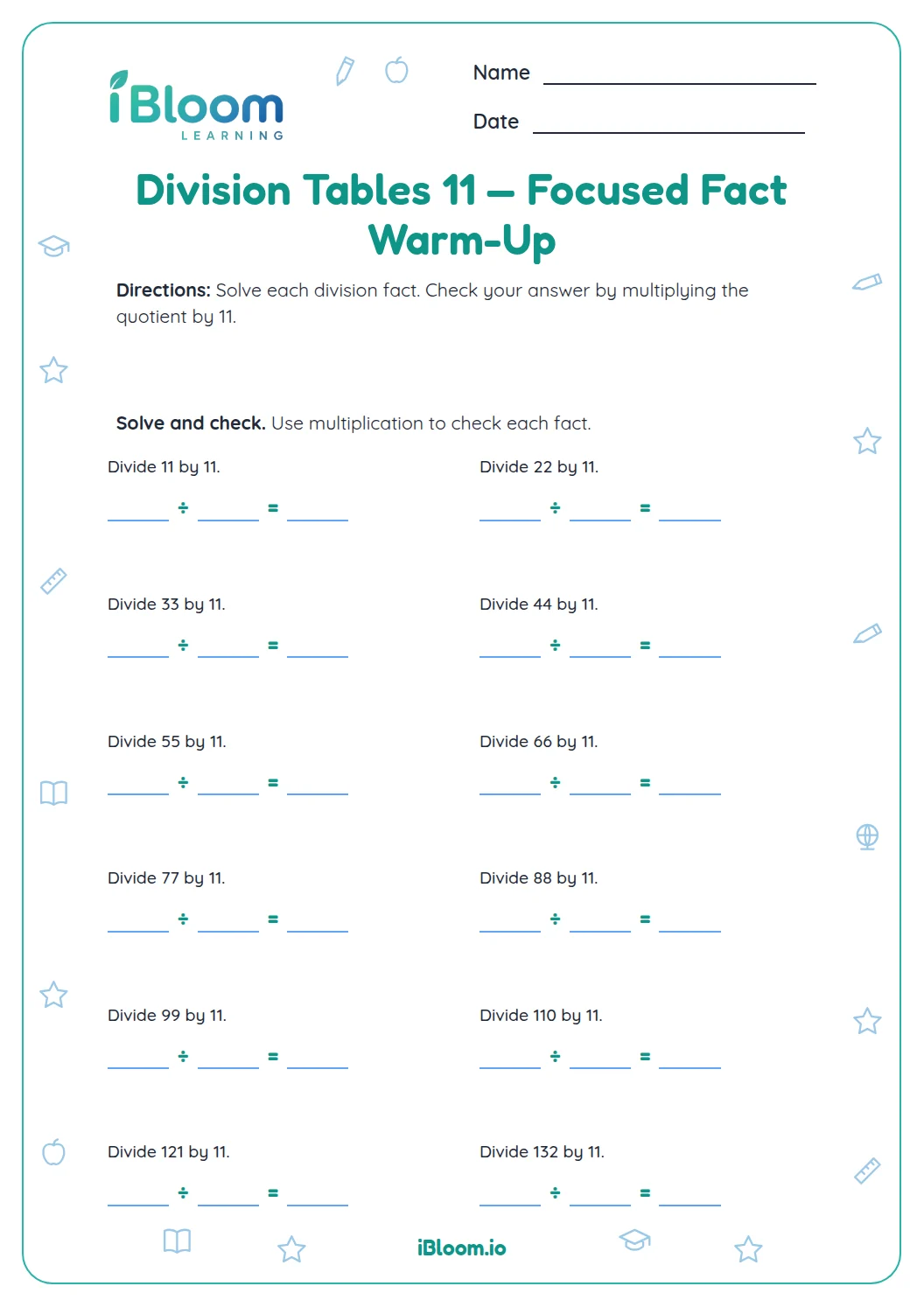
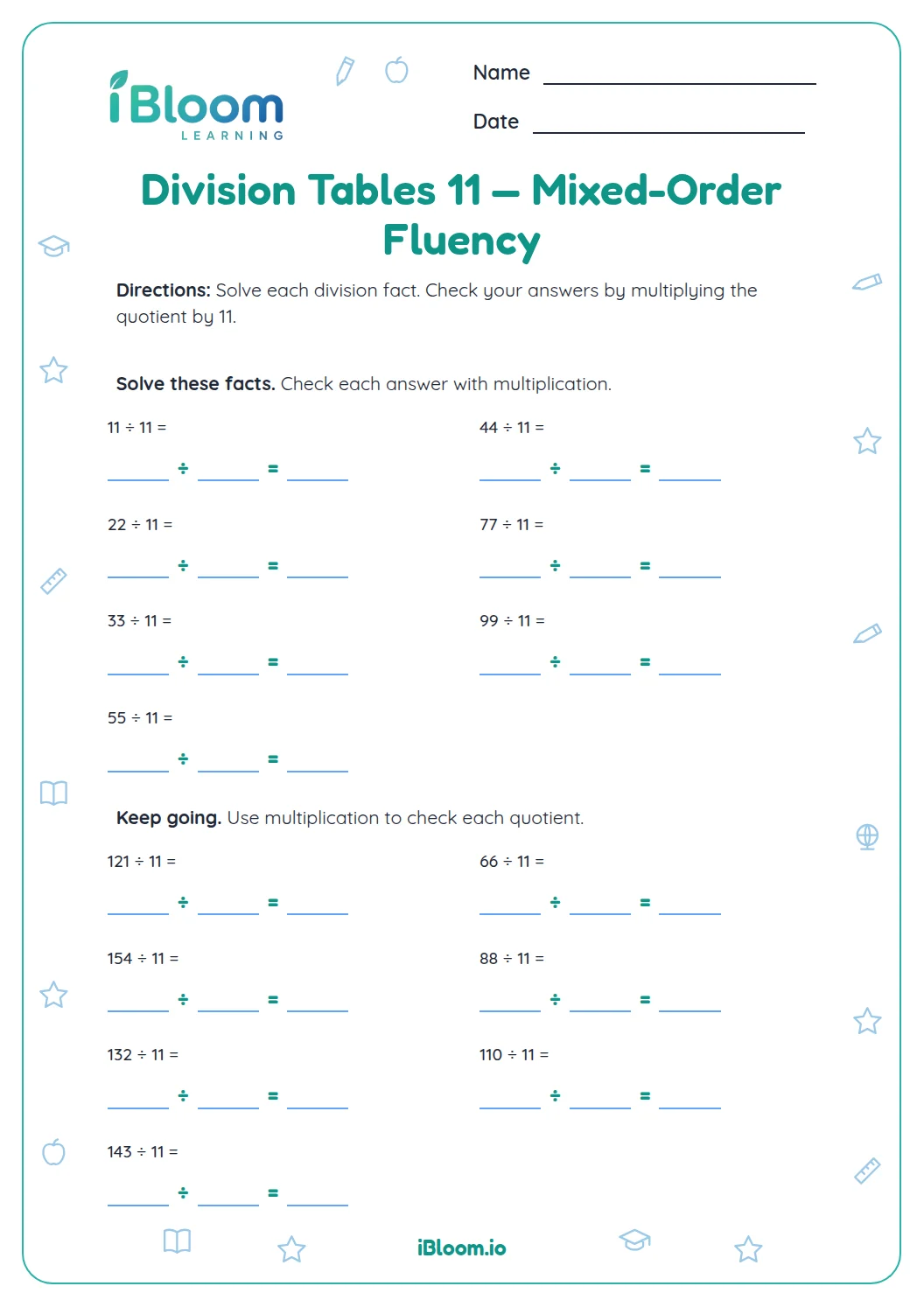
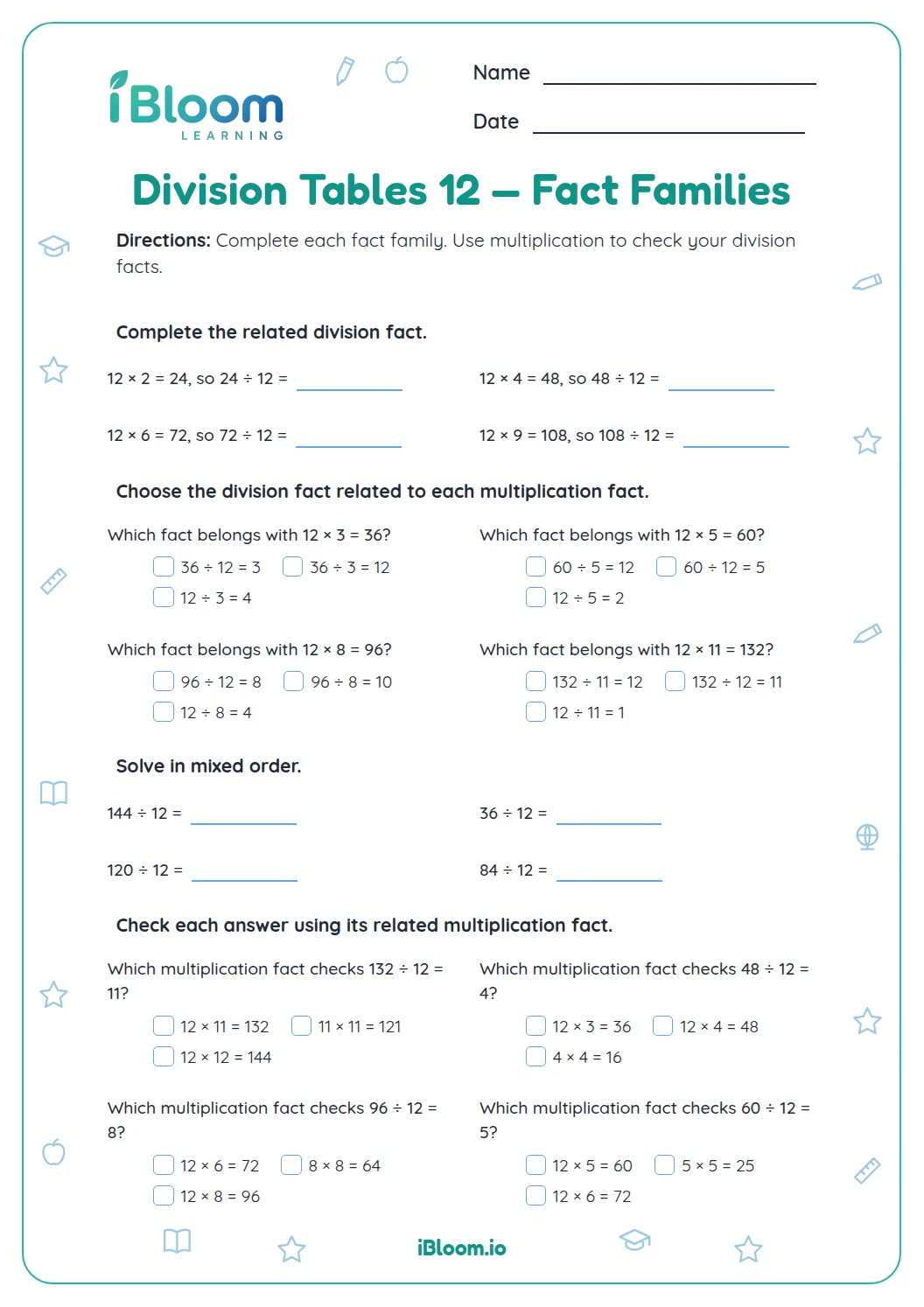
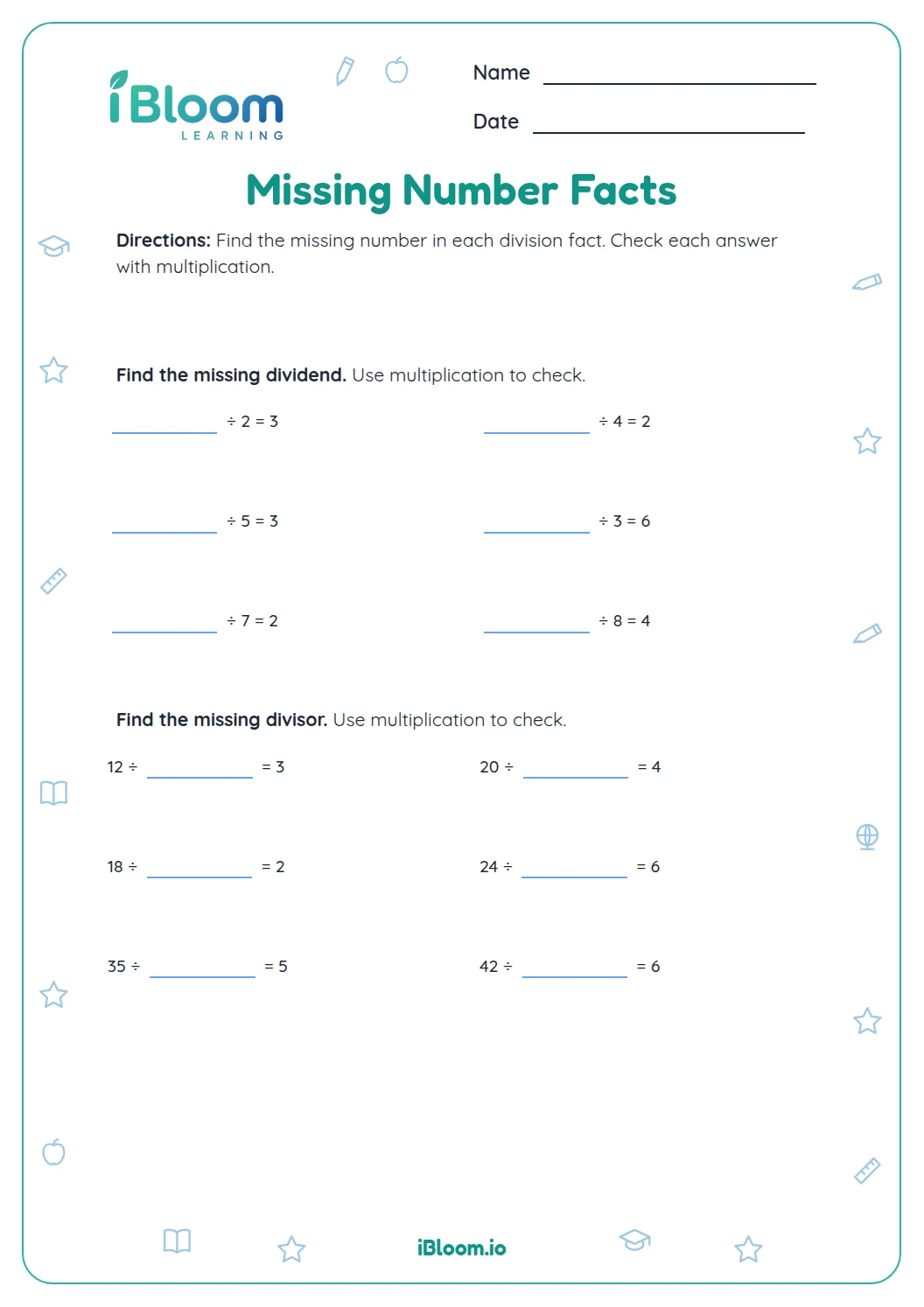
This free printable gives Grades 3–4 learners 36 division facts involving 10, 11 and 12. Children first find missing quotients, then missing dividends, and finally missing divisors. Each divisor appears twelve times across the sheet. The changing blank position encourages children to use the multiplication relationship instead of repeating one procedure. This practices Common Core 3.OA.B.6, understanding division as an unknown-factor problem. All facts divide evenly, and the separate answer key makes it easy to check each completed equation.
Aligned to 3.OA.B.6
What changes when the blank moves?
A quotient is the result of division. A dividend is the number being divided. A divisor is the number you divide by. Point to those places in 30 ÷ 10 = 3 before beginning.
Part A has twelve missing quotients, Part B has twelve missing dividends and Part C has twelve missing divisors. Each part includes four facts for each of 10, 11 and 12.
How does multiplication help?
Multiplication checks the relationship in every fact. When the dividend is missing, multiply the two known numbers. When the divisor or quotient is missing, ask which factor completes the product.
- 1___ ÷ 12 = 8
- 2Think: 12 × 8 = 96.
- 3Write 96 in the blank.
- 4Check: 96 ÷ 12 = 8.
Why do two divisor clues both start with 60?
The last part includes 60 ÷ ___ = 6 and 60 ÷ ___ = 5. The same total can be divided in different ways: 10 × 6 and 12 × 5 both make 60. Children must attend to the quotient to choose the divisor.
The zero-dividend fact in Part B is another useful check. Since 10 × 0 = 0, the missing dividend is 0. Encourage children to read the completed equation aloud.
How to use this worksheet
- 1Name the dividend, divisor and quotient in 30 ÷ 10 = 3.
- 2Finish Part A using related multiplication facts.
- 3For each Part B item, multiply divisor by quotient.
- 4For Part C, find the factor that completes the dividend.
- 5Substitute every answer into its equation and check with multiplication.
Mistakes to notice and how to help
The mistake
Dividing 12 by 8 for ___ ÷ 12 = 8.
The fix
The total is missing. Multiply 12 × 8 to rebuild it.
The mistake
Writing 6 for 60 ÷ ___ = 6.
The fix
Check the full equation: 6 × 6 is 36. The missing divisor is 10.
The mistake
Writing 10 for ___ ÷ 10 = 0.
The fix
Use 10 × 0 = 0; zero is the number being divided.
Common Core alignment
Use related multiplication facts to find missing numbers in division equations.
On this sheet: Children use divisor × quotient = dividend to solve division facts with three different blank positions.
Show the official wordingHide the official wording
Understand division as an unknown-factor problem. For example, find 32 ÷ 8 by finding the number that makes 32 when multiplied by 8.
What to practice next
Make more practice
Further reading
Questions parents and teachers ask
Are all three divisors practiced equally?
Yes, each of 10, 11 and 12 is the divisor in twelve facts. Each table has four missing quotients, four missing dividends and four missing divisors. This balance lets you compare how your child handles the three tables and the changing positions of the blanks.
What should my child do when the first number is missing?
Multiply the divisor by the quotient to find the dividend. For ___ ÷ 12 = 8, use 12 × 8 = 96. Then read the completed equation aloud and check it. This routine works for all twelve missing-dividend questions in Part B.
Why is there a zero in the answer key?
Zero is the answer to ___ ÷ 10 = 0. The multiplication check is 10 × 0 = 0, so the dividend must be zero. Ask your child to put zero into the blank and read the complete fact before moving on.
Should I time this drill?
Timing is optional; checking the blank position is the main task. Let your child solve the facts accurately first, then review any errors with related multiplication. If you later repeat the sheet for fluency, compare careful work with earlier work rather than setting a required speed.
How can I use the answer key to find a pattern in errors?
Group errors by part before assigning more practice. Mistakes in Part A suggest reviewing the division facts themselves. Mistakes in Part B or Part C may mean your child needs help identifying the missing quantity. Ask for a multiplication check on one missed item from each part.