


About this worksheet
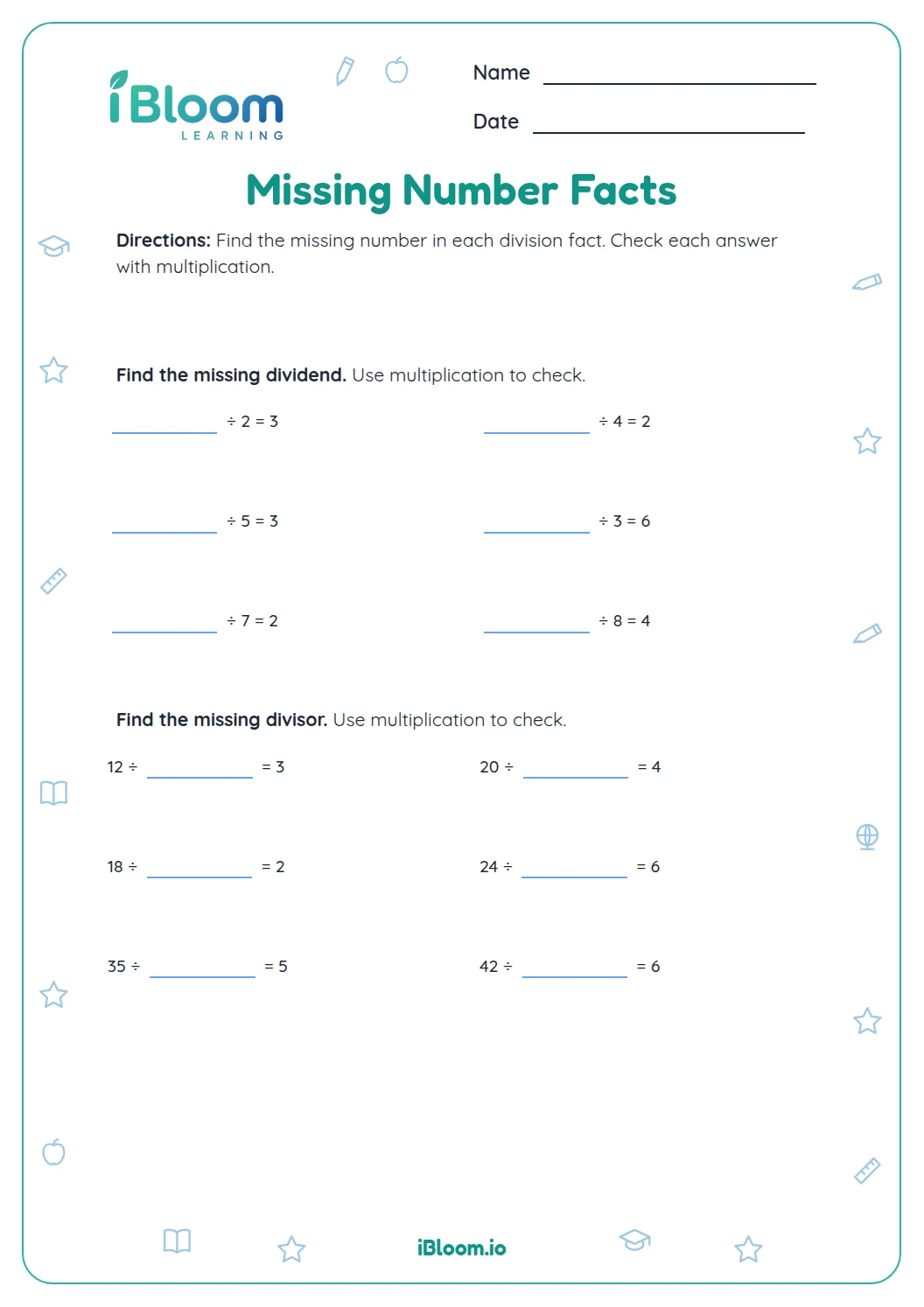
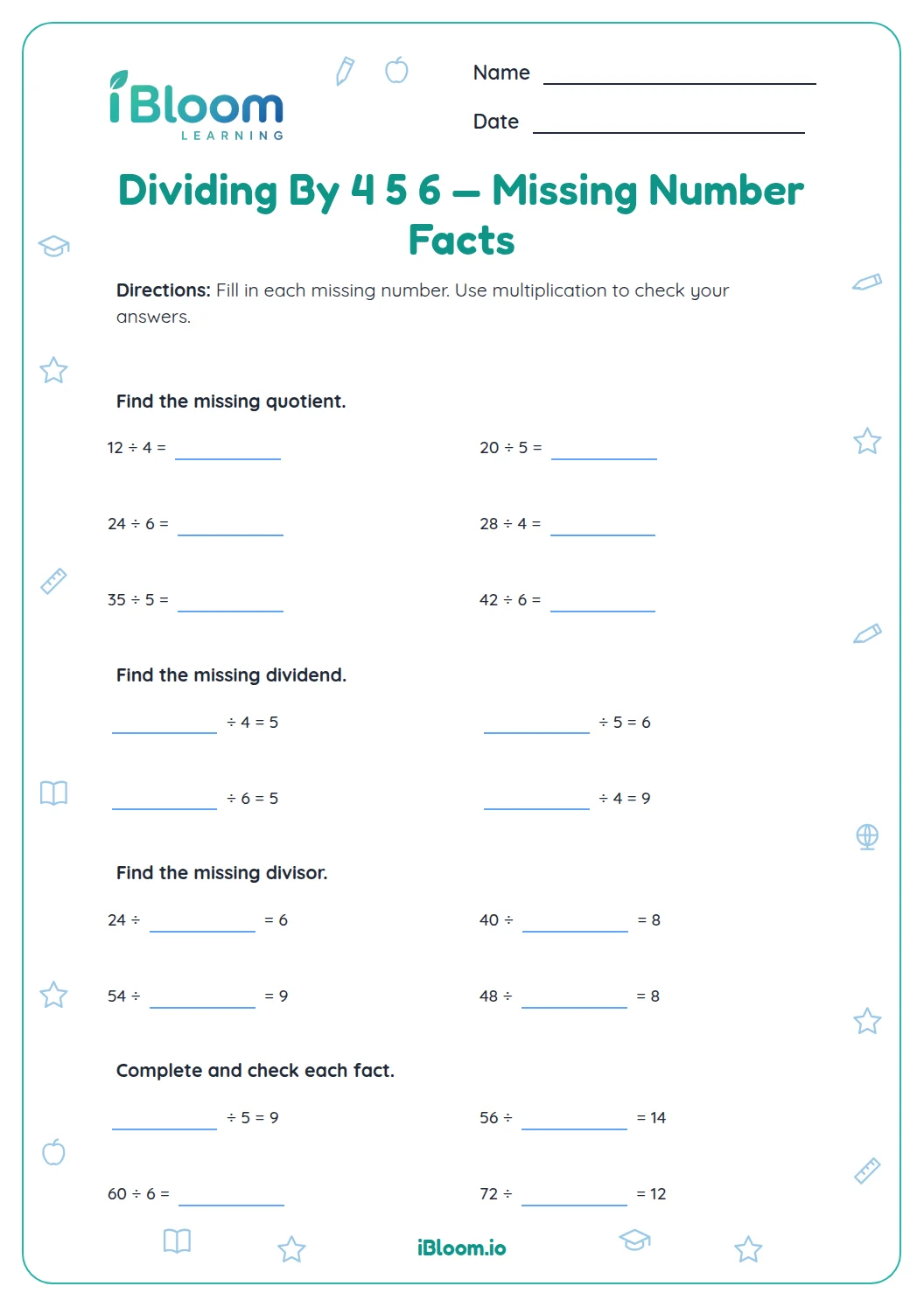
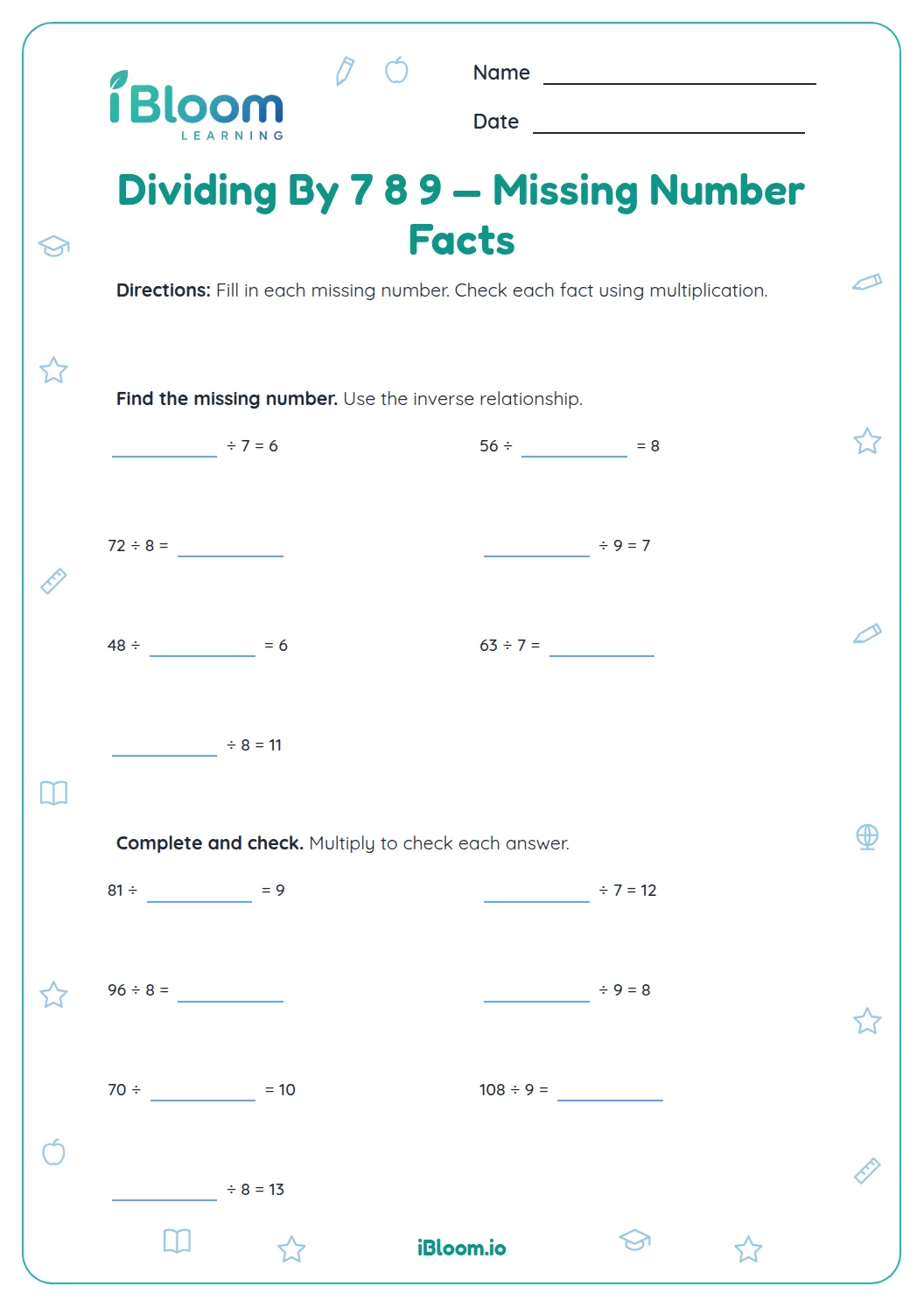
This Grade 3 printable gives practice with the two unknown positions in division facts: the dividend and the divisor. Part A asks for missing dividends; Part B mixes missing dividends and divisors; Part C asks children to check facts by multiplying the divisor by the quotient. For example, in 28 ÷ ___ = 7, the missing divisor is 4 because 4 × 7 = 28. The 20 equations use whole-number facts within 100 and come with a separate answer key.
Aligned to 3.OA.A.4
What kinds of missing numbers are practiced?
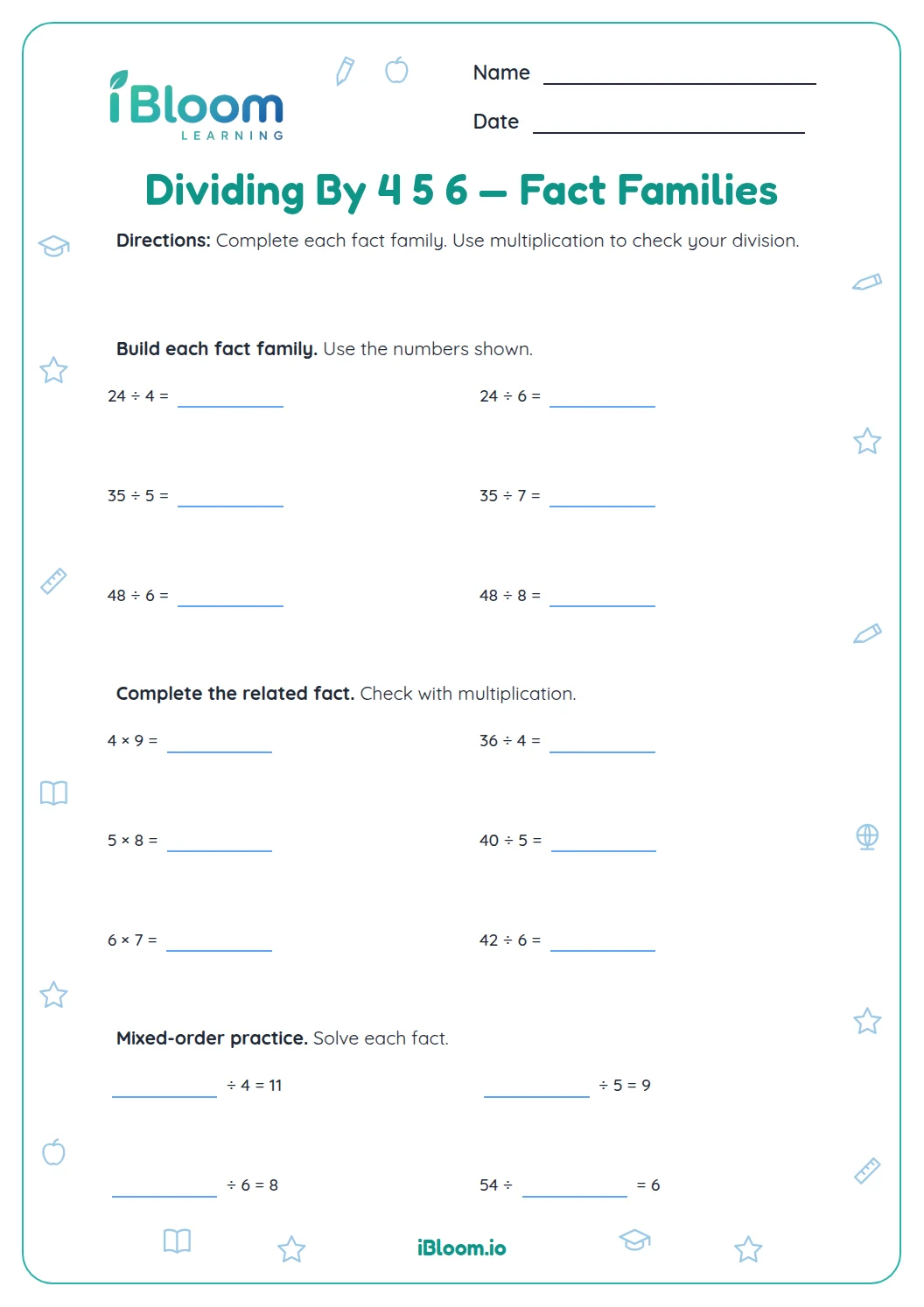
Part A focuses on missing dividends, as in ___ ÷ 4 = 3. Part B mixes missing dividends and divisors. Part C adds a multiplication check, connecting each division fact to a related multiplication fact.
How can multiplication check a division fact?
A division fact asks how many equal groups fit or how many are in each group. The related multiplication fact reverses that relationship.
- 128 ÷ ___ = 7
- 24 × 7 = 28, so the missing divisor is 4.
What should I check before writing an answer?
Identify the position of the blank first. A missing dividend is the number being divided; a missing divisor is the number you divide by. Substitute your answer into the equation and check that both sides agree.
How to solve each missing-number fact
- 1Read the equation and locate the blank.
- 2Name the blank as a dividend or divisor.
- 3Use multiplication to find the number that completes the fact.
- 4Write the missing number in the answer space.
- 5Substitute it back into the division equation.
- 6For the final part, write the related multiplication check.
Common mistakes and quick fixes
The mistake
Using the quotient as the missing divisor.
The fix
Multiply the quotient by a possible divisor and check whether it makes the dividend.
The mistake
Finding a missing dividend by dividing the quotient by the divisor.
The fix
Multiply the divisor by the quotient to get the dividend.
The mistake
Checking with a different number than the one written in the blank.
The fix
Substitute your answer first, then verify the full division fact.
Common Core alignment
Find the missing number in a division equation.
On this sheet: Each blank is a missing dividend or divisor in a division fact.
Show the official wordingHide the official wording
Determine the unknown whole number in a multiplication or division equation relating three whole numbers.
What to practice next
Make more practice
Further reading
Questions parents and teachers ask
What is a missing dividend?
The dividend is the number being divided. In ___ ÷ 4 = 3, multiply the divisor 4 by the quotient 3 to find the missing dividend, 12. Part A gives children practice finding that number from a related multiplication fact.
How do you find a missing divisor?
Use the quotient and dividend to find the factor that makes the dividend. In 28 ÷ ___ = 7, ask what number multiplied by 7 equals 28; the missing divisor is 4. Then check that 28 divided by 4 equals 7.
What is on the worksheet?
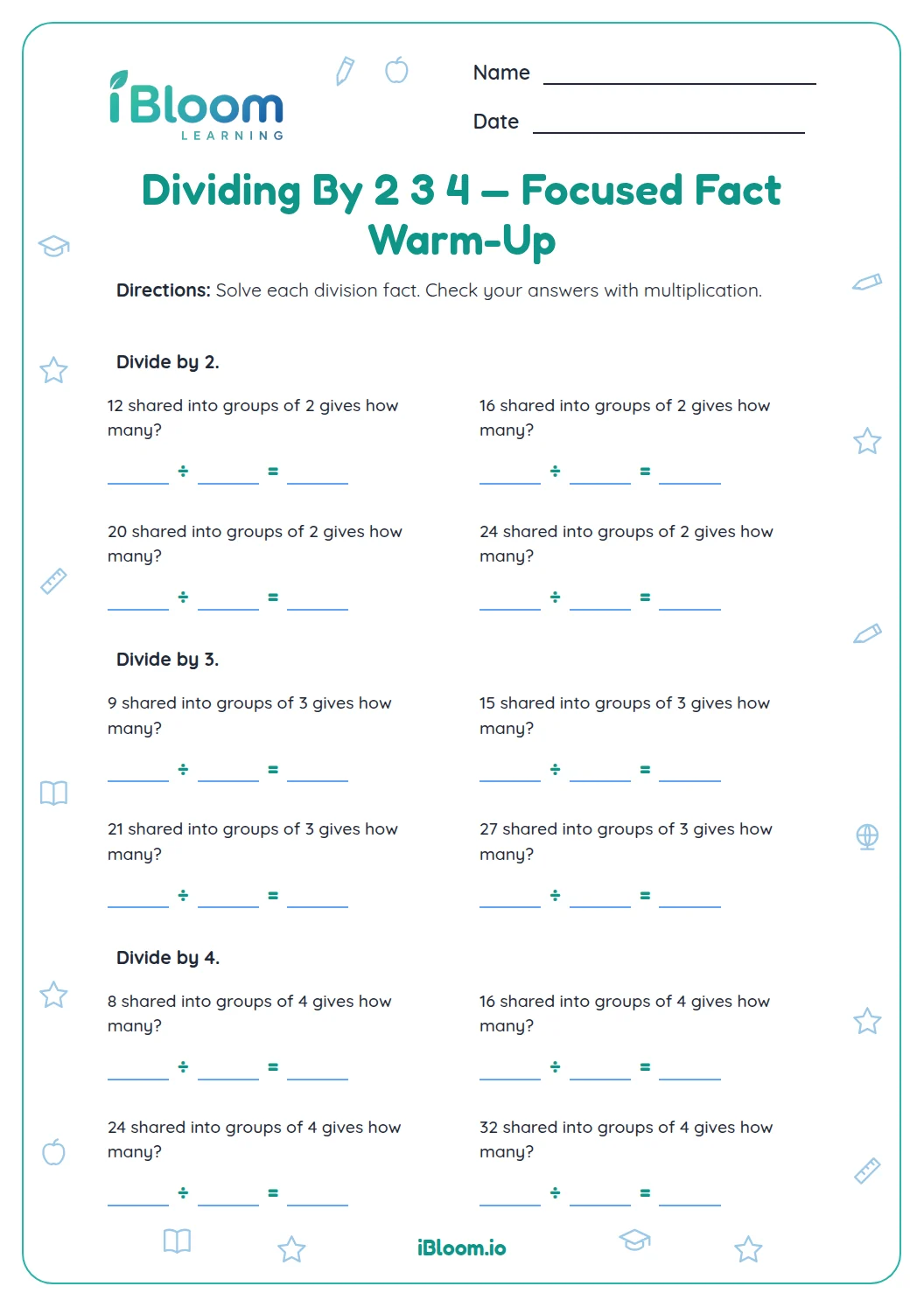
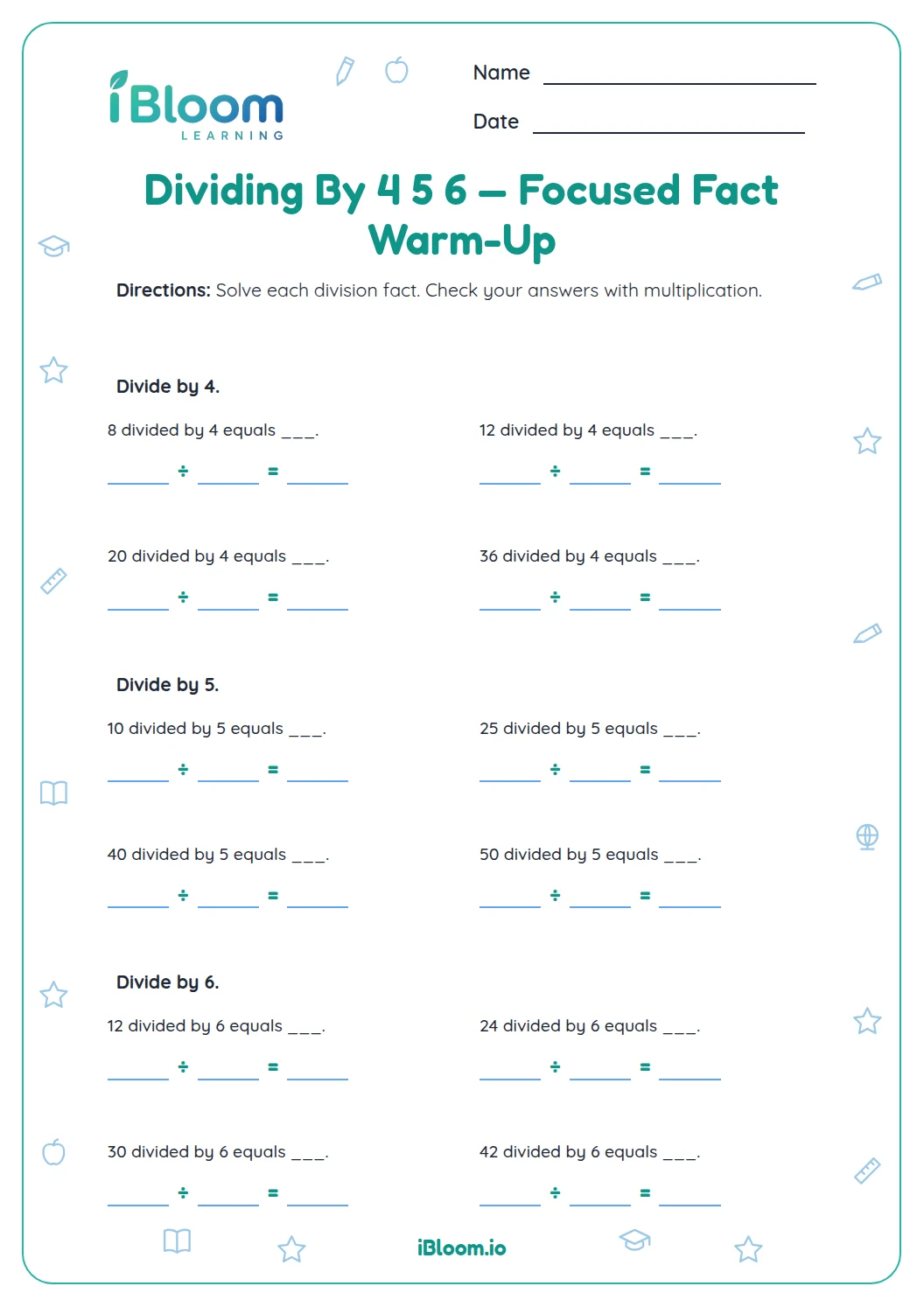
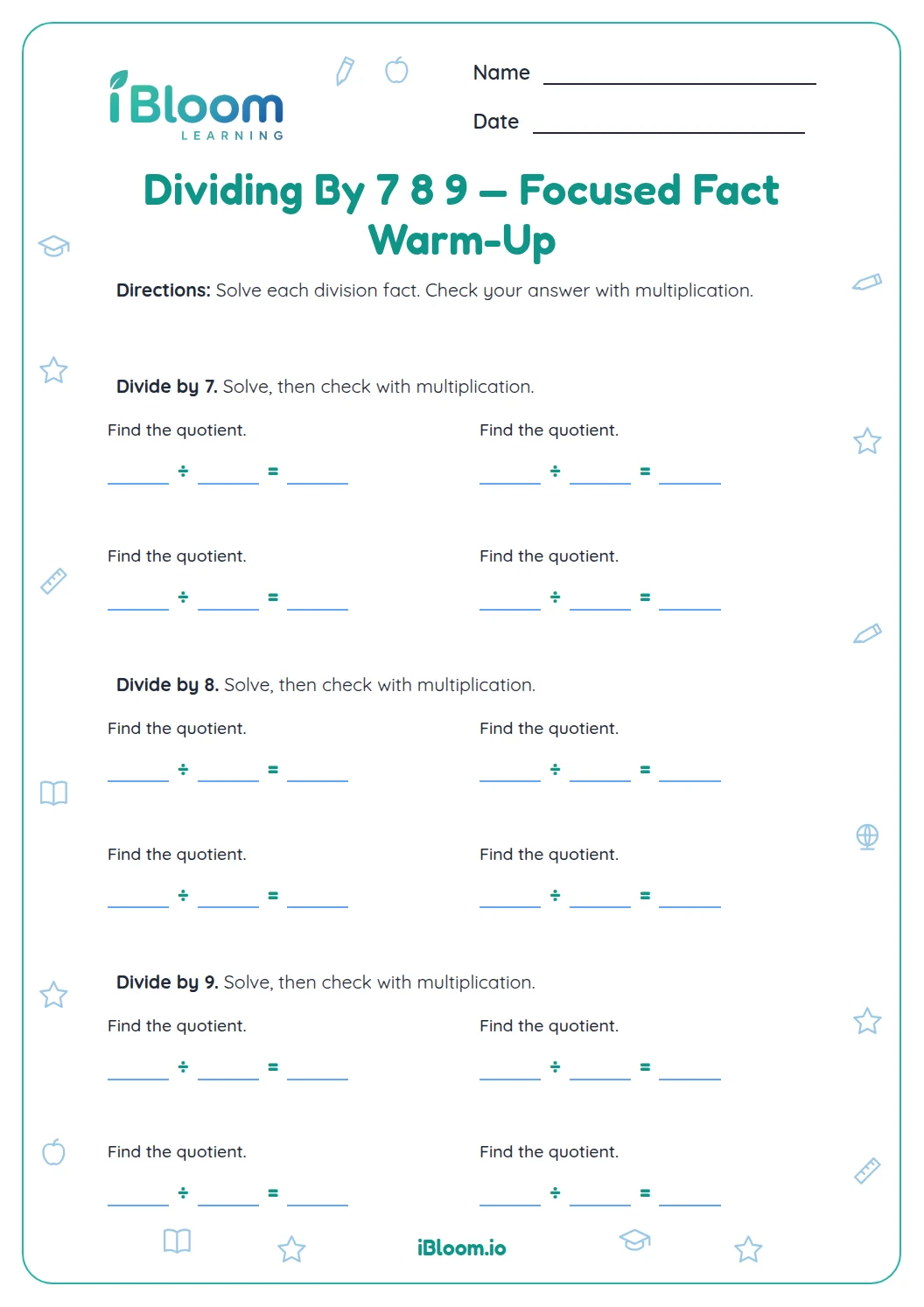
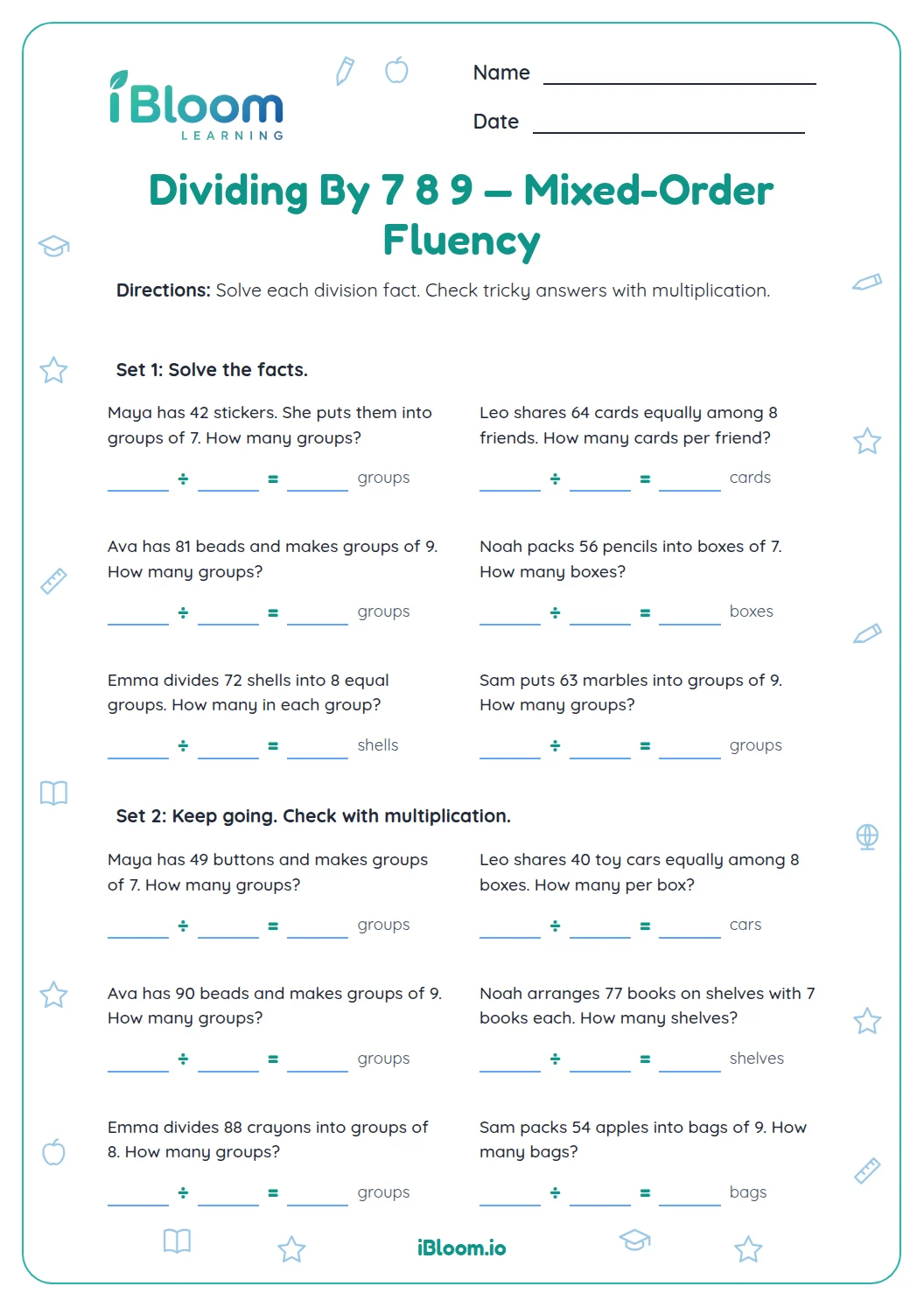
The 20 equations are divided into three parts: missing dividends, a mix of missing dividends and divisors, and facts to check with multiplication. The two worksheet pages are followed by two answer-key pages with the completed values, so children can check each blank after solving.
Why use multiplication to check division?
Multiplication reverses a division fact. If 42 ÷ 7 = 6, then 7 × 6 = 42. That related fact confirms whether a missing dividend or divisor makes the original equation true, and gives children a second way to check their answer.
How long does this division practice take?
About 15 minutes is a reasonable starting point for 20 short equations, including time to check the final facts. A child can pause after a part and return to the remaining questions later, while keeping the answer key separate until ready to review.