




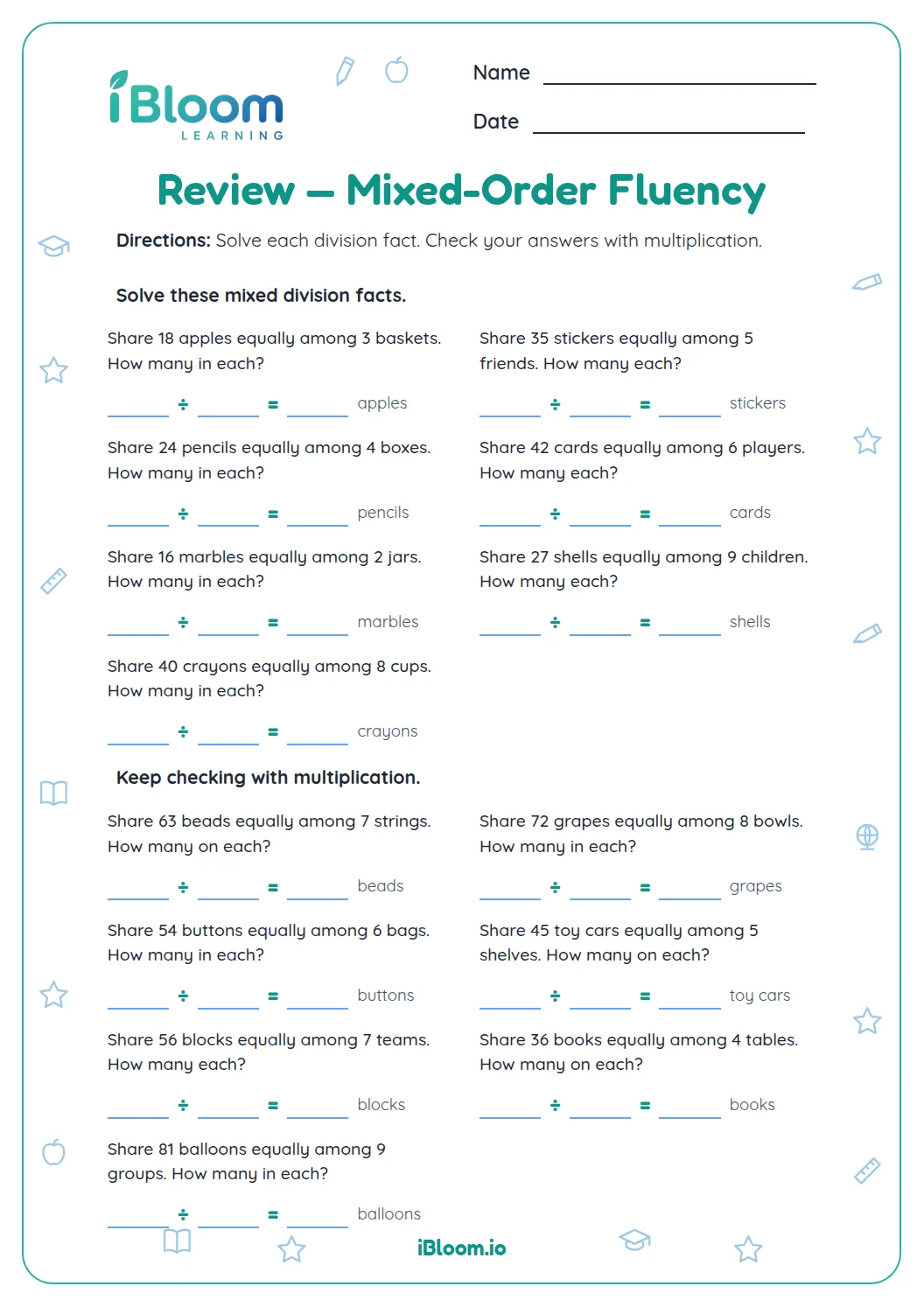
About this worksheet
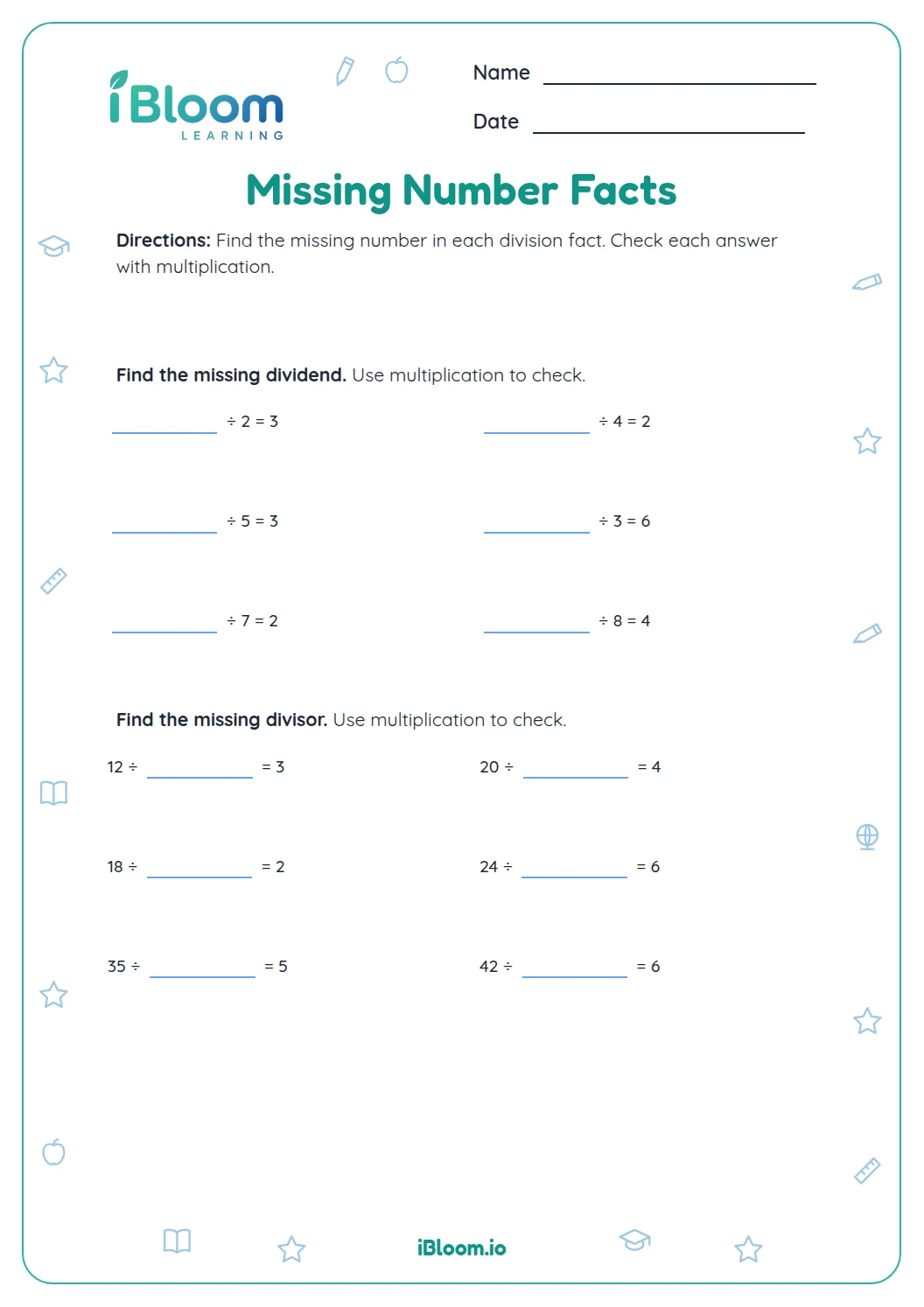
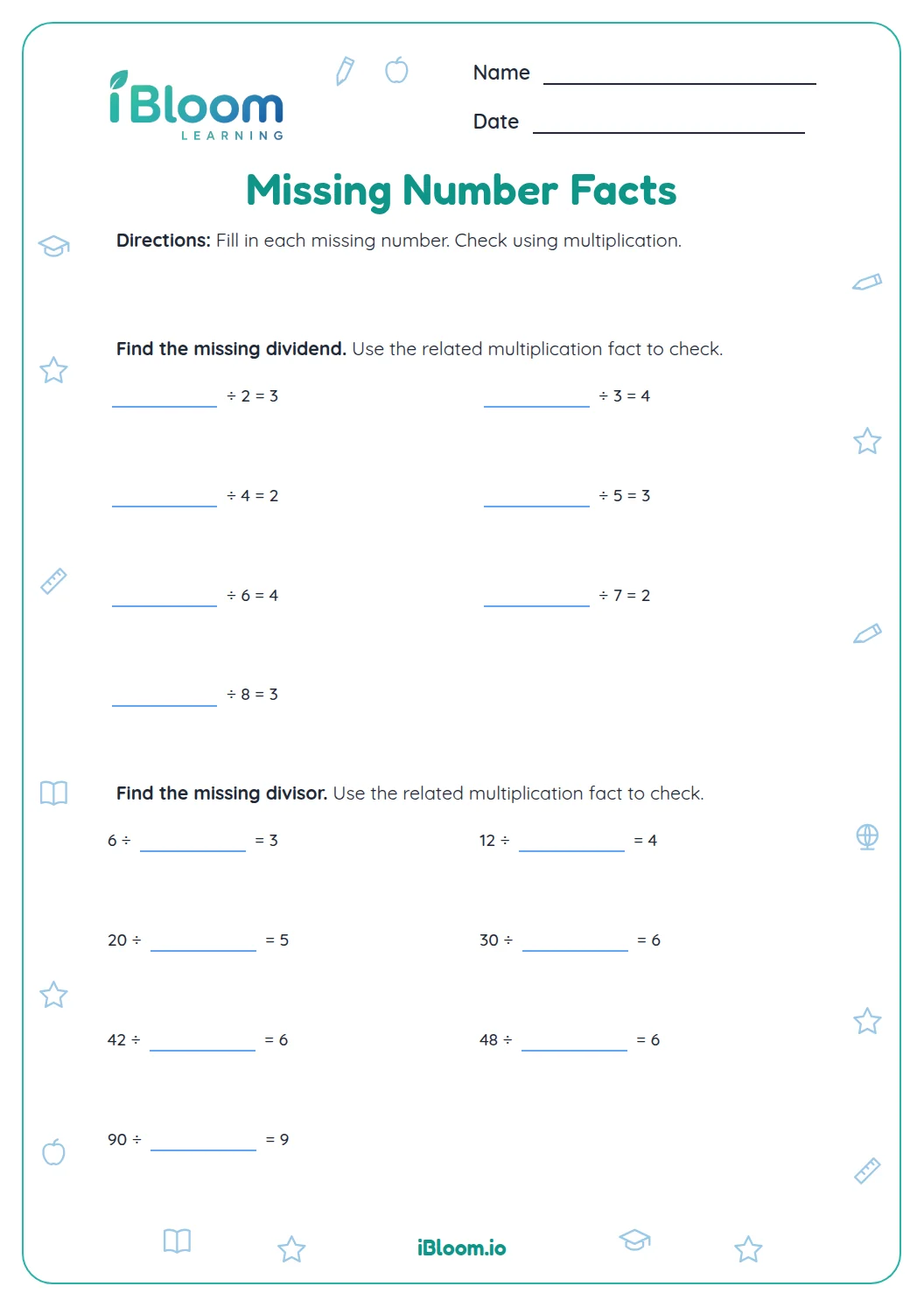
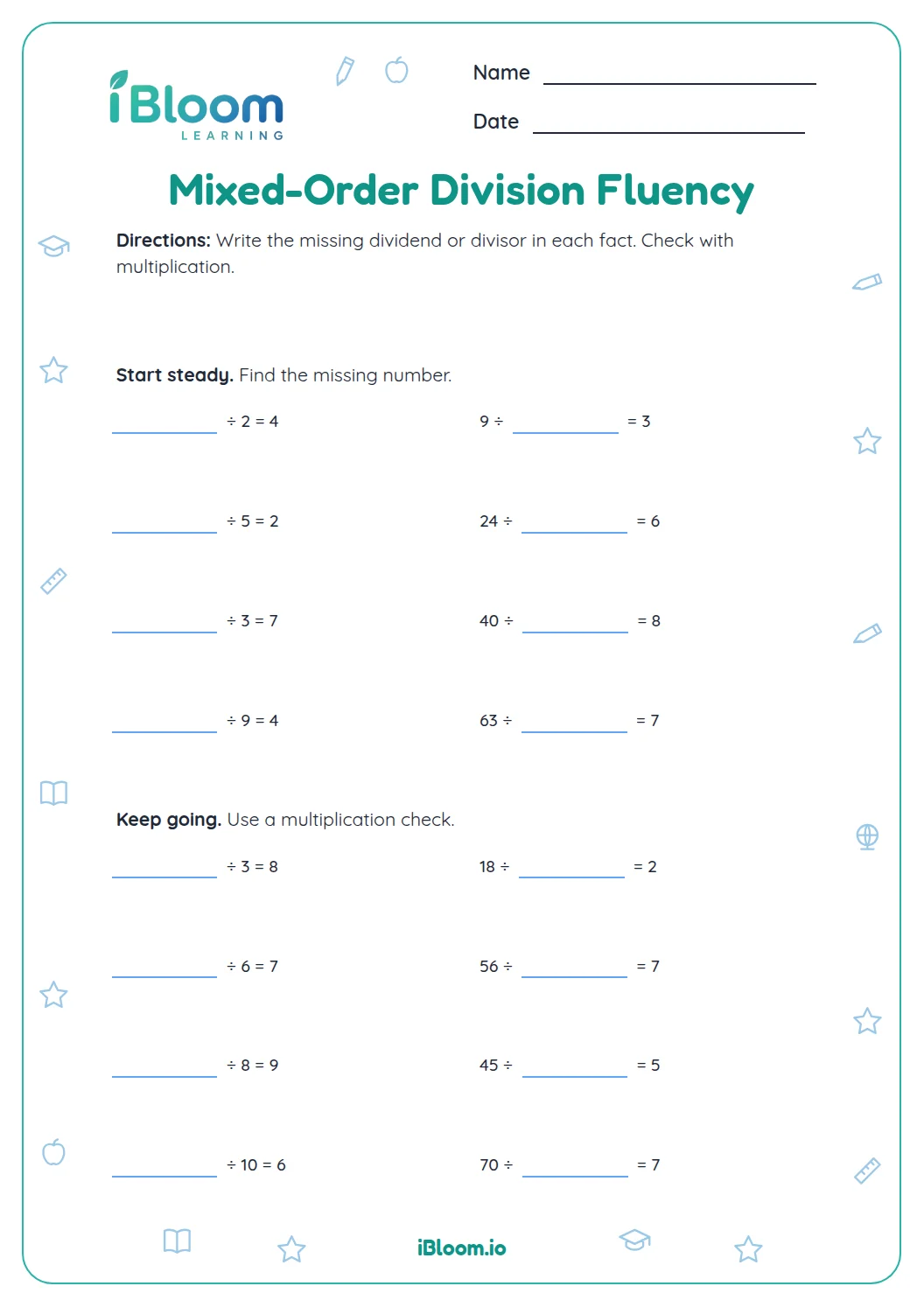
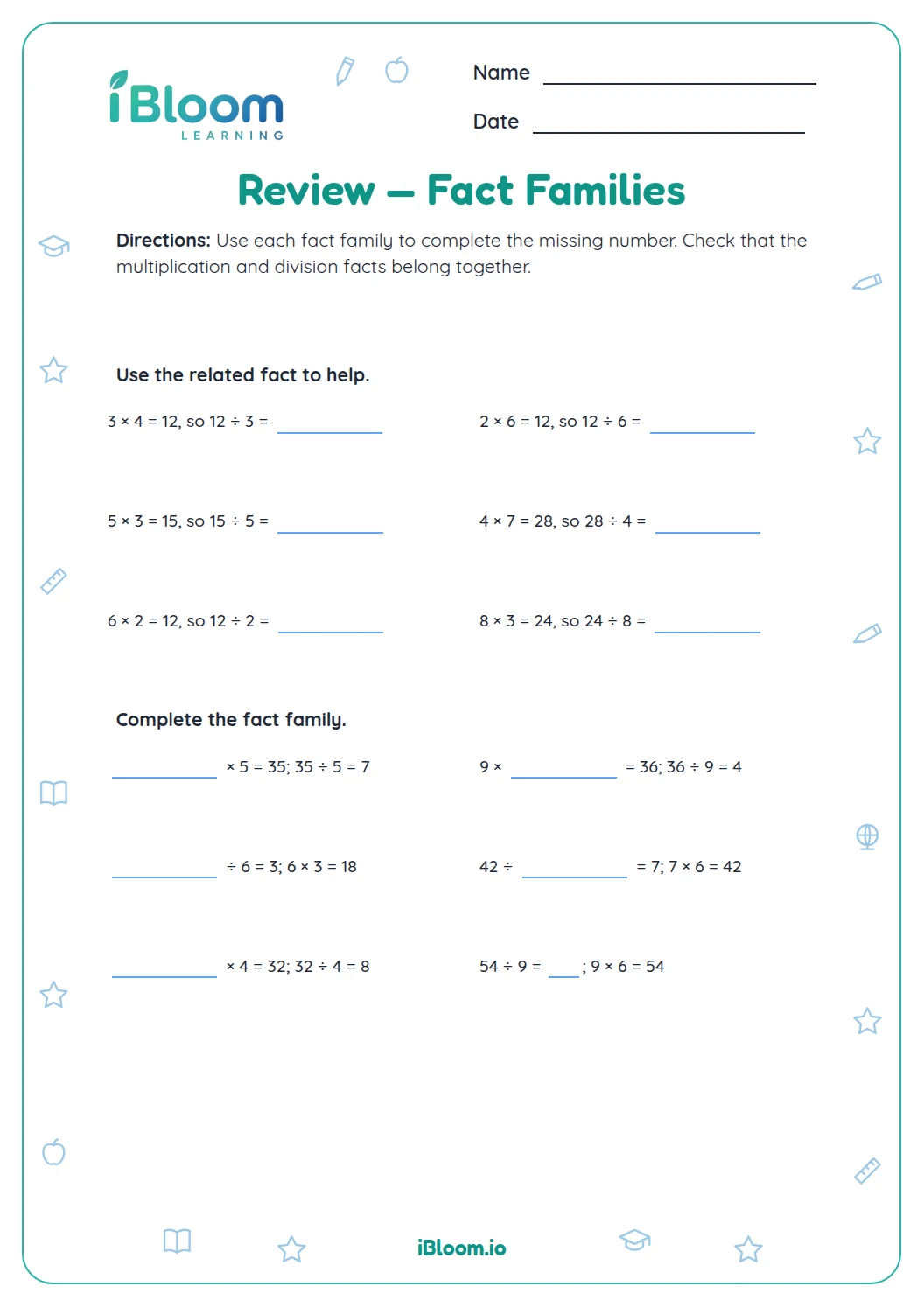
This free printable math drill gives Grade 3 and Grade 4 students 27 division facts that each have one missing number. In Part A the dividend is missing, in Part B the divisor is missing, and in Part C the blank moves around, even to equations that begin with the answer, such as 5 = ___ ÷ 3. Children use what they know about multiplication to find each number. The practice supports Common Core 3.OA.A.4 and 3.OA.C.7, and the answer key lists every missing number.
Aligned to 3.OA.A.4 and 3.OA.C.7
What is on this worksheet?
There are 27 division facts, each with a blank to fill and no word problems. Every fact comes from the times tables up to 10 × 10, so the biggest dividend is 90.
Part A hides the dividend (the number being divided). Part B hides the divisor (the number you divide by). Part C mixes them, and some of its equations are written with the answer first, so the blank is not always in the same place.
- Part A: missing dividends, such as ___ ÷ 5 = 6 (questions 1 to 9)
- Part B: missing divisors, such as 42 ÷ ___ = 7 (questions 10 to 17)
- Part C: mixed order, such as 5 = ___ ÷ 3 (questions 18 to 27)
- Answer key with every missing number
How do you find a missing dividend?
A dividend is the whole amount that gets shared. If a number divided by 5 gives 6, then 5 groups of 6 made it. So the dividend is 5 × 6.
A child who knows 5 × 6 can write 30 straight away. A child who is still learning the 5s can skip count by fives, six times: 5, 10, 15, 20, 25, 30.
- 12) ___ ÷ 5 = 6
- 2Think: 5 × 6 = 30
- 3Check: 30 ÷ 5 = 6 ✓
How do you find a missing divisor?
The divisor says how many groups, or how big each group is. With 42 ÷ ___ = 7, the question is “what number times 7 makes 42?” Multiplication facts answer it, and the fact family 6 × 7 = 42 shows the same three numbers.
A good check is to divide with the number found: 42 ÷ 6 = 7.
- 111) 42 ÷ ___ = 7
- 2Think: ___ × 7 = 42, and 6 × 7 = 42
- 3Check: 42 ÷ 6 = 7 ✓
What changes when the equation starts with the answer?
In Part C, a fact such as 5 = ___ ÷ 3 says the same thing as ___ ÷ 3 = 5, only written the other way round. Reading it backward, it is a missing-dividend fact: 3 × 5 = 15.
Seeing the same three numbers in several arrangements is what helps children treat division facts as a family and not as separate things to memorize.
How to use this worksheet at home or in class
- 1Do one fact from each part together and say it as a multiplication question aloud.
- 2Let your child complete Part A, then check the answers with multiplication.
- 3In Part B, remind your child that the missing number is the one you divide by.
- 4For Part C, ask your child to read each equals-first fact backward before solving it.
- 5Mark with the answer key and circle any fact that needed more than a few seconds to solve.
- 6Come back to the circled facts in a few days, and say each fact family out loud.
Common mistakes and quick fixes
The mistake
Dividing the numbers shown instead of multiplying, such as 6 ÷ 5 for ___ ÷ 5 = 6 (question 2).
The fix
The missing dividend is bigger than the quotient. Multiply the divisor and the quotient: 5 × 6 = 30.
The mistake
Writing the number next to the blank, such as 7 for 42 ÷ ___ = 7 (question 11).
The fix
Put the answer back: 42 ÷ 7 = 6, which is not 7. Ask “what times 7 makes 42?” instead.
The mistake
Copying the number on the left of the equals sign into the blank for 5 = ___ ÷ 3 (question 18).
The fix
Turn it around to ___ ÷ 3 = 5. Now 3 groups of 5 give the dividend, 15.
Common Core alignment
Most US states teach division facts with the Common Core standards or a close state version. These two Grade 3 standards name the work on this page.
Find the unknown number in a division equation that has three numbers.
On this sheet: All 27 facts hide one of the three numbers, including equations like 5 = ___ ÷ 3.
Show the official wordingHide the official wording
Determine the unknown whole number in a multiplication or division equation relating three whole numbers. For example, determine the unknown number that makes the equation true in each of the equations 8 × ? = 48, 5 = _ ÷ 3, 6 × 6 = ?
Use multiplication facts to divide quickly within 100.
On this sheet: Every dividend is 90 or less, and each fact is solved and checked through its multiplication partner.
Show the official wordingHide the official wording
Fluently multiply and divide within 100, using strategies such as the relationship between multiplication and division (e.g., knowing that 8 × 5 = 40, one knows 40 ÷ 5 = 8) or properties of operations. By the end of Grade 3, know from memory all products of two one-digit numbers.
What to practice next
Make more practice
Further reading
Questions parents and teachers ask
Why are there missing numbers instead of plain division facts?
Missing-number facts make children think about how division and multiplication connect, not only recall a quotient. To find ___ ÷ 5 = 6, a child must know that 5 × 6 gives the dividend. That link is useful later for checking long division and solving equations, and it is the key idea behind this sheet.
What are the dividend, divisor and quotient?
The dividend is the number being divided, the divisor is the number you divide by, and the quotient is the answer. In 56 ÷ 7 = 8, the dividend is 56, the divisor is 7 and the quotient is 8. This worksheet hides the dividend in Part A and the divisor in Part B.
Why do some equations start with the answer?
Writing 5 = ___ ÷ 3 puts the answer on the left of the equals sign. It means the same thing as ___ ÷ 3 = 5, so children learn that the equals sign shows two sides that are the same, not just “the answer comes next.” Part C includes ten facts written in different orders.
Is this a timed drill?
No. There is no timer on the page, and accuracy comes first. If your child enjoys a challenge, you can time one part and try to beat it another day. Circle any fact that took a long time and come back to it in a few days, so practice goes where it is needed.
What if my child does not know the times tables yet?
Let your child use a multiplication chart or skip counting to find each missing number, then check it by dividing. Every fact comes from the tables up to 10, so the circled facts show exactly which tables, such as the 7s or 8s, need more practice before trying the sheet again without the chart.
What should my child do after this worksheet?
Ask your child to pick one fact and write its full family: two multiplications and two divisions with the same three numbers. After that, try Missing Dividends Divisors To 10 for another set of missing-number facts, or the Horizontal and Vertical To 100 worksheets for division facts in different layouts.