
About this worksheet
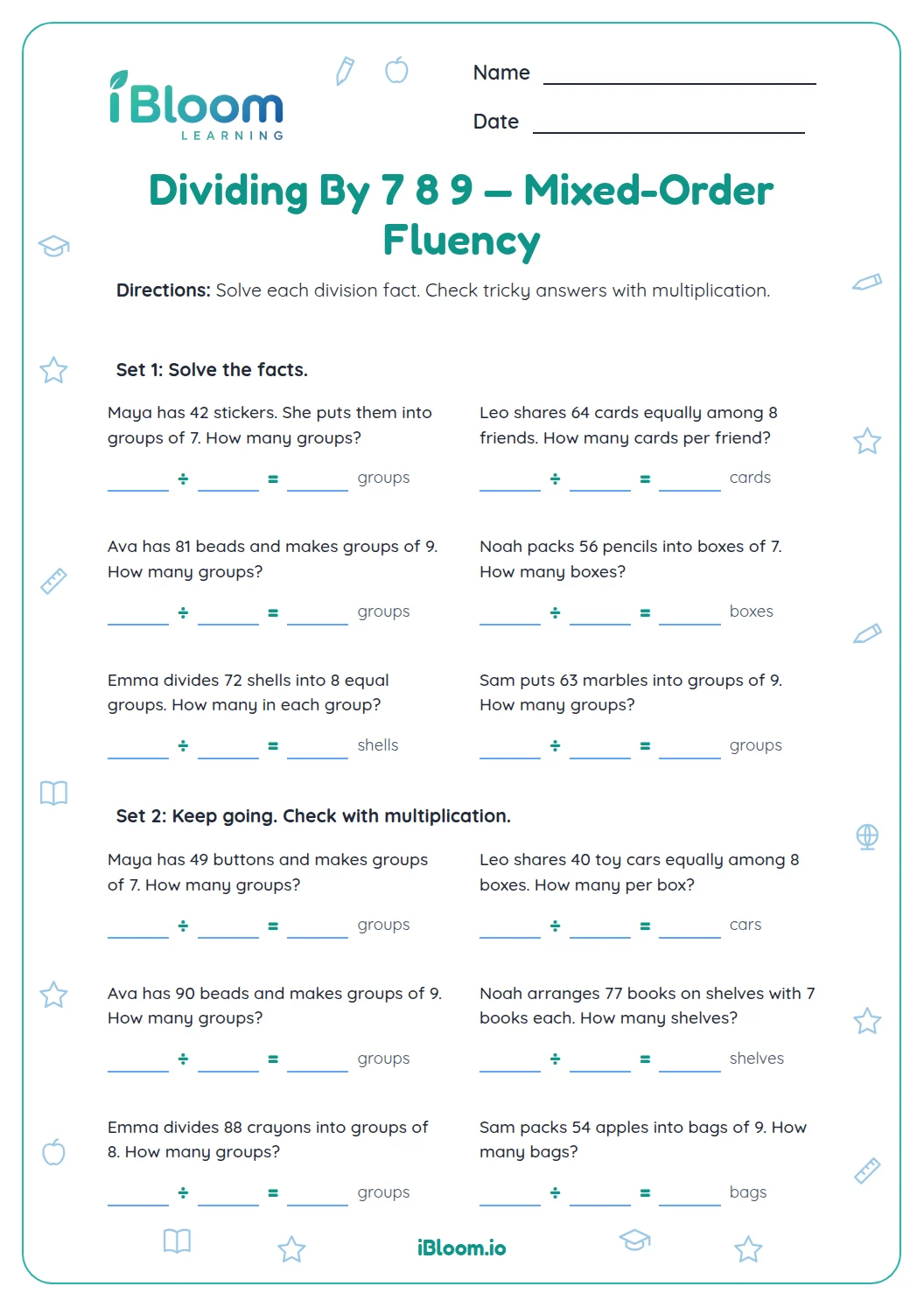
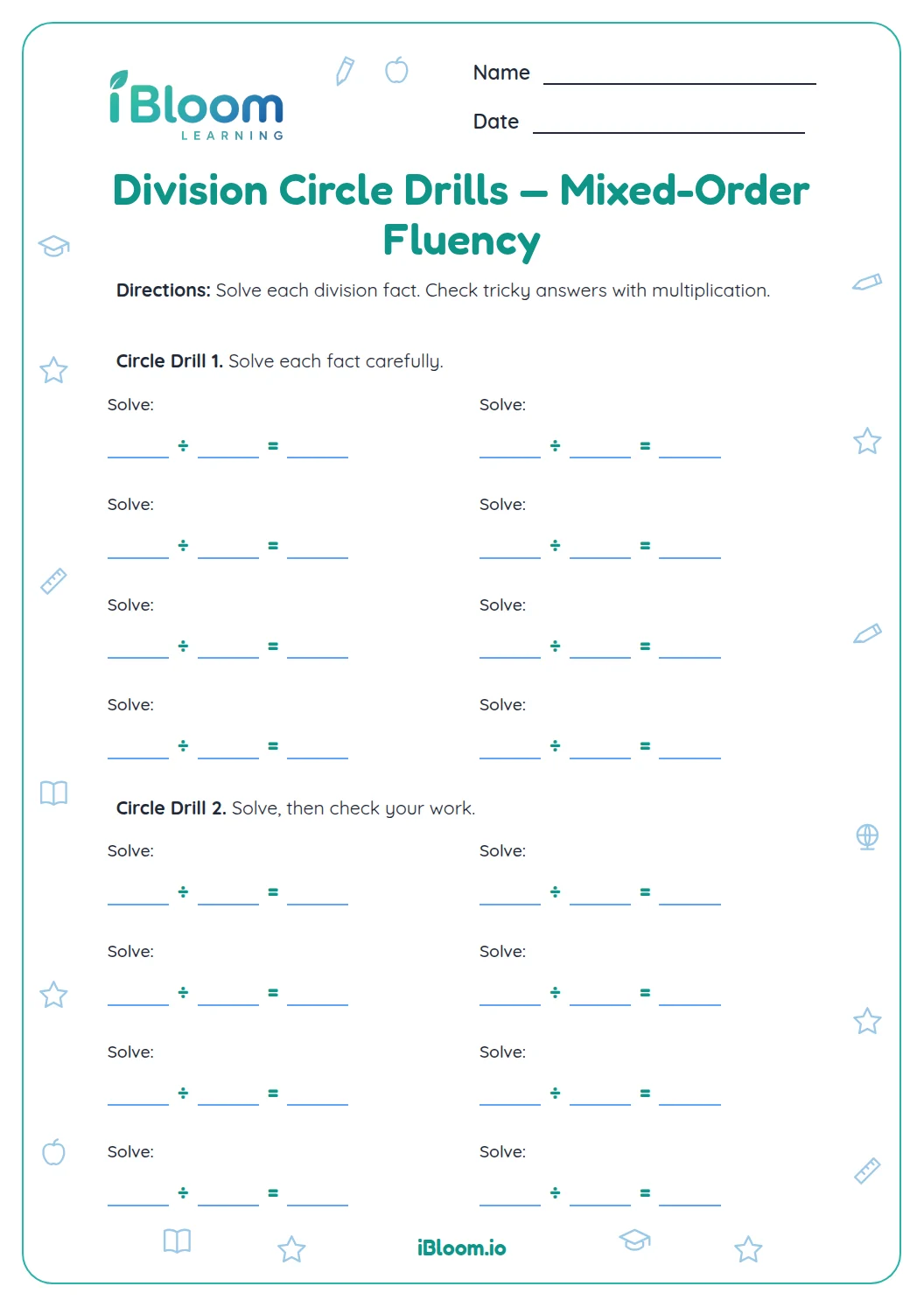
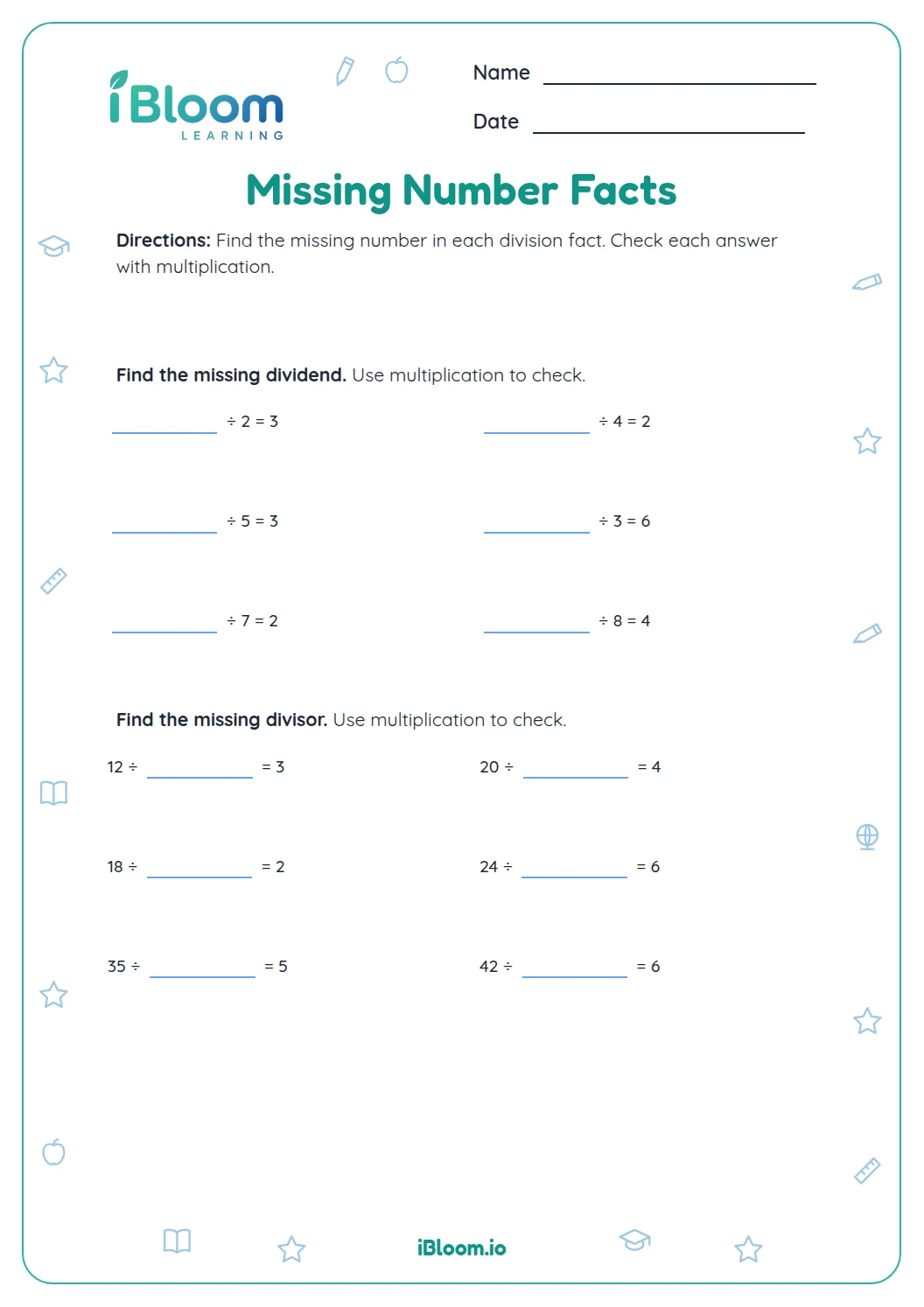
This Grade 3 printable gives students 20 division facts with dividends below 100. The two parts move from a first set of quotients to mixed facts, and the separate answer key supports checking each quotient with multiplication. Students practice the relationship between multiplication and division described in Common Core 3.OA.C.7.
Aligned to 3.OA.C.7
How can multiplication check a division fact?
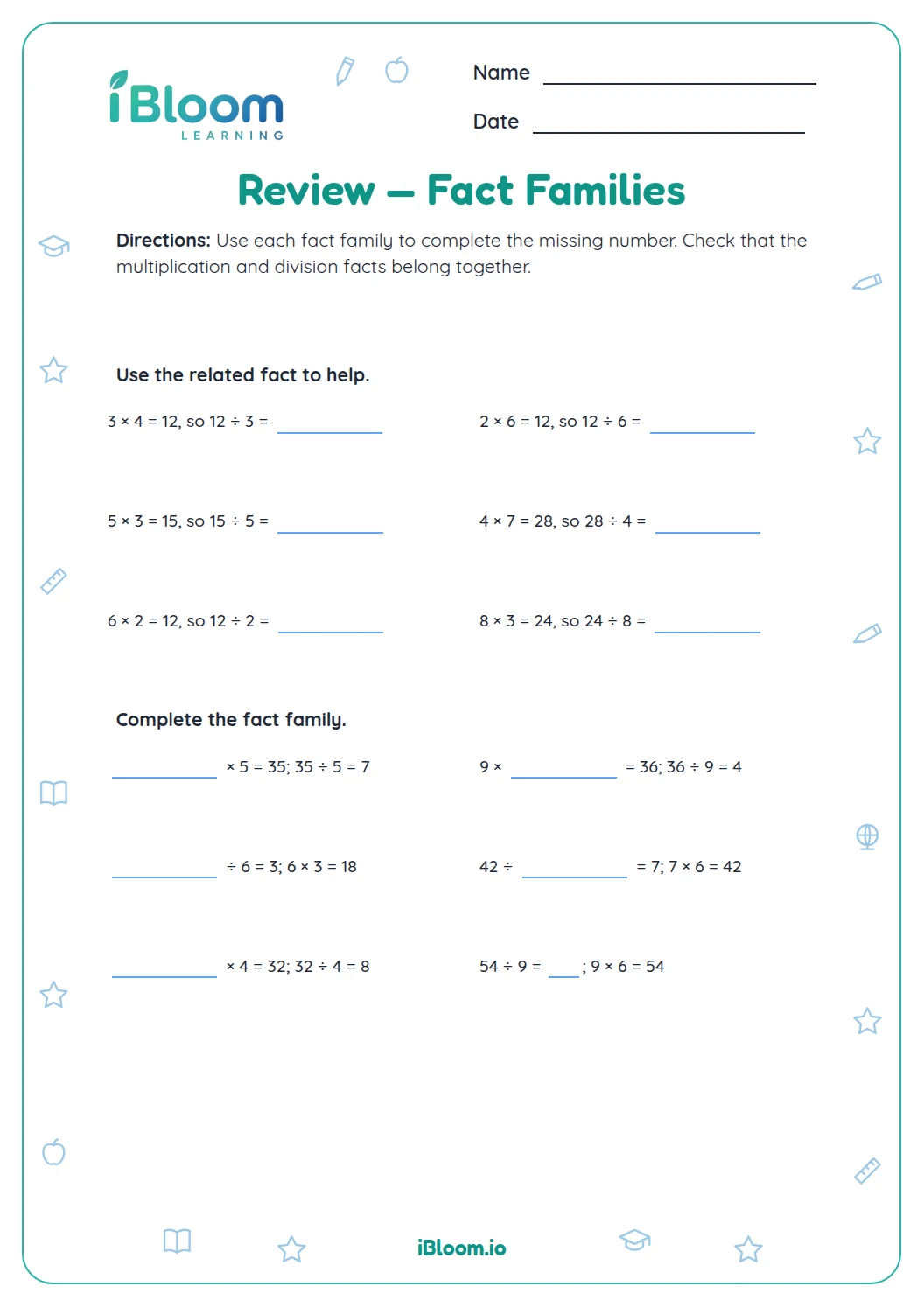
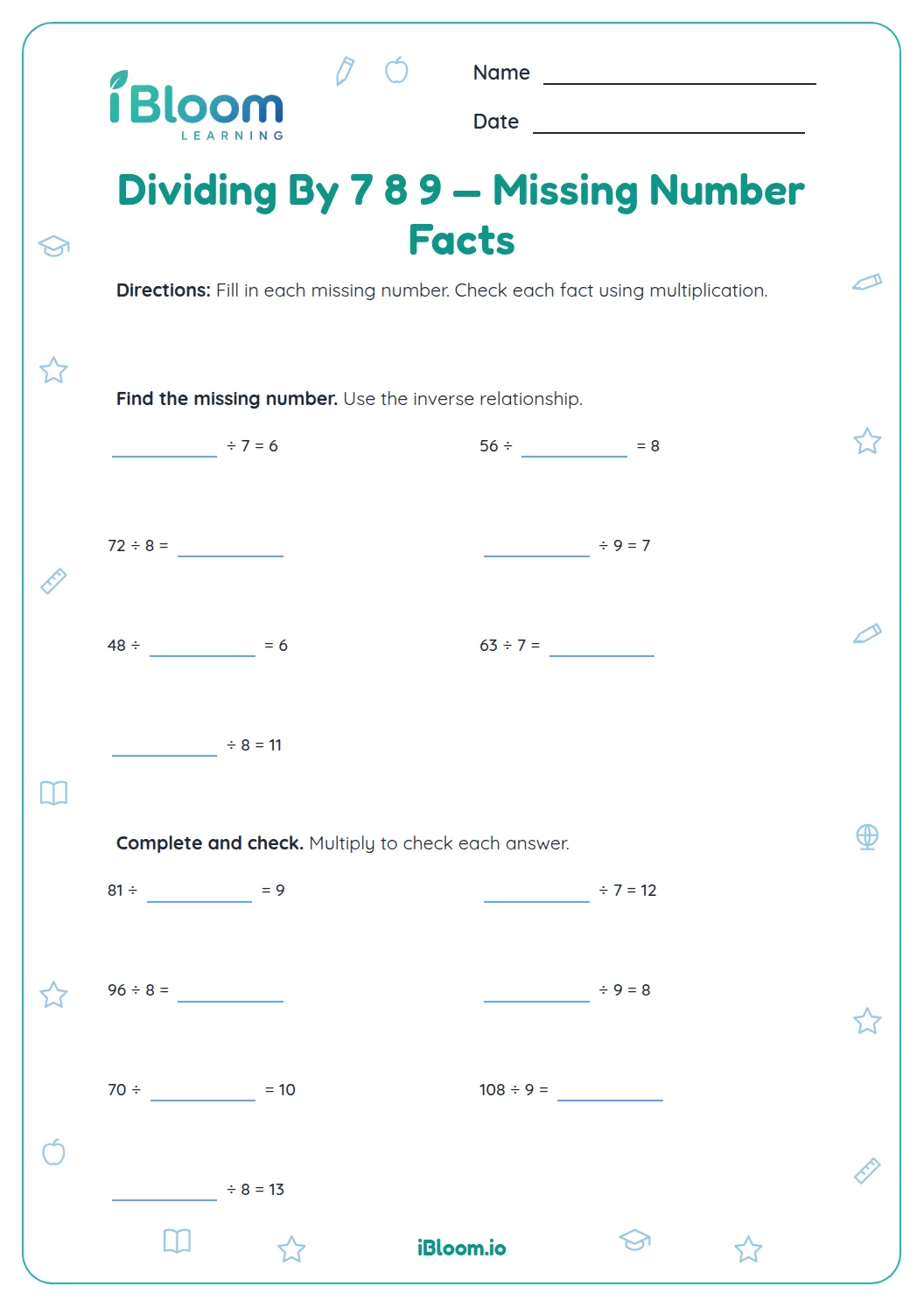
A division quotient is the missing factor in a related multiplication fact. For 56 ÷ 8, ask which number multiplied by 8 makes 56. Since 8 × 7 = 56, the quotient is 7.
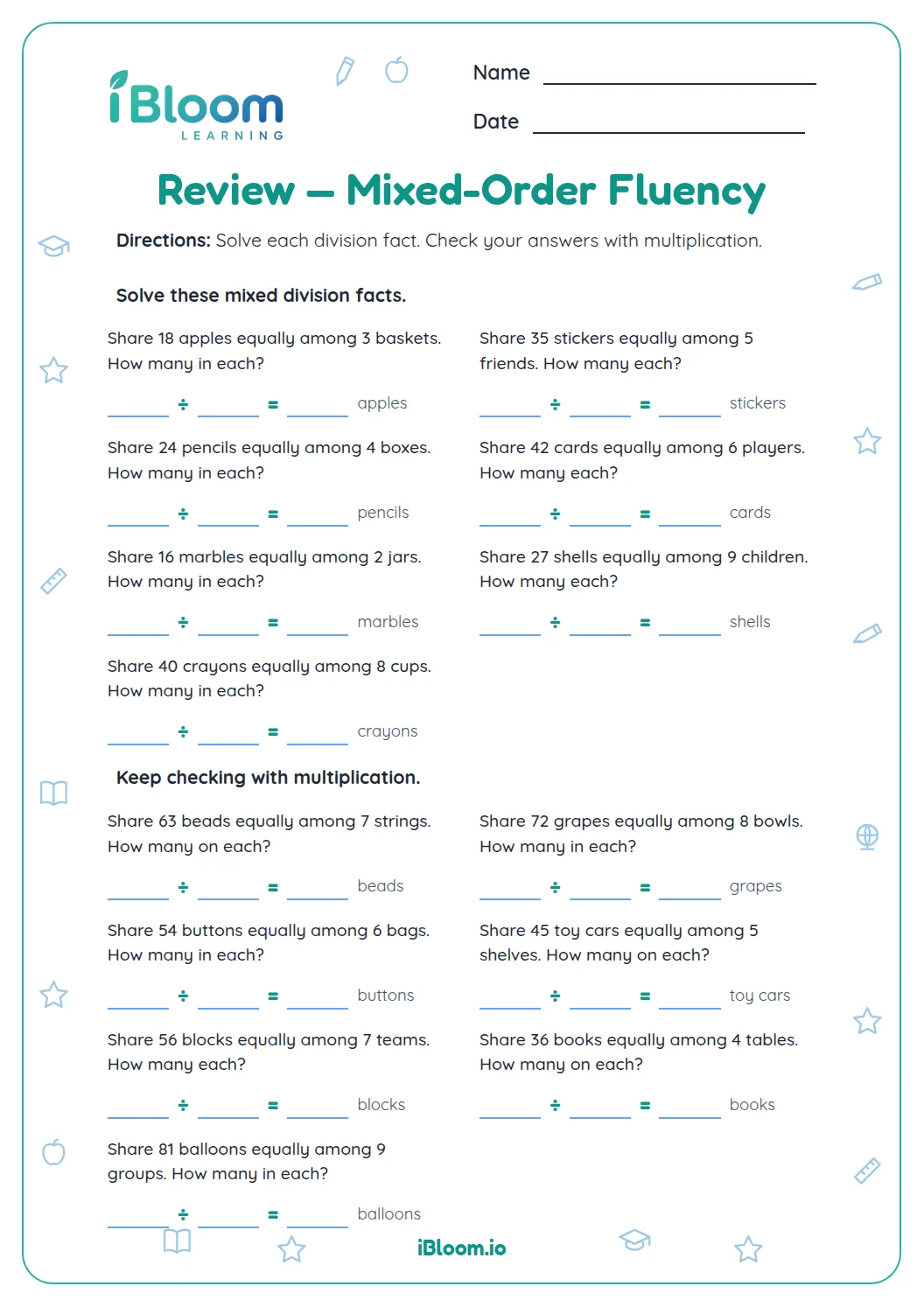
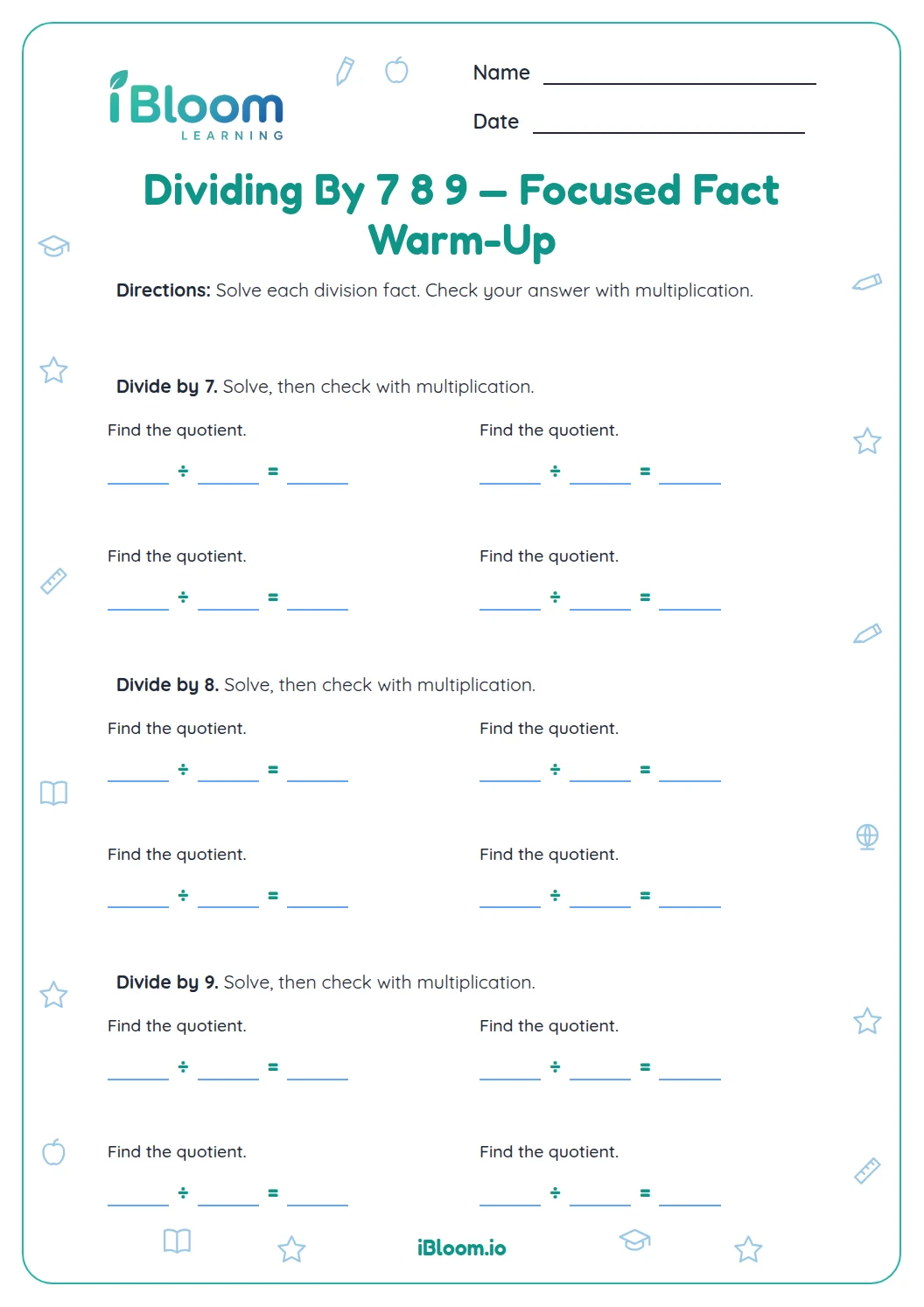
Part A starts with a group of facts, and Part B mixes the order so students attend to each divisor.
- 156 ÷ 8 = 7
- 27 × 8 = 56
How to use this worksheet
- 1Read the direction at the start of each part.
- 2Work through each item and use the provided response space.
- 3For a written response, include the detail named in the prompt.
- 4Check answers with the key and revise any response that misses the task.
Common mistakes and quick fixes
The mistake
Answering before identifying exactly what the prompt asks.
The fix
Underline the key task word, such as quotient, reason, or detail.
The mistake
Giving a choice without checking its supporting evidence.
The fix
Point to the fact or text detail that makes your choice fit.
The mistake
Leaving a written response too general.
The fix
Add the specific number, reason, example, or story detail requested.
Curriculum alignment
Solve division facts within 100 and use multiplication to check each quotient.
On this sheet:
Show the official wordingHide the official wording
Fluently multiply and divide within 100, using strategies such as the relationship between multiplication and division (e.g., knowing that 8 × 5 = 40, one knows 40 ÷ 5 = 8) or properties of operations. By the end of Grade 3, know from memory all products of two one-digit numbers.
What to practice next
Make more practice
Further reading
Questions parents and teachers ask
How many problems are on the sheet?
There are 20 division facts in two parts, followed by a separate answer key. Every dividend is below 100, and each division fact has a whole-number quotient. Students can work at a steady pace and use multiplication to check any quotient they want to verify.
How can a student check a quotient?
Multiply the quotient by the divisor. For example, 56 ÷ 8 = 7 checks because 7 × 8 equals 56. If the product does not match the dividend, revisit the fact family and check which factor is missing.
Which facts are included?
The worksheet mixes division facts with divisors from 2 through 10. The facts use dividends below 100 and have whole-number answers. Their order changes in the second part, so students need to read each equation rather than follow a repeated sequence.
Should students use a timer?
The worksheet directions emphasize solving and checking, not speed. A teacher or parent can offer a timer as an optional fluency activity, but students can also complete the page without one. Accuracy and a clear multiplication check are the focus of the printed directions.
What is in the answer key?
The answer key gives the quotient for every numbered fact. Students can compare each response, then use the related multiplication equation to correct a missed fact. For instance, a quotient of 7 for 56 ÷ 8 is supported by 7 × 8 = 56.