




About this worksheet
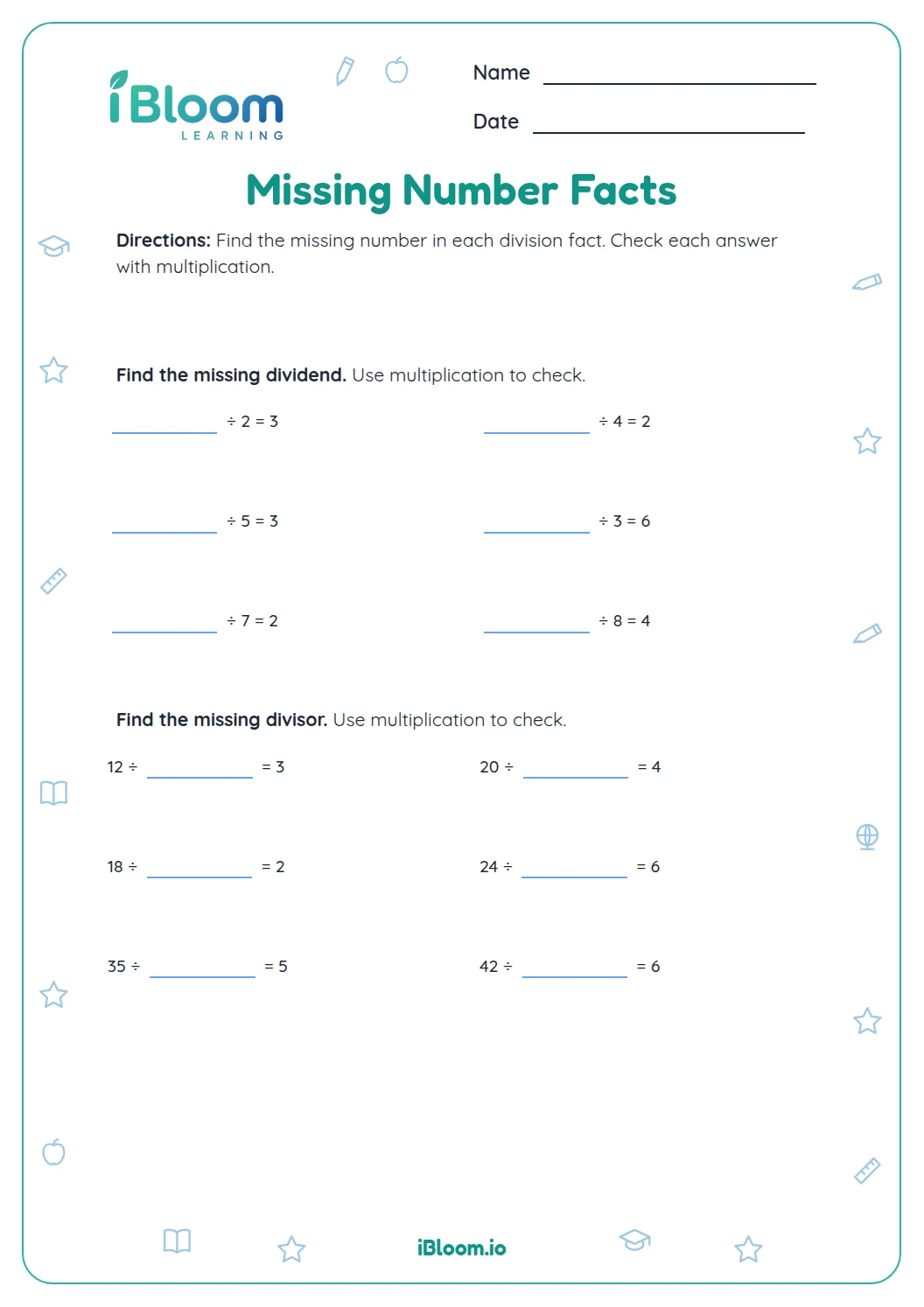
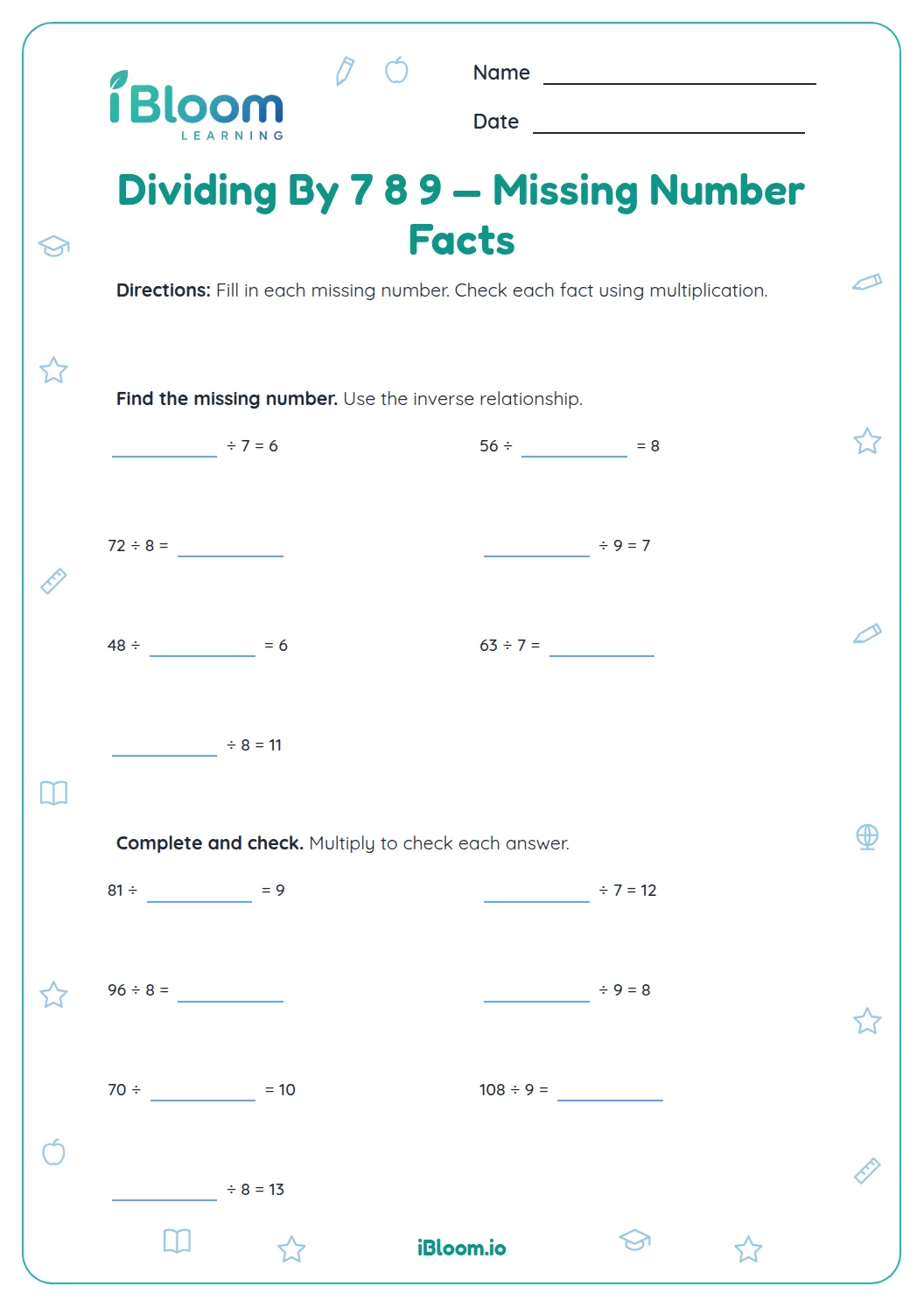
This printable gives Grades 3–4 learners focused practice with division fact families. The sheet has 12 missing-dividend equations and 8 missing-divisor equations. Children use multiplication to find each missing number. All 20 equations use products within 100 and connect division to multiplication, as in CCSS 3.OA.C.7.
Aligned to 3.OA.C.7
How can multiplication uncover a missing dividend?
A dividend is the number being divided. If the divisor and quotient are known, multiply them to find the dividend. Question 1 asks ___ ÷ 6 = 4; the related fact 6 × 4 = 24 gives the missing number.
- 1___ ÷ 6 = 4
- 26 × 4 = 24
- 324 ÷ 6 = 4
How can a fact family uncover a missing divisor?
When the dividend and quotient are known, ask which number multiplied by the quotient gives the dividend. In question 9, 36 ÷ ___ = 6. Since 6 × 6 = 36, the divisor is 6.
What division facts are included?
The first ten items hide the dividend; the final ten hide the divisor. Every equation belongs to a basic multiplication fact family.
- Part A: find ten missing dividends
- Part B: find ten missing divisors
- Use multiplication to check the division equation
How to use this worksheet
- 1Read the whole division equation before filling the blank.
- 2Name the known divisor and quotient.
- 3Multiply them if the dividend is missing.
- 4If the divisor is missing, find the factor that pairs with the quotient.
- 5Substitute the number and check the equation.
- 6Use the answer key to review fact families.
Common mistakes and quick fixes
The mistake
Dividing the known numbers even when the quotient is already given.
The fix
Rewrite the equation as divisor × quotient = dividend.
The mistake
Using the quotient as the dividend.
The fix
Check which number is being divided in the original sentence.
The mistake
Forgetting to test the answer.
The fix
Multiply divisor × quotient and compare with the dividend.
Common Core alignment
The questions practice fluent division through multiplication and division relationships.
Use multiplication facts to solve each division fact fluently.
On this sheet: Use multiplication facts to solve each division fact fluently.
Show the official wordingHide the official wording
Fluently multiply and divide within 100, using strategies such as the relationship between multiplication and division (e.g., knowing that 8 × 5 = 40, one knows 40 ÷ 5 = 8) or properties of operations. By the end of Grade 3, know from memory all products of two one-digit numbers.
What to practice next
Make more practice
Further reading
Questions parents and teachers ask
What is a dividend?
The dividend is the number being divided. In 24 ÷ 6 = 4, 24 is the dividend. For a missing dividend, multiply the divisor by the quotient; question 1 uses 6 × 4 to find 24. The separate answer key gives a clear way to check the result after the child has finished.
How does a multiplication fact help find a missing divisor?
Think of the quotient as the missing factor in a multiplication equation. For 36 ÷ ___ = 6, ask what number times 6 equals 36. Since 6 × 6 = 36, the missing divisor is 6. The separate answer key gives a clear way to check the result after the child has finished.
What is a fact family?
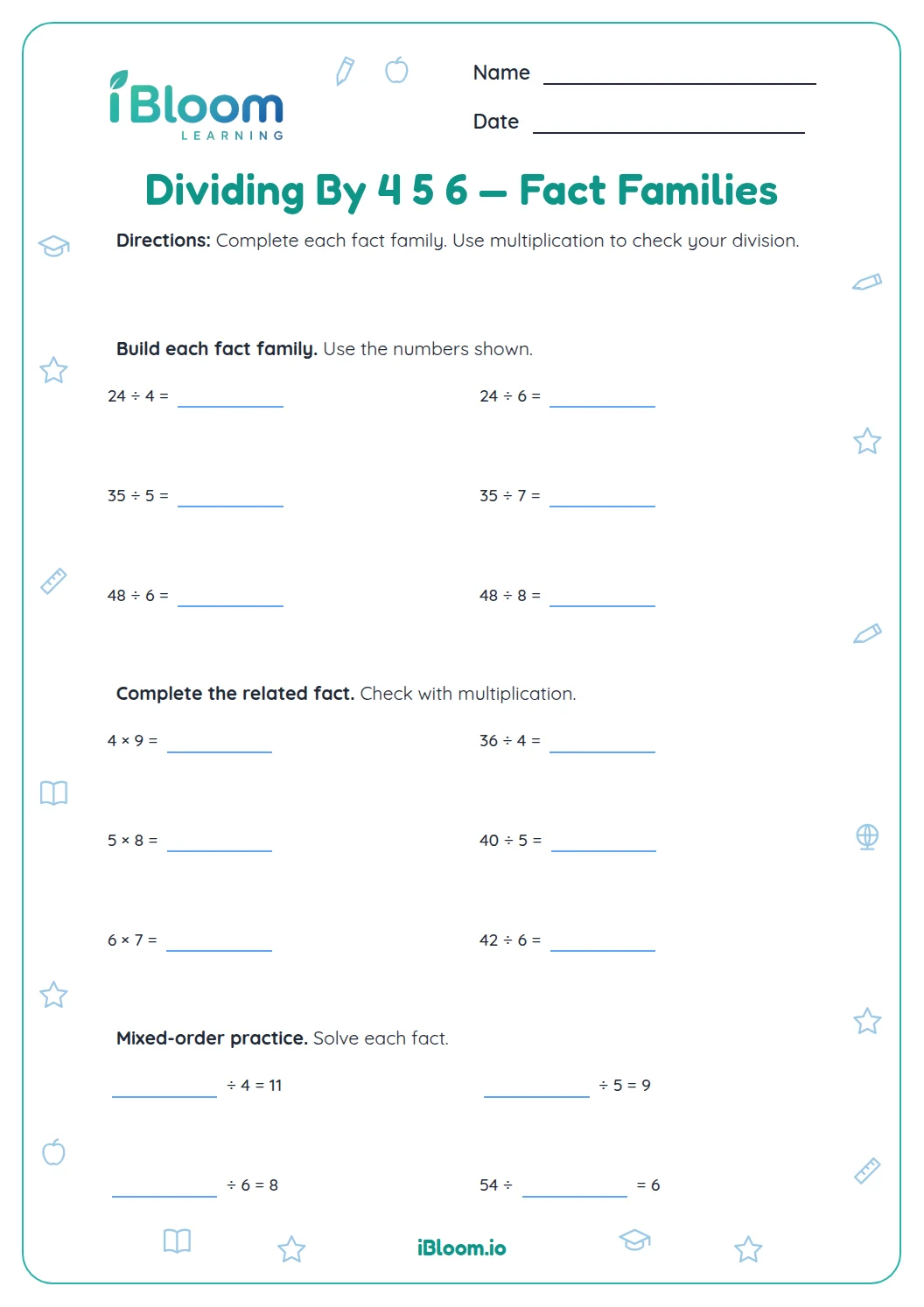
A fact family connects multiplication and division equations that use the same three numbers. From 6 × 4 = 24, children can write 24 ÷ 6 = 4 and 24 ÷ 4 = 6. Those connections help check the unknowns.
How many questions are on this drill?
There are 16 division equations. The first eight ask for a missing dividend, and the last eight ask for a missing divisor. The worksheet and answer key each print as two pages. The separate answer key gives a clear way to check the result after the child has finished.
Are the answers all single-digit numbers?
Each missing divisor is a one-digit factor, and each missing dividend is a product within 100. The quotients also come from multiplication fact families, so children can check each answer by multiplication. The separate answer key gives a clear way to check the result after the child has finished.
Is the timed drill required?
No timer is part of this page. Children can work carefully and use multiplication to check each equation. If an adult wants a fluency check, they can time a later attempt, but accuracy comes first on this printable. The separate answer key gives a clear way to check the result after the child has finished.