
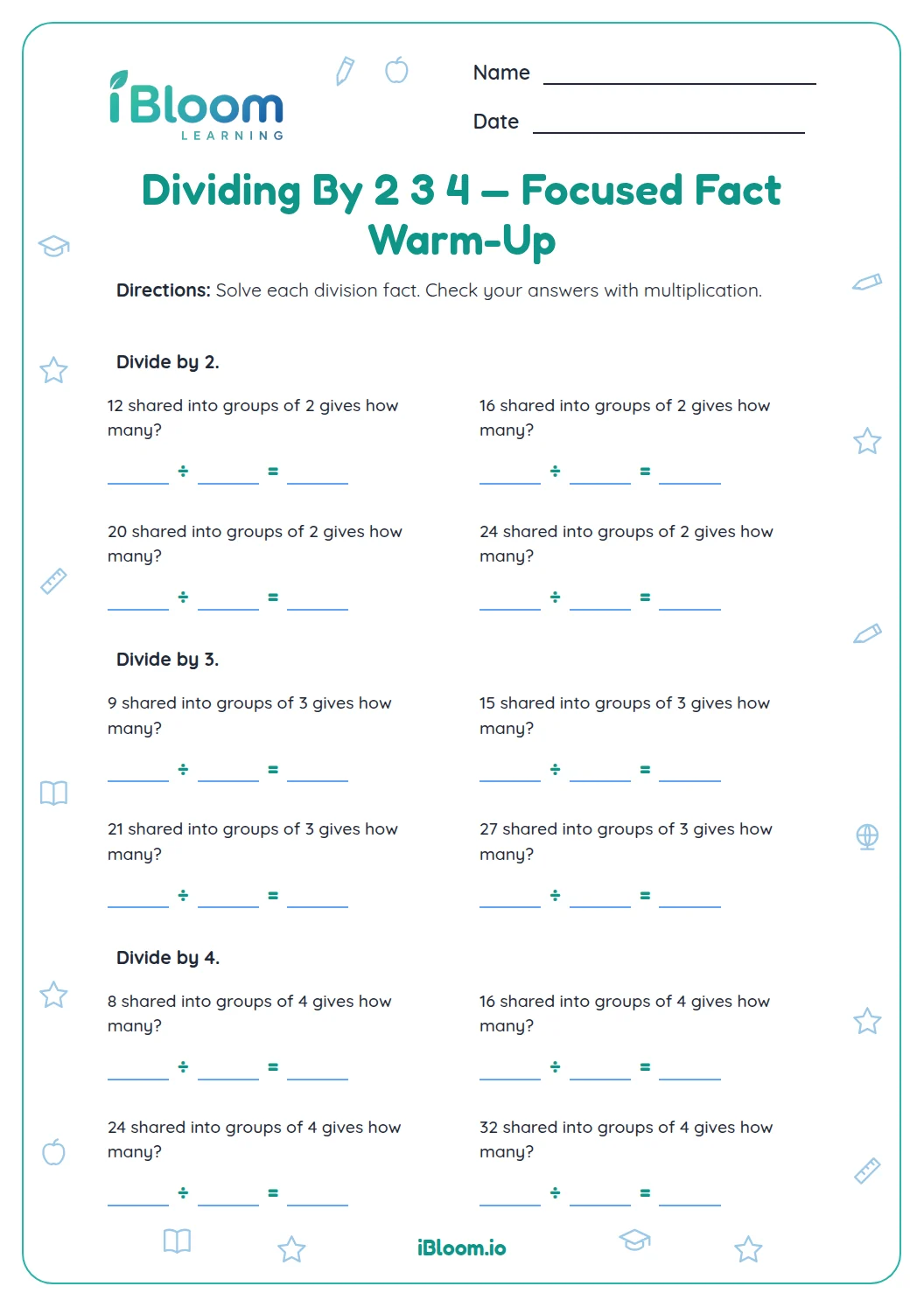
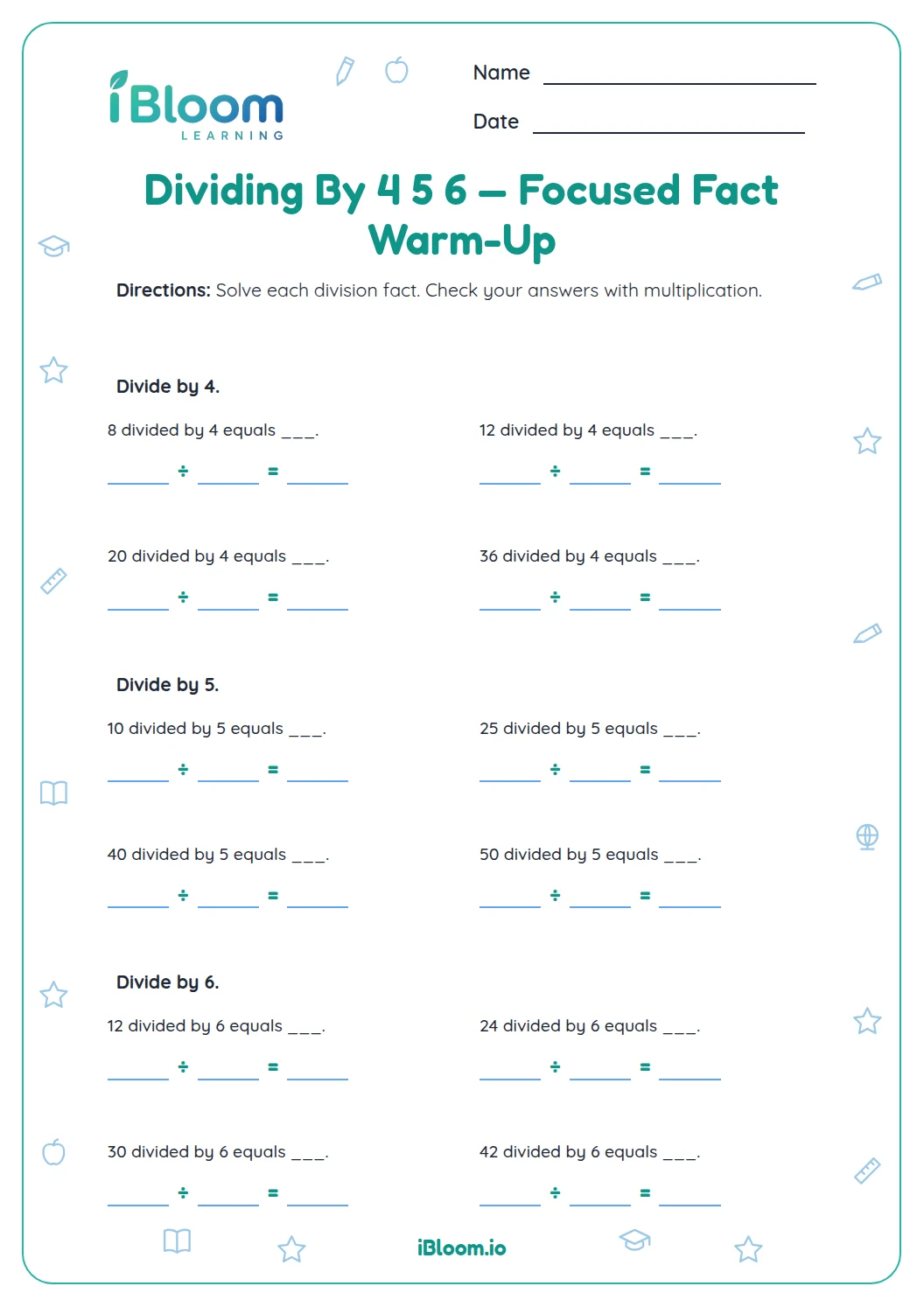
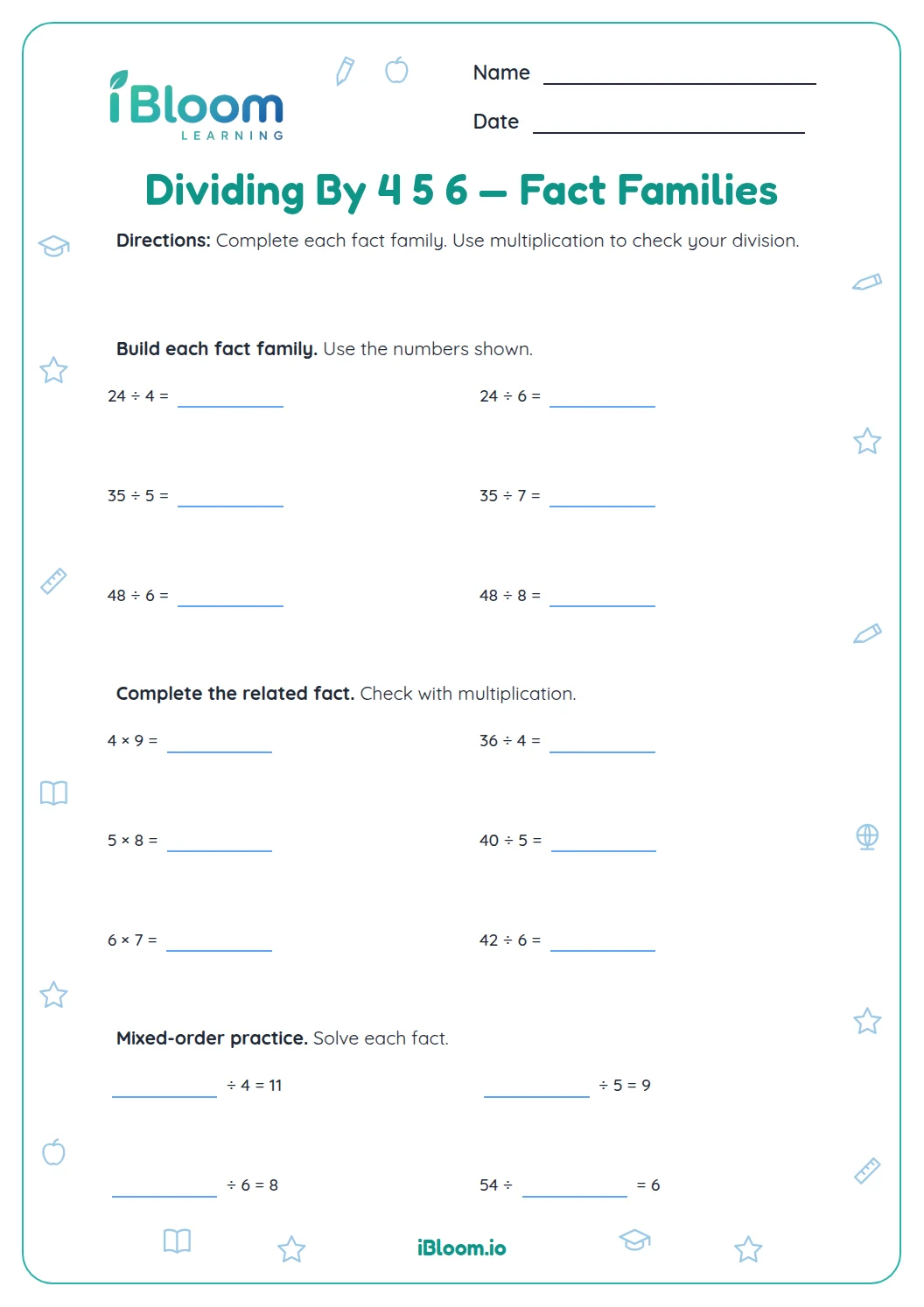
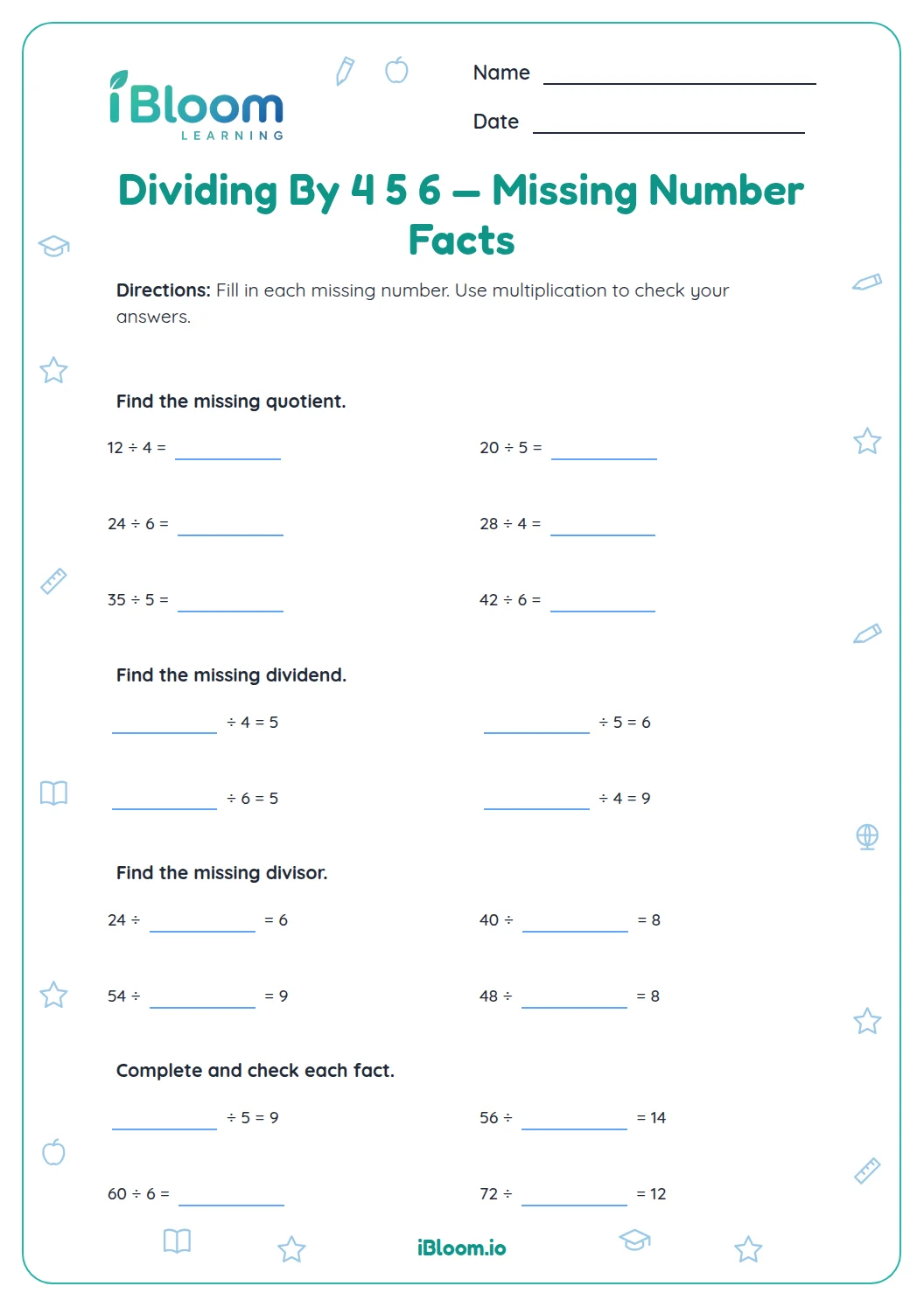
About this worksheet
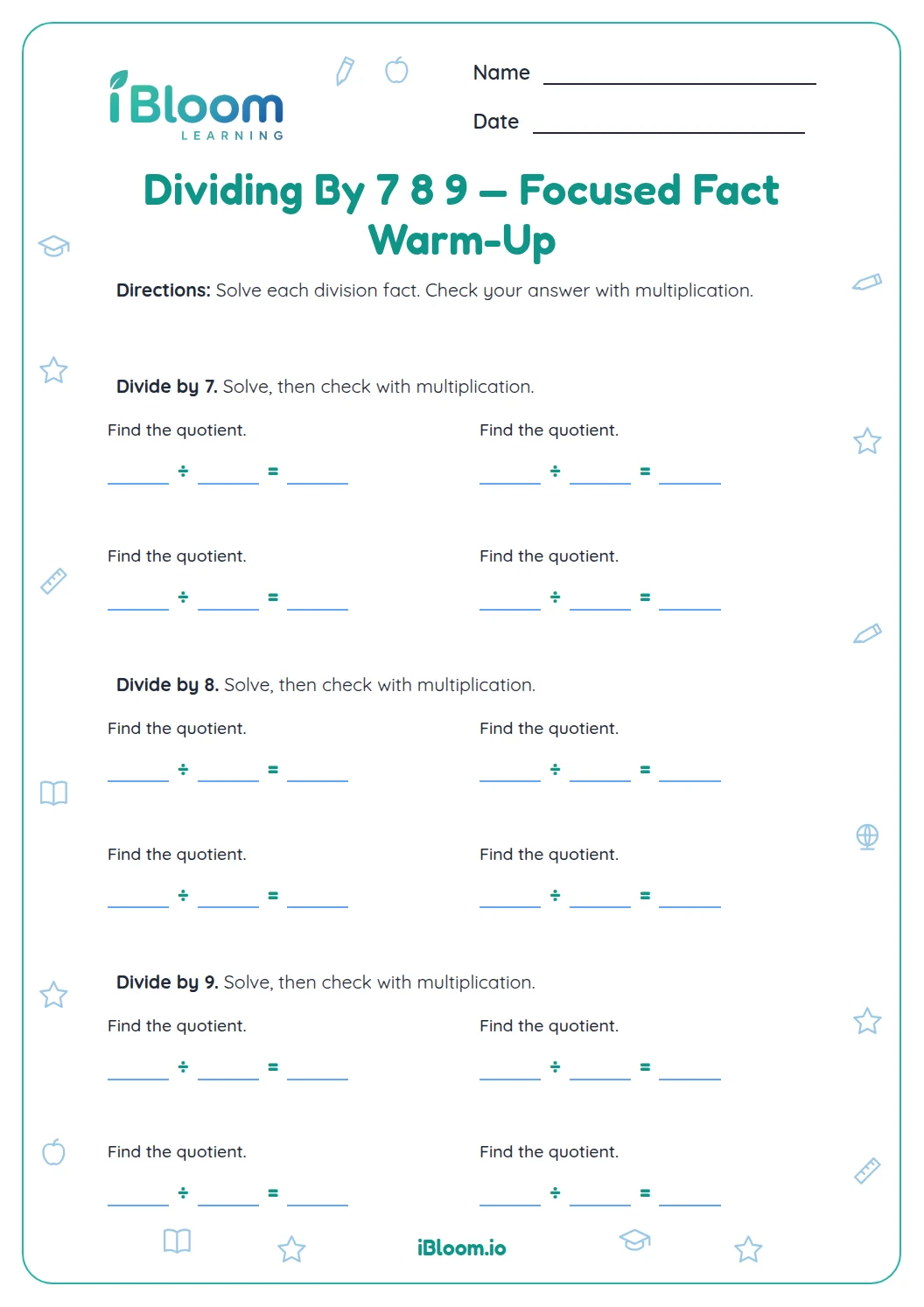
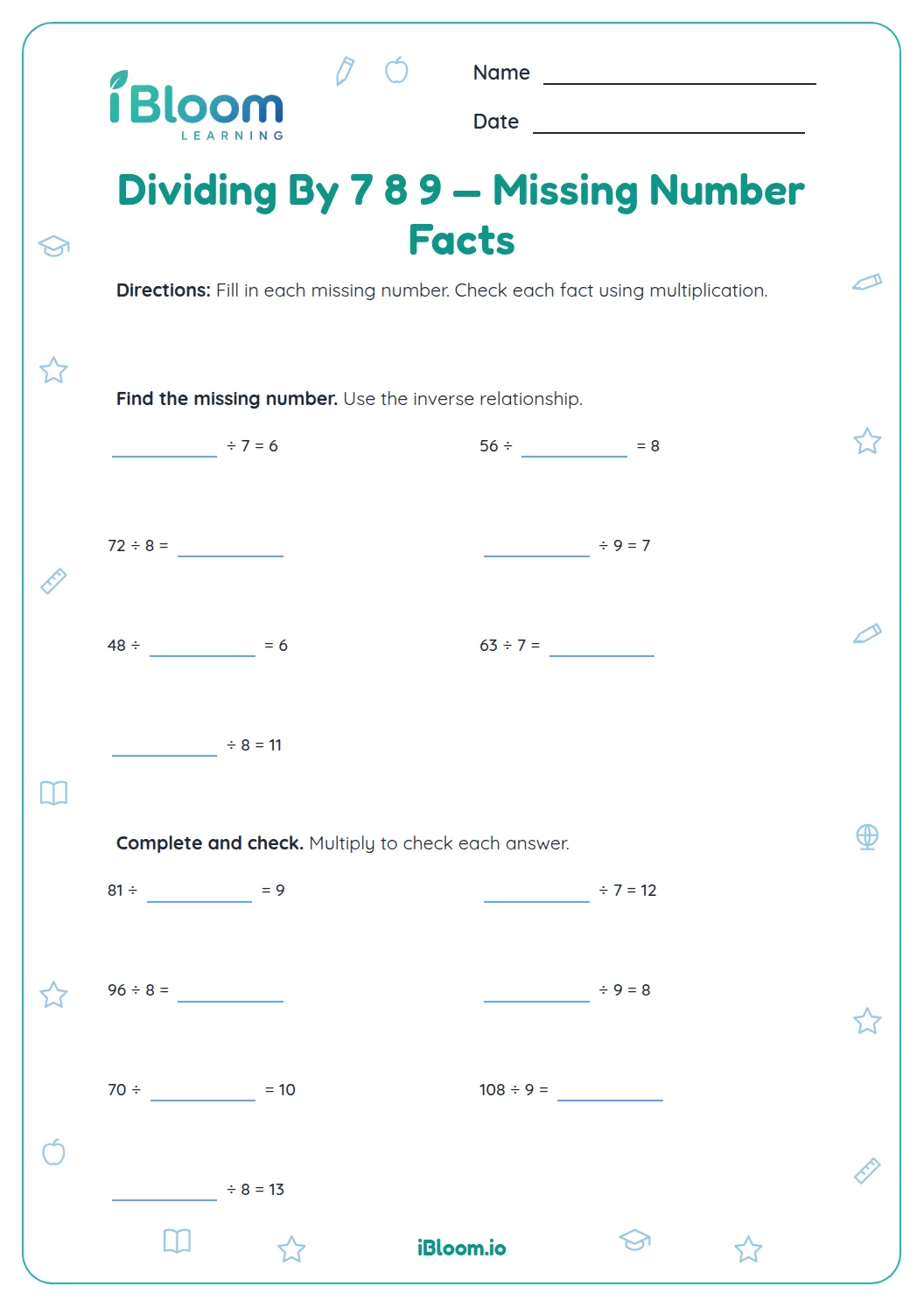
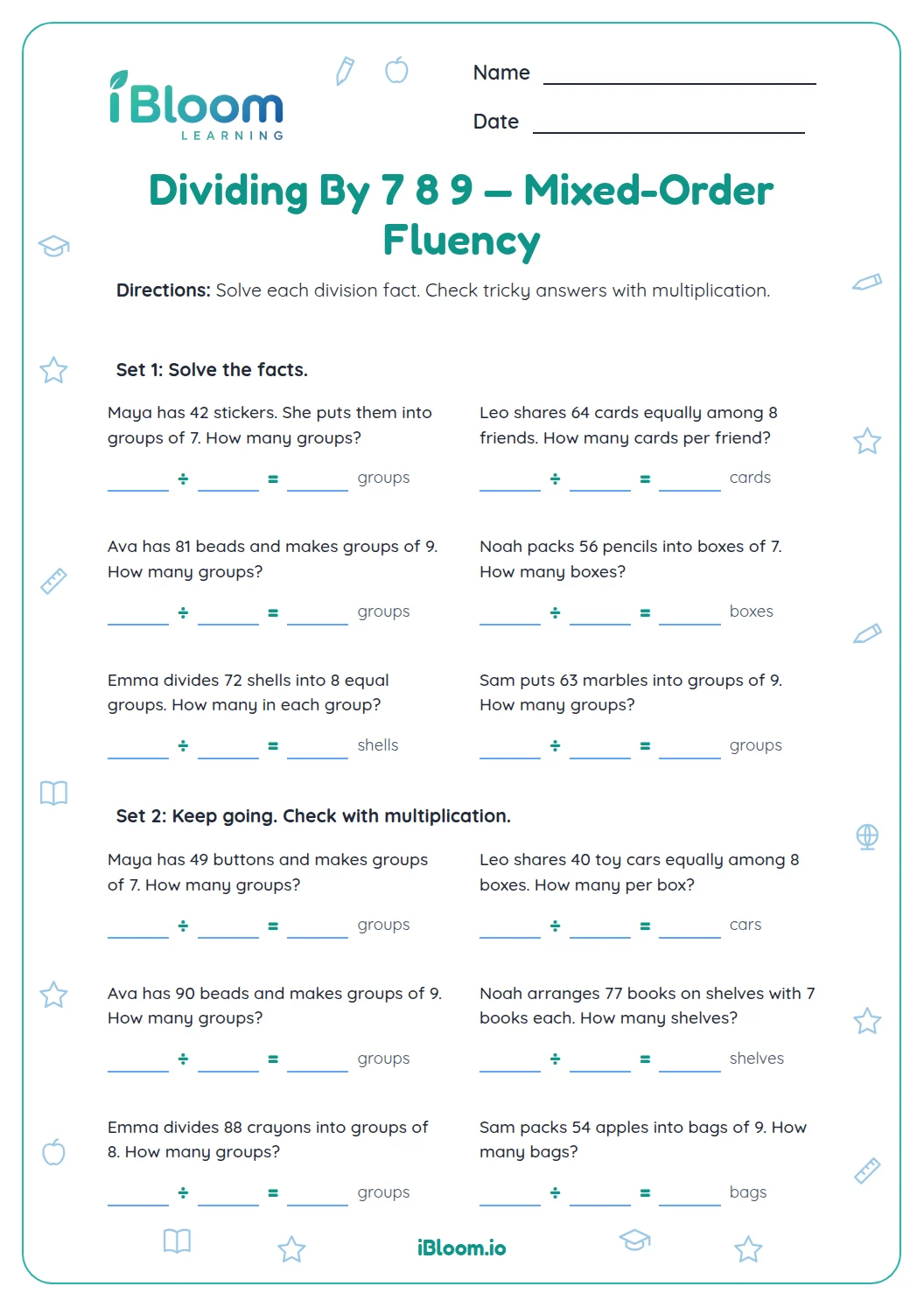
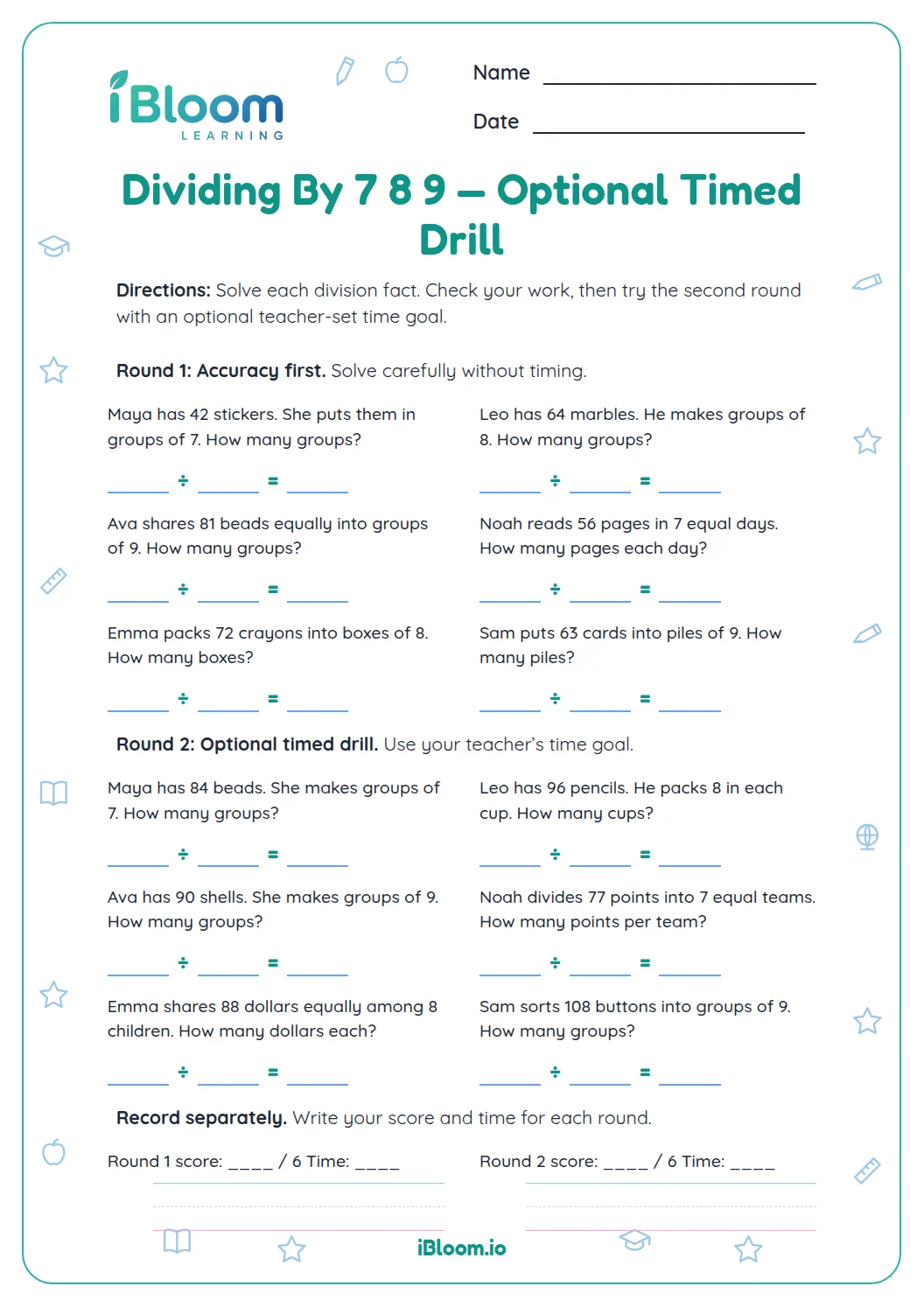
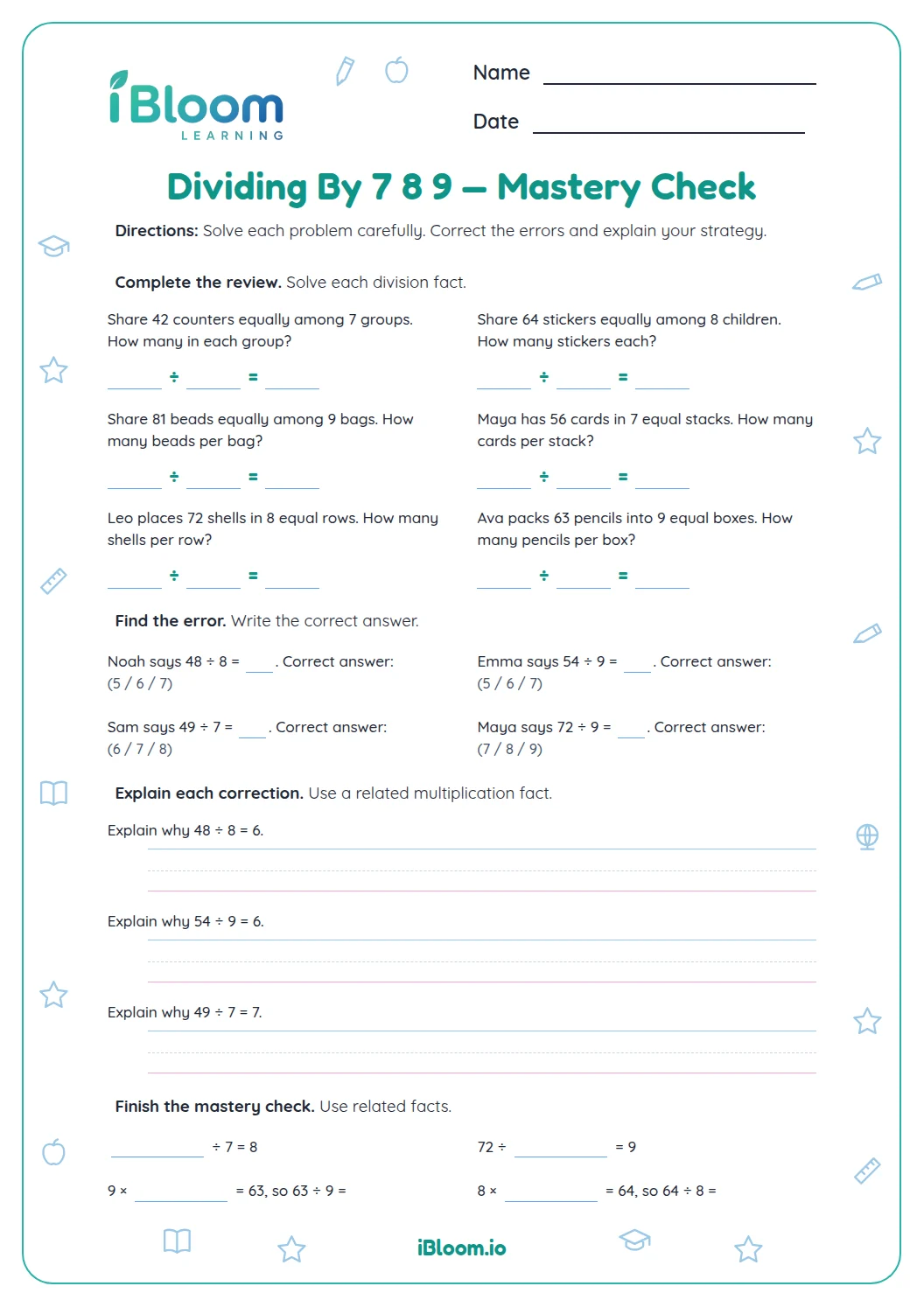
This Grade 3 printable focuses on division facts with 7, 8, and 9. Students find quotients, use related multiplication facts to fill missing factors and divisors, write a fact family, and solve one equal-sharing story. The 18 questions build the connection described in CCSS 3.OA.C.7, and a separate answer key supports checking.
Aligned to 3.OA.C.7
How are quotients connected to multiplication?
A division fact can be checked with its related multiplication fact. Question 1 asks for 56 ÷ 7; because 7 × 8 = 56, the quotient is 8.
How do missing factors and divisors work?
For a missing factor, use the product and known factor to find the unknown. For a missing divisor, ask which divisor makes the given quotient and dividend fit.
What belongs in a fact family?
A fact family writes two multiplication and two division equations using the same three numbers. The worksheet ends by applying division to beads shared equally among bracelets.
Common mistakes and quick fixes
The mistake
Mixing up the divisor and quotient.
The fix
Use divisor × quotient = dividend to check the positions.
The mistake
Choosing a number that does not make the product.
The fix
Multiply the candidate factor by the known factor.
The mistake
Writing only part of a fact family.
The fix
Include both multiplication orders and both matching division facts.
This page practices a Common Core skill.
The questions practice division facts and related multiplication facts.
On this sheet:
Show the official wordingHide the official wording
Fluently multiply and divide within 100, using strategies such as the relationship between multiplication and division (e.g., knowing that 8 × 5 = 40, one knows 40 ÷ 5 = 8) or properties of operations. By the end of Grade 3, know from memory all products of two one-digit numbers.
What to practice next
Make more practice
Further reading
Questions parents and teachers ask
What division facts are practiced?
The worksheet focuses on facts with divisors 7, 8, and 9. Students solve quotients, fill in missing factors or divisors, write a fact family, and apply a division fact to an equal-sharing story. An answer key is provided.
How does multiplication check a division answer?
Multiply the quotient by the divisor. If the product matches the dividend, the division fact is correct. For example, 8 × 7 = 56 checks that 56 ÷ 7 = 8, so the multiplication fact confirms the quotient.
How many questions are included?
There are 18 questions: eight quotient problems, four missing-factor problems, four missing-divisor problems, one fact-family response, and one equal-sharing story. The answer key is separate from the student pages for convenient checking and review after learners complete their own work.
What is a fact family?
A fact family uses the same three numbers to make related multiplication and division equations. With 7, 8, and 56, the family includes 7 × 8 = 56, 8 × 7 = 56, 56 ÷ 7 = 8, and 56 ÷ 8 = 7.
What should students do when the divisor is missing?
Think of a number that multiplied by the quotient gives the dividend. For 64 ÷ ___ = 8, ask what number times 8 equals 64; the missing divisor is 8. Multiplication provides a quick check that the equation is correct.