
About this worksheet
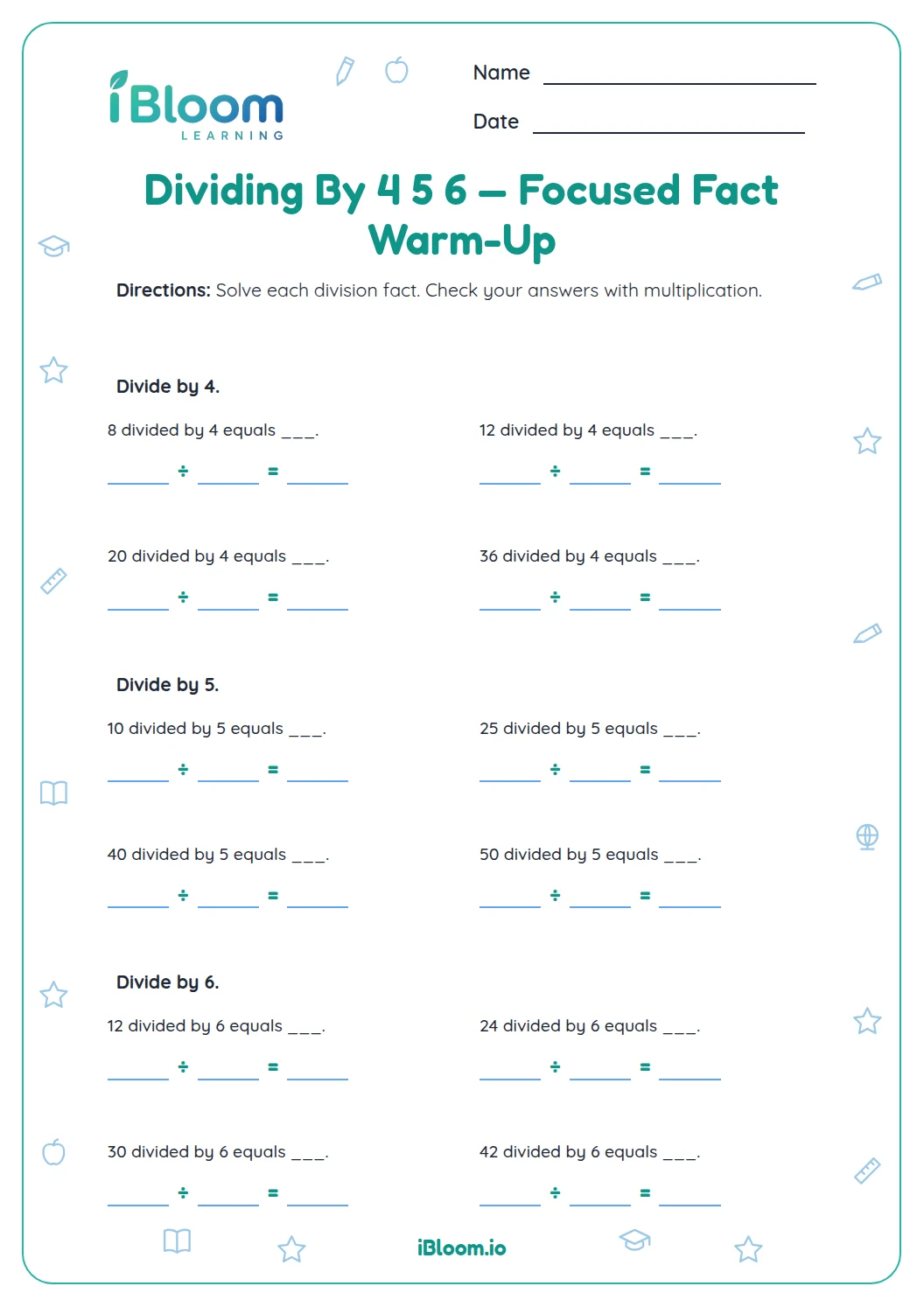
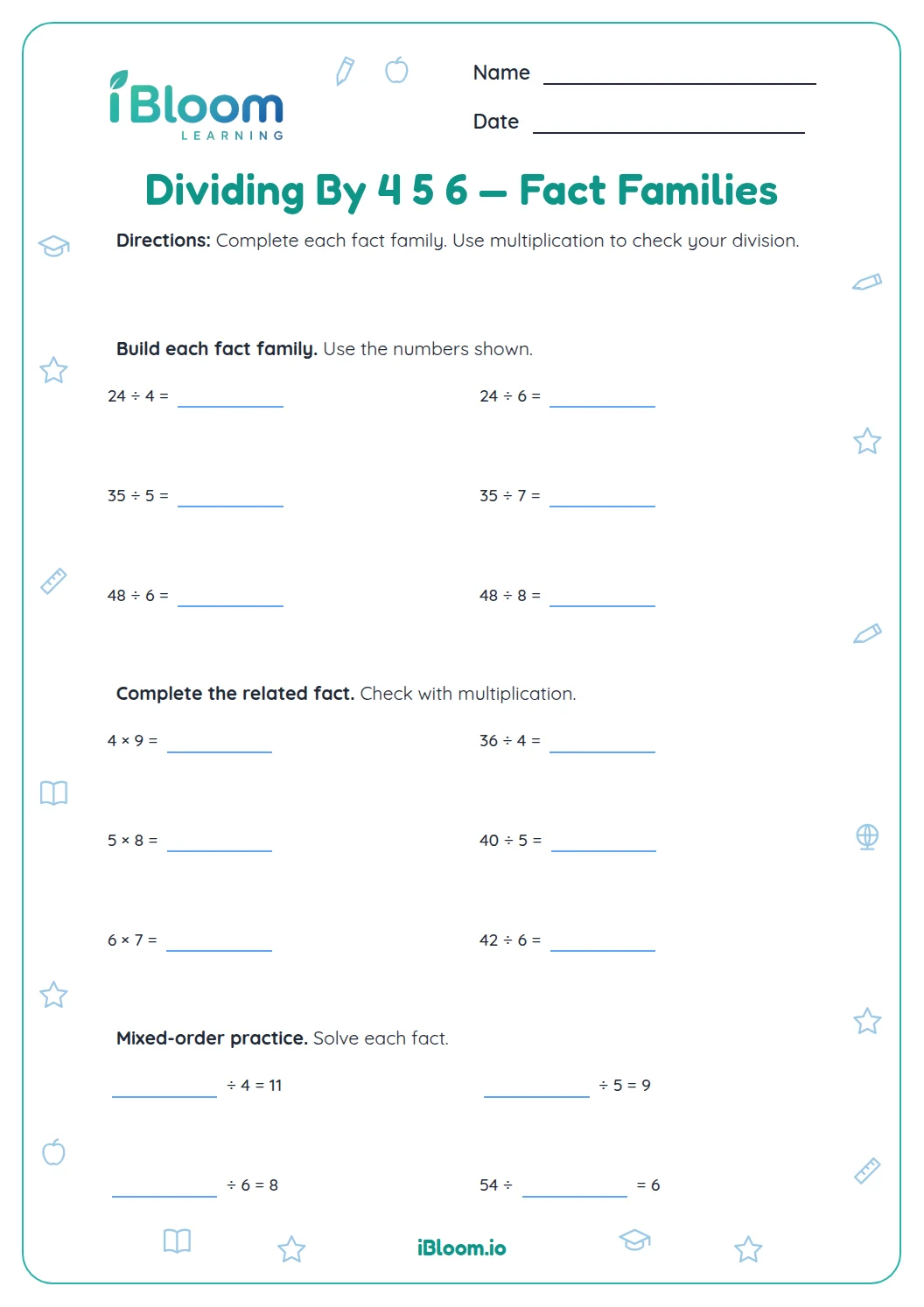
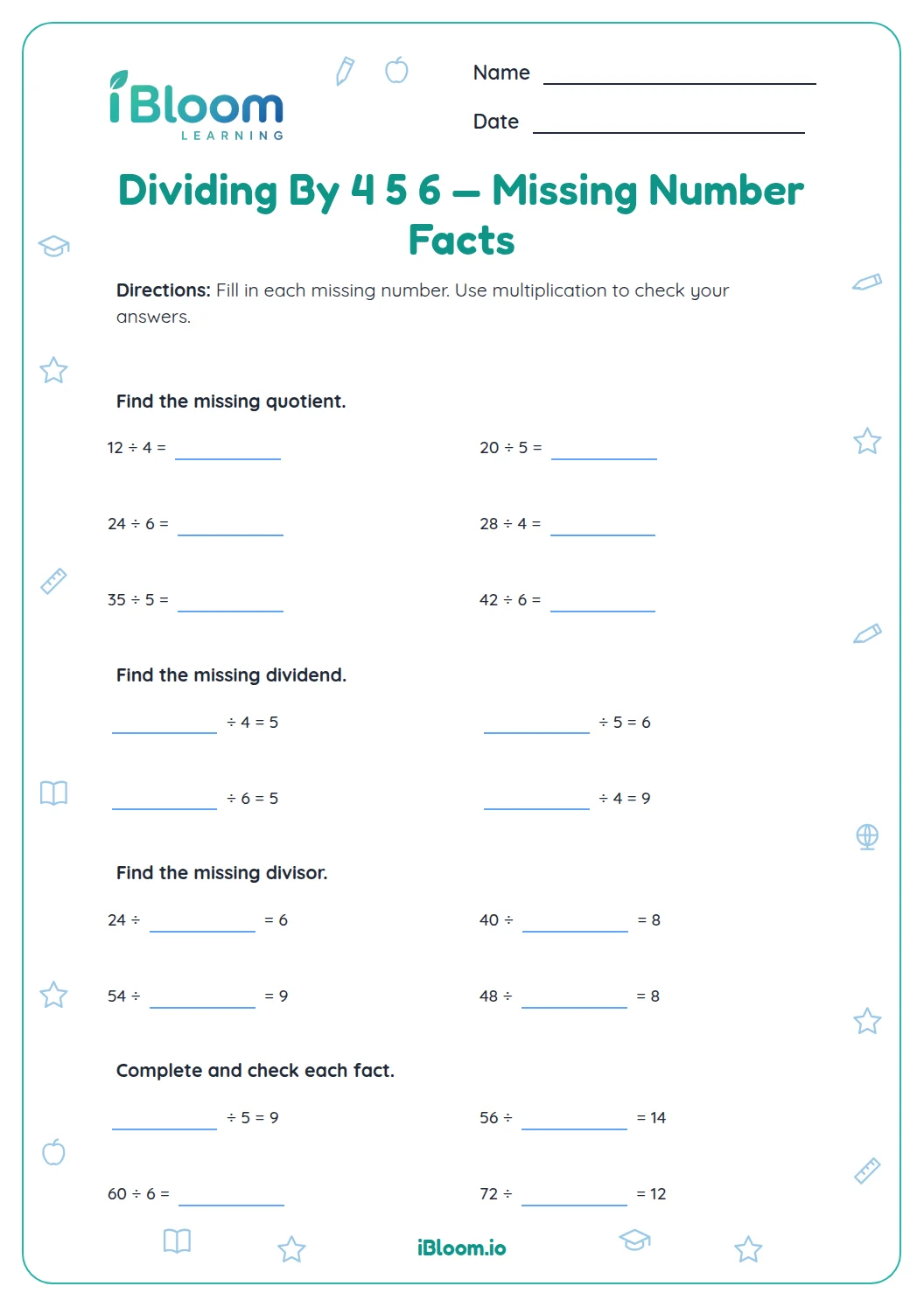
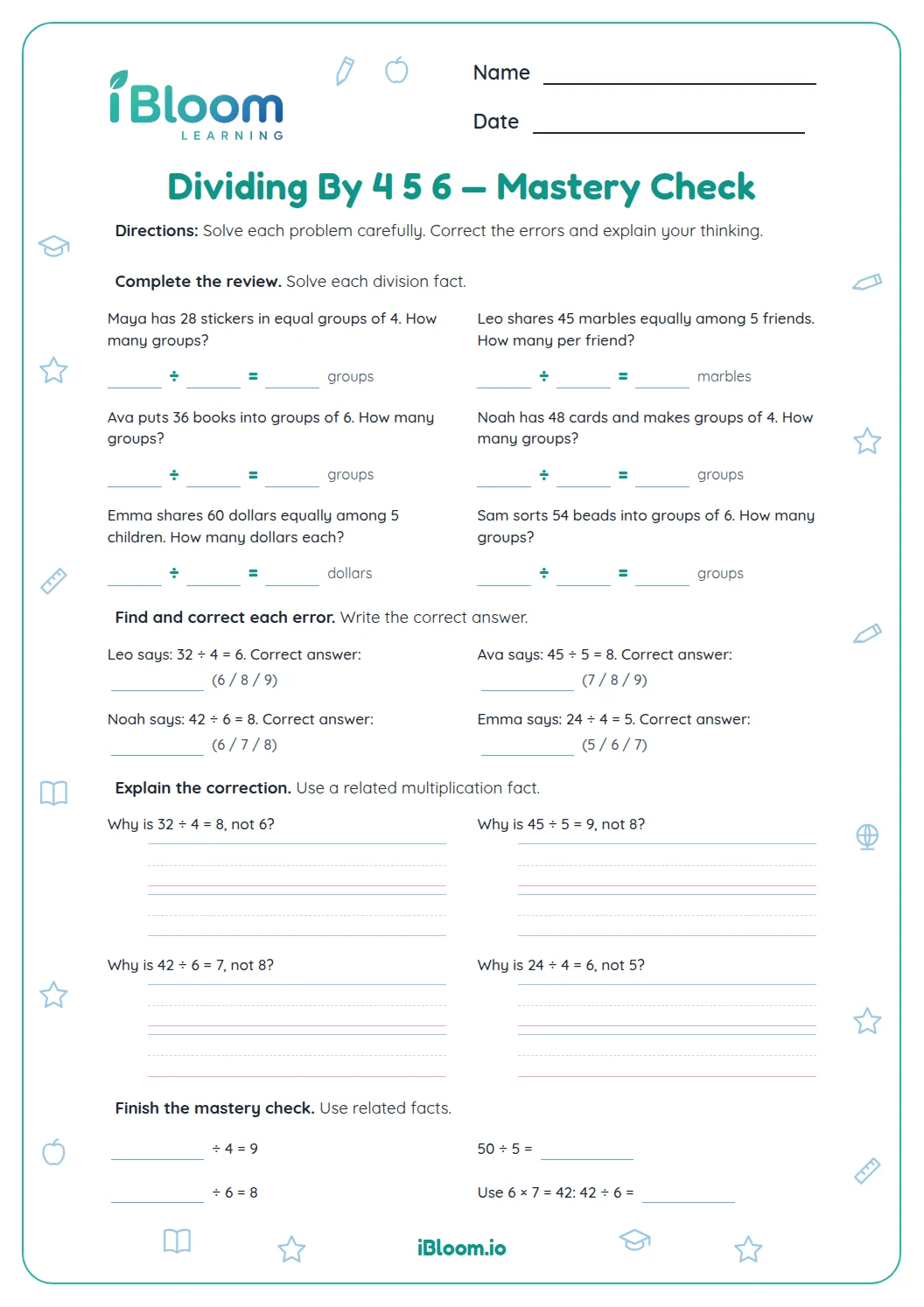
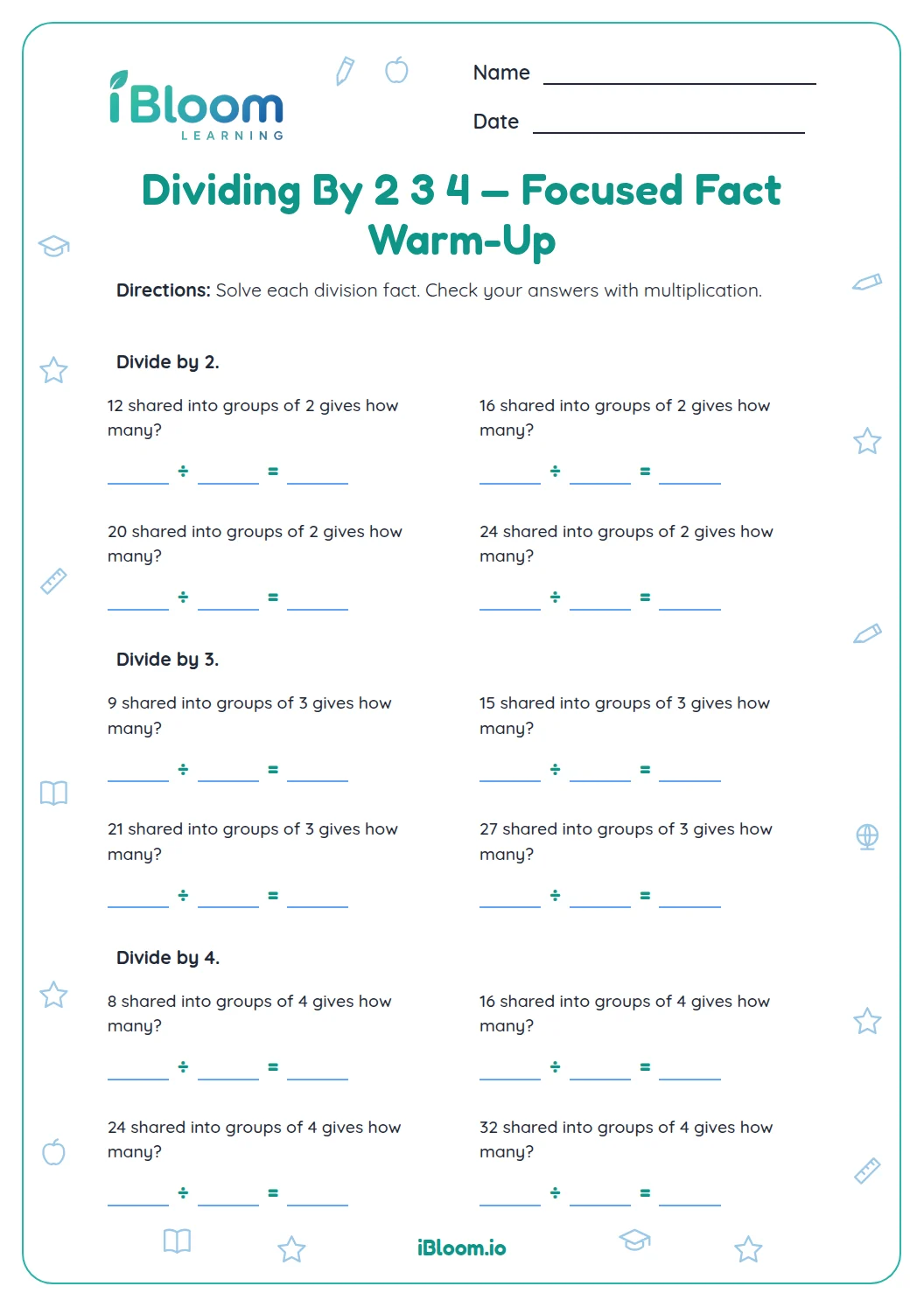
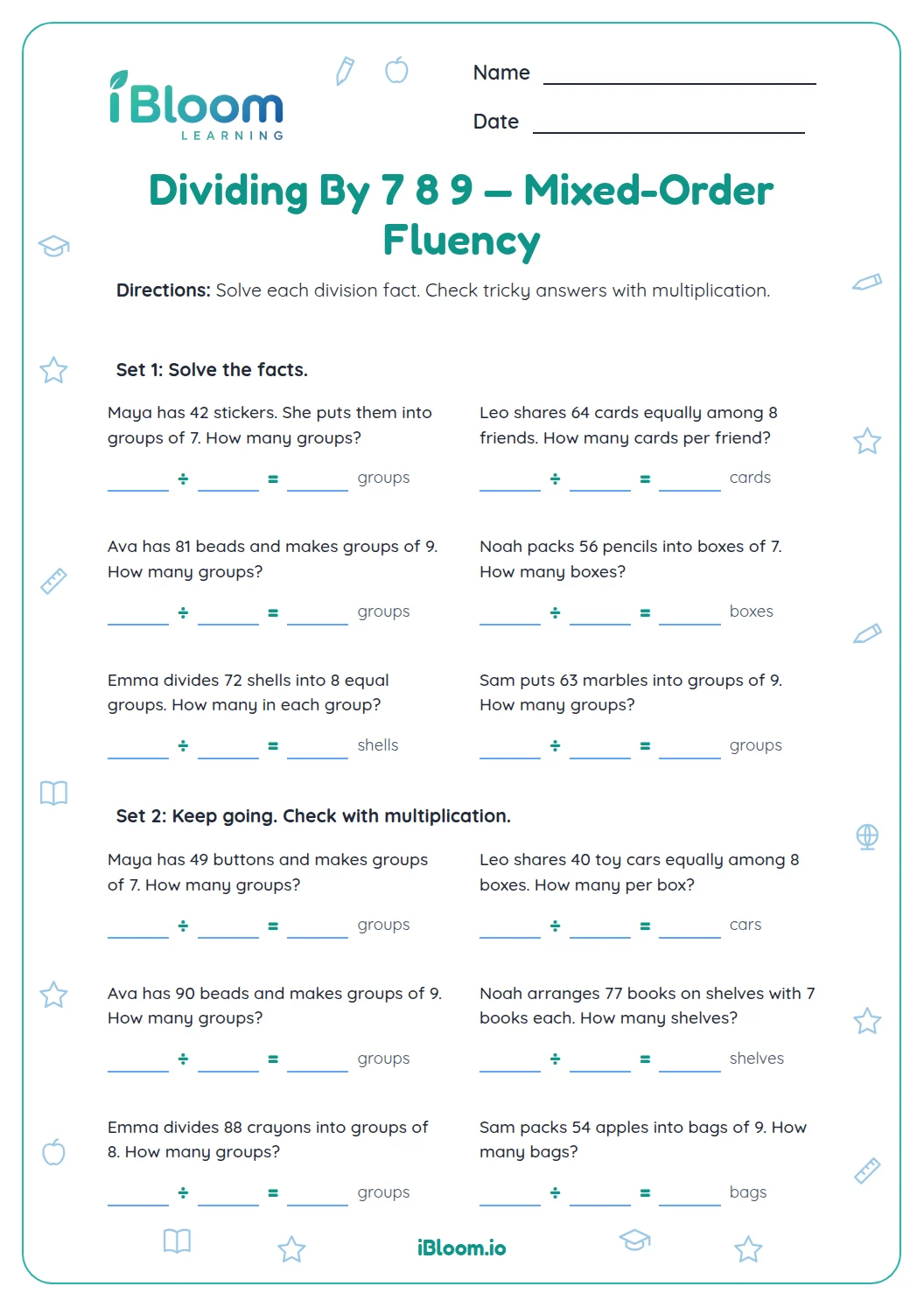
This free printable gives Grades 3–4 students 20 questions using divisors 4, 5, and 6. Sixteen facts appear in mixed order, followed by four equal-group stories that connect division to multiplication. The practice supports CCSS 3.OA.C.7, and a separate answer key lets learners check each quotient.
Aligned to 3.OA.C.7
How can multiplication check a division fact?
Division and multiplication undo each other. For 28 ÷ 4, think 4 × ? = 28. Since 4 × 7 = 28, the quotient is 7.
After solving, multiply the quotient by the divisor. If 7 × 4 returns 28, the equation balances.
- 128 ÷ 4 = ___
- 24 × 7 = 28
- 328 ÷ 4 = 7
What facts does the sheet practice?
Parts A and B mix facts with divisors 4, 5, and 6 so learners identify each divisor instead of following a single table. Part C applies these facts in equal-group stories.
The dividends stay within 60, keeping the focus on basic multiplication and division relationships.
How should a learner check an answer?
Part D returns to two facts for a final check. For 54 ÷ 6 = 9, multiply 9 × 6 to see whether the product returns 54.
How to use this worksheet
- 1Read the divisor first and say its matching multiplication table aloud.
- 2Solve one equation at a time without relying on a sequence.
- 3Use a known multiplication fact to find an uncertain quotient.
- 4Multiply each quotient by its divisor to check.
- 5Use the answer key after completing each group.
Common mistakes and quick fixes
The mistake
Using the divisor as the quotient, such as writing 4 for 28 ÷ 4.
The fix
Ask which number multiplied by 4 makes 28. Check the candidate with 4 × 7 = 28.
The mistake
Multiplying the dividend by the divisor instead of finding the missing factor.
The fix
Rewrite 28 ÷ 4 as 4 × ___ = 28. Division asks for the missing factor.
The mistake
Mixing up facts in the 5 and 6 groups.
The fix
Name the divisor and recite just that table, then test the quotient by multiplication.
Common Core alignment
This worksheet practices the listed Common Core skill through the questions and examples on the printable.
Fluently divide within 100 using multiplication facts.
On this sheet: The facts and equal-group stories use division within 100 and multiplication to check quotients.
Show the official wordingHide the official wording
Fluently multiply and divide within 100, using strategies such as the relationship between multiplication and division (e.g., knowing that 8 × 5 = 40, one knows 40 ÷ 5 = 8) or properties of operations. By the end of Grade 3, know from memory all products of two one-digit numbers.
What to practice next
Make more practice
Further reading
Questions parents and teachers ask
What facts are on this division worksheet?
The sheet has 20 questions: 16 division facts using divisors 4, 5, and 6 in mixed order, plus four equal-group stories. Students identify each divisor, find its quotient, and use multiplication to check. The answer key lists each result.
How can multiplication help with division?
A division fact can be rewritten as a multiplication question with a missing factor. For 28 ÷ 4, ask what number times 4 equals 28. The quotient is 7 because 7 × 4 = 28. Multiplying the answer by the divisor checks the result.
What grade is this worksheet for?
The page is designed for Grades 3–4 division fact practice at home. Grade 3 students use multiplication and division relationships to build fluency, while Grade 4 students can use the short sets as a warm-up or review before longer division work.
Should students use a timer?
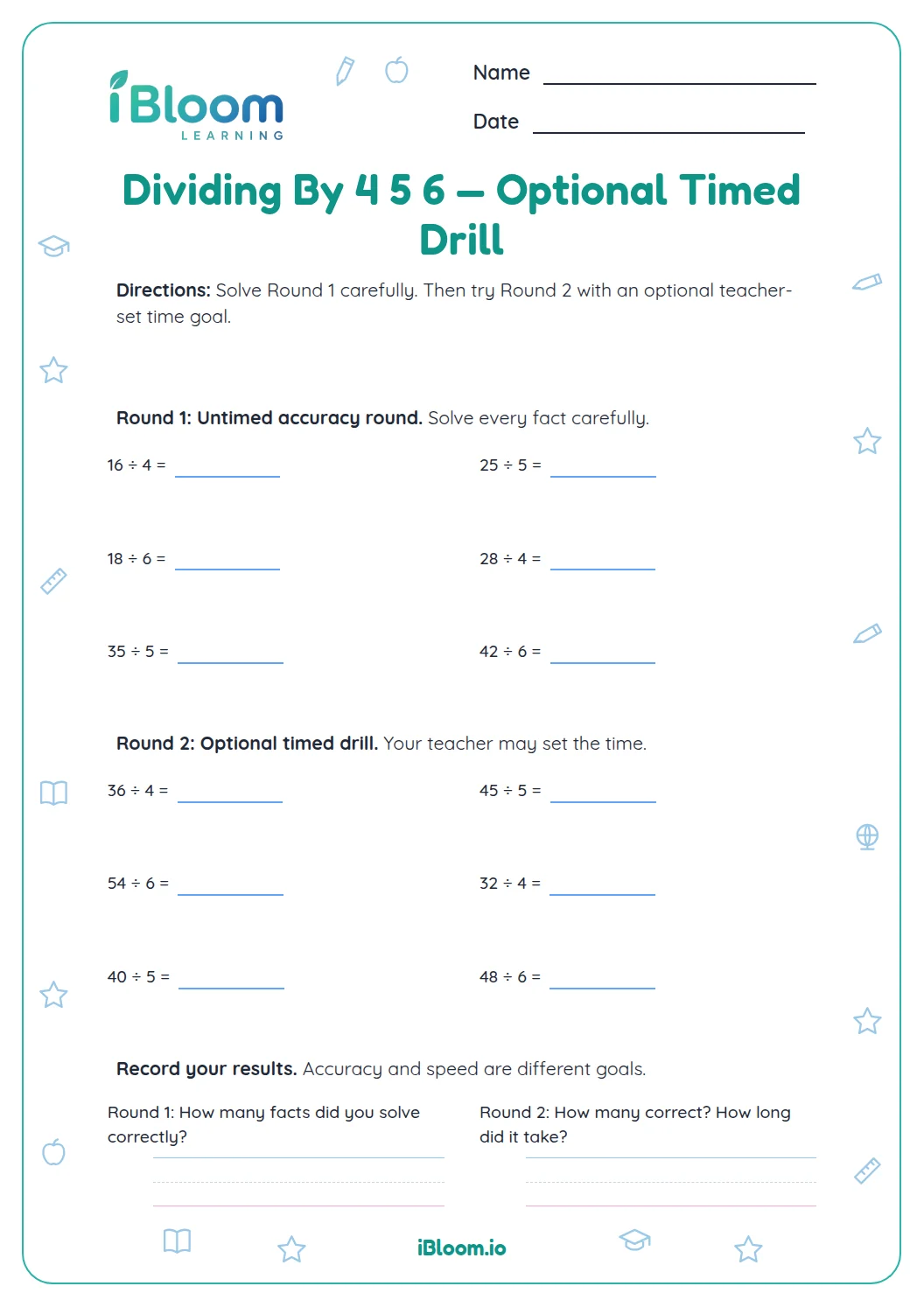
No timer is needed to complete the questions. The purpose is accurate recall and checking. If a teacher or family chooses to time a later attempt, treat the time as an optional progress note and keep accuracy the main goal.
How many questions are included?
There are 20 questions: sixteen fill-in division equations and four equal-group story problems. The facts for 4, 5, and 6 appear in mixed order, and the stories ask students to use matching division facts. The answer key lists each quotient.
How should I help if a fact is hard to remember?
Turn the division equation into a multiplication fact. For 42 ÷ 6, skip count by six or recall 6 × 7 = 42. Then write 7 and multiply 7 by 6 to confirm that the product matches the original dividend.