



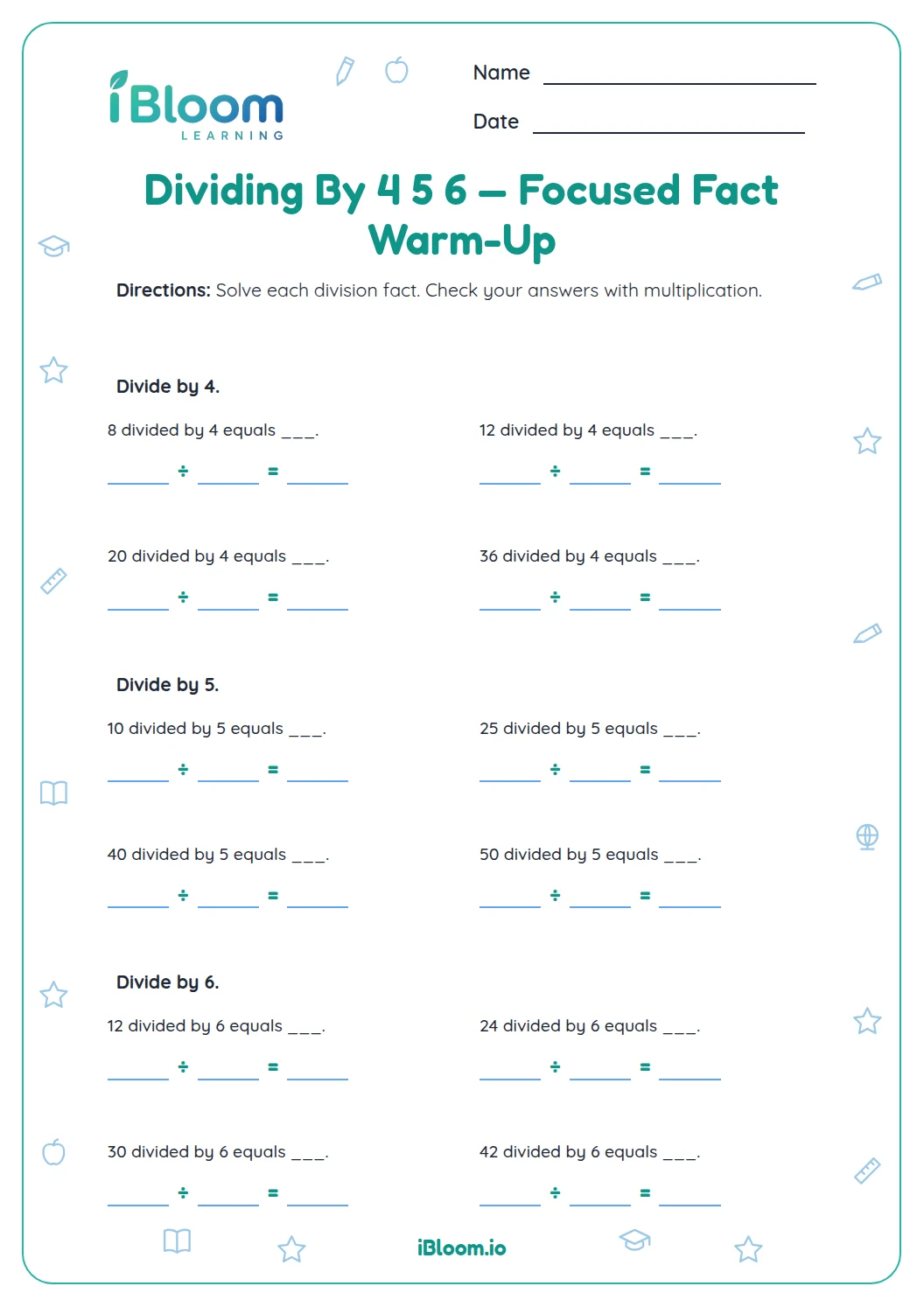
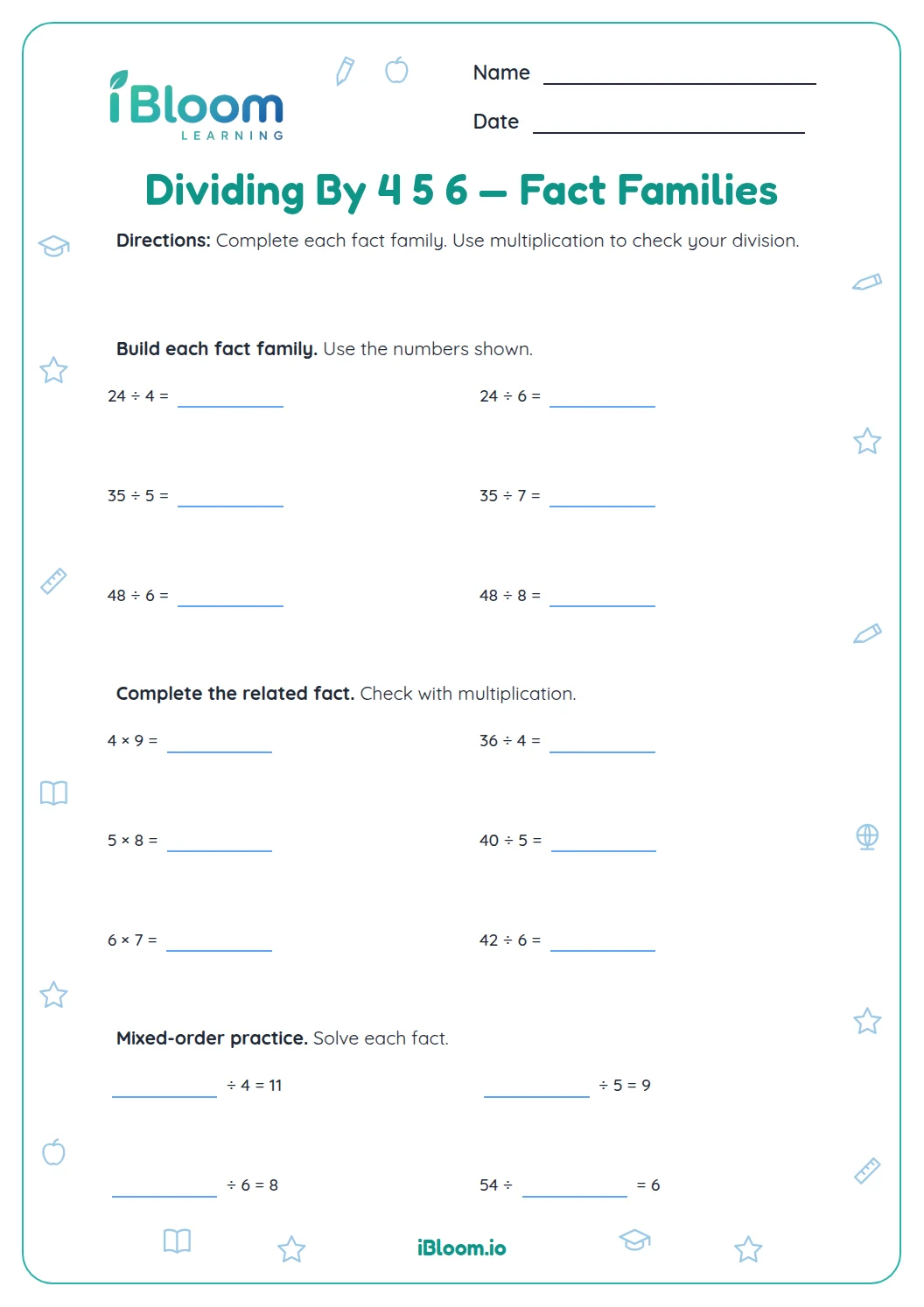
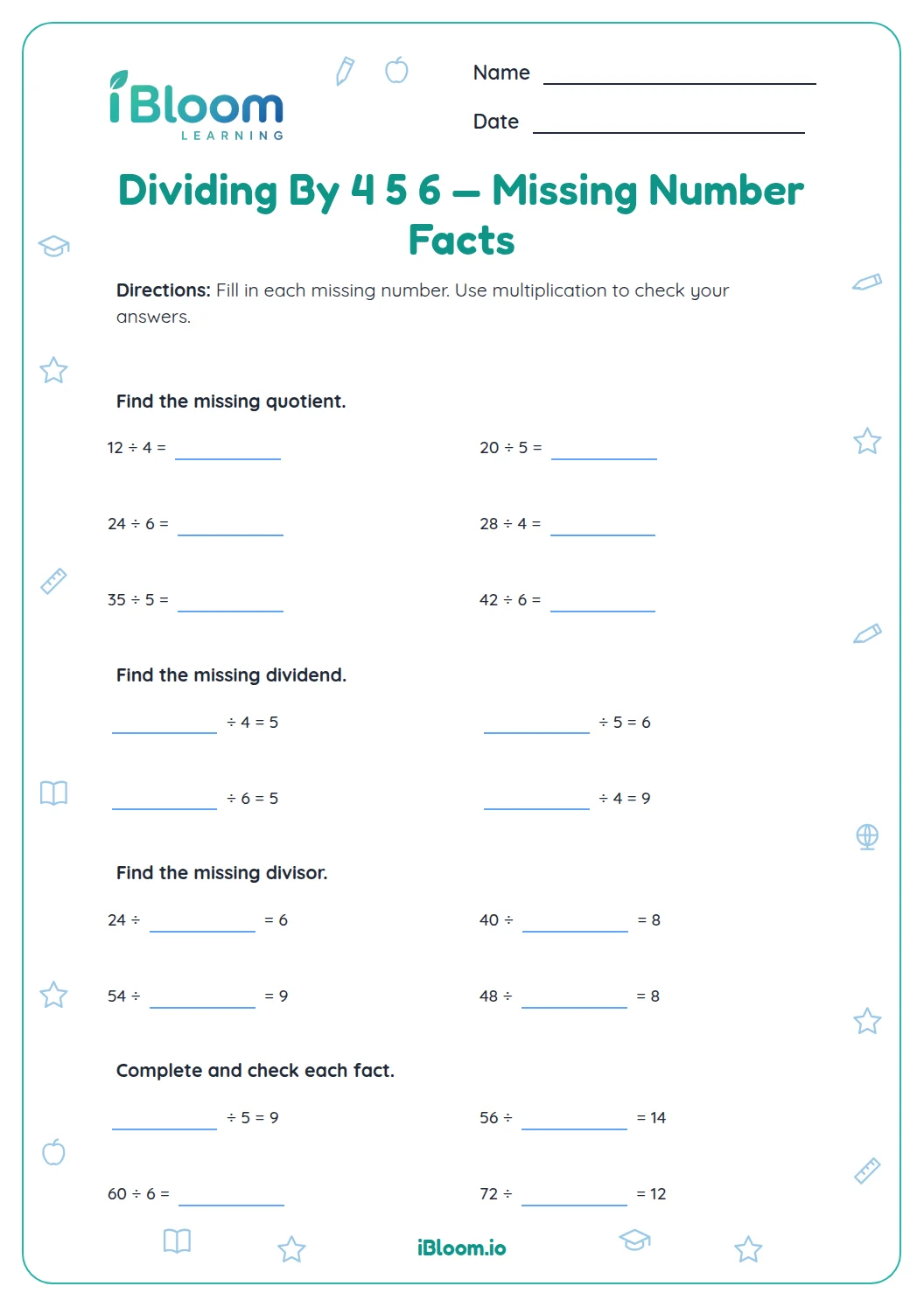
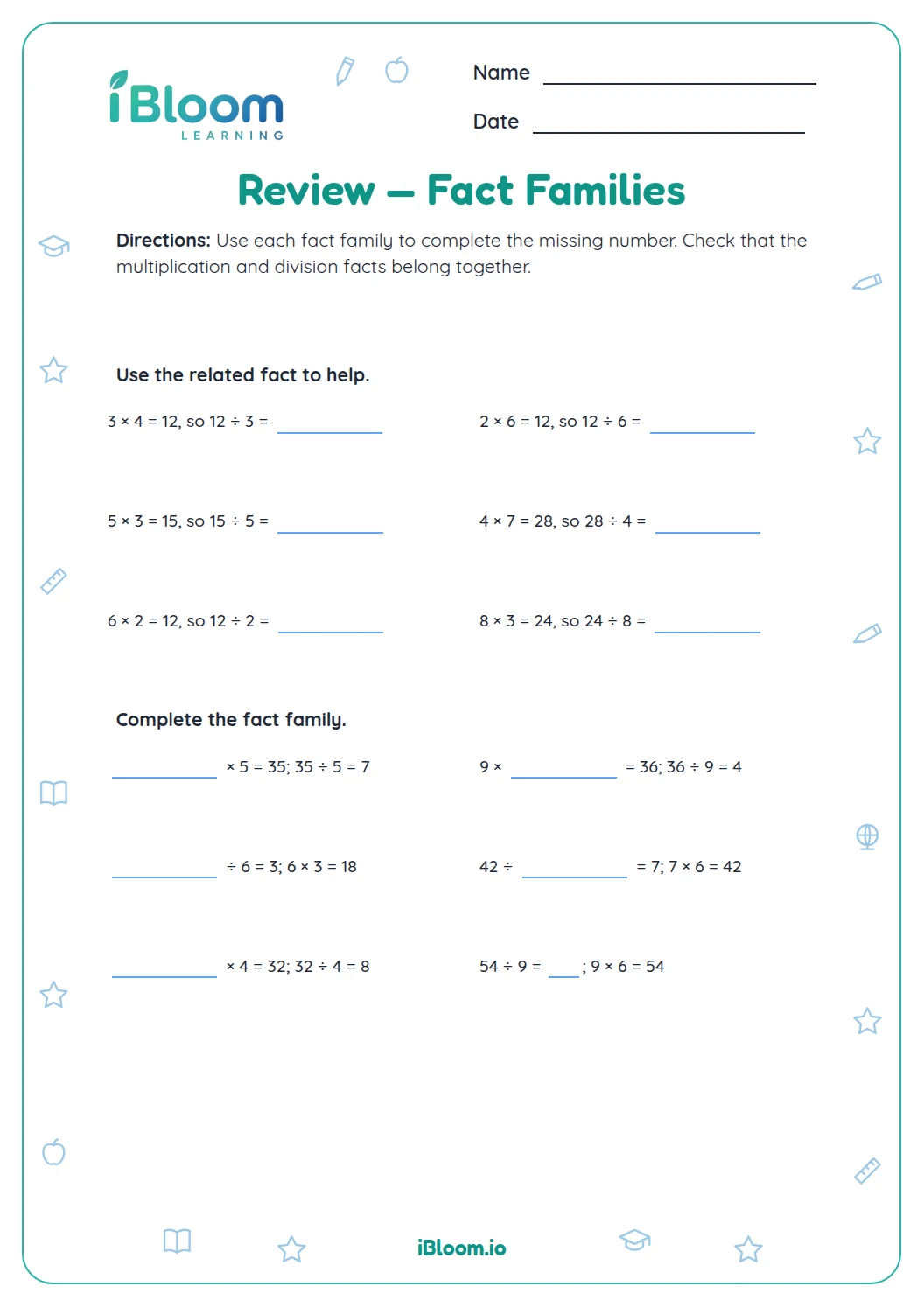
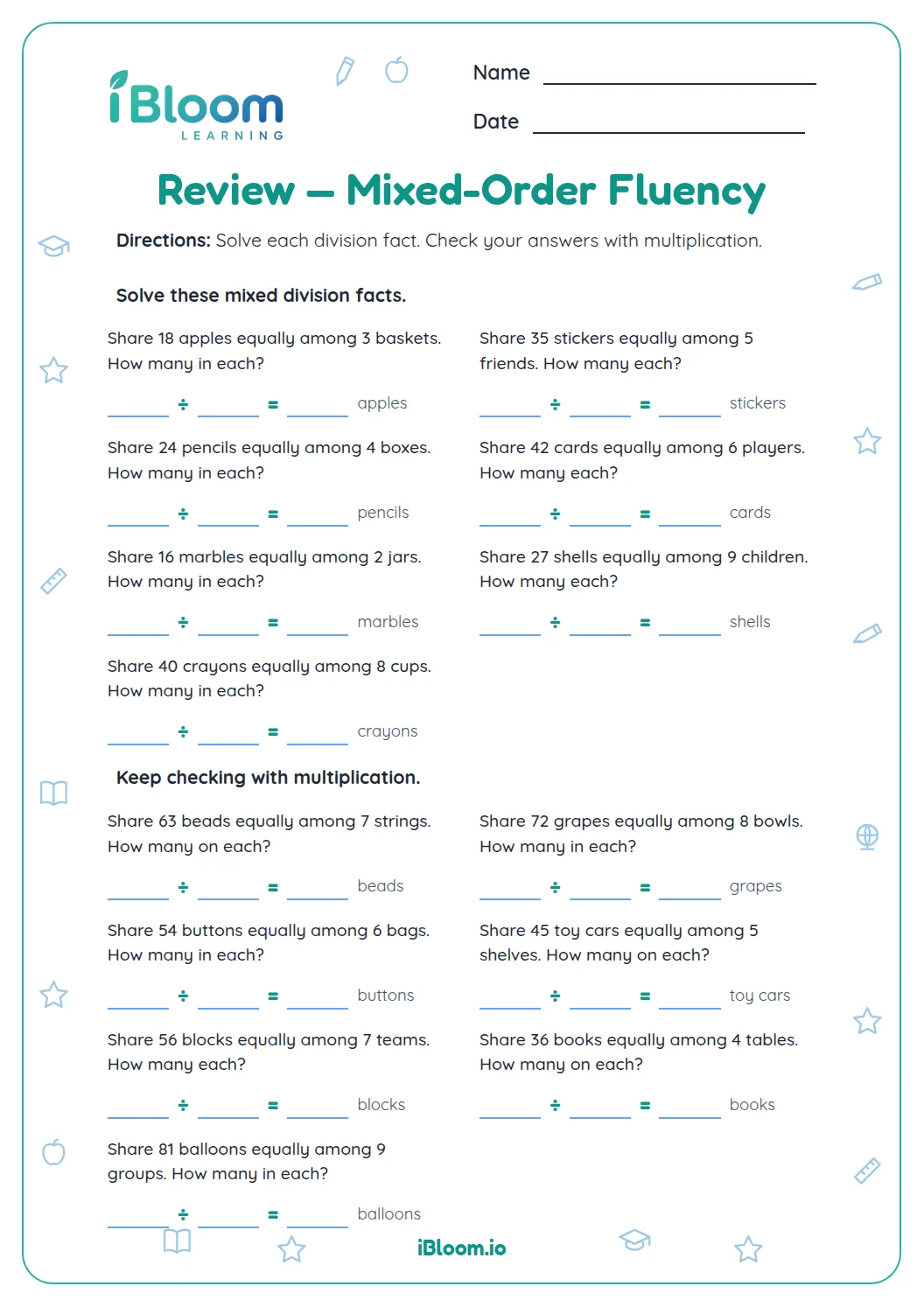
About this worksheet
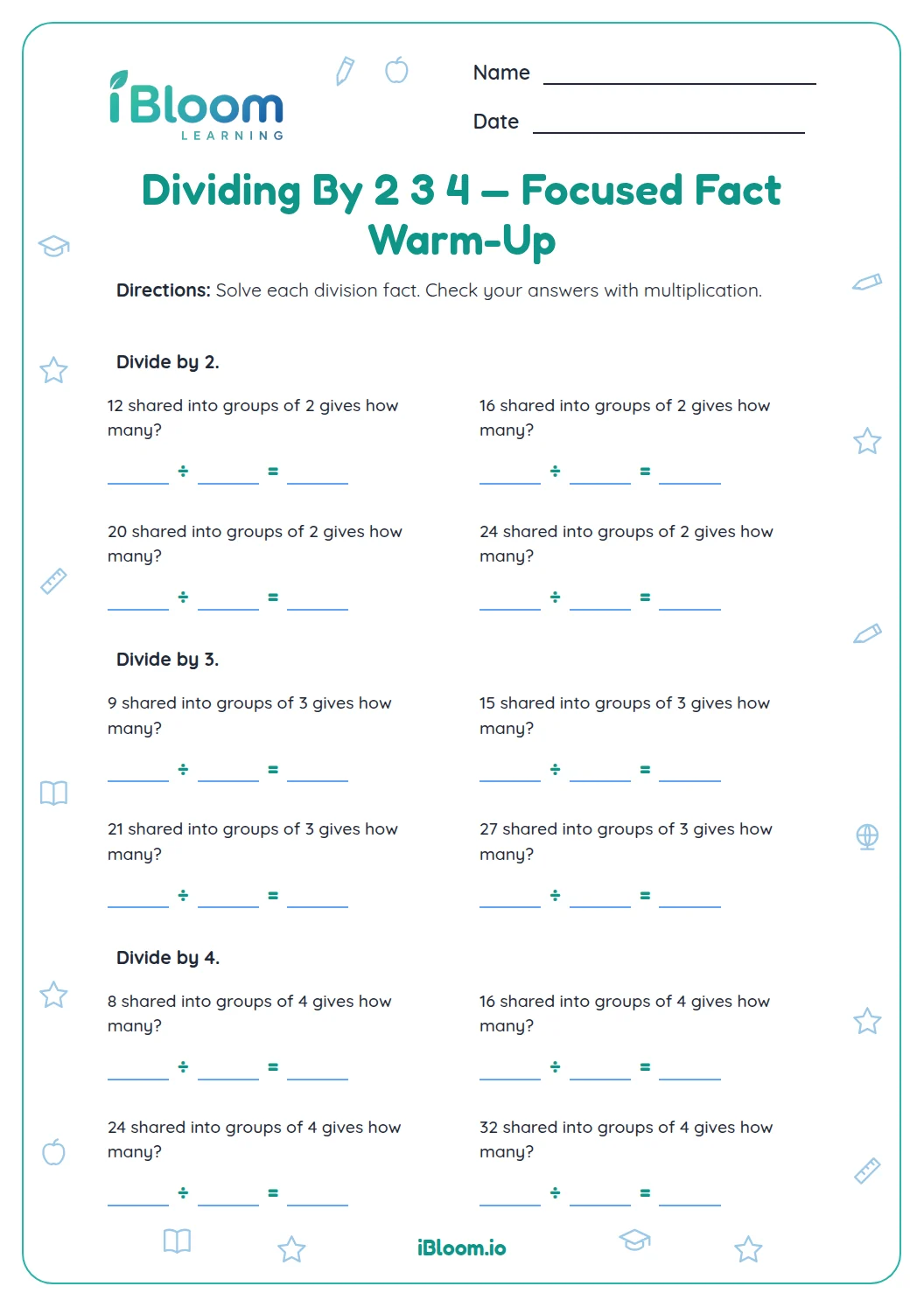
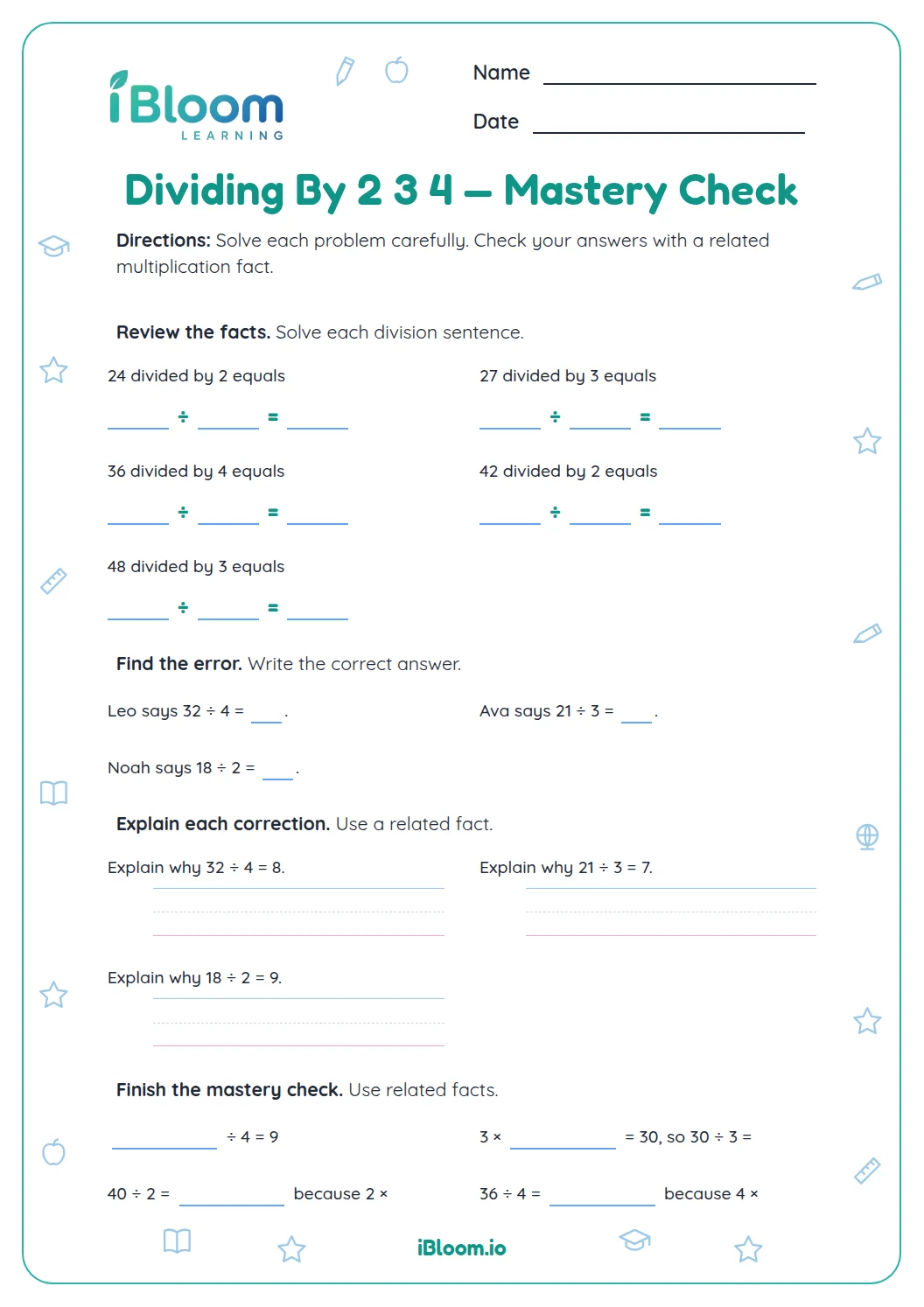
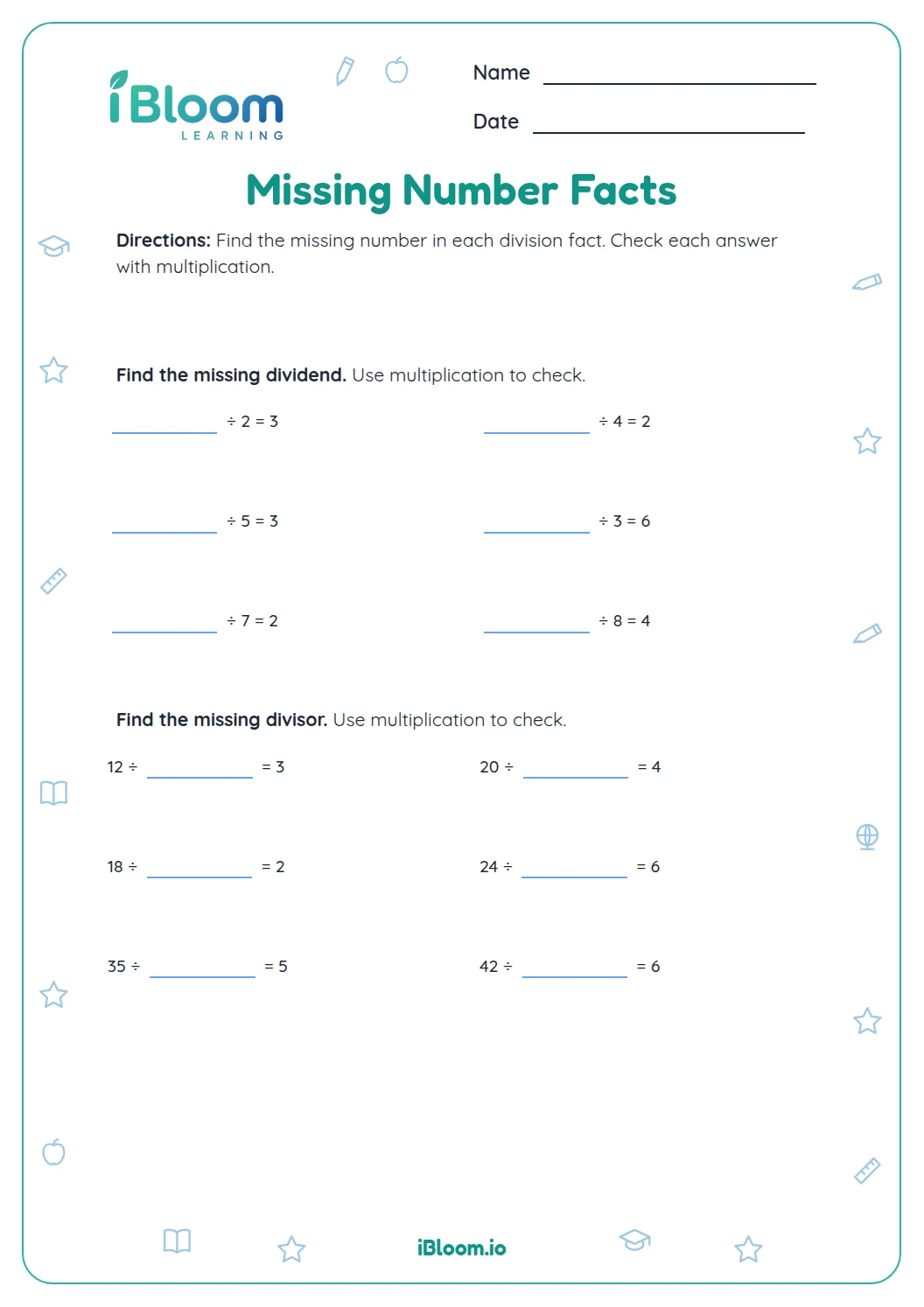
This free printable worksheet helps Grade 3 and Grade 4 students find the missing number in division facts for 2, 3 and 4. In Part A, children find the number that is being shared. In Part B, they find the group size. In Part C, they find the missing factor in a multiplication fact. In Part D, they choose the division fact that belongs in the same family as a multiplication fact. The practice supports Common Core 3.OA.B.6 and 3.OA.C.7: understanding division as an unknown-factor problem and fluently dividing within 100. An answer key lists every missing number.
Aligned to 3.OA.B.6 and 3.OA.C.7
What is on this missing number division worksheet?
Every fact uses 2, 3 or 4 as the divisor or as a factor, and the biggest number is 36, so the facts stay inside the times tables children are learning first. The missing number moves from place to place, which keeps children from filling in the answer after the equals sign by habit.
Part A hides the number being shared, Part B hides the divisor, and Part C hides a factor in multiplication. Part D then asks children to pick, from three choices, the division fact that uses the same three numbers as a multiplication fact.
- Part A: find the missing dividend, as in ___ ÷ 3 = 8 (questions 1 to 6)
- Part B: find the missing divisor, as in 18 ÷ ___ = 6 (questions 7 to 10)
- Part C: find the missing factor, as in 3 × ___ = 21 (questions 11 to 14)
- Part D: choose the matching division fact (questions 15 to 18)
How does multiplication help find a missing number?
Division and multiplication are two views of the same three numbers. If 3 groups of 8 make 24, then 24 split into 3 groups gives 8 in each. So when a division fact is missing a number, children can rewrite it as a multiplication fact and ask what fits.
For a missing dividend like ___ ÷ 3 = 8, the multiplication fact gives the answer directly: 3 × 8. For a missing divisor like 32 ÷ ___ = 8, children ask which number times 8 makes 32.
- 12) ___ ÷ 3 = 8 → 3 × 8 = 24, so 24 ÷ 3 = 8 → 24
- 29) 32 ÷ ___ = 8 → ___ × 8 = 32, and 4 × 8 = 32 → 4
What is a fact family and how does Part D use it?
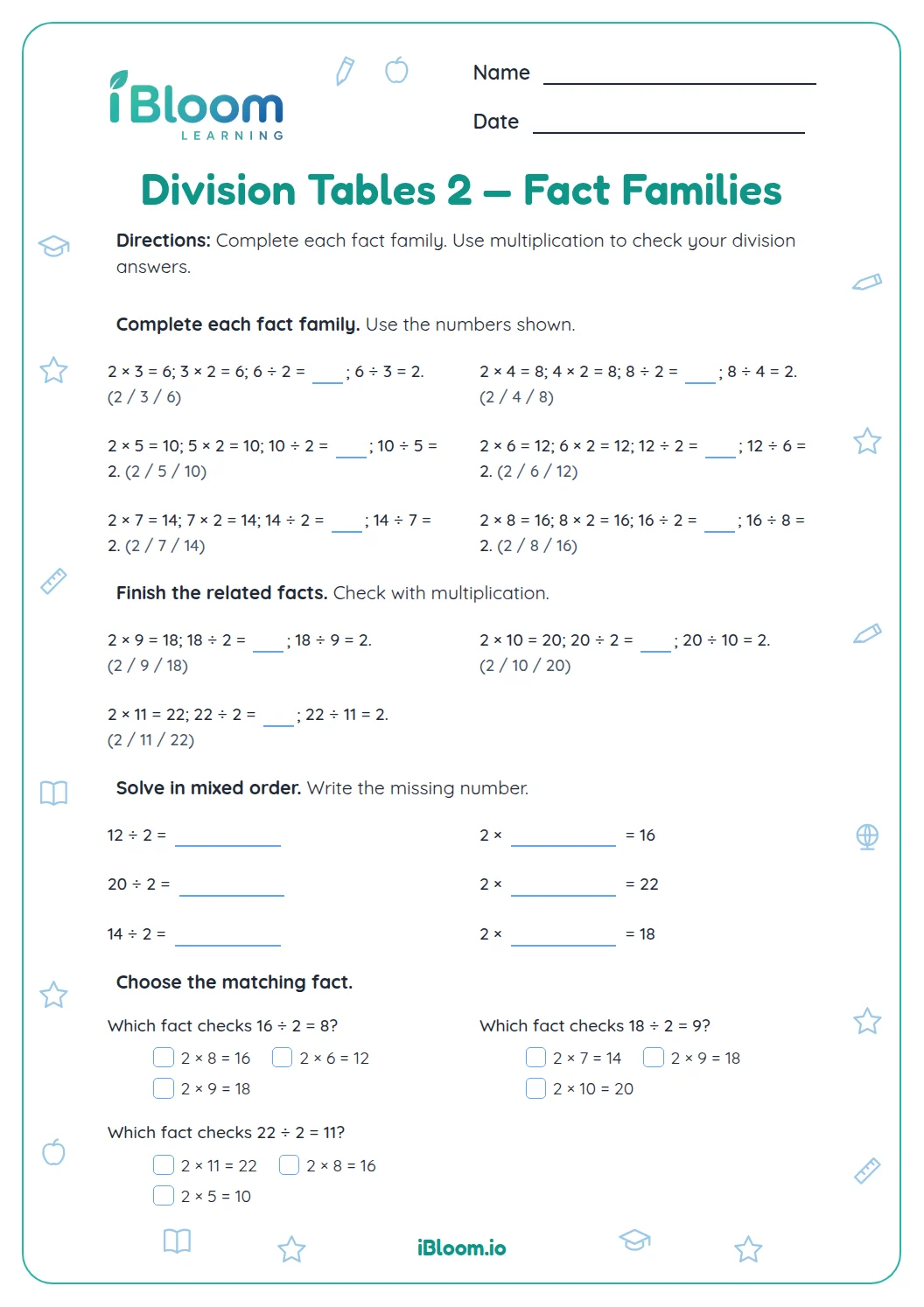
A fact family is a group of facts that use the same three numbers. The numbers 4, 7 and 28 give 4 × 7 = 28, 7 × 4 = 28, 28 ÷ 4 = 7 and 28 ÷ 7 = 4.
In Part D, each choice has the same quotient, so the choices look alike. The only difference is the divisor, and children must check which one matches the multiplication fact. Question 15 is 4 × 7 = 28, so the divisor is 4, not 2 or 3.
- 115) 4 × 7 = 28 → 28 ÷ 4 = 7
- 2Check: 2 × 7 = 14, not 28, and 3 × 7 = 21, not 28
Why practice dividing by 2, 3 and 4 first?
These divisors go with the 2, 3 and 4 times tables, which children can skip-count most easily. Dividing by 2 is the same as halving, and dividing by 4 is halving twice. A child who knows 3 × 8 = 24 already knows two division facts, because 24 ÷ 3 = 8 and 24 ÷ 8 = 3.
Learning to turn multiplication facts into division facts also reduces how much needs to be memorized. Practicing both directions gives children a way to check their own answers.
How to use this worksheet at home or in class
- 1Read the three-number idea aloud: every fact on the page uses a trio of numbers that go together.
- 2Do question 1 together. Ask your child to say the multiplication fact before writing the answer.
- 3Let your child finish Parts A and B on their own, writing the multiplication fact in the margin if it helps.
- 4In Part C, ask your child to say the matching division fact aloud after each answer.
- 5For Part D, have your child check each choice by multiplying the divisor by the quotient.
- 6Check with the answer key, then pick two facts that took the longest and say them aloud together.
Common mistakes and quick fixes
The mistake
Adding the two numbers instead of multiplying, such as writing 9 for ___ ÷ 4 = 5.
The fix
Ask your child what the missing number is divided into. Say, “4 groups with 5 in each group is 4 × 5.” Writing the multiplication fact first prevents the slip.
The mistake
Subtracting to find a missing divisor, such as writing 12 for 18 ÷ ___ = 6 because 18 − 6 is 12.
The fix
Remind your child that division asks how many groups of 6 fit in 18. Ask “What times 6 makes 18?” and let them count up by 6s: 6, 12, 18.
The mistake
Choosing 28 ÷ 2 = 7 in question 15 because the quotient matches the multiplication fact.
The fix
Have your child multiply back. The divisor times the answer must equal the first number, and 2 × 7 is 14, not 28.
Common Core alignment
Most US states teach division facts with the Common Core standards or a close state version. These Grade 3 standards name the unknown-factor idea and the fluency that this page practices.
Find a division answer by finding the missing factor.
On this sheet: Parts B and C ask for the missing factor, and Part A uses multiplication to find the missing number.
Show the official wordingHide the official wording
Understand division as an unknown-factor problem. For example, find 32 ÷ 8 by finding the number that makes 32 when multiplied by 8.
Know multiplication and division facts, and how they connect.
On this sheet: All eighteen questions use facts for 2, 3 and 4 and the link between multiplication and division.
Show the official wordingHide the official wording
Fluently multiply and divide within 100, using strategies such as the relationship between multiplication and division (e.g., knowing that 8 × 5 = 40, one knows 40 ÷ 5 = 8) or properties of operations. By the end of Grade 3, know from memory all products of two one-digit numbers.
What to practice next
Make more practice
Further reading
Questions parents and teachers ask
Why use multiplication to find a missing number in division?
Multiplication and division use the same three numbers, so a multiplication fact answers the division question. For question 2, ___ ÷ 3 = 8, children think 3 × 8 = 24. Times tables are usually practiced first and out loud, so this lets children use facts they can already recite.
What are a dividend and a divisor?
In 14 ÷ 2 = 7, the dividend is 14, the number being divided. The divisor is 2, the number you divide by, and the quotient is 7. Part A hides the dividend, as in question 1, and Part B hides the divisor, as in question 8. Children work with the number sentences, so the words are for adults.
Why do all the facts use 2, 3 and 4?
Keeping the divisors small lets children focus on how the three numbers connect without needing larger times tables. Questions in Part C use 2, 3 and 4 as factors, and every missing number in Parts B and C is 10 or less. Once these facts feel easy, the next worksheets move on to 4, 5, 6 and beyond.
Is this worksheet for Grade 3 or Grade 4?
It suits Grade 3 students who are learning division facts, and Grade 4 students who need to strengthen them. The facts stay within 36, and each one has a multiplication fact that checks it. Any child who can say the times tables for 2, 3 and 4 can begin.
How can my child check a missing number answer?
Put the answer back into the fact and multiply. For question 7, 18 ÷ ___ = 6, a child writes 3, then checks that 3 × 6 = 18. If the multiplication does not give the first number, the answer needs another try. Checking this way builds habits that last into larger division.
What should my child do after this worksheet?
Ask your child to pick one multiplication fact from Part C and write its whole family: two multiplication facts and two division facts. Then try the Division Tables 2 worksheet. The Missing Dividends and Divisors page offers the same kind of question with larger numbers.