



About this worksheet
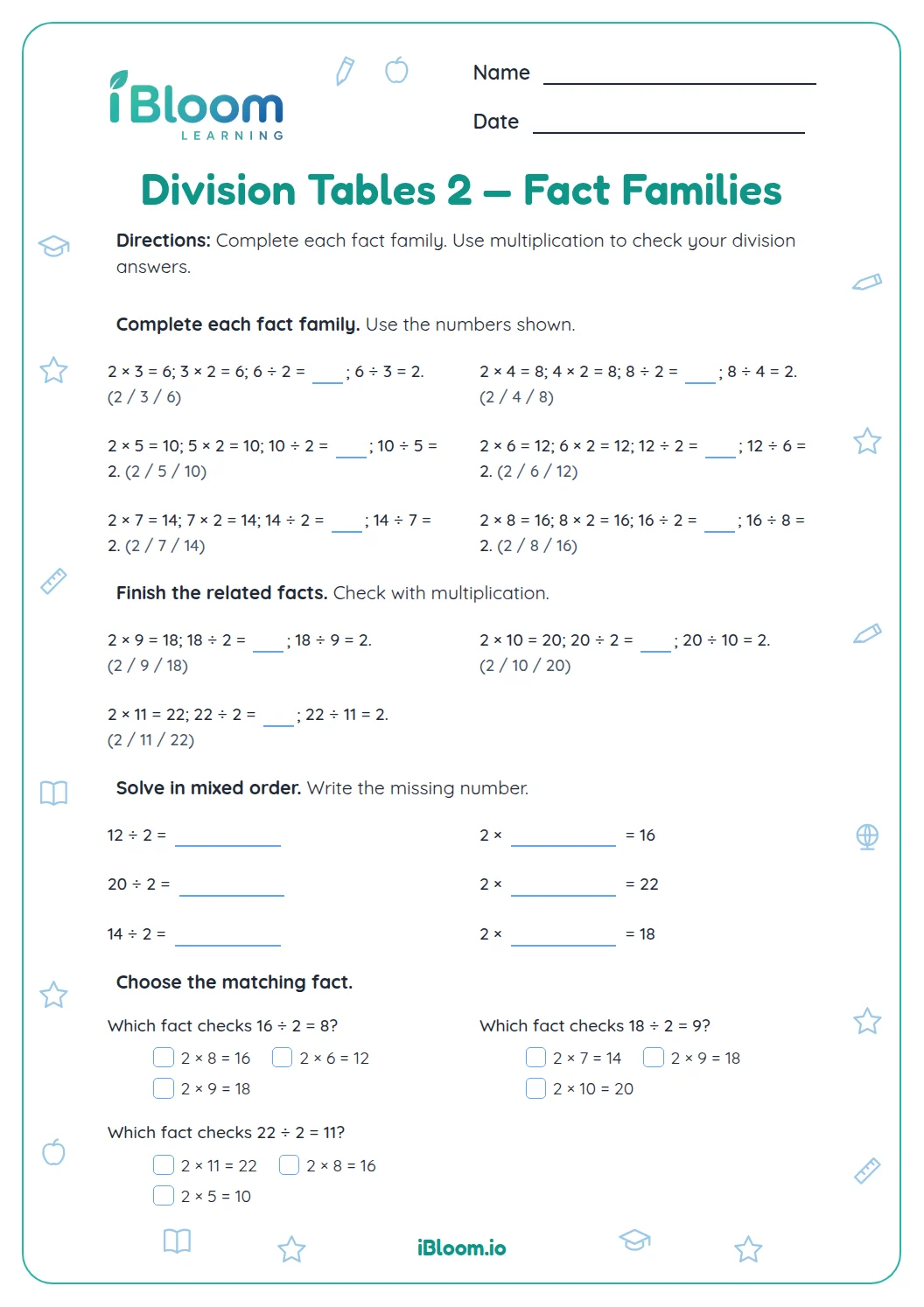
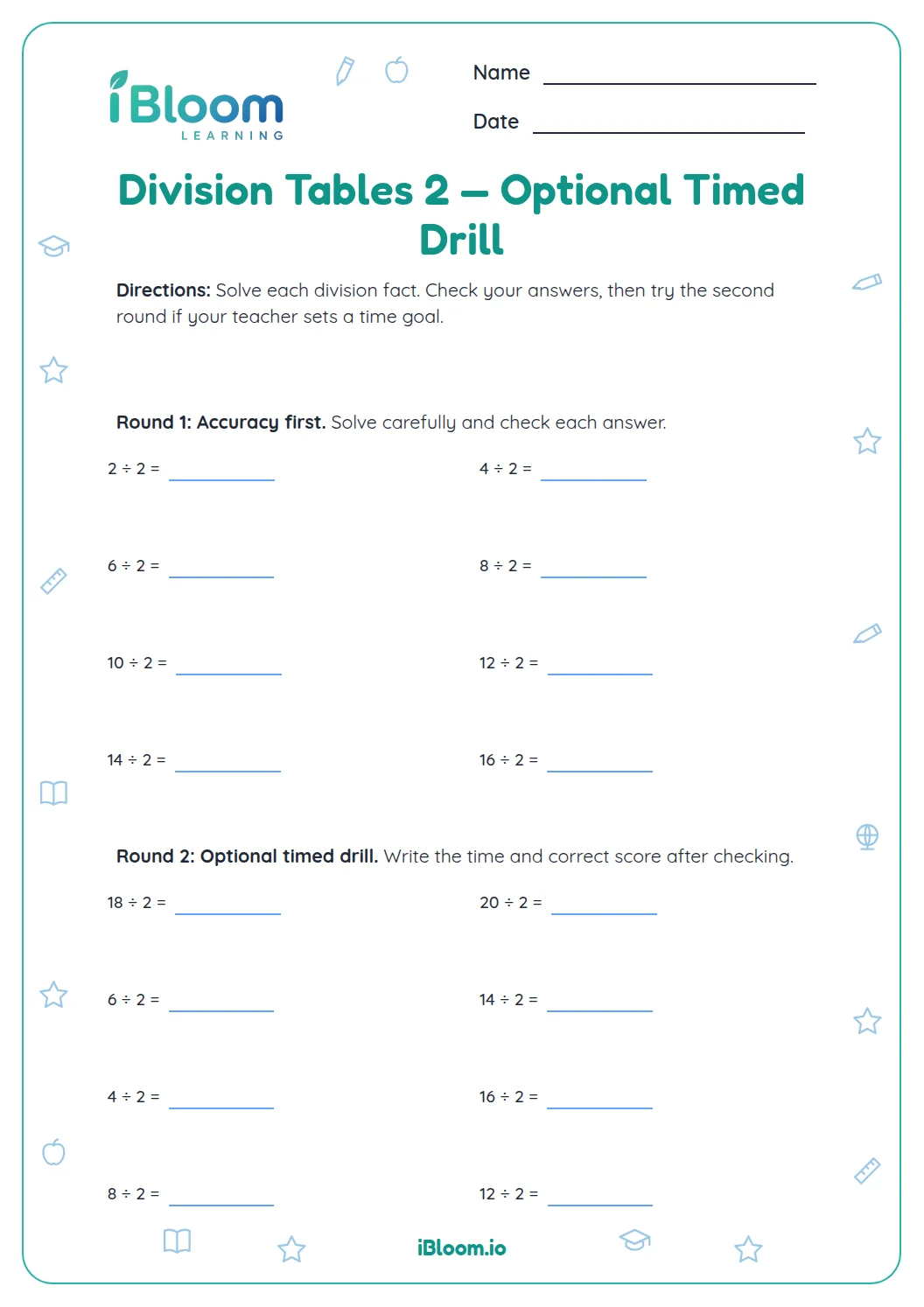
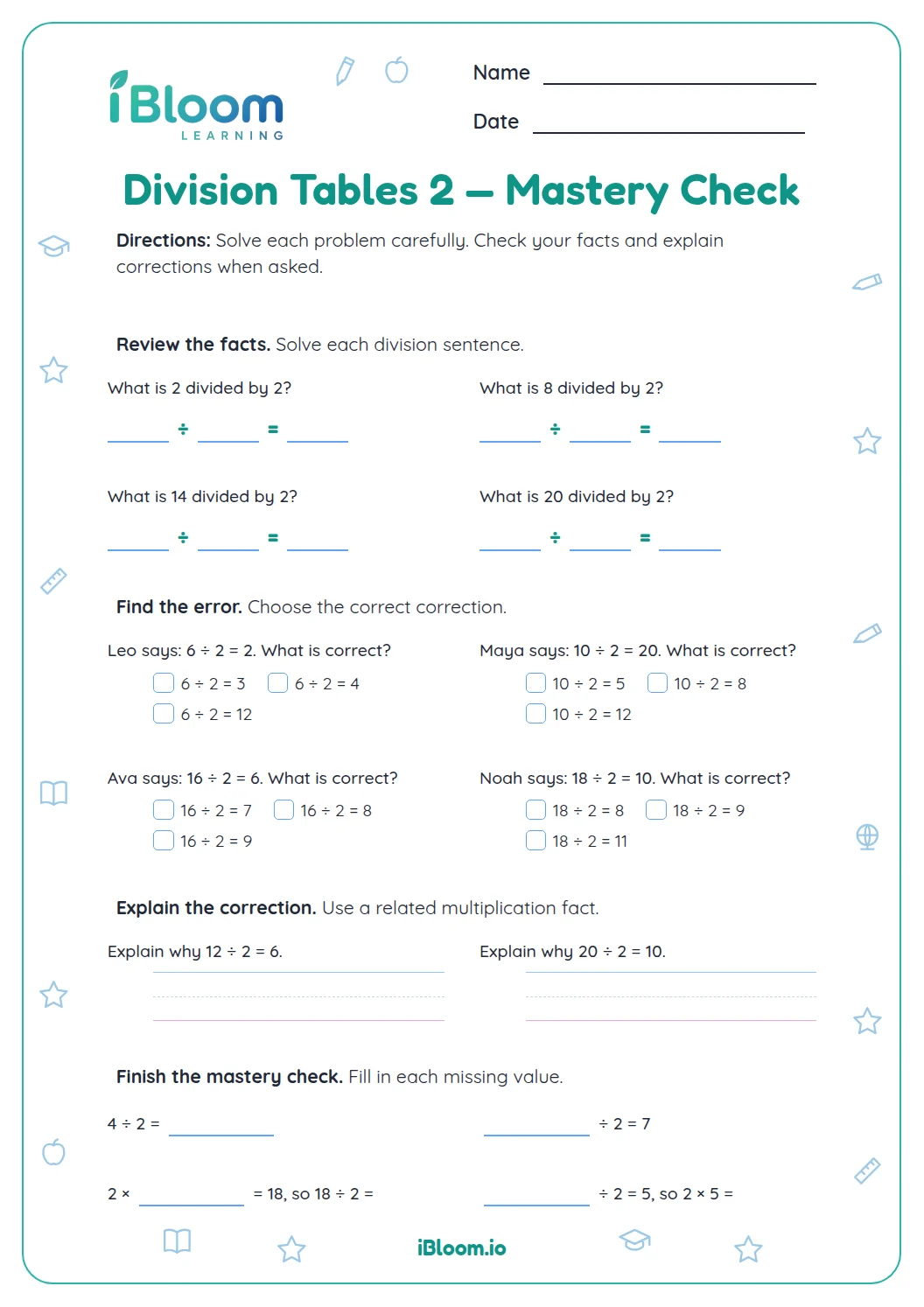
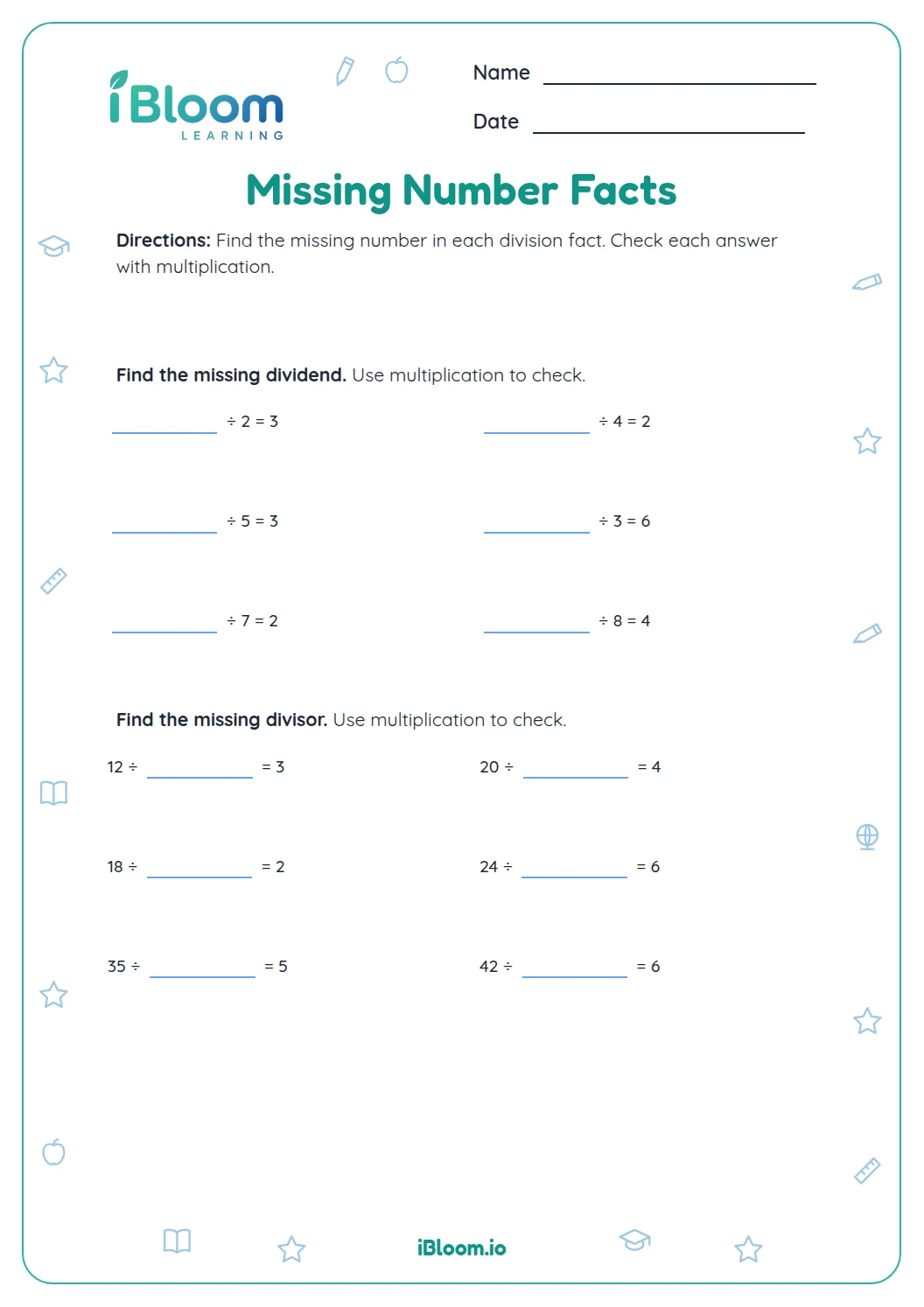
This free division-by-2 worksheet gives students in Grades 3–4 eighteen missing-number facts using the 2 times table through 24. Part A hides the quotient, or division answer. Part B hides the dividend, or starting number. Part C gives six missing divisors, matching the original sheet’s three-position practice. Children read the whole equation before deciding what belongs in its blank, as described in Common Core 3.OA.A.4. The set includes zero divided by 2 and quotients through 12. A separate answer key supplies every missing number for checking after the drill.
Aligned to 3.OA.A.4
Why does the blank’s position matter?
In 14 ÷ 2 = ___, the blank is the quotient: how many groups of 2 make 14, or how many in each of two equal groups. In ___ ÷ 2 = 8, the blank is the dividend: the total before dividing.
For 10 ÷ ___ = 5, the missing divisor is 2 because 2 × 5 = 10. Part C gives six equations with a missing divisor, so students read the full fact before choosing the blank.
How can multiplication find a missing starting number?
Question 10 reads ___ ÷ 2 = 8. Think of 8 in each of two equal groups. Two groups of 8 make 16, so 16 is the number to write in the blank.
Read the completed equation aloud to check it. Dividing the given 8 by 2 would produce 4, but 4 ÷ 2 does not equal 8.
- 1___ ÷ 2 = 8
- 22 × 8 = 16
- 3Write 16 in the blank.
- 4Check: 16 ÷ 2 = 8.
What is included in the three parts?
Part A has six missing quotients, including 0 ÷ 2 and 24 ÷ 2. Part B has six missing dividends. Part C has six missing divisors for quotients 7 through 12, matching the three blank positions practiced on the original sheet.
The completed set uses every quotient from 0 through 12 at least once. Let students work without a timer and use pairs or multiplication facts to check any uncertain answer.
How to use this worksheet
- 1Say a few doubles, such as 2 × 3 = 6 and 2 × 8 = 16.
- 2Complete Part A by finding the division answer for each total.
- 3For Part B, multiply the given quotient by 2 to find the missing total.
- 4In Part C, point to the blank and identify which number is missing.
- 5Substitute every answer and use multiplication to check the completed equation.
Mistakes to notice and how to help
The mistake
Dividing the quotient by 2 when the dividend is missing.
The fix
For ___ ÷ 2 = 8, multiply 8 by 2; then read 16 ÷ 2 = 8.
The mistake
Writing 2 for 0 ÷ 2 because 2 appears in the equation.
The fix
Share zero objects into two groups. Each group still has zero objects.
The mistake
Subtracting 5 from 10 to solve 10 ÷ ___ = 5.
The fix
Ask what number multiplied by 5 makes 10. The missing divisor is 2.
Curriculum alignment
Find missing numbers in division equations from the 2 times table.
On this sheet: All sixteen equations have an unknown quotient, dividend or divisor that makes a division fact true.
Show the official wordingHide the official wording
Determine the unknown whole number in a multiplication or division equation relating three whole numbers. For example, determine the unknown number that makes the equation true in each of the equations 8 × ? = 48, 5 = _ ÷ 3, 6 × 6 = ?
What to practice next
Make more practice
Further reading
Questions parents and teachers ask
Which division-by-2 facts are included?
The eighteen equations include quotient answers from 0 through 12, using even dividends from 0 through 24. Six questions hide the quotient, six hide the dividend and six hide the divisor. Students can use multiplication to check how the three numbers fit together.
How many questions are in each part?
There are six questions in each of the three parts, for eighteen total. Part A hides the quotient, Part B hides the dividend, and Part C hides the divisor. In every equation, students identify the blank’s role before completing the fact.
What does a blank before the division sign mean?
It means the starting number, called the dividend, is missing. In question 10, ___ ÷ 2 = 8, multiply 8 by 2 to find 16. Then check the completed equation: 16 ÷ 2 = 8. This uses the inverse multiplication fact. Multiplication undoes division here.
Why is zero divided by 2 equal to zero?
There are no objects to share, so each of two groups receives zero. Question 3 uses 0 ÷ 2 = ___ to reinforce that idea. Children can check with multiplication: two groups of zero contain zero altogether, so 2 × 0 = 0 confirms the answer.
Should this drill be timed?
Timing is optional; the worksheet works as careful, untimed practice. Have students inspect the blank’s position before solving, especially in Part C. Use the separate key after completion, and revisit a missed fact with multiplication or equal groups so the correction connects to the meaning of division.