




About this worksheet
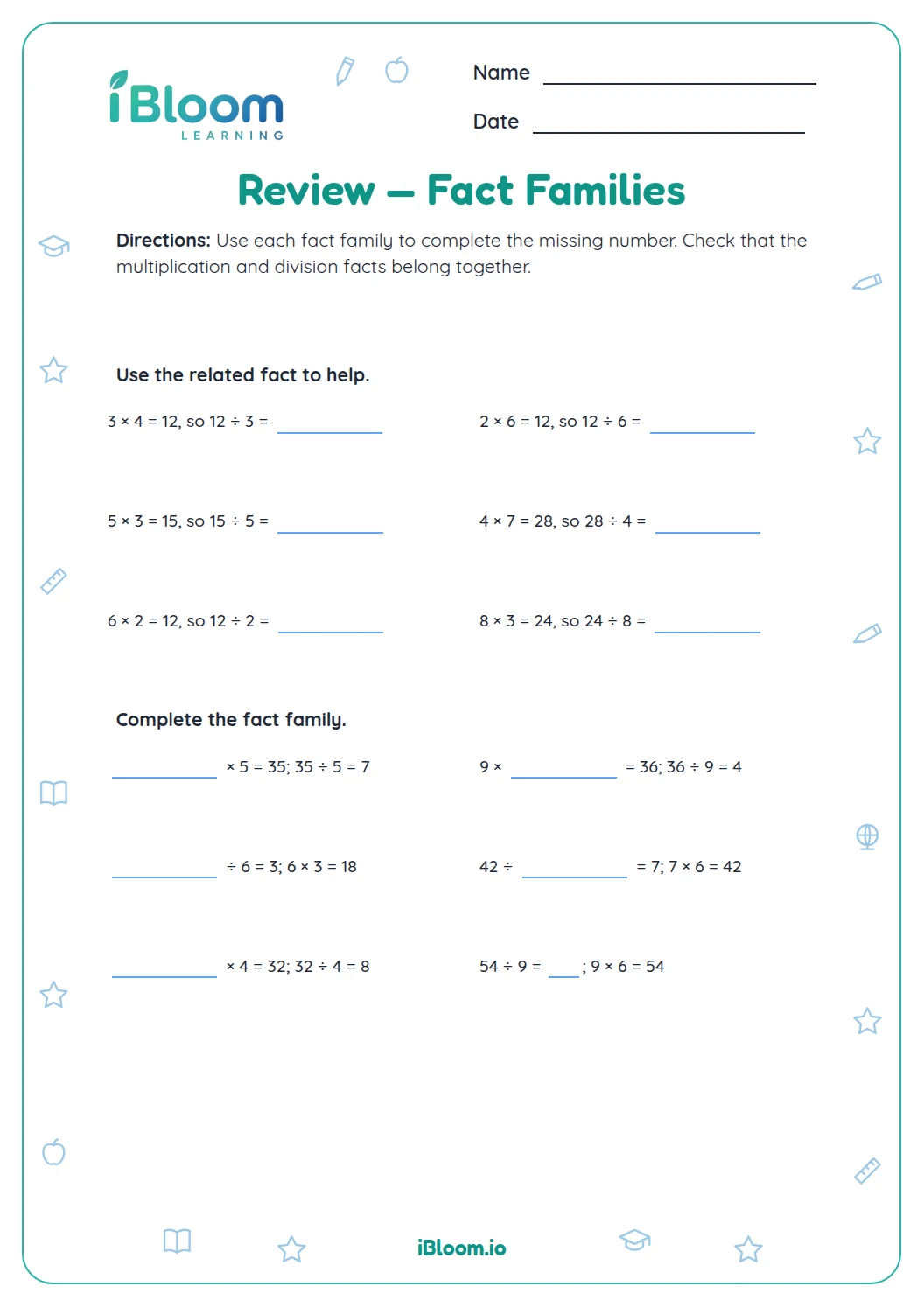
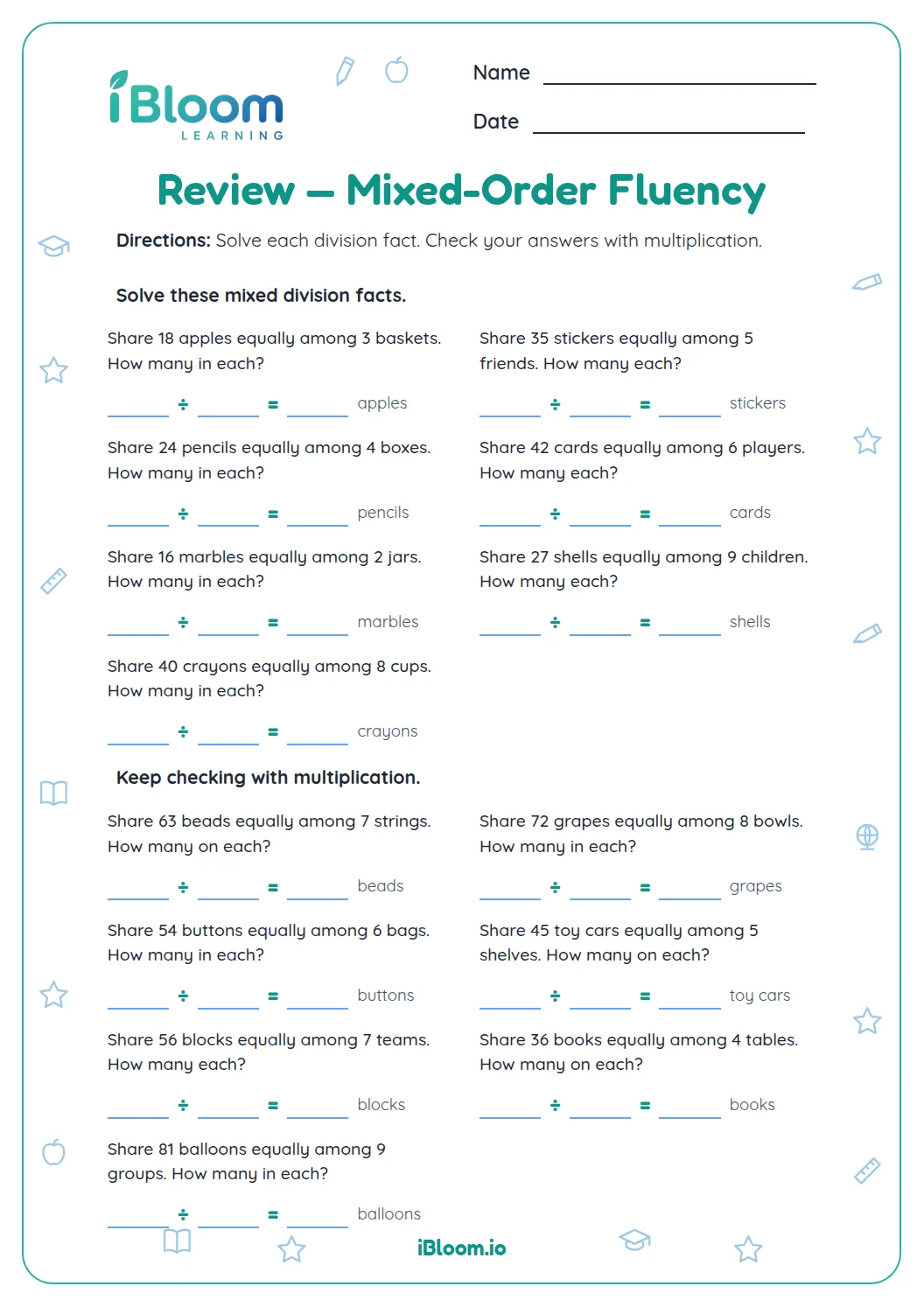
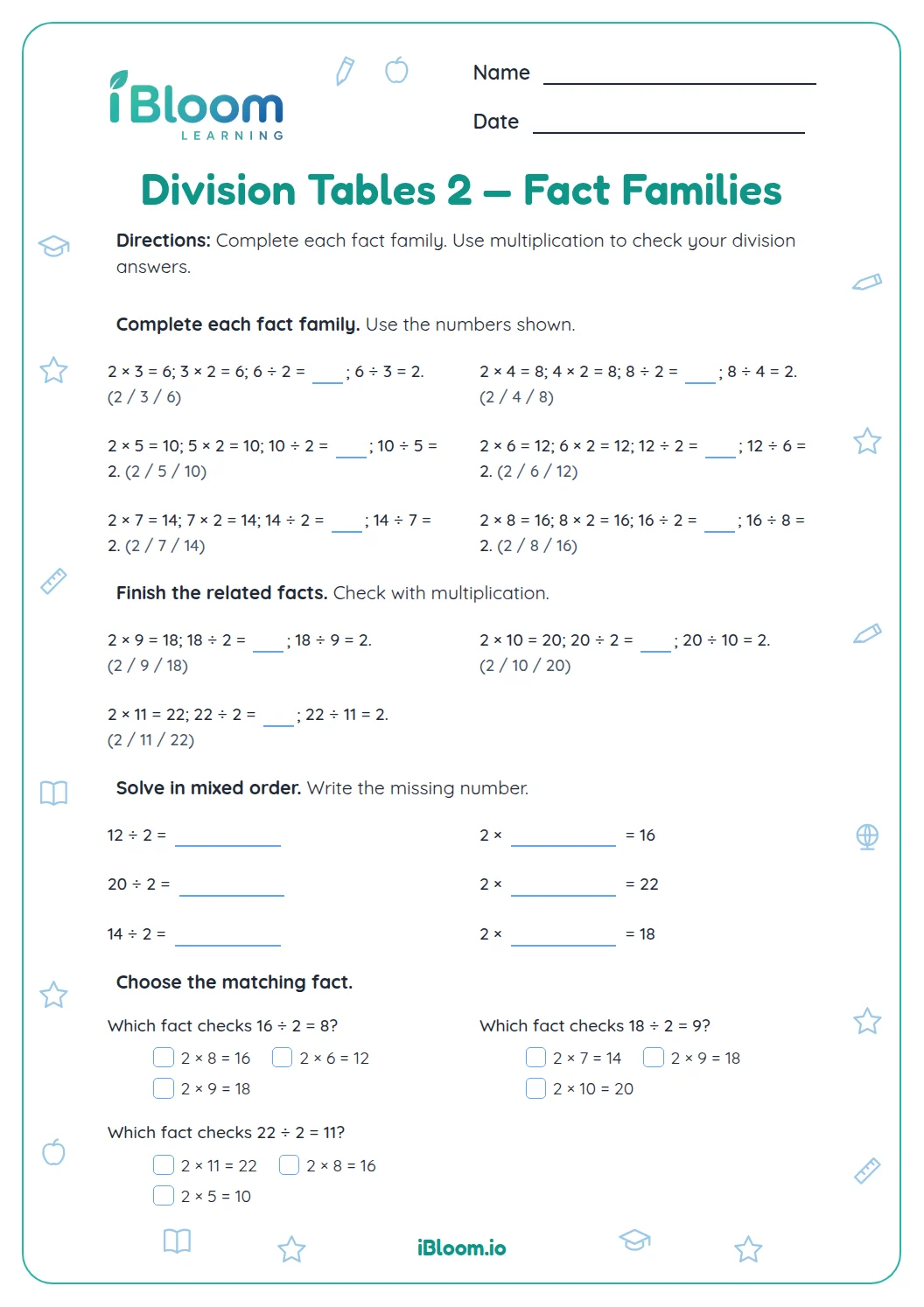
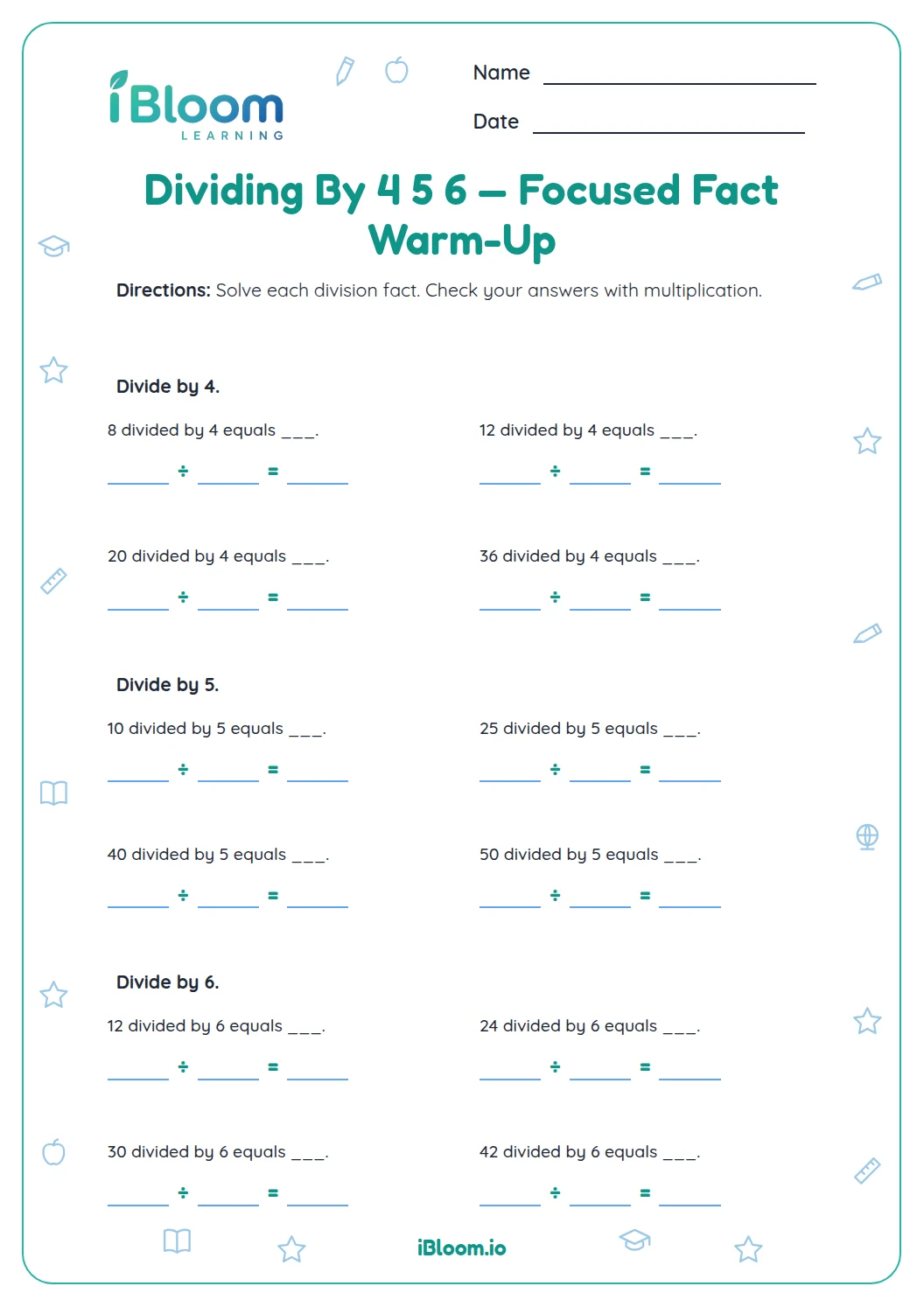
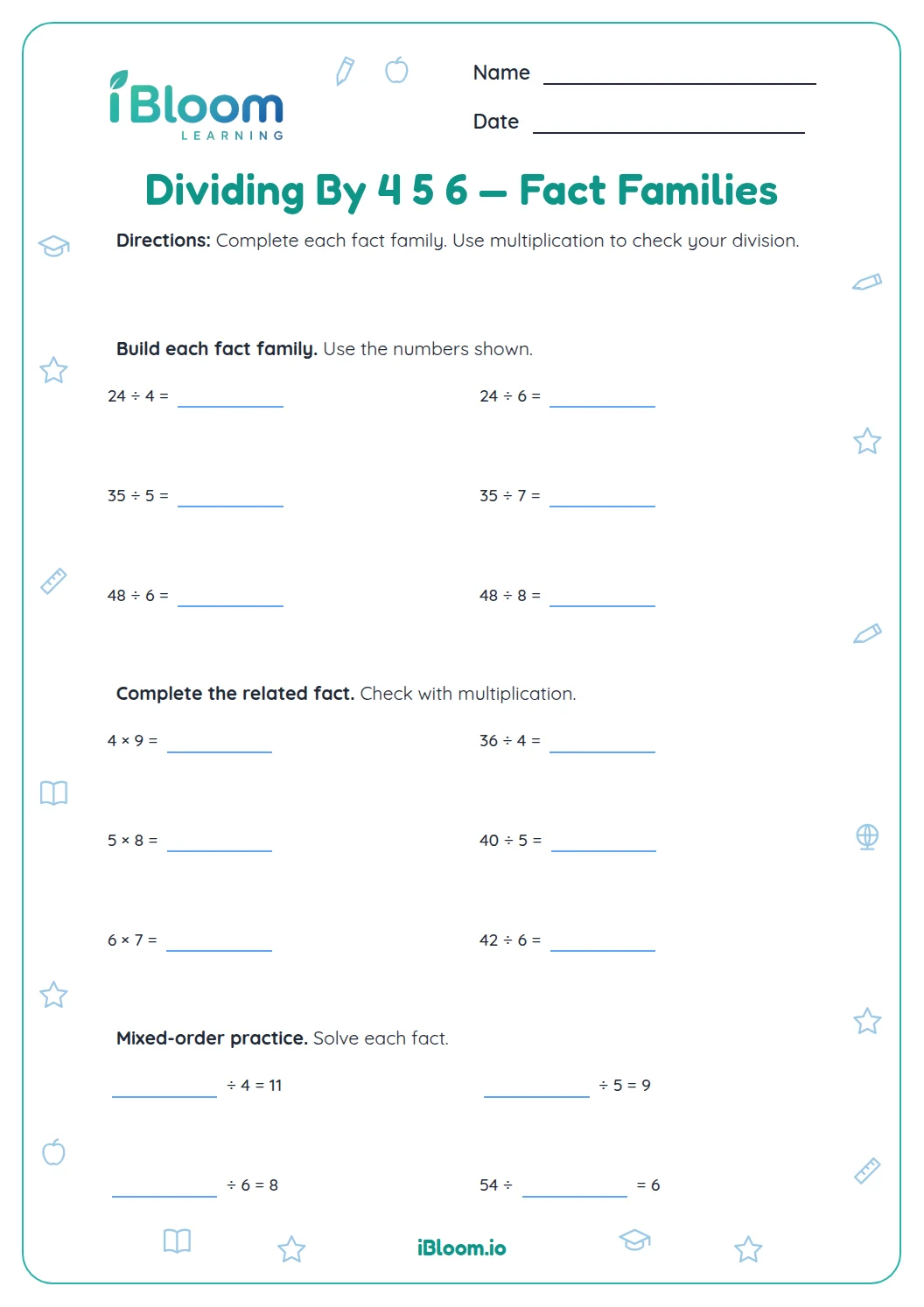
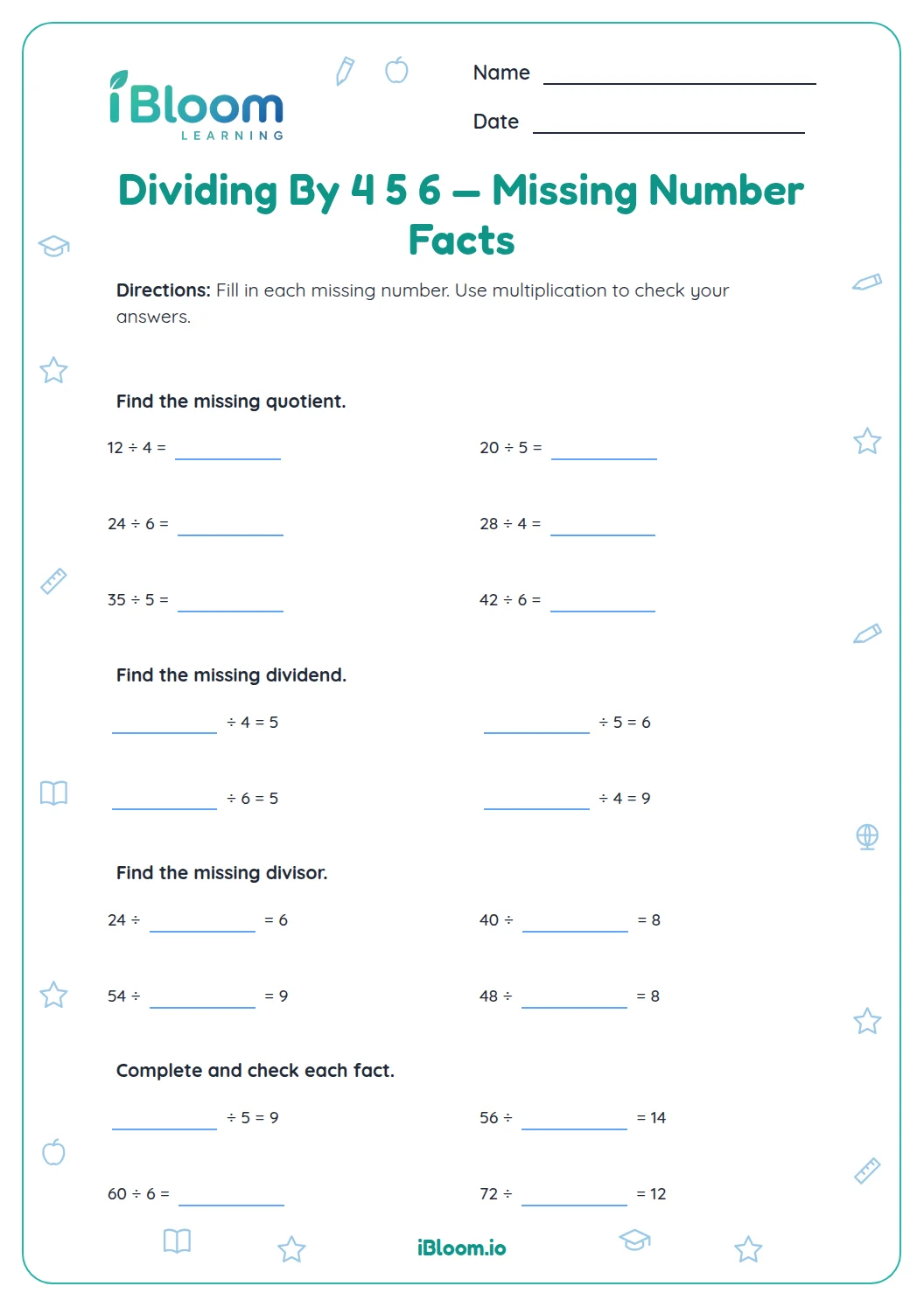
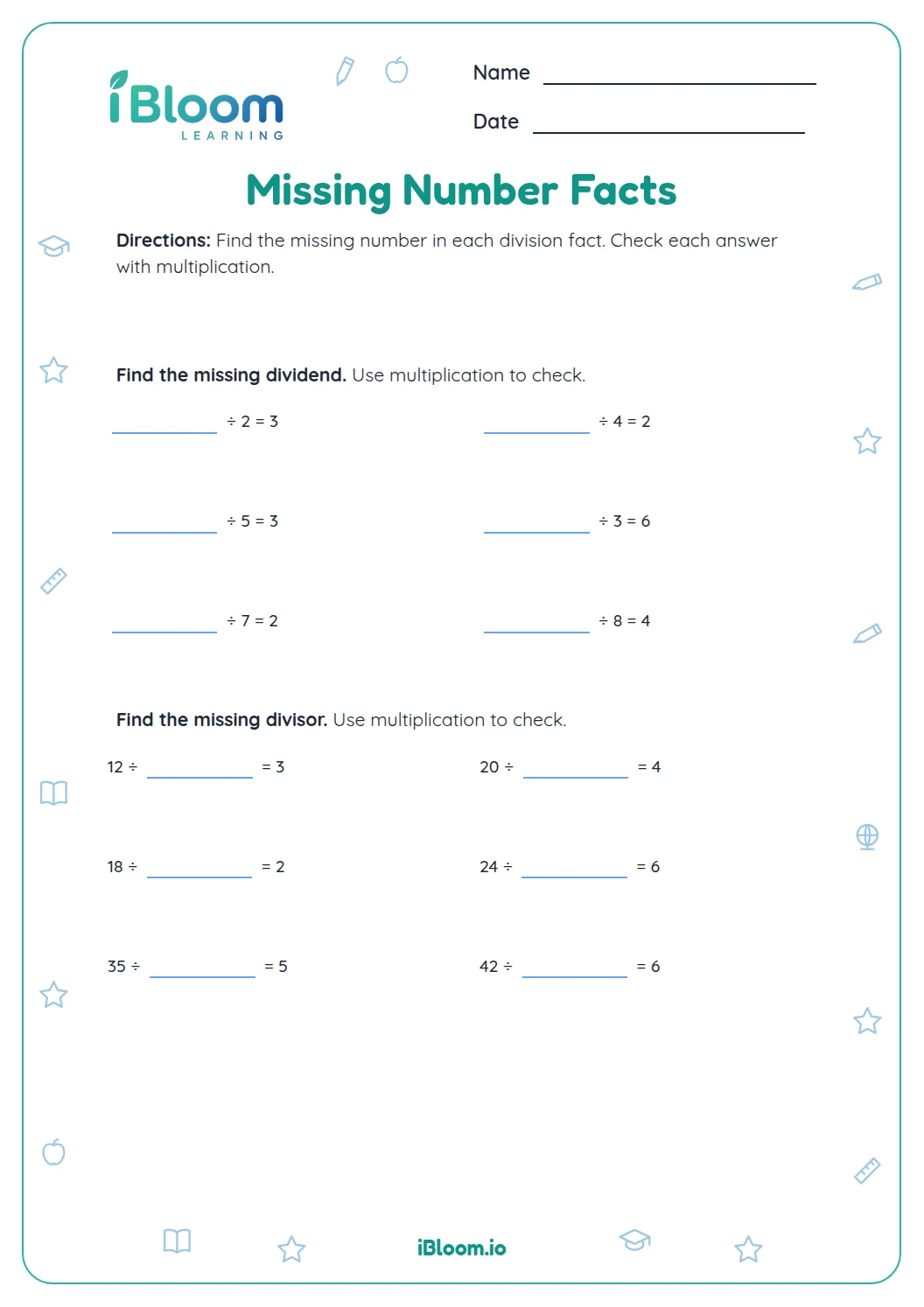
This free printable division review gives Grade 3 and Grade 4 students 18 equations with a missing number. Part A hides the quotient, Part B hides the divisor, and Part C hides the dividend. Facts stay within 100 and use one-digit factors, so students can focus on what the blank means rather than on long calculations. The worksheet practices finding unknowns under CCSS 3.OA.A.4 and using multiplication to divide fluently under CCSS 3.OA.C.7. The answer key fills every blank, making it easy to check a whole section and revisit a particular fact family.
Aligned to 3.OA.A.4 and 3.OA.C.7
What changes when the blank moves?
The relationship stays the same, but the job of the unknown changes. In 24 ÷ 6 = ___, students find how many groups of six make 24. In 42 ÷ ___ = 7, they find the size of each of seven equal groups.
A missing dividend asks for the starting total. For ___ ÷ 8 = 6, multiplying 8 by 6 gives 48. Name the blank’s role before choosing a calculation.
How does multiplication check a missing divisor?
Question 7 starts Part B with 42 ÷ ___ = 7. The known quotient is 7 and the total is 42, so the missing divisor must make 7 × ___ = 42 true.
After writing 6, reread the completed division sentence. This second reading catches an answer that belongs to a different position in the same fact family.
- 142 ÷ ___ = 7
- 2Think: ___ × 7 = 42.
- 36 × 7 = 42, so the missing divisor is 6.
- 4Check: 42 ÷ 6 = 7.
How can I use the three parts for review?
Begin with the six missing quotients in Part A, then discuss why the blanks move in Part B. Part C asks students to rebuild the dividend by multiplying. The grouped practice makes it easy to identify which position needs another example.
Use accuracy as the first goal. If a student pauses, ask for a related multiplication fact. Revisit only the missed facts after checking instead of requiring another full page immediately.
How to use this worksheet
- 1Say the multiplication fact for 24 ÷ 6 before writing the quotient.
- 2Finish the six quotient blanks in Part A.
- 3Point to the divisor blank in question 7 and connect it to 6 × 7 = 42.
- 4Multiply to rebuild each dividend in Part C.
- 5Check the key, then reread each corrected equation aloud.
Mistakes to catch and how to fix them
The mistake
Always dividing the two visible numbers, including in Part C.
The fix
For ___ ÷ 8 = 6, multiply 8 × 6 to find the starting total, 48.
The mistake
Copying the quotient into the divisor blank.
The fix
Test the whole equation. In 42 ÷ ___ = 7, the missing factor is 6.
The mistake
Confusing 6 × 8 with 7 × 8.
The fix
Use 6 × 8 = 48 to check question 13 and 7 × 8 = 56 to check question 6.
Common Core alignment
Find an unknown dividend, divisor or quotient in a division equation.
On this sheet: Every item has one missing whole number, with the blank in three different positions.
Show the official wordingHide the official wording
Determine the unknown whole number in a multiplication or division equation relating three whole numbers. For example, determine the unknown number that makes the equation true in each of the equations 8 × ? = 48, 5 = _ ÷ 3, 6 × 6 = ?
Use multiplication facts to solve division facts within 100.
On this sheet: All 18 facts use one-digit factors and dividends no greater than 81.
Show the official wordingHide the official wording
Fluently multiply and divide within 100, using strategies such as the relationship between multiplication and division (e.g., knowing that 8 × 5 = 40, one knows 40 ÷ 5 = 8) or properties of operations. By the end of Grade 3, know from memory all products of two one-digit numbers.
What to practice next
Make more practice
Further reading
Questions parents and teachers ask
Which numbers are missing on this sheet?
The sheet has six missing quotients, six missing divisors and six missing dividends. These are grouped into Parts A, B and C so students can practice one position at a time. All answers are whole numbers, and every equation can be checked with a related multiplication fact.
How do I explain a missing dividend?
Explain that the dividend is the total being divided. In question 13, ___ ÷ 8 = 6, there are six groups of eight, so the total is 48. Ask the child to write 8 × 6 = 48, then read the completed division sentence aloud.
Is this worksheet suitable for Grade 4 review?
Yes, it gives Grade 4 students a short review of division facts and unknown numbers. The facts also suit Grade 3 students practicing CCSS 3.OA.A.4 and 3.OA.C.7. Use the three sections to see whether a student needs help with fact recall or with the position of the blank.
Should I time the missing-number facts?
Timing is optional; begin by checking whether the student understands each blank. Moving from a missing quotient to a missing dividend changes the calculation needed. Let the student use multiplication facts and explain one example from each part before adding any personal goal for completing the review more quickly.
What does the answer key show?
The answer key supplies the missing number in every one of the 18 equations. Check a section at a time, then ask the student to prove a corrected answer with multiplication. For example, 42 ÷ 6 = 7 is supported by the multiplication fact 6 × 7 = 42.