


About this worksheet
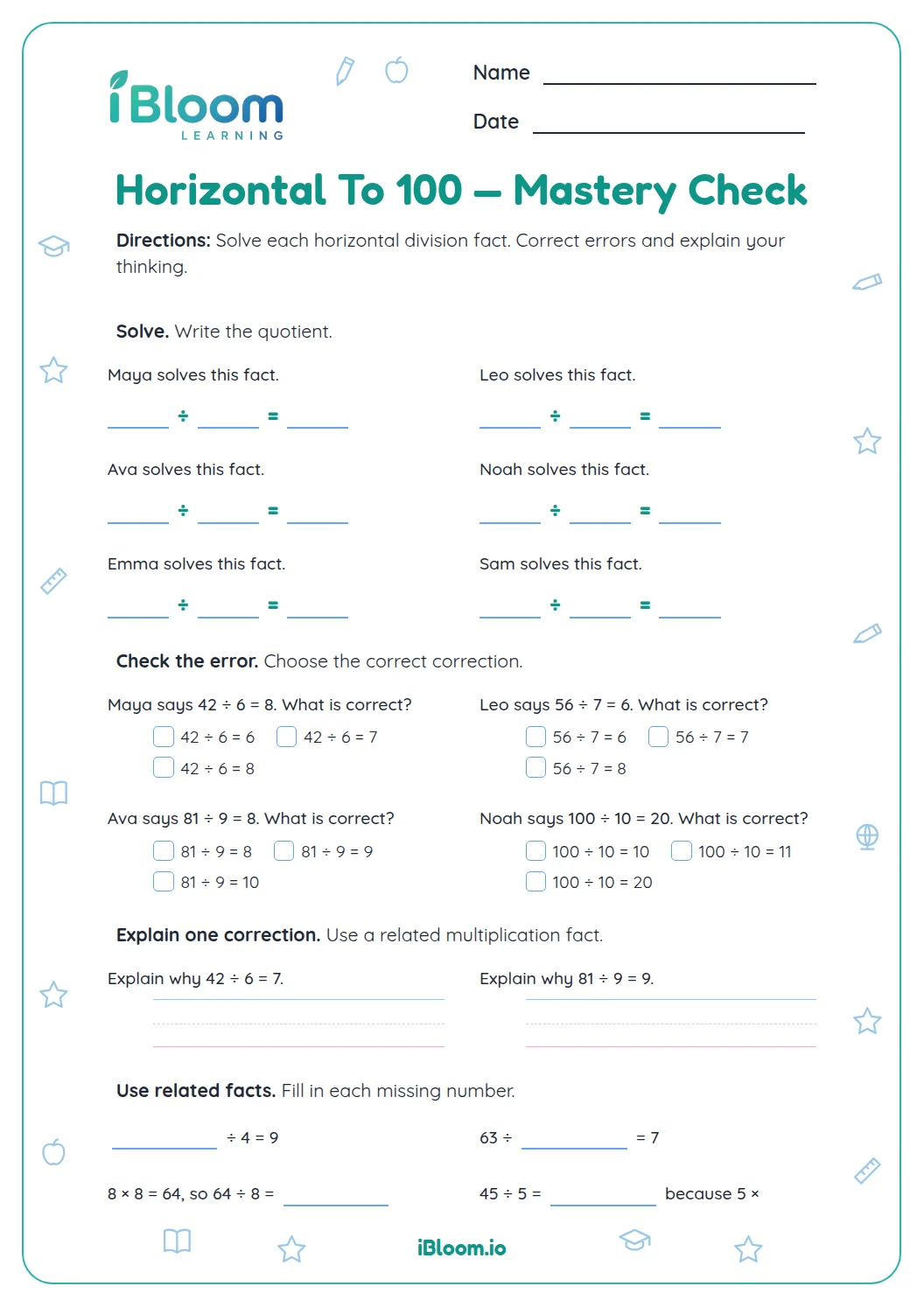
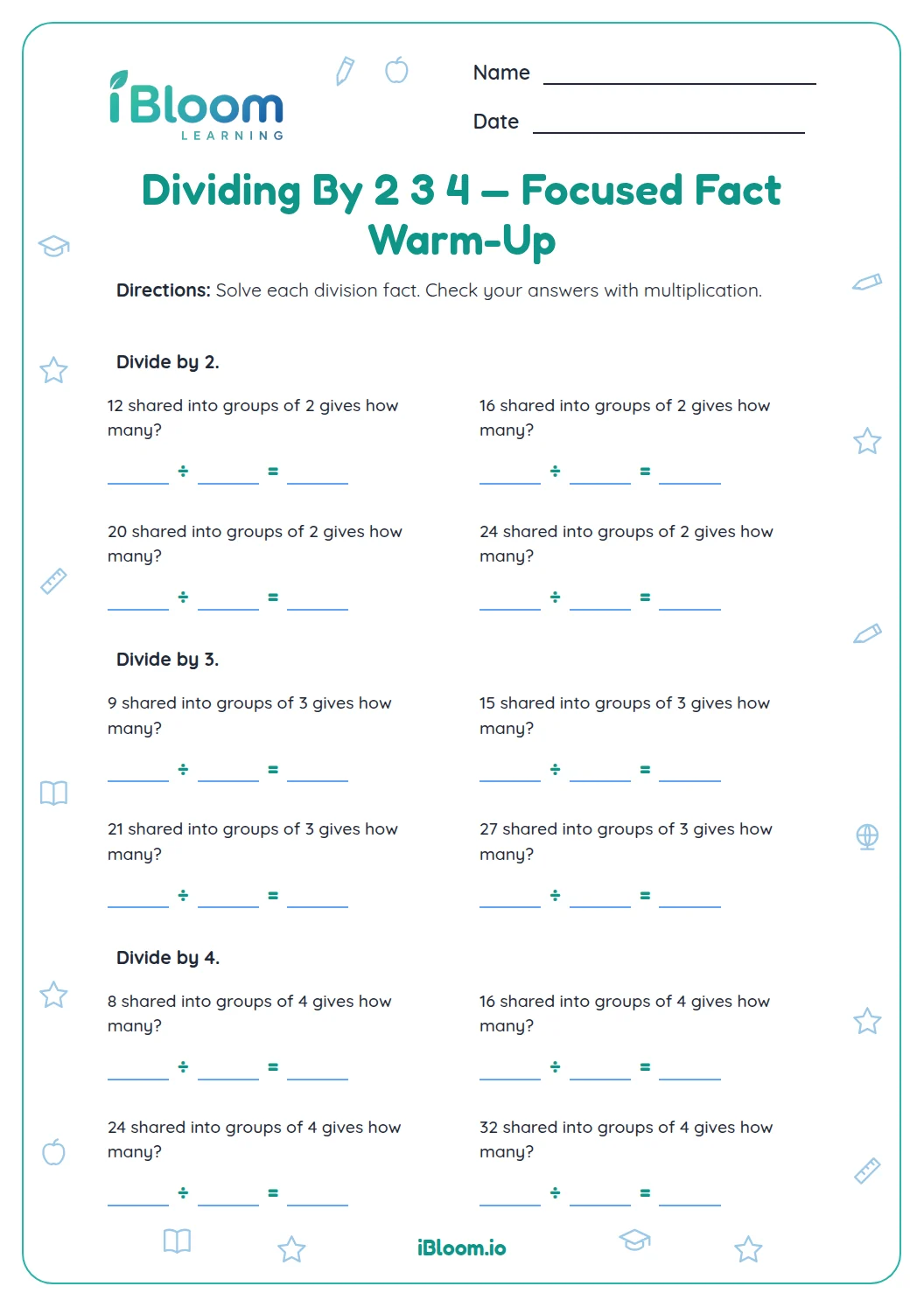
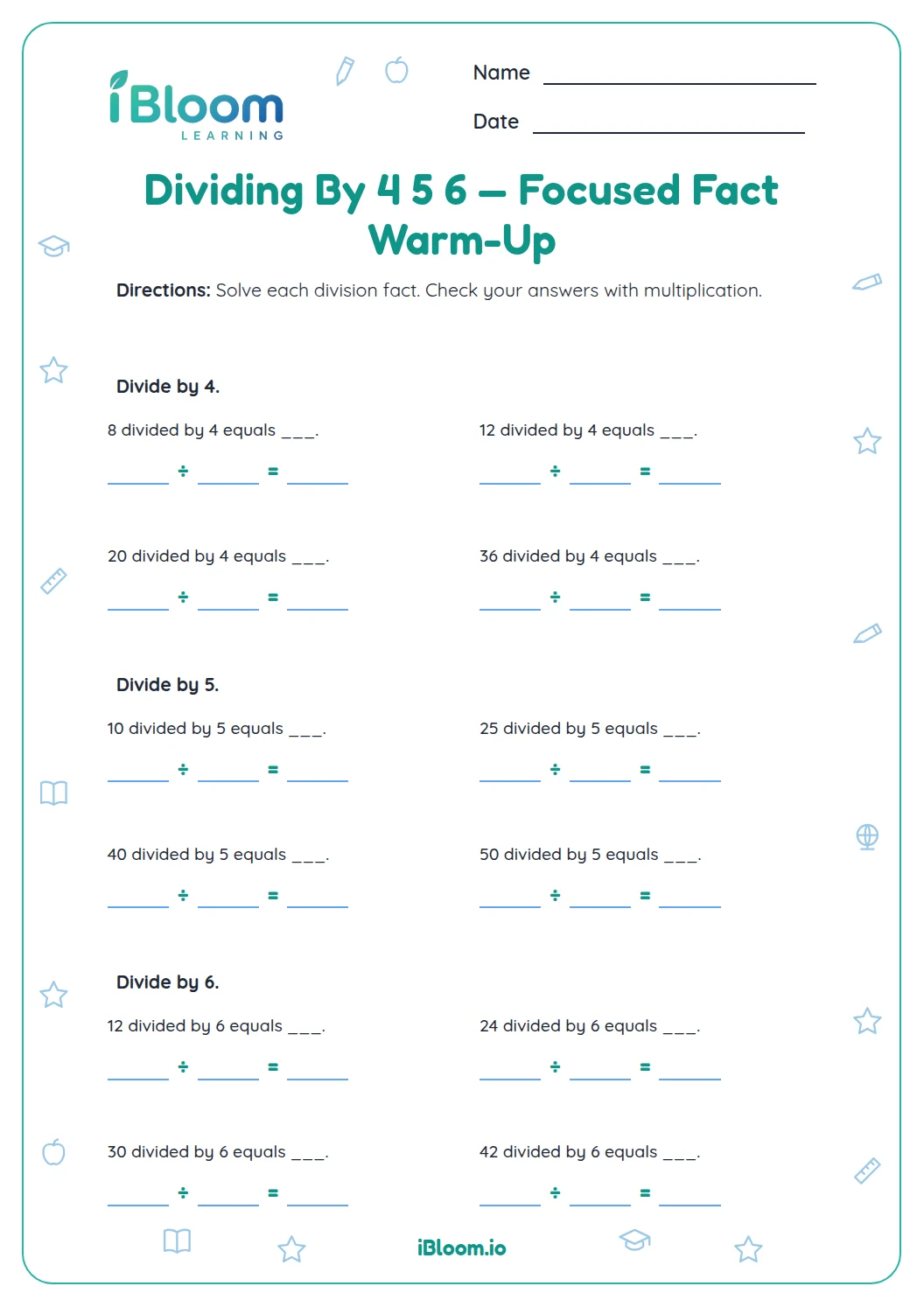
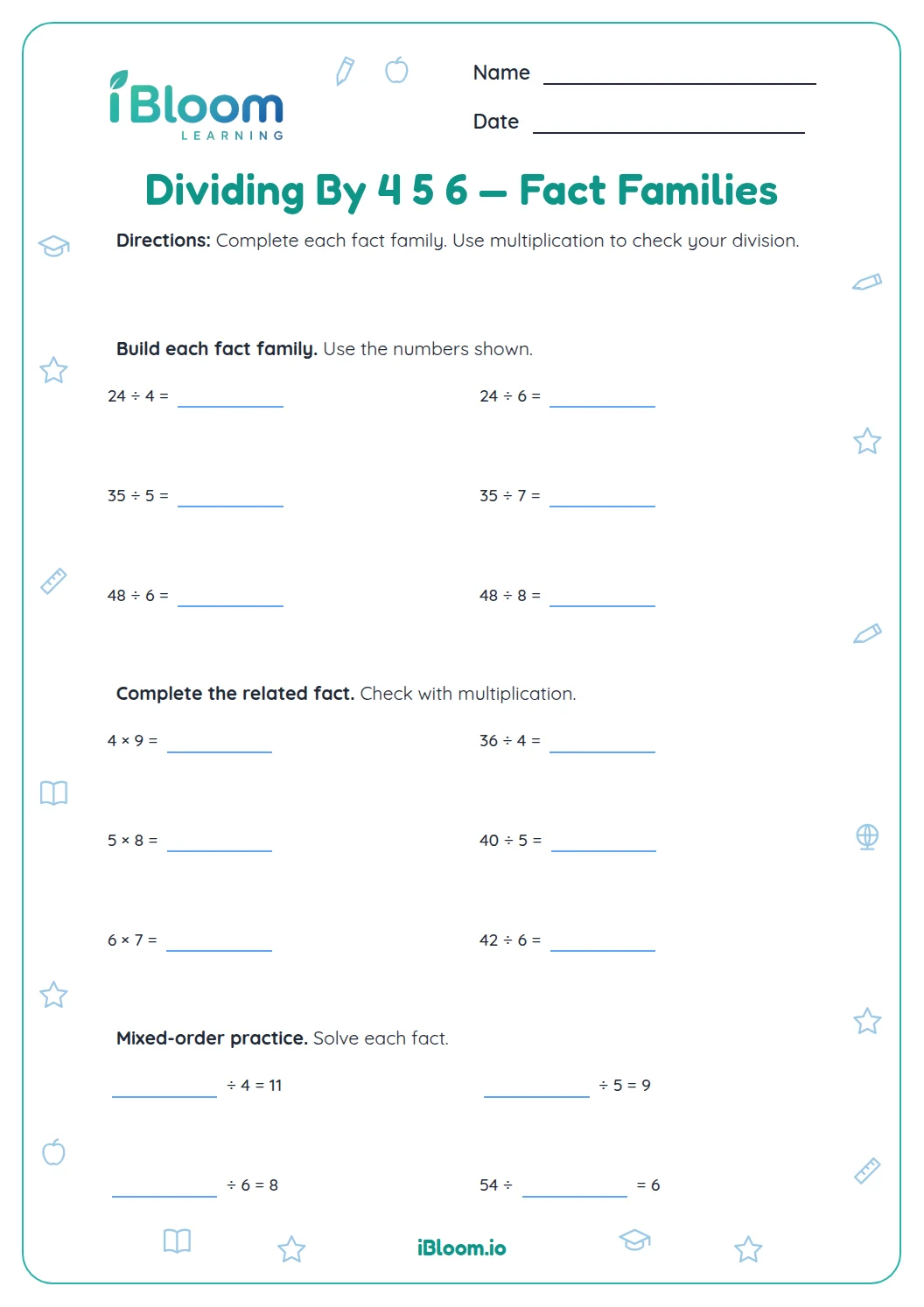
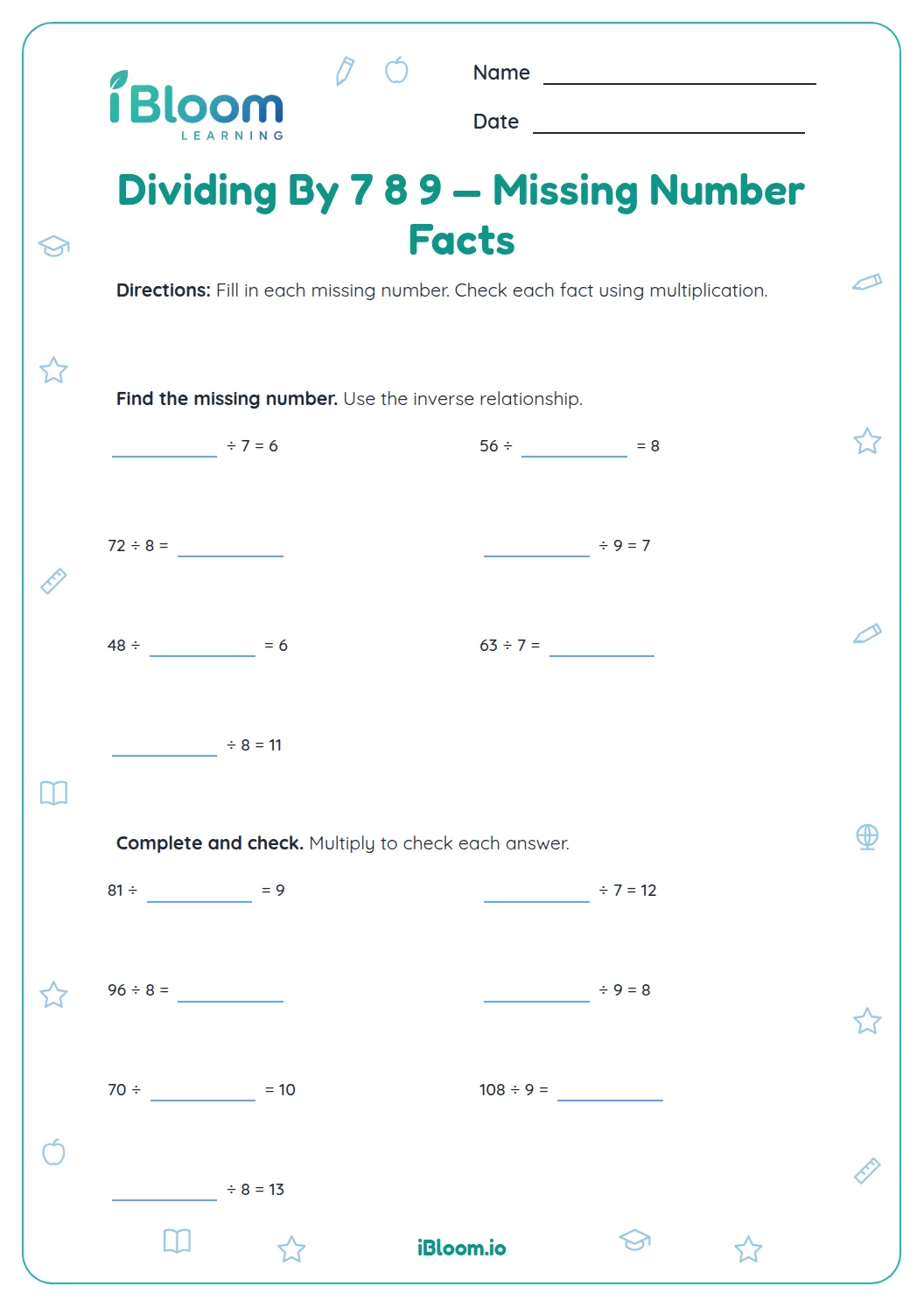
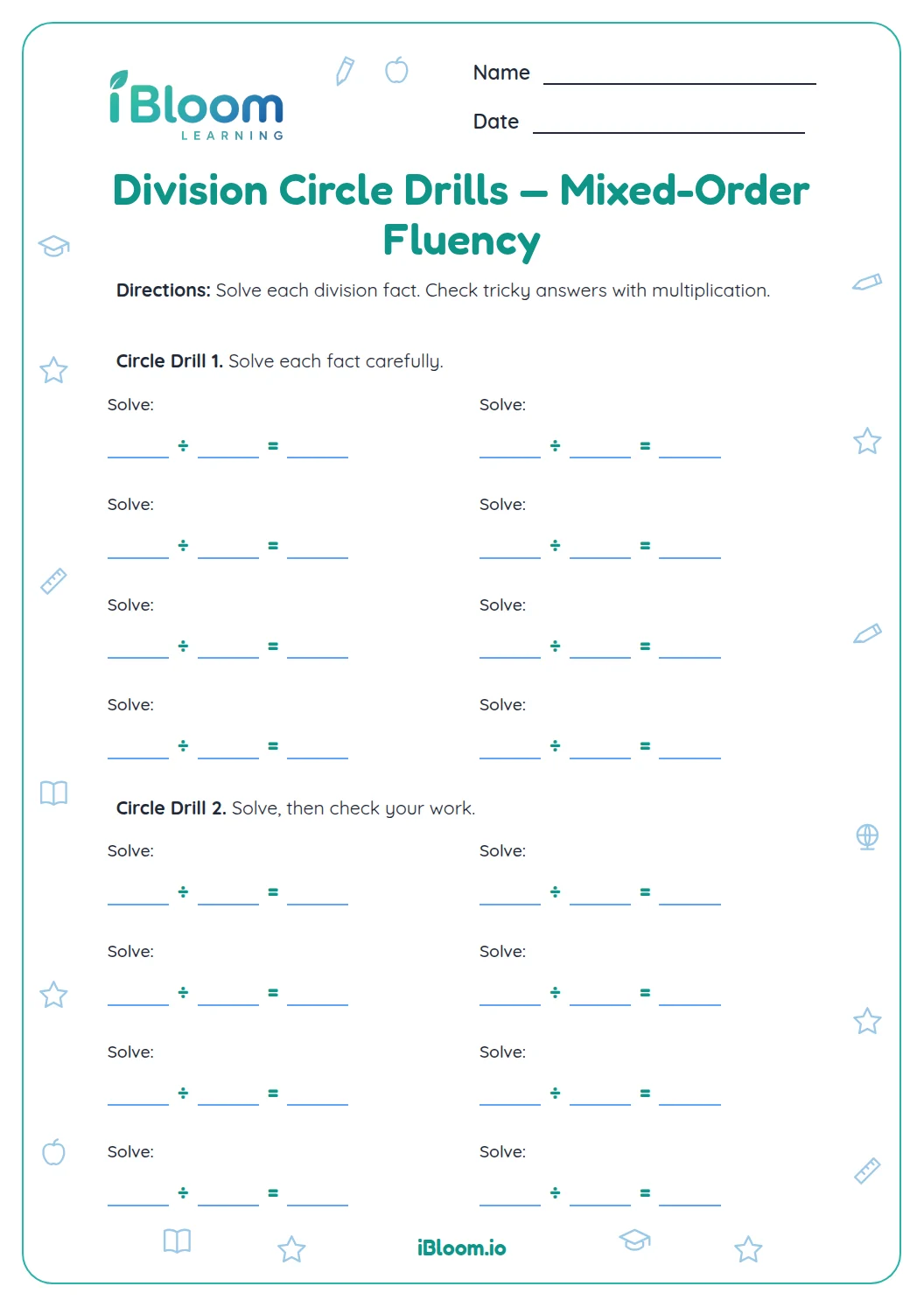
This printable Grade 3 math worksheet gives 16 horizontal division facts with one missing number. Children find missing dividends and divisors in facts with quotients up to 9, then use multiplication to check. The sheet practices CCSS 3.OA.C.7 and includes a separate answer key.
Aligned to 3.OA.C.7
How do you find a missing number in division?
Division and multiplication undo one another. If the quotient is known, multiply it by the missing divisor to find the dividend. If the dividend and quotient are known, divide the dividend by the quotient to find the divisor.
For question 2, 56 ÷ ___ = 8. Since 8 × 7 = 56, the missing divisor is 7.
- 156 ÷ ___ = 8
- 28 × 7 = 56
- 356 ÷ 7 = 8
- 4The missing divisor is 7.
What kinds of facts are on the page?
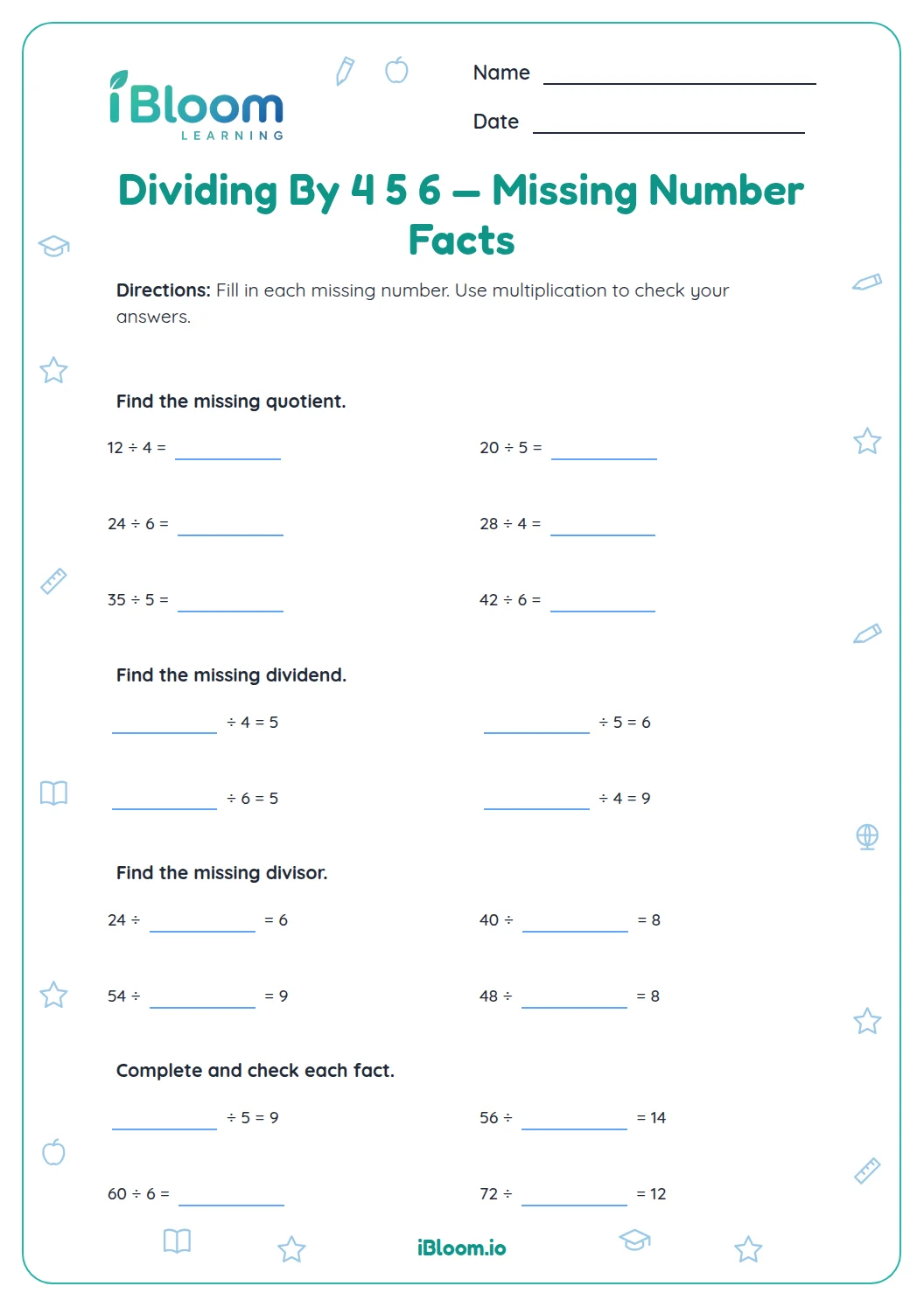
The 16 items are grouped by the number being found: first a missing number in a fact, then missing dividends, then missing divisors, followed by a mixed check. All facts divide evenly and stay within 100.
How to use this worksheet
- 1Read the known dividend, divisor or quotient carefully.
- 2Ask which related multiplication fact would make the known numbers.
- 3Write the missing number in the blank.
- 4Multiply divisor × quotient to check the dividend.
Common mistakes and quick fixes
The mistake
Using the quotient as the divisor.
The fix
Multiply the quotient by the missing divisor to recover the dividend.
The mistake
Dividing the quotient by the dividend.
The fix
Use dividend ÷ quotient when the divisor is missing.
The mistake
Accepting a remainder in an exact fact.
The fix
Multiply your proposed divisor by the quotient; it must equal the dividend.
Common Core alignment
This page practices multiplication and division fact fluency.
Use multiplication relationships to solve and check division facts within 100.
On this sheet: Every item asks children to complete a division fact within 100.
Show the official wordingHide the official wording
Fluently multiply and divide within 100, using strategies such as the relationship between multiplication and division (e.g., knowing that 8 × 5 = 40, one knows 40 ÷ 5 = 8) or properties of operations. By the end of Grade 3, know from memory all products of two one-digit numbers.
What to practice next
Make more practice
Further reading
Questions parents and teachers ask
What is a missing dividend?
The dividend is the number being divided. In ___ ÷ 6 = 7, multiply 6 by 7 to find the missing dividend, 42. The related multiplication fact gives a quick check: 42 ÷ 6 equals 7. Have the learner multiply divisor by quotient to check the fact.
How do you find a missing divisor?
Use the known dividend and quotient. For 56 ÷ ___ = 8, ask what number times 8 equals 56. Since 7 × 8 = 56, the missing divisor is 7. Have the learner multiply divisor by quotient to check the fact.
Are all answers whole numbers?
Yes. Each item is an exact division fact with a whole-number quotient. The facts stay within 100, so children can focus on the relationship between division and multiplication. Have the learner multiply divisor by quotient to check the fact.
How many problems are on the sheet?
There are 16 questions, grouped into four short parts: missing numbers, missing dividends, missing divisors, and a mixed check. Each part asks learners to complete one missing number and relate the fact to multiplication. The answer key lists one answer for every fact across both pages.
Is an answer key included?
Yes. A separate answer key page lists the missing number for every fact. Children can check a completed page by multiplying the divisor by the quotient and confirming the dividend. Have the learner multiply divisor by quotient to check the fact.
How long should the practice take?
Plan for about 15 minutes, with extra time if the child writes multiplication checks. The goal is careful fact work and checking, rather than racing through the blanks. Have the learner multiply divisor by quotient to check the fact.